Basic Counseling
Skills
AILYN T. TARIMAN
Discussant
Objectives:
❑ To identify the few mistaken assumptions in counseling.
❑ To identify who needs counseling
❑ To be familiar with the things to consider as a counselor
❑ To introduce the basic counseling skills of a counselor
❑ To understand the importance of counselling skills of a
counselor
KNOWING WHAT YOU
ALREADY KNOW!
Situation:
Marky was reported by the canteen manager of snagging
something from the school canteen without paying
IDENTIFY THE COUNSELING SKILLS USED BY THE
COUNSELOR
COUNSELING
• The provision of assistance
and guidance in resolving
personal, social, or
psychological problems and
difficulties
Who needs counseling?
•Counseling is
for everyone
EXTERNAL SIGNS OF
PERSONS NEEDING
COUNSELING
BEHAVIORAL SYMPTOMS
- Yawning
- Talking too
fast/loud
- Nail biting
- Grinding teeth
- Drumming fingers
- Over reacting
- Emotional
- Defensive
- Irritable
- Irrational
- Hostile
- Critical
- aggressive
Common Emotional Symptoms
–Fear
–Anxiety
–Grief
–Guilt
–Shame
–Hopelessness
–Isolation
–Sense of betrayal
(Trauma Informed Care Module – 2015)
Common Physiological Symptoms
• Body’s Reaction
• Pupils dilate
• Heart rate increases
• Blood pressure rises
• Breathing faster
• Digestion slows down
• Muscles tense, ready
for action
•Effect
•Blurred vision
•Palpitations, heart pounding
•Light-headed
•Dry mouth, short of breath
•Indigestion, butterflies,
nausea
•Tremor, jelly legs
Performance and Social
Symptoms
• Reduced effectiveness at work/study
• Accident prone
• Forgetful
• Pessimist
• Hygienic problem
• Judgmental
• Poor judgement
• Prone to mistakes
A few mistaken
assumptions
❑ Counselors listen to peoples problems and then give
them sound advice.
❑ The more questions we ask, the more information we
will obtain.
❑ Agreement and sympathy are the same as empathy.
❑ Positive thinking is the same as rational thinking- “you
need to believe in yourself”
❑ Guidance Counselors are the disciplining officer in
schools
In counseling…
❑ Helping people solve their own
problems through providing
encouragement, support, and challenge.
❑ Phenomenological- rather than
assuming we know clients’ feeling and
thoughts, we strive to understand their
subjective world.
Counselor know
thyself
❑ Why are you choosing to help this person?
❑ With what issues are you uncomfortable?
❑ With what emotions are you uncomfortable?
❑ How will you handle students feelings toward you
(transference).
❑ How will you handle your feelings toward them
(countertransference).
❑ Can you be accepting, flexible, gentle?
❑ What amount of progress is acceptable to you?
Basic Counseling
Skills
Some of the most important counseling techniques
you are likely to use in your counseling sessions.
✔ Listening/Observing
✔ Empathy
✔ Genuineness
✔ Unconditional Positive Regards
✔ Counselor Self-Disclosure
✔ Reflection
✔ Asking Questions
✔ Listening/Ob
serving
“We think we listen, but very rarely do we
listen with real understanding, true empathy.
Yet listening, of this very special kind, is one
of the most potent forces for change that I
know”
Carl Rogers
✔ Listening/Ob
serving
Listening is one of the most valuable counseling skills in
the therapeutic relationship. It can be used in three ways:
1. Attending: Attending is the ability to be physically
present for the client. It means giving them your
undivided attention and making appropriate eye
contact, mirroring body language, and nodding. These
attending behaviors show your client that you care. In
fact, according to Kevin J. Drab, approximately 80% of
communication takes place non-verbally.
✔ Listening/Ob
serving
To communicate that you are indeed listening or attending to
the client, you need to the following “3Vs + B”
1. Visual / eye contact. Look at people when you speak.
2. Vocal qualities. Communicate warmth and interest with
your voice.
3. Verbal tracking. Track the client’s story. Don’t change
the subject, stay with the clients.
4. Body Language / facial expression. Be attentive and
genuine. Face clients naturally, lean slightly forward, have
an expressive face, and use facilitative, and encouraging
gesture.
✔ Listening/Ob
serving
For example:
Client: I’m so confused. I can’t decide between a
ABM and HUMSS.
Counselor: (nonattending) Tell me about your hobbies.
What do you like to do? or What are your
grades?
Counselor: (attending) Tell me more or You feel
confused? Or Could you tell me a little
about how each subject interest you? Or
opportunities in ABM are promising now.
Could you explore that field a bit more? or
How would you like to go about making
decision?
✔ Listening/Obs
erving
2. Active listening: Active listening occurs when you are
listening with all of your senses. According to
the Perinatal Mental Health, active listening involves
listening with your body, heart, ears, eyes, and mouth.
ACTIVE LISTENING
✔ Listening/Obs
erving
3. Verbal listening: This is a form of showing you are
listening through the words that you use. These verbal
cues are used to show attention and to encourage more
exploration. This can be as simple as ‘yes’, or ‘go on’. It
can also be in the form of paraphrasing or repeating a
word of emotion that the client has just said.
✔ EMPATHY
“To empathize is to see with the eyes of another, to hear with
the ears of another, and to feel with the heart of another”
Anonymous
Empathy is the ability to put yourself in
someone else’s shoes. It is much more than
sympathy in that you are able to show your
understanding of your clients feeling
surrounding an experience.
✔ EMPATHY
3 types of Empathic Understanding:
1. Subtractive empathy. Counselor
responses give back to the client less
than what the client stated, and perhaps
even distorted what has been said. In this
case the listening or influencing skills are
used inappropriately.
✔ EMPATHY
For example:
Client: I don’t know what to do. I’ve gone over this problem
again in again. My boyfriend just doesn’t seem to understand
that I don’t really care any longer. He just keeps trying in the
same boring way – but it doesn’t seems worth bothering with
him anymore.
Level 1 Empathy. (subtractive) That’s not a very good way to
talk. I think you ought to consider his feelings, too.
(slightly subtractive) Seems like you’ve just
about given up on him. You don’t want to try anymore.
(interpreting the negative)
✔ EMPATHY
3 types of Empathic Understanding:
2. Basic empathy. Counselor responses
are roughly interchangeable with those
of the client. The counselor is able to say
back accurately what the client has said.
✔ EMPATHY
For example:
Level 2 Empathy. (basic empathy or interchangeable response)
You’ve discouraged and confused. You’ve worked over the
issues with your boyfriend, but se just doesn’t understand. At
the moment, you feel he’s not worth bothering with. You really
don’t care.
(Hearing the client accurately is the place to start all empathic
understanding.)
Client: I don’t know what to do. I’ve gone over this problem
again in again. My boyfriend just doesn’t seem to understand
that I don’t really care any longer. He just keeps trying in the
same boring way – but it doesn’t seems worth bothering with
him anymore.
✔ EMPATHY
3 types of Empathic Understanding:
3. Additive empathy. Counselor responses that
add something beyond what the client has said.
This may be adding a link to something the
client has said earlier, or it may be congruent
idea or frame of reference that helps the client
see a new perspective.
✔ EMPATHY
For example:
Level 3 Empathy. (slightly additive) You’ve gone over the
problem with him again and again to the point that you don’t
really care right now. You’ve tried hard. What does this mean to
you?
(The question adds the possibility of the client’s thinking in new ways, but
the client still is in charge of the conversation)
Client: I don’t know what to do. I’ve gone over this problem
again in again. My boyfriend just doesn’t seem to understand
that I don’t really care any longer. He just keeps trying in the
same boring way – but it doesn’t seems worth bothering with
him anymore.
✔ EMPATHY
For example:
Level 3 Empathy. (additive and perhaps transformational) I
sense your hurt and confusion and that right now you really
don’t care anymore. Given what you’ve told me, your thoughts
and feelings make a lot of sense to me. At the same time, you
had a reason for trying so hard. You’ve talked about some deep
feelings of caring for him in the past. How do you put that
together right now with what you are feeling?
(A summary with a mild self-disclosure. The question helps the client
develop her own integration and meanings of the issue at the moment )
✔ GENUINENESS
Ability of counselor to be freely themselves.
Includes congruence between outer words/behaviors and
inner feelings; non-defensiveness; non-role-playing; and
being unpretentious.
For example, if the counselor claims that they are
comfortable helping a client explore a drug or sexual
issue, but their behavior (verbally and nonverbally) shows
signs of discomfort with the topic this will become an
obstacle to progress and often lead to client confusion
about and mistrust of the helper.
✔ GENUINENESS
Qualities of genuineness include being honest,
sincere, and open and an absence of phoniness and
defensiveness. This allows the client to be comfortable
and increases the chance for valuable inquiry and self-
awareness.
Genuineness: Being genuine is the process of
creating congruence between what you think and what
you do, including verbal and nonverbal cues.
Genuineness is essential for all forms of counseling to
build a solid foundation of trust between yourself and
your clients
Why genuineness is important to counseling?
✔ UNCONDITIONAL
POSITIVE REGARDS
Unconditional positive regard means offering
compassion to people even if they have done
something wrong. A counselor practicing unconditional
positive regard would respond with compassion to a
person in treatment who may have lied or mistreated a
friend.
Accepting and
supporting your client exactly
as they are, without
evaluating or judging them.
✔ UNCONDITIONAL
POSITIVE REGARDS
An environment of unconditional positive regard
benefits the client in the following ways:
1. When the counselor offers no judgement the client
feels less fearful and can share their thoughts,
feelings, and actions freely.
2. As the counselor accepts the client, the client is
encouraged to find self-acceptance.
3. The counselor allows the client space to think for
themselves instead of using questions designed to
illicit certain answers. With such a space to think the
client can begin to cultivate their inner resources.
4. By seeing the client and not just their behaviors, the
counselor offers the client a chance to realize they are
more than just their behaviors.
✔ COUNSELOR SELF-
DISCLOSURE
This is a tricky counseling skill to maneuver. A
general rule to follow is to only share personal information
that is beneficial to the therapeutic process. It might also
be used to help the counselor relate better with their
client.
The counselor can shares personal feelings,
experiences, or reactions to the client. Should include
relevant content intended to help them. So, it is better to
not self-disclose unless there is a pressing clinical need
which cannot be met in any other way. Remember
empathy is not sharing similar experiences but conveying
in a caring and understanding manner what the client is
feeling and thinking
✔ COUNSELOR SELF-
DISCLOSURE
Benefits of using self-disclosure:
1. Self-disclosure can be a means of building rapport
with clients
2. Clients may feel uneasy telling a stranger about their
thoughts, feelings and experiences
3. Clients sometimes think that they are alone in their
struggles
4. The counseling process can often feel one-sided for
clients, in that the focus is primarily on their presenting
issues.
✔ COUNSELOR SELF-
DISCLOSURE
Risks of using self-disclosure:
1. One of the most significant risks of counselor self-
disclosure is a shift in treatment focus away from the
client’s needs and treatment goals.
2. Excessive personal sharing by a counselor may be
seen by the client as self-serving.
3. Counselor self-disclosure can be detrimental if it is
provided without consideration of the client’s
presenting problem
4. Too much counselor self-disclosure can blur the
boundaries in the professional relationship
✔ reflection
Ensuring that you understand your clients,
and that your clients feel understood by you is
foundational to the counseling relationship. The
skills on this page are particularly useful for
building the counseling relationship by helping
your clients to know that you are hearing and
understanding what they are saying.
✔ reflection
Includes:
Reflection Feelings
Restating/Rephrasing
Affirmation
✔ ASKING
QUESTIONS
A questioning process to assist the client in
clarifying or exploring thoughts or feelings.
Here, the counselor is not requesting
specific information and not purposively
limiting the nature of the response to only a
yes or no, or very brief answer.
✔ ASKING
QUESTIONS
a. Goal is to facilitate exploration – Not needed if the
client is already doing this.
b. Have an intention or therapeutic purpose for every
question you ask.
c. Avoid asking too many questions, or assuming an
interrogatory role.
d. Best approach is to follow a response to an open-
ended question with a paraphrase or reflection which
encourages the client to share more and avoids repetitive
patterns of question/ answer/ question/ answer, etc.
“Diagnosis helps the doctor, but
for the patient, the crucial thing is
the story”
Carl Jung
Thank you!
Workshop
Panuto:
1. Ang bawat grupo ay bibigyan ng isang caselet na
kanilang ipapakita sa pamamagitan ng role-playing.
Sa gawaing ito pipili ang bawat grupo na gaganap
bilang COUNSELOR, isang COUNSELEE at isang
tagakuha ng video.
2. Bibigyan ang bawat grupo ng limang (5) minuto
para sa gawaing ito base sa inihandang listahan ng
facilitator. Pipili din ng isang lead clapper na
mangunguna sa pagpapalakpak pagkatapos ng
bawat presentasyon.
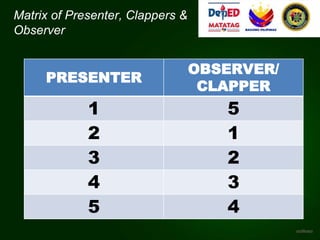
Matrix of Presenter, Clappers &
Observer
PRESENTER
OBSERVER/
CLAPPER
1 5
2 1
3 2
4 3
5 4
Panuto:
3. Pagkatapos ng role-playing ng lahat ng grupo ay isusunod
ang brainstorming/consolidation na gagawin sa loob ng
limang (5) minuto. Ang timer ay ipapakita sa screen at ang
lahat ay inaasahang na handa na sa pag-uulat.
4. Sa pag-uulat, kailangan bigyan pansin lamang ang mga
bagay na may kaugnayan sa paksa o sa hinihingi ng
worksheet.
6. Pagkatapos ng pag-uulat, ang ibang grupo ay bibiyan din
ng pagkakataon na makapagpahayag ng kanilang kuro-kuro
ukol sa ginawang role-playing.
Panuto:
6. Inaasahang ang bawat grupo ay makakapagpakita ng
isang makabuluhan, makatotohanan, at makahulugang
presentation.
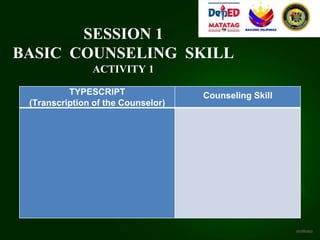
TYPESCRIPT
(Transcription of the Counselor)
Counseling Skill
SESSION 1
BASIC COUNSELING SKILL
ACTIVITY 1
SARONG AKI NA
MASAKIT MAKANOOD
BUDA DAING GANA
MAG-ADAL
Group 1
SARONG AKI NA MATAGAS
ANG PAYO, BULLY BUDA
PERMING NAKIIWAL SA
ESKWELAHAN
Group 2
SARONG AKI NA DATING AKTIBO SA
KLASE ALAGAD BIGLA NA SANANG
NAGBAGO TA NAWARAN NA NING
GANA MAG-ADAL BUDA
MAGPARTISIPAR SA AKTIBIDADES NIN
ESKWELAHAN.
Group 3
SARONG AKI NA NAWARAN
NIN GANA NA MAG-ADAL TA
NAWIWILI SA PORNOGRAPIYA
SA INTERNET.
Group 4
SARONG AKI NA KADAKUL NA NIN
BISYO AROG BAGA KAN SIGARILYO,
ALAK, ASIN NAG-UUSIP AN MGA
KAKLASE NA GAISTORYA DAA AN AKI
NA GAGAMIT NA SIYA NIN
IPINAGBABAWAL NA DROGA.
Group 5

SESSION 1 Basic-Counseling-Skills--.pptx

  • 1.
  • 2.
    Objectives: ❑ To identifythe few mistaken assumptions in counseling. ❑ To identify who needs counseling ❑ To be familiar with the things to consider as a counselor ❑ To introduce the basic counseling skills of a counselor ❑ To understand the importance of counselling skills of a counselor
  • 3.
    KNOWING WHAT YOU ALREADYKNOW! Situation: Marky was reported by the canteen manager of snagging something from the school canteen without paying IDENTIFY THE COUNSELING SKILLS USED BY THE COUNSELOR
  • 4.
    COUNSELING • The provisionof assistance and guidance in resolving personal, social, or psychological problems and difficulties
  • 5.
  • 6.
    EXTERNAL SIGNS OF PERSONSNEEDING COUNSELING
  • 7.
    BEHAVIORAL SYMPTOMS - Yawning -Talking too fast/loud - Nail biting - Grinding teeth - Drumming fingers - Over reacting - Emotional - Defensive - Irritable - Irrational - Hostile - Critical - aggressive
  • 8.
  • 9.
    Common Physiological Symptoms •Body’s Reaction • Pupils dilate • Heart rate increases • Blood pressure rises • Breathing faster • Digestion slows down • Muscles tense, ready for action •Effect •Blurred vision •Palpitations, heart pounding •Light-headed •Dry mouth, short of breath •Indigestion, butterflies, nausea •Tremor, jelly legs
  • 10.
    Performance and Social Symptoms •Reduced effectiveness at work/study • Accident prone • Forgetful • Pessimist • Hygienic problem • Judgmental • Poor judgement • Prone to mistakes
  • 11.
    A few mistaken assumptions ❑Counselors listen to peoples problems and then give them sound advice. ❑ The more questions we ask, the more information we will obtain. ❑ Agreement and sympathy are the same as empathy. ❑ Positive thinking is the same as rational thinking- “you need to believe in yourself” ❑ Guidance Counselors are the disciplining officer in schools
  • 12.
    In counseling… ❑ Helpingpeople solve their own problems through providing encouragement, support, and challenge. ❑ Phenomenological- rather than assuming we know clients’ feeling and thoughts, we strive to understand their subjective world.
  • 13.
    Counselor know thyself ❑ Whyare you choosing to help this person? ❑ With what issues are you uncomfortable? ❑ With what emotions are you uncomfortable? ❑ How will you handle students feelings toward you (transference). ❑ How will you handle your feelings toward them (countertransference). ❑ Can you be accepting, flexible, gentle? ❑ What amount of progress is acceptable to you?
  • 14.
    Basic Counseling Skills Some ofthe most important counseling techniques you are likely to use in your counseling sessions. ✔ Listening/Observing ✔ Empathy ✔ Genuineness ✔ Unconditional Positive Regards ✔ Counselor Self-Disclosure ✔ Reflection ✔ Asking Questions
  • 15.
    ✔ Listening/Ob serving “We thinkwe listen, but very rarely do we listen with real understanding, true empathy. Yet listening, of this very special kind, is one of the most potent forces for change that I know” Carl Rogers
  • 16.
    ✔ Listening/Ob serving Listening isone of the most valuable counseling skills in the therapeutic relationship. It can be used in three ways: 1. Attending: Attending is the ability to be physically present for the client. It means giving them your undivided attention and making appropriate eye contact, mirroring body language, and nodding. These attending behaviors show your client that you care. In fact, according to Kevin J. Drab, approximately 80% of communication takes place non-verbally.
  • 17.
    ✔ Listening/Ob serving To communicatethat you are indeed listening or attending to the client, you need to the following “3Vs + B” 1. Visual / eye contact. Look at people when you speak. 2. Vocal qualities. Communicate warmth and interest with your voice. 3. Verbal tracking. Track the client’s story. Don’t change the subject, stay with the clients. 4. Body Language / facial expression. Be attentive and genuine. Face clients naturally, lean slightly forward, have an expressive face, and use facilitative, and encouraging gesture.
  • 18.
    ✔ Listening/Ob serving For example: Client:I’m so confused. I can’t decide between a ABM and HUMSS. Counselor: (nonattending) Tell me about your hobbies. What do you like to do? or What are your grades? Counselor: (attending) Tell me more or You feel confused? Or Could you tell me a little about how each subject interest you? Or opportunities in ABM are promising now. Could you explore that field a bit more? or How would you like to go about making decision?
  • 19.
    ✔ Listening/Obs erving 2. Activelistening: Active listening occurs when you are listening with all of your senses. According to the Perinatal Mental Health, active listening involves listening with your body, heart, ears, eyes, and mouth. ACTIVE LISTENING
  • 20.
    ✔ Listening/Obs erving 3. Verballistening: This is a form of showing you are listening through the words that you use. These verbal cues are used to show attention and to encourage more exploration. This can be as simple as ‘yes’, or ‘go on’. It can also be in the form of paraphrasing or repeating a word of emotion that the client has just said.
  • 21.
    ✔ EMPATHY “To empathizeis to see with the eyes of another, to hear with the ears of another, and to feel with the heart of another” Anonymous Empathy is the ability to put yourself in someone else’s shoes. It is much more than sympathy in that you are able to show your understanding of your clients feeling surrounding an experience.
  • 22.
    ✔ EMPATHY 3 typesof Empathic Understanding: 1. Subtractive empathy. Counselor responses give back to the client less than what the client stated, and perhaps even distorted what has been said. In this case the listening or influencing skills are used inappropriately.
  • 23.
    ✔ EMPATHY For example: Client:I don’t know what to do. I’ve gone over this problem again in again. My boyfriend just doesn’t seem to understand that I don’t really care any longer. He just keeps trying in the same boring way – but it doesn’t seems worth bothering with him anymore. Level 1 Empathy. (subtractive) That’s not a very good way to talk. I think you ought to consider his feelings, too. (slightly subtractive) Seems like you’ve just about given up on him. You don’t want to try anymore. (interpreting the negative)
  • 24.
    ✔ EMPATHY 3 typesof Empathic Understanding: 2. Basic empathy. Counselor responses are roughly interchangeable with those of the client. The counselor is able to say back accurately what the client has said.
  • 25.
    ✔ EMPATHY For example: Level2 Empathy. (basic empathy or interchangeable response) You’ve discouraged and confused. You’ve worked over the issues with your boyfriend, but se just doesn’t understand. At the moment, you feel he’s not worth bothering with. You really don’t care. (Hearing the client accurately is the place to start all empathic understanding.) Client: I don’t know what to do. I’ve gone over this problem again in again. My boyfriend just doesn’t seem to understand that I don’t really care any longer. He just keeps trying in the same boring way – but it doesn’t seems worth bothering with him anymore.
  • 26.
    ✔ EMPATHY 3 typesof Empathic Understanding: 3. Additive empathy. Counselor responses that add something beyond what the client has said. This may be adding a link to something the client has said earlier, or it may be congruent idea or frame of reference that helps the client see a new perspective.
  • 27.
    ✔ EMPATHY For example: Level3 Empathy. (slightly additive) You’ve gone over the problem with him again and again to the point that you don’t really care right now. You’ve tried hard. What does this mean to you? (The question adds the possibility of the client’s thinking in new ways, but the client still is in charge of the conversation) Client: I don’t know what to do. I’ve gone over this problem again in again. My boyfriend just doesn’t seem to understand that I don’t really care any longer. He just keeps trying in the same boring way – but it doesn’t seems worth bothering with him anymore.
  • 28.
    ✔ EMPATHY For example: Level3 Empathy. (additive and perhaps transformational) I sense your hurt and confusion and that right now you really don’t care anymore. Given what you’ve told me, your thoughts and feelings make a lot of sense to me. At the same time, you had a reason for trying so hard. You’ve talked about some deep feelings of caring for him in the past. How do you put that together right now with what you are feeling? (A summary with a mild self-disclosure. The question helps the client develop her own integration and meanings of the issue at the moment )
  • 29.
    ✔ GENUINENESS Ability ofcounselor to be freely themselves. Includes congruence between outer words/behaviors and inner feelings; non-defensiveness; non-role-playing; and being unpretentious. For example, if the counselor claims that they are comfortable helping a client explore a drug or sexual issue, but their behavior (verbally and nonverbally) shows signs of discomfort with the topic this will become an obstacle to progress and often lead to client confusion about and mistrust of the helper.
  • 30.
    ✔ GENUINENESS Qualities ofgenuineness include being honest, sincere, and open and an absence of phoniness and defensiveness. This allows the client to be comfortable and increases the chance for valuable inquiry and self- awareness. Genuineness: Being genuine is the process of creating congruence between what you think and what you do, including verbal and nonverbal cues. Genuineness is essential for all forms of counseling to build a solid foundation of trust between yourself and your clients Why genuineness is important to counseling?
  • 31.
    ✔ UNCONDITIONAL POSITIVE REGARDS Unconditionalpositive regard means offering compassion to people even if they have done something wrong. A counselor practicing unconditional positive regard would respond with compassion to a person in treatment who may have lied or mistreated a friend. Accepting and supporting your client exactly as they are, without evaluating or judging them.
  • 32.
    ✔ UNCONDITIONAL POSITIVE REGARDS Anenvironment of unconditional positive regard benefits the client in the following ways: 1. When the counselor offers no judgement the client feels less fearful and can share their thoughts, feelings, and actions freely. 2. As the counselor accepts the client, the client is encouraged to find self-acceptance. 3. The counselor allows the client space to think for themselves instead of using questions designed to illicit certain answers. With such a space to think the client can begin to cultivate their inner resources. 4. By seeing the client and not just their behaviors, the counselor offers the client a chance to realize they are more than just their behaviors.
  • 33.
    ✔ COUNSELOR SELF- DISCLOSURE Thisis a tricky counseling skill to maneuver. A general rule to follow is to only share personal information that is beneficial to the therapeutic process. It might also be used to help the counselor relate better with their client. The counselor can shares personal feelings, experiences, or reactions to the client. Should include relevant content intended to help them. So, it is better to not self-disclose unless there is a pressing clinical need which cannot be met in any other way. Remember empathy is not sharing similar experiences but conveying in a caring and understanding manner what the client is feeling and thinking
  • 34.
    ✔ COUNSELOR SELF- DISCLOSURE Benefitsof using self-disclosure: 1. Self-disclosure can be a means of building rapport with clients 2. Clients may feel uneasy telling a stranger about their thoughts, feelings and experiences 3. Clients sometimes think that they are alone in their struggles 4. The counseling process can often feel one-sided for clients, in that the focus is primarily on their presenting issues.
  • 35.
    ✔ COUNSELOR SELF- DISCLOSURE Risksof using self-disclosure: 1. One of the most significant risks of counselor self- disclosure is a shift in treatment focus away from the client’s needs and treatment goals. 2. Excessive personal sharing by a counselor may be seen by the client as self-serving. 3. Counselor self-disclosure can be detrimental if it is provided without consideration of the client’s presenting problem 4. Too much counselor self-disclosure can blur the boundaries in the professional relationship
  • 36.
    ✔ reflection Ensuring thatyou understand your clients, and that your clients feel understood by you is foundational to the counseling relationship. The skills on this page are particularly useful for building the counseling relationship by helping your clients to know that you are hearing and understanding what they are saying.
  • 37.
  • 38.
    ✔ ASKING QUESTIONS A questioningprocess to assist the client in clarifying or exploring thoughts or feelings. Here, the counselor is not requesting specific information and not purposively limiting the nature of the response to only a yes or no, or very brief answer.
  • 39.
    ✔ ASKING QUESTIONS a. Goalis to facilitate exploration – Not needed if the client is already doing this. b. Have an intention or therapeutic purpose for every question you ask. c. Avoid asking too many questions, or assuming an interrogatory role. d. Best approach is to follow a response to an open- ended question with a paraphrase or reflection which encourages the client to share more and avoids repetitive patterns of question/ answer/ question/ answer, etc.
  • 40.
    “Diagnosis helps thedoctor, but for the patient, the crucial thing is the story” Carl Jung
  • 41.
  • 42.
  • 43.
    Panuto: 1. Ang bawatgrupo ay bibigyan ng isang caselet na kanilang ipapakita sa pamamagitan ng role-playing. Sa gawaing ito pipili ang bawat grupo na gaganap bilang COUNSELOR, isang COUNSELEE at isang tagakuha ng video. 2. Bibigyan ang bawat grupo ng limang (5) minuto para sa gawaing ito base sa inihandang listahan ng facilitator. Pipili din ng isang lead clapper na mangunguna sa pagpapalakpak pagkatapos ng bawat presentasyon.
  • 44.
    Matrix of Presenter,Clappers & Observer PRESENTER OBSERVER/ CLAPPER 1 5 2 1 3 2 4 3 5 4
  • 45.
    Panuto: 3. Pagkatapos ngrole-playing ng lahat ng grupo ay isusunod ang brainstorming/consolidation na gagawin sa loob ng limang (5) minuto. Ang timer ay ipapakita sa screen at ang lahat ay inaasahang na handa na sa pag-uulat. 4. Sa pag-uulat, kailangan bigyan pansin lamang ang mga bagay na may kaugnayan sa paksa o sa hinihingi ng worksheet. 6. Pagkatapos ng pag-uulat, ang ibang grupo ay bibiyan din ng pagkakataon na makapagpahayag ng kanilang kuro-kuro ukol sa ginawang role-playing.
  • 46.
    Panuto: 6. Inaasahang angbawat grupo ay makakapagpakita ng isang makabuluhan, makatotohanan, at makahulugang presentation.
  • 47.
    TYPESCRIPT (Transcription of theCounselor) Counseling Skill SESSION 1 BASIC COUNSELING SKILL ACTIVITY 1
  • 48.
    SARONG AKI NA MASAKITMAKANOOD BUDA DAING GANA MAG-ADAL Group 1
  • 49.
    SARONG AKI NAMATAGAS ANG PAYO, BULLY BUDA PERMING NAKIIWAL SA ESKWELAHAN Group 2
  • 50.
    SARONG AKI NADATING AKTIBO SA KLASE ALAGAD BIGLA NA SANANG NAGBAGO TA NAWARAN NA NING GANA MAG-ADAL BUDA MAGPARTISIPAR SA AKTIBIDADES NIN ESKWELAHAN. Group 3
  • 51.
    SARONG AKI NANAWARAN NIN GANA NA MAG-ADAL TA NAWIWILI SA PORNOGRAPIYA SA INTERNET. Group 4
  • 52.
    SARONG AKI NAKADAKUL NA NIN BISYO AROG BAGA KAN SIGARILYO, ALAK, ASIN NAG-UUSIP AN MGA KAKLASE NA GAISTORYA DAA AN AKI NA GAGAMIT NA SIYA NIN IPINAGBABAWAL NA DROGA. Group 5