
ESSENTIALTRACE
ELEMENTS
Prepared by
D.Mahendra,M.Pharm(PA&QA),.
Asst.Professor
NCOP-T7
1
Overview
• Introduction
• Classification
• Individual trace elements
• conclusion
2
Introduction
• Naturally occurring, homogeneous, inorganic
substance required in humans in amounts less
than 100 mg/day
• Minerals for 5% of our diet
3
Classificatio
n
4
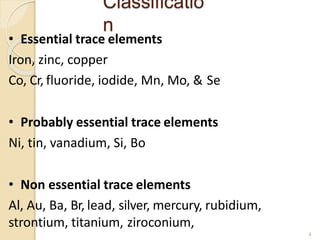
• Essential trace elements
Iron, zinc, copper
Co, Cr, fluoride, iodide, Mn, Mo, & Se
• Probably essential trace elements
Ni, tin, vanadium, Si, Bo
• Non essential trace elements
Al, Au, Ba, Br, lead, silver, mercury, rubidium,
strontium, titanium, ziroconium,
Essential trace
elements
5
• Trace elements
Iron, zinc and copper
• Ultra trace elements
Manganese, selenium, cobalt, chromium,
fluoride, iodine, and molybdenum
Iro
n
6
• Most essential trace element
• Body content – 4-6g
Hb – 68%
ferritin – 13 %
haemosiderin – 12%
myoglobin – 3%
iron enzymes – 0.2%
• Iron dependent enzymes:
Cytochrome oxidase, xanthine oxidase and
peroxidase
• Body requirement
Daily requirement – 0.5 - 2 mg/day
3 - 5mg/day (pregnancy)
Daily excretion – 0.9mg/day
1.3mg/day (during menses)
7
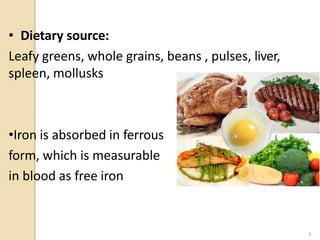
• Dietary source:
Leafy greens, whole grains, beans , pulses, liver,
spleen, mollusks
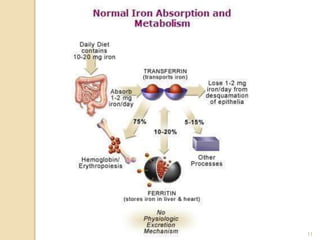
•Iron is absorbed in ferrous
form, which is measurable
in blood as free iron
8
Transferri
n
• Transport protein
• Binds to two iron molecules
• Transports iron to various organs and
tissues
• S.Iron + total iron bound transferrin –
total iron in circulation
• Determination of transferrin gives TIBC
• Transferrin can be measured by
RIA, ELISA & chemiluminescence
9
Ferriti
n
10
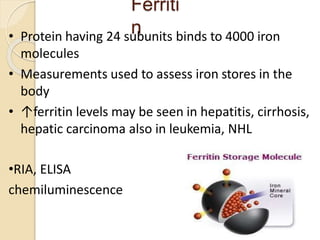
• Protein having 24 subunits binds to 4000 iron
molecules
• Measurements used to assess iron stores in the
body
• ↑ferritin levels may be seen in hepatitis, cirrhosis,
hepatic carcinoma also in leukemia, NHL
•RIA, ELISA
chemiluminescence
11
• Deficiency state:
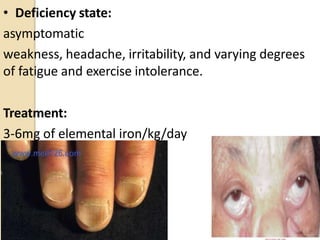
asymptomatic
weakness, headache, irritability, and varying degrees
of fatigue and exercise intolerance.
Treatment:
3-6mg of elemental iron/kg/day
12
• Oral preparations of iron:
Ferrous sulphate
Ferrous fumerate
Ferrous gluconate
Ferrous succinate
Iron calcium complex
Ferric ammonium citrate
Adverse effects: epigastric pain, nausea, vomiting,
gastritis, metallic taste, constipation or diarrhea
Liquid prep- staining of teeth
13
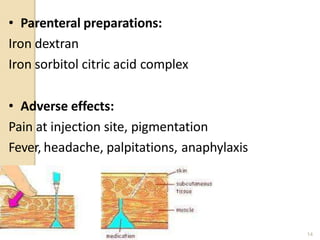
• Parenteral preparations:
Iron dextran
Iron sorbitol citric acid complex
• Adverse effects:
Pain at injection site, pigmentation
Fever, headache, palpitations, anaphylaxis
14
Acute iron
poisoning
• 60mg/kg elemental iron
• Vomiting, abdominal pain, bloody diarrhea, shock,
dehydration, cyanosis, acidosis, coma
• Treatment:
• Gastric lavage with sodium bicarbonate solution
• Desferrioxamine 15 mg/kg per hour IV, ↑ to max
35 mg/kg per hour
•Correction of acidosis and shock
(if fails dialysis) 15
Zinc
16
• Second most abundant trace element
• Cofactor – DNA polymerase, alkaline
phosphatase, carboxypeptidase
Regulate- growth, immune system, collagen
synthesis, wound healing, bone metabolism,
reproduction, taste, smell & vision
• Reduce the time period of diarrhea
• High dose of zinc prevents dysmenorrhea
• Zinc required in producing testosterone
• For common cold
• In treatment of warts
17
• Body content 2.5g
60% in muscle, 30% in bone, 10% in body tissues
and organs
• Daily requirement: 3-14mg
• Diet rich in zinc: red meat, fish, sea food,
pumpkin, cashews, beans, dark chocolate
18
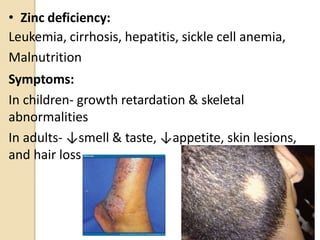
• Zinc deficiency:
Leukemia, cirrhosis, hepatitis, sickle cell anemia,
Malnutrition
Symptoms:
In children- growth retardation & skeletal
abnormalities
In adults- ↓smell & taste, ↓appetite, skin lesions,
and hair loss
19
Zinc deficiency is also associated with
• Acrodermatitis enteropathica
• Anorexia
• Esophageal squamous cell carcinoma
• Cognitive and motor impairement
• Diarrhea and pneumonia
Treatment:
• Zinc supplements 45 – 100mg/day
20
Copper
21
• 3rd most important trace element
• Diet rich in copper: red meat, shell fish, water
pumped through copper pipes
• Body content of copper is 80-120mg
• 40-60% absorbed in duodenum
• Transported through metallozymes eg ascorbic
acid
• 90% bound to ceruplasmin, 9% to albumin and
1% is free
• Body content of Cu is 80-120mg
22
Body functions:
• Erythropoiesis
• Nerve conduction and immune function
• Fertility and to maintain pregnancy
•Act as a catalyst for copper containing enzymes
Eg: tyrosinase, ascorbic acid
23
• Toxic – 5mg/kg
• Adequate – 34mcg/kg
• Deficient - <8.5mcg/kg
• RDA – 09 - 1.3mg/day
24
Deficiency symptoms:
• Fragile hair
• Depigmented skin
• Myeloneuropathy
• Edema
• Hepatosplenomegaly
• Osteoporosis
• Anemia, neutropenia
25
Menkes
disease
26
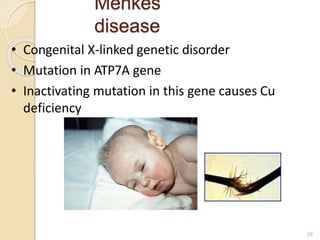
• Congenital X-linked genetic disorder
• Mutation in ATP7A gene
• Inactivating mutation in this gene causes Cu
deficiency
Wilsons
disease
27
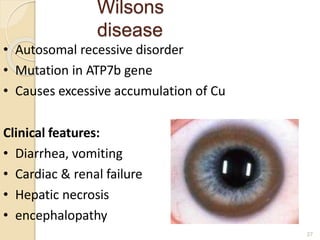
• Autosomal recessive disorder
• Mutation in ATP7b gene
• Causes excessive accumulation of Cu
Clinical features:
• Diarrhea, vomiting
• Cardiac & renal failure
• Hepatic necrosis
• encephalopathy
Treatment:
• life long treatment
• Avoidance of high Cu diet
• In early stages Zn may be effective as it
competes with Cu for absorption
• Penicillamine
28
Chromiu
m
29
• In 1957, extracted from pork kidney and they
named it as “glucose tolerance factor” as it
corrected hyperglycaemia.
• Regulates plasma lipoprotein concentration and
reduces cholesterol and triglycerides.
• Found in – grains, cereals, fruits, processed meat
RDA : 20 – 35 mcg/ day
• In improving lean body mass
Deficiency:
• Limited to hospitalized patients on TPN
Toxicity :
• Lung Ca, Bronchogenic Ca in stainless steel
workers
• Dermatitis, skin ulcers
30
Fluorid
e
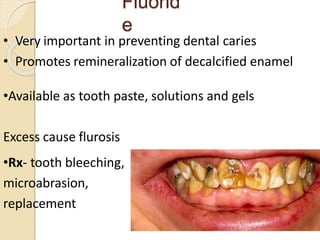
• Very important in preventing dental caries
• Promotes remineralization of decalcified enamel
•Available as tooth paste, solutions and gels
Excess cause flurosis
•Rx- tooth bleeching,
microabrasion,
replacement
31
Iodin
e
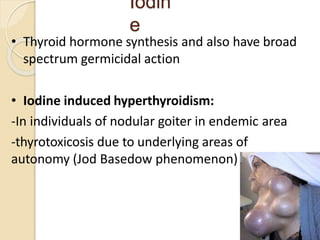
• Thyroid hormone synthesis and also have broad
spectrum germicidal action
• Iodine induced hyperthyroidism:
-In individuals of nodular goiter in endemic area
-thyrotoxicosis due to underlying areas of
autonomy (Jod Basedow phenomenon)
32
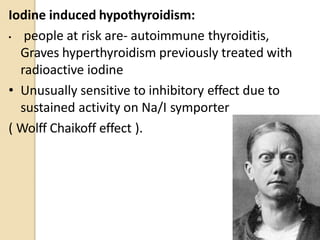
Iodine induced hypothyroidism:
• people at risk are- autoimmune thyroiditis,
Graves hyperthyroidism previously treated with
radioactive iodine
• Unusually sensitive to inhibitory effect due to
sustained activity on Na/I symporter
( Wolff Chaikoff effect ).
33
Iodine deficiency prophylaxis:
• Iodised salt
• Iodised oil
• Iodised water
• Iodine tablets or drops
• Biofortification of vegetables with iodine
• Also available as ointment, solution, mouth
gargles
34
Manganes
e
35
• Shown to be essential for normal growth and
development
• Role in human health unclear
• Dietary sources: meat, fish, poultry, dry fruits and
nuts
• Biological role: manganese superoxide dismutase
arginase, glutamate synthase & pyruvate
carboxylase
• Deficiency :
Experimental animals - ↓growth, ↓fertility, ataxia,
skeletal deformities, abnormal fat and CHO
metabolism
36
• Toxicity:
Neurotoxic- extrapyramidal parts affected
Headache
Hepatic dysfunction
• RDA – 2-11mg/day
37
Molybdenu
m
38
• Act as a catalyst for enzymes and helps facilitate
breakdown of certain amino acids
• Molybdenum in human tooth enamel may have a
role in lowering the risk of tooth decay.
• Deficiency – esophageal carcinoma
• RDA: 45mcg/day
pregnancy and lactation 50mcg/day
Seleniu
m
39
• Least abundant trace element
• Recommended intake for adults 50-200 μg/day
Functions in human body:
Selenium in Glutathione peroxidase (GTH-Px)-
important role immune system function, also plays a
crucial role in the control of oxygen metabolism.
Functions in human body:
40
• protects body from oxidative damage.
•Low GTH-Px in platelets leads to bleeding disorders
& edema due to damage to capillary membranes
• Protects phagocytes from destruction
• GTH-Px protects eye lens tissues and neurons from
damage
• Low Selenium leads to Keshan’s disease, which is a
type of cardiac myopathy discovered in china where
soil Selenium was absent.
Selenium deficiency occurs due to:
•Hemolytic anemia
•Clansman's thrombasthenia (platelet disorder)
•Gastrointestinal cancer
•Malnutrition
41
• Vanadium
• Control of sodium pump, inhibition of ATPase
• Tin
• Interaction with riboflavin metabolism
• Silicon
• Structural role in connective tissue, in metabolism
of osteogenic cells
• Nickel
• Component of enzyme urease 42
Boro
n
43
• Boron is a vital trace mineral that is required for the
normal growth and health of the body.
• apples, oranges, red grapes, kiwis, dates, as well as
certain vegetables, avocado, soybeans and nuts are
rich sources of boron
Health benefits:
• Prevents arthritis
• Used for body building
• Estrogen Production: Boron can improve the
production of estrogen in menopausal women
• Embryonic development: Boron appears to be
essential for reproduction and the development of
the fetus
• Proper cell membrane functions
• Lowers plasma lipid levels
44
Lithiu
m
45
• Discovered in 1817 as mood stabilizing agent
MOA:
• Inositol depletion theory
• Inhibition of NMDA receptor mediated signalling
• Inhibition of GSK3
• BDNF upregulation
Adverse effects:
• Nephrogenic diabetes insipidus
• Thyroid function abnormalities
• mental confusion
• hyperreflexia
• gross tremor
• dysarthria
• Seizures
• cardiac arrhythmias,
• hypotension, and
• albuminuria.
46
Uses
• BPD
• Mania
• Depression
• Cancer induced leukopenia & agranulocytosis
Preparation:
• Lithium carbonate 150/300/600mg
• Lithium citrate syrup 8mEq/5ml
47
Xenon
48
• A trace element in earths atmosphere
• Xenon is a medical gas capable of establishing
neuroprotection, inducing anesthesia and nuclear
medicine as a contrast agent
• Acts through NMDA receptor
THANK YOU

Essential trace elements- Inorganic Chemistry

  • 1.
  • 2.
    Overview • Introduction • Classification •Individual trace elements • conclusion 2
  • 3.
    Introduction • Naturally occurring,homogeneous, inorganic substance required in humans in amounts less than 100 mg/day • Minerals for 5% of our diet 3
  • 4.
    Classificatio n 4 • Essential traceelements Iron, zinc, copper Co, Cr, fluoride, iodide, Mn, Mo, & Se • Probably essential trace elements Ni, tin, vanadium, Si, Bo • Non essential trace elements Al, Au, Ba, Br, lead, silver, mercury, rubidium, strontium, titanium, ziroconium,
  • 5.
    Essential trace elements 5 • Traceelements Iron, zinc and copper • Ultra trace elements Manganese, selenium, cobalt, chromium, fluoride, iodine, and molybdenum
  • 6.
    Iro n 6 • Most essentialtrace element • Body content – 4-6g Hb – 68% ferritin – 13 % haemosiderin – 12% myoglobin – 3% iron enzymes – 0.2%
  • 7.
    • Iron dependentenzymes: Cytochrome oxidase, xanthine oxidase and peroxidase • Body requirement Daily requirement – 0.5 - 2 mg/day 3 - 5mg/day (pregnancy) Daily excretion – 0.9mg/day 1.3mg/day (during menses) 7
  • 8.
    • Dietary source: Leafygreens, whole grains, beans , pulses, liver, spleen, mollusks •Iron is absorbed in ferrous form, which is measurable in blood as free iron 8
  • 9.
    Transferri n • Transport protein •Binds to two iron molecules • Transports iron to various organs and tissues • S.Iron + total iron bound transferrin – total iron in circulation • Determination of transferrin gives TIBC • Transferrin can be measured by RIA, ELISA & chemiluminescence 9
  • 10.
    Ferriti n 10 • Protein having24 subunits binds to 4000 iron molecules • Measurements used to assess iron stores in the body • ↑ferritin levels may be seen in hepatitis, cirrhosis, hepatic carcinoma also in leukemia, NHL •RIA, ELISA chemiluminescence
  • 11.
  • 12.
    • Deficiency state: asymptomatic weakness,headache, irritability, and varying degrees of fatigue and exercise intolerance. Treatment: 3-6mg of elemental iron/kg/day 12
  • 13.
    • Oral preparationsof iron: Ferrous sulphate Ferrous fumerate Ferrous gluconate Ferrous succinate Iron calcium complex Ferric ammonium citrate Adverse effects: epigastric pain, nausea, vomiting, gastritis, metallic taste, constipation or diarrhea Liquid prep- staining of teeth 13
  • 14.
    • Parenteral preparations: Irondextran Iron sorbitol citric acid complex • Adverse effects: Pain at injection site, pigmentation Fever, headache, palpitations, anaphylaxis 14
  • 15.
    Acute iron poisoning • 60mg/kgelemental iron • Vomiting, abdominal pain, bloody diarrhea, shock, dehydration, cyanosis, acidosis, coma • Treatment: • Gastric lavage with sodium bicarbonate solution • Desferrioxamine 15 mg/kg per hour IV, ↑ to max 35 mg/kg per hour •Correction of acidosis and shock (if fails dialysis) 15
  • 16.
    Zinc 16 • Second mostabundant trace element • Cofactor – DNA polymerase, alkaline phosphatase, carboxypeptidase Regulate- growth, immune system, collagen synthesis, wound healing, bone metabolism, reproduction, taste, smell & vision
  • 17.
    • Reduce thetime period of diarrhea • High dose of zinc prevents dysmenorrhea • Zinc required in producing testosterone • For common cold • In treatment of warts 17
  • 18.
    • Body content2.5g 60% in muscle, 30% in bone, 10% in body tissues and organs • Daily requirement: 3-14mg • Diet rich in zinc: red meat, fish, sea food, pumpkin, cashews, beans, dark chocolate 18
  • 19.
    • Zinc deficiency: Leukemia,cirrhosis, hepatitis, sickle cell anemia, Malnutrition Symptoms: In children- growth retardation & skeletal abnormalities In adults- ↓smell & taste, ↓appetite, skin lesions, and hair loss 19
  • 20.
    Zinc deficiency isalso associated with • Acrodermatitis enteropathica • Anorexia • Esophageal squamous cell carcinoma • Cognitive and motor impairement • Diarrhea and pneumonia Treatment: • Zinc supplements 45 – 100mg/day 20
  • 21.
    Copper 21 • 3rd mostimportant trace element • Diet rich in copper: red meat, shell fish, water pumped through copper pipes • Body content of copper is 80-120mg
  • 22.
    • 40-60% absorbedin duodenum • Transported through metallozymes eg ascorbic acid • 90% bound to ceruplasmin, 9% to albumin and 1% is free • Body content of Cu is 80-120mg 22
  • 23.
    Body functions: • Erythropoiesis •Nerve conduction and immune function • Fertility and to maintain pregnancy •Act as a catalyst for copper containing enzymes Eg: tyrosinase, ascorbic acid 23
  • 24.
    • Toxic –5mg/kg • Adequate – 34mcg/kg • Deficient - <8.5mcg/kg • RDA – 09 - 1.3mg/day 24
  • 25.
    Deficiency symptoms: • Fragilehair • Depigmented skin • Myeloneuropathy • Edema • Hepatosplenomegaly • Osteoporosis • Anemia, neutropenia 25
  • 26.
    Menkes disease 26 • Congenital X-linkedgenetic disorder • Mutation in ATP7A gene • Inactivating mutation in this gene causes Cu deficiency
  • 27.
    Wilsons disease 27 • Autosomal recessivedisorder • Mutation in ATP7b gene • Causes excessive accumulation of Cu Clinical features: • Diarrhea, vomiting • Cardiac & renal failure • Hepatic necrosis • encephalopathy
  • 28.
    Treatment: • life longtreatment • Avoidance of high Cu diet • In early stages Zn may be effective as it competes with Cu for absorption • Penicillamine 28
  • 29.
    Chromiu m 29 • In 1957,extracted from pork kidney and they named it as “glucose tolerance factor” as it corrected hyperglycaemia. • Regulates plasma lipoprotein concentration and reduces cholesterol and triglycerides. • Found in – grains, cereals, fruits, processed meat
  • 30.
    RDA : 20– 35 mcg/ day • In improving lean body mass Deficiency: • Limited to hospitalized patients on TPN Toxicity : • Lung Ca, Bronchogenic Ca in stainless steel workers • Dermatitis, skin ulcers 30
  • 31.
    Fluorid e • Very importantin preventing dental caries • Promotes remineralization of decalcified enamel •Available as tooth paste, solutions and gels Excess cause flurosis •Rx- tooth bleeching, microabrasion, replacement 31
  • 32.
    Iodin e • Thyroid hormonesynthesis and also have broad spectrum germicidal action • Iodine induced hyperthyroidism: -In individuals of nodular goiter in endemic area -thyrotoxicosis due to underlying areas of autonomy (Jod Basedow phenomenon) 32
  • 33.
    Iodine induced hypothyroidism: •people at risk are- autoimmune thyroiditis, Graves hyperthyroidism previously treated with radioactive iodine • Unusually sensitive to inhibitory effect due to sustained activity on Na/I symporter ( Wolff Chaikoff effect ). 33
  • 34.
    Iodine deficiency prophylaxis: •Iodised salt • Iodised oil • Iodised water • Iodine tablets or drops • Biofortification of vegetables with iodine • Also available as ointment, solution, mouth gargles 34
  • 35.
    Manganes e 35 • Shown tobe essential for normal growth and development • Role in human health unclear • Dietary sources: meat, fish, poultry, dry fruits and nuts
  • 36.
    • Biological role:manganese superoxide dismutase arginase, glutamate synthase & pyruvate carboxylase • Deficiency : Experimental animals - ↓growth, ↓fertility, ataxia, skeletal deformities, abnormal fat and CHO metabolism 36
  • 37.
    • Toxicity: Neurotoxic- extrapyramidalparts affected Headache Hepatic dysfunction • RDA – 2-11mg/day 37
  • 38.
    Molybdenu m 38 • Act asa catalyst for enzymes and helps facilitate breakdown of certain amino acids • Molybdenum in human tooth enamel may have a role in lowering the risk of tooth decay. • Deficiency – esophageal carcinoma • RDA: 45mcg/day pregnancy and lactation 50mcg/day
  • 39.
    Seleniu m 39 • Least abundanttrace element • Recommended intake for adults 50-200 μg/day Functions in human body: Selenium in Glutathione peroxidase (GTH-Px)- important role immune system function, also plays a crucial role in the control of oxygen metabolism.
  • 40.
    Functions in humanbody: 40 • protects body from oxidative damage. •Low GTH-Px in platelets leads to bleeding disorders & edema due to damage to capillary membranes • Protects phagocytes from destruction • GTH-Px protects eye lens tissues and neurons from damage
  • 41.
    • Low Seleniumleads to Keshan’s disease, which is a type of cardiac myopathy discovered in china where soil Selenium was absent. Selenium deficiency occurs due to: •Hemolytic anemia •Clansman's thrombasthenia (platelet disorder) •Gastrointestinal cancer •Malnutrition 41
  • 42.
    • Vanadium • Controlof sodium pump, inhibition of ATPase • Tin • Interaction with riboflavin metabolism • Silicon • Structural role in connective tissue, in metabolism of osteogenic cells • Nickel • Component of enzyme urease 42
  • 43.
    Boro n 43 • Boron isa vital trace mineral that is required for the normal growth and health of the body. • apples, oranges, red grapes, kiwis, dates, as well as certain vegetables, avocado, soybeans and nuts are rich sources of boron
  • 44.
    Health benefits: • Preventsarthritis • Used for body building • Estrogen Production: Boron can improve the production of estrogen in menopausal women • Embryonic development: Boron appears to be essential for reproduction and the development of the fetus • Proper cell membrane functions • Lowers plasma lipid levels 44
  • 45.
    Lithiu m 45 • Discovered in1817 as mood stabilizing agent MOA: • Inositol depletion theory • Inhibition of NMDA receptor mediated signalling • Inhibition of GSK3 • BDNF upregulation
  • 46.
    Adverse effects: • Nephrogenicdiabetes insipidus • Thyroid function abnormalities • mental confusion • hyperreflexia • gross tremor • dysarthria • Seizures • cardiac arrhythmias, • hypotension, and • albuminuria. 46
  • 47.
    Uses • BPD • Mania •Depression • Cancer induced leukopenia & agranulocytosis Preparation: • Lithium carbonate 150/300/600mg • Lithium citrate syrup 8mEq/5ml 47
  • 48.
    Xenon 48 • A traceelement in earths atmosphere • Xenon is a medical gas capable of establishing neuroprotection, inducing anesthesia and nuclear medicine as a contrast agent • Acts through NMDA receptor
  • 49.