
Corticosteroids
T-5
SUBJECT:- MEDICINAL CHEMISTRY-II
B.PHARMACY
SEMSTER:- V SEM
PREPARED BY
Dr.D Mahendra,M.Pharm,PharmD-PB,(MBA),(Ph.D),.
Research Scholar at Parul University
Asst Professor-Nova College of Pharmacy
Corticosteroids
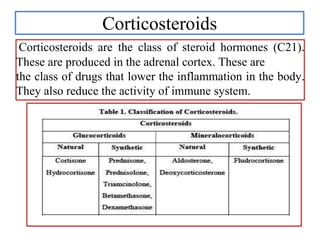
Corticosteroids are the class of steroid hormones (C21).
These are produced in the adrenal cortex. These are
the class of drugs that lower the inflammation in the body.
They also reduce the activity of immune system.
Cortisone:-
Cortisone is corticosteroid hormone (glucocorticoid) of
pregnane type. It is released by the adrenal gland.
Mechanism of action
Cortisone acetate binds to the cytosolic glucocorticoid
receptor. After binding the receptor the newly formed
receptor-ligand complex translocates itself into the cell
nucleus, where it binds to many glucocorticoid
response elements (GRE) in the promoter region of the
target genes.
Adverse effect: Fluid retention, causing swelling in lower
legs. Problems with mood swings, memory and
behavior and other psychological effects, such as confusion
or delirium.
Uses: Cortisone is used as an anti-inflammatory
medication.
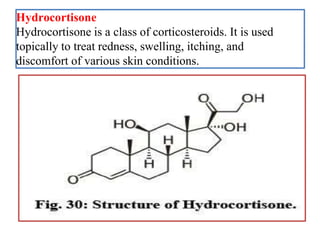
Hydrocortisone
Hydrocortisone is a class of corticosteroids. It is used
topically to treat redness, swelling, itching, and
discomfort of various skin conditions.
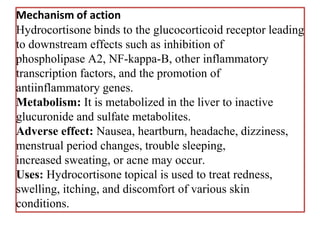
Mechanism of action
Hydrocortisone binds to the glucocorticoid receptor leading
to downstream effects such as inhibition of
phospholipase A2, NF-kappa-B, other inflammatory
transcription factors, and the promotion of
antiinflammatory genes.
Metabolism: It is metabolized in the liver to inactive
glucuronide and sulfate metabolites.
Adverse effect: Nausea, heartburn, headache, dizziness,
menstrual period changes, trouble sleeping,
increased sweating, or acne may occur.
Uses: Hydrocortisone topical is used to treat redness,
swelling, itching, and discomfort of various skin
conditions.
Prednisolone
Prednisolone is a glucocorticoid. It is a medication
used to treat certain types of allergies, inflammatory
conditions, autoimmune disorders, and cancers.
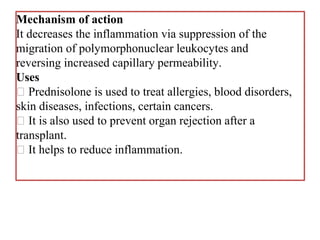
Mechanism of action
It decreases the inflammation via suppression of the
migration of polymorphonuclear leukocytes and
reversing increased capillary permeability.
Uses
Prednisolone is used to treat allergies, blood disorders,
skin diseases, infections, certain cancers.
It is also used to prevent organ rejection after a
transplant.
It helps to reduce inflammation.
Betamethasone:-
Betamethasone is in a class of corticosteroids (Fig. 32). It
is a steroid medication. It is used for a number of
diseases such as rheumatoid arthritis, systemic lupus
erythematosus and skin diseases like dermatitis.
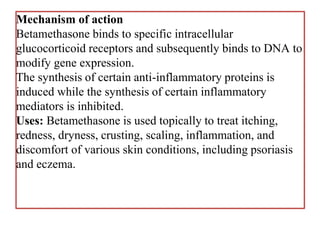
Mechanism of action
Betamethasone binds to specific intracellular
glucocorticoid receptors and subsequently binds to DNA to
modify gene expression.
The synthesis of certain anti-inflammatory proteins is
induced while the synthesis of certain inflammatory
mediators is inhibited.
Uses: Betamethasone is used topically to treat itching,
redness, dryness, crusting, scaling, inflammation, and
discomfort of various skin conditions, including psoriasis
and eczema.
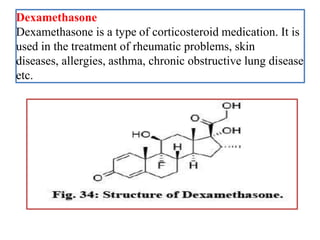
Dexamethasone
Dexamethasone is a type of corticosteroid medication. It is
used in the treatment of rheumatic problems, skin
diseases, allergies, asthma, chronic obstructive lung disease
etc.
Mechanism of action:-
It inhibits phospholipase A2, which decreases the
formation of arachidonic acid derivatives.
It inhibits NF-Kappa B and other inflammatory
transcription factors.
It promotes anti-inflammatory genes like interleukin-10.
Adverse effect: The following side effects are common for
patients taking dexamethasone.
Increased appetite. Irritability. Difficulty sleeping
(insomnia), Swelling in your ankles and feet (fluid
retention), Heartburn.Muscle weakness. Impaired wound
healing. Increased blood sugar levels.
Uses: It relieves inflammation (swelling, heat, redness, and
pain) and is used to treat certain forms of
arthritis.
Corticosteroids- medicinal chemistry

Corticosteroids- medicinal chemistry

  • 1.
    Corticosteroids T-5 SUBJECT:- MEDICINAL CHEMISTRY-II B.PHARMACY SEMSTER:-V SEM PREPARED BY Dr.D Mahendra,M.Pharm,PharmD-PB,(MBA),(Ph.D),. Research Scholar at Parul University Asst Professor-Nova College of Pharmacy
  • 2.
    Corticosteroids Corticosteroids are theclass of steroid hormones (C21). These are produced in the adrenal cortex. These are the class of drugs that lower the inflammation in the body. They also reduce the activity of immune system.
  • 3.
    Cortisone:- Cortisone is corticosteroidhormone (glucocorticoid) of pregnane type. It is released by the adrenal gland.
  • 4.
    Mechanism of action Cortisoneacetate binds to the cytosolic glucocorticoid receptor. After binding the receptor the newly formed receptor-ligand complex translocates itself into the cell nucleus, where it binds to many glucocorticoid response elements (GRE) in the promoter region of the target genes. Adverse effect: Fluid retention, causing swelling in lower legs. Problems with mood swings, memory and behavior and other psychological effects, such as confusion or delirium. Uses: Cortisone is used as an anti-inflammatory medication.
  • 5.
    Hydrocortisone Hydrocortisone is aclass of corticosteroids. It is used topically to treat redness, swelling, itching, and discomfort of various skin conditions.
  • 6.
    Mechanism of action Hydrocortisonebinds to the glucocorticoid receptor leading to downstream effects such as inhibition of phospholipase A2, NF-kappa-B, other inflammatory transcription factors, and the promotion of antiinflammatory genes. Metabolism: It is metabolized in the liver to inactive glucuronide and sulfate metabolites. Adverse effect: Nausea, heartburn, headache, dizziness, menstrual period changes, trouble sleeping, increased sweating, or acne may occur. Uses: Hydrocortisone topical is used to treat redness, swelling, itching, and discomfort of various skin conditions.
  • 7.
    Prednisolone Prednisolone is aglucocorticoid. It is a medication used to treat certain types of allergies, inflammatory conditions, autoimmune disorders, and cancers.
  • 8.
    Mechanism of action Itdecreases the inflammation via suppression of the migration of polymorphonuclear leukocytes and reversing increased capillary permeability. Uses Prednisolone is used to treat allergies, blood disorders, skin diseases, infections, certain cancers. It is also used to prevent organ rejection after a transplant. It helps to reduce inflammation.
  • 9.
    Betamethasone:- Betamethasone is ina class of corticosteroids (Fig. 32). It is a steroid medication. It is used for a number of diseases such as rheumatoid arthritis, systemic lupus erythematosus and skin diseases like dermatitis.
  • 10.
    Mechanism of action Betamethasonebinds to specific intracellular glucocorticoid receptors and subsequently binds to DNA to modify gene expression. The synthesis of certain anti-inflammatory proteins is induced while the synthesis of certain inflammatory mediators is inhibited. Uses: Betamethasone is used topically to treat itching, redness, dryness, crusting, scaling, inflammation, and discomfort of various skin conditions, including psoriasis and eczema.
  • 11.
    Dexamethasone Dexamethasone is atype of corticosteroid medication. It is used in the treatment of rheumatic problems, skin diseases, allergies, asthma, chronic obstructive lung disease etc.
  • 12.
    Mechanism of action:- Itinhibits phospholipase A2, which decreases the formation of arachidonic acid derivatives. It inhibits NF-Kappa B and other inflammatory transcription factors. It promotes anti-inflammatory genes like interleukin-10. Adverse effect: The following side effects are common for patients taking dexamethasone. Increased appetite. Irritability. Difficulty sleeping (insomnia), Swelling in your ankles and feet (fluid retention), Heartburn.Muscle weakness. Impaired wound healing. Increased blood sugar levels. Uses: It relieves inflammation (swelling, heat, redness, and pain) and is used to treat certain forms of arthritis.