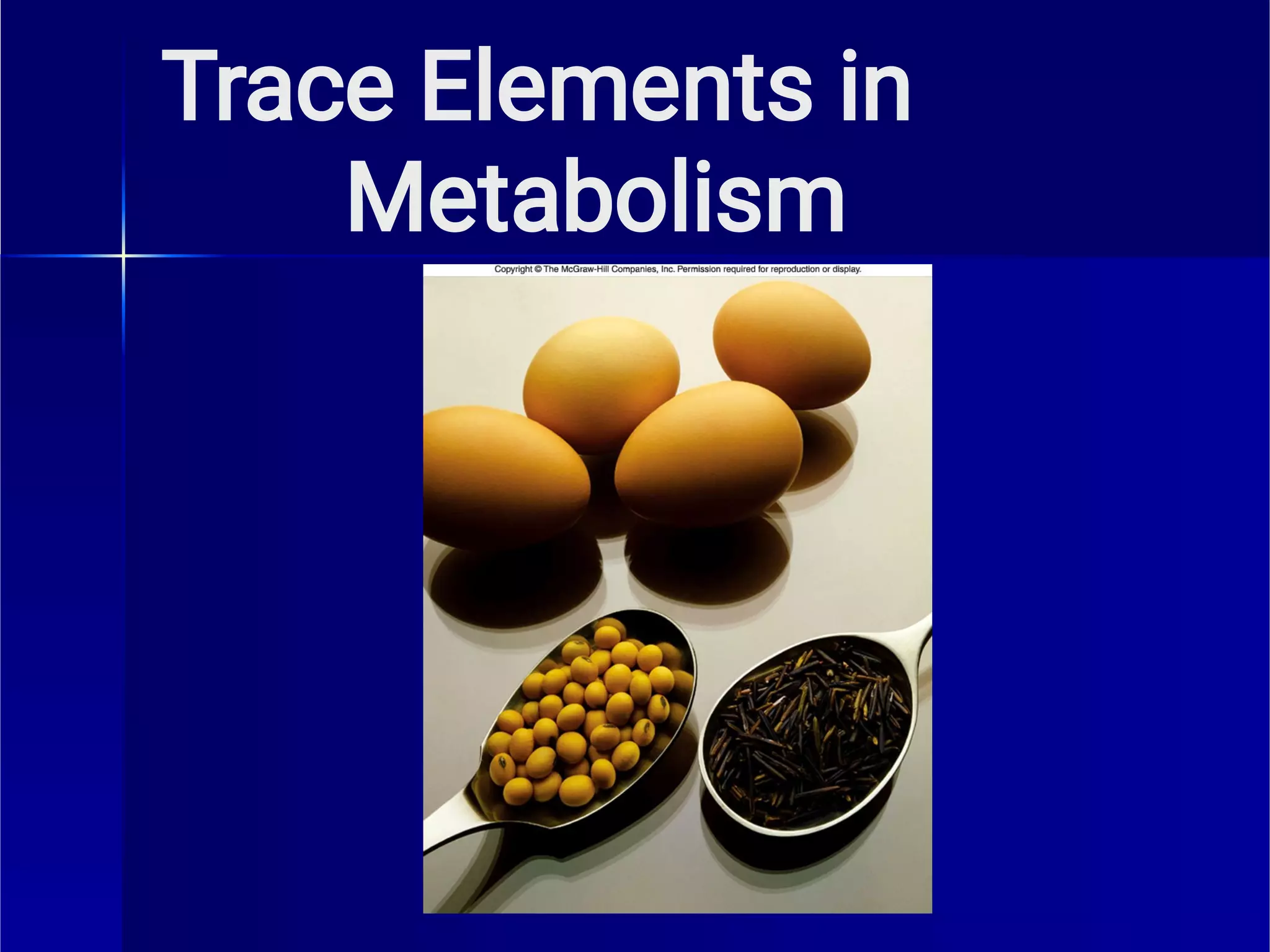
Trace Elements in 
Metabolism
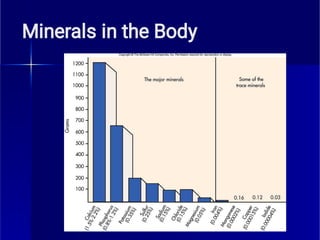
Minerals in the Body
The Trace Minerals





Needed in much smaller amounts
Are essential
Difficult to study due to the trace amounts
needed by the body
Food content dependent on soil content
Animal sources of mineral are generally
better absorbed.
Iron



–
–

Found in minute amount in every cell
15% is absorbed
Heme iron Vs. Nonheme iron
40% of iron in animal flesh is heme
iron
Heme iron is better absorbed than
nonheme
Vitamin C enhances absorption
Absorption of Iron





Determined by body’s need
Acidic environment
Upper small intestine is absorption
site
Hindered by phytic acid, oxalic acid,
high fiber, high calcium, polyphenols
Zinc competes with iron for absorption
Functions of Iron

–
–

–




Hemoglobin in red blood cells
Transports oxygen and carbon dioxide
High turnover, high demand for iron
Myoglobin in muscle cells
Binds oxygen
Electron transport chain
Enzyme cofactor
Immune function
Drug-detoxification pathway
Iron-Deficient Anemia






Most common form of anemia (30% of
world population)
Low levels of hemoglobin and hematocrit
Insufficient intake and storage
Reduction in the production of red blood
cells and oxygen capacity
Infants, toddlers, chronic blood loss,
vegans, runners, and women of
childbearing years are most at risk
Paleness, brittle nails, fatigue, difficulty
breathing, poor growth
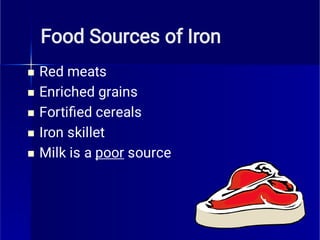
Food Sources of Iron





Red meats
Enriched grains
Fortified cereals
Iron skillet
Milk is a poor source
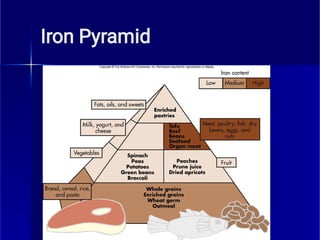
Iron Pyramid
Nonheme Iron



Not as well absorbed
Found in animal flesh, eggs, milk,
vegetables, grains and other plant
foods
Better absorbed if eaten along with
sources of heme iron
Iron Needs





RDA is 8 mg/day for adult male
RDA is 18 mg/day for female age 11 to
50; 8 mg after 50
Assumes that 18% of dietary iron is
absorbed
Average American diet: females 12
mg/day; males 17 mg/day
Average intake exceeds RDA for men,
low for women
Toxicity of Iron





Can be serious, especially for children
Diarrhea, constipation, nausea, abdominal
pain
Upper Level is 45 mg/day
Causes death due to respiratory collapse
(shock); liver damage
Alcohol increases absorption, damages
mucosal cells
Hemochromatosis



Genetic disease (carrier can also
over absorb)
Iron deposit which can lead to
organ damage
May go undetected until 50-60
years of age when organ fails
Zinc



Essential nutrient
Better absorption from animal
source
Deficiencies cause growth
retardation and poor sexual
development
Absorption of Zinc






Influenced by the foods consumed
40% of zinc from an animal source is
absorbed if body’s needs are great
Dependent on body’s need
Presence of phytic acid decreases
absorption
Calcium supplement decreases zinc
absorption
Competes with copper and iron absorption
Functions of Zinc







Cofactor to many enzymes
Synthesis of DNA, RNA
Protein metabolism, cell membrane
Wound healing, immune function,
growth
Development of sexual organs and
bones
Insulin function
Component of superoxide dismutase
Zinc Deficiency





Growth retardation
Slow sexual maturity
Loss of taste
Lethargy, emotional disorders
Slow wound healing
Food Sources of Zinc








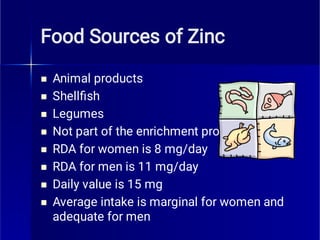
Animal products
Shellfish
Legumes
Not part of the enrichment process
RDA for women is 8 mg/day
RDA for men is 11 mg/day
Daily value is 15 mg
Average intake is marginal for women and
adequate for men
Toxicity of Zinc








Upper Level is 40 mg/day
Inhibits copper absorption
Reduces HDL
Increases risk of heart disease
Diarrhea, cramps, Nausea, vomiting
Depressed immune function
Do not exceed 100 mg/day without medical
supervision
Some take for sore throats, colds
Selenium






Readily absorbed
Excreted through the urine and feces
Co-factor for glutathione peroxidase
Protects the heart and other cells from
oxidative damage
Works together with vitamin E
Cancer prevention
Deficiency of Selenium



Muscle pain
Muscle wasting
Cardiomyopathy
Food Sources of Selenium




Fish, meat (organ meat), egg, milk,
shell fish
Grains, seeds, nuts dependent on soil
content
RDA for adults is 55 ug/day
Average intake exceeds RDA
Toxicity of Selenium







Upper Level is 400 ug/day
Garlicky breath
Hair loss
Nausea, vomiting
Weakness
Rashes
Cirrhosis of the liver
Iodine





Found in an ion form, iodide
Used for thyroid hormone synthesis
Regulates metabolic rate, growth,
development
Thyroid gland enlarges (goiter) with low
intake of iodide
Cretinism is the stunting of fetal growth
and mental development as a result of
low iodine diet
Food Sources of Iodine






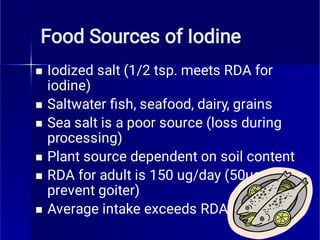
Iodized salt (1/2 tsp. meets RDA for
iodine)
Saltwater fish, seafood, dairy, grains
Sea salt is a poor source (loss during
processing)
Plant source dependent on soil content
RDA for adult is 150 ug/day (50ug to
prevent goiter)
Average intake exceeds RDA
Toxicity of Iodine




Thyroid hormone synthesis is inhibited
“Toxic goiter” results
Consumption of seaweed
Upper Level is 1.1 mg/day
Copper



Aids in iron metabolism
Absorption dependent on body’s
needs
Absorption decreased with high
intakes of vitamin C, phytic acid,
fiber, zinc, iron, certain amino
acids
Functions of Copper




Increases iron absorption
Formation of connective tissue
In superoxide dismutase
Immune system, blood clot,
brain development, cholesterol
metabolism
Deficiency of Copper






Anemia
Decrease WBC
Bone loss
Inadequate growth
Pre-term infants at risk
Cardiovascular disease
Food Sources of Copper







Organ meats
Seafood
Cocoa
Mushroom, legumes, seeds, nuts, whole-
grain
RDA is 900 ug/day for adults
Daily Value is set at 2000 ug
Average intake is about or slightly below the
RDA
Who is at Risk For Deficiency?







Preterm infants
Undernourished infants
Intestinal surgery
Long-term TPN
Dialysis
Burn patients
Excess zinc supplement
Toxicity of Copper


Upper Level is 10 mg/day
Not common
Fluoride




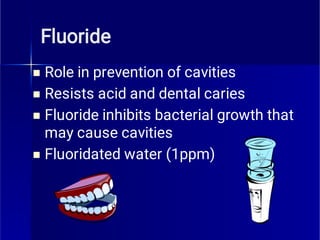
Role in prevention of cavities
Resists acid and dental caries
Fluoride inhibits bacterial growth that
may cause cavities
Fluoridated water (1ppm)
“Food” Sources of Fluoride






Fluoridate water (~0.2 mg/cup)
Tea
Seafood, seaweed
Toothpaste
Adequate intake is 3.1 -3.8 mg/day for
adults
Typical fluoridated water contains 0.2
mg/cup
Toxicity of Fluoride




Mottling of the teeth in children
Limit toothpaste to pea size for
children
In high amounts can weaken teeth in
children
Upper Level is 10 mg/day
Chromium





Not well understood
Role in Type 2 diabetes
May increase the transport of
glucose across the cell
membrane
Impaired glucose tolerance with
low intake
Elevated cholesterol and
triglyceride with low intake
Food Sources of Chromium









Little information
Egg yolk
Bran, whole grain, cereal
Organ meat, meat
Beer
Plant source dependent on soil content
Adequate Intake is 25 - 35 ug/day for adults
Daily Value is set at 120 ug
Average intake meets the AI
Toxicity of Chromium




No toxicity from foods
No Upper Level
Exposed to chromium waste sites,
painters and artists exposed to paints
Lung  liver damage
Maganese





Role in CHO metabolism
Role in bone formation
No deficiency symptom observed in
human
Adequate Intake is 1.8-2.3 mg/day
Average intake meets AI
Manganese Toxicity

–
–

Seen in individuals working in
manganese mine
Severe psychiatric abnormalities
Violence, impaired muscle control
Upper Level is 11 mg/day
Molybdenum



–
–
–




High intake will inhibit copper absorption
Required by several enzymes
Deficiency rare
Increased heart and respiration rates
Night blindness, mental confusion
Edema, weakness, coma
RDA is 45 ug/day
Average intake is 75-110 ug/day
Toxicity seen in animals
Upper Level is 2 mg/day
Other Minerals- Assignment – Functions and
deficiency





Boron
Nickel
Silicon
Vanadium
Arsenic
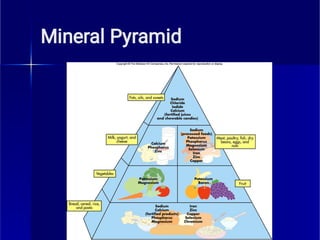
Mineral Pyramid

Trace elements in metabolism.pdf

  • 1.
    Trace Elements in Metabolism
  • 2.
  • 3.
    The Trace Minerals      Neededin much smaller amounts Are essential Difficult to study due to the trace amounts needed by the body Food content dependent on soil content Animal sources of mineral are generally better absorbed.
  • 4.
    Iron    – –  Found in minuteamount in every cell 15% is absorbed Heme iron Vs. Nonheme iron 40% of iron in animal flesh is heme iron Heme iron is better absorbed than nonheme Vitamin C enhances absorption
  • 5.
    Absorption of Iron      Determinedby body’s need Acidic environment Upper small intestine is absorption site Hindered by phytic acid, oxalic acid, high fiber, high calcium, polyphenols Zinc competes with iron for absorption
  • 6.
    Functions of Iron  – –  –     Hemoglobinin red blood cells Transports oxygen and carbon dioxide High turnover, high demand for iron Myoglobin in muscle cells Binds oxygen Electron transport chain Enzyme cofactor Immune function Drug-detoxification pathway
  • 7.
    Iron-Deficient Anemia       Most commonform of anemia (30% of world population) Low levels of hemoglobin and hematocrit Insufficient intake and storage Reduction in the production of red blood cells and oxygen capacity Infants, toddlers, chronic blood loss, vegans, runners, and women of childbearing years are most at risk Paleness, brittle nails, fatigue, difficulty breathing, poor growth
  • 8.
    Food Sources ofIron      Red meats Enriched grains Fortified cereals Iron skillet Milk is a poor source
  • 9.
  • 10.
    Nonheme Iron    Not aswell absorbed Found in animal flesh, eggs, milk, vegetables, grains and other plant foods Better absorbed if eaten along with sources of heme iron
  • 11.
    Iron Needs      RDA is8 mg/day for adult male RDA is 18 mg/day for female age 11 to 50; 8 mg after 50 Assumes that 18% of dietary iron is absorbed Average American diet: females 12 mg/day; males 17 mg/day Average intake exceeds RDA for men, low for women
  • 12.
    Toxicity of Iron      Canbe serious, especially for children Diarrhea, constipation, nausea, abdominal pain Upper Level is 45 mg/day Causes death due to respiratory collapse (shock); liver damage Alcohol increases absorption, damages mucosal cells
  • 13.
    Hemochromatosis    Genetic disease (carriercan also over absorb) Iron deposit which can lead to organ damage May go undetected until 50-60 years of age when organ fails
  • 14.
    Zinc    Essential nutrient Better absorptionfrom animal source Deficiencies cause growth retardation and poor sexual development
  • 15.
    Absorption of Zinc       Influencedby the foods consumed 40% of zinc from an animal source is absorbed if body’s needs are great Dependent on body’s need Presence of phytic acid decreases absorption Calcium supplement decreases zinc absorption Competes with copper and iron absorption
  • 16.
    Functions of Zinc        Cofactorto many enzymes Synthesis of DNA, RNA Protein metabolism, cell membrane Wound healing, immune function, growth Development of sexual organs and bones Insulin function Component of superoxide dismutase
  • 17.
    Zinc Deficiency      Growth retardation Slowsexual maturity Loss of taste Lethargy, emotional disorders Slow wound healing
  • 18.
    Food Sources ofZinc         Animal products Shellfish Legumes Not part of the enrichment process RDA for women is 8 mg/day RDA for men is 11 mg/day Daily value is 15 mg Average intake is marginal for women and adequate for men
  • 19.
    Toxicity of Zinc         UpperLevel is 40 mg/day Inhibits copper absorption Reduces HDL Increases risk of heart disease Diarrhea, cramps, Nausea, vomiting Depressed immune function Do not exceed 100 mg/day without medical supervision Some take for sore throats, colds
  • 20.
    Selenium       Readily absorbed Excreted throughthe urine and feces Co-factor for glutathione peroxidase Protects the heart and other cells from oxidative damage Works together with vitamin E Cancer prevention
  • 21.
    Deficiency of Selenium    Musclepain Muscle wasting Cardiomyopathy
  • 22.
    Food Sources ofSelenium     Fish, meat (organ meat), egg, milk, shell fish Grains, seeds, nuts dependent on soil content RDA for adults is 55 ug/day Average intake exceeds RDA
  • 23.
    Toxicity of Selenium        UpperLevel is 400 ug/day Garlicky breath Hair loss Nausea, vomiting Weakness Rashes Cirrhosis of the liver
  • 24.
    Iodine      Found in anion form, iodide Used for thyroid hormone synthesis Regulates metabolic rate, growth, development Thyroid gland enlarges (goiter) with low intake of iodide Cretinism is the stunting of fetal growth and mental development as a result of low iodine diet
  • 25.
    Food Sources ofIodine       Iodized salt (1/2 tsp. meets RDA for iodine) Saltwater fish, seafood, dairy, grains Sea salt is a poor source (loss during processing) Plant source dependent on soil content RDA for adult is 150 ug/day (50ug to prevent goiter) Average intake exceeds RDA
  • 26.
    Toxicity of Iodine     Thyroidhormone synthesis is inhibited “Toxic goiter” results Consumption of seaweed Upper Level is 1.1 mg/day
  • 27.
    Copper    Aids in ironmetabolism Absorption dependent on body’s needs Absorption decreased with high intakes of vitamin C, phytic acid, fiber, zinc, iron, certain amino acids
  • 28.
    Functions of Copper     Increasesiron absorption Formation of connective tissue In superoxide dismutase Immune system, blood clot, brain development, cholesterol metabolism
  • 29.
    Deficiency of Copper       Anemia DecreaseWBC Bone loss Inadequate growth Pre-term infants at risk Cardiovascular disease
  • 30.
    Food Sources ofCopper        Organ meats Seafood Cocoa Mushroom, legumes, seeds, nuts, whole- grain RDA is 900 ug/day for adults Daily Value is set at 2000 ug Average intake is about or slightly below the RDA
  • 31.
    Who is atRisk For Deficiency?        Preterm infants Undernourished infants Intestinal surgery Long-term TPN Dialysis Burn patients Excess zinc supplement
  • 32.
    Toxicity of Copper   UpperLevel is 10 mg/day Not common
  • 33.
    Fluoride     Role in preventionof cavities Resists acid and dental caries Fluoride inhibits bacterial growth that may cause cavities Fluoridated water (1ppm)
  • 34.
    “Food” Sources ofFluoride       Fluoridate water (~0.2 mg/cup) Tea Seafood, seaweed Toothpaste Adequate intake is 3.1 -3.8 mg/day for adults Typical fluoridated water contains 0.2 mg/cup
  • 35.
    Toxicity of Fluoride     Mottlingof the teeth in children Limit toothpaste to pea size for children In high amounts can weaken teeth in children Upper Level is 10 mg/day
  • 36.
    Chromium      Not well understood Rolein Type 2 diabetes May increase the transport of glucose across the cell membrane Impaired glucose tolerance with low intake Elevated cholesterol and triglyceride with low intake
  • 37.
    Food Sources ofChromium          Little information Egg yolk Bran, whole grain, cereal Organ meat, meat Beer Plant source dependent on soil content Adequate Intake is 25 - 35 ug/day for adults Daily Value is set at 120 ug Average intake meets the AI
  • 38.
    Toxicity of Chromium     Notoxicity from foods No Upper Level Exposed to chromium waste sites, painters and artists exposed to paints Lung liver damage
  • 39.
    Maganese      Role in CHOmetabolism Role in bone formation No deficiency symptom observed in human Adequate Intake is 1.8-2.3 mg/day Average intake meets AI
  • 40.
    Manganese Toxicity  – –  Seen inindividuals working in manganese mine Severe psychiatric abnormalities Violence, impaired muscle control Upper Level is 11 mg/day
  • 41.
    Molybdenum    – – –     High intake willinhibit copper absorption Required by several enzymes Deficiency rare Increased heart and respiration rates Night blindness, mental confusion Edema, weakness, coma RDA is 45 ug/day Average intake is 75-110 ug/day Toxicity seen in animals Upper Level is 2 mg/day
  • 42.
    Other Minerals- Assignment– Functions and deficiency      Boron Nickel Silicon Vanadium Arsenic
  • 43.