GASTROINTESTINAL AGENTS
REVATHI.G
M.PHARM
PHARMACEUTICAL CHEMISTRY
ASSISTANT PROFESSOR,SVCP
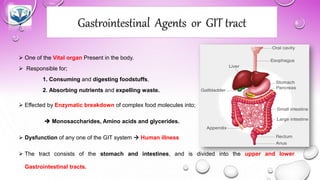
Gastrointestinal Agents or GIT tract
➢ One of the Vital organ Present in the body.
➢ Responsible for;
1. Consuming and digesting foodstuffs,
2. Absorbing nutrients and expelling waste.
➢ Effected by Enzymatic breakdown of complex food molecules into;
➔ Monosaccharides, Amino acids and glycerides.
➢ Dysfunction of any one of the GIT system → Human illness
➢ The tract consists of the stomach and intestines, and is divided into the upper and lower
Gastrointestinal tracts.
GIT AGENTS
Agents used to treat gastrointestinal disturbance are known as gastrointestinal agents.
For the treatment of gastrointestinal disorder of more serious conditions, the various inorganic
agents used to treat GIT disorders include/ classififed as:
1. Acidifying agents and antacids → Products for altering gastric pH
2. Protectives → intestinal inflammation
3. Adsorbents → intestinal toxins
4. Saline cathartics or laxatives → constipation
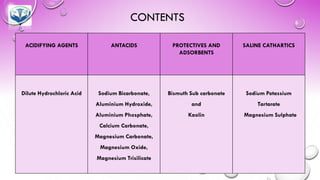
CONTENTS
ACIDIFYING AGENTS ANTACIDS PROTECTIVES AND
ADSORBENTS
SALINE CATHARTICS
Dilute Hydrochloric Acid Sodium Bicarbonate,
Aluminium Hydroxide,
Aluminium Phosphate,
Calcium Carbonate,
Magnesium Carbonate,
Magnesium Oxide,
Magnesium Trisilicate
Bismuth Sub carbonate
and
Kaolin
Sodium Potassium
Tartarate
Magnesium Sulphate
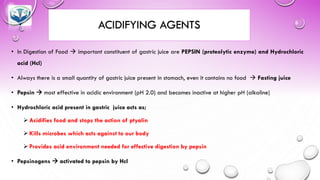
ACIDIFYING AGENTS
• In Digestion of Food → important constituent of gastric juice are PEPSIN (proteolytic enzyme) and Hydrochloric
acid (Hcl)
• Always there is a small quantity of gastric juice present in stomach, even it contains no food → Fasting juice
• Pepsin → most effective in acidic environment (pH 2.0) and becomes inactive at higher pH (alkaline)
• Hydrochloric acid present in gastric juice acts as;
➢ Acidifies food and stops the action of ptyalin
➢ Kills microbes which acts against to our body
➢ Provides acid environment needed for effective digestion by pepsin
• Pepsinogens → activated to pepsin by Hcl
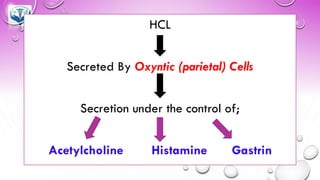
HCL
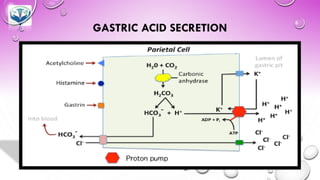
Secreted By Oxyntic (parietal) Cells
Secretion under the control of;
Acetylcholine Histamine Gastrin
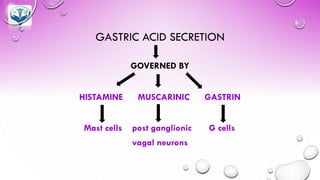
GASTRIC ACID SECRETION
GOVERNED BY
HISTAMINE MUSCARINIC GASTRIN
Mast cells post ganglionic G cells
vagal neurons
GASTRIC ACID SECRETION
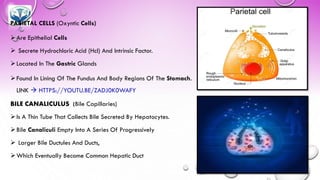
PARIETAL CELLS (Oxyntic Cells)
➢Are Epithelial Cells
➢ Secrete Hydrochloric Acid (Hcl) And Intrinsic Factor.
➢Located In The Gastric Glands
➢Found In Lining Of The Fundus And Body Regions Of The Stomach.
LINK → HTTPS://YOUTU.BE/ZADJ0K0WAFY
BILE CANALICULUS (Bile Capillaries)
➢Is A Thin Tube That Collects Bile Secreted By Hepatocytes.
➢Bile Canaliculi Empty Into A Series Of Progressively
➢ Larger Bile Ductules And Ducts,
➢Which Eventually Become Common Hepatic Duct
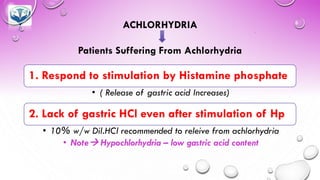
ACHLORHYDRIA
Patients Suffering From Achlorhydria
1. Respond to stimulation by Histamine phosphate
• ( Release of gastric acid Increases)
2. Lack of gastric HCl even after stimulation of Hp
• 10% w/w Dil.HCl recommended to releive from achlorhydria
• Note→ Hypochlorhydria – low gastric acid content
DEFINITION
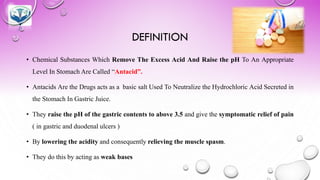
• Chemical Substances Which Remove The Excess Acid And Raise the pH To An Appropriate
Level In Stomach Are Called “Antacid”.
• Antacids Are the Drugs acts as a basic salt Used To Neutralize the Hydrochloric Acid Secreted in
the Stomach In Gastric Juice.
• They raise the pH of the gastric contents to above 3.5 and give the symptomatic relief of pain
( in gastric and duodenal ulcers )
• By lowering the acidity and consequently relieving the muscle spasm.
• They do this by acting as weak bases
ANTACID COMPOUNDS
Antacids are weak bases → used to neutralize excess stomach acid
Most antacids are weak inorganic bases
Common examples include;
1. SODIUM BICARBONATE
2. ALUMINIUM HYDROXIDE GEL
3. ALUMINIUM PHOSPHATE
4. CALCIUM CARBONATE
5. MAGNESIUM CARBONATE
6. MAGNESIUM TRISILICATE
7. MAGNESIUM OXIDE AND COMBINATION OF ANTACID PREPARATIONS
REACTION OF ANTACID
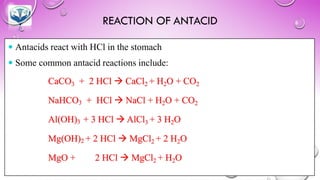
 Antacids react with HCl in the stomach
 Some common antacid reactions include:
CaCO3 + 2 HCl → CaCl2 + H2O + CO2
NaHCO3 + HCl → NaCl + H2O + CO2
Al(OH)3 + 3 HCl → AlCl3 + 3 H2O
Mg(OH)2 + 2 HCl → MgCl2 + 2 H2O
MgO + 2 HCl → MgCl2 + H2O
MECHANISM OF ANTACID
• Antacids perform a neutralization reaction, in the stomach and by inhibiting pepsin, which is a proteolytic
enzyme.
• They buffer gastric acid, raising the pH to reduce acidity in the stomach.
• When gastric hydrochloric acid reaches the nerves in the gastrointestinal mucosa, they signal pain to the central
nervous system. This happens when these nerves are exposed, as in peptic ulcers.
• The gastric acid may also reach ulcers in the esophagus or the duodenum.
• Link → https://youtu.be/d3X0gurRdhg
ANTACID MECHANISM
HOW ANTACID WORKS ?
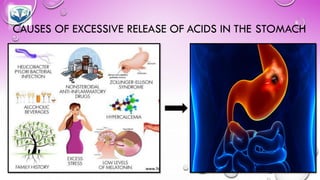
CAUSES OF EXCESSIVE RELEASE OF ACIDS IN THE STOMACH
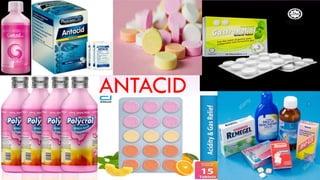
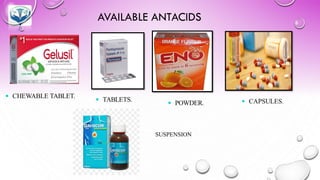
AVAILABLE ANTACIDS
SUSPENSION
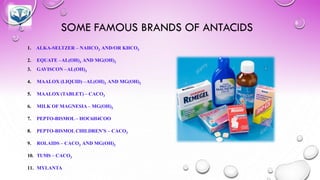
SOME FAMOUS BRANDS OF ANTACIDS
1. ALKA-SELTZER – NAHCO3 AND/OR KHCO3
2. EQUATE –AL(OH)3 AND MG(OH)2
3. GAVISCON –AL(OH)3
4. MAALOX (LIQUID) –AL(OH)3 AND MG(OH)2
5. MAALOX (TABLET) – CACO3
6. MILK OF MAGNESIA – MG(OH)2
7. PEPTO-BISMOL – HOC6H4COO
8. PEPTO-BISMOL CHILDREN’S – CACO3
9. ROLAIDS – CACO3 AND MG(OH)2
10. TUMS – CACO3
11. MYLANTA
USES OF ANTACIDS
 It Bring Down the Percentage Of Acidity In Our Stomach And Prevent Mucus Lining In The
Stomach.
 It Prevent From Heart Burn (Acid From Stomach Rising Into Esophagus) that Can To Our Stomach
Lining.
 It Also Prevent From The Ulcer (damage To Lining Of Stomach Wall, Resulting In Loss Of Tissues
And Inflammation).
SIDE EFFECTS
 Magnesium Compounds May Cause Diarrhea
 Aluminum Compounds May Cause Constipation And They Also May Interfere With The
Adsorption Of Phosphates In The Formation Of Bones. This Is More Likely To Be True If They
Are Taken For An Extended Period Of Time
 Carbonates May Generate Carbon Dioxide Leading To Bloating And Flatulence.
 Calcium Compounds Containing MayAlso Increase Calcium Output In The Urine, Which
Might Be Associated With KidneyStones.
 Sodium : Increased Intake Of Sodium May Be Deleterious ForArterial Hypertension,
Heart Failure And Many Renal Diseases.
WHO CANNOT TAKE ANTACID
• Patient With Kidney Failure Or Heart Burn Diseases Sodium Bicarbonate Has High Sodium
Content And Is Not Appropriate For People Who Are On Salt Restricted Diet Or Have
Congestive Heart Failure High Blood Pressure Or Kidney Problem .In Pregnant If A Lady Is
Pregnant Antacid Are Safetous For Heart Burn Symptoms But Do Not UseAntacid.
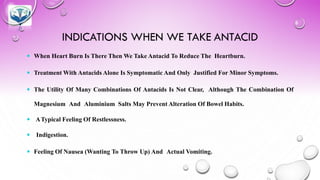
INDICATIONS WHEN WE TAKE ANTACID
 When Heart Burn Is There Then We Take Antacid To Reduce The Heartburn.
 Treatment With Antacids Alone Is Symptomatic And Only Justified For Minor Symptoms.
 The Utility Of Many Combinations Of Antacids Is Not Clear, Although The Combination Of
Magnesium And Aluminium Salts May Prevent Alteration Of Bowel Habits.
 ATypical Feeling Of Restlessness.
 Indigestion.
 Feeling Of Nausea (Wanting To Throw Up) And Actual Vomiting.
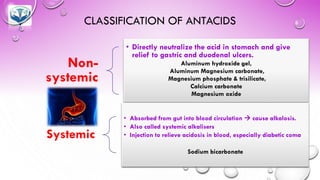
CLASSIFICATION OF ANTACIDS
Non-
systemic
• Directly neutralize the acid in stomach and give
relief to gastric and duodenal ulcers.
Aluminum hydroxide gel,
Aluminum Magnesium carbonate,
Magnesium phosphate & trisilicate,
Calcium carbonate
Magnesium oxide
Systemic
• Absorbed from gut into blood circulation → cause alkalosis.
• Also called systemic alkalisers
• Injection to relieve acidosis in blood, especially diabetic coma
Sodium bicarbonate
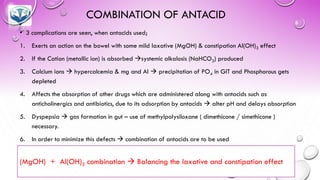
COMBINATION OF ANTACID
• 3 complications are seen, when antacids used;
1. Exerts an action on the bowel with some mild laxative (MgOH) & constipation Al(OH)3 effect
2. If the Cation (metallic ion) is absorbed →systemic alkalosis (NaHCO3) produced
3. Calcium ions → hypercalcemia & mg and Al → precipitation of PO4 in GIT and Phosphorous gets
depleted
4. Affects the absorption of other drugs which are administered along with antacids such as
anticholinergics and antibiotics, due to its adsorption by antacids → alter pH and delays absorption
5. Dyspepsia → gas formation in gut – use of methylpolysiloxane ( dimethicone / simethicone )
necessary.
6. In order to minimize this defects → combination of antacids are to be used
(MgOH) + Al(OH)3 combination → Balancing the laxative and constipation effect
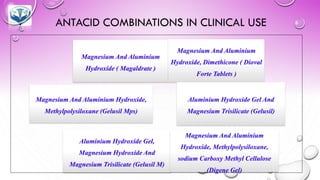
ANTACID COMBINATIONS IN CLINICAL USE
Magnesium And Aluminium
Hydroxide ( Magaldrate )
Magnesium And Aluminium
Hydroxide, Dimethicone ( Dioval
Forte Tablets )
Magnesium And Aluminium Hydroxide,
Methylpolysiloxane (Gelusil Mps)
Aluminium Hydroxide Gel And
Magnesium Trisilicate (Gelusil)
Aluminium Hydroxide Gel,
Magnesium Hydroxide And
Magnesium Trisilicate (Gelusil M)
Magnesium And Aluminium
Hydroxide, Methylpolysiloxane,
sodium Carboxy Methyl Cellulose
(Digene Gel)
SYSTEMIC ANTACIDS
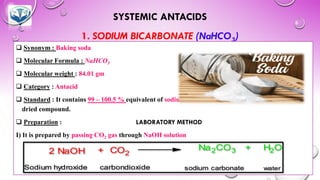
1. SODIUM BICARBONATE (NaHCO3)
❑ Synonym : Baking soda
❑ Molecular Formula : NaHCO3
❑ Molecular weight : 84.01 gm
❑ Category : Antacid
❑ Standard : It contains 99 – 100.5 % equivalent of sodium bicarbonate calculated with reference to
dried compound.
❑ Preparation : LABORATORY METHOD
I) It is prepared by passing CO2 gas through NaOH solution
2 NaOH + CO2
Na2CO3 + H2O
Sodium hydroxide carbondioxide sodium carbonate water
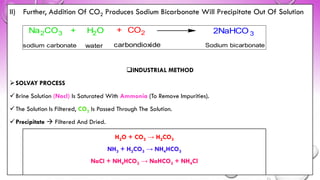
II) Further, Addition Of CO2 Produces Sodium Bicarbonate Will Precipitate Out Of Solution
❑INDUSTRIAL METHOD
➢SOLVAY PROCESS
✓Brine Solution (Nacl) Is Saturated With Ammonia (To Remove Impurities).
✓The Solution Is Filtered, CO2 Is Passed Through The Solution.
✓Precipitate → Filtered And Dried.
Na2CO3 + H2O + CO2 2NaHCO 3
sodium carbonate water carbondioxide Sodium bicarbonate
H2O + CO2 → H2CO3
NH3 + H2CO3 → NH4HCO3
NaCl + NH4HCO3 → NaHCO3 + NH4Cl
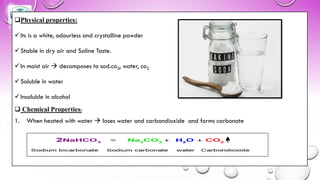
❑Physical properties:
✓Its is a white, odourless and crystalline powder
✓Stable in dry air and Saline Taste.
✓In moist air → decomposes to sod.co3, water, co2
✓Soluble in water
✓Insoluble in alcohol
❑ Chemical Properties:
1. When heated with water → loses water and carbondioxide and forms carbonate
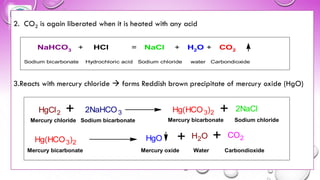
2. CO2 is again liberated when it is heated with any acid
3.Reacts with mercury chloride → forms Reddish brown precipitate of mercury oxide (HgO)
NaHCO3 + HCl = NaCl + H2O + CO2
Sodium bicarbonate Hydrochloric acid Sodium chloride water Carbondioxide
HgCl2 + 2NaHCO3 Hg(HCO3)2 + 2NaCl
Hg(HCO3)2
HgO + H2O + CO2
Mercury chloride Sodium bicarbonate Mercury bicarbonate Sodium chloride
Mercury bicarbonate Mercury oxide Water Carbondioxide
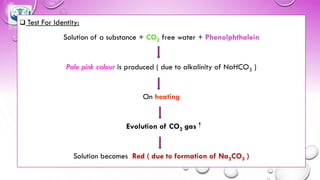
❑ Test For Identity:
Solution of a substance + CO2 free water + Phenolphthalein
Pale pink colour is produced ( due to alkalinity of NaHCO3 )
On heating
Evolution of CO2 gas
Solution becomes Red ( due to formation of Na2CO3 )
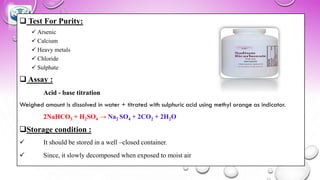
❑ Test For Purity:
✓ Arsenic
✓ Calcium
✓ Heavy metals
✓ Chloride
✓ Sulphate
❑ Assay :
Acid - base titration
Weighed amount is dissolved in water + titrated with sulphuric acid using methyl orange as indicator.
2NaHCO3 + H2SO4 → Na2 SO4 + 2CO2 + 2H2O
❑Storage condition :
✓ It should be stored in a well –closed container.
✓ Since, it slowly decomposed when exposed to moist air
❑Dosage:
1 to 4 gm per day
❑Medicinal And Pharmaceutical Uses:
✓Used As An Antacid
✓Used In Systemic Acidosis, Especially In Diabetic Coma
✓Used As A Electrolyte Replinisher
✓Used As Local Application For Burns, Insect Bites Etc.
✓Used As A Constituent In Ear Drops To Soften And Remove Wax.
NON - SYSTEMIC ANTACIDS
1. ALUMINIUM HYDROXIDE GEL
❑Description:
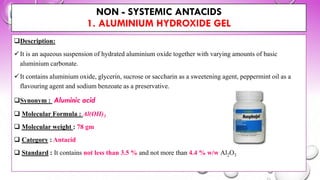
✓It is an aqueous suspension of hydrated aluminium oxide together with varying amounts of basic
aluminium carbonate.
✓It contains aluminium oxide, glycerin, sucrose or saccharin as a sweetening agent, peppermint oil as a
flavouring agent and sodium benzoate as a preservative.
❑Synonym : Aluminic acid
❑ Molecular Formula : Al(OH)3
❑ Molecular weight : 78 gm
❑ Category : Antacid
❑ Standard : It contains not less than 3.5 % and not more than 4.4 % w/w Al2O3
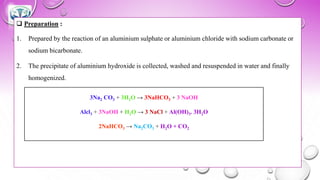
❑ Preparation :
1. Prepared by the reaction of an aluminium sulphate or aluminium chloride with sodium carbonate or
sodium bicarbonate.
2. The precipitate of aluminium hydroxide is collected, washed and resuspended in water and finally
homogenized.
3Na2 CO3 + 3H2O → 3NaHCO3 + 3 NaOH
Alcl3 + 3NaOH + H2O → 3 NaCl + Al(OH)3. 3H2O
2NaHCO3 → Na2CO3 + H2O + CO2
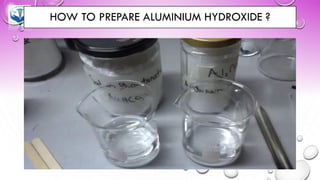
HOW TO PREPARE ALUMINIUM HYDROXIDE ?
❑Physical Properties :
1. It is a white viscous suspension.
2. A clear liquid gets separated when it is kept standing for sometime.
3. pH between 5.5 to 8.0
4. Amphoteric in nature and
5. Dissolves readily in acids or alkalis → forming aluminium salts and aluminates
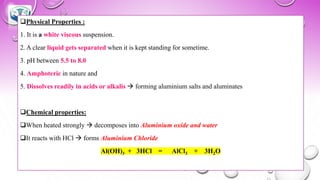
❑Chemical properties:
❑When heated strongly → decomposes into Aluminium oxide and water
❑It reacts with HCl → forms Aluminium Chloride
Al(OH)3 + 3HCl = AlCl3 + 3H2O
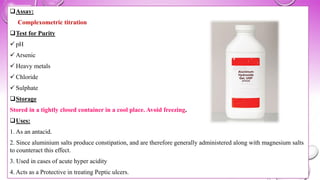
❑Assay:
Complexometric titration
❑Test for Purity
✓ pH
✓ Arsenic
✓ Heavy metals
✓ Chloride
✓ Sulphate
❑Storage
Stored in a tightly closed container in a cool place. Avoid freezing.
❑Uses:
1. As an antacid.
2. Since aluminium salts produce constipation, and are therefore generally administered along with magnesium salts
to counteract this effect.
3. Used in cases of acute hyper acidity
4. Acts as a Protective in treating Peptic ulcers.
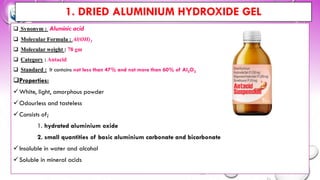
1. DRIED ALUMINIUM HYDROXIDE GEL
❑ Synonym : Aluminic acid
❑ Molecular Formula : Al(OH)3
❑ Molecular weight : 78 gm
❑ Category : Antacid
❑ Standard : It contains not less than 47% and not more than 60% of Al2O3
❑Properties:
✓White, light, amorphous powder
✓Odourless and tasteless
✓Consists of;
1. hydrated aluminium oxide
2. small quantities of basic aluminium carbonate and bicarbonate
✓Insoluble in water and alcohol
✓Soluble in mineral acids
❑Chemical properties:
❑When heated strongly → decomposes into Aluminium oxide and water
❑It reacts with HCl → forms Aluminium Chloride
Al(OH)3 + 3HCl = AlCl3 + 3H2O
❑Assay:
Complexometric titration
❑Test for Purity
✓ pH
✓ Arsenic
✓ Heavy metals
✓ Chloride
✓ Sulphate
❑Storage
Stored in a tightly closed container
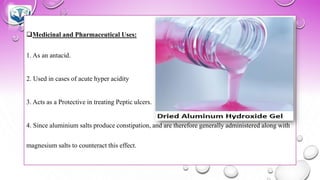
❑Medicinal and Pharmaceutical Uses:
1. As an antacid.
2. Used in cases of acute hyper acidity
3. Acts as a Protective in treating Peptic ulcers.
4. Since aluminium salts produce constipation, and are therefore generally administered along with
magnesium salts to counteract this effect.
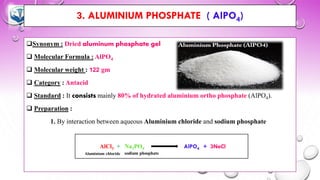
3. ALUMINIUM PHOSPHATE ( AlPO4)
❑Synonym : Dried aluminum phosphate gel
❑ Molecular Formula : AlPO4
❑ Molecular weight : 122 gm
❑ Category : Antacid
❑ Standard : It consists mainly 80% of hydrated aluminium ortho phosphate (AlPO4).
❑ Preparation :
1. By interaction between aqueous Aluminium chloride and sodium phosphate
AlCl3 + Na3PO4 AlPO4 + 3NaCl
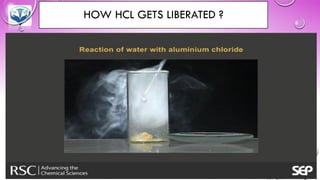
HOW HCL GETS LIBERATED ?
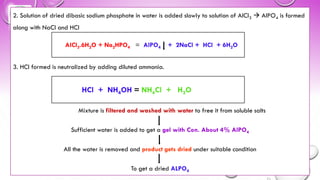
2. Solution of dried dibasic sodium phosphate in water is added slowly to solution of AlCl3 → AlPO4 is formed
along with NaCl and HCl
3. HCl formed is neutralized by adding diluted ammonia.
Mixture is filtered and washed with water to free it from soluble salts
Sufficient water is added to get a gel with Con. About 4% AlPO4
All the water is removed and product gets dried under suitable condition
To get a dried ALPO4
AlCl3.6H2O + Na2HPO4 = AlPO4 + 2NaCl + HCl + 6H2O
HCl + NH4OH = NH4Cl + H2O
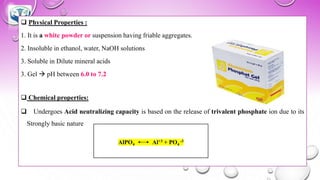
❑ Physical Properties :
1. It is a white powder or suspension having friable aggregates.
2. Insoluble in ethanol, water, NaOH solutions
3. Soluble in Dilute mineral acids
3. Gel → pH between 6.0 to 7.2
❑ Chemical properties:
❑ Undergoes Acid neutralizing capacity is based on the release of trivalent phosphate ion due to its
Strongly basic nature
AlPO4 Al+3 + PO4
-3
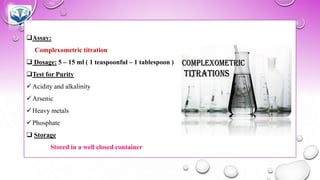
❑Assay:
Complexometric titration
❑ Dosage: 5 – 15 ml ( 1 teaspoonful – 1 tablespoon )
❑Test for Purity
✓Acidity and alkalinity
✓Arsenic
✓Heavy metals
✓Phosphate
❑ Storage
Stored in a well closed container
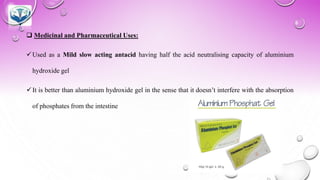
❑ Medicinal and Pharmaceutical Uses:
✓Used as a Mild slow acting antacid having half the acid neutralising capacity of aluminium
hydroxide gel
✓It is better than aluminium hydroxide gel in the sense that it doesn’t interfere with the absorption
of phosphates from the intestine
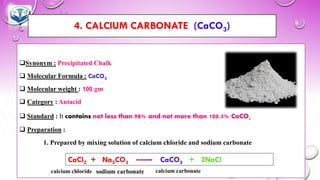
4. CALCIUM CARBONATE (CaCO3)
❑Synonym : Precipitated Chalk
❑ Molecular Formula : CaCO3
❑ Molecular weight : 100 gm
❑ Category : Antacid
❑ Standard : It contains not less than 98% and not more than 100.5% CaCO3
❑ Preparation :
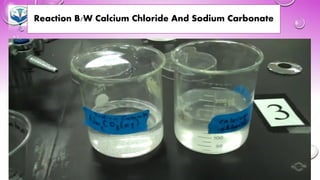
1. Prepared by mixing solution of calcium chloride and sodium carbonate
CaCl2 + Na2CO3 CaCO3 + 2NaCl
Reaction B/W Calcium Chloride And Sodium Carbonate
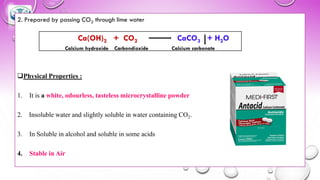
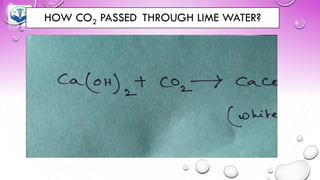
2. Prepared by passing CO2 through lime water
❑Physical Properties :
1. It is a white, odourless, tasteless microcrystalline powder
2. Insoluble water and slightly soluble in water containing CO2.
3. In Soluble in alcohol and soluble in some acids
4. Stable in Air
Ca(OH)2 + CO2 CaCO3 + H2O
Calcium hydroxide Carbondioxide Calcium carbonate
HOW CO2 PASSED THROUGH LIME WATER?
❑Chemical properties:
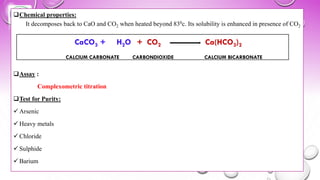
It decomposes back to CaO and CO2 when heated beyond 830c. Its solubility is enhanced in presence of CO2
❑Assay :
Complexometric titration
❑Test for Purity:
✓ Arsenic
✓ Heavy metals
✓ Chloride
✓ Sulphide
✓ Barium
CaCO3 + H2O + CO2 Ca(HCO3)2
CALCIUM CARBONATE CARBONDIOXIDE CALCIUM BICARBONATE
❑Storage:
Is stable in air, it may be stored in a well closed container.
❑Medicinal and Pharmaceutical Uses
✓ Used as fast acting non-systemic antacid
✓ As a supplement for calcium deficiency
✓ As Dentrifices due to mild abrasive property and in cosmetics
✓ As a precipitated chalk used in Tooth powder.
✓ Also used in treatment of some forms of diarrhoea, due to its non-irritating nature.
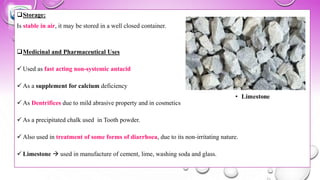
✓ Limestone → used in manufacture of cement, lime, washing soda and glass.
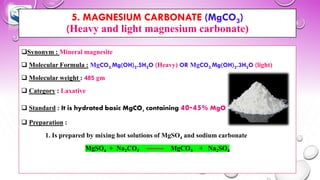
5. MAGNESIUM CARBONATE (MgCO3)
(Heavy and light magnesium carbonate)
❑Synonym : Mineral magnesite
❑ Molecular Formula : MgCO3.Mg(OH)2.5H2O (Heavy) OR MgCO3.Mg(OH)2.3H2O (light)
❑ Molecular weight : 485 gm
❑ Category : Laxative
❑ Standard : It is hydrated basic MgCO3 containing 40-45% MgO
❑ Preparation :
1. Is prepared by mixing hot solutions of MgSO4 and sodium carbonate
MgSO4 + Na2CO3 MgCO3 + Na2SO4
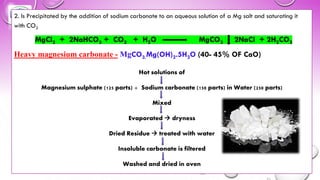
2. Is Precipitated by the addition of sodium carbonate to an aqueous solution of a Mg salt and saturating it
with CO2
MgCl2 + 2NaHCO3 + CO2 + H2O MgCO3 2NaCl + 2H2CO3
Heavy magnesium carbonate - MgCO3.Mg(OH)2.5H2O (40- 45% OF CaO)
Hot solutions of
Magnesium sulphate (125 parts) + Sodium carbonate (150 parts) in Water (250 parts)
Mixed
Evaporated → dryness
Dried Residue → treated with water
Insoluble carbonate is filtered
Washed and dried in oven
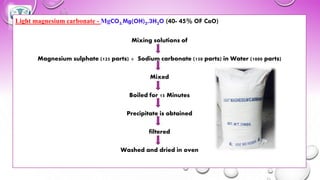
Light magnesium carbonate - MgCO3.Mg(OH)2.3H2O (40- 45% OF CaO)
Mixing solutions of
Magnesium sulphate (125 parts) + Sodium carbonate (150 parts) in Water (1000 parts)
Mixed
Boiled for 15 Minutes
Precipitate is obtained
filtered
Washed and dried in oven
MAGNESIUM CARBONATE PREPARATION
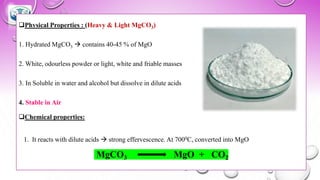
❑Physical Properties : (Heavy & Light MgCO3)
1. Hydrated MgCO3 → contains 40-45 % of MgO
2. White, odourless powder or light, white and friable masses
3. In Soluble in water and alcohol but dissolve in dilute acids
4. Stable in Air
❑Chemical properties:
1. It reacts with dilute acids → strong effervescence. At 7000C, converted into MgO
MgCO3 MgO + CO2
2. When heated to redness → give MgO
3[MgCO3.Mg(OH)2.5H2O] 4MgO + 3CO2 + 6H2O
❑Assay :
Complexometric titration
❑Test for Purity:
✓Arsenic
✓Heavy metals
✓Chloride
✓Sulphide
✓Copper and Lead
❑Storage:
Stored in a well closed container.
❑Medicinal and Pharmaceutical Uses
✓Used as a Cathartic and laxative
✓Also used in food additive, in tooth and face powders
✓Used as a mild non-systemic Antacid
6. MAGNESIUM TRISILICATE
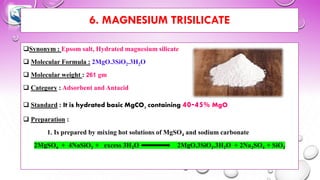
❑Synonym : Epsom salt, Hydrated magnesium silicate
❑ Molecular Formula : 2MgO.3SiO2.3H2O
❑ Molecular weight : 261 gm
❑ Category : Adsorbent and Antacid
❑ Standard : It is hydrated basic MgCO3 containing 40-45% MgO
❑ Preparation :
1. Is prepared by mixing hot solutions of MgSO4 and sodium carbonate
2MgSO4 + 4NaSiO2 + excess 3H2O 2MgO.3SiO2.3H2O + 2Na2SO4 + SiO2
HOW MAGNESIUM TRISILICATE FORMULATED ?
❑Physical Properties :
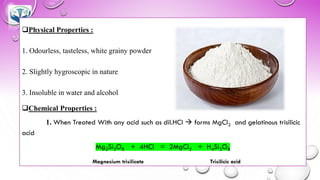
1. Odourless, tasteless, white grainy powder
2. Slightly hygroscopic in nature
3. Insoluble in water and alcohol
❑Chemical Properties :
1. When Treated With any acid such as dil.HCl → forms MgCl2 and gelatinous trisilicic
acid
Mg2Si3O8 + 4HCl = 2MgCl2 + H4Si3O8
Magnesium trisilicate Trisilicic acid
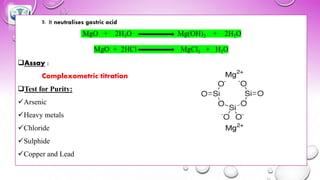
2. It neutralises gastric acid
MgO + 2H3O Mg(OH)2 + 2H2O
MgO + 2HCl MgCl2 + H2O
❑Assay :
Complexometric titration
❑Test for Purity:
✓Arsenic
✓Heavy metals
✓Chloride
✓Sulphide
✓Copper and Lead
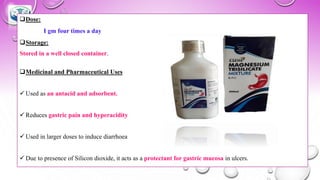
❑Dose:
I gm four times a day
❑Storage:
Stored in a well closed container.
❑Medicinal and Pharmaceutical Uses
✓ Used as an antacid and adsorbent.
✓ Reduces gastric pain and hyperacidity
✓ Used in larger doses to induce diarrhoea
✓ Due to presence of Silicon dioxide, it acts as a protectant for gastric mucosa in ulcers.
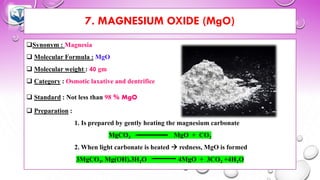
7. MAGNESIUM OXIDE (MgO)
❑Synonym : Magnesia
❑ Molecular Formula : MgO
❑ Molecular weight : 40 gm
❑ Category : Osmotic laxative and dentrifice
❑ Standard : Not less than 98 % MgO
❑ Preparation :
1. Is prepared by gently heating the magnesium carbonate
MgCO3 MgO + CO2
2. When light carbonate is heated → redness, MgO is formed
3MgCO3. Mg(OH).3H2O 4MgO + 3CO2 +4H2O
❑Physical Properties :
1. Very light, bulky, white powder→ light MgO, Dense mass → heavy MgO
2. Odourless, slightly alkaline taste
3. Practically insoluble in water
4. Dissolve with dilute acids → slight effervescence
5. When exposed to air → absorbs moisture and CO2
❑Chemical Properties :
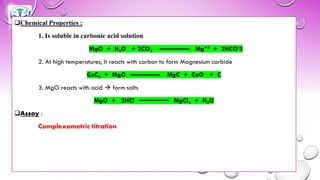
1. Is soluble in carbonic acid solution
MgO + H2O + 2CO2 Mg+2 + 2HCO-3
2. At high temperatures, it reacts with carbon to form Magnesium carbide
CaC2 + MgO MgC + CaO + C
3. MgO reacts with acid → form salts
MgO + 2HCl MgCl2 + H2O
❑Assay :
Complexometric titration
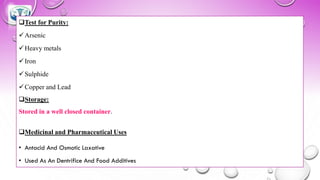
❑Test for Purity:
✓Arsenic
✓Heavy metals
✓Iron
✓Sulphide
✓Copper and Lead
❑Storage:
Stored in a well closed container.
❑Medicinal and Pharmaceutical Uses
• Antacid And Osmotic Laxative
• Used As An Dentrifice And Food Additives
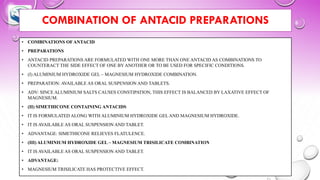
COMBINATION OF ANTACID PREPARATIONS
• COMBINATIONS OFANTACID
• PREPARATIONS
• ANTACID PREPARATIONS ARE FORMULATED WITH ONE MORE THAN ONE ANTACID AS COMBINATIONS TO
COUNTERACT THE SIDE EFFECT OF ONE BY ANOTHER OR TO BE USED FOR SPECIFIC CONDITIONS.
• (I) ALUMINIUM HYDROXIDE GEL – MAGNESIUM HYDROXIDE COMBINATION.
• PREPARATION: AVAILABLE AS ORAL SUSPENSION AND TABLETS.
• ADV: SINCE ALUMINIUM SALTS CAUSES CONSTIPATION, THIS EFFECT IS BALANCED BY LAXATIVE EFFECT OF
MAGNESIUM.
• (II) SIMETHICONE CONTAINING ANTACIDS
• IT IS FORMULATED ALONG WITH ALUMINIUM HYDROXIDE GEL AND MAGNESIUM HYDROXIDE.
• IT IS AVAILABLE AS ORAL SUSPENSION AND TABLET.
• ADVANTAGE: SIMETHICONE RELIEVES FLATULENCE.
• (III) ALUMINIUM HYDROXIDE GEL – MAGNESIUM TRISILICATE COMBINATION
• IT IS AVAILABLE AS ORAL SUSPENSION AND TABLET.
• ADVANTAGE:
• MAGNESIUM TRISILICATE HAS PROTECTIVE EFFECT.
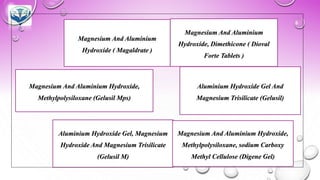
Magnesium And Aluminium
Hydroxide ( Magaldrate )
Magnesium And Aluminium
Hydroxide, Dimethicone ( Dioval
Forte Tablets )
Magnesium And Aluminium Hydroxide,
Methylpolysiloxane (Gelusil Mps)
Aluminium Hydroxide Gel And
Magnesium Trisilicate (Gelusil)
Aluminium Hydroxide Gel, Magnesium
Hydroxide And Magnesium Trisilicate
(Gelusil M)
Magnesium And Aluminium Hydroxide,
Methylpolysiloxane, sodium Carboxy
Methyl Cellulose (Digene Gel)
Magnesium And Aluminium Hydroxide
( Magaldrate )
Magaldrate → product of chemical combination of aluminium hydroxide and magnesium
hydroxide along with the sulphates of aluminium and magnesium
❑Synonym : MAGALDRATUM
❑ Molecular Formula : Al5Mg10(OH)31(SO4)2,xH2O
❑ Molecular weight : 164 gm
❑ Category : Antacid
❑ Standard : Not more than 100.5 % and Not less than 90 % Al5Mg10(OH)31(SO4)2,xH2O
❑Assay: Potentiometric titration
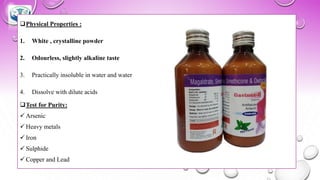
❑Physical Properties :
1. White , crystalline powder
2. Odourless, slightly alkaline taste
3. Practically insoluble in water and water
4. Dissolve with dilute acids
❑Test for Purity:
✓ Arsenic
✓ Heavy metals
✓ Iron
✓ Sulphide
✓ Copper and Lead
❑Storage:
Stored in a well closed container.
❑Medicinal and Pharmaceutical Uses
• Antacid
• Magaldrate used in the formulation of magaldrate oral suspension and oral tablet

Gastrointestinal agents

  • 1.
  • 2.
    Gastrointestinal Agents orGIT tract ➢ One of the Vital organ Present in the body. ➢ Responsible for; 1. Consuming and digesting foodstuffs, 2. Absorbing nutrients and expelling waste. ➢ Effected by Enzymatic breakdown of complex food molecules into; ➔ Monosaccharides, Amino acids and glycerides. ➢ Dysfunction of any one of the GIT system → Human illness ➢ The tract consists of the stomach and intestines, and is divided into the upper and lower Gastrointestinal tracts.
  • 3.
    GIT AGENTS Agents usedto treat gastrointestinal disturbance are known as gastrointestinal agents. For the treatment of gastrointestinal disorder of more serious conditions, the various inorganic agents used to treat GIT disorders include/ classififed as: 1. Acidifying agents and antacids → Products for altering gastric pH 2. Protectives → intestinal inflammation 3. Adsorbents → intestinal toxins 4. Saline cathartics or laxatives → constipation
  • 4.
    CONTENTS ACIDIFYING AGENTS ANTACIDSPROTECTIVES AND ADSORBENTS SALINE CATHARTICS Dilute Hydrochloric Acid Sodium Bicarbonate, Aluminium Hydroxide, Aluminium Phosphate, Calcium Carbonate, Magnesium Carbonate, Magnesium Oxide, Magnesium Trisilicate Bismuth Sub carbonate and Kaolin Sodium Potassium Tartarate Magnesium Sulphate
  • 5.
    ACIDIFYING AGENTS • InDigestion of Food → important constituent of gastric juice are PEPSIN (proteolytic enzyme) and Hydrochloric acid (Hcl) • Always there is a small quantity of gastric juice present in stomach, even it contains no food → Fasting juice • Pepsin → most effective in acidic environment (pH 2.0) and becomes inactive at higher pH (alkaline) • Hydrochloric acid present in gastric juice acts as; ➢ Acidifies food and stops the action of ptyalin ➢ Kills microbes which acts against to our body ➢ Provides acid environment needed for effective digestion by pepsin • Pepsinogens → activated to pepsin by Hcl
  • 6.
    HCL Secreted By Oxyntic(parietal) Cells Secretion under the control of; Acetylcholine Histamine Gastrin
  • 7.
    GASTRIC ACID SECRETION GOVERNEDBY HISTAMINE MUSCARINIC GASTRIN Mast cells post ganglionic G cells vagal neurons
  • 8.
  • 9.
    PARIETAL CELLS (OxynticCells) ➢Are Epithelial Cells ➢ Secrete Hydrochloric Acid (Hcl) And Intrinsic Factor. ➢Located In The Gastric Glands ➢Found In Lining Of The Fundus And Body Regions Of The Stomach. LINK → HTTPS://YOUTU.BE/ZADJ0K0WAFY BILE CANALICULUS (Bile Capillaries) ➢Is A Thin Tube That Collects Bile Secreted By Hepatocytes. ➢Bile Canaliculi Empty Into A Series Of Progressively ➢ Larger Bile Ductules And Ducts, ➢Which Eventually Become Common Hepatic Duct
  • 10.
    ACHLORHYDRIA Patients Suffering FromAchlorhydria 1. Respond to stimulation by Histamine phosphate • ( Release of gastric acid Increases) 2. Lack of gastric HCl even after stimulation of Hp • 10% w/w Dil.HCl recommended to releive from achlorhydria • Note→ Hypochlorhydria – low gastric acid content
  • 12.
    DEFINITION • Chemical SubstancesWhich Remove The Excess Acid And Raise the pH To An Appropriate Level In Stomach Are Called “Antacid”. • Antacids Are the Drugs acts as a basic salt Used To Neutralize the Hydrochloric Acid Secreted in the Stomach In Gastric Juice. • They raise the pH of the gastric contents to above 3.5 and give the symptomatic relief of pain ( in gastric and duodenal ulcers ) • By lowering the acidity and consequently relieving the muscle spasm. • They do this by acting as weak bases
  • 13.
    ANTACID COMPOUNDS Antacids areweak bases → used to neutralize excess stomach acid Most antacids are weak inorganic bases Common examples include; 1. SODIUM BICARBONATE 2. ALUMINIUM HYDROXIDE GEL 3. ALUMINIUM PHOSPHATE 4. CALCIUM CARBONATE 5. MAGNESIUM CARBONATE 6. MAGNESIUM TRISILICATE 7. MAGNESIUM OXIDE AND COMBINATION OF ANTACID PREPARATIONS
  • 14.
    REACTION OF ANTACID Antacids react with HCl in the stomach  Some common antacid reactions include: CaCO3 + 2 HCl → CaCl2 + H2O + CO2 NaHCO3 + HCl → NaCl + H2O + CO2 Al(OH)3 + 3 HCl → AlCl3 + 3 H2O Mg(OH)2 + 2 HCl → MgCl2 + 2 H2O MgO + 2 HCl → MgCl2 + H2O
  • 15.
    MECHANISM OF ANTACID •Antacids perform a neutralization reaction, in the stomach and by inhibiting pepsin, which is a proteolytic enzyme. • They buffer gastric acid, raising the pH to reduce acidity in the stomach. • When gastric hydrochloric acid reaches the nerves in the gastrointestinal mucosa, they signal pain to the central nervous system. This happens when these nerves are exposed, as in peptic ulcers. • The gastric acid may also reach ulcers in the esophagus or the duodenum. • Link → https://youtu.be/d3X0gurRdhg
  • 16.
  • 17.
  • 18.
    CAUSES OF EXCESSIVERELEASE OF ACIDS IN THE STOMACH
  • 19.
  • 20.
    SOME FAMOUS BRANDSOF ANTACIDS 1. ALKA-SELTZER – NAHCO3 AND/OR KHCO3 2. EQUATE –AL(OH)3 AND MG(OH)2 3. GAVISCON –AL(OH)3 4. MAALOX (LIQUID) –AL(OH)3 AND MG(OH)2 5. MAALOX (TABLET) – CACO3 6. MILK OF MAGNESIA – MG(OH)2 7. PEPTO-BISMOL – HOC6H4COO 8. PEPTO-BISMOL CHILDREN’S – CACO3 9. ROLAIDS – CACO3 AND MG(OH)2 10. TUMS – CACO3 11. MYLANTA
  • 21.
    USES OF ANTACIDS It Bring Down the Percentage Of Acidity In Our Stomach And Prevent Mucus Lining In The Stomach.  It Prevent From Heart Burn (Acid From Stomach Rising Into Esophagus) that Can To Our Stomach Lining.  It Also Prevent From The Ulcer (damage To Lining Of Stomach Wall, Resulting In Loss Of Tissues And Inflammation).
  • 22.
    SIDE EFFECTS  MagnesiumCompounds May Cause Diarrhea  Aluminum Compounds May Cause Constipation And They Also May Interfere With The Adsorption Of Phosphates In The Formation Of Bones. This Is More Likely To Be True If They Are Taken For An Extended Period Of Time  Carbonates May Generate Carbon Dioxide Leading To Bloating And Flatulence.  Calcium Compounds Containing MayAlso Increase Calcium Output In The Urine, Which Might Be Associated With KidneyStones.  Sodium : Increased Intake Of Sodium May Be Deleterious ForArterial Hypertension, Heart Failure And Many Renal Diseases.
  • 23.
    WHO CANNOT TAKEANTACID • Patient With Kidney Failure Or Heart Burn Diseases Sodium Bicarbonate Has High Sodium Content And Is Not Appropriate For People Who Are On Salt Restricted Diet Or Have Congestive Heart Failure High Blood Pressure Or Kidney Problem .In Pregnant If A Lady Is Pregnant Antacid Are Safetous For Heart Burn Symptoms But Do Not UseAntacid.
  • 24.
    INDICATIONS WHEN WETAKE ANTACID  When Heart Burn Is There Then We Take Antacid To Reduce The Heartburn.  Treatment With Antacids Alone Is Symptomatic And Only Justified For Minor Symptoms.  The Utility Of Many Combinations Of Antacids Is Not Clear, Although The Combination Of Magnesium And Aluminium Salts May Prevent Alteration Of Bowel Habits.  ATypical Feeling Of Restlessness.  Indigestion.  Feeling Of Nausea (Wanting To Throw Up) And Actual Vomiting.
  • 25.
    CLASSIFICATION OF ANTACIDS Non- systemic •Directly neutralize the acid in stomach and give relief to gastric and duodenal ulcers. Aluminum hydroxide gel, Aluminum Magnesium carbonate, Magnesium phosphate & trisilicate, Calcium carbonate Magnesium oxide Systemic • Absorbed from gut into blood circulation → cause alkalosis. • Also called systemic alkalisers • Injection to relieve acidosis in blood, especially diabetic coma Sodium bicarbonate
  • 26.
    COMBINATION OF ANTACID •3 complications are seen, when antacids used; 1. Exerts an action on the bowel with some mild laxative (MgOH) & constipation Al(OH)3 effect 2. If the Cation (metallic ion) is absorbed →systemic alkalosis (NaHCO3) produced 3. Calcium ions → hypercalcemia & mg and Al → precipitation of PO4 in GIT and Phosphorous gets depleted 4. Affects the absorption of other drugs which are administered along with antacids such as anticholinergics and antibiotics, due to its adsorption by antacids → alter pH and delays absorption 5. Dyspepsia → gas formation in gut – use of methylpolysiloxane ( dimethicone / simethicone ) necessary. 6. In order to minimize this defects → combination of antacids are to be used (MgOH) + Al(OH)3 combination → Balancing the laxative and constipation effect
  • 27.
    ANTACID COMBINATIONS INCLINICAL USE Magnesium And Aluminium Hydroxide ( Magaldrate ) Magnesium And Aluminium Hydroxide, Dimethicone ( Dioval Forte Tablets ) Magnesium And Aluminium Hydroxide, Methylpolysiloxane (Gelusil Mps) Aluminium Hydroxide Gel And Magnesium Trisilicate (Gelusil) Aluminium Hydroxide Gel, Magnesium Hydroxide And Magnesium Trisilicate (Gelusil M) Magnesium And Aluminium Hydroxide, Methylpolysiloxane, sodium Carboxy Methyl Cellulose (Digene Gel)
  • 28.
    SYSTEMIC ANTACIDS 1. SODIUMBICARBONATE (NaHCO3) ❑ Synonym : Baking soda ❑ Molecular Formula : NaHCO3 ❑ Molecular weight : 84.01 gm ❑ Category : Antacid ❑ Standard : It contains 99 – 100.5 % equivalent of sodium bicarbonate calculated with reference to dried compound. ❑ Preparation : LABORATORY METHOD I) It is prepared by passing CO2 gas through NaOH solution 2 NaOH + CO2 Na2CO3 + H2O Sodium hydroxide carbondioxide sodium carbonate water
  • 29.
    II) Further, AdditionOf CO2 Produces Sodium Bicarbonate Will Precipitate Out Of Solution ❑INDUSTRIAL METHOD ➢SOLVAY PROCESS ✓Brine Solution (Nacl) Is Saturated With Ammonia (To Remove Impurities). ✓The Solution Is Filtered, CO2 Is Passed Through The Solution. ✓Precipitate → Filtered And Dried. Na2CO3 + H2O + CO2 2NaHCO 3 sodium carbonate water carbondioxide Sodium bicarbonate H2O + CO2 → H2CO3 NH3 + H2CO3 → NH4HCO3 NaCl + NH4HCO3 → NaHCO3 + NH4Cl
  • 30.
    ❑Physical properties: ✓Its isa white, odourless and crystalline powder ✓Stable in dry air and Saline Taste. ✓In moist air → decomposes to sod.co3, water, co2 ✓Soluble in water ✓Insoluble in alcohol ❑ Chemical Properties: 1. When heated with water → loses water and carbondioxide and forms carbonate
  • 31.
    2. CO2 isagain liberated when it is heated with any acid 3.Reacts with mercury chloride → forms Reddish brown precipitate of mercury oxide (HgO) NaHCO3 + HCl = NaCl + H2O + CO2 Sodium bicarbonate Hydrochloric acid Sodium chloride water Carbondioxide HgCl2 + 2NaHCO3 Hg(HCO3)2 + 2NaCl Hg(HCO3)2 HgO + H2O + CO2 Mercury chloride Sodium bicarbonate Mercury bicarbonate Sodium chloride Mercury bicarbonate Mercury oxide Water Carbondioxide
  • 32.
    ❑ Test ForIdentity: Solution of a substance + CO2 free water + Phenolphthalein Pale pink colour is produced ( due to alkalinity of NaHCO3 ) On heating Evolution of CO2 gas Solution becomes Red ( due to formation of Na2CO3 )
  • 33.
    ❑ Test ForPurity: ✓ Arsenic ✓ Calcium ✓ Heavy metals ✓ Chloride ✓ Sulphate ❑ Assay : Acid - base titration Weighed amount is dissolved in water + titrated with sulphuric acid using methyl orange as indicator. 2NaHCO3 + H2SO4 → Na2 SO4 + 2CO2 + 2H2O ❑Storage condition : ✓ It should be stored in a well –closed container. ✓ Since, it slowly decomposed when exposed to moist air
  • 34.
    ❑Dosage: 1 to 4gm per day ❑Medicinal And Pharmaceutical Uses: ✓Used As An Antacid ✓Used In Systemic Acidosis, Especially In Diabetic Coma ✓Used As A Electrolyte Replinisher ✓Used As Local Application For Burns, Insect Bites Etc. ✓Used As A Constituent In Ear Drops To Soften And Remove Wax.
  • 35.
    NON - SYSTEMICANTACIDS 1. ALUMINIUM HYDROXIDE GEL ❑Description: ✓It is an aqueous suspension of hydrated aluminium oxide together with varying amounts of basic aluminium carbonate. ✓It contains aluminium oxide, glycerin, sucrose or saccharin as a sweetening agent, peppermint oil as a flavouring agent and sodium benzoate as a preservative. ❑Synonym : Aluminic acid ❑ Molecular Formula : Al(OH)3 ❑ Molecular weight : 78 gm ❑ Category : Antacid ❑ Standard : It contains not less than 3.5 % and not more than 4.4 % w/w Al2O3
  • 36.
    ❑ Preparation : 1.Prepared by the reaction of an aluminium sulphate or aluminium chloride with sodium carbonate or sodium bicarbonate. 2. The precipitate of aluminium hydroxide is collected, washed and resuspended in water and finally homogenized. 3Na2 CO3 + 3H2O → 3NaHCO3 + 3 NaOH Alcl3 + 3NaOH + H2O → 3 NaCl + Al(OH)3. 3H2O 2NaHCO3 → Na2CO3 + H2O + CO2
  • 37.
    HOW TO PREPAREALUMINIUM HYDROXIDE ?
  • 38.
    ❑Physical Properties : 1.It is a white viscous suspension. 2. A clear liquid gets separated when it is kept standing for sometime. 3. pH between 5.5 to 8.0 4. Amphoteric in nature and 5. Dissolves readily in acids or alkalis → forming aluminium salts and aluminates ❑Chemical properties: ❑When heated strongly → decomposes into Aluminium oxide and water ❑It reacts with HCl → forms Aluminium Chloride Al(OH)3 + 3HCl = AlCl3 + 3H2O
  • 39.
    ❑Assay: Complexometric titration ❑Test forPurity ✓ pH ✓ Arsenic ✓ Heavy metals ✓ Chloride ✓ Sulphate ❑Storage Stored in a tightly closed container in a cool place. Avoid freezing. ❑Uses: 1. As an antacid. 2. Since aluminium salts produce constipation, and are therefore generally administered along with magnesium salts to counteract this effect. 3. Used in cases of acute hyper acidity 4. Acts as a Protective in treating Peptic ulcers.
  • 40.
    1. DRIED ALUMINIUMHYDROXIDE GEL ❑ Synonym : Aluminic acid ❑ Molecular Formula : Al(OH)3 ❑ Molecular weight : 78 gm ❑ Category : Antacid ❑ Standard : It contains not less than 47% and not more than 60% of Al2O3 ❑Properties: ✓White, light, amorphous powder ✓Odourless and tasteless ✓Consists of; 1. hydrated aluminium oxide 2. small quantities of basic aluminium carbonate and bicarbonate ✓Insoluble in water and alcohol ✓Soluble in mineral acids
  • 41.
    ❑Chemical properties: ❑When heatedstrongly → decomposes into Aluminium oxide and water ❑It reacts with HCl → forms Aluminium Chloride Al(OH)3 + 3HCl = AlCl3 + 3H2O ❑Assay: Complexometric titration ❑Test for Purity ✓ pH ✓ Arsenic ✓ Heavy metals ✓ Chloride ✓ Sulphate ❑Storage Stored in a tightly closed container
  • 42.
    ❑Medicinal and PharmaceuticalUses: 1. As an antacid. 2. Used in cases of acute hyper acidity 3. Acts as a Protective in treating Peptic ulcers. 4. Since aluminium salts produce constipation, and are therefore generally administered along with magnesium salts to counteract this effect.
  • 43.
    3. ALUMINIUM PHOSPHATE( AlPO4) ❑Synonym : Dried aluminum phosphate gel ❑ Molecular Formula : AlPO4 ❑ Molecular weight : 122 gm ❑ Category : Antacid ❑ Standard : It consists mainly 80% of hydrated aluminium ortho phosphate (AlPO4). ❑ Preparation : 1. By interaction between aqueous Aluminium chloride and sodium phosphate AlCl3 + Na3PO4 AlPO4 + 3NaCl
  • 44.
    HOW HCL GETSLIBERATED ?
  • 45.
    2. Solution ofdried dibasic sodium phosphate in water is added slowly to solution of AlCl3 → AlPO4 is formed along with NaCl and HCl 3. HCl formed is neutralized by adding diluted ammonia. Mixture is filtered and washed with water to free it from soluble salts Sufficient water is added to get a gel with Con. About 4% AlPO4 All the water is removed and product gets dried under suitable condition To get a dried ALPO4 AlCl3.6H2O + Na2HPO4 = AlPO4 + 2NaCl + HCl + 6H2O HCl + NH4OH = NH4Cl + H2O
  • 46.
    ❑ Physical Properties: 1. It is a white powder or suspension having friable aggregates. 2. Insoluble in ethanol, water, NaOH solutions 3. Soluble in Dilute mineral acids 3. Gel → pH between 6.0 to 7.2 ❑ Chemical properties: ❑ Undergoes Acid neutralizing capacity is based on the release of trivalent phosphate ion due to its Strongly basic nature AlPO4 Al+3 + PO4 -3
  • 47.
    ❑Assay: Complexometric titration ❑ Dosage:5 – 15 ml ( 1 teaspoonful – 1 tablespoon ) ❑Test for Purity ✓Acidity and alkalinity ✓Arsenic ✓Heavy metals ✓Phosphate ❑ Storage Stored in a well closed container
  • 48.
    ❑ Medicinal andPharmaceutical Uses: ✓Used as a Mild slow acting antacid having half the acid neutralising capacity of aluminium hydroxide gel ✓It is better than aluminium hydroxide gel in the sense that it doesn’t interfere with the absorption of phosphates from the intestine
  • 49.
    4. CALCIUM CARBONATE(CaCO3) ❑Synonym : Precipitated Chalk ❑ Molecular Formula : CaCO3 ❑ Molecular weight : 100 gm ❑ Category : Antacid ❑ Standard : It contains not less than 98% and not more than 100.5% CaCO3 ❑ Preparation : 1. Prepared by mixing solution of calcium chloride and sodium carbonate CaCl2 + Na2CO3 CaCO3 + 2NaCl
  • 50.
    Reaction B/W CalciumChloride And Sodium Carbonate
  • 51.
    2. Prepared bypassing CO2 through lime water ❑Physical Properties : 1. It is a white, odourless, tasteless microcrystalline powder 2. Insoluble water and slightly soluble in water containing CO2. 3. In Soluble in alcohol and soluble in some acids 4. Stable in Air Ca(OH)2 + CO2 CaCO3 + H2O Calcium hydroxide Carbondioxide Calcium carbonate
  • 52.
    HOW CO2 PASSEDTHROUGH LIME WATER?
  • 53.
    ❑Chemical properties: It decomposesback to CaO and CO2 when heated beyond 830c. Its solubility is enhanced in presence of CO2 ❑Assay : Complexometric titration ❑Test for Purity: ✓ Arsenic ✓ Heavy metals ✓ Chloride ✓ Sulphide ✓ Barium CaCO3 + H2O + CO2 Ca(HCO3)2 CALCIUM CARBONATE CARBONDIOXIDE CALCIUM BICARBONATE
  • 54.
    ❑Storage: Is stable inair, it may be stored in a well closed container. ❑Medicinal and Pharmaceutical Uses ✓ Used as fast acting non-systemic antacid ✓ As a supplement for calcium deficiency ✓ As Dentrifices due to mild abrasive property and in cosmetics ✓ As a precipitated chalk used in Tooth powder. ✓ Also used in treatment of some forms of diarrhoea, due to its non-irritating nature. ✓ Limestone → used in manufacture of cement, lime, washing soda and glass.
  • 55.
    5. MAGNESIUM CARBONATE(MgCO3) (Heavy and light magnesium carbonate) ❑Synonym : Mineral magnesite ❑ Molecular Formula : MgCO3.Mg(OH)2.5H2O (Heavy) OR MgCO3.Mg(OH)2.3H2O (light) ❑ Molecular weight : 485 gm ❑ Category : Laxative ❑ Standard : It is hydrated basic MgCO3 containing 40-45% MgO ❑ Preparation : 1. Is prepared by mixing hot solutions of MgSO4 and sodium carbonate MgSO4 + Na2CO3 MgCO3 + Na2SO4
  • 56.
    2. Is Precipitatedby the addition of sodium carbonate to an aqueous solution of a Mg salt and saturating it with CO2 MgCl2 + 2NaHCO3 + CO2 + H2O MgCO3 2NaCl + 2H2CO3 Heavy magnesium carbonate - MgCO3.Mg(OH)2.5H2O (40- 45% OF CaO) Hot solutions of Magnesium sulphate (125 parts) + Sodium carbonate (150 parts) in Water (250 parts) Mixed Evaporated → dryness Dried Residue → treated with water Insoluble carbonate is filtered Washed and dried in oven
  • 57.
    Light magnesium carbonate- MgCO3.Mg(OH)2.3H2O (40- 45% OF CaO) Mixing solutions of Magnesium sulphate (125 parts) + Sodium carbonate (150 parts) in Water (1000 parts) Mixed Boiled for 15 Minutes Precipitate is obtained filtered Washed and dried in oven
  • 58.
  • 59.
    ❑Physical Properties :(Heavy & Light MgCO3) 1. Hydrated MgCO3 → contains 40-45 % of MgO 2. White, odourless powder or light, white and friable masses 3. In Soluble in water and alcohol but dissolve in dilute acids 4. Stable in Air ❑Chemical properties: 1. It reacts with dilute acids → strong effervescence. At 7000C, converted into MgO MgCO3 MgO + CO2
  • 60.
    2. When heatedto redness → give MgO 3[MgCO3.Mg(OH)2.5H2O] 4MgO + 3CO2 + 6H2O ❑Assay : Complexometric titration ❑Test for Purity: ✓Arsenic ✓Heavy metals ✓Chloride ✓Sulphide ✓Copper and Lead
  • 61.
    ❑Storage: Stored in awell closed container. ❑Medicinal and Pharmaceutical Uses ✓Used as a Cathartic and laxative ✓Also used in food additive, in tooth and face powders ✓Used as a mild non-systemic Antacid
  • 62.
    6. MAGNESIUM TRISILICATE ❑Synonym: Epsom salt, Hydrated magnesium silicate ❑ Molecular Formula : 2MgO.3SiO2.3H2O ❑ Molecular weight : 261 gm ❑ Category : Adsorbent and Antacid ❑ Standard : It is hydrated basic MgCO3 containing 40-45% MgO ❑ Preparation : 1. Is prepared by mixing hot solutions of MgSO4 and sodium carbonate 2MgSO4 + 4NaSiO2 + excess 3H2O 2MgO.3SiO2.3H2O + 2Na2SO4 + SiO2
  • 63.
  • 64.
    ❑Physical Properties : 1.Odourless, tasteless, white grainy powder 2. Slightly hygroscopic in nature 3. Insoluble in water and alcohol ❑Chemical Properties : 1. When Treated With any acid such as dil.HCl → forms MgCl2 and gelatinous trisilicic acid Mg2Si3O8 + 4HCl = 2MgCl2 + H4Si3O8 Magnesium trisilicate Trisilicic acid
  • 65.
    2. It neutralisesgastric acid MgO + 2H3O Mg(OH)2 + 2H2O MgO + 2HCl MgCl2 + H2O ❑Assay : Complexometric titration ❑Test for Purity: ✓Arsenic ✓Heavy metals ✓Chloride ✓Sulphide ✓Copper and Lead
  • 66.
    ❑Dose: I gm fourtimes a day ❑Storage: Stored in a well closed container. ❑Medicinal and Pharmaceutical Uses ✓ Used as an antacid and adsorbent. ✓ Reduces gastric pain and hyperacidity ✓ Used in larger doses to induce diarrhoea ✓ Due to presence of Silicon dioxide, it acts as a protectant for gastric mucosa in ulcers.
  • 67.
    7. MAGNESIUM OXIDE(MgO) ❑Synonym : Magnesia ❑ Molecular Formula : MgO ❑ Molecular weight : 40 gm ❑ Category : Osmotic laxative and dentrifice ❑ Standard : Not less than 98 % MgO ❑ Preparation : 1. Is prepared by gently heating the magnesium carbonate MgCO3 MgO + CO2 2. When light carbonate is heated → redness, MgO is formed 3MgCO3. Mg(OH).3H2O 4MgO + 3CO2 +4H2O
  • 68.
    ❑Physical Properties : 1.Very light, bulky, white powder→ light MgO, Dense mass → heavy MgO 2. Odourless, slightly alkaline taste 3. Practically insoluble in water 4. Dissolve with dilute acids → slight effervescence 5. When exposed to air → absorbs moisture and CO2
  • 69.
    ❑Chemical Properties : 1.Is soluble in carbonic acid solution MgO + H2O + 2CO2 Mg+2 + 2HCO-3 2. At high temperatures, it reacts with carbon to form Magnesium carbide CaC2 + MgO MgC + CaO + C 3. MgO reacts with acid → form salts MgO + 2HCl MgCl2 + H2O ❑Assay : Complexometric titration
  • 70.
    ❑Test for Purity: ✓Arsenic ✓Heavymetals ✓Iron ✓Sulphide ✓Copper and Lead ❑Storage: Stored in a well closed container. ❑Medicinal and Pharmaceutical Uses • Antacid And Osmotic Laxative • Used As An Dentrifice And Food Additives
  • 71.
    COMBINATION OF ANTACIDPREPARATIONS • COMBINATIONS OFANTACID • PREPARATIONS • ANTACID PREPARATIONS ARE FORMULATED WITH ONE MORE THAN ONE ANTACID AS COMBINATIONS TO COUNTERACT THE SIDE EFFECT OF ONE BY ANOTHER OR TO BE USED FOR SPECIFIC CONDITIONS. • (I) ALUMINIUM HYDROXIDE GEL – MAGNESIUM HYDROXIDE COMBINATION. • PREPARATION: AVAILABLE AS ORAL SUSPENSION AND TABLETS. • ADV: SINCE ALUMINIUM SALTS CAUSES CONSTIPATION, THIS EFFECT IS BALANCED BY LAXATIVE EFFECT OF MAGNESIUM. • (II) SIMETHICONE CONTAINING ANTACIDS • IT IS FORMULATED ALONG WITH ALUMINIUM HYDROXIDE GEL AND MAGNESIUM HYDROXIDE. • IT IS AVAILABLE AS ORAL SUSPENSION AND TABLET. • ADVANTAGE: SIMETHICONE RELIEVES FLATULENCE. • (III) ALUMINIUM HYDROXIDE GEL – MAGNESIUM TRISILICATE COMBINATION • IT IS AVAILABLE AS ORAL SUSPENSION AND TABLET. • ADVANTAGE: • MAGNESIUM TRISILICATE HAS PROTECTIVE EFFECT.
  • 72.
    Magnesium And Aluminium Hydroxide( Magaldrate ) Magnesium And Aluminium Hydroxide, Dimethicone ( Dioval Forte Tablets ) Magnesium And Aluminium Hydroxide, Methylpolysiloxane (Gelusil Mps) Aluminium Hydroxide Gel And Magnesium Trisilicate (Gelusil) Aluminium Hydroxide Gel, Magnesium Hydroxide And Magnesium Trisilicate (Gelusil M) Magnesium And Aluminium Hydroxide, Methylpolysiloxane, sodium Carboxy Methyl Cellulose (Digene Gel)
  • 73.
    Magnesium And AluminiumHydroxide ( Magaldrate ) Magaldrate → product of chemical combination of aluminium hydroxide and magnesium hydroxide along with the sulphates of aluminium and magnesium ❑Synonym : MAGALDRATUM ❑ Molecular Formula : Al5Mg10(OH)31(SO4)2,xH2O ❑ Molecular weight : 164 gm ❑ Category : Antacid ❑ Standard : Not more than 100.5 % and Not less than 90 % Al5Mg10(OH)31(SO4)2,xH2O ❑Assay: Potentiometric titration
  • 74.
    ❑Physical Properties : 1.White , crystalline powder 2. Odourless, slightly alkaline taste 3. Practically insoluble in water and water 4. Dissolve with dilute acids ❑Test for Purity: ✓ Arsenic ✓ Heavy metals ✓ Iron ✓ Sulphide ✓ Copper and Lead
  • 75.
    ❑Storage: Stored in awell closed container. ❑Medicinal and Pharmaceutical Uses • Antacid • Magaldrate used in the formulation of magaldrate oral suspension and oral tablet