Module 4 - Videos and 3D
simulations for laboratory
This programme has been funded with
support from the European Commission
Objective:
Integration of video and 3d simulations as learning
materials for engineering laboratory teaching.
Expected learning outcomes:
• Awareness on simulation and video techniques for
engineering laboratory teaching
• Understanding the benefits of video and simulation
techniques for laboratory practical applications
• Ability to select suitable simulation and video techniques
for relevant laboratory course
INTRODUCTION
Using technological tools such as animation, simulation, video and multimedia as a part of the learning
environment have several benefits such as: visuality, student satisfaction/motivation, technological interaction,
readiness to laboratory study, remote access, time saving, low cost in terms of consumables and technical
equipment, improved lab safety, and possibility of trial and error.
ESCOLA | DIGITAL TEACHING TOOLS FOR ENGINEERING LABS
01
This programme has been funded with support from the European Commission. The author is
solely responsible for this publication (communication) and the Commission accepts no
responsibility for any use that may be made of the information contained therein.
02
03
04
05
06
Video and simulation technics for
engineering teaching
Videos
Remote Labs
Simulations (Virtual Labs)
Summary
Digital Teaching Tools for Engineering
Laboratories
ESCOLA | DIGITAL TEACHING TOOLS FOR ENGINEERING LABS
1. Digital Teaching Tools for Engineering Laboratories
ESCOLA | DIGITAL TEACHING TOOLS FOR ENGINEERING LABS
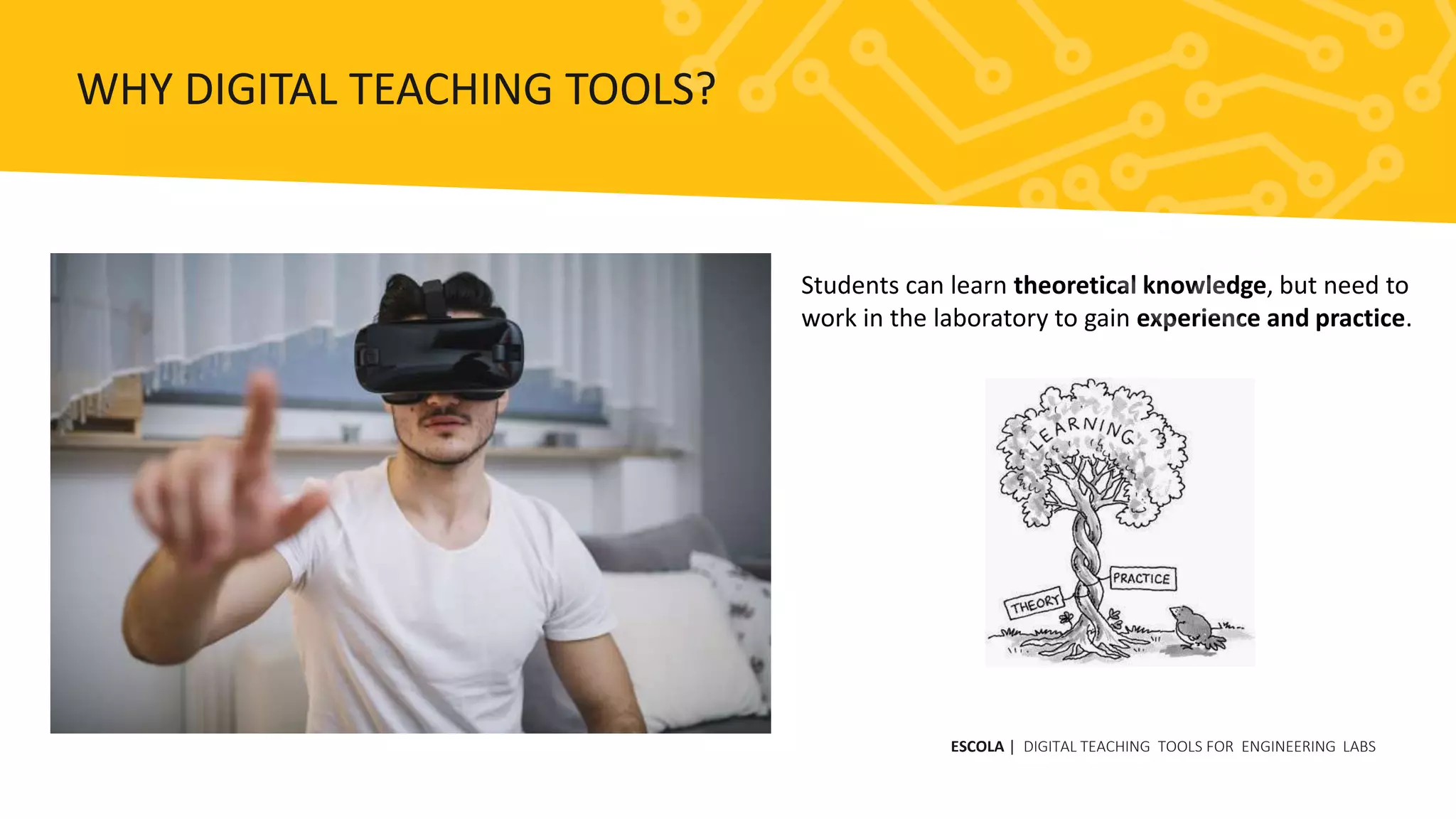
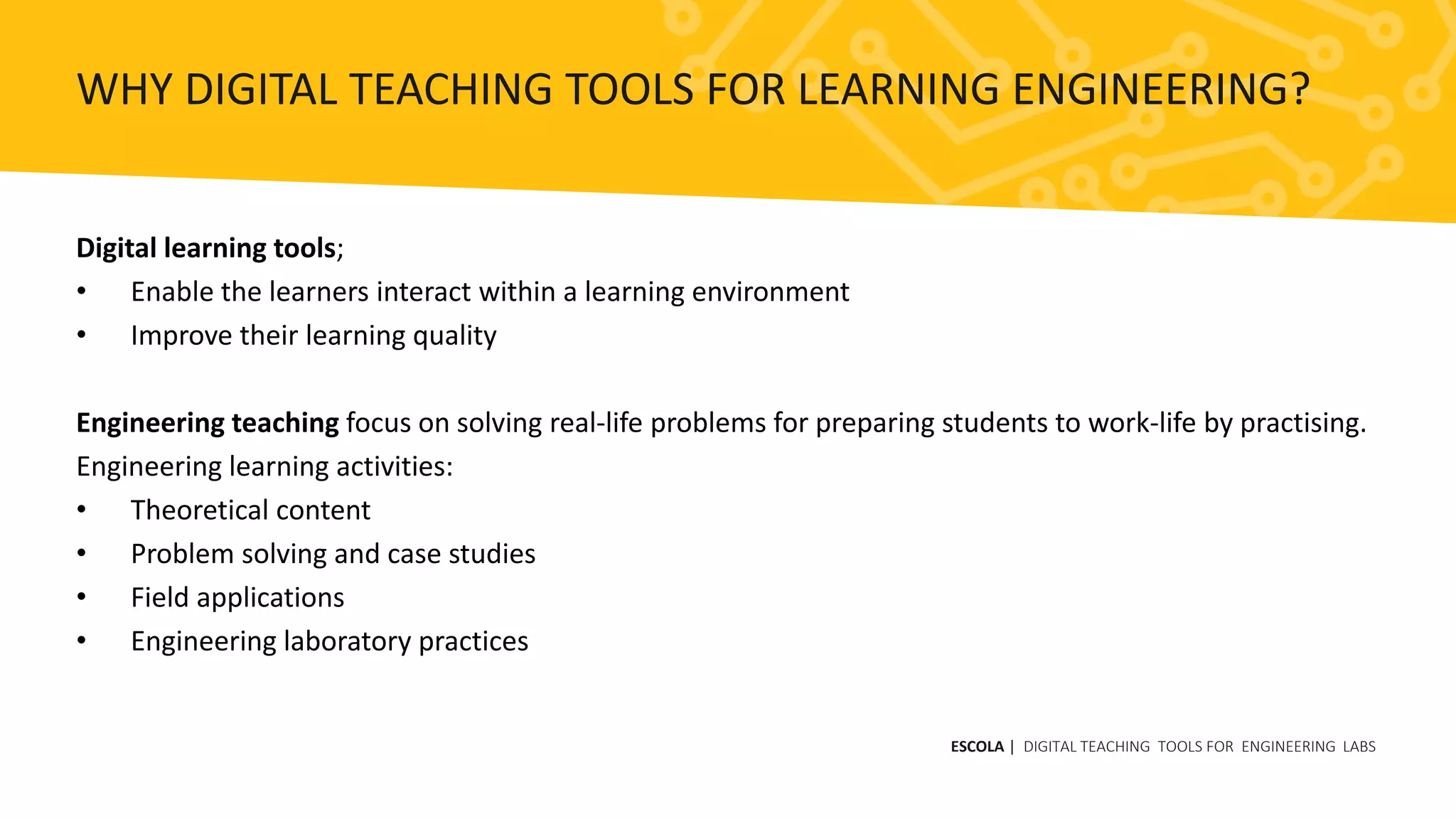
Students can learn theoretical knowledge, but need to
work in the laboratory to gain experience and practice.
ESCOLA | DIGITAL TEACHING TOOLS FOR ENGINEERING LABS
WHY DIGITAL TEACHING TOOLS?
Digital learning tools;
• Enable the learners interact within a learning environment
• Improve their learning quality
Engineering teaching focus on solving real-life problems for preparing students to work-life by practising.
Engineering learning activities:
• Theoretical content
• Problem solving and case studies
• Field applications
• Engineering laboratory practices
ESCOLA | DIGITAL TEACHING TOOLS FOR ENGINEERING LABS
WHY DIGITAL TEACHING TOOLS FOR LEARNING ENGINEERING?
Learning environments may contain tools such as;
• animations
• simulations
• videos
• multimedia and hypermedia
They help us actively produce, research and experiment!
Digitally supported laboratory courses do not aim to replace the real-time do & learn activities, but they
support to save time and sources.
ESCOLA | DIGITAL TEACHING TOOLS FOR ENGINEERING LABS
DIGITALLY-SUPPORTED COURSES: WHICH TOOLS?
WILL SIMULATIONS REPLACE REALTIME LEARNING ACTIVITIES?
2. Video and simulation technics for engineering teaching
ESCOLA | DIGITAL TEACHING TOOLS FOR ENGINEERING LABS
When there is not enough time and source to
conduct the experiment, the videos may be
used as important teaching tools.
Modeling and simulation are important in
terms of the educational processes that can
not be tested in real life.
ESCOLA | DIGITAL TEACHING TOOLS FOR ENGINEERING LABS
VIDEOS AND 3D SIMULATIONS FOR ENGINEERING LABORATORIES
WHY?
• Increased visuality
• Student satisfaction/motivation
• Technological interaction
• Readiness (pre-laboratory study)
• Remote access
ESCOLA | DIGITAL TEACHING TOOLS FOR ENGINEERING LABS
VIDEOS AND 3D SIMULATIONS FOR ENGINEERING LABORATORIES
BENEFITS
• Time saving
• Low cost (in terms of consumables and technical equipment)
• Improved lab safety
• Possibility of trial and error
ESCOLA | DIGITAL TEACHING TOOLS FOR ENGINEERING LABS
VIDEOS AND 3D SIMULATIONS FOR ENGINEERING LABORATORIES
BENEFITS
• Lack of interactivity
• Lack of real experience (if not supported by lab experience)
• Need high quality hardware
• High cost and labor (at preparation)
• Teachers’ fear of technology
• Lack of readiness for teachers and students
ESCOLA | DIGITAL TEACHING TOOLS FOR ENGINEERING LABS
VIDEOS AND 3D SIMULATIONS FOR ENGINEERING LABORATORIES
LIMITATIONS
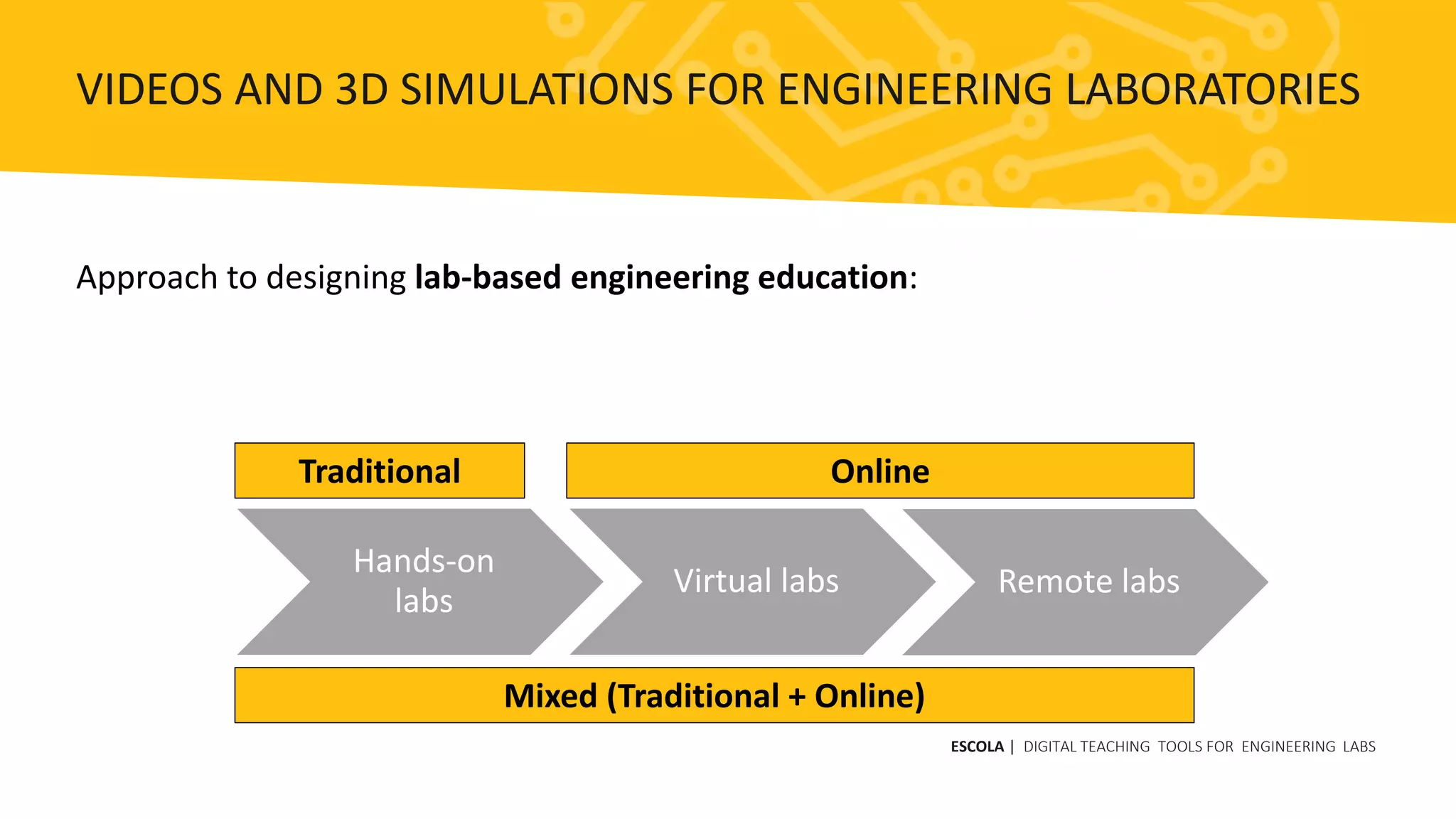
Approach to designing lab-based engineering education:
Hands-on
labs
Virtual labs Remote labs
Traditional Online
Mixed (Traditional + Online)
ESCOLA | DIGITAL TEACHING TOOLS FOR ENGINEERING LABS
VIDEOS AND 3D SIMULATIONS FOR ENGINEERING LABORATORIES
3. Videos
ESCOLA | DIGITAL TEACHING TOOLS FOR ENGINEERING LABS
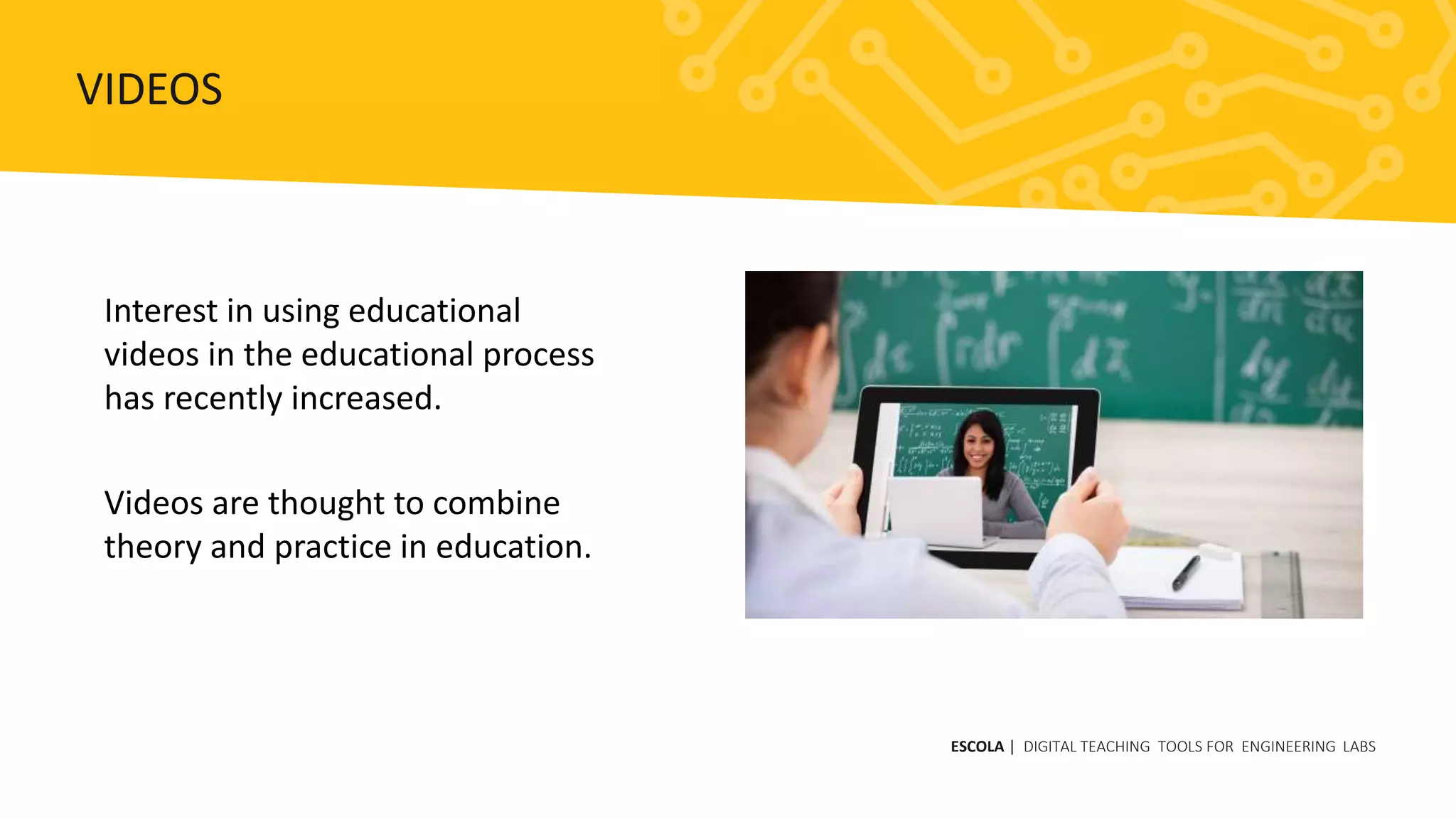
Interest in using educational
videos in the educational process
has recently increased.
Videos are thought to combine
theory and practice in education.
ESCOLA | DIGITAL TEACHING TOOLS FOR ENGINEERING LABS
VIDEOS
The videos:
• Support cognitive, emotional and informational skill of students
• Allow students to create meaningful activities
• Develop students' ability to engage, critical thinking and problem solving skills
• Increase motivation
ESCOLA | DIGITAL TEACHING TOOLS FOR ENGINEERING LABS
VIDEOS
Videos as learning tools:
• Contribute to the focus of the attention of the learners on the topic conveyed in the
teaching process,
• Support to keep scientific information,
• Help withdraw critical parts during the learning process.
ESCOLA | DIGITAL TEACHING TOOLS FOR ENGINEERING LABS
VIDEOS: BENEFITS
• Interactivity
• Realtime or simulated experience
• Trial-error
ESCOLA | DIGITAL TEACHING TOOLS FOR ENGINEERING LABS
VIDEOS: LIMITATIONS
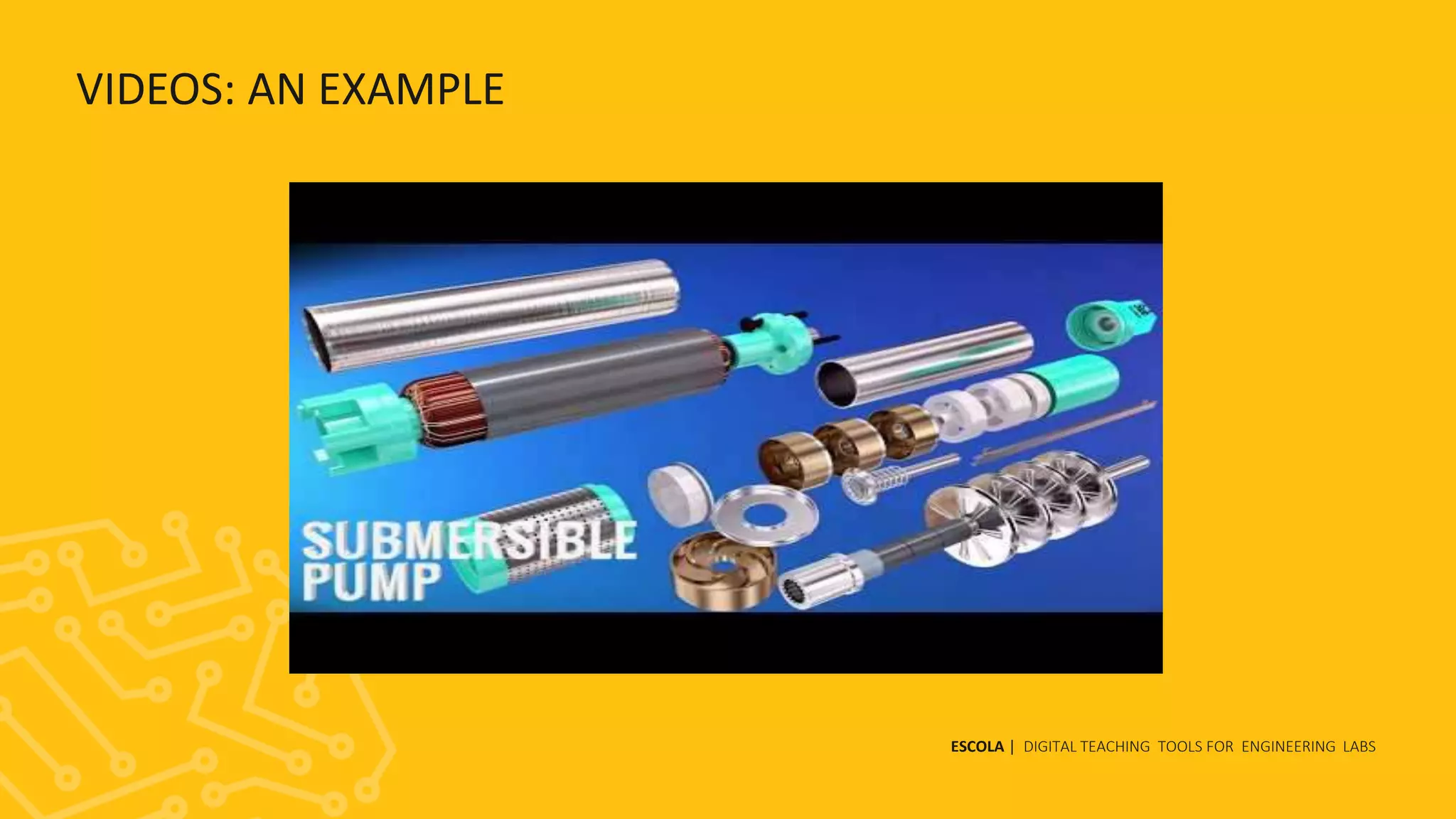
VIDEOS: AN EXAMPLE
ESCOLA | DIGITAL TEACHING TOOLS FOR ENGINEERING LABS
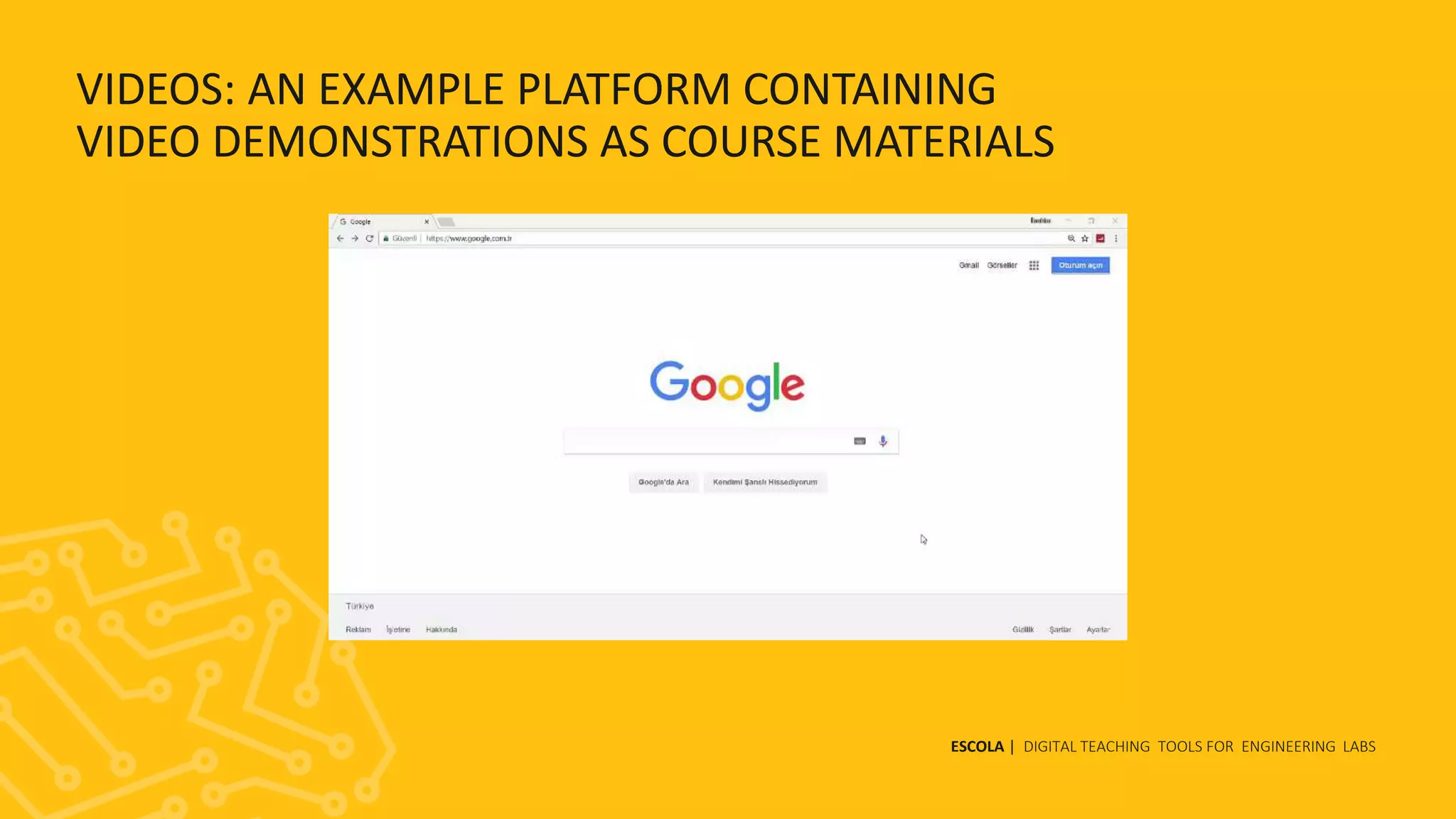
VIDEOS: AN EXAMPLE PLATFORM CONTAINING
VIDEO DEMONSTRATIONS AS COURSE MATERIALS
ESCOLA | DIGITAL TEACHING TOOLS FOR ENGINEERING LABS
4. Virtual Labs and Simulations
ESCOLA | DIGITAL TEACHING TOOLS FOR ENGINEERING LABS
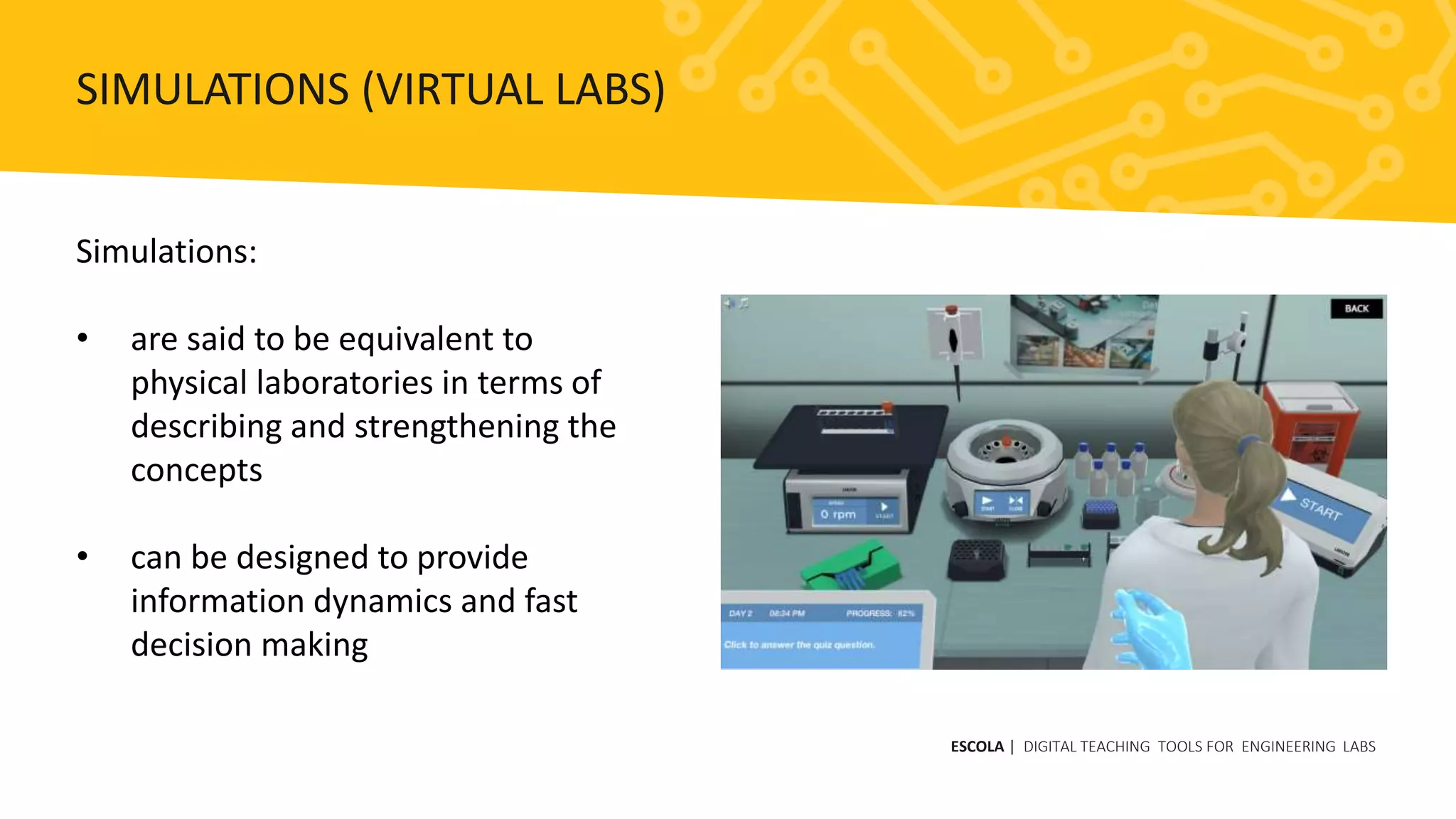
Simulations:
• are said to be equivalent to
physical laboratories in terms of
describing and strengthening the
concepts
• can be designed to provide
information dynamics and fast
decision making
ESCOLA | DIGITAL TEACHING TOOLS FOR ENGINEERING LABS
SIMULATIONS (VIRTUAL LABS)
Simulations, challenge students' perceptual
and decision-making abilities similar to
those encountered in real life, resulting in
higher levels of interaction.
ESCOLA | DIGITAL TEACHING TOOLS FOR ENGINEERING LABS
SIMULATIONS (VIRTUAL LABS)
The use of virtual laboratories in experiments:
• help to advance the stages of the experiment
• increase the contribution of the students to the experiment
Other benefits:
• no time limitation
• no physical boundaries
• less cost
ESCOLA | DIGITAL TEACHING TOOLS FOR ENGINEERING LABS
SIMULATIONS (VIRTUAL LABS)
• Lack of hands on application, troubleshooting etc,
• Poor understanding of physical systems,
• Lack of collaboration and knowledge sharing
• Complex simulations may require a fast processor and large memory (or bandwidth)
ESCOLA | DIGITAL TEACHING TOOLS FOR ENGINEERING LABS
SIMULATIONS (VIRTUAL LABS): LIMITATIONS
ESCOLA | DIGITAL TEACHING TOOLS FOR ENGINEERING LABS
SIMULATIONS (VIRTUAL LABS): AN EXAMPLE  VLAB
ESCOLA | DIGITAL TEACHING TOOLS FOR ENGINEERING LABS
SIMULATIONS (VIRTUAL LABS): AN EXAMPLE  LABSTER
5. Remote Labs
ESCOLA | DIGITAL TEACHING TOOLS FOR ENGINEERING LABS
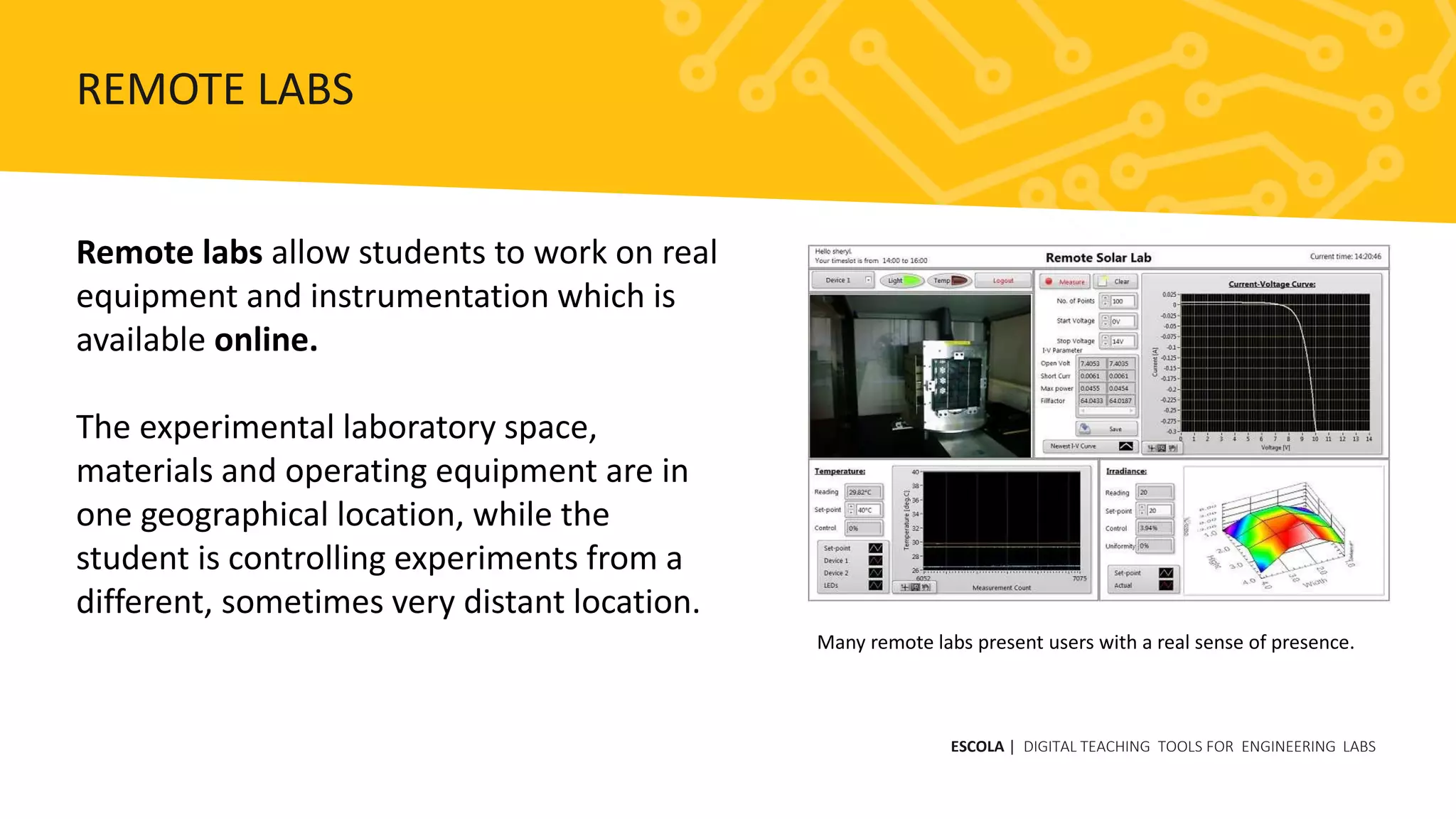
Remote labs allow students to work on real
equipment and instrumentation which is
available online.
The experimental laboratory space,
materials and operating equipment are in
one geographical location, while the
student is controlling experiments from a
different, sometimes very distant location.
Many remote labs present users with a real sense of presence.
ESCOLA | DIGITAL TEACHING TOOLS FOR ENGINEERING LABS
REMOTE LABS
• Ease of access to very expensive equipment with restricted usage
• Time effective, (book and use)
• Enhance knowledge sharing and collaboration
• Learn by trial and error
• Improved safety and security
The technology can be integrated into MOOCs.
ESCOLA | DIGITAL TEACHING TOOLS FOR ENGINEERING LABS
REMOTE LABS: BENEFITS
• Lack of hands on application, troubleshooting etc
• Lack of set-up experience
• Necessitates an interaction with an expert online
ESCOLA | DIGITAL TEACHING TOOLS FOR ENGINEERING LABS
REMOTE LABS: LIMITATIONS
ESCOLA | DIGITAL TEACHING TOOLS FOR ENGINEERING LABS
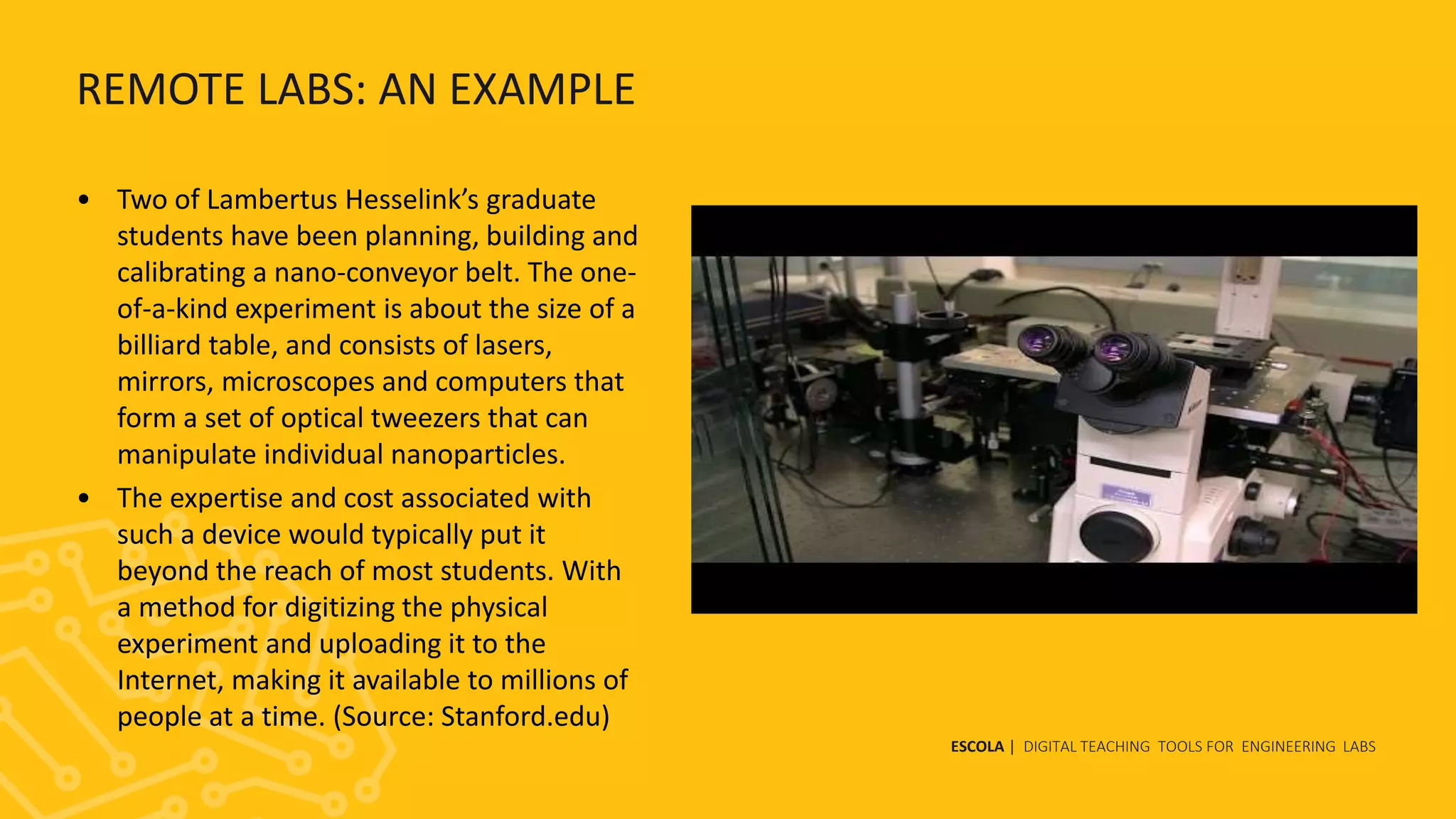
REMOTE LABS: AN EXAMPLE
• Two of Lambertus Hesselink’s graduate
students have been planning, building and
calibrating a nano-conveyor belt. The one-
of-a-kind experiment is about the size of a
billiard table, and consists of lasers,
mirrors, microscopes and computers that
form a set of optical tweezers that can
manipulate individual nanoparticles.
• The expertise and cost associated with
such a device would typically put it
beyond the reach of most students. With
a method for digitizing the physical
experiment and uploading it to the
Internet, making it available to millions of
people at a time. (Source: Stanford.edu)
6. Summary
ESCOLA | DIGITAL TEACHING TOOLS FOR ENGINEERING LABS
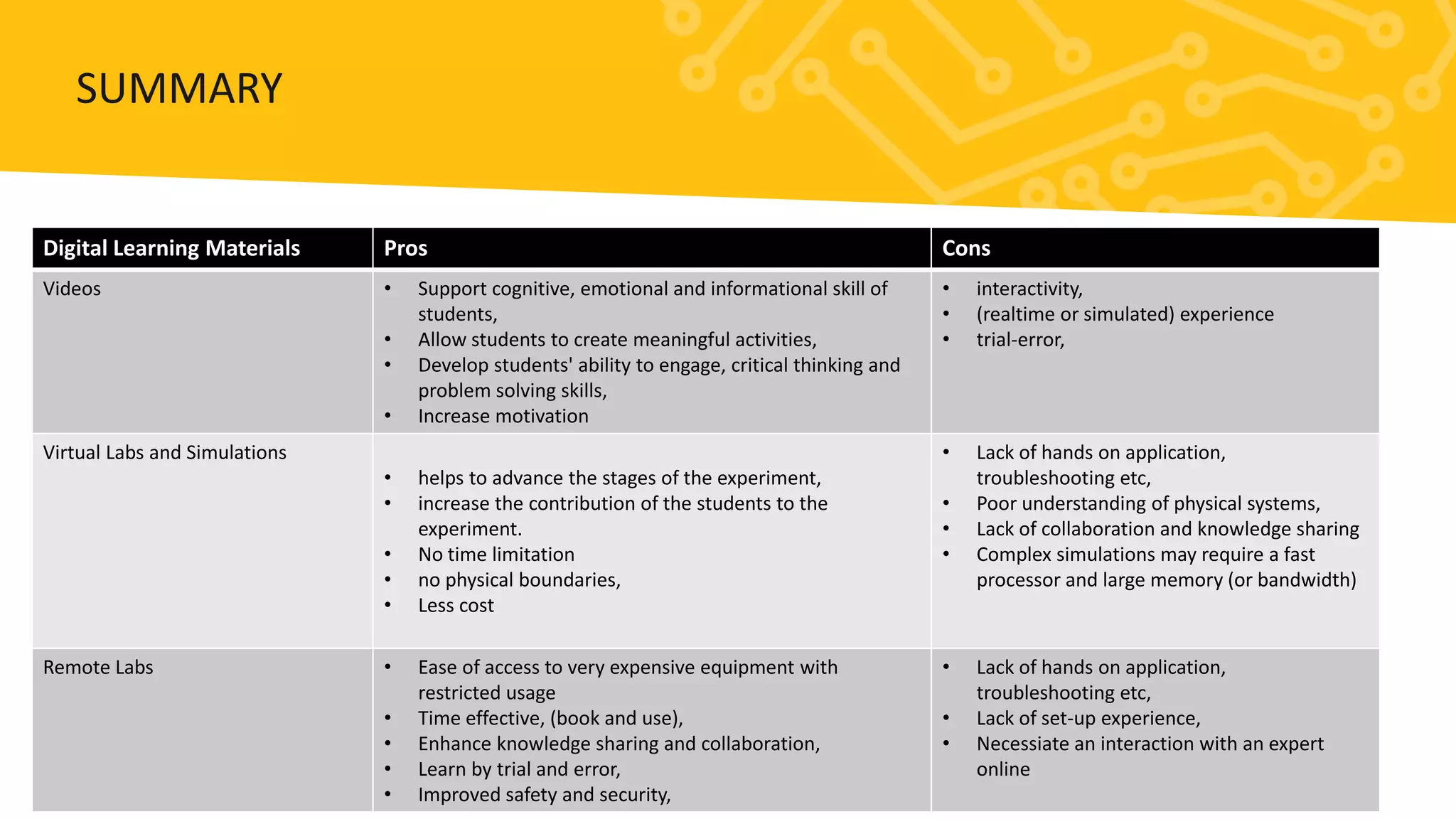
Digital Learning Materials Pros Cons
Videos • Support cognitive, emotional and informational skill of
students,
• Allow students to create meaningful activities,
• Develop students' ability to engage, critical thinking and
problem solving skills,
• Increase motivation
• interactivity,
• (realtime or simulated) experience
• trial-error,
Virtual Labs and Simulations
• helps to advance the stages of the experiment,
• increase the contribution of the students to the
experiment.
• No time limitation
• no physical boundaries,
• Less cost
• Lack of hands on application,
troubleshooting etc,
• Poor understanding of physical systems,
• Lack of collaboration and knowledge sharing
• Complex simulations may require a fast
processor and large memory (or bandwidth)
Remote Labs • Ease of access to very expensive equipment with
restricted usage
• Time effective, (book and use),
• Enhance knowledge sharing and collaboration,
• Learn by trial and error,
• Improved safety and security,
• Lack of hands on application,
troubleshooting etc,
• Lack of set-up experience,
• Necessiate an interaction with an expert
online
SUMMARY
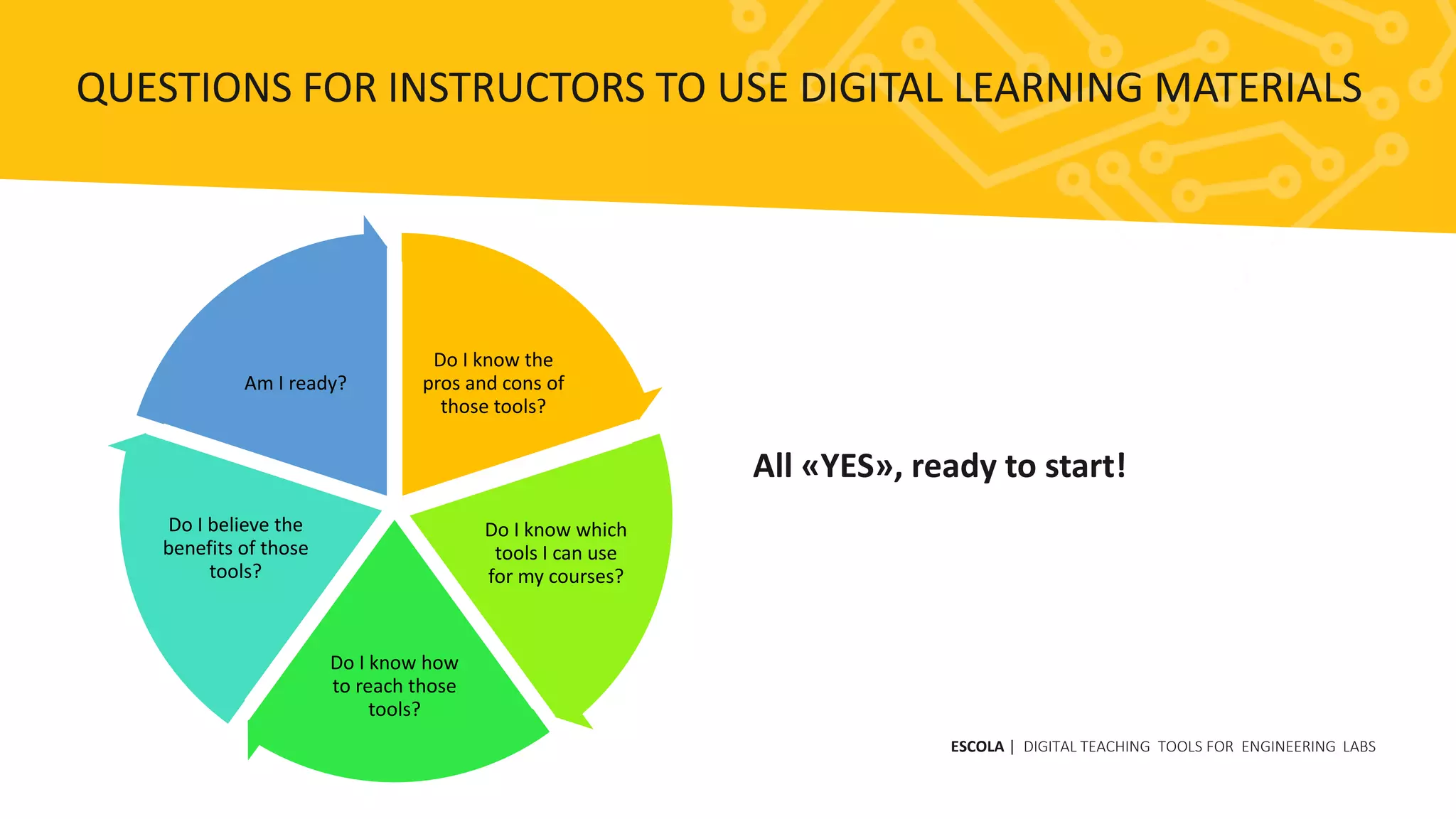
All «YES», ready to start!
Do I know the
pros and cons of
those tools?
Do I know which
tools I can use
for my courses?
Do I know how
to reach those
tools?
Do I believe the
benefits of those
tools?
Am I ready?
ESCOLA | DIGITAL TEACHING TOOLS FOR ENGINEERING LABS
QUESTIONS FOR INSTRUCTORS TO USE DIGITAL LEARNING MATERIALS
1. Spoedler, H. J. W. (1999). Virtual instruments and virtual environements. IEEE. Instrum. Meas. Mag, 2.
2. Jonassen, D. H. (1996). Computers in the classroom: Mindtools for critical thinking. NewJersey: Prentice Hall,
Englewood Cliffs.
3. Wulfsberg, G., Laroche, L. H., & Young, B. (2003). Discovery videos: A safe, tested, time-efficient way to
incorporate discovery-laboratory experiments into the classroom. Journal of Chemical Education, 80(8), 962.
4. Russell, J. W., Kozma, R. B., Jones, T., Wykoff, J., Marx, N., & Davis, J. (1997). Use of simultaneous-
synchronized macroscopic, microscopic, and symbolic representations to enhance the teaching and learning
of chemical concepts. Journal of Chemical Education, 74(3), 330-334.
5. Schwan, S., & Riempp, R. (2004). The cognitive benefits of interactive videos: learning to tie nautical knots.
Learning and instruction, 14(3), 293-305.
6. Akın Korhan, E., Tokem, Y., Uzelli Yılmaz, D., & Dilemek, H. (2016). Hemşirelikte Psikomotor Beceri Eğitiminde
Video Destekli Öğretim ve OSCE Uygulaması: Bir Deneyim Paylaşımı= Video-Based Teaching and OSCE
Implementation in Nursing Psychomotor Skills Education: Sharing of an Experience.
7. Byers, D. N. (1997, April). So why use multimedia, the Internet, and lotus notes? Paper presented at the
Technology in Education Conference, San Jose, CA. (ERIC Document Reproduction Service No. ED413023)
8. Abulrub, A.-H. G., Attridge, A. N., & Williams, M. A. (2011). Virtual reality in engineering education: The
future of creative learning. 2011 IEEE Global Engineering Education Conference (EDUCON), 751–757.
https://doi.org/10.1109/EDUCON.2011.5773223
REFERENCES
ESCOLA | DIGITAL TEACHING TOOLS FOR ENGINEERING LABS
9. Andrews, D. H., Edwards, B. J., Mattoon, J. S., & Thurman, R. A. (1996). Potential modeling and simulation
contributions to specialized undergraduate pilot training. Educational Technology, 36(4), 6-17.
10.ESCOLA IO3 report (unpublished)
11. Martin, F. G. (2012). Will massive open online courses change how we teach?. Communications of the ACM,
55(8), 26-28.
12.Duchastel, P., Fleury, M., & Provost, G. (1988). Rôles cognitifs de l’image dans l’apprentissage scolaire.
Bulletin de psychologie, 41(386), 667-671.
13. Striegel, A. (2001). Distance education and its impact on computer engineering laboratories. In Frontiers in
Education Conference, 2001. 31st Annual (Vol. 2, pp. F2D-4). IEEE.
14.GÜLER, Y. E. İ., ÖZBAY, Y., & ALTUNKAYA, S. MULTIMEDIAL INTERNET SUPPORT FOR BIOMEDICAL
LABORATORY EDUCATION.
15.Feisel, L. D., & Peterson, G. D. (2002, June). A colloquy on learning objectives for engineering education
laboratories. In Proceedings of the 2002 American Society for Engineering Education Annual Conference &
Exposition (pp. 16-19).
REFERENCES
ESCOLA | DIGITAL TEACHING TOOLS FOR ENGINEERING LABS
escolaproject.eu
Facebook.com/EUESCOLAPROJECT
eu.escola.project@gmail.com
Thank You

ESCOLA Module 4 Videos and 3D simulations for laboratory

  • 1.
    Module 4 -Videos and 3D simulations for laboratory This programme has been funded with support from the European Commission
  • 2.
    Objective: Integration of videoand 3d simulations as learning materials for engineering laboratory teaching. Expected learning outcomes: • Awareness on simulation and video techniques for engineering laboratory teaching • Understanding the benefits of video and simulation techniques for laboratory practical applications • Ability to select suitable simulation and video techniques for relevant laboratory course INTRODUCTION Using technological tools such as animation, simulation, video and multimedia as a part of the learning environment have several benefits such as: visuality, student satisfaction/motivation, technological interaction, readiness to laboratory study, remote access, time saving, low cost in terms of consumables and technical equipment, improved lab safety, and possibility of trial and error. ESCOLA | DIGITAL TEACHING TOOLS FOR ENGINEERING LABS
  • 3.
    01 This programme hasbeen funded with support from the European Commission. The author is solely responsible for this publication (communication) and the Commission accepts no responsibility for any use that may be made of the information contained therein. 02 03 04 05 06 Video and simulation technics for engineering teaching Videos Remote Labs Simulations (Virtual Labs) Summary Digital Teaching Tools for Engineering Laboratories ESCOLA | DIGITAL TEACHING TOOLS FOR ENGINEERING LABS
  • 4.
    1. Digital TeachingTools for Engineering Laboratories ESCOLA | DIGITAL TEACHING TOOLS FOR ENGINEERING LABS
  • 5.
    Students can learntheoretical knowledge, but need to work in the laboratory to gain experience and practice. ESCOLA | DIGITAL TEACHING TOOLS FOR ENGINEERING LABS WHY DIGITAL TEACHING TOOLS?
  • 6.
    Digital learning tools; •Enable the learners interact within a learning environment • Improve their learning quality Engineering teaching focus on solving real-life problems for preparing students to work-life by practising. Engineering learning activities: • Theoretical content • Problem solving and case studies • Field applications • Engineering laboratory practices ESCOLA | DIGITAL TEACHING TOOLS FOR ENGINEERING LABS WHY DIGITAL TEACHING TOOLS FOR LEARNING ENGINEERING?
  • 7.
    Learning environments maycontain tools such as; • animations • simulations • videos • multimedia and hypermedia They help us actively produce, research and experiment! Digitally supported laboratory courses do not aim to replace the real-time do & learn activities, but they support to save time and sources. ESCOLA | DIGITAL TEACHING TOOLS FOR ENGINEERING LABS DIGITALLY-SUPPORTED COURSES: WHICH TOOLS? WILL SIMULATIONS REPLACE REALTIME LEARNING ACTIVITIES?
  • 9.
    2. Video andsimulation technics for engineering teaching ESCOLA | DIGITAL TEACHING TOOLS FOR ENGINEERING LABS
  • 10.
    When there isnot enough time and source to conduct the experiment, the videos may be used as important teaching tools. Modeling and simulation are important in terms of the educational processes that can not be tested in real life. ESCOLA | DIGITAL TEACHING TOOLS FOR ENGINEERING LABS VIDEOS AND 3D SIMULATIONS FOR ENGINEERING LABORATORIES WHY?
  • 11.
    • Increased visuality •Student satisfaction/motivation • Technological interaction • Readiness (pre-laboratory study) • Remote access ESCOLA | DIGITAL TEACHING TOOLS FOR ENGINEERING LABS VIDEOS AND 3D SIMULATIONS FOR ENGINEERING LABORATORIES BENEFITS
  • 12.
    • Time saving •Low cost (in terms of consumables and technical equipment) • Improved lab safety • Possibility of trial and error ESCOLA | DIGITAL TEACHING TOOLS FOR ENGINEERING LABS VIDEOS AND 3D SIMULATIONS FOR ENGINEERING LABORATORIES BENEFITS
  • 13.
    • Lack ofinteractivity • Lack of real experience (if not supported by lab experience) • Need high quality hardware • High cost and labor (at preparation) • Teachers’ fear of technology • Lack of readiness for teachers and students ESCOLA | DIGITAL TEACHING TOOLS FOR ENGINEERING LABS VIDEOS AND 3D SIMULATIONS FOR ENGINEERING LABORATORIES LIMITATIONS
  • 14.
    Approach to designinglab-based engineering education: Hands-on labs Virtual labs Remote labs Traditional Online Mixed (Traditional + Online) ESCOLA | DIGITAL TEACHING TOOLS FOR ENGINEERING LABS VIDEOS AND 3D SIMULATIONS FOR ENGINEERING LABORATORIES
  • 16.
    3. Videos ESCOLA |DIGITAL TEACHING TOOLS FOR ENGINEERING LABS
  • 17.
    Interest in usingeducational videos in the educational process has recently increased. Videos are thought to combine theory and practice in education. ESCOLA | DIGITAL TEACHING TOOLS FOR ENGINEERING LABS VIDEOS
  • 18.
    The videos: • Supportcognitive, emotional and informational skill of students • Allow students to create meaningful activities • Develop students' ability to engage, critical thinking and problem solving skills • Increase motivation ESCOLA | DIGITAL TEACHING TOOLS FOR ENGINEERING LABS VIDEOS
  • 19.
    Videos as learningtools: • Contribute to the focus of the attention of the learners on the topic conveyed in the teaching process, • Support to keep scientific information, • Help withdraw critical parts during the learning process. ESCOLA | DIGITAL TEACHING TOOLS FOR ENGINEERING LABS VIDEOS: BENEFITS
  • 20.
    • Interactivity • Realtimeor simulated experience • Trial-error ESCOLA | DIGITAL TEACHING TOOLS FOR ENGINEERING LABS VIDEOS: LIMITATIONS
  • 21.
    VIDEOS: AN EXAMPLE ESCOLA| DIGITAL TEACHING TOOLS FOR ENGINEERING LABS
  • 22.
    VIDEOS: AN EXAMPLEPLATFORM CONTAINING VIDEO DEMONSTRATIONS AS COURSE MATERIALS ESCOLA | DIGITAL TEACHING TOOLS FOR ENGINEERING LABS
  • 24.
    4. Virtual Labsand Simulations ESCOLA | DIGITAL TEACHING TOOLS FOR ENGINEERING LABS
  • 25.
    Simulations: • are saidto be equivalent to physical laboratories in terms of describing and strengthening the concepts • can be designed to provide information dynamics and fast decision making ESCOLA | DIGITAL TEACHING TOOLS FOR ENGINEERING LABS SIMULATIONS (VIRTUAL LABS)
  • 26.
    Simulations, challenge students'perceptual and decision-making abilities similar to those encountered in real life, resulting in higher levels of interaction. ESCOLA | DIGITAL TEACHING TOOLS FOR ENGINEERING LABS SIMULATIONS (VIRTUAL LABS)
  • 27.
    The use ofvirtual laboratories in experiments: • help to advance the stages of the experiment • increase the contribution of the students to the experiment Other benefits: • no time limitation • no physical boundaries • less cost ESCOLA | DIGITAL TEACHING TOOLS FOR ENGINEERING LABS SIMULATIONS (VIRTUAL LABS)
  • 28.
    • Lack ofhands on application, troubleshooting etc, • Poor understanding of physical systems, • Lack of collaboration and knowledge sharing • Complex simulations may require a fast processor and large memory (or bandwidth) ESCOLA | DIGITAL TEACHING TOOLS FOR ENGINEERING LABS SIMULATIONS (VIRTUAL LABS): LIMITATIONS
  • 29.
    ESCOLA | DIGITALTEACHING TOOLS FOR ENGINEERING LABS SIMULATIONS (VIRTUAL LABS): AN EXAMPLE  VLAB
  • 30.
    ESCOLA | DIGITALTEACHING TOOLS FOR ENGINEERING LABS SIMULATIONS (VIRTUAL LABS): AN EXAMPLE  LABSTER
  • 31.
    5. Remote Labs ESCOLA| DIGITAL TEACHING TOOLS FOR ENGINEERING LABS
  • 32.
    Remote labs allowstudents to work on real equipment and instrumentation which is available online. The experimental laboratory space, materials and operating equipment are in one geographical location, while the student is controlling experiments from a different, sometimes very distant location. Many remote labs present users with a real sense of presence. ESCOLA | DIGITAL TEACHING TOOLS FOR ENGINEERING LABS REMOTE LABS
  • 33.
    • Ease ofaccess to very expensive equipment with restricted usage • Time effective, (book and use) • Enhance knowledge sharing and collaboration • Learn by trial and error • Improved safety and security The technology can be integrated into MOOCs. ESCOLA | DIGITAL TEACHING TOOLS FOR ENGINEERING LABS REMOTE LABS: BENEFITS
  • 34.
    • Lack ofhands on application, troubleshooting etc • Lack of set-up experience • Necessitates an interaction with an expert online ESCOLA | DIGITAL TEACHING TOOLS FOR ENGINEERING LABS REMOTE LABS: LIMITATIONS
  • 35.
    ESCOLA | DIGITALTEACHING TOOLS FOR ENGINEERING LABS REMOTE LABS: AN EXAMPLE • Two of Lambertus Hesselink’s graduate students have been planning, building and calibrating a nano-conveyor belt. The one- of-a-kind experiment is about the size of a billiard table, and consists of lasers, mirrors, microscopes and computers that form a set of optical tweezers that can manipulate individual nanoparticles. • The expertise and cost associated with such a device would typically put it beyond the reach of most students. With a method for digitizing the physical experiment and uploading it to the Internet, making it available to millions of people at a time. (Source: Stanford.edu)
  • 36.
    6. Summary ESCOLA |DIGITAL TEACHING TOOLS FOR ENGINEERING LABS
  • 37.
    Digital Learning MaterialsPros Cons Videos • Support cognitive, emotional and informational skill of students, • Allow students to create meaningful activities, • Develop students' ability to engage, critical thinking and problem solving skills, • Increase motivation • interactivity, • (realtime or simulated) experience • trial-error, Virtual Labs and Simulations • helps to advance the stages of the experiment, • increase the contribution of the students to the experiment. • No time limitation • no physical boundaries, • Less cost • Lack of hands on application, troubleshooting etc, • Poor understanding of physical systems, • Lack of collaboration and knowledge sharing • Complex simulations may require a fast processor and large memory (or bandwidth) Remote Labs • Ease of access to very expensive equipment with restricted usage • Time effective, (book and use), • Enhance knowledge sharing and collaboration, • Learn by trial and error, • Improved safety and security, • Lack of hands on application, troubleshooting etc, • Lack of set-up experience, • Necessiate an interaction with an expert online SUMMARY
  • 38.
    All «YES», readyto start! Do I know the pros and cons of those tools? Do I know which tools I can use for my courses? Do I know how to reach those tools? Do I believe the benefits of those tools? Am I ready? ESCOLA | DIGITAL TEACHING TOOLS FOR ENGINEERING LABS QUESTIONS FOR INSTRUCTORS TO USE DIGITAL LEARNING MATERIALS
  • 39.
    1. Spoedler, H.J. W. (1999). Virtual instruments and virtual environements. IEEE. Instrum. Meas. Mag, 2. 2. Jonassen, D. H. (1996). Computers in the classroom: Mindtools for critical thinking. NewJersey: Prentice Hall, Englewood Cliffs. 3. Wulfsberg, G., Laroche, L. H., & Young, B. (2003). Discovery videos: A safe, tested, time-efficient way to incorporate discovery-laboratory experiments into the classroom. Journal of Chemical Education, 80(8), 962. 4. Russell, J. W., Kozma, R. B., Jones, T., Wykoff, J., Marx, N., & Davis, J. (1997). Use of simultaneous- synchronized macroscopic, microscopic, and symbolic representations to enhance the teaching and learning of chemical concepts. Journal of Chemical Education, 74(3), 330-334. 5. Schwan, S., & Riempp, R. (2004). The cognitive benefits of interactive videos: learning to tie nautical knots. Learning and instruction, 14(3), 293-305. 6. Akın Korhan, E., Tokem, Y., Uzelli Yılmaz, D., & Dilemek, H. (2016). Hemşirelikte Psikomotor Beceri Eğitiminde Video Destekli Öğretim ve OSCE Uygulaması: Bir Deneyim Paylaşımı= Video-Based Teaching and OSCE Implementation in Nursing Psychomotor Skills Education: Sharing of an Experience. 7. Byers, D. N. (1997, April). So why use multimedia, the Internet, and lotus notes? Paper presented at the Technology in Education Conference, San Jose, CA. (ERIC Document Reproduction Service No. ED413023) 8. Abulrub, A.-H. G., Attridge, A. N., & Williams, M. A. (2011). Virtual reality in engineering education: The future of creative learning. 2011 IEEE Global Engineering Education Conference (EDUCON), 751–757. https://doi.org/10.1109/EDUCON.2011.5773223 REFERENCES ESCOLA | DIGITAL TEACHING TOOLS FOR ENGINEERING LABS
  • 40.
    9. Andrews, D.H., Edwards, B. J., Mattoon, J. S., & Thurman, R. A. (1996). Potential modeling and simulation contributions to specialized undergraduate pilot training. Educational Technology, 36(4), 6-17. 10.ESCOLA IO3 report (unpublished) 11. Martin, F. G. (2012). Will massive open online courses change how we teach?. Communications of the ACM, 55(8), 26-28. 12.Duchastel, P., Fleury, M., & Provost, G. (1988). Rôles cognitifs de l’image dans l’apprentissage scolaire. Bulletin de psychologie, 41(386), 667-671. 13. Striegel, A. (2001). Distance education and its impact on computer engineering laboratories. In Frontiers in Education Conference, 2001. 31st Annual (Vol. 2, pp. F2D-4). IEEE. 14.GÜLER, Y. E. İ., ÖZBAY, Y., & ALTUNKAYA, S. MULTIMEDIAL INTERNET SUPPORT FOR BIOMEDICAL LABORATORY EDUCATION. 15.Feisel, L. D., & Peterson, G. D. (2002, June). A colloquy on learning objectives for engineering education laboratories. In Proceedings of the 2002 American Society for Engineering Education Annual Conference & Exposition (pp. 16-19). REFERENCES ESCOLA | DIGITAL TEACHING TOOLS FOR ENGINEERING LABS
  • 41.