BY :
YASHIKA VARSHNEY
SHRADDHA MANGAL
WAFA SAMREEN
A report submitted in partial fulfillment of
the requirements for the certification of
DIPLOMA IN ENGINEERING(III Semester)
WHAT IS A VIRTUAL CLASSROOM (VCR)?
FEATURES OF THE VCR
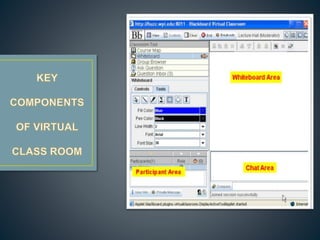
KEY COMPONENTS OF VCR
TYPICAL CLASS ACTIVITIES IN VCR
WHY VCR?
CONTRIBUTION OF VCR TO THE E-LEARNING
PROGRAMME
WHAT ELSE YOU CAN DO WITH VCR?
DIGITAL CLASSROOM AND GOALS OF THE VCR
PROJECT
CONCLUSION
Just as the term VIRTUAL
means a simulation of the
real thing,
Virtual Classroom is a
simulated classroom via
Internet, which provides a
convenient
communication
environment for distance
learners just like
traditional face-to-face
It is an advanced learning environment,
created using internet, computers,
supplicated video conferencing
devices, in which either teacher is not
physically present (for remote learning)
or students are not present (distance
education) in the classroom.
• Live Video Streaming Presentations with Powerful
functionality that delivers easy viewing of slides and other
documents.
• Application, file, and desktop sharing enable us to view
live demonstrations.
• Instructor can view each student’s session when we
perform our hands-on labs, the instructor can access our
remote system to demonstrate and assist .
• Public and private text chat allows for increased
interactivity between participants and can be easily saved
as a text file.
A virtual classroom needs to have:
• Students
• Shared learning environment
• Functioning components of the virtual classroom :
• Whiteboard/or comparable site
• Chat
• Polling
VCR
CLASS
ACTIVITIES
Polling
Discussi
on
Team
work
Questio
n time
White
board
Breakou
t
session
Resour
ce
sharing
• Polling: Asking learners to present their views and ideas to
reflect on the topic and then revealing the topic OR Displays
a picture or plays the video that illustrates a concept you
are teaching and asking on what they observe in the image.
• Discussion: Students with or without their teacher are
holding on an interactive discussion on a specified topic
related learning contents.
• Team Work :A group of students are working together on a
term project.
• Question Time: Students can ask their teacher or tutor
• Whiteboard: whiteboard can be used to explain some topic,
or to solve any particular doubt asked by the participant.
• Breakout Sessions: participants can be divided into groups
to discuss a specific topic or to work on a group
assignment.
• Resource sharing: The useful resources shared by the
presenter can be downloaded. resources can be the files
(course material, e-book) or it may be web links.
• Cost Effective : Enables the learner to attend class
anywhere from the world without wasting travelling cost and
time .
• Interaction: interaction is faster and efficient through live
virtual discussion boards where we can read and respond
to questions, thoughts freely.
• Global Reach: Learners anywhere from the world can
attend a single live training session if they have a computer
and internet connection.
• Sessions Can Be Recorded: Learners those who joined
VCR late or those who were unable to attend the class can
• Ensures Comprehension: Ensure students understand their
lessons by asking for immediate feedback ,answering
questions, and giving in-depth verbal explanations of
complex material.
• Public & Private Text Chat: Chat messaging allows the shy
student to communicate textually so they can participate
with their more talkative classmates.
• Access To Disabled Students: Close captioning live and
archived classes for hearing impaired students , offering
numerous shortcut keys, hot keys for visually impaired
students. These accessibility features will ensure this
technology is inclusive to all.
• Access to high quality and flexible learning technologies.
• Provide interactive and flexible approaches to e-learning
including work based learning and assessment.
• Delivering more personalised learning experiences better
suited to individuals’ learning styles.
• Implementation of technologies that will be supporting
collaboration and presentation of achievements.
•Virtual classroom is very multipurpose technology or
platform which can be used for Webinars, Tuition, One-
to-one training and tuition, mentoring, Interviews, Team
meetings, Project meetings, Sales demonstrations,
Client meetings, Technical support, Customer service,
On-line user communities.
• Its provides a set of tools and utility to enhance
on-line learning.
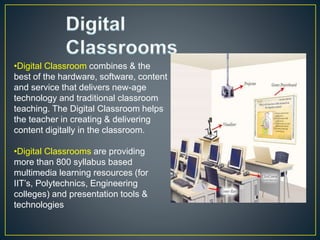
•Digital Classroom combines & the
best of the hardware, software, content
and service that delivers new-age
technology and traditional classroom
teaching. The Digital Classroom helps
the teacher in creating & delivering
content digitally in the classroom.
•Digital Classrooms are providing
more than 800 syllabus based
multimedia learning resources (for
IIT’s, Polytechnics, Engineering
colleges) and presentation tools &
technologies
•To improve the uptake in the use of the Virtual Classroom (VCR) by
developing a number of staff to actively improve the use by, and support
of, learners in the actual or virtual classrooms across all areas of the
college.
• Incorporate a number of other available technologies - Live
Classroom, On-demand Video.
•To provide an integrated and consistent approach to video generation
and developments; to generate a pool of shared video resources.
• Develop a curriculum delivery model to provide supported learning in
the virtual classrooms in three skill/topic:- areas Beauty & Holistic
Therapy, Computing & IT and Training & Professional Development.
The design of a virtual classroom system serves as a learning
platform with events based synchronous and asynchronous
modes. The system consists of several modules which help us
to meet up with its designed objectives. It offers the use of
real-time interaction as a learner would experience in a
classroom by using a variety of learning styles. It also create a
sense of community among students and instructors who
might not otherwise interact with one another.
VIRTUAL CLASSROOM
VIRTUAL CLASSROOM

VIRTUAL CLASSROOM

  • 1.
    BY : YASHIKA VARSHNEY SHRADDHAMANGAL WAFA SAMREEN A report submitted in partial fulfillment of the requirements for the certification of DIPLOMA IN ENGINEERING(III Semester)
  • 2.
    WHAT IS AVIRTUAL CLASSROOM (VCR)? FEATURES OF THE VCR KEY COMPONENTS OF VCR TYPICAL CLASS ACTIVITIES IN VCR WHY VCR? CONTRIBUTION OF VCR TO THE E-LEARNING PROGRAMME WHAT ELSE YOU CAN DO WITH VCR? DIGITAL CLASSROOM AND GOALS OF THE VCR PROJECT CONCLUSION
  • 3.
    Just as theterm VIRTUAL means a simulation of the real thing, Virtual Classroom is a simulated classroom via Internet, which provides a convenient communication environment for distance learners just like traditional face-to-face
  • 4.
    It is anadvanced learning environment, created using internet, computers, supplicated video conferencing devices, in which either teacher is not physically present (for remote learning) or students are not present (distance education) in the classroom.
  • 6.
    • Live VideoStreaming Presentations with Powerful functionality that delivers easy viewing of slides and other documents. • Application, file, and desktop sharing enable us to view live demonstrations. • Instructor can view each student’s session when we perform our hands-on labs, the instructor can access our remote system to demonstrate and assist . • Public and private text chat allows for increased interactivity between participants and can be easily saved as a text file.
  • 7.
    A virtual classroomneeds to have: • Students • Shared learning environment • Functioning components of the virtual classroom : • Whiteboard/or comparable site • Chat • Polling
  • 9.
  • 10.
    • Polling: Askinglearners to present their views and ideas to reflect on the topic and then revealing the topic OR Displays a picture or plays the video that illustrates a concept you are teaching and asking on what they observe in the image. • Discussion: Students with or without their teacher are holding on an interactive discussion on a specified topic related learning contents. • Team Work :A group of students are working together on a term project. • Question Time: Students can ask their teacher or tutor
  • 11.
    • Whiteboard: whiteboardcan be used to explain some topic, or to solve any particular doubt asked by the participant. • Breakout Sessions: participants can be divided into groups to discuss a specific topic or to work on a group assignment. • Resource sharing: The useful resources shared by the presenter can be downloaded. resources can be the files (course material, e-book) or it may be web links.
  • 12.
    • Cost Effective: Enables the learner to attend class anywhere from the world without wasting travelling cost and time . • Interaction: interaction is faster and efficient through live virtual discussion boards where we can read and respond to questions, thoughts freely. • Global Reach: Learners anywhere from the world can attend a single live training session if they have a computer and internet connection. • Sessions Can Be Recorded: Learners those who joined VCR late or those who were unable to attend the class can
  • 13.
    • Ensures Comprehension:Ensure students understand their lessons by asking for immediate feedback ,answering questions, and giving in-depth verbal explanations of complex material. • Public & Private Text Chat: Chat messaging allows the shy student to communicate textually so they can participate with their more talkative classmates. • Access To Disabled Students: Close captioning live and archived classes for hearing impaired students , offering numerous shortcut keys, hot keys for visually impaired students. These accessibility features will ensure this technology is inclusive to all.
  • 14.
    • Access tohigh quality and flexible learning technologies. • Provide interactive and flexible approaches to e-learning including work based learning and assessment. • Delivering more personalised learning experiences better suited to individuals’ learning styles. • Implementation of technologies that will be supporting collaboration and presentation of achievements.
  • 15.
    •Virtual classroom isvery multipurpose technology or platform which can be used for Webinars, Tuition, One- to-one training and tuition, mentoring, Interviews, Team meetings, Project meetings, Sales demonstrations, Client meetings, Technical support, Customer service, On-line user communities. • Its provides a set of tools and utility to enhance on-line learning.
  • 16.
    •Digital Classroom combines& the best of the hardware, software, content and service that delivers new-age technology and traditional classroom teaching. The Digital Classroom helps the teacher in creating & delivering content digitally in the classroom. •Digital Classrooms are providing more than 800 syllabus based multimedia learning resources (for IIT’s, Polytechnics, Engineering colleges) and presentation tools & technologies
  • 17.
    •To improve theuptake in the use of the Virtual Classroom (VCR) by developing a number of staff to actively improve the use by, and support of, learners in the actual or virtual classrooms across all areas of the college. • Incorporate a number of other available technologies - Live Classroom, On-demand Video. •To provide an integrated and consistent approach to video generation and developments; to generate a pool of shared video resources. • Develop a curriculum delivery model to provide supported learning in the virtual classrooms in three skill/topic:- areas Beauty & Holistic Therapy, Computing & IT and Training & Professional Development.
  • 18.
    The design ofa virtual classroom system serves as a learning platform with events based synchronous and asynchronous modes. The system consists of several modules which help us to meet up with its designed objectives. It offers the use of real-time interaction as a learner would experience in a classroom by using a variety of learning styles. It also create a sense of community among students and instructors who might not otherwise interact with one another.