9/10/2014 
1 
What’s up? Whatsapp? 
Technology in Medical Education 
Daniëlle Verstegen, Anne Marie Cunningham, 
Mary Dankbaar and Peter de Jong 
Overview of the workshop 
13.30 hrs Introduction & connect in Guidebook! 
13.40 hrs Trends in Technology Enhanced Learning 
14.00 hrs Scenarios of the future 
14.15 hrs Group discussion of scenarios 
15.00 hrs Break 
15.15 hrs Plenary presentation of ideas 
16.00 hrs Discussion and conclusions
9/10/2014 
2 
Presenters 
Daniëlle Verstegen 
Maastricht University 
Anne Marie Cunningham 
Cardiff University 
Mary Dankbaar 
Erasmus Medical Center Rotterdam 
Peter de Jong 
Leiden University Medical Center 
Overview of the workshop 
13.30 hrs Introduction & connect in Guidebook! 
13.40 hrs Trends in Technology Enhanced Learning 
14.00 hrs Scenarios of the future 
14.15 hrs Group discussion of scenarios 
15.00 hrs Break 
15.15 hrs Plenary presentation of ideas 
16.00 hrs Discussion and conclusions
9/10/2014 
3 
“Online learning is the single 
biggest change in education since 
the printing press… ” 
John Chubb and Terry Moe 
May 2012 
Trends in Technology enhanced learning 
• MOOCs and OER’s 
Massive Open Online Courses & Open Educational Resources 
• Social media 
• Simulations and serious games 
• Flipping the Classroom 
Mary Dankbaar and Peter de Jong
9/10/2014 
4 
Trends in Technology enhanced learning 
• MOOCs and OERs 
Massive Open Online Courses & Open Educational Resources 
• Social media 
• Simulations and serious games 
• Flipping the Classroom 
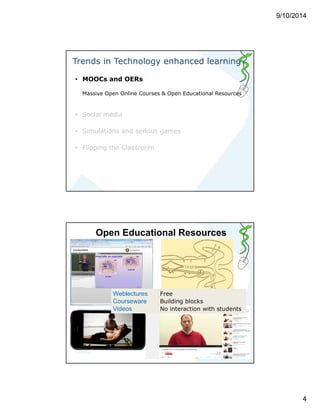
Open Educational Resources 
Weblectures Free 
Courseware Building blocks 
Videos No interaction with students
9/10/2014 
5 
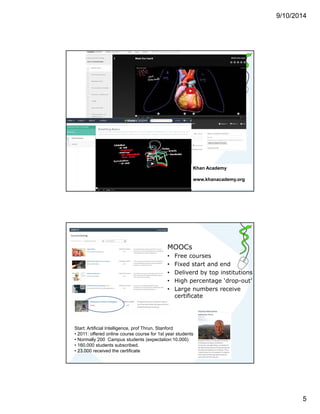
Khan Academy 
www.khanacademy.org 
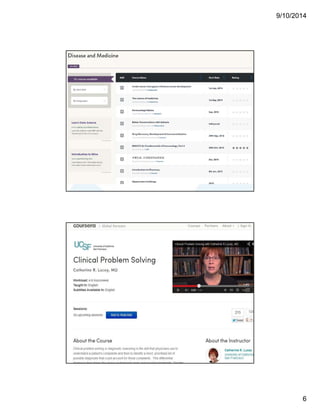
MOOCs 
• Free courses 
• Fixed start and end 
• Deliverd by top institutions 
• High percentage ‘drop-out’ 
• Large numbers receive 
certificate 
Start: Artificial Intelligence, prof Thrun, Stanford 
• 2011: offered online course course for 1st year students 
• Normally 200 Campus students (expectation:10.000) 
• 160.000 students subscribed. 
• 23.000 received the certificate
9/10/2014 
6
9/10/2014 
7 
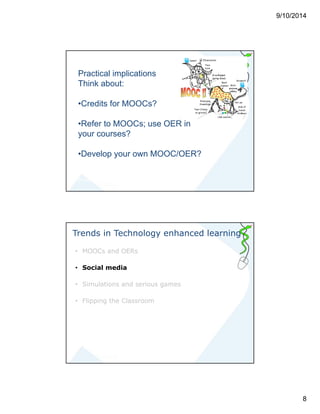
MOOC Platforms 
T.Kos, Cap Gemini, 2013
9/10/2014 
8 
Practical implications 
Think about: 
•Credits for MOOCs? 
•Refer to MOOCs; use OER in 
your courses? 
•Develop your own MOOC/OER? 
m.dankbaar@erasmusmc.nl 
Trends in Technology enhanced learning 
• MOOCs and OERs 
• Social media 
• Simulations and serious games 
• Flipping the Classroom
9/10/2014 
9 
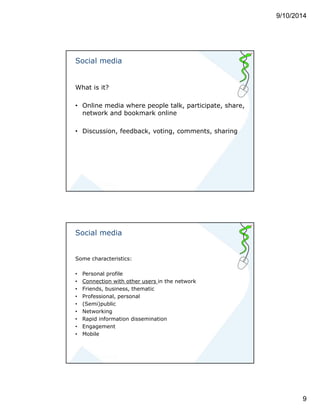
Social media 
What is it? 
• Online media where people talk, participate, share, 
network and bookmark online 
• Discussion, feedback, voting, comments, sharing 
Social media 
Some characteristics: 
• Personal profile 
• Connection with other users in the network 
• Friends, business, thematic 
• Professional, personal 
• (Semi)public 
• Networking 
• Rapid information dissemination 
• Engagement 
• Mobile
9/10/2014 
10 
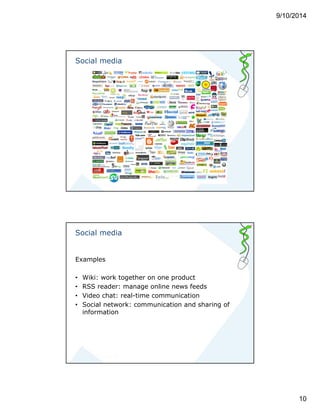
Social media 
Social media 
Examples 
• Wiki: work together on one product 
• RSS reader: manage online news feeds 
• Video chat: real-time communication 
• Social network: communication and sharing of 
information
9/10/2014 
11 
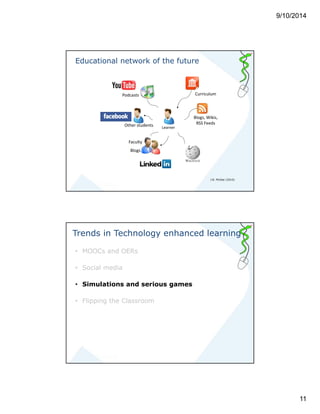
Educational network of the future 
Podcasts 
Other students 
Faculty 
Blogs 
Blogs, Wikis, 
RSS Feeds 
Learner 
Curriculum 
J.B. McGee (2010) 
Trends in Technology enhanced learning 
• MOOCs and OERs 
• Social media 
• Simulations and serious games 
• Flipping the Classroom
9/10/2014 
12 
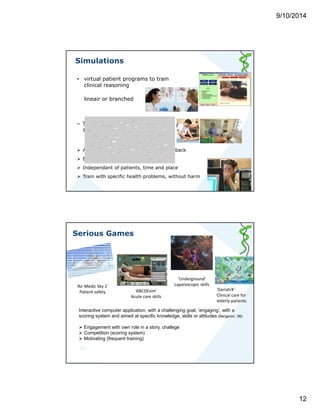
Simulations 
• virtual patient programs to train 
clinical reasoning 
lineair or branched 
– Simple or complex ‘high fidelity’ 
simulations 
 Active role of learner, control over feedback 
 Engagement with clinical role 
 Independant of patients, time and place 
 Train with specific health problems, without harm 
Serious Games 
‘Air Medic Sky 1’ 
Patient safety 
‘Underground’ 
Laparoscopic skills 
‘ABCDEsim’ 
Acute care skills 
Interactive computer application, with a challenging goal, ‘engaging’, with a 
scoring system and aimed at specific knowledge, skills or attitudes (Bergeron, ‘06) 
 Engagement with own role in a story, challege 
 Competition (scoring system) 
 Motivating (frequent training) 
‘GeriatrX’ 
Clinical care for 
elderly patients
9/10/2014 
13 
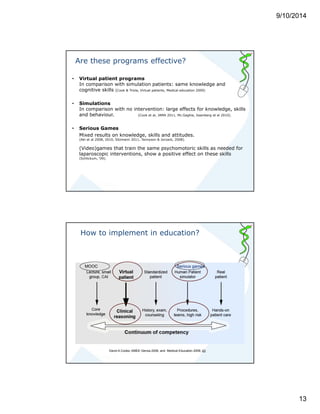
Are these programs effective? 
• Virtual patient programs 
In comparison with simulation patients: same knowledge and 
cognitive skills (Cook & Triola, Virtual patients, Medical education 2009) 
• Simulations 
In comparison with no intervention: large effects for knowledge, skills 
and behaviour. (Cook et al, JAMA 2011, Mc.Gaghie, Issenberg et al 2010). 
• Serious Games 
Mixed results on knowledge, skills and attitudes. 
(Akl et al 2008, 2010, Sitzmann 2011, Tennyson & Jorzack, 2008). 
(Video)games that train the same psychomotoric skills as needed for 
laparoscopic interventions, show a positive effect on these skills 
(Schlickum, ‘09). 
How to implement in education? 
MOOC Serious games 
David A Cooke, AMEE Genoa 2006, and Medical Education 2009, 43
9/10/2014 
14 
Trends in Technology enhanced learning 
• MOOCs and OERs 
• Social media 
• Simulations and serious games 
• Flipping the Classroom 
Flipping the classroom 
• “New” educational model 
• Triggered by technological possibilities 
• Do at home what you can do by yourself 
• Use face-to-face time with the teacher for deeper 
learning processes
9/10/2014 
15 
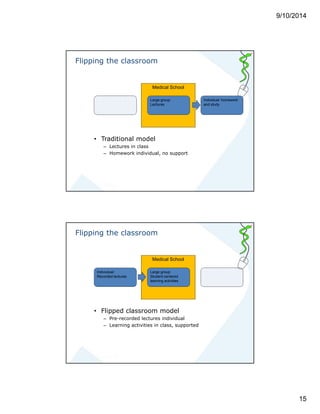
Flipping the classroom 
Medical School 
Large group: 
Lectures 
• Traditional model 
– Lectures in class 
– Homework individual, no support 
Individual: homework 
and study 
Flipping the classroom 
Medical School 
Large group: 
Student centered 
learning activities 
Indivudual: 
Recorded lectures 
• Flipped classroom model 
– Pre-recorded lectures individual 
– Learning activities in class, supported
9/10/2014 
16 
Flipping the classroom 
• Free up time by putting recorded lectures online 
• Bring in student centered learning activities 
– Problem based learning 
– Audience response systems 
– Pair and share (peer discussions) 
– Quizzes 
• Appropriate assessment 
• Student responsibility 
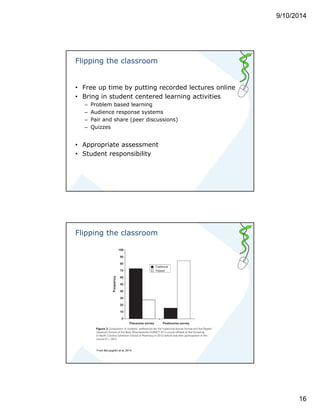
Flipping the classroom 
From McLaughlin et al. 2014
9/10/2014 
17 
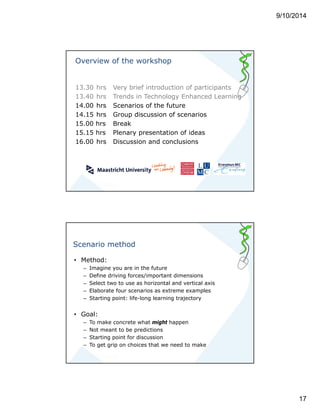
Overview of the workshop 
13.30 hrs Very brief introduction of participants 
13.40 hrs Trends in Technology Enhanced Learning 
14.00 hrs Scenarios of the future 
14.15 hrs Group discussion of scenarios 
15.00 hrs Break 
15.15 hrs Plenary presentation of ideas 
16.00 hrs Discussion and conclusions 
Scenario method 
• Method: 
– Imagine you are in the future 
– Define driving forces/important dimensions 
– Select two to use as horizontal and vertical axis 
– Elaborate four scenarios as extreme examples 
– Starting point: life-long learning trajectory 
• Goal: 
– To make concrete what might happen 
– Not meant to be predictions 
– Starting point for discussion 
– To get grip on choices that we need to make
9/10/2014 
18 
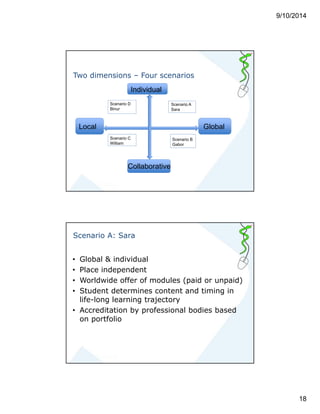
Two dimensions – Four scenarios 
Individual 
Scenario D 
Binur 
Local Global 
Collaborative 
Scenario A 
Sara 
Scenario B 
Gabor 
Scenario C 
William 
Scenario A: Sara 
• Global & individual 
• Place independent 
• Worldwide offer of modules (paid or unpaid) 
• Student determines content and timing in 
life-long learning trajectory 
• Accreditation by professional bodies based 
on portfolio
9/10/2014 
19 
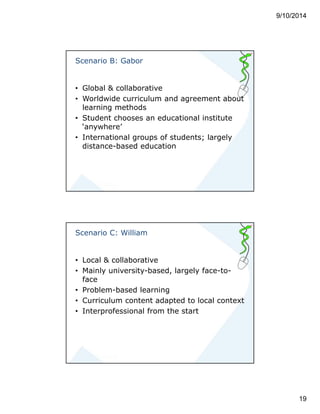
Scenario B: Gabor 
• Global & collaborative 
• Worldwide curriculum and agreement about 
learning methods 
• Student chooses an educational institute 
‘anywhere’ 
• International groups of students; largely 
distance-based education 
Scenario C: William 
• Local & collaborative 
• Mainly university-based, largely face-to-face 
• Problem-based learning 
• Curriculum content adapted to local context 
• Interprofessional from the start
9/10/2014 
20 
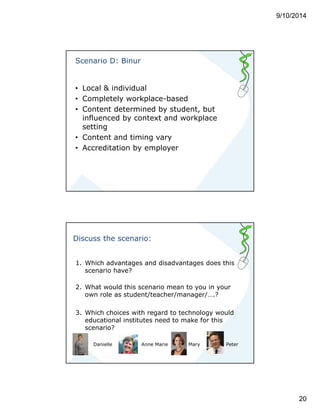
Scenario D: Binur 
• Local & individual 
• Completely workplace-based 
• Content determined by student, but 
influenced by context and workplace 
setting 
• Content and timing vary 
• Accreditation by employer 
Discuss the scenario: 
1. Which advantages and disadvantages does this 
scenario have? 
2. What would this scenario mean to you in your 
own role as student/teacher/manager/….? 
3. Which choices with regard to technology would 
educational institutes need to make for this 
scenario? 
4. Danielle Anne Marie Mary Peter
9/10/2014 
21 
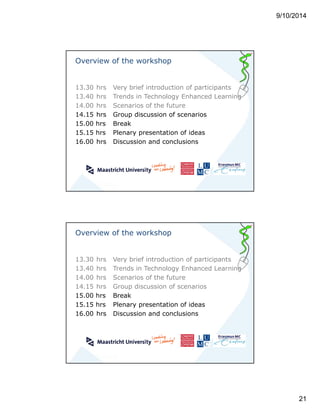
Overview of the workshop 
13.30 hrs Very brief introduction of participants 
13.40 hrs Trends in Technology Enhanced Learning 
14.00 hrs Scenarios of the future 
14.15 hrs Group discussion of scenarios 
15.00 hrs Break 
15.15 hrs Plenary presentation of ideas 
16.00 hrs Discussion and conclusions 
Overview of the workshop 
13.30 hrs Very brief introduction of participants 
13.40 hrs Trends in Technology Enhanced Learning 
14.00 hrs Scenarios of the future 
14.15 hrs Group discussion of scenarios 
15.00 hrs Break 
15.15 hrs Plenary presentation of ideas 
16.00 hrs Discussion and conclusions

Pre preconf whtas upapp amee 2014 final 2p

  • 1.
    9/10/2014 1 What’sup? Whatsapp? Technology in Medical Education Daniëlle Verstegen, Anne Marie Cunningham, Mary Dankbaar and Peter de Jong Overview of the workshop 13.30 hrs Introduction & connect in Guidebook! 13.40 hrs Trends in Technology Enhanced Learning 14.00 hrs Scenarios of the future 14.15 hrs Group discussion of scenarios 15.00 hrs Break 15.15 hrs Plenary presentation of ideas 16.00 hrs Discussion and conclusions
  • 2.
    9/10/2014 2 Presenters Daniëlle Verstegen Maastricht University Anne Marie Cunningham Cardiff University Mary Dankbaar Erasmus Medical Center Rotterdam Peter de Jong Leiden University Medical Center Overview of the workshop 13.30 hrs Introduction & connect in Guidebook! 13.40 hrs Trends in Technology Enhanced Learning 14.00 hrs Scenarios of the future 14.15 hrs Group discussion of scenarios 15.00 hrs Break 15.15 hrs Plenary presentation of ideas 16.00 hrs Discussion and conclusions
  • 3.
    9/10/2014 3 “Onlinelearning is the single biggest change in education since the printing press… ” John Chubb and Terry Moe May 2012 Trends in Technology enhanced learning • MOOCs and OER’s Massive Open Online Courses & Open Educational Resources • Social media • Simulations and serious games • Flipping the Classroom Mary Dankbaar and Peter de Jong
  • 4.
    9/10/2014 4 Trendsin Technology enhanced learning • MOOCs and OERs Massive Open Online Courses & Open Educational Resources • Social media • Simulations and serious games • Flipping the Classroom Open Educational Resources Weblectures Free Courseware Building blocks Videos No interaction with students
  • 5.
    9/10/2014 5 KhanAcademy www.khanacademy.org MOOCs • Free courses • Fixed start and end • Deliverd by top institutions • High percentage ‘drop-out’ • Large numbers receive certificate Start: Artificial Intelligence, prof Thrun, Stanford • 2011: offered online course course for 1st year students • Normally 200 Campus students (expectation:10.000) • 160.000 students subscribed. • 23.000 received the certificate
  • 6.
  • 7.
    9/10/2014 7 MOOCPlatforms T.Kos, Cap Gemini, 2013
  • 8.
    9/10/2014 8 Practicalimplications Think about: •Credits for MOOCs? •Refer to MOOCs; use OER in your courses? •Develop your own MOOC/OER? m.dankbaar@erasmusmc.nl Trends in Technology enhanced learning • MOOCs and OERs • Social media • Simulations and serious games • Flipping the Classroom
  • 9.
    9/10/2014 9 Socialmedia What is it? • Online media where people talk, participate, share, network and bookmark online • Discussion, feedback, voting, comments, sharing Social media Some characteristics: • Personal profile • Connection with other users in the network • Friends, business, thematic • Professional, personal • (Semi)public • Networking • Rapid information dissemination • Engagement • Mobile
  • 10.
    9/10/2014 10 Socialmedia Social media Examples • Wiki: work together on one product • RSS reader: manage online news feeds • Video chat: real-time communication • Social network: communication and sharing of information
  • 11.
    9/10/2014 11 Educationalnetwork of the future Podcasts Other students Faculty Blogs Blogs, Wikis, RSS Feeds Learner Curriculum J.B. McGee (2010) Trends in Technology enhanced learning • MOOCs and OERs • Social media • Simulations and serious games • Flipping the Classroom
  • 12.
    9/10/2014 12 Simulations • virtual patient programs to train clinical reasoning lineair or branched – Simple or complex ‘high fidelity’ simulations  Active role of learner, control over feedback  Engagement with clinical role  Independant of patients, time and place  Train with specific health problems, without harm Serious Games ‘Air Medic Sky 1’ Patient safety ‘Underground’ Laparoscopic skills ‘ABCDEsim’ Acute care skills Interactive computer application, with a challenging goal, ‘engaging’, with a scoring system and aimed at specific knowledge, skills or attitudes (Bergeron, ‘06)  Engagement with own role in a story, challege  Competition (scoring system)  Motivating (frequent training) ‘GeriatrX’ Clinical care for elderly patients
  • 13.
    9/10/2014 13 Arethese programs effective? • Virtual patient programs In comparison with simulation patients: same knowledge and cognitive skills (Cook & Triola, Virtual patients, Medical education 2009) • Simulations In comparison with no intervention: large effects for knowledge, skills and behaviour. (Cook et al, JAMA 2011, Mc.Gaghie, Issenberg et al 2010). • Serious Games Mixed results on knowledge, skills and attitudes. (Akl et al 2008, 2010, Sitzmann 2011, Tennyson & Jorzack, 2008). (Video)games that train the same psychomotoric skills as needed for laparoscopic interventions, show a positive effect on these skills (Schlickum, ‘09). How to implement in education? MOOC Serious games David A Cooke, AMEE Genoa 2006, and Medical Education 2009, 43
  • 14.
    9/10/2014 14 Trendsin Technology enhanced learning • MOOCs and OERs • Social media • Simulations and serious games • Flipping the Classroom Flipping the classroom • “New” educational model • Triggered by technological possibilities • Do at home what you can do by yourself • Use face-to-face time with the teacher for deeper learning processes
  • 15.
    9/10/2014 15 Flippingthe classroom Medical School Large group: Lectures • Traditional model – Lectures in class – Homework individual, no support Individual: homework and study Flipping the classroom Medical School Large group: Student centered learning activities Indivudual: Recorded lectures • Flipped classroom model – Pre-recorded lectures individual – Learning activities in class, supported
  • 16.
    9/10/2014 16 Flippingthe classroom • Free up time by putting recorded lectures online • Bring in student centered learning activities – Problem based learning – Audience response systems – Pair and share (peer discussions) – Quizzes • Appropriate assessment • Student responsibility Flipping the classroom From McLaughlin et al. 2014
  • 17.
    9/10/2014 17 Overviewof the workshop 13.30 hrs Very brief introduction of participants 13.40 hrs Trends in Technology Enhanced Learning 14.00 hrs Scenarios of the future 14.15 hrs Group discussion of scenarios 15.00 hrs Break 15.15 hrs Plenary presentation of ideas 16.00 hrs Discussion and conclusions Scenario method • Method: – Imagine you are in the future – Define driving forces/important dimensions – Select two to use as horizontal and vertical axis – Elaborate four scenarios as extreme examples – Starting point: life-long learning trajectory • Goal: – To make concrete what might happen – Not meant to be predictions – Starting point for discussion – To get grip on choices that we need to make
  • 18.
    9/10/2014 18 Twodimensions – Four scenarios Individual Scenario D Binur Local Global Collaborative Scenario A Sara Scenario B Gabor Scenario C William Scenario A: Sara • Global & individual • Place independent • Worldwide offer of modules (paid or unpaid) • Student determines content and timing in life-long learning trajectory • Accreditation by professional bodies based on portfolio
  • 19.
    9/10/2014 19 ScenarioB: Gabor • Global & collaborative • Worldwide curriculum and agreement about learning methods • Student chooses an educational institute ‘anywhere’ • International groups of students; largely distance-based education Scenario C: William • Local & collaborative • Mainly university-based, largely face-to-face • Problem-based learning • Curriculum content adapted to local context • Interprofessional from the start
  • 20.
    9/10/2014 20 ScenarioD: Binur • Local & individual • Completely workplace-based • Content determined by student, but influenced by context and workplace setting • Content and timing vary • Accreditation by employer Discuss the scenario: 1. Which advantages and disadvantages does this scenario have? 2. What would this scenario mean to you in your own role as student/teacher/manager/….? 3. Which choices with regard to technology would educational institutes need to make for this scenario? 4. Danielle Anne Marie Mary Peter
  • 21.
    9/10/2014 21 Overviewof the workshop 13.30 hrs Very brief introduction of participants 13.40 hrs Trends in Technology Enhanced Learning 14.00 hrs Scenarios of the future 14.15 hrs Group discussion of scenarios 15.00 hrs Break 15.15 hrs Plenary presentation of ideas 16.00 hrs Discussion and conclusions Overview of the workshop 13.30 hrs Very brief introduction of participants 13.40 hrs Trends in Technology Enhanced Learning 14.00 hrs Scenarios of the future 14.15 hrs Group discussion of scenarios 15.00 hrs Break 15.15 hrs Plenary presentation of ideas 16.00 hrs Discussion and conclusions