Topic
ERRORANALYSIS : CAUSES OF ERROR
And Shahnaz Mehboob
1
DEFINITION OF ERROR
2
Error
 An error according to Corder , takes place when
the deviation arises due to lack of knowledge. An
error cannot be self-corrected.
( Ellis,1994)
ERROR ANALYSIS
DEFINITION OF ERROR ANALYSIS
 Corder (1974) defines EA as
What has come to be known as error analysis has
to do with the investigation of the language of
second language learners.
4
WHAT IS ERROR ANALYSIS/BACKGROUND
 Error analysis is linguistic analysis that focuses on
the errors learners make by comparing between
the errors made in the target language (TL) and
that TL itself.
 Error analysis is an important source of
information to teachers
 It provides information on students' errors
 Helps teachers to correct students' errors
 Improves the effectiveness of teachers,
students, researchers
Michaelides(1990:30) 5
AN ARTICLE BY CORDER
6
 Pit Corder (1967) ‘Father’ of Error Analysis
through his article ‘The significance of Learner
Errors’ that Error Analysis took a new turn.
SIGNIFICANCE OF EA
7
Error analysis helps teachers to
 assess the remedial work necessary for English
as a Second Language (ESL) students preparing
for an English Language test and to help
students avoid the most common errors
TWO JUSTIFICATIONS OF EA
8
Corder, (1981:112) suggests that there are two
justifications for studying learners' errors:
 its relevance to language teaching.
 the study of the language acquisition process.
TWO OBJECTS OF EA
9
According to Corder (1974) error analysis has two
objects: one theoretical and another applied.
 The theoretical object deals with what and how
a learner learns when he studies a second
language.’
 The applied object enables the learner ‘to learn
more efficiently by manipulating knowledge of
his vernacular for academic purposes’.
CORDER’S EXPLANATION OF ERROR
10
Corder (1974) distinguishes between systematic
and non-systematic errors
 Nonsystematic errors occur in one’s native
language.
 L2 errors are systemic
WHY EA IS DONE?
11
Sercombe, (2000) explains that EA serves three
purposes.
 Firstly, to find out the level of language
proficiency the learner has reached.
 Secondly, to obtain information about common
difficulties in language learning
 Thirdly, to find out how people learn a language.
MISTAKES AND ERRORS
⦁ In order to analyze learner language in an appropriate
perspective, it is crucial to make a distinction
between mistakes and errors, technically two very
different phenomena.
 Mistake –refers to a performance error that is
either a random guess or a “slip”, in that is a failure
to utilize a known system correctly. Native speakers
make mistakes. When attention is called to them,
they can be self-corrected.
⦁ Error –a noticeable deviation from the adult grammar
of a native speaker, reflects the competence of the
learner 12
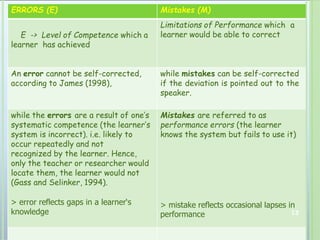
ERRORS (E) Mistakes (M)
E -> Level of Competence which a
learner has achieved
Limitations of Performance which a
learner would be able to correct
An error cannot be self-corrected,
according to James (1998),
while mistakes can be self-corrected
if the deviation is pointed out to the
speaker.
while the errors are a result of one’s
systematic competence (the learner’s
system is incorrect). i.e. likely to
occur repeatedly and not
recognized by the learner. Hence,
only the teacher or researcher would
locate them, the learner would not
(Gass and Selinker, 1994).
> error reflects gaps in a learner‘s
knowledge
Mistakes are referred to as
performance errors (the learner
knows the system but fails to use it)
> mistake reflects occasional lapses in
performance 13
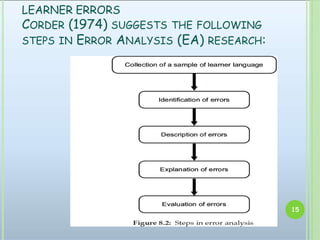
STEPS IN ANALYSING LEARNERS ERRORS
Corder (1967) identified a model for error analysis which
included these stages:
1. Collection
2. Identifying
3. Describing
4. Explaining
5. Evaluating/correcting the errors
14
Models for Error Analysis
LEARNER ERRORS
CORDER (1974) SUGGESTS THE FOLLOWING
STEPS IN ERROR ANALYSIS (EA) RESEARCH:
15
STEP 1
16
 (a) Collection of a Sample of Learner Language
 The starting point in EA is deciding what samples of
learner language to use for the analysis and how to
collect these samples.
 A massive sample involves collecting several samples
of language use from a large number of learners in
order to compile a comprehensive list of errors,
representative of the entire population.
 A specific sample consists of one sample of language
use collected from a limited number of learners.
 Incidental sample involves only one sample of
language use produced by a single learner.
1.IDENTIFYING ERRORS
 question arises whether the error is overt or covert
 An overt error is easy to identify because there is a clear
deviation in form, as when a learner says:
2. “I runned all the way.”
3. I hungry!
A covert error occurs in utterances that are superficially well-
formed but which do not mean what the learner intended them to
mean. For example, the utterance from (Corder, 1971 a):“It was
stopped.” is apparently grammatical until it becomes clear that “it”
refers to“the wind”.
17
STEP 2
2.DESCRIBING ERRORS
⚫ It is categorizing errors grammatically.
⚫ Trying to identify general ways in which the learners
utterances differ from target-language utterances.
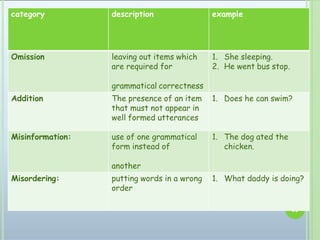
⚫Corder (1973) proposed four major categories:
18
STEP 3
19
category description example
Omission leaving out items which
are required for
grammatical correctness
1. She sleeping.
2. He went bus stop.
Addition The presence of an item
that must not appear in
well formed utterances
1. Does he can swim?
Misinformation: use of one grammatical
form instead of
another
1. The dog ated the
chicken.
Misordering: putting words in a wrong
order
1. What daddy is doing?
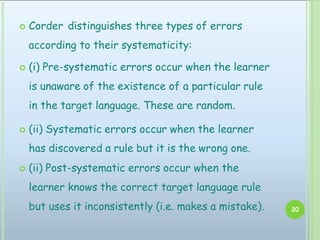
 Corder distinguishes three types of errors
according to their systematicity:
 (i) Pre-systematic errors occur when the learner
is unaware of the existence of a particular rule
in the target language. These are random.
 (ii) Systematic errors occur when the learner
has discovered a rule but it is the wrong one.
 (ii) Post-systematic errors occur when the
learner knows the correct target language rule
but uses it inconsistently (i.e. makes a mistake). 20
STEP 4
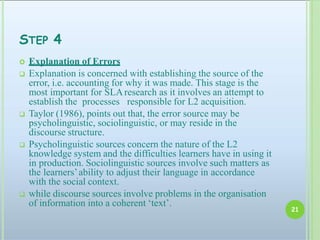
 Explanation of Errors
 Explanation is concerned with establishing the source of the
error, i.e. accounting for why it was made. This stage is the
most important for SLAresearch as it involves an attempt to
establish the processes responsible for L2 acquisition.
 Taylor (1986), points out that, the error source may be
psycholinguistic, sociolinguistic, or may reside in the
discourse structure.
 Psycholinguistic sources concern the nature of the L2
knowledge system and the difficulties learners have in using it
in production. Sociolinguistic sources involve such matters as
the learners’ability to adjust their language in accordance
with the social context.
 while discourse sources involve problems in the organisation
of information into a coherent ‘text’.
21
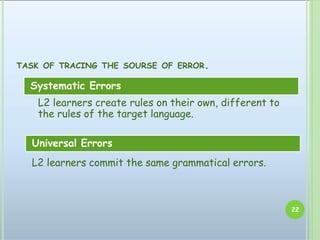
TASK OF TRACING THE SOURSE OF ERROR.
22
L2 learners create rules on their own, different to
the rules of the target language.
Systematic Errors
Universal Errors
L2 learners commit the same grammatical errors.
L2 learners overgeneralize form that they find easy to
learn and process.
23
Overgeneralized Errors
Transfer Errors
L2 learners attempt to make use of their L1 knowledge
STEP 5
24
ERRORS EVALUATION
 Purpose: to help learners to learn an L2.
 Global errors (violate the overall structure of a
sentence)
 Local error (affect only a single constituent in a
sentence)
EXAMPLE OF ERROR AND ERROR
ANALYSIS
One day an Indian gentleman, a snake charmer, arrived
in England by plane. He was coming from Bombay with
two pieces of luggage. The big of them contained a
snake. A man and a little boy was watching him in the
customs area. The man said to the little boy: ‘Go and
speak with this gentleman’. When the little boy was
speaking with the traveller, the thief took the big
suitcase and went out quickly. When the victim saw
that he cried ‘Help me! Help me! A thief! A thief!’ The
policeman was in this corner whistle but it was too late.
The two thieves escape with the big suitcase, took
their car and went in the traffic. They passed near a
zoo and stop in a forest. There they had a big surprise.
The basket contain a big snake.
[French native speaker]
One day an Indian gentleman, a snake charmer, arrived in
England by plane. He was coming from Bombay with two
pieces of luggage. The bigger of them contained a snake.
A man and a little boy were watching him in the customs
area. The man said to the little boy: ‘Go and speak with
this gentleman’. When the little boy was speaking with
the traveller, the thief took the big suitcase and went
out quickly. When the victim saw that he cried ‘Help me!
Help me! A thief! A thief!’ The policeman, who was in this
corner, whistled but it was too late. The two thieves
escaped with the big suitcase, took their car and went
into the traffic. They passed near a zoo and stopped in a
forest. There they had a big surprise. The basket
contain a big snake.
[French native speaker]
SOURCES OF ERRORS
They can be categorized in two domains:
1. Interlingual transfer
2. Intralingual transfer
28
INTERLINGUAL TRANSFER:
Errors due to the influence of the native language in
learning L2 are called interlingual errors. Interlingual errors
are also called transfer or interference errors
Interlingual Transfer is a significant source for language
learners.
Dictionary of language Teaching and applied Linguistics
(1992) defines:
“Interlingual errors are the result of language transfer
which is caused by the learners’ first language (MT).”
LEVELS OF INTERLINGUAL ERRORS
It occurs at different levels:
 phonological,
 morphological,
 Grammatical.
elements of the native language (L1) into the
Target Language.
30
INTERLINGUAL TRANSFER
31
 At phonological level:Lack of certain L2 phonemes in
the learner’s L1
 Differences in syllable structures in L1 and L2
 Spelling pronunciation of words
 The problem of silnt letters
The sounds that do not occur in TL cause the
students to mispronounce them. Indonesian learners
attempt to pronounce
-‘th’ of ‘thank you’ as ‘t’ of ‘tea’.
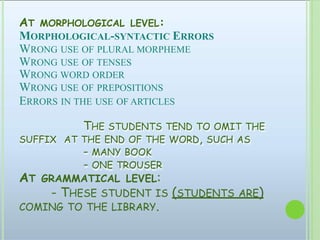
AT MORPHOLOGICAL LEVEL:
MORPHOLOGICAL-SYNTACTIC ERRORS
WRONG USE OF PLURAL MORPHEME
WRONG USE OF TENSES
WRONG WORD ORDER
WRONG USE OF PREPOSITIONS
ERRORS IN THE USE OF ARTICLES
THE STUDENTS TEND TO OMIT THE
SUFFIX AT THE END OF THE WORD, SUCH AS
- MANY BOOK
- ONE TROUSER
AT GRAMMATICAL LEVEL:
- THESE STUDENT IS (STUDENTS ARE)
COMING TO THE LIBRARY.
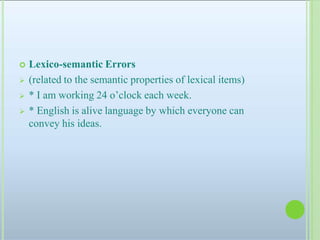
 Lexico-semantic Errors
 (related to the semantic properties of lexical items)
 * I am working 24 o’clock each week.
 * English is alive language by which everyone can
convey his ideas.
INTRALINGUAL
Interference of the student’s own language
(MT/L1) is not the only reason for committing
errors.
Some errors seem universal, reflecting learners’
attempts to make the tasks of learning and using
the SL/TL/FL simpler. (Ellis,1997).
These errors are common in the speech of the
SL/TL/FL learners.
34
INTRALINGUAL
35
Intralingual and developmental errors are due to the difficulty of the
second/target language. Intralingual and developmental factors include the
following
1. Simplification: Learners often choose
simple forms and
constructions instead of
more complex ones
Overgeneralization: This is the use of one
form or construction in
one context and
extending its application
to other contexts where
it should not apply.
Faulty teaching: Sometimes it happens
that learners' errors are
teacher-induced ones.
i.e., caused by the
teacher, teaching
materials, or the order
of presentation
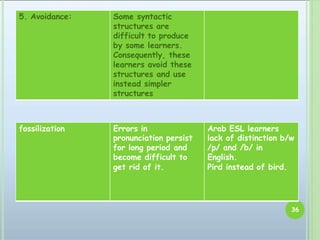
5. Avoidance: Some syntactic
structures are
difficult to produce
by some learners.
Consequently, these
learners avoid these
structures and use
instead simpler
structures
36
fossilization Errors in
pronunciation persist
Arab ESL learners
lack of distinction b/w
for long period and /p/ and /b/ in
become difficult to English.
get rid of it. Pird instead of bird.
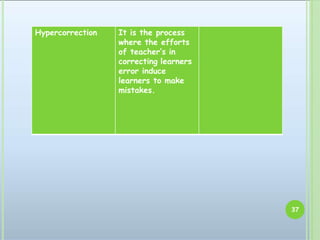
Hypercorrection It is the process
where the efforts
of teacher’s in
correcting learners
error induce
learners to make
mistakes.
37
ERROR TREATMENT
38
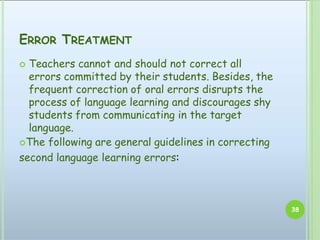
 Teachers cannot and should not correct all
errors committed by their students. Besides, the
frequent correction of oral errors disrupts the
process of language learning and discourages shy
students from communicating in the target
language.
The following are general guidelines in correcting
second language learning errors:
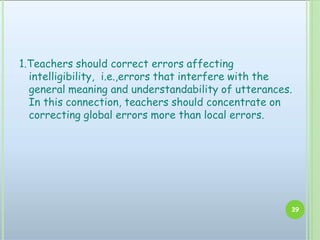
1.Teachers should correct errors affecting
intelligibility, i.e.,errors that interfere with the
general meaning and understandability of utterances.
In this connection, teachers should concentrate on
correcting global errors more than local errors.
39
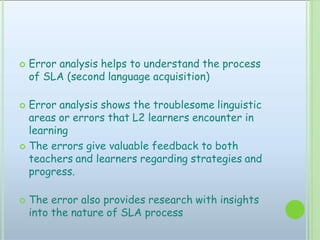
 Error analysis helps to understand the process
of SLA (second language acquisition)
 Error analysis shows the troublesome linguistic
areas or errors that L2 learners encounter in
learning
 The errors give valuable feedback to both
teachers and learners regarding strategies and
progress.
 The error also provides research with insights
into the nature of SLA process
IMPORTANCE;(CONTI)
 Error analysis is useful in second language
learning because it reveals to us.
 Teaching strategies
 Syllabus designing
 Textbook writers of what the problems areas
are.
CONCLUSION
Error anaalysis is a useful technique to define the
learners errors of second language.
1. It is beneficial to the learner and the teacher both
2. It is compulsory to evaluate the current status of
the learner
3. It also indicate the problem areas and the solutions
of them
It explores the reinforcement areas of the learners
It helps to acquire linguistic rules of second language
THANK YOU
43
ANY Q?
REFERENCES
44
 Corder, S.P.1967. The significance of a learner’s errors. In:
IRAL 5, 4:161-170.
 Corder, S.P. 1974. Error Analysis. (158-171). London: Longman.
 Corder, S.P. 1975. Error analysis, interlanguage and second
language acquisition. Language teaching and linguistics:
Abstracts, 8, 201-218.
 Corder, S.P. 1981. Error Analysis and Interlanguage. Oxford:
Oxford University Press.
 Ellis, R. 1997. Two approaches for investigating second language
acquisition in context. In R. Ellis (Ed.), Second Language
Acquisition in Context (pp. 3-29). London: Prentice-Hall.
 Gass, S.M. and Selinker, L. (Eds.). 1994. Language transfer in
language learning (re.ed.).Amsterdam: John Benjamins.
 Michaelides, N.N. 1990. Error Analysis: An Aid to teaching.
English Teaching Forum Vol.XXXVIII/ 4: 28:30
 Selinker, L. Lakshnaman, V. 1992. Language Transfer and
fossilisation: The Multiple Effect Principle. In Grass, S.M. and
Selinker(eds) 1992. 197-216

erroranalysislecture-160525161755 (1).pptx

  • 1.
    Topic ERRORANALYSIS : CAUSESOF ERROR And Shahnaz Mehboob 1
  • 2.
    DEFINITION OF ERROR 2 Error An error according to Corder , takes place when the deviation arises due to lack of knowledge. An error cannot be self-corrected. ( Ellis,1994)
  • 3.
  • 4.
    DEFINITION OF ERRORANALYSIS  Corder (1974) defines EA as What has come to be known as error analysis has to do with the investigation of the language of second language learners. 4
  • 5.
    WHAT IS ERRORANALYSIS/BACKGROUND  Error analysis is linguistic analysis that focuses on the errors learners make by comparing between the errors made in the target language (TL) and that TL itself.  Error analysis is an important source of information to teachers  It provides information on students' errors  Helps teachers to correct students' errors  Improves the effectiveness of teachers, students, researchers Michaelides(1990:30) 5
  • 6.
    AN ARTICLE BYCORDER 6  Pit Corder (1967) ‘Father’ of Error Analysis through his article ‘The significance of Learner Errors’ that Error Analysis took a new turn.
  • 7.
    SIGNIFICANCE OF EA 7 Erroranalysis helps teachers to  assess the remedial work necessary for English as a Second Language (ESL) students preparing for an English Language test and to help students avoid the most common errors
  • 8.
    TWO JUSTIFICATIONS OFEA 8 Corder, (1981:112) suggests that there are two justifications for studying learners' errors:  its relevance to language teaching.  the study of the language acquisition process.
  • 9.
    TWO OBJECTS OFEA 9 According to Corder (1974) error analysis has two objects: one theoretical and another applied.  The theoretical object deals with what and how a learner learns when he studies a second language.’  The applied object enables the learner ‘to learn more efficiently by manipulating knowledge of his vernacular for academic purposes’.
  • 10.
    CORDER’S EXPLANATION OFERROR 10 Corder (1974) distinguishes between systematic and non-systematic errors  Nonsystematic errors occur in one’s native language.  L2 errors are systemic
  • 11.
    WHY EA ISDONE? 11 Sercombe, (2000) explains that EA serves three purposes.  Firstly, to find out the level of language proficiency the learner has reached.  Secondly, to obtain information about common difficulties in language learning  Thirdly, to find out how people learn a language.
  • 12.
    MISTAKES AND ERRORS ⦁In order to analyze learner language in an appropriate perspective, it is crucial to make a distinction between mistakes and errors, technically two very different phenomena.  Mistake –refers to a performance error that is either a random guess or a “slip”, in that is a failure to utilize a known system correctly. Native speakers make mistakes. When attention is called to them, they can be self-corrected. ⦁ Error –a noticeable deviation from the adult grammar of a native speaker, reflects the competence of the learner 12
  • 13.
    ERRORS (E) Mistakes(M) E -> Level of Competence which a learner has achieved Limitations of Performance which a learner would be able to correct An error cannot be self-corrected, according to James (1998), while mistakes can be self-corrected if the deviation is pointed out to the speaker. while the errors are a result of one’s systematic competence (the learner’s system is incorrect). i.e. likely to occur repeatedly and not recognized by the learner. Hence, only the teacher or researcher would locate them, the learner would not (Gass and Selinker, 1994). > error reflects gaps in a learner‘s knowledge Mistakes are referred to as performance errors (the learner knows the system but fails to use it) > mistake reflects occasional lapses in performance 13
  • 14.
    STEPS IN ANALYSINGLEARNERS ERRORS Corder (1967) identified a model for error analysis which included these stages: 1. Collection 2. Identifying 3. Describing 4. Explaining 5. Evaluating/correcting the errors 14 Models for Error Analysis
  • 15.
    LEARNER ERRORS CORDER (1974)SUGGESTS THE FOLLOWING STEPS IN ERROR ANALYSIS (EA) RESEARCH: 15
  • 16.
    STEP 1 16  (a)Collection of a Sample of Learner Language  The starting point in EA is deciding what samples of learner language to use for the analysis and how to collect these samples.  A massive sample involves collecting several samples of language use from a large number of learners in order to compile a comprehensive list of errors, representative of the entire population.  A specific sample consists of one sample of language use collected from a limited number of learners.  Incidental sample involves only one sample of language use produced by a single learner.
  • 17.
    1.IDENTIFYING ERRORS  questionarises whether the error is overt or covert  An overt error is easy to identify because there is a clear deviation in form, as when a learner says: 2. “I runned all the way.” 3. I hungry! A covert error occurs in utterances that are superficially well- formed but which do not mean what the learner intended them to mean. For example, the utterance from (Corder, 1971 a):“It was stopped.” is apparently grammatical until it becomes clear that “it” refers to“the wind”. 17 STEP 2
  • 18.
    2.DESCRIBING ERRORS ⚫ Itis categorizing errors grammatically. ⚫ Trying to identify general ways in which the learners utterances differ from target-language utterances. ⚫Corder (1973) proposed four major categories: 18 STEP 3
  • 19.
    19 category description example Omissionleaving out items which are required for grammatical correctness 1. She sleeping. 2. He went bus stop. Addition The presence of an item that must not appear in well formed utterances 1. Does he can swim? Misinformation: use of one grammatical form instead of another 1. The dog ated the chicken. Misordering: putting words in a wrong order 1. What daddy is doing?
  • 20.
     Corder distinguishesthree types of errors according to their systematicity:  (i) Pre-systematic errors occur when the learner is unaware of the existence of a particular rule in the target language. These are random.  (ii) Systematic errors occur when the learner has discovered a rule but it is the wrong one.  (ii) Post-systematic errors occur when the learner knows the correct target language rule but uses it inconsistently (i.e. makes a mistake). 20
  • 21.
    STEP 4  Explanationof Errors  Explanation is concerned with establishing the source of the error, i.e. accounting for why it was made. This stage is the most important for SLAresearch as it involves an attempt to establish the processes responsible for L2 acquisition.  Taylor (1986), points out that, the error source may be psycholinguistic, sociolinguistic, or may reside in the discourse structure.  Psycholinguistic sources concern the nature of the L2 knowledge system and the difficulties learners have in using it in production. Sociolinguistic sources involve such matters as the learners’ability to adjust their language in accordance with the social context.  while discourse sources involve problems in the organisation of information into a coherent ‘text’. 21
  • 22.
    TASK OF TRACINGTHE SOURSE OF ERROR. 22 L2 learners create rules on their own, different to the rules of the target language. Systematic Errors Universal Errors L2 learners commit the same grammatical errors.
  • 23.
    L2 learners overgeneralizeform that they find easy to learn and process. 23 Overgeneralized Errors Transfer Errors L2 learners attempt to make use of their L1 knowledge
  • 24.
    STEP 5 24 ERRORS EVALUATION Purpose: to help learners to learn an L2.  Global errors (violate the overall structure of a sentence)  Local error (affect only a single constituent in a sentence)
  • 25.
    EXAMPLE OF ERRORAND ERROR ANALYSIS
  • 26.
    One day anIndian gentleman, a snake charmer, arrived in England by plane. He was coming from Bombay with two pieces of luggage. The big of them contained a snake. A man and a little boy was watching him in the customs area. The man said to the little boy: ‘Go and speak with this gentleman’. When the little boy was speaking with the traveller, the thief took the big suitcase and went out quickly. When the victim saw that he cried ‘Help me! Help me! A thief! A thief!’ The policeman was in this corner whistle but it was too late. The two thieves escape with the big suitcase, took their car and went in the traffic. They passed near a zoo and stop in a forest. There they had a big surprise. The basket contain a big snake. [French native speaker]
  • 27.
    One day anIndian gentleman, a snake charmer, arrived in England by plane. He was coming from Bombay with two pieces of luggage. The bigger of them contained a snake. A man and a little boy were watching him in the customs area. The man said to the little boy: ‘Go and speak with this gentleman’. When the little boy was speaking with the traveller, the thief took the big suitcase and went out quickly. When the victim saw that he cried ‘Help me! Help me! A thief! A thief!’ The policeman, who was in this corner, whistled but it was too late. The two thieves escaped with the big suitcase, took their car and went into the traffic. They passed near a zoo and stopped in a forest. There they had a big surprise. The basket contain a big snake. [French native speaker]
  • 28.
    SOURCES OF ERRORS Theycan be categorized in two domains: 1. Interlingual transfer 2. Intralingual transfer 28
  • 29.
    INTERLINGUAL TRANSFER: Errors dueto the influence of the native language in learning L2 are called interlingual errors. Interlingual errors are also called transfer or interference errors Interlingual Transfer is a significant source for language learners. Dictionary of language Teaching and applied Linguistics (1992) defines: “Interlingual errors are the result of language transfer which is caused by the learners’ first language (MT).”
  • 30.
    LEVELS OF INTERLINGUALERRORS It occurs at different levels:  phonological,  morphological,  Grammatical. elements of the native language (L1) into the Target Language. 30
  • 31.
    INTERLINGUAL TRANSFER 31  Atphonological level:Lack of certain L2 phonemes in the learner’s L1  Differences in syllable structures in L1 and L2  Spelling pronunciation of words  The problem of silnt letters The sounds that do not occur in TL cause the students to mispronounce them. Indonesian learners attempt to pronounce -‘th’ of ‘thank you’ as ‘t’ of ‘tea’.
  • 32.
    AT MORPHOLOGICAL LEVEL: MORPHOLOGICAL-SYNTACTICERRORS WRONG USE OF PLURAL MORPHEME WRONG USE OF TENSES WRONG WORD ORDER WRONG USE OF PREPOSITIONS ERRORS IN THE USE OF ARTICLES THE STUDENTS TEND TO OMIT THE SUFFIX AT THE END OF THE WORD, SUCH AS - MANY BOOK - ONE TROUSER AT GRAMMATICAL LEVEL: - THESE STUDENT IS (STUDENTS ARE) COMING TO THE LIBRARY.
  • 33.
     Lexico-semantic Errors (related to the semantic properties of lexical items)  * I am working 24 o’clock each week.  * English is alive language by which everyone can convey his ideas.
  • 34.
    INTRALINGUAL Interference of thestudent’s own language (MT/L1) is not the only reason for committing errors. Some errors seem universal, reflecting learners’ attempts to make the tasks of learning and using the SL/TL/FL simpler. (Ellis,1997). These errors are common in the speech of the SL/TL/FL learners. 34
  • 35.
    INTRALINGUAL 35 Intralingual and developmentalerrors are due to the difficulty of the second/target language. Intralingual and developmental factors include the following 1. Simplification: Learners often choose simple forms and constructions instead of more complex ones Overgeneralization: This is the use of one form or construction in one context and extending its application to other contexts where it should not apply. Faulty teaching: Sometimes it happens that learners' errors are teacher-induced ones. i.e., caused by the teacher, teaching materials, or the order of presentation
  • 36.
    5. Avoidance: Somesyntactic structures are difficult to produce by some learners. Consequently, these learners avoid these structures and use instead simpler structures 36 fossilization Errors in pronunciation persist Arab ESL learners lack of distinction b/w for long period and /p/ and /b/ in become difficult to English. get rid of it. Pird instead of bird.
  • 37.
    Hypercorrection It isthe process where the efforts of teacher’s in correcting learners error induce learners to make mistakes. 37
  • 38.
    ERROR TREATMENT 38  Teacherscannot and should not correct all errors committed by their students. Besides, the frequent correction of oral errors disrupts the process of language learning and discourages shy students from communicating in the target language. The following are general guidelines in correcting second language learning errors:
  • 39.
    1.Teachers should correcterrors affecting intelligibility, i.e.,errors that interfere with the general meaning and understandability of utterances. In this connection, teachers should concentrate on correcting global errors more than local errors. 39
  • 40.
     Error analysishelps to understand the process of SLA (second language acquisition)  Error analysis shows the troublesome linguistic areas or errors that L2 learners encounter in learning  The errors give valuable feedback to both teachers and learners regarding strategies and progress.  The error also provides research with insights into the nature of SLA process
  • 41.
    IMPORTANCE;(CONTI)  Error analysisis useful in second language learning because it reveals to us.  Teaching strategies  Syllabus designing  Textbook writers of what the problems areas are.
  • 42.
    CONCLUSION Error anaalysis isa useful technique to define the learners errors of second language. 1. It is beneficial to the learner and the teacher both 2. It is compulsory to evaluate the current status of the learner 3. It also indicate the problem areas and the solutions of them It explores the reinforcement areas of the learners It helps to acquire linguistic rules of second language
  • 43.
  • 44.
    REFERENCES 44  Corder, S.P.1967.The significance of a learner’s errors. In: IRAL 5, 4:161-170.  Corder, S.P. 1974. Error Analysis. (158-171). London: Longman.  Corder, S.P. 1975. Error analysis, interlanguage and second language acquisition. Language teaching and linguistics: Abstracts, 8, 201-218.  Corder, S.P. 1981. Error Analysis and Interlanguage. Oxford: Oxford University Press.  Ellis, R. 1997. Two approaches for investigating second language acquisition in context. In R. Ellis (Ed.), Second Language Acquisition in Context (pp. 3-29). London: Prentice-Hall.  Gass, S.M. and Selinker, L. (Eds.). 1994. Language transfer in language learning (re.ed.).Amsterdam: John Benjamins.  Michaelides, N.N. 1990. Error Analysis: An Aid to teaching. English Teaching Forum Vol.XXXVIII/ 4: 28:30  Selinker, L. Lakshnaman, V. 1992. Language Transfer and fossilisation: The Multiple Effect Principle. In Grass, S.M. and Selinker(eds) 1992. 197-216