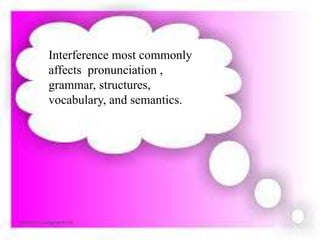
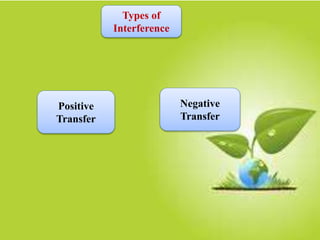
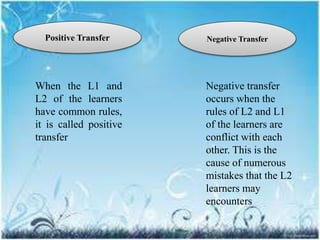
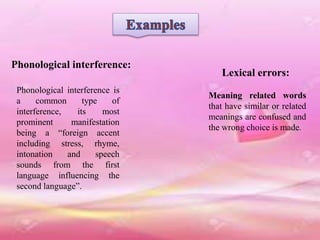
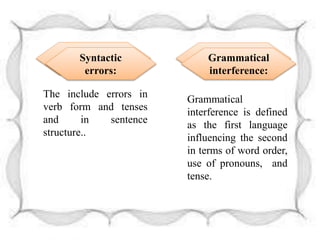
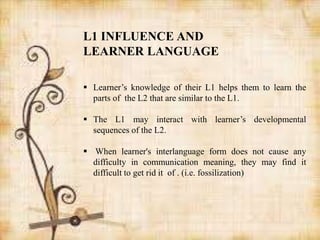
This document discusses language interference that occurs when learning a second language. It defines L1 as one's native or first language and L2 as a second language learned afterwards. L1 interference happens when a learner's first language influences their acquisition of the second language. This can cause positive transfer, when rules of both languages are similar, or negative transfer, when rules conflict. Negative transfer leads to errors in areas like pronunciation, grammar, vocabulary and semantics. The document provides examples and discusses factors that can influence the degree of interference, like differences between the languages. It concludes that learning involves mistakes and the L1 can both help and hinder L2 learning depending on similarities and differences between the languages.

















![Linguistic Factors Presentation [Autoguardado]](https://cdn.slidesharecdn.com/ss_thumbnails/linguisticfactorspresentationautoguardado-090912181007-phpapp02-thumbnail.jpg?width=640&height=640&fit=bounds)


![[SLA] Psycholinguistics and linguistics aspects of interlanguage.pptx](https://cdn.slidesharecdn.com/ss_thumbnails/slapsycholinguisticsandlinguisticsaspectsofinterlanguage-240729221801-71a7a85b-thumbnail.jpg?width=640&height=640&fit=bounds)


