Error taxonomies
Course: applied linguistics
Group: 1 and 2
Semester: 5
Definition
Taxonomy of errors is a
branch of science that
classifies types of errors
Classification of errors
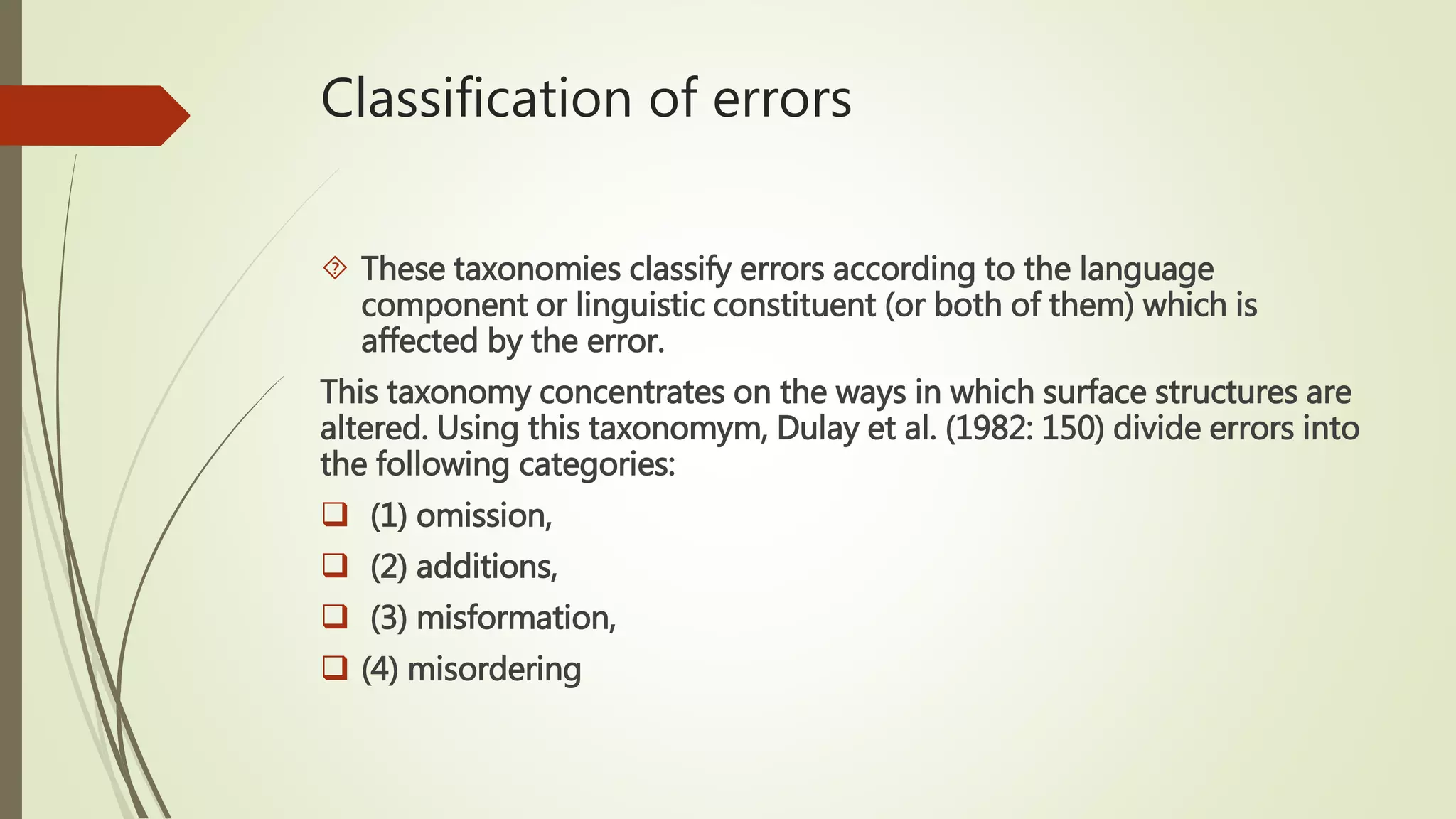
 These taxonomies classify errors according to the language
component or linguistic constituent (or both of them) which is
affected by the error.
This taxonomy concentrates on the ways in which surface structures are
altered. Using this taxonomym, Dulay et al. (1982: 150) divide errors into
the following categories:
 (1) omission,
 (2) additions,
 (3) misformation,
 (4) misordering
Classification of errors
(1) Omission:
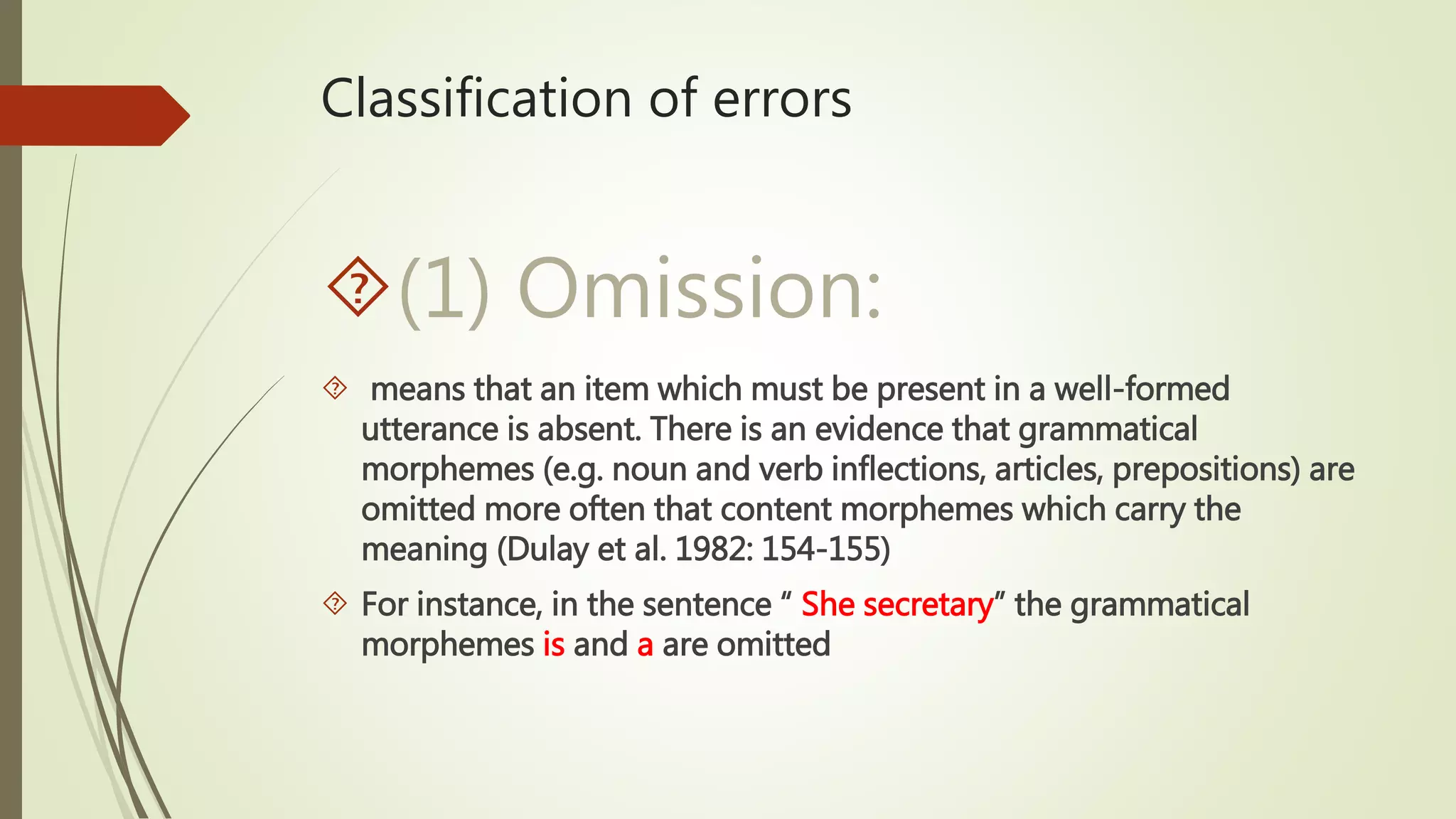
 means that an item which must be present in a well-formed
utterance is absent. There is an evidence that grammatical
morphemes (e.g. noun and verb inflections, articles, prepositions) are
omitted more often that content morphemes which carry the
meaning (Dulay et al. 1982: 154-155)
 For instance, in the sentence “ She secretary” the grammatical
morphemes is and a are omitted
Classification of errors
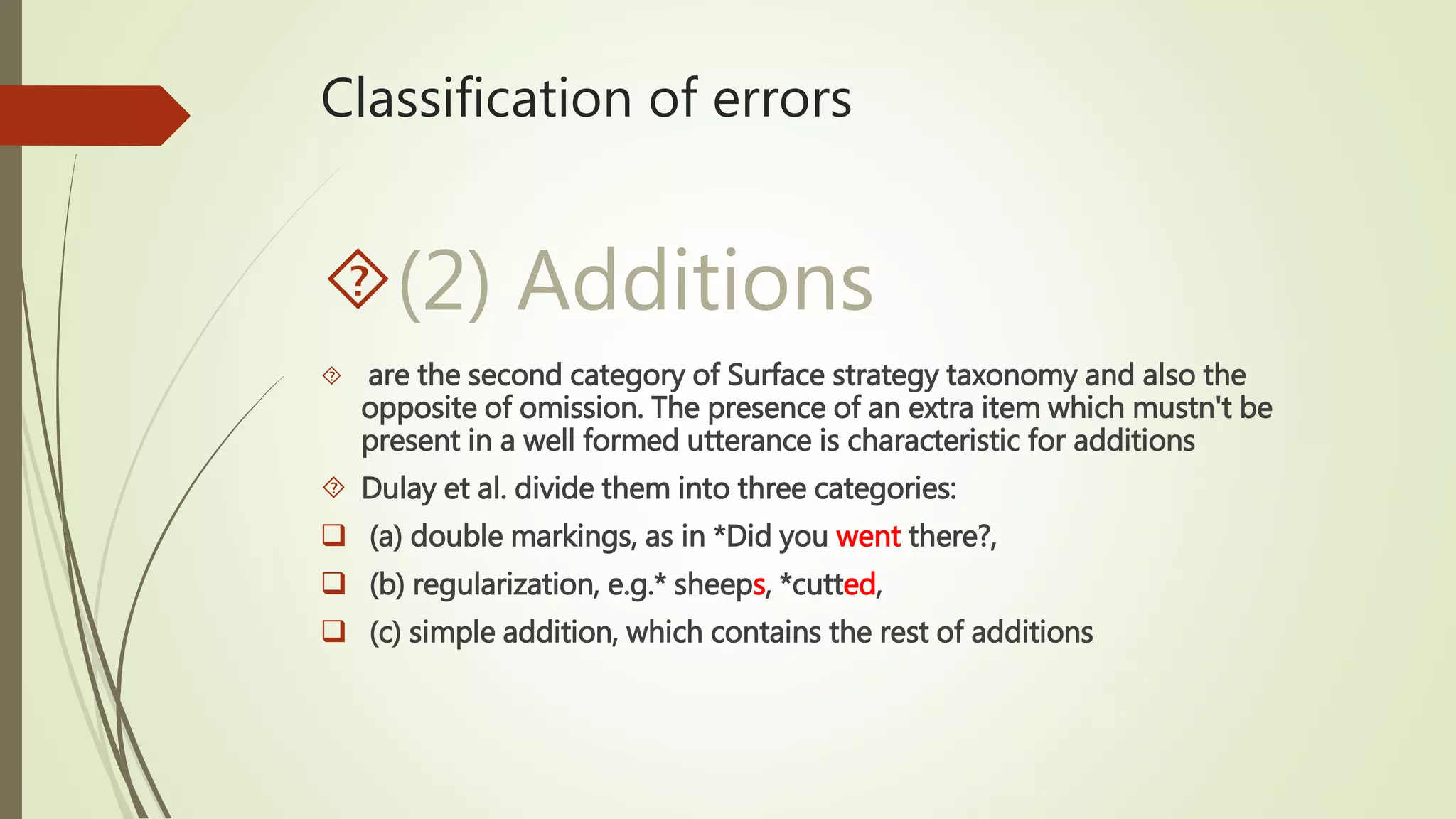
(2) Additions
 are the second category of Surface strategy taxonomy and also the
opposite of omission. The presence of an extra item which mustn't be
present in a well formed utterance is characteristic for additions
 Dulay et al. divide them into three categories:
 (a) double markings, as in *Did you went there?,
 (b) regularization, e.g.* sheeps, *cutted,
 (c) simple addition, which contains the rest of additions
Classification of errors
(3) Misformation
 refers to the use of the wrong form of the morpheme or structure.
 For instance, in the sentence “I understanded the course” ( this is an
irregular verb, past tense is misformed, I should say I understood the
course)
Classification of errors
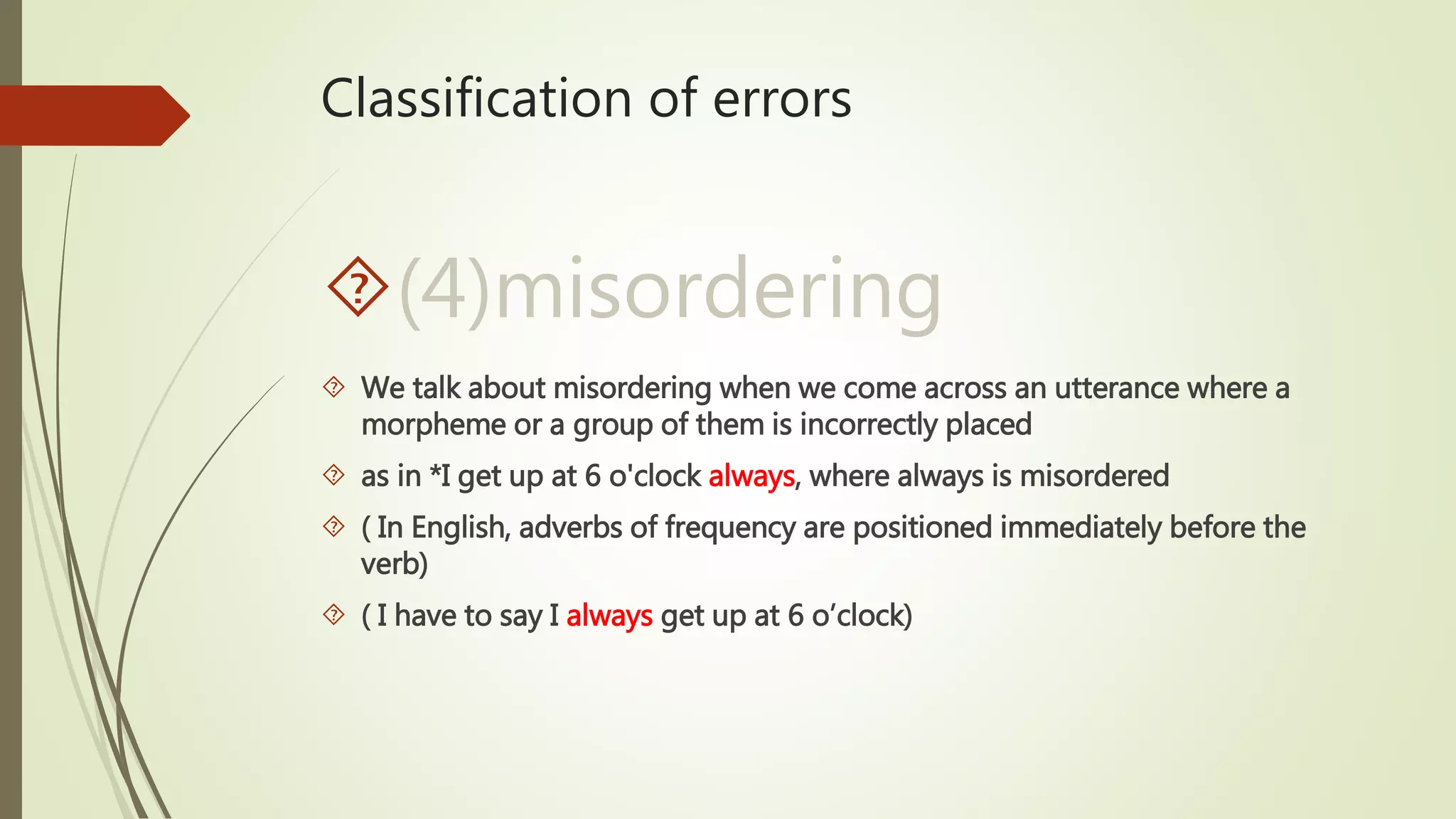
(4)misordering
 We talk about misordering when we come across an utterance where a
morpheme or a group of them is incorrectly placed
 as in *I get up at 6 o'clock always, where always is misordered
 ( In English, adverbs of frequency are positioned immediately before the
verb)
 ( I have to say I always get up at 6 o’clock)
Thank you

Error taxonomies

  • 1.
    Error taxonomies Course: appliedlinguistics Group: 1 and 2 Semester: 5
  • 2.
    Definition Taxonomy of errorsis a branch of science that classifies types of errors
  • 3.
    Classification of errors These taxonomies classify errors according to the language component or linguistic constituent (or both of them) which is affected by the error. This taxonomy concentrates on the ways in which surface structures are altered. Using this taxonomym, Dulay et al. (1982: 150) divide errors into the following categories:  (1) omission,  (2) additions,  (3) misformation,  (4) misordering
  • 4.
    Classification of errors (1)Omission:  means that an item which must be present in a well-formed utterance is absent. There is an evidence that grammatical morphemes (e.g. noun and verb inflections, articles, prepositions) are omitted more often that content morphemes which carry the meaning (Dulay et al. 1982: 154-155)  For instance, in the sentence “ She secretary” the grammatical morphemes is and a are omitted
  • 5.
    Classification of errors (2)Additions  are the second category of Surface strategy taxonomy and also the opposite of omission. The presence of an extra item which mustn't be present in a well formed utterance is characteristic for additions  Dulay et al. divide them into three categories:  (a) double markings, as in *Did you went there?,  (b) regularization, e.g.* sheeps, *cutted,  (c) simple addition, which contains the rest of additions
  • 6.
    Classification of errors (3)Misformation  refers to the use of the wrong form of the morpheme or structure.  For instance, in the sentence “I understanded the course” ( this is an irregular verb, past tense is misformed, I should say I understood the course)
  • 7.
    Classification of errors (4)misordering We talk about misordering when we come across an utterance where a morpheme or a group of them is incorrectly placed  as in *I get up at 6 o'clock always, where always is misordered  ( In English, adverbs of frequency are positioned immediately before the verb)  ( I have to say I always get up at 6 o’clock)
  • 8.