&
Responding to
Distressed Disruptive
Student Behavior
A Guide for Faculty & Staff
OREGON STATE UNIVERSITY
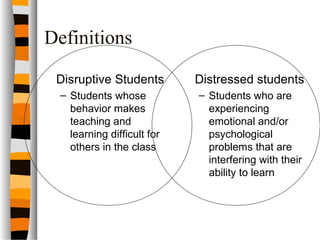
Definitions
Disruptive Students
– Students whose
behavior makes
teaching and
learning difficult for
others in the class
Distressed students
– Students who are
experiencing
emotional and/or
psychological
problems that are
interfering with their
ability to learn
Your Role
Often the first to recognize that a
student needs help
Important to have knowledge of campus
and community resources for referral
Responsibility to maintain appropriate
learning environment
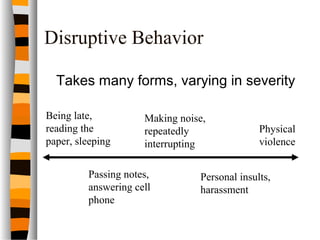
Disruptive Behavior
Being late,
reading the
paper, sleeping
Physical
violence
Making noise,
repeatedly
interrupting
Personal insults,
harassment
Passing notes,
answering cell
phone
Takes many forms, varying in severity
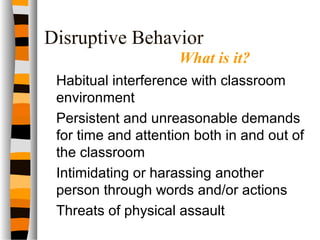
Disruptive Behavior
Habitual interference with classroom
environment
Persistent and unreasonable demands
for time and attention both in and out of
the classroom
Intimidating or harassing another
person through words and/or actions
Threats of physical assault
What is it?
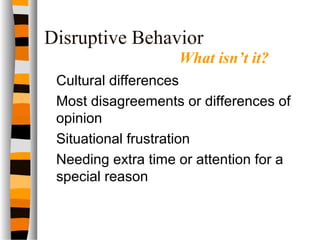
Disruptive Behavior
Cultural differences
Most disagreements or differences of
opinion
Situational frustration
Needing extra time or attention for a
special reason
What isn’t it?
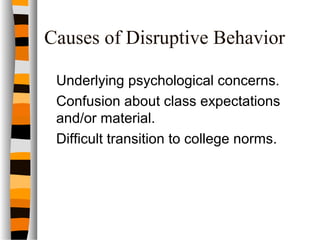
Causes of Disruptive Behavior
Underlying psychological concerns.
Confusion about class expectations
and/or material.
Difficult transition to college norms.
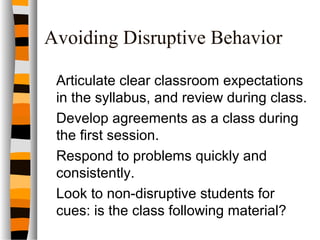
Avoiding Disruptive Behavior
Articulate clear classroom expectations
in the syllabus, and review during class.
Develop agreements as a class during
the first session.
Respond to problems quickly and
consistently.
Look to non-disruptive students for
cues: is the class following material?
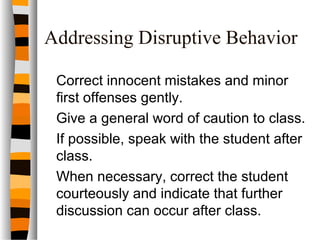
Addressing Disruptive Behavior
Correct innocent mistakes and minor
first offenses gently.
Give a general word of caution to class.
If possible, speak with the student after
class.
When necessary, correct the student
courteously and indicate that further
discussion can occur after class.
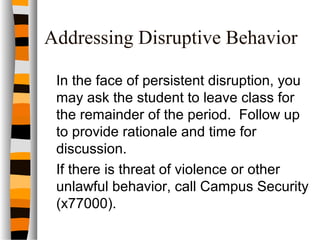
Addressing Disruptive Behavior
In the face of persistent disruption, you
may ask the student to leave class for
the remainder of the period. Follow up
to provide rationale and time for
discussion.
If there is threat of violence or other
unlawful behavior, call Campus Security
(x77000).
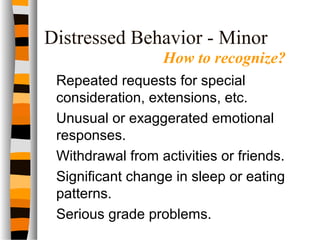
Distressed Behavior - Minor
Repeated requests for special
consideration, extensions, etc.
Unusual or exaggerated emotional
responses.
Withdrawal from activities or friends.
Significant change in sleep or eating
patterns.
Serious grade problems.
How to recognize?
Distressed Behavior - Minor
Excessive absences, especially if
attendance was previously consistent.
Perfectionism, procrastination, or
excessive worrying.
Markedly changed patterns of
interaction (avoiding participation or
dominating discussion).
How to recognize?
Distressed Behavior - Severe
Depressed mood
– Marked changes in personal hygiene;
swollen, red eyes; falling asleep in class;
excessively active and talkative.
Inability to communicate
– Garbled, slurred, disjointed, or incoherent
speech.
Loss of contact with reality
– Seeing/hearing things that do not exist.
How to recognize?
Distressed Behavior - Severe
Suicidal thoughts or intentions
– Overtly discussing or hinting that this is a
current and viable option.
Homicidal threats
Highly disruptive behavior
– Hostile, threatening, violent; withdrawal into
corner of room or fetal position.
How to recognize?
Addressing Distressed Behavior
Talk to the student in private, when both
of you have time. Give the student your
undivided attention.
Express your concerns in behavioral,
nonjudgmental terms.
– “I've noticed you’ve been absent from class
lately and I’m concerned.”
Listen in a sensitive, non-threatening
way.
Addressing Distressed Behavior
Communicate understanding by
repeating back the gist of what the
student has said.
Avoid judging, evaluating, or criticizing.
Respect the student’s value system,
even if you disagree with it.
If appropriate, make a referral.
When to Make a Referral
You know that you can’t handle the
request or the behavior.
You believe personality differences will
interfere with your ability to help.
You know the student personally and
believe that you could not be objective.
You feel overwhelmed or unsure of how
to proceed.
How to Make a Referral
Let the student know that it is not
necessary to know exactly what is
wrong in order to seek assistance.
Assure the student that seeking help
does not necessarily mean their
problems are unusual or extremely
serious.
Be frank about your own limits of time,
energy, training, and objectivity.
Campus Resources
University Counseling & Psychological
Services
– 737-2131
Student Health Services
– 737-WELL
Student Conduct & Mediation
– 737-3656
Campus Resources
Services for Students with Disabilities
– 737-4098
Dean of Students
– 737-8748
Campus Security
– 737-3010 or 737-7000
Affirmative Action
– 737-3556
Community Resources
Center Against Rape & Domestic
Violence
– 754-0110
Benton County Mental Health
– 766-6844
Questions to Discuss as a
Department
If a student has been exhibiting unusual
behavior and other students are
complaining, what should I do?
What are my rights as a professor?
What are my students’ rights?
What is due process?
What if a student confides emotional
difficulties to me?
Questions to Discuss as a
Department
What if a student presents me with an
overt or veiled threat?
Can I tell a student to leave the class
and not come back?
What should I do if my students begin
challenging my authority?
Classes are getting larger and students
harder to deal with. What can I do?
Other Topics Available
Assisting Students in Distress
• University Counseling & Psychological Services
Handling Classroom Disruption
• Student Conduct & Mediation
Violence in the Workplace
• Human Resources, Campus Security
Creating Inclusive Classrooms
• Affirmative Action

Distressed disruptive behavior

  • 1.
    & Responding to Distressed Disruptive StudentBehavior A Guide for Faculty & Staff OREGON STATE UNIVERSITY
  • 2.
    Definitions Disruptive Students – Studentswhose behavior makes teaching and learning difficult for others in the class Distressed students – Students who are experiencing emotional and/or psychological problems that are interfering with their ability to learn
  • 3.
    Your Role Often thefirst to recognize that a student needs help Important to have knowledge of campus and community resources for referral Responsibility to maintain appropriate learning environment
  • 4.
    Disruptive Behavior Being late, readingthe paper, sleeping Physical violence Making noise, repeatedly interrupting Personal insults, harassment Passing notes, answering cell phone Takes many forms, varying in severity
  • 5.
    Disruptive Behavior Habitual interferencewith classroom environment Persistent and unreasonable demands for time and attention both in and out of the classroom Intimidating or harassing another person through words and/or actions Threats of physical assault What is it?
  • 6.
    Disruptive Behavior Cultural differences Mostdisagreements or differences of opinion Situational frustration Needing extra time or attention for a special reason What isn’t it?
  • 7.
    Causes of DisruptiveBehavior Underlying psychological concerns. Confusion about class expectations and/or material. Difficult transition to college norms.
  • 8.
    Avoiding Disruptive Behavior Articulateclear classroom expectations in the syllabus, and review during class. Develop agreements as a class during the first session. Respond to problems quickly and consistently. Look to non-disruptive students for cues: is the class following material?
  • 9.
    Addressing Disruptive Behavior Correctinnocent mistakes and minor first offenses gently. Give a general word of caution to class. If possible, speak with the student after class. When necessary, correct the student courteously and indicate that further discussion can occur after class.
  • 10.
    Addressing Disruptive Behavior Inthe face of persistent disruption, you may ask the student to leave class for the remainder of the period. Follow up to provide rationale and time for discussion. If there is threat of violence or other unlawful behavior, call Campus Security (x77000).
  • 11.
    Distressed Behavior -Minor Repeated requests for special consideration, extensions, etc. Unusual or exaggerated emotional responses. Withdrawal from activities or friends. Significant change in sleep or eating patterns. Serious grade problems. How to recognize?
  • 12.
    Distressed Behavior -Minor Excessive absences, especially if attendance was previously consistent. Perfectionism, procrastination, or excessive worrying. Markedly changed patterns of interaction (avoiding participation or dominating discussion). How to recognize?
  • 13.
    Distressed Behavior -Severe Depressed mood – Marked changes in personal hygiene; swollen, red eyes; falling asleep in class; excessively active and talkative. Inability to communicate – Garbled, slurred, disjointed, or incoherent speech. Loss of contact with reality – Seeing/hearing things that do not exist. How to recognize?
  • 14.
    Distressed Behavior -Severe Suicidal thoughts or intentions – Overtly discussing or hinting that this is a current and viable option. Homicidal threats Highly disruptive behavior – Hostile, threatening, violent; withdrawal into corner of room or fetal position. How to recognize?
  • 15.
    Addressing Distressed Behavior Talkto the student in private, when both of you have time. Give the student your undivided attention. Express your concerns in behavioral, nonjudgmental terms. – “I've noticed you’ve been absent from class lately and I’m concerned.” Listen in a sensitive, non-threatening way.
  • 16.
    Addressing Distressed Behavior Communicateunderstanding by repeating back the gist of what the student has said. Avoid judging, evaluating, or criticizing. Respect the student’s value system, even if you disagree with it. If appropriate, make a referral.
  • 17.
    When to Makea Referral You know that you can’t handle the request or the behavior. You believe personality differences will interfere with your ability to help. You know the student personally and believe that you could not be objective. You feel overwhelmed or unsure of how to proceed.
  • 18.
    How to Makea Referral Let the student know that it is not necessary to know exactly what is wrong in order to seek assistance. Assure the student that seeking help does not necessarily mean their problems are unusual or extremely serious. Be frank about your own limits of time, energy, training, and objectivity.
  • 19.
    Campus Resources University Counseling& Psychological Services – 737-2131 Student Health Services – 737-WELL Student Conduct & Mediation – 737-3656
  • 20.
    Campus Resources Services forStudents with Disabilities – 737-4098 Dean of Students – 737-8748 Campus Security – 737-3010 or 737-7000 Affirmative Action – 737-3556
  • 21.
    Community Resources Center AgainstRape & Domestic Violence – 754-0110 Benton County Mental Health – 766-6844
  • 22.
    Questions to Discussas a Department If a student has been exhibiting unusual behavior and other students are complaining, what should I do? What are my rights as a professor? What are my students’ rights? What is due process? What if a student confides emotional difficulties to me?
  • 23.
    Questions to Discussas a Department What if a student presents me with an overt or veiled threat? Can I tell a student to leave the class and not come back? What should I do if my students begin challenging my authority? Classes are getting larger and students harder to deal with. What can I do?
  • 24.
    Other Topics Available AssistingStudents in Distress • University Counseling & Psychological Services Handling Classroom Disruption • Student Conduct & Mediation Violence in the Workplace • Human Resources, Campus Security Creating Inclusive Classrooms • Affirmative Action