Difficult Students, Disruptive
Students and Students in
Distress: Tools for Maintaining a Successful
Learning Environment
Presented by Paul Rakowski and Larry Loften
Adapted in part from Ohio State University
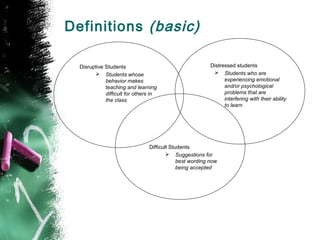
Definitions (basic)
Disruptive Students
 Students whose
behavior makes
teaching and learning
difficult for others in
the class
Distressed students
 Students who are
experiencing emotional
and/or psychological
problems that are
interfering with their ability
to learn
Difficult Students
 Suggestions for
best wording now
being accepted
Goals for this Session
• Faculty will:
• Gain a clear understanding of their role as stewards of the
learning environment
• Begin to Recognize signs and symptoms of various mental
health concerns
• Gain an understanding of how to assist students in distress
and access resources on campus including:
• Counseling Center
• Behavioral Evaluation and Threat Assessment Team
• Community Standards/Conduct Process
• Peers and Colleagues
• Learn basic skills for how to de-escalate a situation
Your Role
• Often the first to recognize that a student needs
help
• Important to have knowledge of campus and
community resources for referral
• Responsibility to maintain appropriate learning
environment
Disruptive Behavior –
What is it?
• Habitual interference with classroom
environment
• Persistent and unreasonable demands for time
and attention both in and out of the classroom
• Intimidating or harassing another person
through words and/or actions
• Refusal to comply with faculty or staff direction
• Threats of physical violence
• Cultural differences
• Most disagreements or differences of opinion
• Situational frustration
• Needing extra time or attention for a special
reason
Disruptive Behavior –
What isn’t it?
Other Behaviors
• Often not disruptive but may be an indicator
that there other issues at play
• Potential warning signs/indicators
 Marked changes in behavior/attitude
 Depression and Lethargy
 Hyperactivity
 Deterioration of Personal Hygiene
 References to suicide/homicide
 Strange or bizarre behavior
Disruptive Behavior
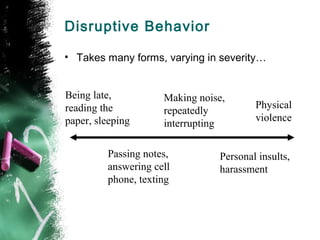
• Takes many forms, varying in severity…
Being late,
reading the
paper, sleeping
Physical
violence
Making noise,
repeatedly
interrupting
Personal insults,
harassment
Passing notes,
answering cell
phone, texting
Causes of Disruptive Behavior
• Underlying psychological or mental health
concerns
• Confusion about class expectations and/or
material
• Difficult transition to college norms
• Lack of or underdeveloped social skills
Signs of Stress/Distress
• Depression - noted changes in dress/demeanor, sadness,
crying, lack of energy, sleeping in class, withdrawal from others,
infrequent class attendance, poor academic performance,
procrastination.
• Agitation – nervousness, hurried speech, erratic hand gestures
or non-verbal communication, aggressive behavior.
• Anxiety – excessive worry, procrastination, hyper-vigilance,
irritably, overly dependent. Physical signs include panic attacks,
hyperventilation, excessive perspiration, stomach upset,
gastrointestinal distress.
• Aggression – Explosive and/or aggressive outbursts, violence
or threats of violence toward others, over-reactivity, hostility
toward others without provocation, harsh judgments toward
others without reasonable foundation, disrespect toward others,
particularly authority figures.
Signs of Stress/Distress
• Violence – Extremely aggressive behavior, yelling, harmful
physical contact, harmful threats or actions toward self or
others, erratic behavior.
• Delusions, Poor contact with reality – Difficulty distinguishing
fantasy from reality, confused thinking, seeing/hearing/tasting
odd things, descriptions of hearing internal voices, illogical
speech, bizarre behavior.
• Substance Abuse – Physical signs of intoxication, slurred
speech, hyperactivity, excessive perspiration, depressed mood.
• Suicidal Expression – Expressed plan of suicide, talk of not
wanting to be alive, talk of feelings that no one cares, expressed
feelings of hopelessness/alienation/isolation, history of alcohol
or substance abuse.
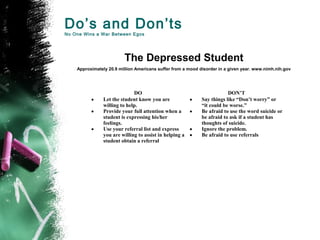
Do’s and Don’ts
No One Wins a War Between Egos
The Depressed Student
Approximately 20.9 million Americans suffer from a mood disorder in a given year. www.nimh.nih.gov
DO DON’T
• Let the student know you are
willing to help.
• Provide your full attention when a
student is expressing his/her
feelings.
• Use your referral list and express
you are willing to assist in helping a
student obtain a referral
• Say things like “Don’t worry” or
“it could be worse.”
• Be afraid to use the word suicide or
be afraid to ask if a student has
thoughts of suicide.
• Ignore the problem.
• Be afraid to use referrals
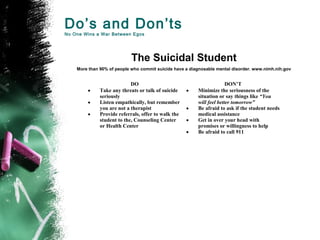
Do’s and Don’ts
No One Wins a War Between Egos
The Suicidal Student
More than 90% of people who commit suicide have a diagnosable mental disorder. www.nimh.nih.gov
DO DON’T
• Take any threats or talk of suicide
seriously
• Listen empathically, but remember
you are not a therapist
• Provide referrals, offer to walk the
student to the, Counseling Center
or Health Center
• Minimize the seriousness of the
situation or say things like “You
will feel better tomorrow”
• Be afraid to ask if the student needs
medical assistance
• Get in over your head with
promises or willingness to help
• Be afraid to call 911
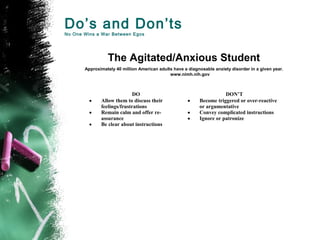
Do’s and Don’ts
No One Wins a War Between Egos
The Agitated/Anxious Student
Approximately 40 million American adults have a diagnosable anxiety disorder in a given year.
www.nimh.nih.gov
DO DON’T
• Allow them to discuss their
feelings/frustrations
• Remain calm and offer re-
assurance
• Be clear about instructions
• Become triggered or over-reactive
or argumentative
• Convey complicated instructions
• Ignore or patronize
Do’s and Don’ts
No One Wins a War Between Egos
The Aggressive/Violent Student
If you are between the ages of 12 and 24 you face the highest risk of being a victim of violence.
www.apahelpcenter.org
DO DON’T
• Remain calm
• Calmly acknowledge the person’s
anger/frustration, “I can see you
are very upset, I will try to assist you
as best I can”
• Remember you have the right to
call for help
• Stay in open areas
• Ignore warning signs of violence,
e.g. yelling/screaming, clenched
fists, statements like “I’m warning
you”
• Become hostile yourself
• Threaten, taunt, ignore or corner
the person, or get into an arguing
match
• Be afraid to call 911
• EVER TOUCH THE PERSON
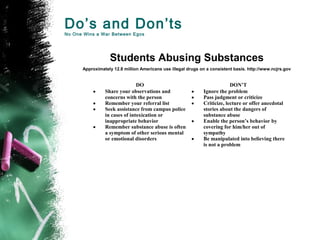
Do’s and Don’ts
No One Wins a War Between Egos
Students Abusing Substances
Approximately 12.8 million Americans use illegal drugs on a consistent basis. http://www.ncjrs.gov
DO DON’T
• Share your observations and
concerns with the person
• Remember your referral list
• Seek assistance from campus police
in cases of intoxication or
inappropriate behavior
• Remember substance abuse is often
a symptom of other serious mental
or emotional disorders
• Ignore the problem
• Pass judgment or criticize
• Criticize, lecture or offer anecdotal
stories about the dangers of
substance abuse
• Enable the person’s behavior by
covering for him/her out of
sympathy
• Be manipulated into believing there
is not a problem
Do’s and Don’ts
No One Wins a War Between Egos
The Delusional/Psychotic Student
Approximately 2.4 million American adults suffer from schizophrenia in a given year. www.nimh.nih.gov
DO DON’T
• Express compassion but do not
offer support outside of
professional boundaries
• Maintain a gentle but firm and
steady tone of voice
• Call for help if you feel you are in
danger
• Be specific about what you are
asking of a student or what
behavior is expected
• Challenge or agree with illogical
beliefs
• Panic
• Make fun of or belittle illogical
beliefs
• Play along with the bizarre
behavior
• Offer to be the student’s friend
• Joke with the student or attempt to
be funny to de-escalate the
situation
Tips on Communication
• Listen to students and show interest when they are expressing
concerns or needing assistance. It is true that we are all busy, but sometimes
pausing to address a student with your full attention will mitigate future problems for both the
student and you.
• Use friendly, open ended questions. “What can I do for you?” “How can I help?”
“What other resources have you looked into?”
• Reflect back what you heard when a students express concerns or
asks questions. “So I am hearing you say…”, “Am I correct in understanding…”, “Help
me see if I understand”.
• Be aware of the non-verbal messages you are sending. Use direct eye
contact, be aware of your posture and hand gestures. Communicate with an open posture.
• Remove objects from between you and the student whenever
possible. Sitting across from a student with a desk or table between you can often be
intimidating. If you do not wish to demonstrate a position of authority, try to remove any barriers.
• Remember you can model good communication skills. Learning
effective interpersonal communication skills is a developmental endeavor. One does not just
become a good communicator over night. You can help in the learning process by setting a
good example.
•
Tips on Communication
• Be aware and respectful of how you address students. Referring to
students as “kids” or using other derogatory or demeaning descriptors is not only offensive and
inappropriate; it can also lead students to feel alienated or inferior.
• Remember a University is a learning environment. Learning new skills is
not confined to the classroom. Students learn valuable lessons on how to effectively
communicate by interacting with you and others on campus. Though what you have to teach
may not be considered “academic” in nature, the skills you model will impact a student’s future
interactions with the world.
• Use “I” statements. When working through conflict or a situation of miscommunication,
using “I” statements will prevent the potential of engaging in the “Blame Game”. “I feel like I am
not making myself clear” sounds much better than “You are not listening to me”.
• Be gracious. And remember most of the time, students exhibit signs of distress when they
are scared or feel helpless. Showing compassion for their fears while maintaining a professional
helpful demeanor will alleviate most anxiety.
• Smile. Remember, a smile goes a long way. A genuine smile goes even further.
Tips for the Classroom
Setting the Tone for a Productive and Respectful Learning Environment
• Articulate clear classroom expectations in the
syllabus, and review during the first class
• Develop agreements as a class during the first
session
• Respond to problems quickly and consistently
• Look to non-disruptive students for cues: is the
class following material?
Addressing Disruptive Behavior
• Do not wait for patterns to form. Address
concerns immediately
• Correct innocent mistakes and minor first
offenses gently
• Give a general word of caution to class
• If possible, speak with the student after class
• When necessary, correct the student
courteously and indicate that further discussion
can occur after class
• Documentation and Warnings
Addressing Disruptive Behavior
• Consult your Department Chair or other
colleagues for guidance and suggestions
• In the face of persistent disruption, you may ask
the student to leave class for the remainder of
the period. In instances where a student is
asked to leave the class make sure to
document the time, date and circumstance and
inform the Department Chair.
• If there is threat of violence or other unlawful
behavior, call Campus Police 303-556-5000 (6-
5000)
Resources and Referrals
• When considering a referral for a student, it is very important to
remember that students may be hesitant to the idea of
assistance. Unfortunately, there is still a stigma attached to
mental health counseling or even academic skills assistance
which prevents many students from taking advantage of the
many different resources our campus offers. The UC Denver
Student and Community Counseling Center offers more than
just mental/emotional health counseling. The following is a short
list of the many services the center provides:
 Individual, Couples, and Family Counseling
 Groups on various topics including, “How to Quit Smoking”, “How Reduce
Stress”, “How to Maintain a Relationship” etc.
 Tips on reducing test anxiety and how to study better
 Learning disability assessment
When to Consult with Community
Standards?
• After initial attempts to address the behavior
have failed
• You know that you cannot handle the behavior
• You believe personality differences will interfere
with your ability to resolve the situation
• You are unsure how to proceed
How to Make a Report or Referral to
Community Standards?
• Submit the “Student of Concern” form at
https://cudenver-jams.symplicity.com/care_report/
• Document the situation in writing, including your
attempts to resolve it
 Dates, times and locations
 What was said and by whom
• Call 303-556-3682 for assistance
What to Expect
• Our response will vary greatly depending on:
 Nature and Severity of the behaviors and concerns
 Actions and attempts made by faculty/staff to address
concerns
 Determination of Code of Conduct Violation
• Our response may include:
 Summary Suspension or other immediate action
where there is an immediate threat
 Conduct hearing and/or mediated conversation with
student and faculty
 Consultation and guidance
 Referral to Chair or Dean for Academic Review
Our goal is to resolve issues informally whenever
possible.
Food For Thought
• Encourage faculty and instructors to document
incidents and concerns in writing
 Second and third hand reports can present numerous
challenges
• Reports should address concerns directly – if there is a
concern it needs to be expressed as a concern
 Objectivity is essential in documenting classroom
disruption
• The report should be very factual and void of personal
opinions and feelings
• Detail, detail, detail. The more details included in the
report that easier it is to make an informed decision.
Food For Thought
• Encourage faculty and staff to read and
understand the Code of Conduct
 Some concerns in the classroom do not necessarily fit
into this code and may need to be evaluated in more
than one context
• One common example of this is in creative expression
that may touch on disturbing or violent subject matter
– How are expectations about what is acceptable and limitations
about such expression communicated to students?
– Is there a policy or statement in the syllabus?
– Who should review this content and using what scale?
On the Horizon
• B.E.T.A. Team – 303-817-2813
 New Resource to help support faculty and staff
working with disruptive and distressed students
• Members from counseling, faculty, HR, Student
Life, Disability Services, Legal, etc.
• Updated Code of Conduct and new Classroom
Behavior Policies
 Policies and procedures are being updated and
expanded to address current issues and realities
• Training Workshops for Faculty addressing
 classroom disruptions, emergency preparedness
and mental health referrals
Contacts and Resources
Community Standards and Wellness
Larry Loften - 303-556-3682
Dean of Students
Samantha Ortiz - 303-556-3399
Auraria Campus Police
303-556-5000
Counseling Center
303-556-4372
Behavioral Evaluation and Threat Assessment Team
Faculty and Staff Resources Online
http://thunder1.cudenver.edu//campussafety/facultystaff.html
http://thunder1.cudenver.edu/CFD/

Classroom disruption

  • 1.
    Difficult Students, Disruptive Studentsand Students in Distress: Tools for Maintaining a Successful Learning Environment Presented by Paul Rakowski and Larry Loften Adapted in part from Ohio State University
  • 2.
    Definitions (basic) Disruptive Students Students whose behavior makes teaching and learning difficult for others in the class Distressed students  Students who are experiencing emotional and/or psychological problems that are interfering with their ability to learn Difficult Students  Suggestions for best wording now being accepted
  • 3.
    Goals for thisSession • Faculty will: • Gain a clear understanding of their role as stewards of the learning environment • Begin to Recognize signs and symptoms of various mental health concerns • Gain an understanding of how to assist students in distress and access resources on campus including: • Counseling Center • Behavioral Evaluation and Threat Assessment Team • Community Standards/Conduct Process • Peers and Colleagues • Learn basic skills for how to de-escalate a situation
  • 4.
    Your Role • Oftenthe first to recognize that a student needs help • Important to have knowledge of campus and community resources for referral • Responsibility to maintain appropriate learning environment
  • 5.
    Disruptive Behavior – Whatis it? • Habitual interference with classroom environment • Persistent and unreasonable demands for time and attention both in and out of the classroom • Intimidating or harassing another person through words and/or actions • Refusal to comply with faculty or staff direction • Threats of physical violence
  • 6.
    • Cultural differences •Most disagreements or differences of opinion • Situational frustration • Needing extra time or attention for a special reason Disruptive Behavior – What isn’t it?
  • 7.
    Other Behaviors • Oftennot disruptive but may be an indicator that there other issues at play • Potential warning signs/indicators  Marked changes in behavior/attitude  Depression and Lethargy  Hyperactivity  Deterioration of Personal Hygiene  References to suicide/homicide  Strange or bizarre behavior
  • 8.
    Disruptive Behavior • Takesmany forms, varying in severity… Being late, reading the paper, sleeping Physical violence Making noise, repeatedly interrupting Personal insults, harassment Passing notes, answering cell phone, texting
  • 9.
    Causes of DisruptiveBehavior • Underlying psychological or mental health concerns • Confusion about class expectations and/or material • Difficult transition to college norms • Lack of or underdeveloped social skills
  • 10.
    Signs of Stress/Distress •Depression - noted changes in dress/demeanor, sadness, crying, lack of energy, sleeping in class, withdrawal from others, infrequent class attendance, poor academic performance, procrastination. • Agitation – nervousness, hurried speech, erratic hand gestures or non-verbal communication, aggressive behavior. • Anxiety – excessive worry, procrastination, hyper-vigilance, irritably, overly dependent. Physical signs include panic attacks, hyperventilation, excessive perspiration, stomach upset, gastrointestinal distress. • Aggression – Explosive and/or aggressive outbursts, violence or threats of violence toward others, over-reactivity, hostility toward others without provocation, harsh judgments toward others without reasonable foundation, disrespect toward others, particularly authority figures.
  • 11.
    Signs of Stress/Distress •Violence – Extremely aggressive behavior, yelling, harmful physical contact, harmful threats or actions toward self or others, erratic behavior. • Delusions, Poor contact with reality – Difficulty distinguishing fantasy from reality, confused thinking, seeing/hearing/tasting odd things, descriptions of hearing internal voices, illogical speech, bizarre behavior. • Substance Abuse – Physical signs of intoxication, slurred speech, hyperactivity, excessive perspiration, depressed mood. • Suicidal Expression – Expressed plan of suicide, talk of not wanting to be alive, talk of feelings that no one cares, expressed feelings of hopelessness/alienation/isolation, history of alcohol or substance abuse.
  • 12.
    Do’s and Don’ts NoOne Wins a War Between Egos The Depressed Student Approximately 20.9 million Americans suffer from a mood disorder in a given year. www.nimh.nih.gov DO DON’T • Let the student know you are willing to help. • Provide your full attention when a student is expressing his/her feelings. • Use your referral list and express you are willing to assist in helping a student obtain a referral • Say things like “Don’t worry” or “it could be worse.” • Be afraid to use the word suicide or be afraid to ask if a student has thoughts of suicide. • Ignore the problem. • Be afraid to use referrals
  • 13.
    Do’s and Don’ts NoOne Wins a War Between Egos The Suicidal Student More than 90% of people who commit suicide have a diagnosable mental disorder. www.nimh.nih.gov DO DON’T • Take any threats or talk of suicide seriously • Listen empathically, but remember you are not a therapist • Provide referrals, offer to walk the student to the, Counseling Center or Health Center • Minimize the seriousness of the situation or say things like “You will feel better tomorrow” • Be afraid to ask if the student needs medical assistance • Get in over your head with promises or willingness to help • Be afraid to call 911
  • 14.
    Do’s and Don’ts NoOne Wins a War Between Egos The Agitated/Anxious Student Approximately 40 million American adults have a diagnosable anxiety disorder in a given year. www.nimh.nih.gov DO DON’T • Allow them to discuss their feelings/frustrations • Remain calm and offer re- assurance • Be clear about instructions • Become triggered or over-reactive or argumentative • Convey complicated instructions • Ignore or patronize
  • 15.
    Do’s and Don’ts NoOne Wins a War Between Egos The Aggressive/Violent Student If you are between the ages of 12 and 24 you face the highest risk of being a victim of violence. www.apahelpcenter.org DO DON’T • Remain calm • Calmly acknowledge the person’s anger/frustration, “I can see you are very upset, I will try to assist you as best I can” • Remember you have the right to call for help • Stay in open areas • Ignore warning signs of violence, e.g. yelling/screaming, clenched fists, statements like “I’m warning you” • Become hostile yourself • Threaten, taunt, ignore or corner the person, or get into an arguing match • Be afraid to call 911 • EVER TOUCH THE PERSON
  • 16.
    Do’s and Don’ts NoOne Wins a War Between Egos Students Abusing Substances Approximately 12.8 million Americans use illegal drugs on a consistent basis. http://www.ncjrs.gov DO DON’T • Share your observations and concerns with the person • Remember your referral list • Seek assistance from campus police in cases of intoxication or inappropriate behavior • Remember substance abuse is often a symptom of other serious mental or emotional disorders • Ignore the problem • Pass judgment or criticize • Criticize, lecture or offer anecdotal stories about the dangers of substance abuse • Enable the person’s behavior by covering for him/her out of sympathy • Be manipulated into believing there is not a problem
  • 17.
    Do’s and Don’ts NoOne Wins a War Between Egos The Delusional/Psychotic Student Approximately 2.4 million American adults suffer from schizophrenia in a given year. www.nimh.nih.gov DO DON’T • Express compassion but do not offer support outside of professional boundaries • Maintain a gentle but firm and steady tone of voice • Call for help if you feel you are in danger • Be specific about what you are asking of a student or what behavior is expected • Challenge or agree with illogical beliefs • Panic • Make fun of or belittle illogical beliefs • Play along with the bizarre behavior • Offer to be the student’s friend • Joke with the student or attempt to be funny to de-escalate the situation
  • 18.
    Tips on Communication •Listen to students and show interest when they are expressing concerns or needing assistance. It is true that we are all busy, but sometimes pausing to address a student with your full attention will mitigate future problems for both the student and you. • Use friendly, open ended questions. “What can I do for you?” “How can I help?” “What other resources have you looked into?” • Reflect back what you heard when a students express concerns or asks questions. “So I am hearing you say…”, “Am I correct in understanding…”, “Help me see if I understand”. • Be aware of the non-verbal messages you are sending. Use direct eye contact, be aware of your posture and hand gestures. Communicate with an open posture. • Remove objects from between you and the student whenever possible. Sitting across from a student with a desk or table between you can often be intimidating. If you do not wish to demonstrate a position of authority, try to remove any barriers. • Remember you can model good communication skills. Learning effective interpersonal communication skills is a developmental endeavor. One does not just become a good communicator over night. You can help in the learning process by setting a good example. •
  • 19.
    Tips on Communication •Be aware and respectful of how you address students. Referring to students as “kids” or using other derogatory or demeaning descriptors is not only offensive and inappropriate; it can also lead students to feel alienated or inferior. • Remember a University is a learning environment. Learning new skills is not confined to the classroom. Students learn valuable lessons on how to effectively communicate by interacting with you and others on campus. Though what you have to teach may not be considered “academic” in nature, the skills you model will impact a student’s future interactions with the world. • Use “I” statements. When working through conflict or a situation of miscommunication, using “I” statements will prevent the potential of engaging in the “Blame Game”. “I feel like I am not making myself clear” sounds much better than “You are not listening to me”. • Be gracious. And remember most of the time, students exhibit signs of distress when they are scared or feel helpless. Showing compassion for their fears while maintaining a professional helpful demeanor will alleviate most anxiety. • Smile. Remember, a smile goes a long way. A genuine smile goes even further.
  • 20.
    Tips for theClassroom Setting the Tone for a Productive and Respectful Learning Environment • Articulate clear classroom expectations in the syllabus, and review during the first class • Develop agreements as a class during the first session • Respond to problems quickly and consistently • Look to non-disruptive students for cues: is the class following material?
  • 21.
    Addressing Disruptive Behavior •Do not wait for patterns to form. Address concerns immediately • Correct innocent mistakes and minor first offenses gently • Give a general word of caution to class • If possible, speak with the student after class • When necessary, correct the student courteously and indicate that further discussion can occur after class • Documentation and Warnings
  • 22.
    Addressing Disruptive Behavior •Consult your Department Chair or other colleagues for guidance and suggestions • In the face of persistent disruption, you may ask the student to leave class for the remainder of the period. In instances where a student is asked to leave the class make sure to document the time, date and circumstance and inform the Department Chair. • If there is threat of violence or other unlawful behavior, call Campus Police 303-556-5000 (6- 5000)
  • 23.
    Resources and Referrals •When considering a referral for a student, it is very important to remember that students may be hesitant to the idea of assistance. Unfortunately, there is still a stigma attached to mental health counseling or even academic skills assistance which prevents many students from taking advantage of the many different resources our campus offers. The UC Denver Student and Community Counseling Center offers more than just mental/emotional health counseling. The following is a short list of the many services the center provides:  Individual, Couples, and Family Counseling  Groups on various topics including, “How to Quit Smoking”, “How Reduce Stress”, “How to Maintain a Relationship” etc.  Tips on reducing test anxiety and how to study better  Learning disability assessment
  • 24.
    When to Consultwith Community Standards? • After initial attempts to address the behavior have failed • You know that you cannot handle the behavior • You believe personality differences will interfere with your ability to resolve the situation • You are unsure how to proceed
  • 25.
    How to Makea Report or Referral to Community Standards? • Submit the “Student of Concern” form at https://cudenver-jams.symplicity.com/care_report/ • Document the situation in writing, including your attempts to resolve it  Dates, times and locations  What was said and by whom • Call 303-556-3682 for assistance
  • 26.
    What to Expect •Our response will vary greatly depending on:  Nature and Severity of the behaviors and concerns  Actions and attempts made by faculty/staff to address concerns  Determination of Code of Conduct Violation • Our response may include:  Summary Suspension or other immediate action where there is an immediate threat  Conduct hearing and/or mediated conversation with student and faculty  Consultation and guidance  Referral to Chair or Dean for Academic Review Our goal is to resolve issues informally whenever possible.
  • 27.
    Food For Thought •Encourage faculty and instructors to document incidents and concerns in writing  Second and third hand reports can present numerous challenges • Reports should address concerns directly – if there is a concern it needs to be expressed as a concern  Objectivity is essential in documenting classroom disruption • The report should be very factual and void of personal opinions and feelings • Detail, detail, detail. The more details included in the report that easier it is to make an informed decision.
  • 28.
    Food For Thought •Encourage faculty and staff to read and understand the Code of Conduct  Some concerns in the classroom do not necessarily fit into this code and may need to be evaluated in more than one context • One common example of this is in creative expression that may touch on disturbing or violent subject matter – How are expectations about what is acceptable and limitations about such expression communicated to students? – Is there a policy or statement in the syllabus? – Who should review this content and using what scale?
  • 29.
    On the Horizon •B.E.T.A. Team – 303-817-2813  New Resource to help support faculty and staff working with disruptive and distressed students • Members from counseling, faculty, HR, Student Life, Disability Services, Legal, etc. • Updated Code of Conduct and new Classroom Behavior Policies  Policies and procedures are being updated and expanded to address current issues and realities • Training Workshops for Faculty addressing  classroom disruptions, emergency preparedness and mental health referrals
  • 30.
    Contacts and Resources CommunityStandards and Wellness Larry Loften - 303-556-3682 Dean of Students Samantha Ortiz - 303-556-3399 Auraria Campus Police 303-556-5000 Counseling Center 303-556-4372 Behavioral Evaluation and Threat Assessment Team Faculty and Staff Resources Online http://thunder1.cudenver.edu//campussafety/facultystaff.html http://thunder1.cudenver.edu/CFD/