APPLIED
LINGUISTICS
What is Applied Linguistics?
(Definitions)
■ Applied linguistics is not easy to define.
■ In fact, those who practice applied linguistics do not agree upon a
certain definition.
■ The definition problem is due to the lack of agreement on what is
that to be applied?
Widdowson (1998, 2000,
2004, 2005)
He has argued over a decade that applied linguistics is not an
interdisciplinary discipline as much as a mediating field or
domain between the theoretical plane of linguistics and
language knowledge on the one hand and its applications to
problems that arise in a number of real-world settings.
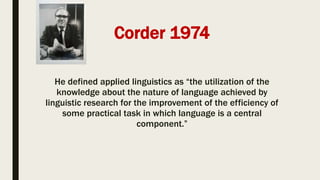
Corder 1974
He defined applied linguistics as “the utilization of the
knowledge about the nature of language achieved by
linguistic research for the improvement of the efficiency of
some practical task in which language is a central
component.”
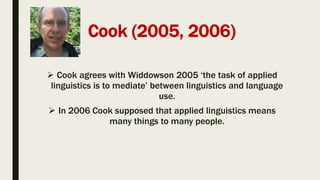
Cook (2005, 2006)
 Cook agrees with Widdowson 2005 ‘the task of applied
linguistics is to mediate’ between linguistics and language
use.
 In 2006 Cook supposed that applied linguistics means
many things to many people.
Spolsky (2005)
He defined the discipline by looking at the professionals
involved in its study “Applied Linguistics [is now] a cover term
for a sizeable group of semi-autonomous disciplines, each
dividing its parentage and allegiances between the formal
study of language and other relevant fields, and each working
to develop its own methodologies and principles”.
Development of Applied
Linguistics
1948 1950s 1960s
1970s 1980s 1990s
1948
■ A realistic history of the field of applied linguistics would place its origins at around
the year 1948 with the publication of the first issue of the journal Language
Learning: A Journal of Applied Linguistics (cf. Davies, 1999; Kaplan, elsewhere in
this volume). Although there are certainly other possible starting points,
particularly from a British perspective, this dating still accords roughly with most
discussions of the beginning of applied linguistics.
1950
■ Over the years, the term applied linguistics has been defined and interpreted in a
number of different ways. In the 1950s, the term was commonly meant to reflect
the insights of structural and functional linguists that could be applied directly to
second language teaching, first language (L1) literacy and language arts issues as
well.
1960
■ In the 1960s, the term broadened to cover matters of language assessment,
language policies, and the new field of second language acquisition (SLA), focusing
on learning, rather than on teaching (Ortega, 2009).
1970
■ In the 1970s, the field of applied linguistics was accompanied by more overt
specification of its role as a discipline that addresses real-world language-based
problems such as language assessment, SLA, L2 literacy, multilingualism,
language-minority rights, language policy and planning, and language teacher
training (Kaplan, 1980; Widdowson, 1979/1984). Although the focus on language
teaching remained central to the discipline.
1980
■ In the 1980s, applied linguistics truly extended in a systematic way to encompass
language assessment, language policy and planning, language use issues in
professional settings, translation, lexicography, bilingualism and multilingualism,
language and technology, and corpus linguistics.
1990
■ By the beginning of the 1990s, a common trend was emerging to view applied
linguistics as incorporating many subfields and drawing on many supporting
disciplines in addition to linguistics (e.g., anthropology; education; English studies;
modern languages; policy studies; political sciences; psychology; public
administration; and sociology). Combined with these two foundations (subfields
and supporting disciplines) was the view of applied linguistics as problem driven
and real-world based rather than theory driven and disconnected from real
language use data (Davies, 1999; Kaplan and Widdowson, 1992; Strevens, 1992).
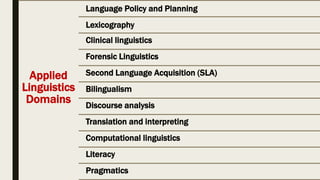
Applied
Linguistics
Domains
Language Policy and Planning
Lexicography
Clinical linguistics
Forensic Linguistics
Second Language Acquisition (SLA)
Bilingualism
Discourse analysis
Translation and interpreting
Computational linguistics
Literacy
Pragmatics
Language Policy and Planning (LPP)
■ is defined as large-scale national planning, usually undertaken by governments,
meant to influence, if not change, ways of speaking or literacy practices within a
society (Baldauf, 2006 [5]). The modern history of this discipline can be described
in terms of three main stages (Ricento 2000): (i) the language problems of newly
independent states could be solved via the implementation of rational and
systematic procedures; (ii) a more critical and reflexive appreciation of the role that
language and linguists play in society; and (iii) a growing sense that LPP needs to
be reconstituted as a multidisciplinary and politicized approach, since the issues it
grapples with are complex and represent interests that can pervade multiple levels
of social life, ranging from the individual to the state and across state boundaries
as well.
Lexicography
■ is an area of applied linguistics that focuses on the compilation of dictionaries
(practical lexicography) as well as on the description of the various types of
relations found in the lexicon (theoretical lexicography). It is the science concerned
with the theory and practice of dictionaries. Historians generally agree that the first
dictionaries can be traced back to the explanations of difficult words inserted into
Latin manuscripts in the middle ages.
Clinical linguistics
■ involves the study of how language and communication may be impaired. In its
most applied sense it focuses on the use of linguistics to describe, analyze, assess,
diagnose and treat communication disorders (e.g. Crystal 1981). A major
milestone in putting the study and treatment of communication disorders on a
more scientific footing, based on the discipline of linguistics, was Roman Jakobson
in 1941.
Forensic Linguistics
■ is "the field of the provision of linguistic evidence" which includes phonetic,
syntactic, lexical, handwriting, discourse and sociolinguistic analyses (J. Gibbons).
Linguists with specialisms ranging from phonetics to pragmatics can perform
tasks as fundamental as informing decisions about whether an illegal activity has
occurred. Forensic linguistics is so new and diverse that its history is still being
written.
Second Language Acquisition (SLA)
■ This field is a branch of applied linguistics that has a history extending over half a
century. It investigates the human capacity to learn additional languages during
late childhood, adolescence, or adulthood, once the first language have been
acquired. SLA shares its interest in explaining human language development with
two other fields. These are Bilingual First Language Acquisition (BFLA), and First
Language Acquisition (FLA).
Bilingualism
■ is ‘the ability of societies, institutions, groups and individuals to engage, on a
regular basis, with more than one language in their day-to-day lives’ (European
Commission 2007: 6). The relationship between multilingualism and applied
linguistics is that research in applied linguistics deals with real-world problems
related to language, and while multilingualism is not a problem in itself but a
traditional monolingual view has seen multilingualism as a problem (Auer and Li
2007). Multilingualism is related to many areas of applied linguistics including
cognitive issues and socioeducational issues.
Discourse analysis
■ Discourse can be defined as a stretch of language in use, of any length and in any
mode, which achieves meaning and coherence for those involved. Discourse
analysis can be defined as the use and development of theories and methods
which elucidate how this meaning and coherence is achieved. Applied linguistics
discourse analysts have espoused and also developed a wide range of approaches
to language beyond linguistics. These have included pragmatics, schema theory,
conversation analysis, ethnography, semiotics, multimodal analysis, literary theory,
rhetoric, genre analysis, and social theory
Translation and interpreting
■ are forms of linguistic mediation that involve rendering written or oral text from
one language to another. As language-based activities that have practical
implications, they are often seen as falling within the remit of applied linguistics.
The academic study of translation and interpreting dates back only to the middle
of the twentieth century
Computational linguistics
■ is a field ranges between linguistics and computer science with the help of
psychology and logic. It uses computers to simplify treating with linguistic issues
(McGuigan, 2006). Computational linguistics is still considered a new field.
Researchers of C.L. are divided into two teams: One of them apply their experience
in computer science to linguistics showing people what they should know in order
to understand a natural language, how they find this knowledge and how they
should use this knowledge. The second apply their experience in linguistics to
computer science so that computers can understand everyday human language
and translation. They also deal with computers linguistically under the name of
natural language processing NLP (Wintner, 2004).
literacy
■ The term literacy in its narrowest sense is “the ability to read and write”. Literacy in
the broad interpretation, on the other hand, examines the deployment of literacy
practices in society, and has its origins in sociology and anthropology. Literacy
comes under the remit of applied linguistics as it represent some of the more
recent shifts that have moved away from an emphasis on so-called ‘problems’ and
towards an understanding that all language and literacy practices are situated
within particular social, historical, political contexts and are therefore potential
resources which might be differentially valued and supported depending on
situation, place, audience, and goals.
Pragmatics
■ Pragmatics is the study of language use and its object is meaning in use.
Pragmatics theories can be used in analyzing language problems and therefor it
can be used as a tool in applied linguistics researches.

Applied linguistics: overview

  • 1.
  • 2.
    What is AppliedLinguistics? (Definitions) ■ Applied linguistics is not easy to define. ■ In fact, those who practice applied linguistics do not agree upon a certain definition. ■ The definition problem is due to the lack of agreement on what is that to be applied?
  • 3.
    Widdowson (1998, 2000, 2004,2005) He has argued over a decade that applied linguistics is not an interdisciplinary discipline as much as a mediating field or domain between the theoretical plane of linguistics and language knowledge on the one hand and its applications to problems that arise in a number of real-world settings.
  • 4.
    Corder 1974 He definedapplied linguistics as “the utilization of the knowledge about the nature of language achieved by linguistic research for the improvement of the efficiency of some practical task in which language is a central component.”
  • 5.
    Cook (2005, 2006) Cook agrees with Widdowson 2005 ‘the task of applied linguistics is to mediate’ between linguistics and language use.  In 2006 Cook supposed that applied linguistics means many things to many people.
  • 6.
    Spolsky (2005) He definedthe discipline by looking at the professionals involved in its study “Applied Linguistics [is now] a cover term for a sizeable group of semi-autonomous disciplines, each dividing its parentage and allegiances between the formal study of language and other relevant fields, and each working to develop its own methodologies and principles”.
  • 7.
    Development of Applied Linguistics 19481950s 1960s 1970s 1980s 1990s
  • 8.
    1948 ■ A realistichistory of the field of applied linguistics would place its origins at around the year 1948 with the publication of the first issue of the journal Language Learning: A Journal of Applied Linguistics (cf. Davies, 1999; Kaplan, elsewhere in this volume). Although there are certainly other possible starting points, particularly from a British perspective, this dating still accords roughly with most discussions of the beginning of applied linguistics.
  • 9.
    1950 ■ Over theyears, the term applied linguistics has been defined and interpreted in a number of different ways. In the 1950s, the term was commonly meant to reflect the insights of structural and functional linguists that could be applied directly to second language teaching, first language (L1) literacy and language arts issues as well.
  • 10.
    1960 ■ In the1960s, the term broadened to cover matters of language assessment, language policies, and the new field of second language acquisition (SLA), focusing on learning, rather than on teaching (Ortega, 2009).
  • 11.
    1970 ■ In the1970s, the field of applied linguistics was accompanied by more overt specification of its role as a discipline that addresses real-world language-based problems such as language assessment, SLA, L2 literacy, multilingualism, language-minority rights, language policy and planning, and language teacher training (Kaplan, 1980; Widdowson, 1979/1984). Although the focus on language teaching remained central to the discipline.
  • 12.
    1980 ■ In the1980s, applied linguistics truly extended in a systematic way to encompass language assessment, language policy and planning, language use issues in professional settings, translation, lexicography, bilingualism and multilingualism, language and technology, and corpus linguistics.
  • 13.
    1990 ■ By thebeginning of the 1990s, a common trend was emerging to view applied linguistics as incorporating many subfields and drawing on many supporting disciplines in addition to linguistics (e.g., anthropology; education; English studies; modern languages; policy studies; political sciences; psychology; public administration; and sociology). Combined with these two foundations (subfields and supporting disciplines) was the view of applied linguistics as problem driven and real-world based rather than theory driven and disconnected from real language use data (Davies, 1999; Kaplan and Widdowson, 1992; Strevens, 1992).
  • 14.
    Applied Linguistics Domains Language Policy andPlanning Lexicography Clinical linguistics Forensic Linguistics Second Language Acquisition (SLA) Bilingualism Discourse analysis Translation and interpreting Computational linguistics Literacy Pragmatics
  • 15.
    Language Policy andPlanning (LPP) ■ is defined as large-scale national planning, usually undertaken by governments, meant to influence, if not change, ways of speaking or literacy practices within a society (Baldauf, 2006 [5]). The modern history of this discipline can be described in terms of three main stages (Ricento 2000): (i) the language problems of newly independent states could be solved via the implementation of rational and systematic procedures; (ii) a more critical and reflexive appreciation of the role that language and linguists play in society; and (iii) a growing sense that LPP needs to be reconstituted as a multidisciplinary and politicized approach, since the issues it grapples with are complex and represent interests that can pervade multiple levels of social life, ranging from the individual to the state and across state boundaries as well.
  • 16.
    Lexicography ■ is anarea of applied linguistics that focuses on the compilation of dictionaries (practical lexicography) as well as on the description of the various types of relations found in the lexicon (theoretical lexicography). It is the science concerned with the theory and practice of dictionaries. Historians generally agree that the first dictionaries can be traced back to the explanations of difficult words inserted into Latin manuscripts in the middle ages.
  • 17.
    Clinical linguistics ■ involvesthe study of how language and communication may be impaired. In its most applied sense it focuses on the use of linguistics to describe, analyze, assess, diagnose and treat communication disorders (e.g. Crystal 1981). A major milestone in putting the study and treatment of communication disorders on a more scientific footing, based on the discipline of linguistics, was Roman Jakobson in 1941.
  • 18.
    Forensic Linguistics ■ is"the field of the provision of linguistic evidence" which includes phonetic, syntactic, lexical, handwriting, discourse and sociolinguistic analyses (J. Gibbons). Linguists with specialisms ranging from phonetics to pragmatics can perform tasks as fundamental as informing decisions about whether an illegal activity has occurred. Forensic linguistics is so new and diverse that its history is still being written.
  • 19.
    Second Language Acquisition(SLA) ■ This field is a branch of applied linguistics that has a history extending over half a century. It investigates the human capacity to learn additional languages during late childhood, adolescence, or adulthood, once the first language have been acquired. SLA shares its interest in explaining human language development with two other fields. These are Bilingual First Language Acquisition (BFLA), and First Language Acquisition (FLA).
  • 20.
    Bilingualism ■ is ‘theability of societies, institutions, groups and individuals to engage, on a regular basis, with more than one language in their day-to-day lives’ (European Commission 2007: 6). The relationship between multilingualism and applied linguistics is that research in applied linguistics deals with real-world problems related to language, and while multilingualism is not a problem in itself but a traditional monolingual view has seen multilingualism as a problem (Auer and Li 2007). Multilingualism is related to many areas of applied linguistics including cognitive issues and socioeducational issues.
  • 21.
    Discourse analysis ■ Discoursecan be defined as a stretch of language in use, of any length and in any mode, which achieves meaning and coherence for those involved. Discourse analysis can be defined as the use and development of theories and methods which elucidate how this meaning and coherence is achieved. Applied linguistics discourse analysts have espoused and also developed a wide range of approaches to language beyond linguistics. These have included pragmatics, schema theory, conversation analysis, ethnography, semiotics, multimodal analysis, literary theory, rhetoric, genre analysis, and social theory
  • 22.
    Translation and interpreting ■are forms of linguistic mediation that involve rendering written or oral text from one language to another. As language-based activities that have practical implications, they are often seen as falling within the remit of applied linguistics. The academic study of translation and interpreting dates back only to the middle of the twentieth century
  • 23.
    Computational linguistics ■ isa field ranges between linguistics and computer science with the help of psychology and logic. It uses computers to simplify treating with linguistic issues (McGuigan, 2006). Computational linguistics is still considered a new field. Researchers of C.L. are divided into two teams: One of them apply their experience in computer science to linguistics showing people what they should know in order to understand a natural language, how they find this knowledge and how they should use this knowledge. The second apply their experience in linguistics to computer science so that computers can understand everyday human language and translation. They also deal with computers linguistically under the name of natural language processing NLP (Wintner, 2004).
  • 24.
    literacy ■ The termliteracy in its narrowest sense is “the ability to read and write”. Literacy in the broad interpretation, on the other hand, examines the deployment of literacy practices in society, and has its origins in sociology and anthropology. Literacy comes under the remit of applied linguistics as it represent some of the more recent shifts that have moved away from an emphasis on so-called ‘problems’ and towards an understanding that all language and literacy practices are situated within particular social, historical, political contexts and are therefore potential resources which might be differentially valued and supported depending on situation, place, audience, and goals.
  • 25.
    Pragmatics ■ Pragmatics isthe study of language use and its object is meaning in use. Pragmatics theories can be used in analyzing language problems and therefor it can be used as a tool in applied linguistics researches.