Downloaded 82 times
![From the beginning, error analysis was beset
with methodological problems. In particular, the above
typologies are problematic: from linguistic data alone,
it is often impossible to reliably determine what kind of
error a learner is making. Also, error analysis can deal
effectively only with learner production
(speaking and writing) and not with learner reception
(listening and reading). Furthermore, it cannot account
for learner use of communicative strategies such
as avoidance[disambiguation needed], in which learners simply
do not use a form with which they are uncomfortable.
For these reasons, although error analysis is still used
to investigate specific questions in SLA, the quest for
an overarching theory of learner errors has largely
been abandoned. In the mid-1970s, Corder and others
moved on to a more wide-ranging approach to learner
language, known as interlanguage.](https://image.slidesharecdn.com/erroranalysispresentation-150406072957-conversion-gate01/85/Error-analysis-presentation-7-320.jpg)
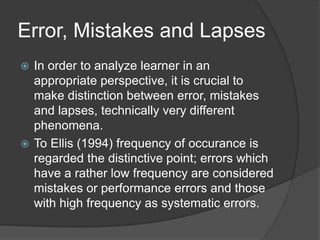
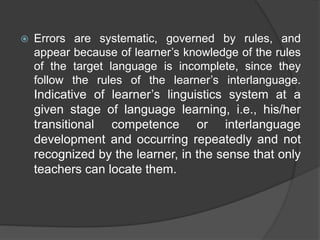
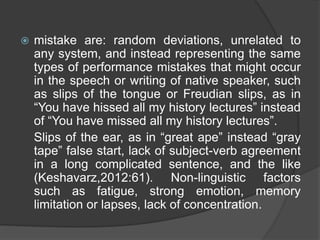
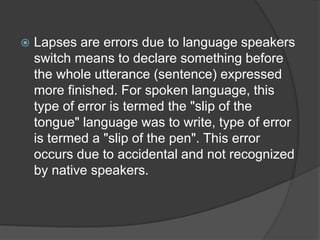


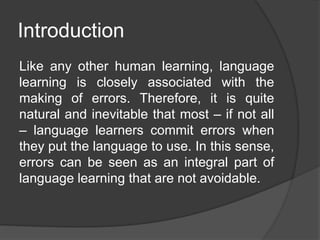
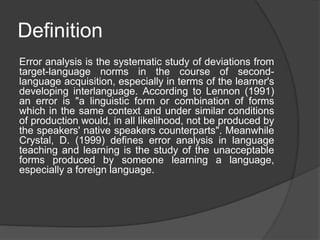
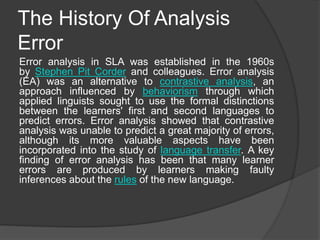
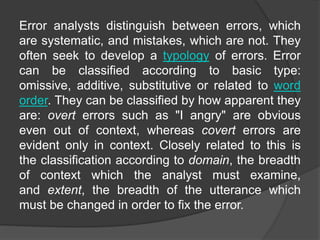
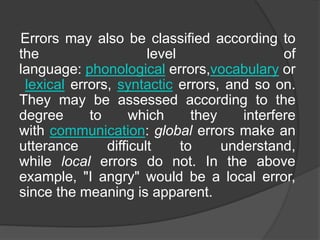
The document discusses error analysis in second language acquisition. It begins by stating that making errors is natural and inevitable in language learning. It then defines error analysis as the systematic study of deviations from target language norms during second language acquisition. The history of error analysis is discussed, noting that it was established in the 1960s as an alternative to contrastive analysis. Error analysis showed that contrastive analysis could not predict most learner errors. The document also discusses different ways of classifying errors and some methodological problems with error analysis approaches. It concludes by distinguishing between errors, mistakes, and lapses in learner language.


