Errors
Errors
 Errors not affecting trial balance
agreement
 Errors affecting trial balance agreement
Errors not affecting trial balance
agreement
E.g.
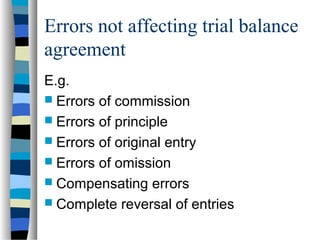
 Errors of commission
 Errors of principle
 Errors of original entry
 Errors of omission
 Compensating errors
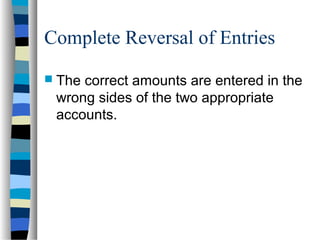
 Complete reversal of entries
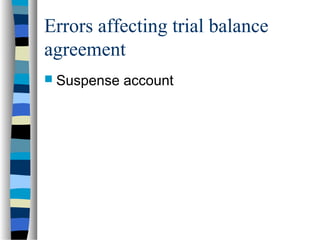
Errors affecting trial balance
agreement
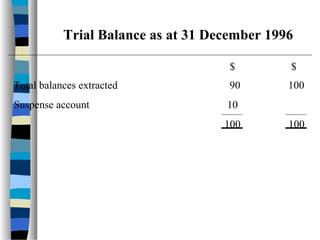
 Suspense account
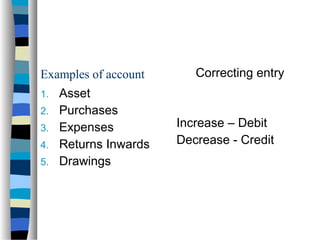
Correcting entry
1. Asset
2. Purchases
3. Expenses
4. Returns Inwards
5. Drawings
Increase – Debit
Decrease - Credit
Examples of account
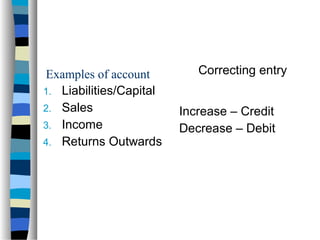
Correcting entry
1. Liabilities/Capital
2. Sales
3. Income
4. Returns Outwards
Increase – Credit
Decrease – Debit
Examples of account
Errors Not Affecting Trial
Balance Agreement
Errors of Commission
 The correct amount is entered but in a
wrong personal account
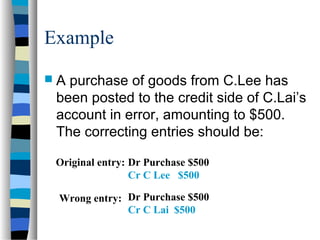
Example
 A purchase of goods from C.Lee has
been posted to the credit side of C.Lai’s
account in error, amounting to $500.
The correcting entries should be:
Original entry:
Wrong entry:
Dr Purchase $500
Cr C Lee $500
Dr Purchase $500
Cr C Lai $500
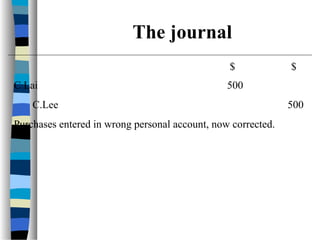
$ $
C.Lai 500
C.Lee 500
Purchases entered in wrong personal account, now corrected.
The journal
$$
C.Lee 500
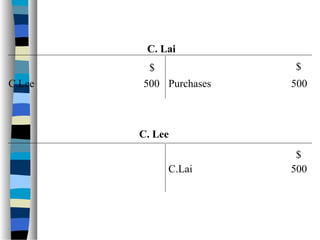
C. Lai
Purchases 500
$
C. Lee
C.Lai 500
Errors of Principle
 An item is entered in the wrong type of
account due to misunderstanding of the
nature of the item.
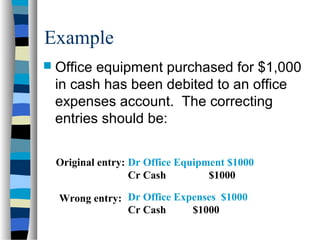
Example
 Office equipment purchased for $1,000
in cash has been debited to an office
expenses account. The correcting
entries should be:
Original entry:
Wrong entry:
Dr Office Equipment $1000
Cr Cash $1000
Dr Office Expenses $1000
Cr Cash $1000
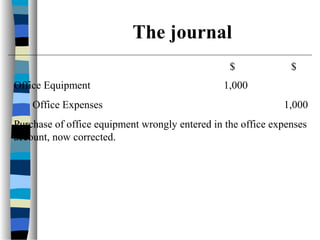
$ $
Office Equipment 1,000
Office Expenses 1,000
Purchase of office equipment wrongly entered in the office expenses
account, now corrected.
The journal
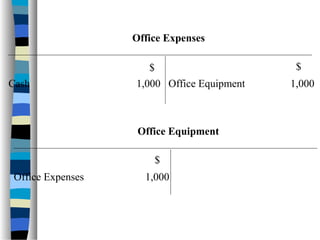
$$
Cash 1,000
Office Expenses
Office Equipment 1,000
$
Office Equipment
Office Expenses 1,000
Errors of Original Entry
 Wrong original figure is entered in the
journals, and hence posted incorrectly
to the accounts.
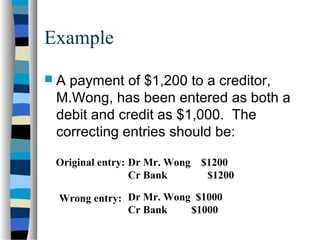
Example
 A payment of $1,200 to a creditor,
M.Wong, has been entered as both a
debit and credit as $1,000. The
correcting entries should be:
Original entry:
Wrong entry:
Dr Mr. Wong $1200
Cr Bank $1200
Dr Mr. Wong $1000
Cr Bank $1000
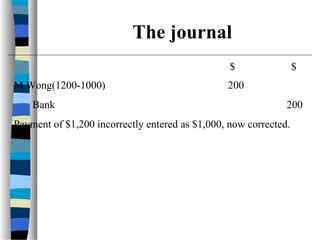
$ $
M Wong(1200-1000) 200
Bank 200
Payment of $1,200 incorrectly entered as $1,000, now corrected.
The journal
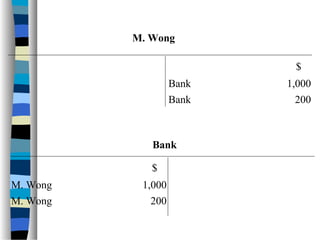
$
M. Wong
Bank 1,000
Bank 200
$
Bank
M. Wong 1,000
M. Wong 200
Errors of Omission
 A transaction has been completely
omitted from the accounts.
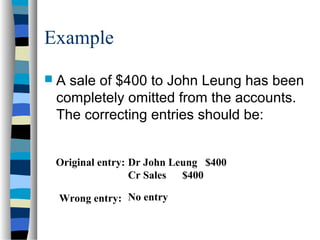
Example
 A sale of $400 to John Leung has been
completely omitted from the accounts.
The correcting entries should be:
Original entry:
Wrong entry:
Dr John Leung $400
Cr Sales $400
No entry
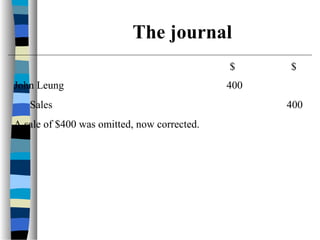
$ $
John Leung 400
Sales 400
A sale of $400 was omitted, now corrected.
The journal
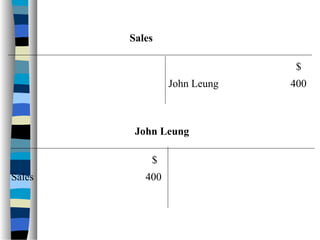
$
Sales
John Leung 400
$
John Leung
Sales 400
Compensating Errors
 Debit side errors are equal to credit side
errors.
Example
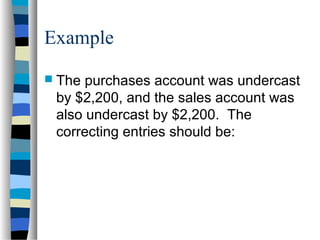
 The purchases account was undercast
by $2,200, and the sales account was
also undercast by $2,200. The
correcting entries should be:
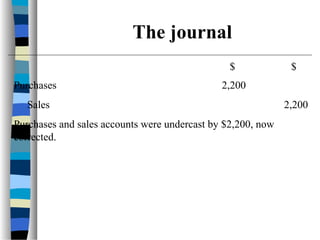
$ $
Purchases 2,200
Sales 2,200
Purchases and sales accounts were undercast by $2,200, now
corrected.
The journal
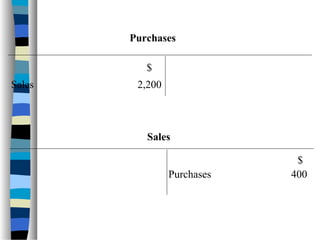
$
Purchases
Sales 2,200
$
Sales
Purchases 400
Complete Reversal of Entries
 The correct amounts are entered in the
wrong sides of the two appropriate
accounts.
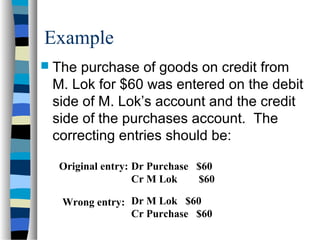
Example
 The purchase of goods on credit from
M. Lok for $60 was entered on the debit
side of M. Lok’s account and the credit
side of the purchases account. The
correcting entries should be:
Original entry:
Wrong entry:
Dr Purchase $60
Cr M Lok $60
Dr M Lok $60
Cr Purchase $60
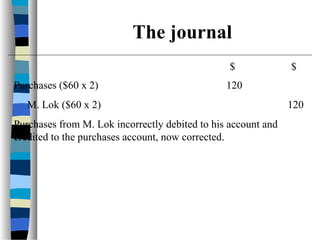
$ $
Purchases ($60 x 2) 120
M. Lok ($60 x 2) 120
Purchases from M. Lok incorrectly debited to his account and
credited to the purchases account, now corrected.
The journal
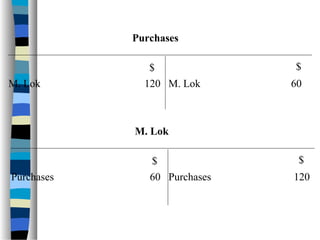
$$
M. Lok 120
Purchases
M. Lok 60
$$
Purchases 60
M. Lok
Purchases 120
Errors Affecting Trial Balance
Agreement
Errors affecting trial balance
agreement may occur when
 (i) recording transactions in the
accounts:
– (1) omitting a debit or credit entry
– (2) posting a wrong amount to one of the
accounts
– (3) recording an entry on the wrong side
• E.g. a debit entry entered as a credit or a credit
entry as a debit
 (ii) Balancing of accounts:
Incorrect calculation of a balance
– E.g. overcast or undercast
 (iii) Drawing up a trial balance:
(1) omitting a balance from the trial balance
(2) incorrectly posting an amount to the trial
balance
(3) incorrectly posting a balance to the wrong
side of the trial balance
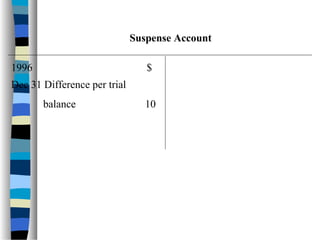
Suspense Account
 When the trial balance does not agree,
the amount of the difference is entered
in a suspense account.
$ $
Total balances extracted 90 100
Suspense account 10
100 100
Trial Balance as at 31 December 1996
$
Suspense Account
Dec 31 Difference per trial
balance 10
1996
How To Show a Suspense
Account on the Balance Sheet
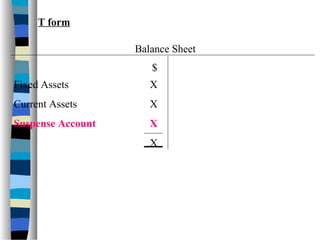
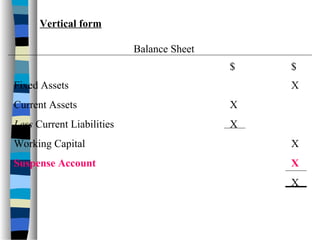
Debit Balance of the
Suspense Account
$
T form
Fixed Assets X
Current Assets X
Suspense Account X
X
Balance Sheet
$ $
Fixed Assets X
Current Assets X
Less Current Liabilities X
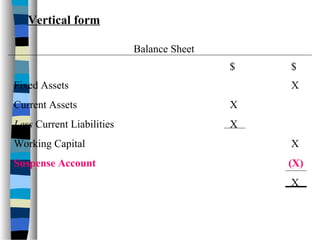
Working Capital X
Suspense Account X
X
Vertical form
Balance Sheet
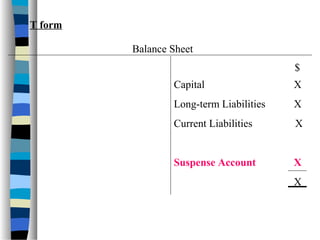
Credit Balance of the
Suspense Account
$
T form
Capital X
Long-term Liabilities X
Current Liabilities X
Suspense Account X
X
Balance Sheet
$ $
Fixed Assets X
Current Assets X
Less Current Liabilities X
Working Capital X
Suspense Account (X)
X
Vertical form
Balance Sheet
Correction of Errors
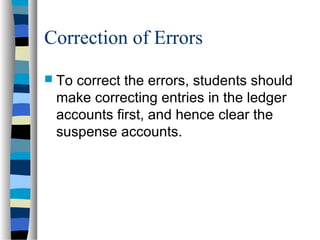
 To correct the errors, students should
make correcting entries in the ledger
accounts first, and hence clear the
suspense accounts.
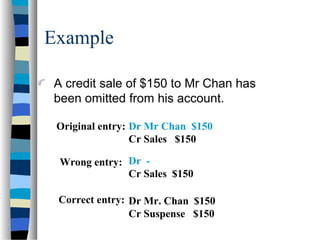
Example
Original entry:
Wrong entry:
Dr Mr Chan $150
Cr Sales $150
Dr -
Cr Sales $150
A credit sale of $150 to Mr Chan has
been omitted from his account.
Correct entry: Dr Mr. Chan $150
Cr Suspense $150
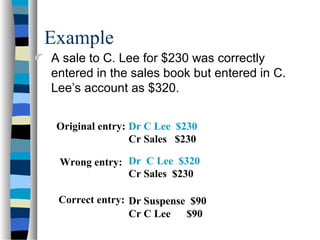
Example
Original entry:
Wrong entry:
Dr C Lee $230
Cr Sales $230
Dr C Lee $320
Cr Sales $230
Correct entry: Dr Suspense $90
Cr C Lee $90
A sale to C. Lee for $230 was correctly
entered in the sales book but entered in C.
Lee’s account as $320.
Original entry:
Wrong entry:
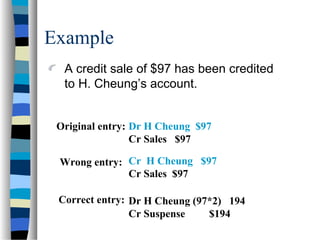
Dr H Cheung $97
Cr Sales $97
Cr H Cheung $97
Cr Sales $97
Correct entry: Dr H Cheung (97*2) 194
Cr Suspense $194
Example
A credit sale of $97 has been credited
to H. Cheung’s account.
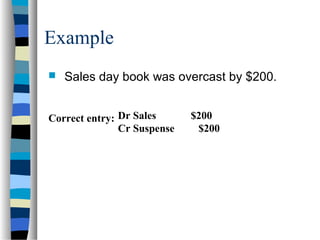
Correct entry: Dr Sales $200
Cr Suspense $200
 Sales day book was overcast by $200.
Example
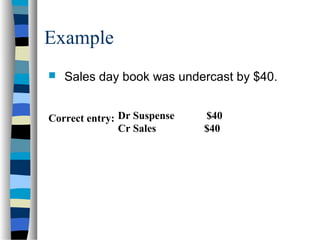
Correct entry: Dr Suspense $40
Cr Sales $40
 Sales day book was undercast by $40.
Example
Correction of Errors
 A single entry in the suspense account.
 This occurs when errors are made in
extracting balances, rather than in the
recording phase.
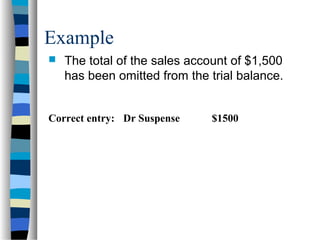
Correct entry: Dr Suspense $1500
Example
 The total of the sales account of $1,500
has been omitted from the trial balance.
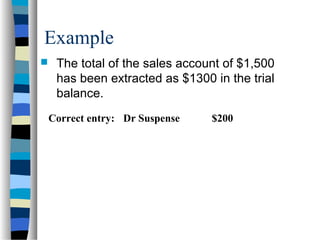
Correct entry: Dr Suspense $200
Example
 The total of the sales account of $1,500
has been extracted as $1300 in the trial
balance.
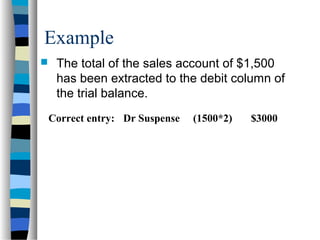
Correct entry: Dr Suspense (1500*2) $3000
Example
 The total of the sales account of $1,500
has been extracted to the debit column of
the trial balance.
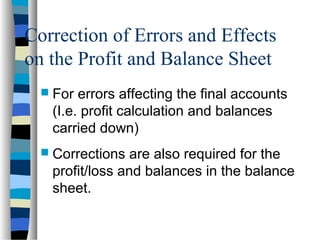
Correction of Errors and Effects
on the Profit and Balance Sheet
 For errors affecting the final accounts
(I.e. profit calculation and balances
carried down)
 Corrections are also required for the
profit/loss and balances in the balance
sheet.
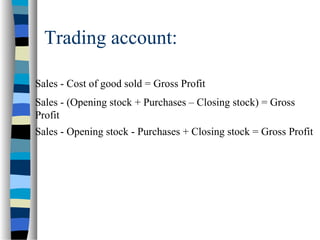
Trading account:
Sales - Cost of good sold = Gross Profit
Sales - (Opening stock + Purchases – Closing stock) = Gross
Profit
Sales - Opening stock - Purchases + Closing stock = Gross Profit
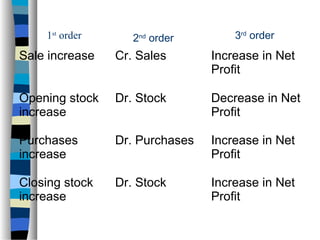
1st
order
Sale increase Cr. Sales Increase in Net
Profit
Opening stock
increase
Dr. Stock Decrease in Net
Profit
Purchases
increase
Dr. Purchases Increase in Net
Profit
Closing stock
increase
Dr. Stock Increase in Net
Profit
2nd
order 3rd
order
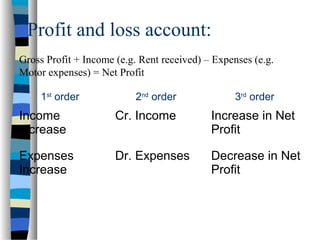
Profit and loss account:
Gross Profit + Income (e.g. Rent received) – Expenses (e.g.
Motor expenses) = Net Profit
1st
order
Income
increase
Cr. Income Increase in Net
Profit
Expenses
Increase
Dr. Expenses Decrease in Net
Profit
2nd
order 3rd
order
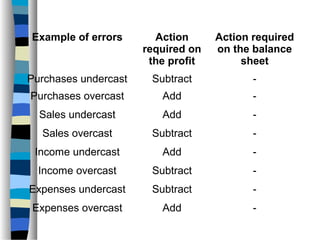
Example of errors Action
required on
the profit
Action required
on the balance
sheet
Purchases undercast Subtract -
Purchases overcast Add -
Sales undercast Add -
Sales overcast Subtract -
Income undercast Add -
Income overcast Subtract -
Expenses undercast Subtract -
Expenses overcast Add -
Example of errors Action
required on
the profit
Action required
on the balance
sheet
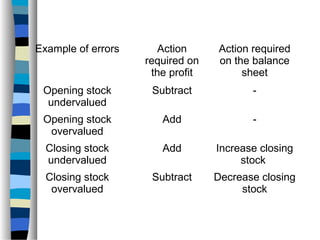
Opening stock
undervalued
Subtract -
Opening stock
overvalued
Add -
Closing stock
undervalued
Add Increase closing
stock
Closing stock
overvalued
Subtract Decrease closing
stock
Example of errors Action
required on
the profit
Action required
on the balance
sheet
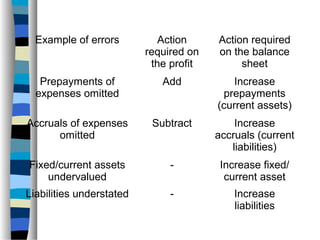
Prepayments of
expenses omitted
Add Increase
prepayments
(current assets)
Accruals of expenses
omitted
Subtract Increase
accruals (current
liabilities)
Fixed/current assets
undervalued
- Increase fixed/
current asset
Liabilities understated - Increase
liabilities

Error

  • 1.
  • 2.
    Errors  Errors notaffecting trial balance agreement  Errors affecting trial balance agreement
  • 3.
    Errors not affectingtrial balance agreement E.g.  Errors of commission  Errors of principle  Errors of original entry  Errors of omission  Compensating errors  Complete reversal of entries
  • 4.
    Errors affecting trialbalance agreement  Suspense account
  • 5.
    Correcting entry 1. Asset 2.Purchases 3. Expenses 4. Returns Inwards 5. Drawings Increase – Debit Decrease - Credit Examples of account
  • 6.
    Correcting entry 1. Liabilities/Capital 2.Sales 3. Income 4. Returns Outwards Increase – Credit Decrease – Debit Examples of account
  • 7.
    Errors Not AffectingTrial Balance Agreement
  • 8.
    Errors of Commission The correct amount is entered but in a wrong personal account
  • 9.
    Example  A purchaseof goods from C.Lee has been posted to the credit side of C.Lai’s account in error, amounting to $500. The correcting entries should be: Original entry: Wrong entry: Dr Purchase $500 Cr C Lee $500 Dr Purchase $500 Cr C Lai $500
  • 10.
    $ $ C.Lai 500 C.Lee500 Purchases entered in wrong personal account, now corrected. The journal
  • 11.
    $$ C.Lee 500 C. Lai Purchases500 $ C. Lee C.Lai 500
  • 12.
    Errors of Principle An item is entered in the wrong type of account due to misunderstanding of the nature of the item.
  • 13.
    Example  Office equipmentpurchased for $1,000 in cash has been debited to an office expenses account. The correcting entries should be: Original entry: Wrong entry: Dr Office Equipment $1000 Cr Cash $1000 Dr Office Expenses $1000 Cr Cash $1000
  • 14.
    $ $ Office Equipment1,000 Office Expenses 1,000 Purchase of office equipment wrongly entered in the office expenses account, now corrected. The journal
  • 15.
    $$ Cash 1,000 Office Expenses OfficeEquipment 1,000 $ Office Equipment Office Expenses 1,000
  • 16.
    Errors of OriginalEntry  Wrong original figure is entered in the journals, and hence posted incorrectly to the accounts.
  • 17.
    Example  A paymentof $1,200 to a creditor, M.Wong, has been entered as both a debit and credit as $1,000. The correcting entries should be: Original entry: Wrong entry: Dr Mr. Wong $1200 Cr Bank $1200 Dr Mr. Wong $1000 Cr Bank $1000
  • 18.
    $ $ M Wong(1200-1000)200 Bank 200 Payment of $1,200 incorrectly entered as $1,000, now corrected. The journal
  • 19.
    $ M. Wong Bank 1,000 Bank200 $ Bank M. Wong 1,000 M. Wong 200
  • 20.
    Errors of Omission A transaction has been completely omitted from the accounts.
  • 21.
    Example  A saleof $400 to John Leung has been completely omitted from the accounts. The correcting entries should be: Original entry: Wrong entry: Dr John Leung $400 Cr Sales $400 No entry
  • 22.
    $ $ John Leung400 Sales 400 A sale of $400 was omitted, now corrected. The journal
  • 23.
  • 24.
    Compensating Errors  Debitside errors are equal to credit side errors.
  • 25.
    Example  The purchasesaccount was undercast by $2,200, and the sales account was also undercast by $2,200. The correcting entries should be:
  • 26.
    $ $ Purchases 2,200 Sales2,200 Purchases and sales accounts were undercast by $2,200, now corrected. The journal
  • 27.
  • 28.
    Complete Reversal ofEntries  The correct amounts are entered in the wrong sides of the two appropriate accounts.
  • 29.
    Example  The purchaseof goods on credit from M. Lok for $60 was entered on the debit side of M. Lok’s account and the credit side of the purchases account. The correcting entries should be: Original entry: Wrong entry: Dr Purchase $60 Cr M Lok $60 Dr M Lok $60 Cr Purchase $60
  • 30.
    $ $ Purchases ($60x 2) 120 M. Lok ($60 x 2) 120 Purchases from M. Lok incorrectly debited to his account and credited to the purchases account, now corrected. The journal
  • 31.
    $$ M. Lok 120 Purchases M.Lok 60 $$ Purchases 60 M. Lok Purchases 120
  • 32.
    Errors Affecting TrialBalance Agreement
  • 33.
    Errors affecting trialbalance agreement may occur when  (i) recording transactions in the accounts: – (1) omitting a debit or credit entry – (2) posting a wrong amount to one of the accounts – (3) recording an entry on the wrong side • E.g. a debit entry entered as a credit or a credit entry as a debit
  • 34.
     (ii) Balancingof accounts: Incorrect calculation of a balance – E.g. overcast or undercast  (iii) Drawing up a trial balance: (1) omitting a balance from the trial balance (2) incorrectly posting an amount to the trial balance (3) incorrectly posting a balance to the wrong side of the trial balance
  • 35.
    Suspense Account  Whenthe trial balance does not agree, the amount of the difference is entered in a suspense account.
  • 36.
    $ $ Total balancesextracted 90 100 Suspense account 10 100 100 Trial Balance as at 31 December 1996
  • 37.
    $ Suspense Account Dec 31Difference per trial balance 10 1996
  • 38.
    How To Showa Suspense Account on the Balance Sheet
  • 39.
    Debit Balance ofthe Suspense Account
  • 40.
    $ T form Fixed AssetsX Current Assets X Suspense Account X X Balance Sheet
  • 41.
    $ $ Fixed AssetsX Current Assets X Less Current Liabilities X Working Capital X Suspense Account X X Vertical form Balance Sheet
  • 42.
    Credit Balance ofthe Suspense Account
  • 43.
    $ T form Capital X Long-termLiabilities X Current Liabilities X Suspense Account X X Balance Sheet
  • 44.
    $ $ Fixed AssetsX Current Assets X Less Current Liabilities X Working Capital X Suspense Account (X) X Vertical form Balance Sheet
  • 45.
    Correction of Errors To correct the errors, students should make correcting entries in the ledger accounts first, and hence clear the suspense accounts.
  • 46.
    Example Original entry: Wrong entry: DrMr Chan $150 Cr Sales $150 Dr - Cr Sales $150 A credit sale of $150 to Mr Chan has been omitted from his account. Correct entry: Dr Mr. Chan $150 Cr Suspense $150
  • 47.
    Example Original entry: Wrong entry: DrC Lee $230 Cr Sales $230 Dr C Lee $320 Cr Sales $230 Correct entry: Dr Suspense $90 Cr C Lee $90 A sale to C. Lee for $230 was correctly entered in the sales book but entered in C. Lee’s account as $320.
  • 48.
    Original entry: Wrong entry: DrH Cheung $97 Cr Sales $97 Cr H Cheung $97 Cr Sales $97 Correct entry: Dr H Cheung (97*2) 194 Cr Suspense $194 Example A credit sale of $97 has been credited to H. Cheung’s account.
  • 49.
    Correct entry: DrSales $200 Cr Suspense $200  Sales day book was overcast by $200. Example
  • 50.
    Correct entry: DrSuspense $40 Cr Sales $40  Sales day book was undercast by $40. Example
  • 51.
    Correction of Errors A single entry in the suspense account.  This occurs when errors are made in extracting balances, rather than in the recording phase.
  • 52.
    Correct entry: DrSuspense $1500 Example  The total of the sales account of $1,500 has been omitted from the trial balance.
  • 53.
    Correct entry: DrSuspense $200 Example  The total of the sales account of $1,500 has been extracted as $1300 in the trial balance.
  • 54.
    Correct entry: DrSuspense (1500*2) $3000 Example  The total of the sales account of $1,500 has been extracted to the debit column of the trial balance.
  • 55.
    Correction of Errorsand Effects on the Profit and Balance Sheet  For errors affecting the final accounts (I.e. profit calculation and balances carried down)  Corrections are also required for the profit/loss and balances in the balance sheet.
  • 56.
    Trading account: Sales -Cost of good sold = Gross Profit Sales - (Opening stock + Purchases – Closing stock) = Gross Profit Sales - Opening stock - Purchases + Closing stock = Gross Profit
  • 57.
    1st order Sale increase Cr.Sales Increase in Net Profit Opening stock increase Dr. Stock Decrease in Net Profit Purchases increase Dr. Purchases Increase in Net Profit Closing stock increase Dr. Stock Increase in Net Profit 2nd order 3rd order
  • 58.
    Profit and lossaccount: Gross Profit + Income (e.g. Rent received) – Expenses (e.g. Motor expenses) = Net Profit 1st order Income increase Cr. Income Increase in Net Profit Expenses Increase Dr. Expenses Decrease in Net Profit 2nd order 3rd order
  • 59.
    Example of errorsAction required on the profit Action required on the balance sheet Purchases undercast Subtract - Purchases overcast Add - Sales undercast Add - Sales overcast Subtract - Income undercast Add - Income overcast Subtract - Expenses undercast Subtract - Expenses overcast Add -
  • 60.
    Example of errorsAction required on the profit Action required on the balance sheet Opening stock undervalued Subtract - Opening stock overvalued Add - Closing stock undervalued Add Increase closing stock Closing stock overvalued Subtract Decrease closing stock
  • 61.
    Example of errorsAction required on the profit Action required on the balance sheet Prepayments of expenses omitted Add Increase prepayments (current assets) Accruals of expenses omitted Subtract Increase accruals (current liabilities) Fixed/current assets undervalued - Increase fixed/ current asset Liabilities understated - Increase liabilities