1
EQUIPMENT VALIDATION
CONTENT
Introduction
Validation Study Phases
Master Validation Protocol
Dissolution Apparatus Validation
Conclusion
References
2
INTRODUCTION
A validation programme involves various components in
pharmaceutical organisation related to process, equipment and
product.
It is a regulatory requirement for pharmaceutical companies to perform
Instrument Validation on all new instruments.
Instrument Validation requires detailed knowledge of the
instrumentation system being validated and is therefore usually
performed by the company supplying the instrument.
3
EQUIPMENT VALIDATION
Definition (US-FDA):- Validation is the establishment of
documentary evidence which provide a high degree
assurance of specified process will consistently produce the
product meeting with predetermined specification and
quality attributes.
Validation studies are performed for analytical equipment,
tests, facility systems such as air, water, steam, the
manufacturing, cleaning, sterilization processes
4
CYCLE OF VALIDATION
5
VALIDATION STUDY PHASES
Phase 1:
Pre-Validation Phase (Qualification Phase)
Phase 2:
Process Validation Phase (Process Qualification phase)
Phase 3:
Validation Maintenance Phase
6
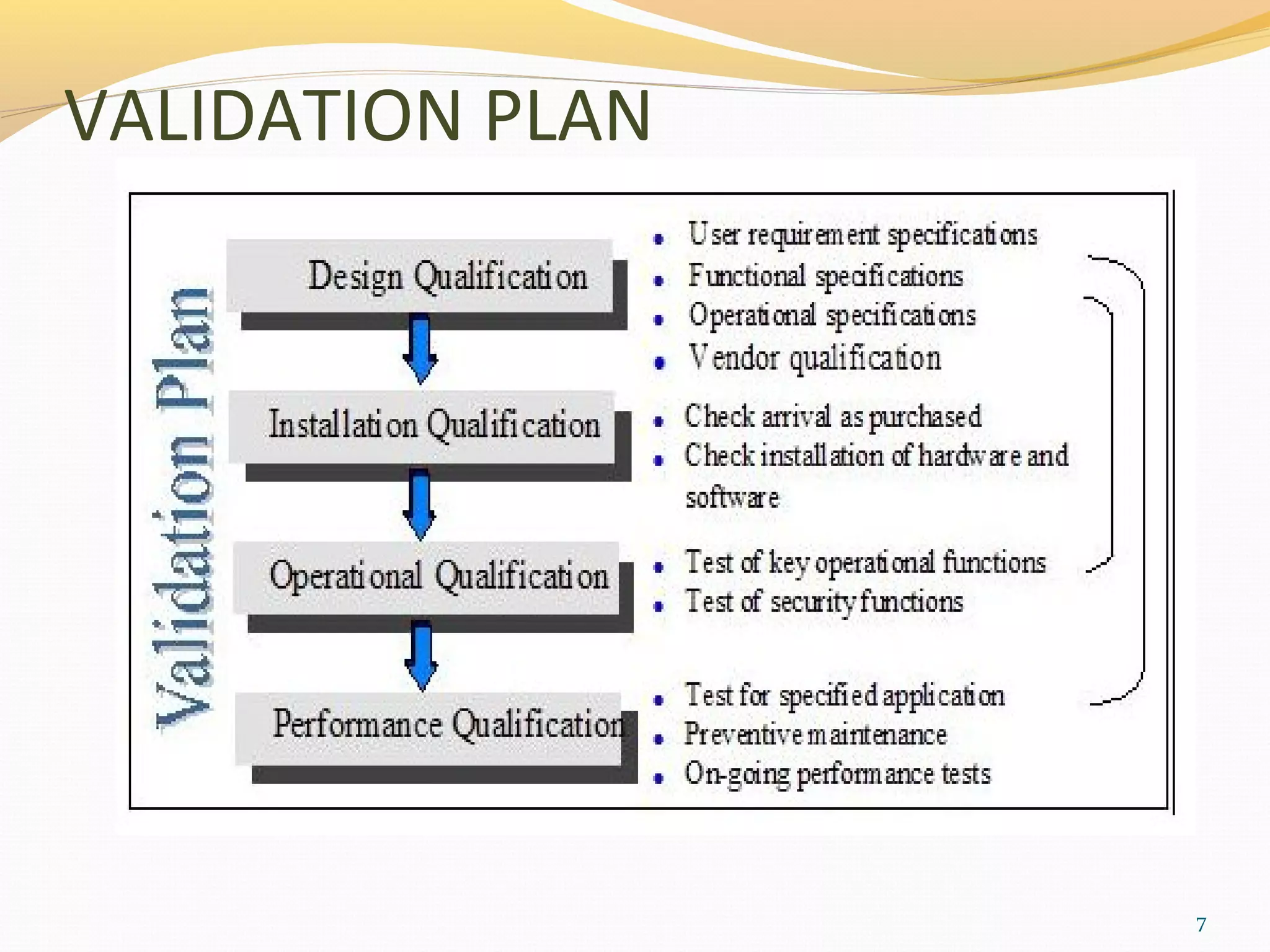
VALIDATION PLAN
7
PHASE-1(QUALIFICATION)
DESIGN QUALIFICATION:
“A documented review of the design, at an appropriate stage or
stages in the project, for conformance to operational and regulatory
expectations.”
Specification of requirements for facilities, plants and
equipment, mainly in connection with purchase/modification
of equipment.
8
DQ REVIEW DOCUMENTS
User Requirement Specification (URS)
Functional Specification (FS)
Tender Specifications and Drawings
Vendor Quality procedures and documents
Purchase Specification
9
INSTALLATION QUALIFICATION
IQ verifies that the equipment has been installed in accordance
with the manufacturer’s recommendation in a proper manner
and that all of the devices are placed in an environment suitable
for their intended purpose.
10
COMPUTER AND SOFTWARE IQ
Software Requirements and Specifications should be clear, written
down, and approved by the appropriate personnel prior to creating
the software package.
Software Installation should be recorded, when made, so that the
proper model numbers, serial numbers ,installation date, etc
11
Phase-2
(process qualification phase)
OPERATIONAL QUALIFICATION
The documented action of demonstrating that process equipment and
ancillary systems work correctly and operate consistently In
accordance with established specifications.
Operation Qualification (OQ) for testing the equipment in the selected
user environment to ensure that it meets the previously defined
functional and performance specifications.
12
How may runs are to be performed during Operational
Qualification (OQ) testing?
Guidelines stress the importance of equipment qualification simulating
actual production conditions, including 'worst case' situations and that
"tests and challenges should be repeated a sufficient number of times to
assure reliable and meaningful results."
"three consecutive batches" is recommended for process validation rather
than for equipment qualification. No specific number of "runs" for
equipment qualification, but multiple tests to simulate actual operating
ranges and to establish consistency are expected
13
PERFOMANCE QUALIFICATION
Assurance that the process continues to comply with
established requirements.
Performance Qualification (PQ) for testing that the
system consistently performs as intended for the
selected application.
14
Performance Qualification
Purpose- To define testing requirements in a product/
process/performance/qualification/validation protocol.
Principle- Performance qualification validation testing plan
are usually process or product specific but will include the
following background and result for the plan, testing
method used, and a predetermined and general and/or
specific acceptance criteria.
15
RE-VALIDATION
Re-validation is required when the operating
equipment or system has been changed in some way.
It is carried out when:
Major mechanical equipment has been replaced
Computer systems have been replaced
New products have to be run on the system.
Critical items have been replaced or repaired.
16
RETRO-VALIDATIONS
Retrospective validation must be done on equipment that records have
either been lost or validation was not provided for in the initial life of
the machine. Retrospective validations get more difficult the older
the machine.
17
PHASE-3
(VALIDATION MAINTENANCE PHASE)
It is the maintenance of the validation which has been
already
established.
18
MASTER VALIDATION PROTOCOL
The Master Validation Protocol (MVP) is the outline of the
validation for a facility.
MVP :
 Identifies which items are subjects to validation.
 Defines the nature and extent of testing expected to be done on each
item.
 Outlines the test procedures and protocols to be followed to
accomplish validation.
 Describes functional responsibilities and requirements to document
the work carried out and the results obtained.
19
Installation Qualification
Installation qualification consists of documented
verification that all key aspects of the dissolution
apparatus are in working condition and have been
properly installed in accordance with manufacturer’s
specifications in the proper operating environment.
Calibration
The installation qualification should document that
specific devices contained within the dissolution
apparatus (e.g., speed, time, and temperature displays)
have been calibrated to traceable standards.
20
INSTALLATION QUALIFICATION-
Environmental Conditions
Computerized System
Equipment Information
Preventive maintenance
SOP
Utilities
21
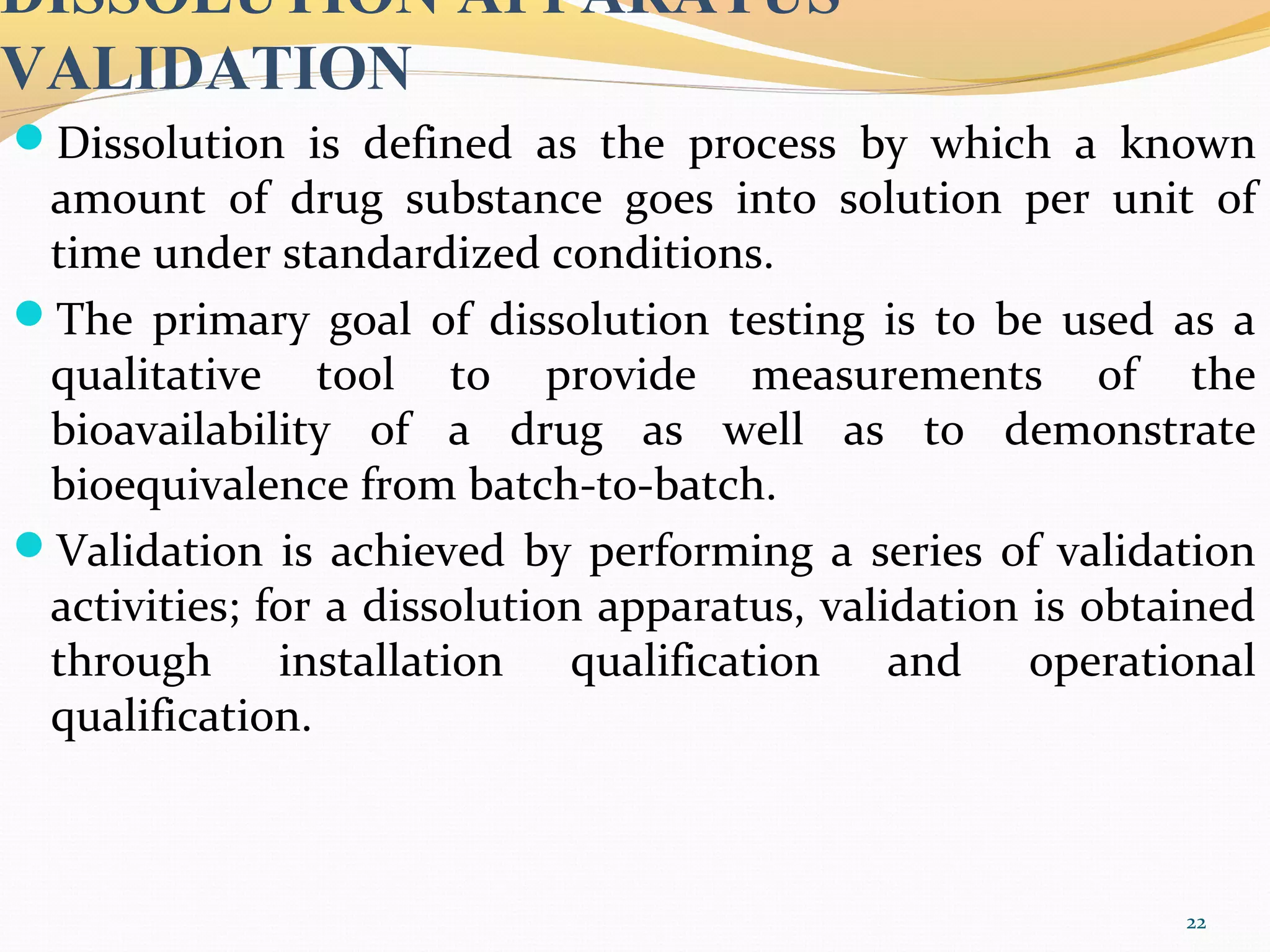
DISSOLUTION APPARATUS
VALIDATION
Dissolution is defined as the process by which a known
amount of drug substance goes into solution per unit of
time under standardized conditions.
The primary goal of dissolution testing is to be used as a
qualitative tool to provide measurements of the
bioavailability of a drug as well as to demonstrate
bioequivalence from batch-to-batch.
Validation is achieved by performing a series of validation
activities; for a dissolution apparatus, validation is obtained
through installation qualification and operational
qualification.
22
DISSOLUTION APPARATUS
• Apparatus 1
• Vessel: cylindrical, 160-210 mm height, inside diameter 98-
106 mm, nominal capacity is 1000 mL; sides are flanged at
the top. Shaft: positioned so that its axis is not more than 2
mm at any point from the vertical axis of the vessel and
rotates smoothly and without significant wobble.
 Materials of Construction: Shaft and basket components
are stainless steel, type 316 or equivalent. Basket position:
the distance between the inside bottom of the vessel and the
basket is maintained at 25 +/- 2 mm during the test.
23
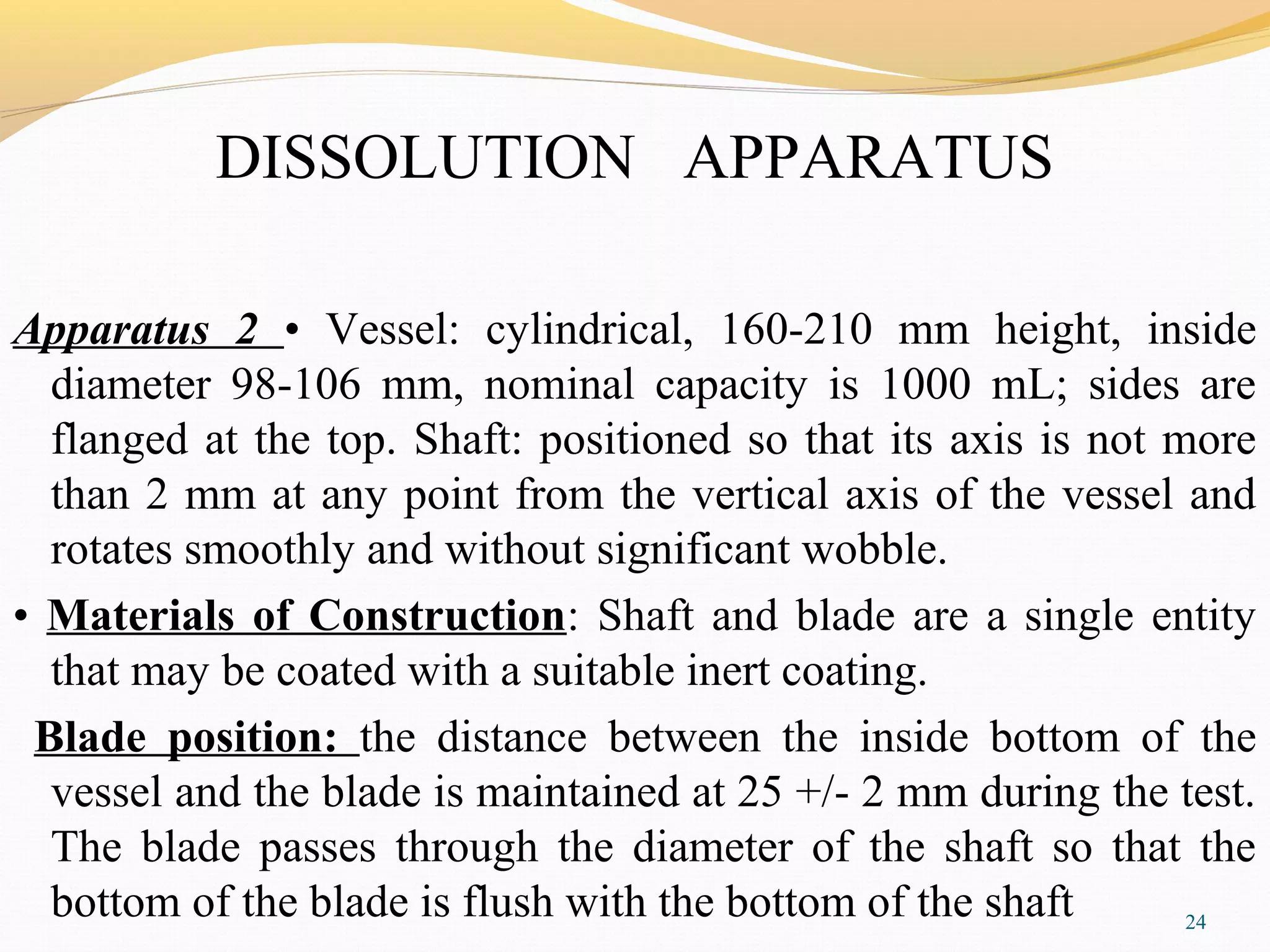
DISSOLUTION APPARATUS
Apparatus 2 • Vessel: cylindrical, 160-210 mm height, inside
diameter 98-106 mm, nominal capacity is 1000 mL; sides are
flanged at the top. Shaft: positioned so that its axis is not more
than 2 mm at any point from the vertical axis of the vessel and
rotates smoothly and without significant wobble.
• Materials of Construction: Shaft and blade are a single entity
that may be coated with a suitable inert coating.
Blade position: the distance between the inside bottom of the
vessel and the blade is maintained at 25 +/- 2 mm during the test.
The blade passes through the diameter of the shaft so that the
bottom of the blade is flush with the bottom of the shaft 24
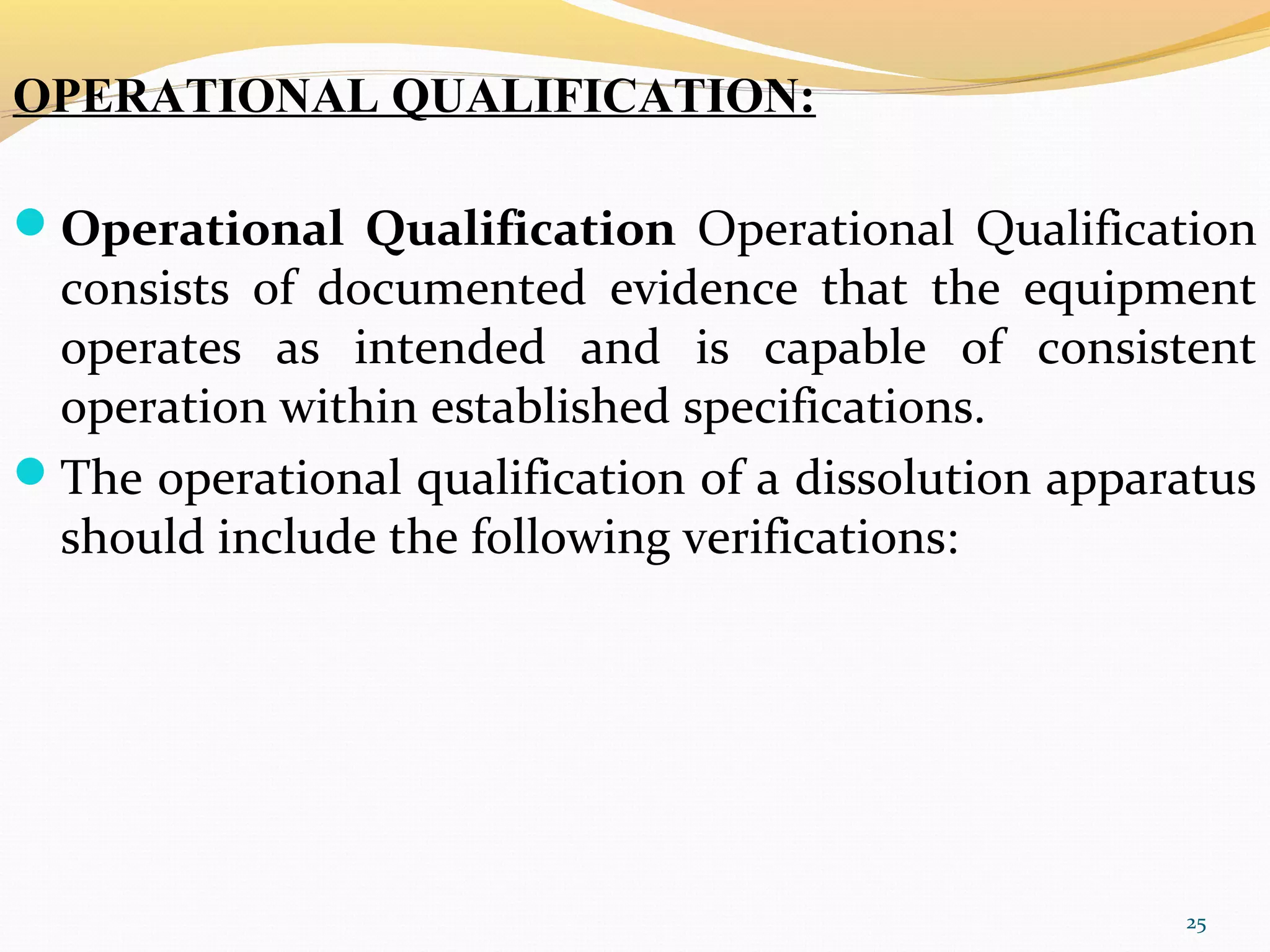
OPERATIONAL QUALIFICATION:
Operational Qualification Operational Qualification
consists of documented evidence that the equipment
operates as intended and is capable of consistent
operation within established specifications.
The operational qualification of a dissolution apparatus
should include the following verifications:
25
• Temperature Distribution Study
A temperature distribution study should be conducted
during the operational qualification. The study should
include temperature mapping of each vessel contained
within the dissolution apparatus. Temperature should
be mapped using a data system for a minimum time
that is based on the monograph or 1 hour, whichever is
greater. The temperature must remain at 37°C ± 0.5°C;
Rotation Speed Study
 A rotation speed study should be conducted during the
operational qualification. The study should include a
measurement of the speed of the shaft rotation for each
vessel contained within the dissolution apparatus.
26
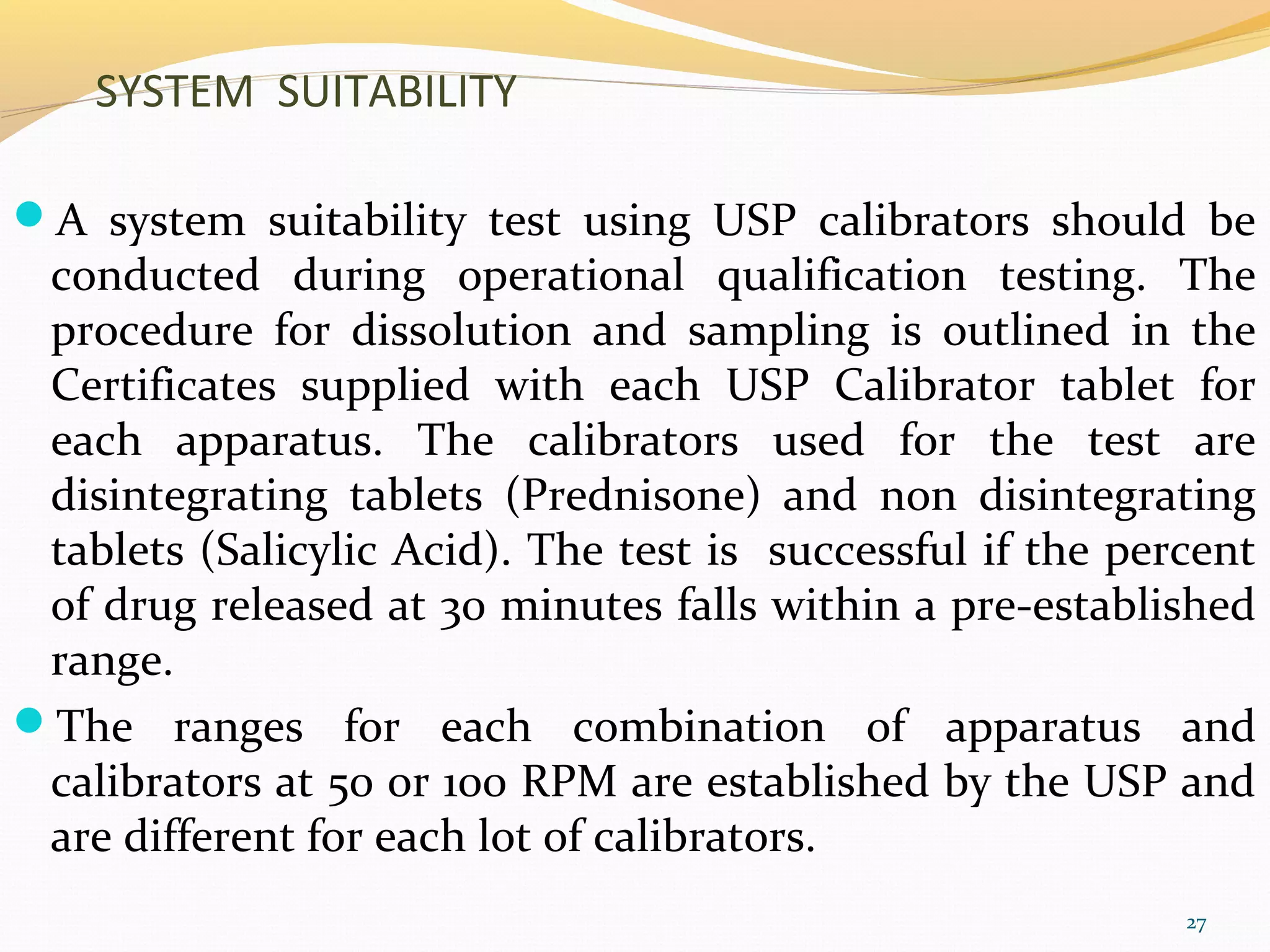
SYSTEM SUITABILITY
A system suitability test using USP calibrators should be
conducted during operational qualification testing. The
procedure for dissolution and sampling is outlined in the
Certificates supplied with each USP Calibrator tablet for
each apparatus. The calibrators used for the test are
disintegrating tablets (Prednisone) and non disintegrating
tablets (Salicylic Acid). The test is successful if the percent
of drug released at 30 minutes falls within a pre-established
range.
The ranges for each combination of apparatus and
calibrators at 50 or 100 RPM are established by the USP and
are different for each lot of calibrators.
27
Performance Qualification
In Performance qualification different types of
dosage form are used.
28
CONCLUSION
Validation provide the good quality product and the equipment .
Validation give the surety that equipment having the good
qualification like design, operation, installation, and performance
qualification which have pre-determined.
Validation data should be generated for the all types of the product
and the equipment to demonstrate the adequacy of the
manufacturing
process
29
30
REFERENCES
1. Potdar Manohar A. “Pharmaceutical quality assurance” 2nd
Edition, Nirali
Prakashan, p-8.1-8.7
2. Nash Robert A. “Pharmaceutical Process Validation”3rd
Edition, Marcel Dekker Inc,
p-442
3. Cole Graham C. ‘Pharmaceutical Production Facilities” 2nd
Edition, CRC Press, p-
199
4. Despautz Joseph F. “Automation And Validation Of Information In Pharmaceutical
Processing” Vol-90, Marcel Dekker Inc, p-221
5. Berry And Harpaz “ Validation Of Active Pharmaceutical Ingredient”2nd
Edition,
CRC Press, p-429
6. Sharon M.Averell Frost, “ Introduction to the Validation of a Dissolution
Apparatus.”p-19.
28

EQUIPMENT VALIDATION

  • 1.
  • 2.
    CONTENT Introduction Validation Study Phases MasterValidation Protocol Dissolution Apparatus Validation Conclusion References 2
  • 3.
    INTRODUCTION A validation programmeinvolves various components in pharmaceutical organisation related to process, equipment and product. It is a regulatory requirement for pharmaceutical companies to perform Instrument Validation on all new instruments. Instrument Validation requires detailed knowledge of the instrumentation system being validated and is therefore usually performed by the company supplying the instrument. 3
  • 4.
    EQUIPMENT VALIDATION Definition (US-FDA):-Validation is the establishment of documentary evidence which provide a high degree assurance of specified process will consistently produce the product meeting with predetermined specification and quality attributes. Validation studies are performed for analytical equipment, tests, facility systems such as air, water, steam, the manufacturing, cleaning, sterilization processes 4
  • 5.
  • 6.
    VALIDATION STUDY PHASES Phase1: Pre-Validation Phase (Qualification Phase) Phase 2: Process Validation Phase (Process Qualification phase) Phase 3: Validation Maintenance Phase 6
  • 7.
  • 8.
    PHASE-1(QUALIFICATION) DESIGN QUALIFICATION: “A documentedreview of the design, at an appropriate stage or stages in the project, for conformance to operational and regulatory expectations.” Specification of requirements for facilities, plants and equipment, mainly in connection with purchase/modification of equipment. 8
  • 9.
    DQ REVIEW DOCUMENTS UserRequirement Specification (URS) Functional Specification (FS) Tender Specifications and Drawings Vendor Quality procedures and documents Purchase Specification 9
  • 10.
    INSTALLATION QUALIFICATION IQ verifiesthat the equipment has been installed in accordance with the manufacturer’s recommendation in a proper manner and that all of the devices are placed in an environment suitable for their intended purpose. 10
  • 11.
    COMPUTER AND SOFTWAREIQ Software Requirements and Specifications should be clear, written down, and approved by the appropriate personnel prior to creating the software package. Software Installation should be recorded, when made, so that the proper model numbers, serial numbers ,installation date, etc 11
  • 12.
    Phase-2 (process qualification phase) OPERATIONALQUALIFICATION The documented action of demonstrating that process equipment and ancillary systems work correctly and operate consistently In accordance with established specifications. Operation Qualification (OQ) for testing the equipment in the selected user environment to ensure that it meets the previously defined functional and performance specifications. 12
  • 13.
    How may runsare to be performed during Operational Qualification (OQ) testing? Guidelines stress the importance of equipment qualification simulating actual production conditions, including 'worst case' situations and that "tests and challenges should be repeated a sufficient number of times to assure reliable and meaningful results." "three consecutive batches" is recommended for process validation rather than for equipment qualification. No specific number of "runs" for equipment qualification, but multiple tests to simulate actual operating ranges and to establish consistency are expected 13
  • 14.
    PERFOMANCE QUALIFICATION Assurance thatthe process continues to comply with established requirements. Performance Qualification (PQ) for testing that the system consistently performs as intended for the selected application. 14
  • 15.
    Performance Qualification Purpose- Todefine testing requirements in a product/ process/performance/qualification/validation protocol. Principle- Performance qualification validation testing plan are usually process or product specific but will include the following background and result for the plan, testing method used, and a predetermined and general and/or specific acceptance criteria. 15
  • 16.
    RE-VALIDATION Re-validation is requiredwhen the operating equipment or system has been changed in some way. It is carried out when: Major mechanical equipment has been replaced Computer systems have been replaced New products have to be run on the system. Critical items have been replaced or repaired. 16
  • 17.
    RETRO-VALIDATIONS Retrospective validation mustbe done on equipment that records have either been lost or validation was not provided for in the initial life of the machine. Retrospective validations get more difficult the older the machine. 17
  • 18.
    PHASE-3 (VALIDATION MAINTENANCE PHASE) Itis the maintenance of the validation which has been already established. 18
  • 19.
    MASTER VALIDATION PROTOCOL TheMaster Validation Protocol (MVP) is the outline of the validation for a facility. MVP :  Identifies which items are subjects to validation.  Defines the nature and extent of testing expected to be done on each item.  Outlines the test procedures and protocols to be followed to accomplish validation.  Describes functional responsibilities and requirements to document the work carried out and the results obtained. 19
  • 20.
    Installation Qualification Installation qualificationconsists of documented verification that all key aspects of the dissolution apparatus are in working condition and have been properly installed in accordance with manufacturer’s specifications in the proper operating environment. Calibration The installation qualification should document that specific devices contained within the dissolution apparatus (e.g., speed, time, and temperature displays) have been calibrated to traceable standards. 20
  • 21.
    INSTALLATION QUALIFICATION- Environmental Conditions ComputerizedSystem Equipment Information Preventive maintenance SOP Utilities 21
  • 22.
    DISSOLUTION APPARATUS VALIDATION Dissolution isdefined as the process by which a known amount of drug substance goes into solution per unit of time under standardized conditions. The primary goal of dissolution testing is to be used as a qualitative tool to provide measurements of the bioavailability of a drug as well as to demonstrate bioequivalence from batch-to-batch. Validation is achieved by performing a series of validation activities; for a dissolution apparatus, validation is obtained through installation qualification and operational qualification. 22
  • 23.
    DISSOLUTION APPARATUS • Apparatus1 • Vessel: cylindrical, 160-210 mm height, inside diameter 98- 106 mm, nominal capacity is 1000 mL; sides are flanged at the top. Shaft: positioned so that its axis is not more than 2 mm at any point from the vertical axis of the vessel and rotates smoothly and without significant wobble.  Materials of Construction: Shaft and basket components are stainless steel, type 316 or equivalent. Basket position: the distance between the inside bottom of the vessel and the basket is maintained at 25 +/- 2 mm during the test. 23
  • 24.
    DISSOLUTION APPARATUS Apparatus 2• Vessel: cylindrical, 160-210 mm height, inside diameter 98-106 mm, nominal capacity is 1000 mL; sides are flanged at the top. Shaft: positioned so that its axis is not more than 2 mm at any point from the vertical axis of the vessel and rotates smoothly and without significant wobble. • Materials of Construction: Shaft and blade are a single entity that may be coated with a suitable inert coating. Blade position: the distance between the inside bottom of the vessel and the blade is maintained at 25 +/- 2 mm during the test. The blade passes through the diameter of the shaft so that the bottom of the blade is flush with the bottom of the shaft 24
  • 25.
    OPERATIONAL QUALIFICATION: Operational QualificationOperational Qualification consists of documented evidence that the equipment operates as intended and is capable of consistent operation within established specifications. The operational qualification of a dissolution apparatus should include the following verifications: 25
  • 26.
    • Temperature DistributionStudy A temperature distribution study should be conducted during the operational qualification. The study should include temperature mapping of each vessel contained within the dissolution apparatus. Temperature should be mapped using a data system for a minimum time that is based on the monograph or 1 hour, whichever is greater. The temperature must remain at 37°C ± 0.5°C; Rotation Speed Study  A rotation speed study should be conducted during the operational qualification. The study should include a measurement of the speed of the shaft rotation for each vessel contained within the dissolution apparatus. 26
  • 27.
    SYSTEM SUITABILITY A systemsuitability test using USP calibrators should be conducted during operational qualification testing. The procedure for dissolution and sampling is outlined in the Certificates supplied with each USP Calibrator tablet for each apparatus. The calibrators used for the test are disintegrating tablets (Prednisone) and non disintegrating tablets (Salicylic Acid). The test is successful if the percent of drug released at 30 minutes falls within a pre-established range. The ranges for each combination of apparatus and calibrators at 50 or 100 RPM are established by the USP and are different for each lot of calibrators. 27
  • 28.
    Performance Qualification In Performancequalification different types of dosage form are used. 28
  • 29.
    CONCLUSION Validation provide thegood quality product and the equipment . Validation give the surety that equipment having the good qualification like design, operation, installation, and performance qualification which have pre-determined. Validation data should be generated for the all types of the product and the equipment to demonstrate the adequacy of the manufacturing process 29
  • 30.
    30 REFERENCES 1. Potdar ManoharA. “Pharmaceutical quality assurance” 2nd Edition, Nirali Prakashan, p-8.1-8.7 2. Nash Robert A. “Pharmaceutical Process Validation”3rd Edition, Marcel Dekker Inc, p-442 3. Cole Graham C. ‘Pharmaceutical Production Facilities” 2nd Edition, CRC Press, p- 199 4. Despautz Joseph F. “Automation And Validation Of Information In Pharmaceutical Processing” Vol-90, Marcel Dekker Inc, p-221 5. Berry And Harpaz “ Validation Of Active Pharmaceutical Ingredient”2nd Edition, CRC Press, p-429 6. Sharon M.Averell Frost, “ Introduction to the Validation of a Dissolution Apparatus.”p-19.
  • 31.