Qualification of Dissolution Test
Apparatus and Validation of
Utility System
Presented by : Akshay G. Trivedi
Guided by : Dr. Pintu Prajapati
Enrollment No : 201804103910007
Department of Pharmaceutical Quality Assurance
Maliba Pharmacy College
Uka Tarsadia University
Qualification of Dissolution Test
Apparatus
 Contents :
 Introduction & Types
 Installation Qualification
 Operational Qualification
 Performance Qualification
 Maintenance Schedule
 Qualification Protocol
 References
Introduction and Types
 Dissolution:
 “The process by which a known amount of drug substance goes into solution
per unit of time under standardized conditions.”
 Dissolution testing is used as a qualitative tool to provide measurements of
the bioavailability of a drug as well as to demonstrate bioequivalence from
batch-to-batch.
 Introduction :
 The bioavailability and bioequivalence data obtained can be used to guide the
development of a new formulation and product development processes
toward product optimization, as well as to ensure continuing product quality
and performance of the manufacturing process.
 Requirement for regulatory approval for product marketing.
 Vital component of the overall quality control program.
Introduction and Types
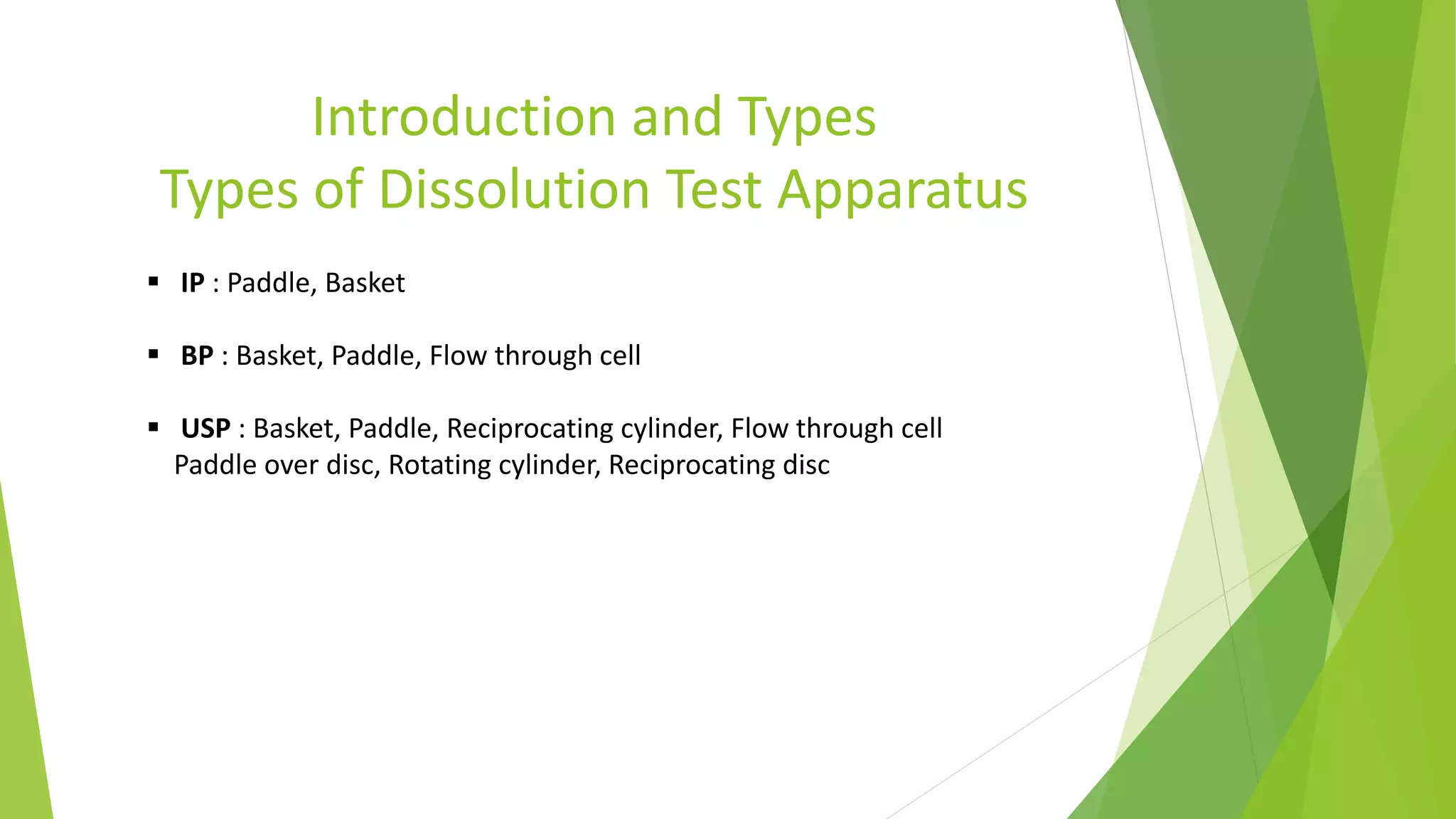
Types of Dissolution Test Apparatus
 IP : Paddle, Basket
 BP : Basket, Paddle, Flow through cell
 USP : Basket, Paddle, Reciprocating cylinder, Flow through cell
Paddle over disc, Rotating cylinder, Reciprocating disc
Installation Qualification
 Procedure
 Acceptance Criteria
 Conclusion
Installation Qualification
 Procedure :
 Details of the Equipment
 Supplier or Manufacturer Name & Address
 Equipment Name, Make & Model No.
 In-house Equipment Code No.
 Location
 Utilities
Installation Qualification
 Installation Procedure :
 Site Inspection, Environmental Conditions and Prerequisite
 Parts Identification List
 Validation of Physical Parameter
 SOPs
 Computerized System
Installation Qualification
 Acceptance Criteria :
 Fulfill the Selection Criteria & its Purpose of Application
 Material of Construction and Name of the Manufacturer & Supplier shall be as
mentioned in the Purchase order
 Meet pre-selected Design Parameters
 Equipment Manual shall be provided
 Utilities of recommended capacities are to be provided
Installation Qualification
 Conclusion :
 The equipment shall be considered qualified for installation provided it meets
all the parameters mentioned in the acceptance criteria.
 After receiving installation report, it shall be evaluated & released for
operational qualification, provided installation report is evaluated & the
equipment is found meeting all parameters of acceptance criteria.
Operational Qualification
Procedure :
 Power ON Check
 Lift Movement Check
 Temperature Accuracy
 Accuracy of Shaft Rotation
 Control of Paddle Wobbling
Operational Qualification
 Control of Paddle Centering
 Control of Distance of Shaft to Side of Vessel
 For Automated Dissolution Systems :
 Software/Hardware Communication
 Operator Interface Functions
 Stress / Boundary / Challenge Testing
Operational Qualification
 Acceptance Criteria :
 All operating inputs provided on the equipment when tested shall successfully
comply to their intended use & meet tolerance limit given by the
manufacturer.
 Perform successfully when operated as per SOP.
 Critical indicators provided on the equipment are calibrated.
 Equipment when operated shall not produce any abnormal sound or show
any discrepancy in its smooth operation.
Operational Qualification
 Conclusion :
 The equipment shall be considered qualified for performance qualification
provided it meets the acceptance criteria of operational qualification.
 The operational test reports shall be evaluated & equipment shall be released
for carrying out the performance qualification.
Performance Qualification
 Procedure :
 Test must be conducted for each of the combinations of vessels and
apparatus.
 USP Calibrator Tablets are used:
Disintegrating Tablets (Prednisone)
Non-disintegrating Tablets (Salicylic Acid)
Performance Qualification
 Effectiveness of dissolution will be qualified by determining drug content in
the solution.
 For the comparison, solution of known concentration of USP Reference
Standard is used.
 Document the deviation details.
Performance Qualification
 Acceptance Criteria :
 The result of the suitability test should be as per USP specification.
 The equipment should work smoothly with minimum noise while operating.
 The equipment should produce intended outputs with respect to quality &
quantity consistently.
Performance Qualification
 Conclusion :
 The equipment shall be considered qualified for regular usage provided it
should meet the acceptance criteria of performance qualification.
 The performance test reports shall be evaluated & equipment shall be
released for Carrying out the routine process.
Maintenance Schedule
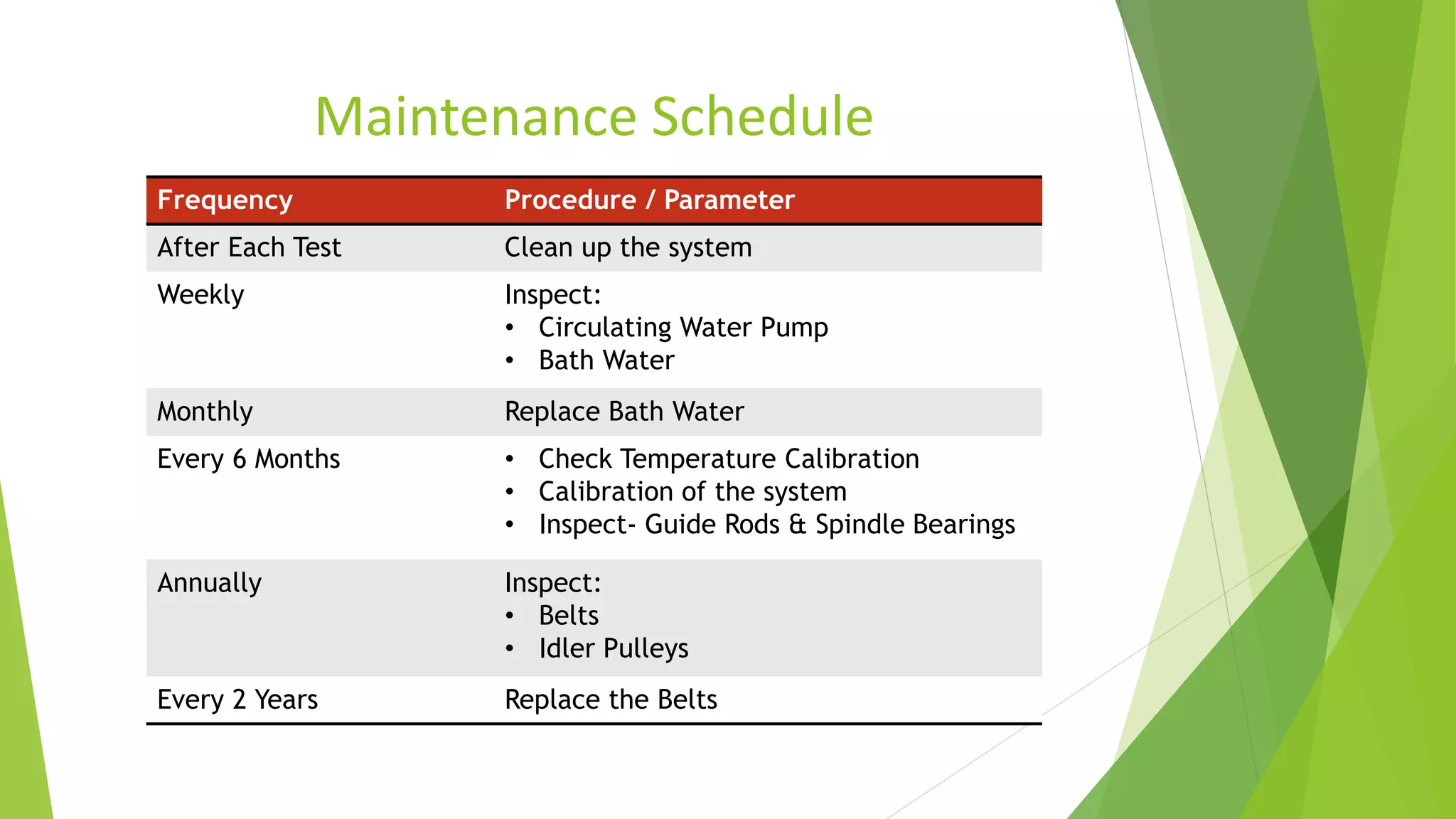
Frequency Procedure / Parameter
After Each Test Clean up the system
Weekly Inspect:
• Circulating Water Pump
• Bath Water
Monthly Replace Bath Water
Every 6 Months • Check Temperature Calibration
• Calibration of the system
• Inspect- Guide Rods & Spindle Bearings
Annually Inspect:
• Belts
• Idler Pulleys
Every 2 Years Replace the Belts
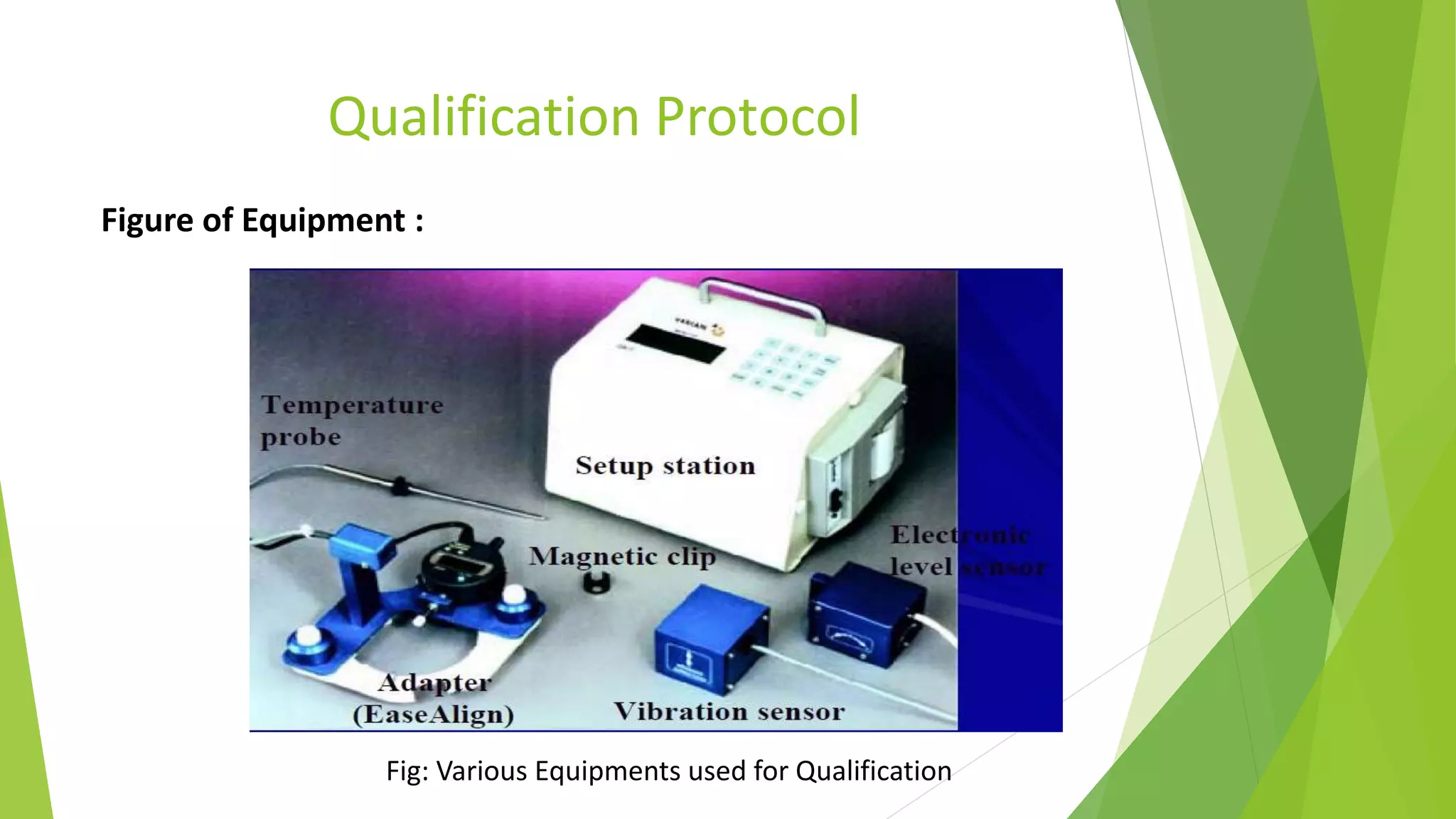
Qualification Protocol
Figure of Equipment :
Fig: Various Equipments used for Qualification
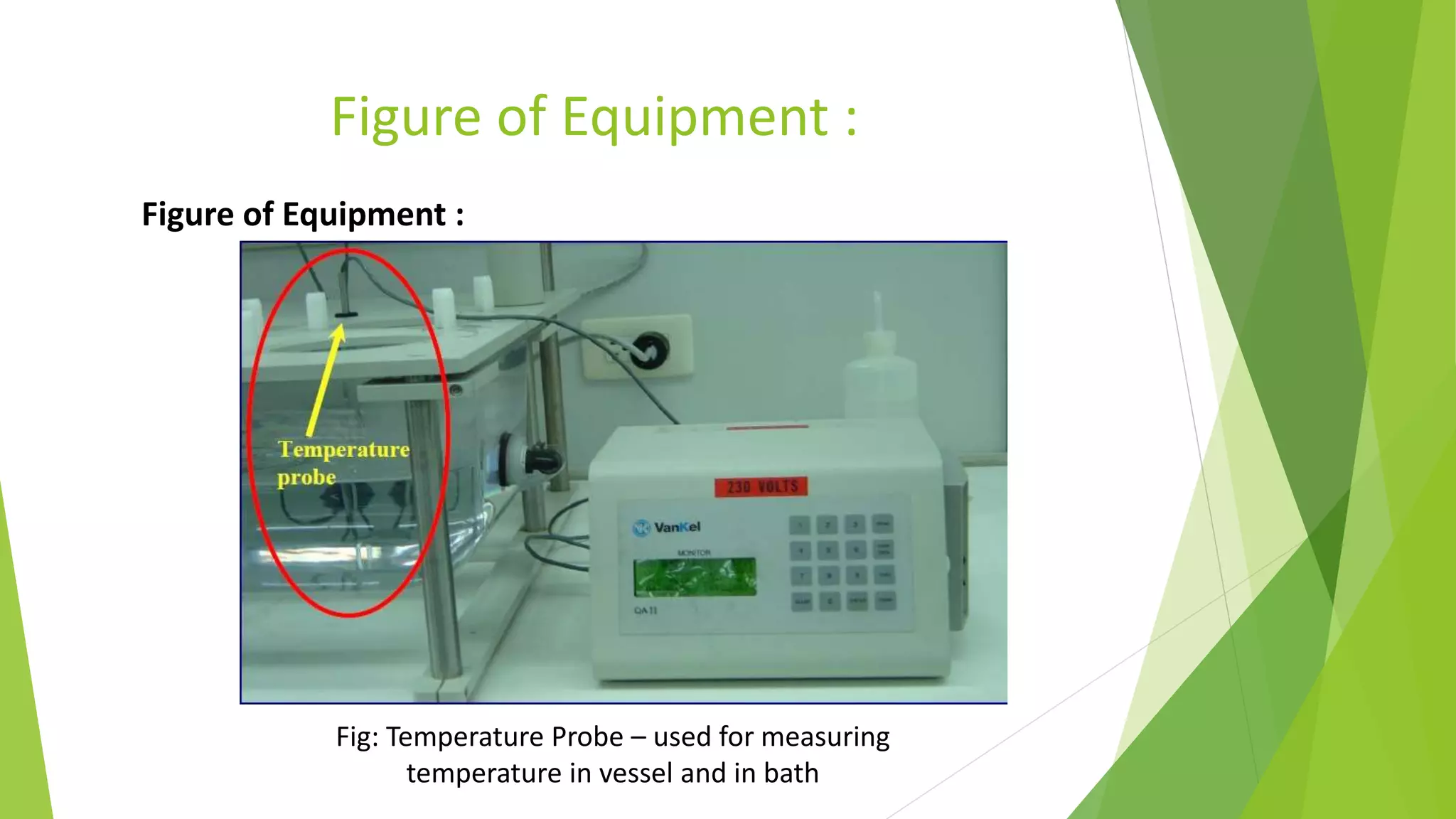
Figure of Equipment :
Fig: Temperature Probe – used for measuring
temperature in vessel and in bath
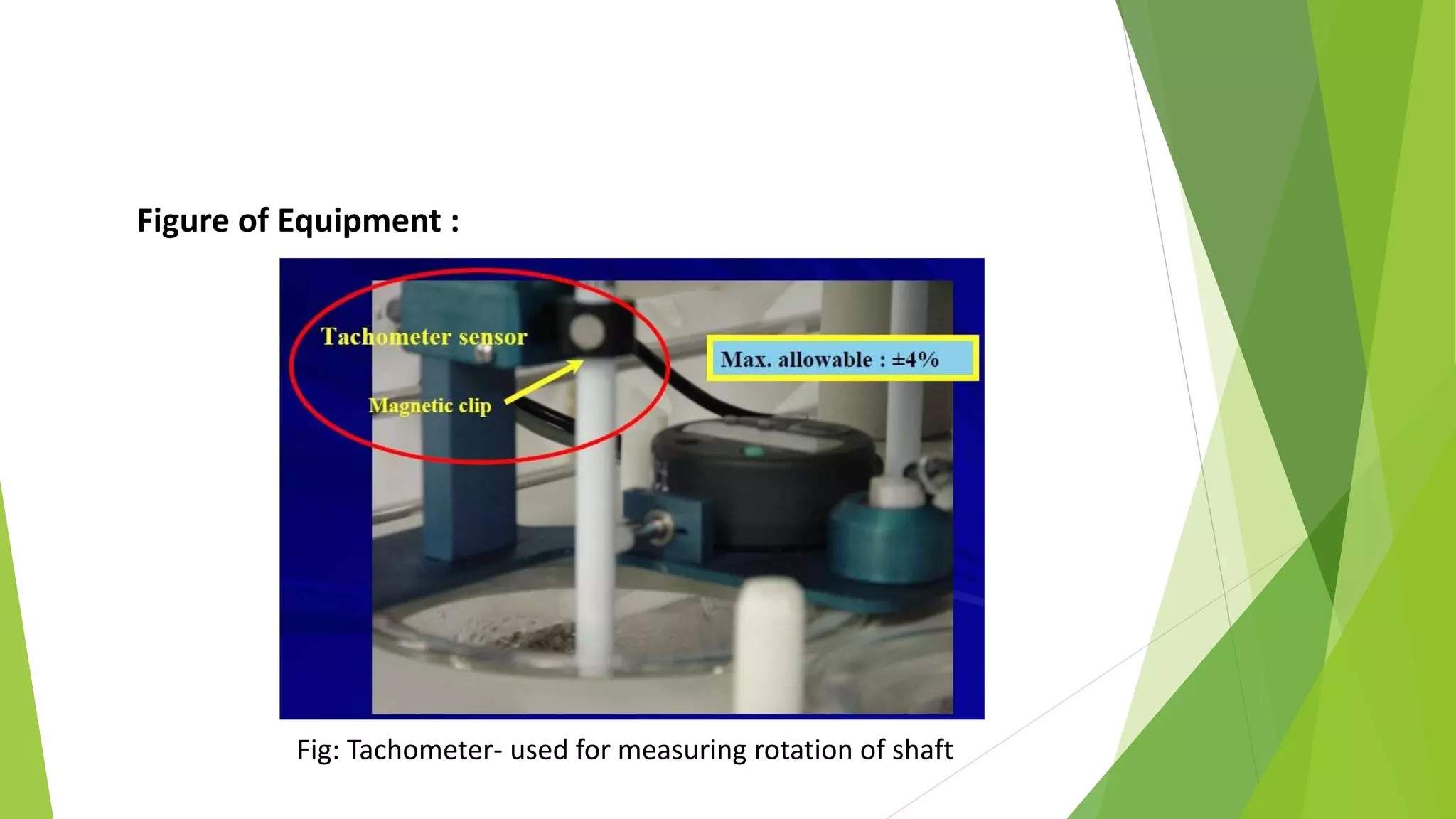
Figure of Equipment :
Fig: Tachometer- used for measuring rotation of shaft
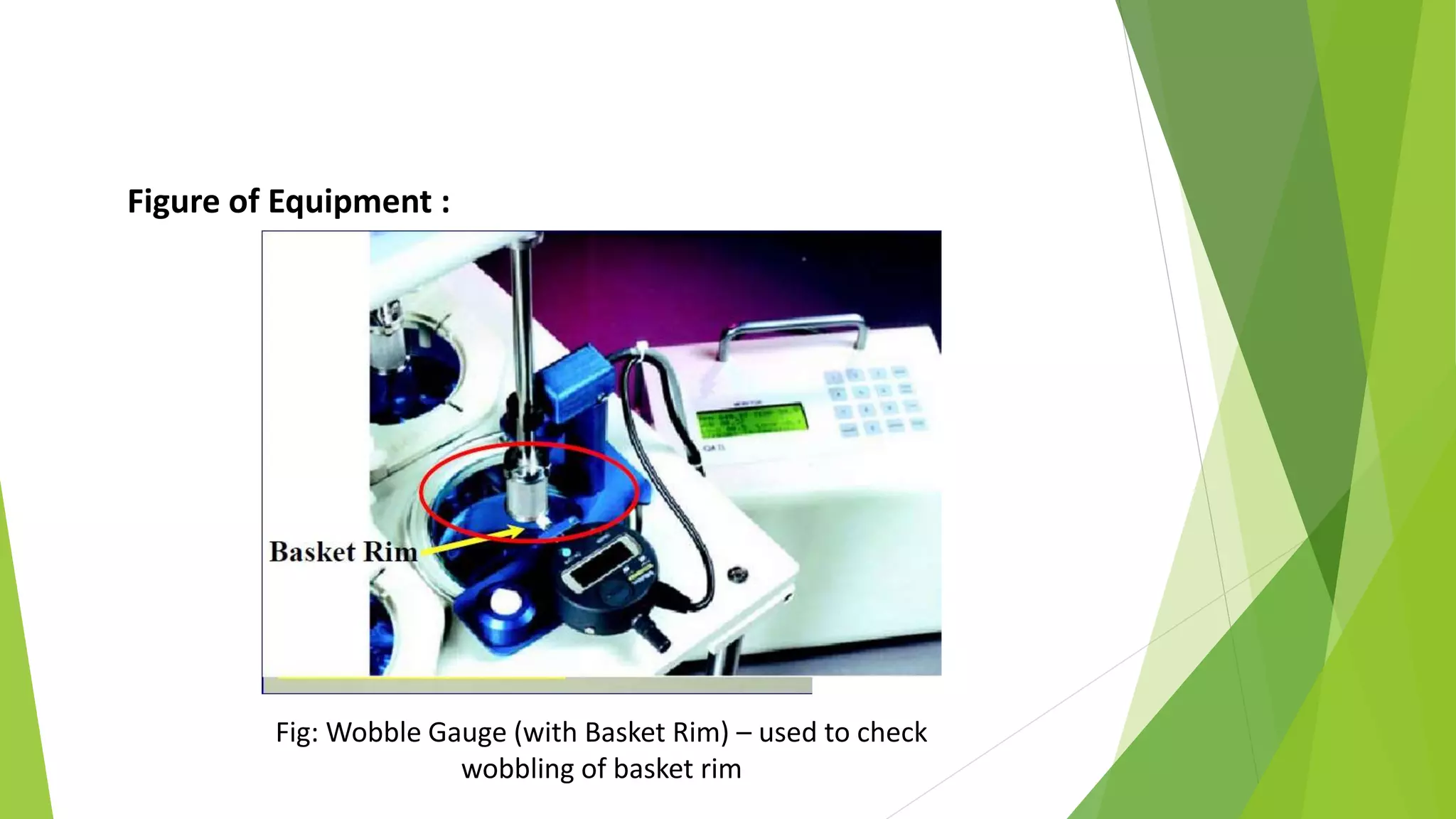
Figure of Equipment :
Fig: Wobble Gauge (with Basket Rim) – used to check
wobbling of basket rim
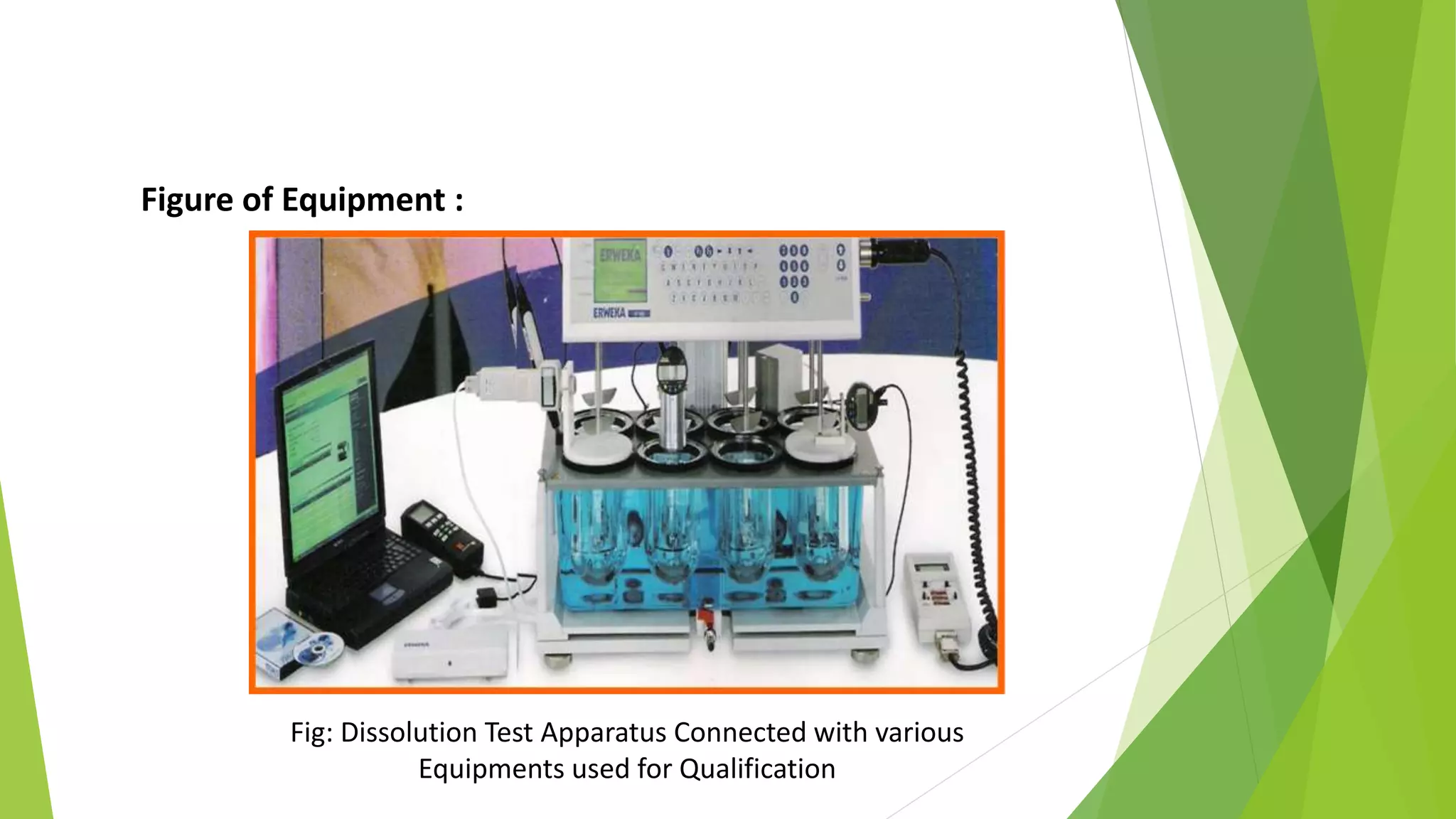
Figure of Equipment :
Fig: Dissolution Test Apparatus Connected with various
Equipments used for Qualification
Figure of Equipment :
Validation of Utility System
 This study provides a summary of the key validation test functions and
acceptance criteria for each utility system. These are provided as a guideline
for those involved in the validation of any pharmaceutical.
 Approval of this master plan neither provides approval of these test functions
and acceptance criteria for does it limit the test functions and acceptance
criteria included in any protocol.
 final approval of test functions and acceptance criteria is made by approval of
the installation, operational, and where applicable, performance qualification
protocols.
Plant steam
 Test functions :
 Perform installation qualification of deionizer and distillation equipment,
holding tanks, clean steam generator, and distribution system.
 Complete and document all required pre-start-up maintenance procedures
(including cleaning).
 Perform general operational controls verification testing.
 Verify that the system has adequate steam capacity during peak hours of
operation. Confirm that the steam pressure in within 5 psi of the
recommended operating pressure.
 Record the range of all process or equipment parameters (set points,
pressure, etc). Test the water produced by the system to ensure adequate
conductivity.
 Check that the holding tank water quality does not change adversely during
storage in holding tanks.
 Acceptance criteria :
 The system is installed in accordance with design specifications, manufacturer
recommendations, and cGMPs. Instruments are calibrated, identified, and
entered into the calibration program.
 General controls and alarms operate in accordance with design specification.
 The system operates in accordance with design specifications throughout the
operating range or range of intended use.
 System regulators must operate within ± 2 psi of design level.
 The system capacity must be sufficient to operate all system at peak demand
periods.
Pure steam
 Test functions :
 Perform installation qualification.
 Perform general operational controls verification testing.
 Verify that clean steam is fed by a purified water system or WFI system.
 Operate the system per applicable SOPs. Perform sampling as per the
sampling procedure and schedule.
 Record the range of all process or equipment parameters (set points,
pressure, etc.) verified during operational and performance qualification
testing.
 Acceptance criteria :
 The system is installed in accordance with design specifications, manufacturer
recommendations, and cGMPs. Instruments are calibrated, identified, and
entered into the calibrated program.
 General controls and alarms operate in accordance with design specifications.
 Operate the system per applicable SOPs. Perform sampling over a 1- month
period as per the sampling procedure and schedule.
 Test samples for conformance to current USP water for injection monograph.
Water for injection
 Test functions :
 Perform installation qualification. Verify piping, fitting, proper dimensions,
Drawings, wiring, PC software, calibration, and quality of materials.
 Check flow rates, low volume of water supply, excessive pressure drop, and
temperature drop or increase beyond set level.
 Perform general operational controls verification testing. Operate system
throughout the range of intended use.
 System regulators must operate within ± 2 psi of design level.
 Record the range of all process or equipment parameters verified during
operational and performance qualification testing.
 Acceptance criteria :
 The system is installed in accordance with design specifications, manufacturer
recommendations, and cGMPs. Instrument are calibrated, identified, and
entered into the calibration program.
 General controls and alarms operate in accordance with design specifications.
 All samples must meet the following criteria :
 Bacteriological purity. All samples must contain no more than 10 cfu/100 ml.
 Physical properties. The temperature of the hot water for injection must be
greater than 80°C.
Emergency power(standby generator)
 Test functions :
 Perform installation qualification.
 Perform general operational controls verification testing.
 Operate system throughout the range of opening design specifications or
range of intended use.
 Verify that the emergency power generation system has adequate power to
provide all intended users.
 Record the range of all process or equipment parameters verified during
operational and performance qualifications testing.
 Acceptance criteria :
 The system is installed in accordance with design specifications, manufacturer
recommendations, and cGMPs. Instruments are calibrated, identified, and
entered into the calibration program.
 General controls and alarms operate in accordance with design specifications.
 All intended users must operate under normal power source interruption
conditions.
References
 Frost S; “Introduction to the Validation of a Dissolution Apparatus”;
Dissolution Technologies; February 2004; 19-21.
 Sigvardson K; “Laboratory Equipment Qualification”; Pharmaceutical
Technologies; October 2011; 102-108.
 United States Pharmacopeial Convention, Inc; United States Pharmacopeia 26;
Rockville, Maryland: United States Pharmacopeial Convention, Inc; 2003.
 United state pharmacopoeia- 2014.
Qualification of Dissolution Test Apparatus and Validation of Utility System

Qualification of Dissolution Test Apparatus and Validation of Utility System

  • 1.
    Qualification of DissolutionTest Apparatus and Validation of Utility System Presented by : Akshay G. Trivedi Guided by : Dr. Pintu Prajapati Enrollment No : 201804103910007 Department of Pharmaceutical Quality Assurance Maliba Pharmacy College Uka Tarsadia University
  • 2.
    Qualification of DissolutionTest Apparatus  Contents :  Introduction & Types  Installation Qualification  Operational Qualification  Performance Qualification  Maintenance Schedule  Qualification Protocol  References
  • 3.
    Introduction and Types Dissolution:  “The process by which a known amount of drug substance goes into solution per unit of time under standardized conditions.”  Dissolution testing is used as a qualitative tool to provide measurements of the bioavailability of a drug as well as to demonstrate bioequivalence from batch-to-batch.
  • 4.
     Introduction : The bioavailability and bioequivalence data obtained can be used to guide the development of a new formulation and product development processes toward product optimization, as well as to ensure continuing product quality and performance of the manufacturing process.  Requirement for regulatory approval for product marketing.  Vital component of the overall quality control program.
  • 5.
    Introduction and Types Typesof Dissolution Test Apparatus  IP : Paddle, Basket  BP : Basket, Paddle, Flow through cell  USP : Basket, Paddle, Reciprocating cylinder, Flow through cell Paddle over disc, Rotating cylinder, Reciprocating disc
  • 6.
    Installation Qualification  Procedure Acceptance Criteria  Conclusion
  • 7.
    Installation Qualification  Procedure:  Details of the Equipment  Supplier or Manufacturer Name & Address  Equipment Name, Make & Model No.  In-house Equipment Code No.  Location  Utilities
  • 8.
    Installation Qualification  InstallationProcedure :  Site Inspection, Environmental Conditions and Prerequisite  Parts Identification List  Validation of Physical Parameter  SOPs  Computerized System
  • 9.
    Installation Qualification  AcceptanceCriteria :  Fulfill the Selection Criteria & its Purpose of Application  Material of Construction and Name of the Manufacturer & Supplier shall be as mentioned in the Purchase order  Meet pre-selected Design Parameters  Equipment Manual shall be provided  Utilities of recommended capacities are to be provided
  • 10.
    Installation Qualification  Conclusion:  The equipment shall be considered qualified for installation provided it meets all the parameters mentioned in the acceptance criteria.  After receiving installation report, it shall be evaluated & released for operational qualification, provided installation report is evaluated & the equipment is found meeting all parameters of acceptance criteria.
  • 11.
    Operational Qualification Procedure : Power ON Check  Lift Movement Check  Temperature Accuracy  Accuracy of Shaft Rotation  Control of Paddle Wobbling
  • 12.
    Operational Qualification  Controlof Paddle Centering  Control of Distance of Shaft to Side of Vessel  For Automated Dissolution Systems :  Software/Hardware Communication  Operator Interface Functions  Stress / Boundary / Challenge Testing
  • 13.
    Operational Qualification  AcceptanceCriteria :  All operating inputs provided on the equipment when tested shall successfully comply to their intended use & meet tolerance limit given by the manufacturer.  Perform successfully when operated as per SOP.  Critical indicators provided on the equipment are calibrated.  Equipment when operated shall not produce any abnormal sound or show any discrepancy in its smooth operation.
  • 14.
    Operational Qualification  Conclusion:  The equipment shall be considered qualified for performance qualification provided it meets the acceptance criteria of operational qualification.  The operational test reports shall be evaluated & equipment shall be released for carrying out the performance qualification.
  • 15.
    Performance Qualification  Procedure:  Test must be conducted for each of the combinations of vessels and apparatus.  USP Calibrator Tablets are used: Disintegrating Tablets (Prednisone) Non-disintegrating Tablets (Salicylic Acid)
  • 16.
    Performance Qualification  Effectivenessof dissolution will be qualified by determining drug content in the solution.  For the comparison, solution of known concentration of USP Reference Standard is used.  Document the deviation details.
  • 17.
    Performance Qualification  AcceptanceCriteria :  The result of the suitability test should be as per USP specification.  The equipment should work smoothly with minimum noise while operating.  The equipment should produce intended outputs with respect to quality & quantity consistently.
  • 18.
    Performance Qualification  Conclusion:  The equipment shall be considered qualified for regular usage provided it should meet the acceptance criteria of performance qualification.  The performance test reports shall be evaluated & equipment shall be released for Carrying out the routine process.
  • 19.
    Maintenance Schedule Frequency Procedure/ Parameter After Each Test Clean up the system Weekly Inspect: • Circulating Water Pump • Bath Water Monthly Replace Bath Water Every 6 Months • Check Temperature Calibration • Calibration of the system • Inspect- Guide Rods & Spindle Bearings Annually Inspect: • Belts • Idler Pulleys Every 2 Years Replace the Belts
  • 20.
    Qualification Protocol Figure ofEquipment : Fig: Various Equipments used for Qualification
  • 21.
    Figure of Equipment: Fig: Temperature Probe – used for measuring temperature in vessel and in bath Figure of Equipment :
  • 22.
    Fig: Tachometer- usedfor measuring rotation of shaft Figure of Equipment :
  • 23.
    Fig: Wobble Gauge(with Basket Rim) – used to check wobbling of basket rim Figure of Equipment :
  • 24.
    Fig: Dissolution TestApparatus Connected with various Equipments used for Qualification Figure of Equipment :
  • 25.
    Validation of UtilitySystem  This study provides a summary of the key validation test functions and acceptance criteria for each utility system. These are provided as a guideline for those involved in the validation of any pharmaceutical.  Approval of this master plan neither provides approval of these test functions and acceptance criteria for does it limit the test functions and acceptance criteria included in any protocol.  final approval of test functions and acceptance criteria is made by approval of the installation, operational, and where applicable, performance qualification protocols.
  • 26.
    Plant steam  Testfunctions :  Perform installation qualification of deionizer and distillation equipment, holding tanks, clean steam generator, and distribution system.  Complete and document all required pre-start-up maintenance procedures (including cleaning).  Perform general operational controls verification testing.  Verify that the system has adequate steam capacity during peak hours of operation. Confirm that the steam pressure in within 5 psi of the recommended operating pressure.  Record the range of all process or equipment parameters (set points, pressure, etc). Test the water produced by the system to ensure adequate conductivity.  Check that the holding tank water quality does not change adversely during storage in holding tanks.
  • 27.
     Acceptance criteria:  The system is installed in accordance with design specifications, manufacturer recommendations, and cGMPs. Instruments are calibrated, identified, and entered into the calibration program.  General controls and alarms operate in accordance with design specification.  The system operates in accordance with design specifications throughout the operating range or range of intended use.  System regulators must operate within ± 2 psi of design level.  The system capacity must be sufficient to operate all system at peak demand periods.
  • 28.
    Pure steam  Testfunctions :  Perform installation qualification.  Perform general operational controls verification testing.  Verify that clean steam is fed by a purified water system or WFI system.  Operate the system per applicable SOPs. Perform sampling as per the sampling procedure and schedule.  Record the range of all process or equipment parameters (set points, pressure, etc.) verified during operational and performance qualification testing.
  • 29.
     Acceptance criteria:  The system is installed in accordance with design specifications, manufacturer recommendations, and cGMPs. Instruments are calibrated, identified, and entered into the calibrated program.  General controls and alarms operate in accordance with design specifications.  Operate the system per applicable SOPs. Perform sampling over a 1- month period as per the sampling procedure and schedule.  Test samples for conformance to current USP water for injection monograph.
  • 30.
    Water for injection Test functions :  Perform installation qualification. Verify piping, fitting, proper dimensions, Drawings, wiring, PC software, calibration, and quality of materials.  Check flow rates, low volume of water supply, excessive pressure drop, and temperature drop or increase beyond set level.  Perform general operational controls verification testing. Operate system throughout the range of intended use.  System regulators must operate within ± 2 psi of design level.  Record the range of all process or equipment parameters verified during operational and performance qualification testing.
  • 31.
     Acceptance criteria:  The system is installed in accordance with design specifications, manufacturer recommendations, and cGMPs. Instrument are calibrated, identified, and entered into the calibration program.  General controls and alarms operate in accordance with design specifications.  All samples must meet the following criteria :  Bacteriological purity. All samples must contain no more than 10 cfu/100 ml.  Physical properties. The temperature of the hot water for injection must be greater than 80°C.
  • 32.
    Emergency power(standby generator) Test functions :  Perform installation qualification.  Perform general operational controls verification testing.  Operate system throughout the range of opening design specifications or range of intended use.  Verify that the emergency power generation system has adequate power to provide all intended users.  Record the range of all process or equipment parameters verified during operational and performance qualifications testing.
  • 33.
     Acceptance criteria:  The system is installed in accordance with design specifications, manufacturer recommendations, and cGMPs. Instruments are calibrated, identified, and entered into the calibration program.  General controls and alarms operate in accordance with design specifications.  All intended users must operate under normal power source interruption conditions.
  • 34.
    References  Frost S;“Introduction to the Validation of a Dissolution Apparatus”; Dissolution Technologies; February 2004; 19-21.  Sigvardson K; “Laboratory Equipment Qualification”; Pharmaceutical Technologies; October 2011; 102-108.  United States Pharmacopeial Convention, Inc; United States Pharmacopeia 26; Rockville, Maryland: United States Pharmacopeial Convention, Inc; 2003.  United state pharmacopoeia- 2014.

Editor's Notes

  • #16 Prednisone – glucocorticoid medication use decrease inflammation.