Maryam Fida (o-1827)
EPITHELIUM
 STRATIFIED CUBOIDAL EPITHELIUM
 STRATIFIED COLUMNAR EPITHELIUM
 TRANSITIONAL EPITHELIUM
 BASEMENT MEMBRANE
 FUNCTIONS OF EPITHELIUM
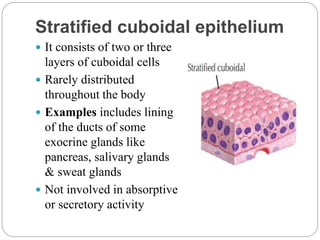
Stratified cuboidal epithelium
 It consists of two or three
layers of cuboidal cells
 Rarely distributed
throughout the body
 Examples includes lining
of the ducts of some
exocrine glands like
pancreas, salivary glands
& sweat glands
 Not involved in absorptive
or secretory activity
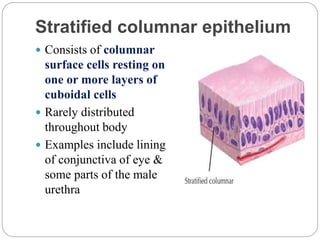
Stratified columnar epithelium
 Consists of columnar
surface cells resting on
one or more layers of
cuboidal cells
 Rarely distributed
throughout body
 Examples include lining
of conjunctiva of eye &
some parts of the male
urethra
 Unlike the stratified squamous epithelium
 the surface cells of stratified cuboidal and
stratified columnar epithelium are not
continuously replaced by mitosis at basal
cell layer and no progress of cells from the
base to surface.
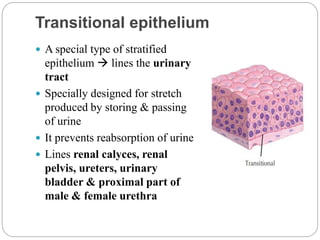
Transitional epithelium
 A special type of stratified
epithelium  lines the urinary
tract
 Specially designed for stretch
produced by storing & passing
of urine
 It prevents reabsorption of urine
 Lines renal calyces, renal
pelvis, ureters, urinary
bladder & proximal part of
male & female urethra
BASEMENT MEMBRANE or BASAL
LAMINA
 A thin layer of extracellular material present between
epithelial cells and the underlying connective tissue
 It consist of:
 Collagen type IV
 Glycoproteins
 Functions of basement membrane:
 Binds epithelial cells
 Provides support to epithelial cells
 Diffusion occurs through it  leading to
nourishment of epithelial cells
FUNCTIONS OF EPITHELIUM
1. PROTECION
 Function of all
 Most marked in stratified squamous
epithelium
2. SECRETION
 Goblet cells
3. ABSORPTION
 Lining of small intestine
 Epithelial cells of kidney tubules
4. EXCRETION
 Urine & Sweat
5. TRANSPORT
 Cilia  transport of mucus & ovum

Epithelium

  • 1.
  • 2.
     STRATIFIED CUBOIDALEPITHELIUM  STRATIFIED COLUMNAR EPITHELIUM  TRANSITIONAL EPITHELIUM  BASEMENT MEMBRANE  FUNCTIONS OF EPITHELIUM
  • 3.
    Stratified cuboidal epithelium It consists of two or three layers of cuboidal cells  Rarely distributed throughout the body  Examples includes lining of the ducts of some exocrine glands like pancreas, salivary glands & sweat glands  Not involved in absorptive or secretory activity
  • 4.
    Stratified columnar epithelium Consists of columnar surface cells resting on one or more layers of cuboidal cells  Rarely distributed throughout body  Examples include lining of conjunctiva of eye & some parts of the male urethra
  • 5.
     Unlike thestratified squamous epithelium  the surface cells of stratified cuboidal and stratified columnar epithelium are not continuously replaced by mitosis at basal cell layer and no progress of cells from the base to surface.
  • 6.
    Transitional epithelium  Aspecial type of stratified epithelium  lines the urinary tract  Specially designed for stretch produced by storing & passing of urine  It prevents reabsorption of urine  Lines renal calyces, renal pelvis, ureters, urinary bladder & proximal part of male & female urethra
  • 7.
    BASEMENT MEMBRANE orBASAL LAMINA  A thin layer of extracellular material present between epithelial cells and the underlying connective tissue  It consist of:  Collagen type IV  Glycoproteins  Functions of basement membrane:  Binds epithelial cells  Provides support to epithelial cells  Diffusion occurs through it  leading to nourishment of epithelial cells
  • 8.
    FUNCTIONS OF EPITHELIUM 1.PROTECION  Function of all  Most marked in stratified squamous epithelium 2. SECRETION  Goblet cells 3. ABSORPTION  Lining of small intestine  Epithelial cells of kidney tubules
  • 9.
    4. EXCRETION  Urine& Sweat 5. TRANSPORT  Cilia  transport of mucus & ovum