Histology of Male Reproductive
System
Dr. Laxman Khanal
Asst. Professor (Department of Anatomy)
BPKIHS, Nepal
To MBBS 2nd year
09-12-2016
Q. Crystel of Reinke is the characteristic feature of-
a. Cell of Leydig b. Sertoli cell
c. Spermatogonia d. spermatozoa
Q. Most numerous cell organell in Leydig cell is-
a. SER b. RER
c. Ribosome d. Lysosome
Q. Most of the duct system of male reproductive system is
lined by ---------- type of epithelium.
a. Simple columner b. pseudostratified ciliated columner
c. Simple cuboidal d. stratified columner
Anatomical subdivision of male reproductive system
Male gonad (Testis)
Duct system (efferent ductules, Epididymis, vas
deferens, ejaculatory duct and part of urethra)
Accessory glands- seminal vesicle, prostate and
bulbourethral gland (Cowper’s gland)
Penis
Function of male reproductive system
Production, storage , nourishment and transmission
of male gametes (spermatozoa)
Production of male hormones
Developmental site- post abdominal wall
Mature position- cooler scrotum (by descent of testis)
Histology of testis
No of lobule- 200-300
Each lobule – 1-3 ST
Covering of the testis
1. T vaginalis
2. T albuginea
3. T vasculosa
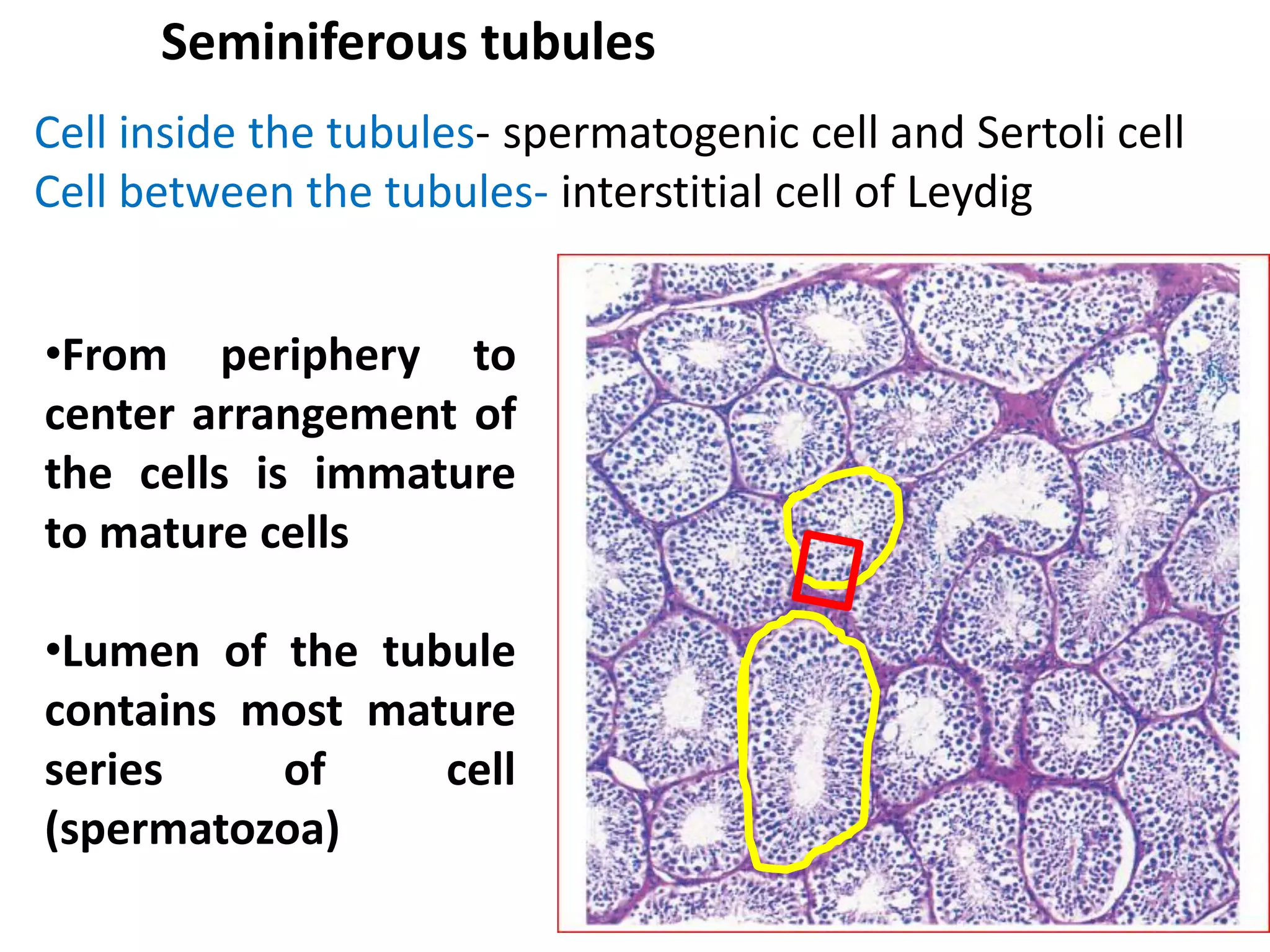
Seminiferous tubules
Cell inside the tubules- spermatogenic cell and Sertoli cell
Cell between the tubules- interstitial cell of Leydig
•From periphery to
center arrangement of
the cells is immature
to mature cells
•Lumen of the tubule
contains most mature
series of cell
(spermatozoa)
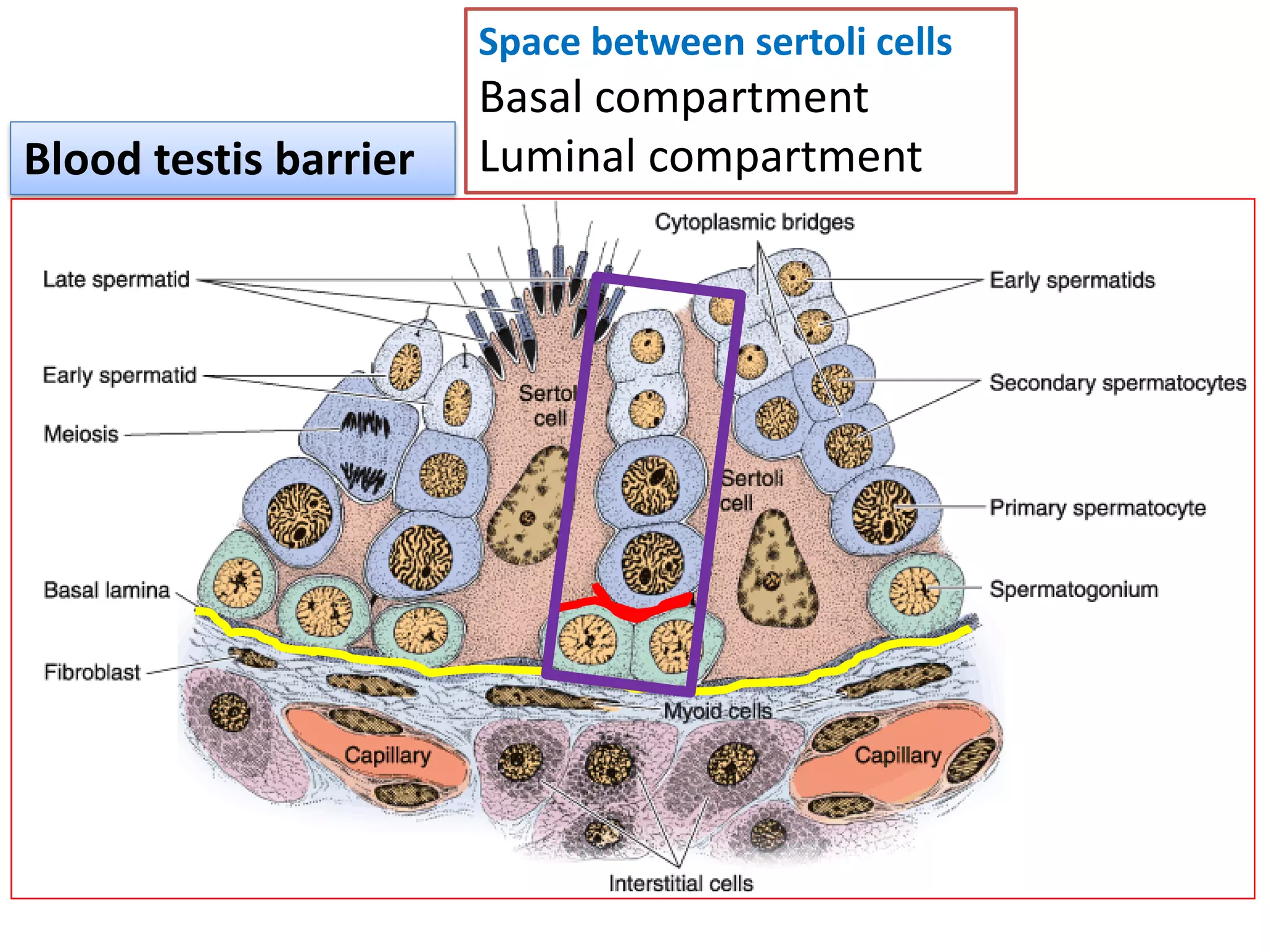
Blood testis barrier
Space between sertoli cells
Basal compartment
Luminal compartment
Function of Testis
Functions of Leydig cell
• Senses LH and secrets androgen (testosterone)
responsible for male type of sexual characters
Function of Sertoli cell
•Nourishment of spermatogenic cells
•Blood testis barrier
•Phagocytosis of residual bodies
•Senses FSH and secrets ABP
•In fetus secrets MIS (suppresses the female genital tract
development)
Spermatogenic cells- act as male gametes
Castor Semenya – 800 m gold
medalist in Rio Olympic 2016.
She was Found to have
suffered from androgen
insensitivity syndrome (AIS).
• Genotype: 44+XY
• Phenotype: Female
• Y chromosome present
• Leydig’s cells present
• Normal androgen level
• No receptor found for
androgen
• no male sex organ develops
• Looks like female
•Seminiferous tubules
•Straight tubules
•Rete testis
•Efferent ductules (15-20)
•Duct of Epididymis
•Vas deferens
•The epididymis is a long & extremely convoluted duct
lying on the posterior aspect of the testis.
•Made up of head (efferent ductules), body & tail (duct
of Epididymis).
•Amount of smooth muscle increases from head to tail
direction.
•Lining epithelium- pseudostratified columner
epithelium with stereocillia.
•Function- storage and maturation of spermatozoa.
Epididymis
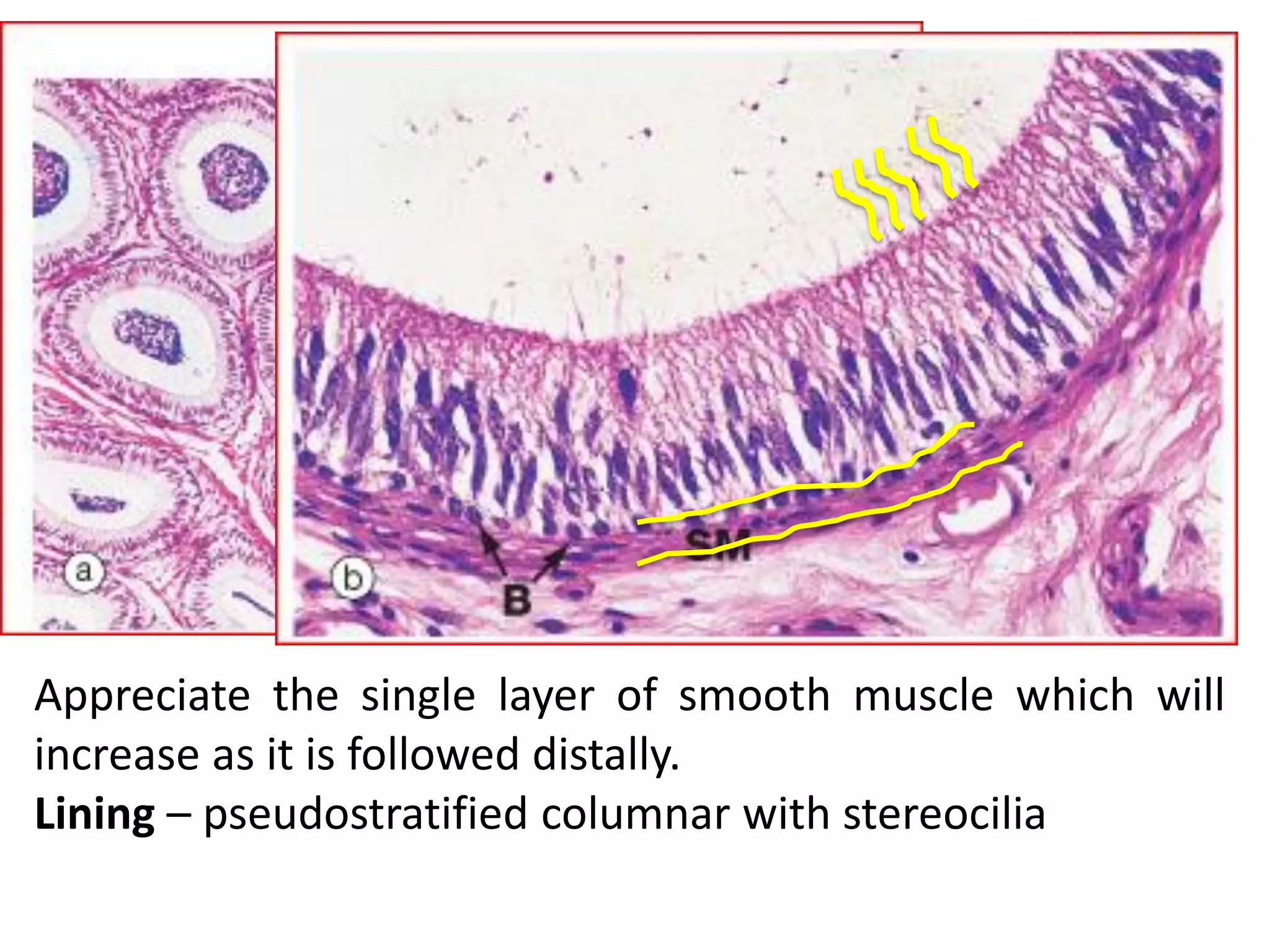
Appreciate the single layer of smooth muscle which will
increase as it is followed distally.
Lining – pseudostratified columnar with stereocilia
No muscle layer
Uniform shape of tubules
Stereocilia absent
Muscle layer present
Variable shape of ducts
Stereocilia present
Vas Deferens
• Length-45 cm
• Continue from tail of epididymis to the
seminal vesicle
• Lining epth- pseudostratified columner
epithelium with few stereocilia.
• Multiple layer of smooth muscle (outer and
inner layer of longitudinal muscle with circular
layer in between)
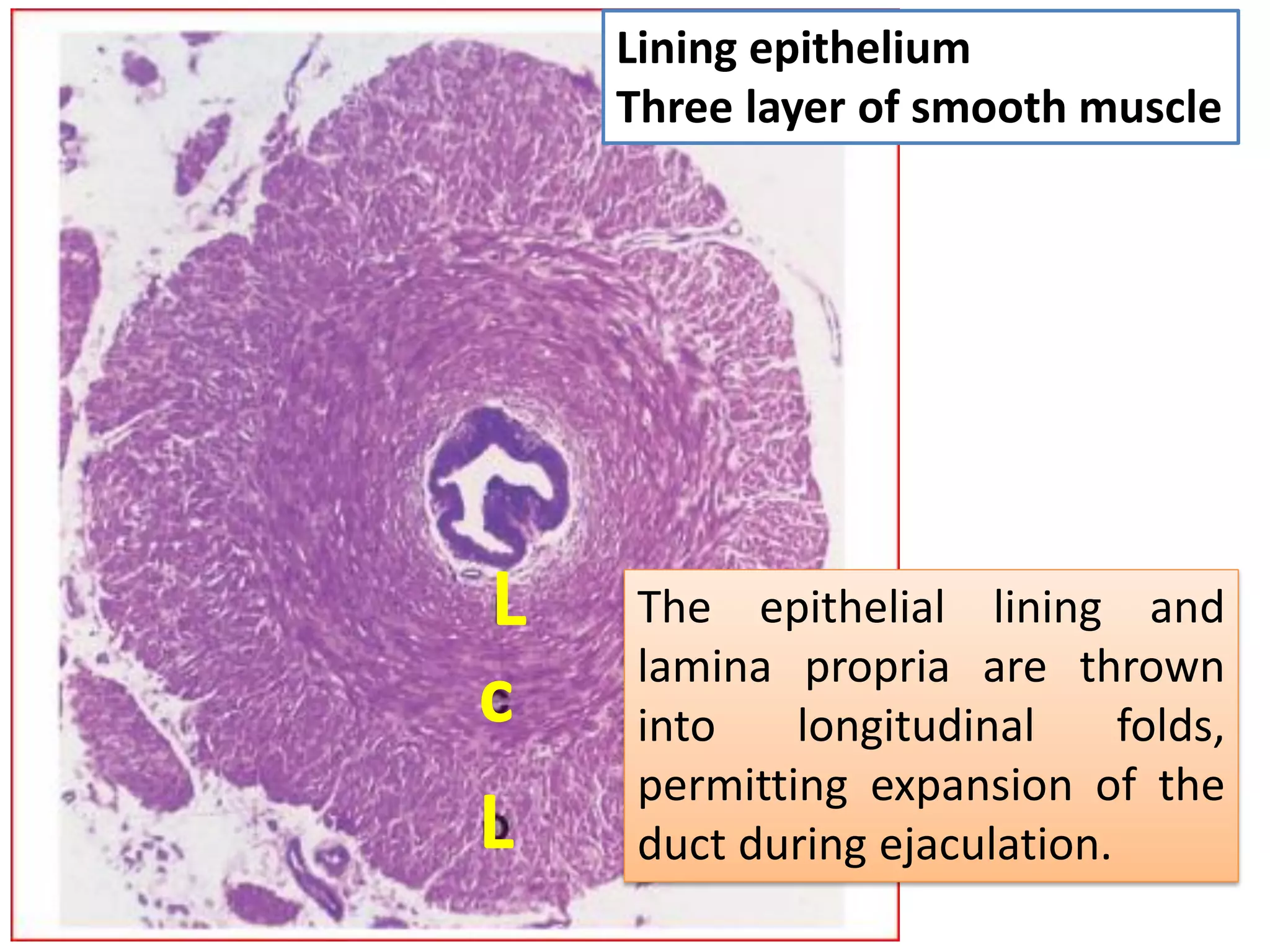
Lining epithelium
Three layer of smooth muscle
L
c
L
The epithelial lining and
lamina propria are thrown
into longitudinal folds,
permitting expansion of the
duct during ejaculation.
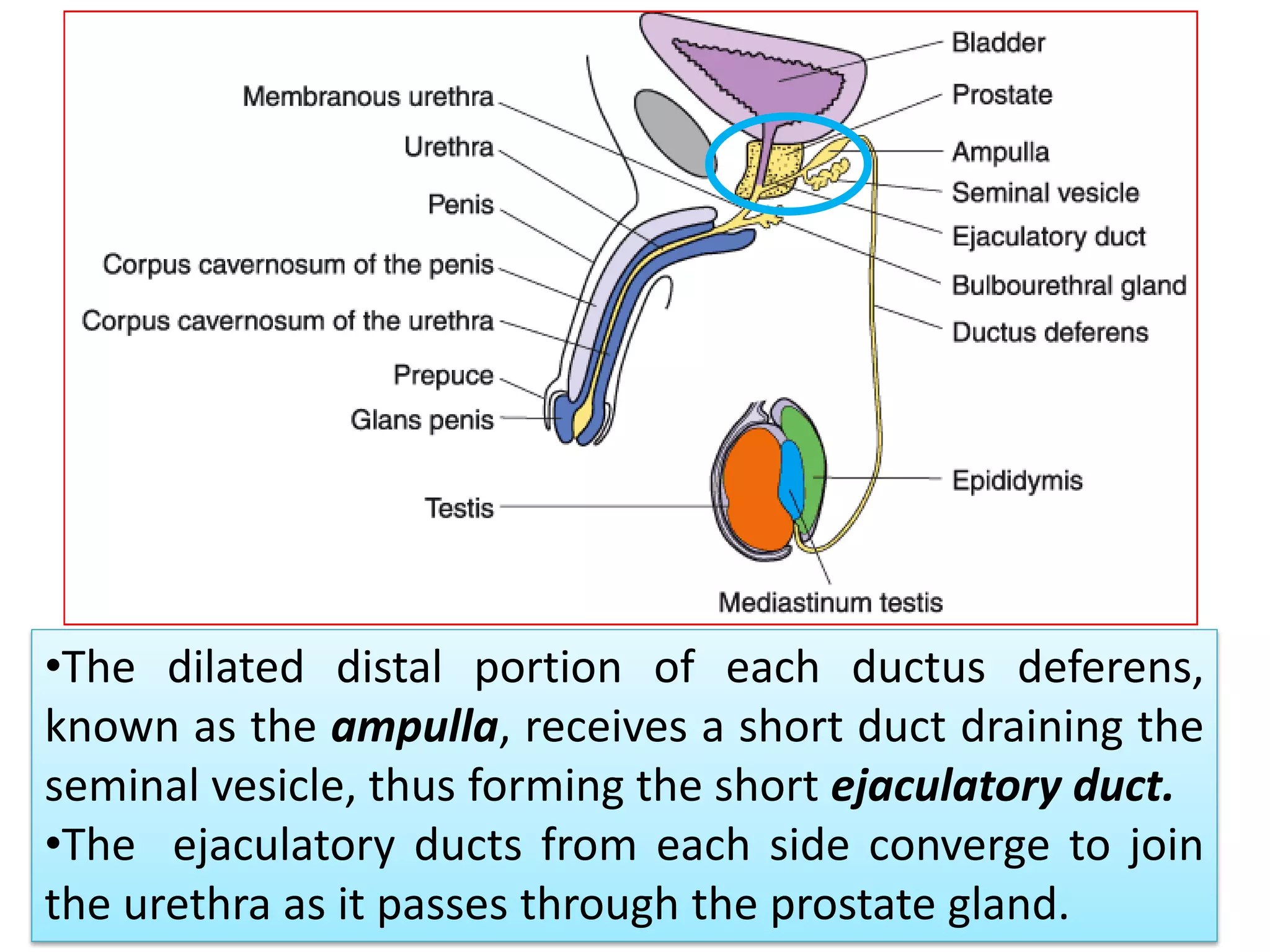
•The dilated distal portion of each ductus deferens,
known as the ampulla, receives a short duct draining the
seminal vesicle, thus forming the short ejaculatory duct.
•The ejaculatory ducts from each side converge to join
the urethra as it passes through the prostate gland.
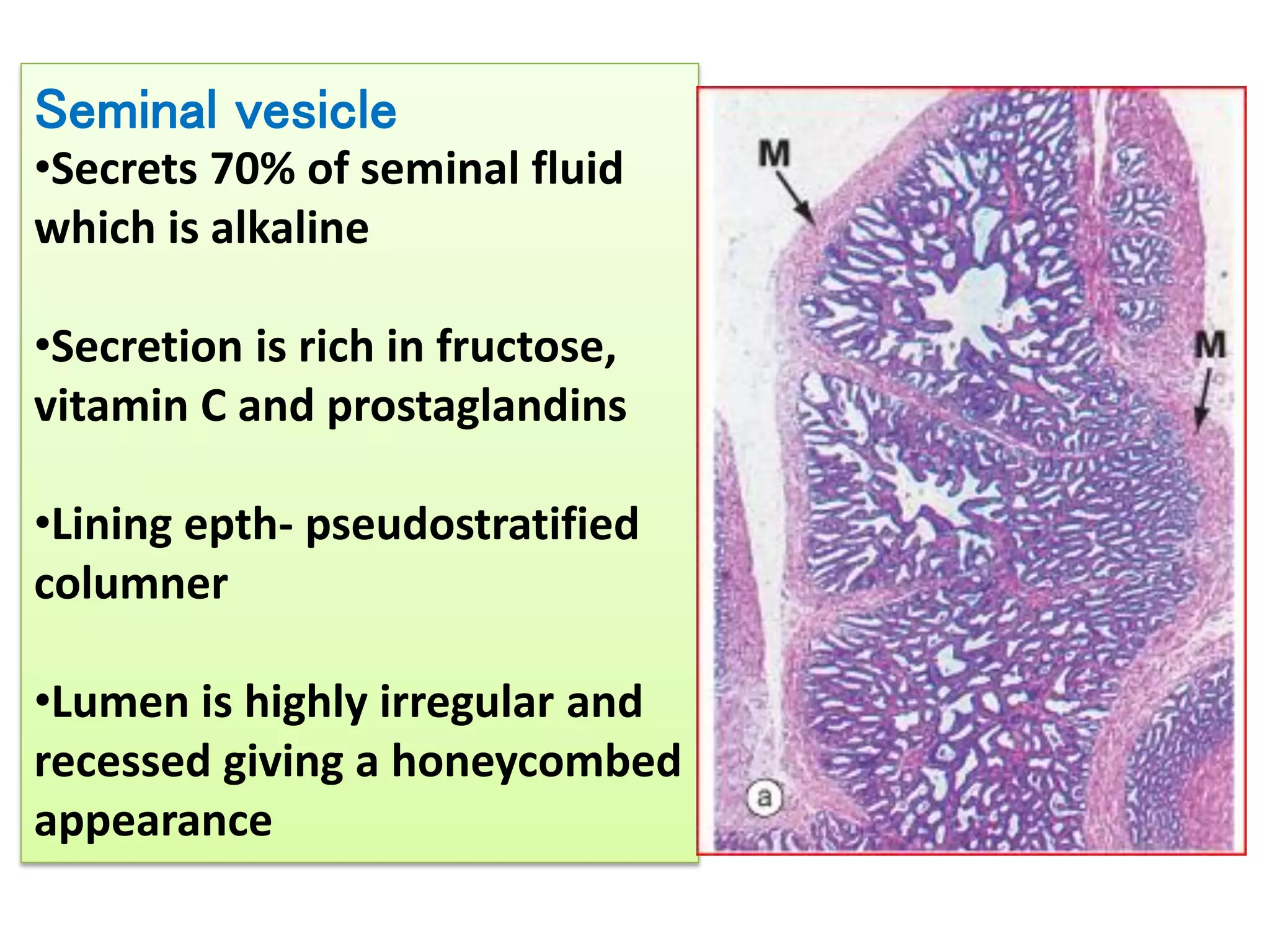
Seminal vesicle
•Secrets 70% of seminal fluid
which is alkaline
•Secretion is rich in fructose,
vitamin C and prostaglandins
•Lining epth- pseudostratified
columner
•Lumen is highly irregular and
recessed giving a honeycombed
appearance
Honeycomb appearance – lumen of seminal vesicle
Prostate gland
• Surrounds the bladder neck and the part of
the urethra, known as the prostatic urethra.
• In the substance of the gland, the urethra
merges with the ejaculatory ducts.
• Histologically the prostate is compound
tubulo-alveolar glands embedded in a
fibromuscular stroma.
• Secretion consists of 30% of seminal fluid.
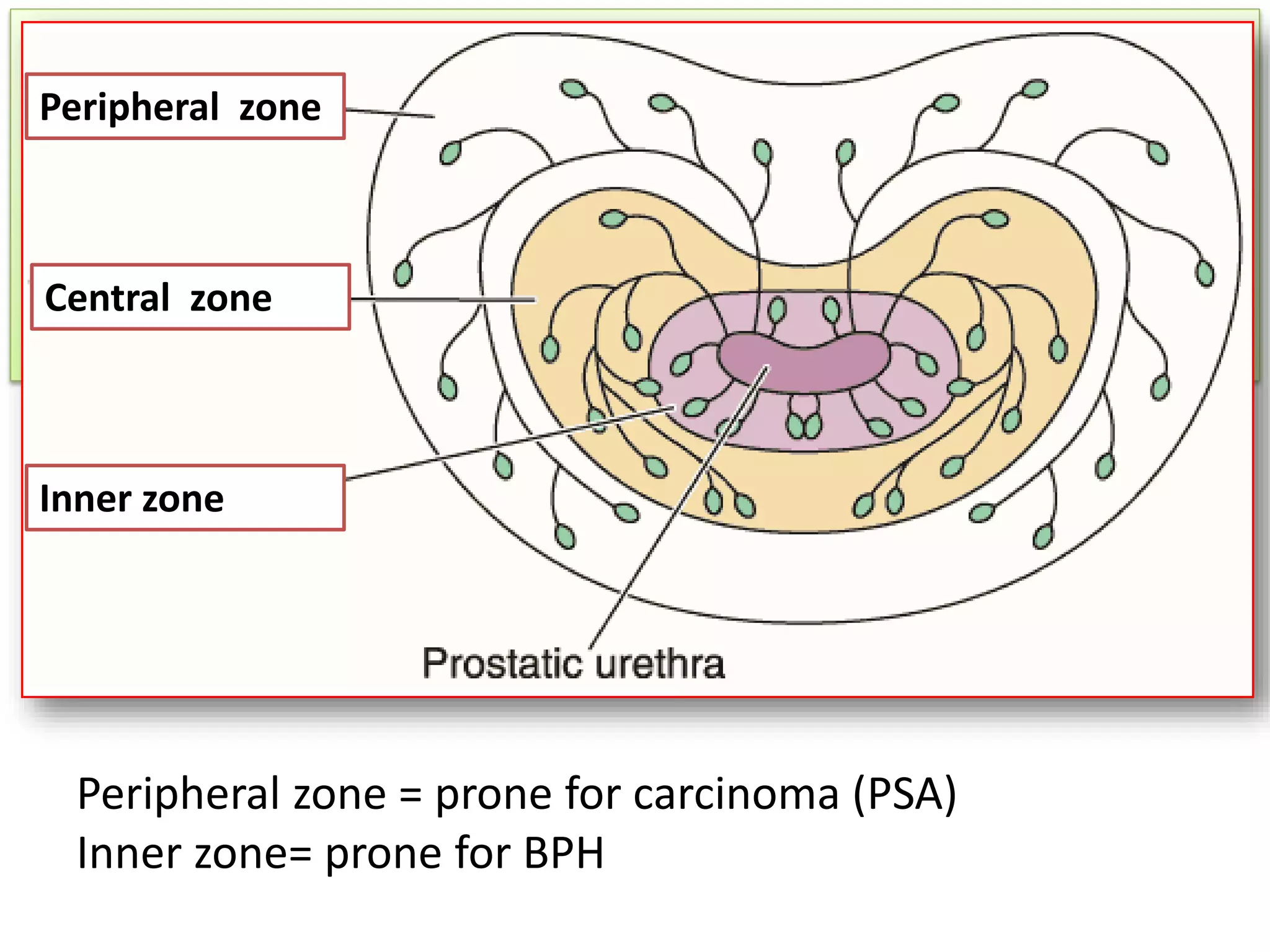
In the histological section prostate has arrangement of
glands in three concentric layers.
1. Inner zone- mucosal gland
2. Central zone- submucosal gland
3. Peripheral zone- main gland
• All the secretion finally secreted into prostatic urethra.
Peripheral zone = prone for carcinoma (PSA)
Inner zone= prone for BPH
Inner zone
Central zone
Peripheral zone
•Prostate
= glandular tissue + fibromuscular stroma.
•Contains prostatic urethra
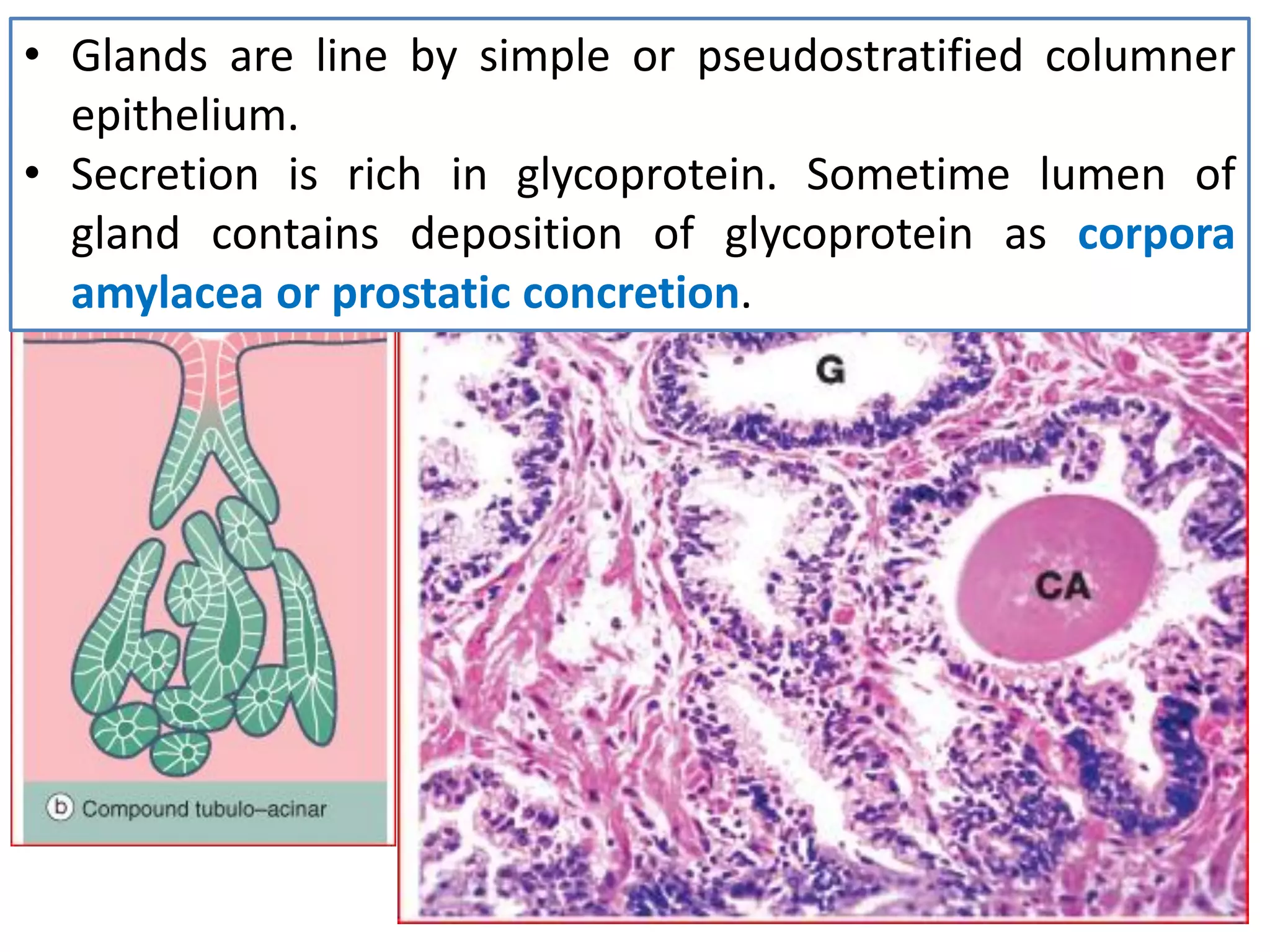
• Glands are line by simple or pseudostratified columner
epithelium.
• Secretion is rich in glycoprotein. Sometime lumen of
gland contains deposition of glycoprotein as corpora
amylacea or prostatic concretion.
Benign prostate hyperplasia
Testosterone Dihydrotestosterone (DHT)
5α reductase
• Found in urogenital diaphragm
• Secret preseminal mucus secretion
• Help to lubricate the penile urethra
Penis
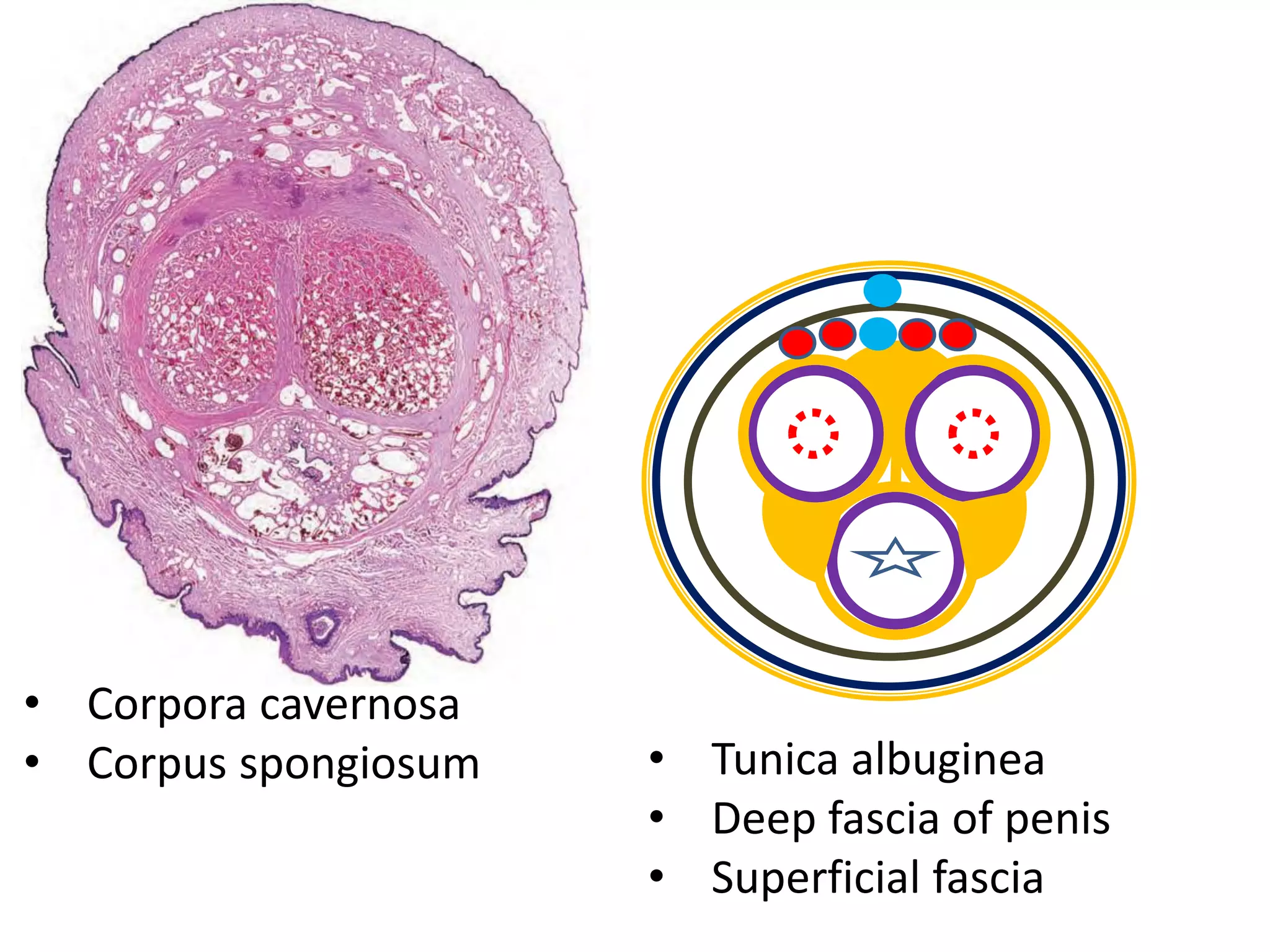
• The main components of the penis are three
cylindrical masses of erectile tissue, plus the
urethra, surrounded by skin.
• At its distal end, the corpus spongiosum
expands to form the glans penis.
• Except for the prostatic part of urethra, and
most distal part of urethra lining is
pseudostratified columner epithlium.
• Corpora cavernosa
• Corpus spongiosum • Tunica albuginea
• Deep fascia of penis
• Superficial fascia
Sexual stimulation
Parasympathetic
Stimulation (S2-S4)
Increased blood flow.
Smooth muscle relaxation.
Erection
Reflex sympathetic
stimulation (L1)
Emission
Blood flow decreases.
Smooth muscle contracts
Contraction of BS & IC
Ejaculation
Histology of male reproductive system

Histology of male reproductive system

  • 1.
    Histology of MaleReproductive System Dr. Laxman Khanal Asst. Professor (Department of Anatomy) BPKIHS, Nepal To MBBS 2nd year 09-12-2016
  • 2.
    Q. Crystel ofReinke is the characteristic feature of- a. Cell of Leydig b. Sertoli cell c. Spermatogonia d. spermatozoa Q. Most numerous cell organell in Leydig cell is- a. SER b. RER c. Ribosome d. Lysosome Q. Most of the duct system of male reproductive system is lined by ---------- type of epithelium. a. Simple columner b. pseudostratified ciliated columner c. Simple cuboidal d. stratified columner
  • 3.
    Anatomical subdivision ofmale reproductive system Male gonad (Testis) Duct system (efferent ductules, Epididymis, vas deferens, ejaculatory duct and part of urethra) Accessory glands- seminal vesicle, prostate and bulbourethral gland (Cowper’s gland) Penis Function of male reproductive system Production, storage , nourishment and transmission of male gametes (spermatozoa) Production of male hormones
  • 5.
    Developmental site- postabdominal wall Mature position- cooler scrotum (by descent of testis) Histology of testis No of lobule- 200-300 Each lobule – 1-3 ST Covering of the testis 1. T vaginalis 2. T albuginea 3. T vasculosa
  • 6.
    Seminiferous tubules Cell insidethe tubules- spermatogenic cell and Sertoli cell Cell between the tubules- interstitial cell of Leydig •From periphery to center arrangement of the cells is immature to mature cells •Lumen of the tubule contains most mature series of cell (spermatozoa)
  • 7.
    Blood testis barrier Spacebetween sertoli cells Basal compartment Luminal compartment
  • 8.
    Function of Testis Functionsof Leydig cell • Senses LH and secrets androgen (testosterone) responsible for male type of sexual characters Function of Sertoli cell •Nourishment of spermatogenic cells •Blood testis barrier •Phagocytosis of residual bodies •Senses FSH and secrets ABP •In fetus secrets MIS (suppresses the female genital tract development) Spermatogenic cells- act as male gametes
  • 9.
    Castor Semenya –800 m gold medalist in Rio Olympic 2016. She was Found to have suffered from androgen insensitivity syndrome (AIS). • Genotype: 44+XY • Phenotype: Female • Y chromosome present • Leydig’s cells present • Normal androgen level • No receptor found for androgen • no male sex organ develops • Looks like female
  • 10.
    •Seminiferous tubules •Straight tubules •Retetestis •Efferent ductules (15-20) •Duct of Epididymis •Vas deferens
  • 11.
    •The epididymis isa long & extremely convoluted duct lying on the posterior aspect of the testis. •Made up of head (efferent ductules), body & tail (duct of Epididymis). •Amount of smooth muscle increases from head to tail direction. •Lining epithelium- pseudostratified columner epithelium with stereocillia. •Function- storage and maturation of spermatozoa. Epididymis
  • 13.
    Appreciate the singlelayer of smooth muscle which will increase as it is followed distally. Lining – pseudostratified columnar with stereocilia
  • 14.
    No muscle layer Uniformshape of tubules Stereocilia absent Muscle layer present Variable shape of ducts Stereocilia present
  • 15.
    Vas Deferens • Length-45cm • Continue from tail of epididymis to the seminal vesicle • Lining epth- pseudostratified columner epithelium with few stereocilia. • Multiple layer of smooth muscle (outer and inner layer of longitudinal muscle with circular layer in between)
  • 16.
    Lining epithelium Three layerof smooth muscle L c L The epithelial lining and lamina propria are thrown into longitudinal folds, permitting expansion of the duct during ejaculation.
  • 17.
    •The dilated distalportion of each ductus deferens, known as the ampulla, receives a short duct draining the seminal vesicle, thus forming the short ejaculatory duct. •The ejaculatory ducts from each side converge to join the urethra as it passes through the prostate gland.
  • 18.
    Seminal vesicle •Secrets 70%of seminal fluid which is alkaline •Secretion is rich in fructose, vitamin C and prostaglandins •Lining epth- pseudostratified columner •Lumen is highly irregular and recessed giving a honeycombed appearance
  • 19.
    Honeycomb appearance –lumen of seminal vesicle
  • 20.
    Prostate gland • Surroundsthe bladder neck and the part of the urethra, known as the prostatic urethra. • In the substance of the gland, the urethra merges with the ejaculatory ducts. • Histologically the prostate is compound tubulo-alveolar glands embedded in a fibromuscular stroma. • Secretion consists of 30% of seminal fluid.
  • 21.
    In the histologicalsection prostate has arrangement of glands in three concentric layers. 1. Inner zone- mucosal gland 2. Central zone- submucosal gland 3. Peripheral zone- main gland • All the secretion finally secreted into prostatic urethra. Peripheral zone = prone for carcinoma (PSA) Inner zone= prone for BPH Inner zone Central zone Peripheral zone
  • 22.
    •Prostate = glandular tissue+ fibromuscular stroma. •Contains prostatic urethra • Glands are line by simple or pseudostratified columner epithelium. • Secretion is rich in glycoprotein. Sometime lumen of gland contains deposition of glycoprotein as corpora amylacea or prostatic concretion.
  • 23.
    Benign prostate hyperplasia TestosteroneDihydrotestosterone (DHT) 5α reductase
  • 24.
    • Found inurogenital diaphragm • Secret preseminal mucus secretion • Help to lubricate the penile urethra
  • 25.
    Penis • The maincomponents of the penis are three cylindrical masses of erectile tissue, plus the urethra, surrounded by skin. • At its distal end, the corpus spongiosum expands to form the glans penis. • Except for the prostatic part of urethra, and most distal part of urethra lining is pseudostratified columner epithlium.
  • 27.
    • Corpora cavernosa •Corpus spongiosum • Tunica albuginea • Deep fascia of penis • Superficial fascia
  • 28.
    Sexual stimulation Parasympathetic Stimulation (S2-S4) Increasedblood flow. Smooth muscle relaxation. Erection Reflex sympathetic stimulation (L1) Emission Blood flow decreases. Smooth muscle contracts Contraction of BS & IC Ejaculation