Epigenetic
Modifications of Proteins
Akshay More,
M.Sc. Biotechnology-1.,
Modern College, Ganeshkhind, Pune.
OUTLINE
 What is epigenetics?
 Epigenetic Modification of Histone
Proteins
 Epigenetic Modifications of
 Sox 2
 CCAAT/enhancer binding protein a (C/EBPa)
 Caveolae associated proteins
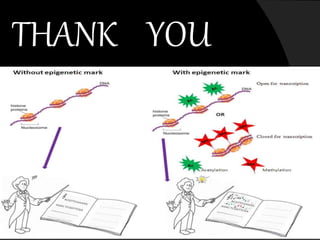
Epigenetics
- Literally means "above" or "on top of" genetics.
- ‘Heritable changes in gene activity and expression that
occur without alteration in DNA sequences’
- i.e. a change in phenotype without a change in genotype.
- Epigenetics is the reason why a skin cell looks different
from a brain cell or a muscle cell. All three cells contain the
same DNA, but their genes are expressed differently
(turned "on" or "off"), which creates the different cell types.
Can be achieved by…..
1) DNA methylations
2) Histone Modifications
3) Post translational Modifications
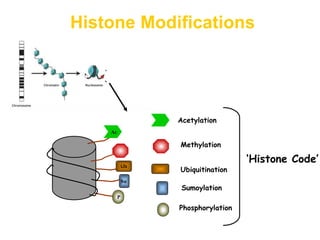
Modifications of Histones
- Histones are highly alkaline proteins found in eukaryotic
cell nuclei that package and order the DNA into structural
units called nucleosomes.
Histone Modifications
Me
P
Ub
Su
Ac Me
Acetylation
Methylation
Ubiquitination
Sumoylation
Phosphorylation
‘Histone Code’
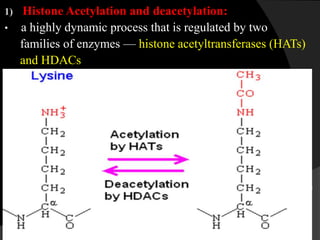
1) Histone Acetylation and deacetylation:
• a highly dynamic process that is regulated by two
families of enzymes — histone acetyltransferases (HATs)
and HDACs
• HATs use acetyl-CoA as a cofactor and catalyze the
transfer of an acetyl group to the ε-amino group of lysine
side chains on the histone protein. This neutralizes the
positive charge on lysine, thus reducing the affinity of the
histone tail that protrudes from the nucleosome core of
DNA. As a result, chromatin adopts a more relaxed
structure, enabling the recruitment of the transcriptional
machinery.
• HDACs reverse the acetylation of lysine residues to restore
their positive charge and stabilize the local chromatin
architecture.
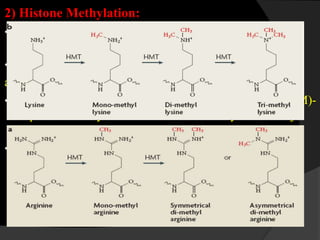
2) Histone Methylation:
• Lysine residues on histones can be monomethylated,
dimethylated or trimethylated.
• Arginine residues are also subject to monomethylation
and dimethylation.
• Methyl marks are written by S-adenosylmethionine (SAM)-
dependent methyltransferases and erased by the Jumonji
family of 2-oxoglutarate-dependent demethylases.
• Histone lysine methylation can be associated with either
transcriptional activation (H3K4me3) or repression
(H3K9me3 and H3K27me3 )
1) Sox 2
• SRY (sex determining region Y)-box 2, also known as SOX2, is
a transcription factor that is essential for maintaining self-
renewal, or pluripotency, of undifferentiated embryonic stem
cells.
• Sox2, a critical transcription regulator of embryonic and neural
normal stem cell function, has been reported to be dysregulated
in several human cancers.
• Sox2 was found to be frequently downregulated in gastric
cancers and overexpressed in small-cell lung cancers,
esophageal squamous carcinomas, and basal cell-like breast
carcinomas.
• Sox2 locus was shown to be amplified in small-cell lung cancer,
esophageal squamous carcinomas and, to a lesser extent, in
GBM .
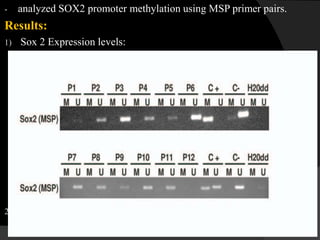
• Sox2 promoter hypomethylated in Sox2-expressing cell lines
and Sox2- negative cell lines exhibited a methylated promoter
pattern ( Marta,Ricardo et al. 2011)
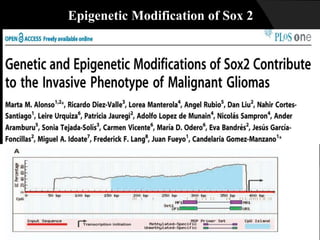
Epigenetic Modification of Sox 2
• The glioma cell lines LN229, U87 MG, U251 MG, U373, A172,
SNB19, D54 and human GBM surgical specimens.
1) Sox2 Expression Levels by Quantitative PCR.
2) Assessment of SOX2 Promoter Methylation:
- DNA was extracted from cell lines and patients.
- analyzed SOX2 promoter methylation using MSP primer pairs.
Results:
1) Sox 2 Expression levels:
2) Assessment of SOX2 Promoter Methylation
2) CCAAT/Enhancer Binding Protein A
• CCAAT/enhancer binding protein a (C/EBPa), is a key
transcription factor involved in the regulation of cell
proliferation and differentiation in a variety of cell
types, particularly in the hematopoietic system.
• Under physiologic conditions, C/EBPa is a master
regulator for myeloid differentiation and granulocytic
maturation, its absence results in a block of
granulopoiesis.
• Aberrant promoter methylation of C/EBPa is a
common event in AML.( Kristi, Romulo 2008)
Epigenetic Modification of C/EBPa
- One hundred forty-six bone marrow samples from AML patients.
- DNA and RNA Isolation.
- Assessment of C/EBPa methylation by COBRA.
[Combined Bisulfite Restriction Analysis (or COBRA) is a molecular
biology technique that allows for the sensitive quantification of DNA
methylation levels at a specific genomic locus on a DNA sequence in a
small sample of genomic DNA. The technique is a variation of bisulfite
sequencing, and combines bisulfite conversion based polymerase chain
reaction with restriction digestion. ]
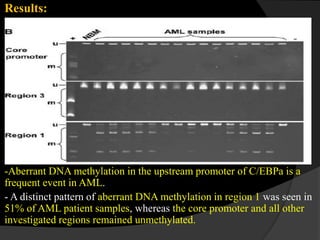
Results:
-Aberrant DNA methylation in the upstream promoter of C/EBPa is a
frequent event in AML.
- A distinct pattern of aberrant DNA methylation in region 1 was seen in
51% of AML patient samples, whereas the core promoter and all other
investigated regions remained unmethylated.
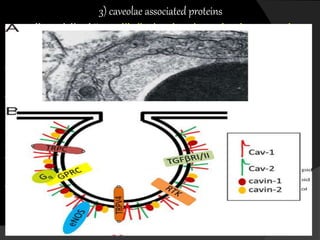
3) caveolae associated proteins
• small specialized “cave-like” microdomains at the plasma membrane
that function as trafficking vesicles and are involved in organization
of signal transduction.
• Caveolae are present in most tissues and are particularly abundant in
cardiac, continuous endothelial and epithelial cells.
• Within caveolae are caveolae associated proteins;
1) caveolin-1 (CAV1)
2) caveolin-2 (CAV2) ,
3) caveolin-3 (CAV3),
• Cavin-1 (also know as polymerase-1 and transcript release factor)
(PTRF) ,
• Cavin-2 , Cavin-3 and Cavin-4 , which are important for the
formation and maintenance of the caveolar structure..
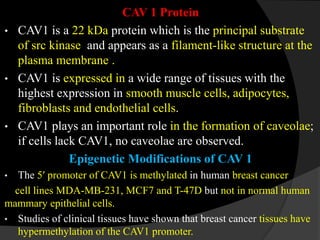
CAV 1 Protein
• CAV1 is a 22 kDa protein which is the principal substrate
of src kinase and appears as a filament-like structure at the
plasma membrane .
• CAV1 is expressed in a wide range of tissues with the
highest expression in smooth muscle cells, adipocytes,
fibroblasts and endothelial cells.
• CAV1 plays an important role in the formation of caveolae;
if cells lack CAV1, no caveolae are observed.
Epigenetic Modifications of CAV 1
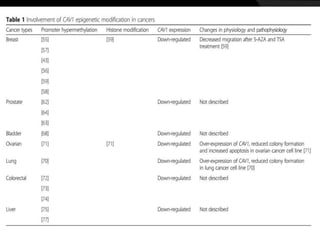
• The 5′ promoter of CAV1 is methylated in human breast cancer
cell lines MDA-MB-231, MCF7 and T-47D but not in normal human
mammary epithelial cells.
• Studies of clinical tissues have shown that breast cancer tissues have
hypermethylation of the CAV1 promoter.
• Because of hypermethylation of CAV 1 promoter , there is
down-regulation of CAV1 expression when compared to
adjacent normal breast tissues.
• In prostate cancer, CAV1 is down-regulated and this is
accompanied by promoter hypermethylation of CpGi sites
at the 5′ promoter region of CAV1.
• Treatment with 5-AZA has been shown to restore CAV1
expression in some cancers confirming hypermethylation.
REFERNCES
1. Bjo¨rn Hackanson, Kristi L. Bennett, Epigenetic Modification of
CCAAT/Enhancer Binding Protein A Expression in Acute
Myeloid Leukemia, Cancer Res 2008; 68: (9).
2. Cheryl H. Arrowsmith, Chas Bountra, Epigenetic protein families :
a new frontier for drug discovery, Nature Reviews, (MAY 2012)
VOLUME 11, 384-400
3. Jin-Yih Low and Helen D. Nicholson, Epigenetic modifications of
caveolae associated proteins in health and disease, Low and
Nicholson BMC Genetics (2015) VOL 16:71.
4. Marta M. Alonso1, Ricardo Diez-Valle, Genetic and Epigenetic
Modifications of Sox2 Contribute to the Invasive Phenotype of
Malignant Glioma, PLoS ONE, (November 2011), Volume 6 (11).
THANK YOU

Epigenetic modifications of proteins

  • 1.
    Epigenetic Modifications of Proteins AkshayMore, M.Sc. Biotechnology-1., Modern College, Ganeshkhind, Pune.
  • 2.
    OUTLINE  What isepigenetics?  Epigenetic Modification of Histone Proteins  Epigenetic Modifications of  Sox 2  CCAAT/enhancer binding protein a (C/EBPa)  Caveolae associated proteins
  • 3.
    Epigenetics - Literally means"above" or "on top of" genetics. - ‘Heritable changes in gene activity and expression that occur without alteration in DNA sequences’ - i.e. a change in phenotype without a change in genotype. - Epigenetics is the reason why a skin cell looks different from a brain cell or a muscle cell. All three cells contain the same DNA, but their genes are expressed differently (turned "on" or "off"), which creates the different cell types.
  • 4.
    Can be achievedby….. 1) DNA methylations 2) Histone Modifications 3) Post translational Modifications
  • 5.
    Modifications of Histones -Histones are highly alkaline proteins found in eukaryotic cell nuclei that package and order the DNA into structural units called nucleosomes.
  • 6.
  • 7.
    1) Histone Acetylationand deacetylation: • a highly dynamic process that is regulated by two families of enzymes — histone acetyltransferases (HATs) and HDACs • HATs use acetyl-CoA as a cofactor and catalyze the transfer of an acetyl group to the ε-amino group of lysine side chains on the histone protein. This neutralizes the positive charge on lysine, thus reducing the affinity of the histone tail that protrudes from the nucleosome core of DNA. As a result, chromatin adopts a more relaxed structure, enabling the recruitment of the transcriptional machinery. • HDACs reverse the acetylation of lysine residues to restore their positive charge and stabilize the local chromatin architecture.
  • 8.
    2) Histone Methylation: •Lysine residues on histones can be monomethylated, dimethylated or trimethylated. • Arginine residues are also subject to monomethylation and dimethylation. • Methyl marks are written by S-adenosylmethionine (SAM)- dependent methyltransferases and erased by the Jumonji family of 2-oxoglutarate-dependent demethylases. • Histone lysine methylation can be associated with either transcriptional activation (H3K4me3) or repression (H3K9me3 and H3K27me3 )
  • 9.
    1) Sox 2 •SRY (sex determining region Y)-box 2, also known as SOX2, is a transcription factor that is essential for maintaining self- renewal, or pluripotency, of undifferentiated embryonic stem cells. • Sox2, a critical transcription regulator of embryonic and neural normal stem cell function, has been reported to be dysregulated in several human cancers. • Sox2 was found to be frequently downregulated in gastric cancers and overexpressed in small-cell lung cancers, esophageal squamous carcinomas, and basal cell-like breast carcinomas. • Sox2 locus was shown to be amplified in small-cell lung cancer, esophageal squamous carcinomas and, to a lesser extent, in GBM . • Sox2 promoter hypomethylated in Sox2-expressing cell lines and Sox2- negative cell lines exhibited a methylated promoter pattern ( Marta,Ricardo et al. 2011)
  • 10.
    Epigenetic Modification ofSox 2 • The glioma cell lines LN229, U87 MG, U251 MG, U373, A172, SNB19, D54 and human GBM surgical specimens. 1) Sox2 Expression Levels by Quantitative PCR. 2) Assessment of SOX2 Promoter Methylation: - DNA was extracted from cell lines and patients.
  • 11.
    - analyzed SOX2promoter methylation using MSP primer pairs. Results: 1) Sox 2 Expression levels: 2) Assessment of SOX2 Promoter Methylation
  • 12.
    2) CCAAT/Enhancer BindingProtein A • CCAAT/enhancer binding protein a (C/EBPa), is a key transcription factor involved in the regulation of cell proliferation and differentiation in a variety of cell types, particularly in the hematopoietic system. • Under physiologic conditions, C/EBPa is a master regulator for myeloid differentiation and granulocytic maturation, its absence results in a block of granulopoiesis. • Aberrant promoter methylation of C/EBPa is a common event in AML.( Kristi, Romulo 2008)
  • 13.
    Epigenetic Modification ofC/EBPa - One hundred forty-six bone marrow samples from AML patients. - DNA and RNA Isolation. - Assessment of C/EBPa methylation by COBRA. [Combined Bisulfite Restriction Analysis (or COBRA) is a molecular biology technique that allows for the sensitive quantification of DNA methylation levels at a specific genomic locus on a DNA sequence in a small sample of genomic DNA. The technique is a variation of bisulfite sequencing, and combines bisulfite conversion based polymerase chain reaction with restriction digestion. ]
  • 14.
    Results: -Aberrant DNA methylationin the upstream promoter of C/EBPa is a frequent event in AML. - A distinct pattern of aberrant DNA methylation in region 1 was seen in 51% of AML patient samples, whereas the core promoter and all other investigated regions remained unmethylated.
  • 15.
    3) caveolae associatedproteins • small specialized “cave-like” microdomains at the plasma membrane that function as trafficking vesicles and are involved in organization of signal transduction. • Caveolae are present in most tissues and are particularly abundant in cardiac, continuous endothelial and epithelial cells. • Within caveolae are caveolae associated proteins; 1) caveolin-1 (CAV1) 2) caveolin-2 (CAV2) , 3) caveolin-3 (CAV3), • Cavin-1 (also know as polymerase-1 and transcript release factor) (PTRF) , • Cavin-2 , Cavin-3 and Cavin-4 , which are important for the formation and maintenance of the caveolar structure..
  • 16.
    CAV 1 Protein •CAV1 is a 22 kDa protein which is the principal substrate of src kinase and appears as a filament-like structure at the plasma membrane . • CAV1 is expressed in a wide range of tissues with the highest expression in smooth muscle cells, adipocytes, fibroblasts and endothelial cells. • CAV1 plays an important role in the formation of caveolae; if cells lack CAV1, no caveolae are observed. Epigenetic Modifications of CAV 1 • The 5′ promoter of CAV1 is methylated in human breast cancer cell lines MDA-MB-231, MCF7 and T-47D but not in normal human mammary epithelial cells. • Studies of clinical tissues have shown that breast cancer tissues have hypermethylation of the CAV1 promoter.
  • 17.
    • Because ofhypermethylation of CAV 1 promoter , there is down-regulation of CAV1 expression when compared to adjacent normal breast tissues. • In prostate cancer, CAV1 is down-regulated and this is accompanied by promoter hypermethylation of CpGi sites at the 5′ promoter region of CAV1. • Treatment with 5-AZA has been shown to restore CAV1 expression in some cancers confirming hypermethylation.
  • 18.
    REFERNCES 1. Bjo¨rn Hackanson,Kristi L. Bennett, Epigenetic Modification of CCAAT/Enhancer Binding Protein A Expression in Acute Myeloid Leukemia, Cancer Res 2008; 68: (9). 2. Cheryl H. Arrowsmith, Chas Bountra, Epigenetic protein families : a new frontier for drug discovery, Nature Reviews, (MAY 2012) VOLUME 11, 384-400 3. Jin-Yih Low and Helen D. Nicholson, Epigenetic modifications of caveolae associated proteins in health and disease, Low and Nicholson BMC Genetics (2015) VOL 16:71. 4. Marta M. Alonso1, Ricardo Diez-Valle, Genetic and Epigenetic Modifications of Sox2 Contribute to the Invasive Phenotype of Malignant Glioma, PLoS ONE, (November 2011), Volume 6 (11).
  • 19.