




2www.yourwebsite.com
Genetics
Quaid - i - Azam University Islamabad
Adenosine Deaminase
Deficiency
Severe Combined Immunodeficiency Disease
Group Members:
Areej Salman
(Introduction)
01
Uzma Khalid
(Frequency & Symptoms)
02
Umm E Kalsoom
(Molecular Reasons)
03
Hira Sulaiman
(Diagnosis & Counselling)
04
Noor Ul Ain
(Treatment & Conclusion)
05
CONTENT:
What is ADA deficiency? Discovery and Summary?
ADA gene?
Introduction:
01
Population dynamics of ADA & possible symptoms related to
ADA deficiency.
Frequency & Symptoms:
02
Causes and inheritance pattern, Mutations related to ADA
deficiency.
Molecular Reasons:
03
techniques to diagnose this disease & genetic counselling.
Diagnosis & Counselling:
04
Possible treatment for ADA deficiency and conclusion.
Treatment & Conclusion:
05
Introduction
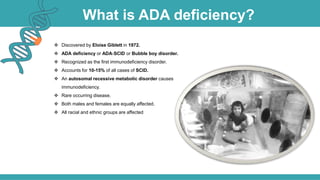
What is ADA deficiency?
 Discovered by Eloise Giblett in 1972.
 ADA deficiency or ADA-SCID or Bubble boy disorder.
 Recognized as the first immunodeficiency disorder.
 Accounts for 10-15% of all cases of SCID.
 An autosomal recessive metabolic disorder causes
immunodeficiency.
 Rare occurring disease.
 Both males and females are equally affected.
 All racial and ethnic groups are affected
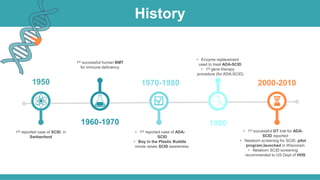
Timeline Style
2000-2010
• 1st successful GT trial for ADA-
SCID reported
• Newborn screening for SCID, pilot
program,launched in Wisconsin
• Newborn SCID screening
recommended to US Dept of HHS
1970-1980
• 1st reported case of ADA-
SCID
• Boy in the Plastic Bubble
movie raises SCID awareness.
1950
1st reported case of SCID, in
Switzerland
1st successful human BMT
for immune deficiency
1960-1970
• Enzyme replacement
used to treat ADA-SCID
• 1st gene therapy
procedure (for ADA-SCID)
1990
History
ADA Gene
 ADA deficiency is caused by mutation in ADA gene; Which normally form enzyme Adenosine
Deaminase.
CHROMOSOMAL LOCATION:
Cytogenetic Location: 20q13.12, which is the long (q) arm of chromosome 20 at position 13.12.
Coordinates: Chromosome 20: 44,619,522-44,651,699 (GRCh38/hg38)
Size: 32,712 bases
Orientation: Reverse strand
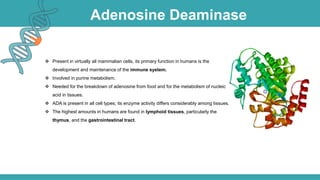
Adenosine Deaminase
 Present in virtually all mammalian cells, its primary function in humans is the
development and maintenance of the immune system.
 Involved in purine metabolism.
 Needed for the breakdown of adenosine from food and for the metabolism of nucleic
acid in tissues.
 ADA is present in all cell types; its enzyme activity differs considerably among tissues.
 The highest amounts in humans are found in lymphoid tissues, particularly the
thymus, and the gastrointestinal tract.
Symptoms & Frequency
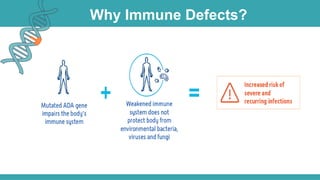
Why Immune Defects?
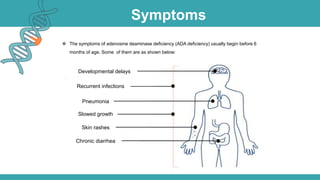
Symptoms
 The symptoms of adenosine deaminase deficiency (ADA deficiency) usually begin before 6
months of age. Some of them are as shown below:
Developmental delays
Recurrent infections
Pneumonia
Slowed growth
Skin rashes
Chronic diarrhea
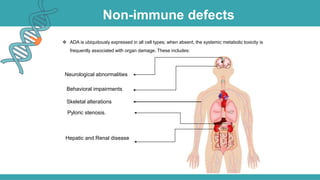
Non-immune defects
 ADA is ubiquitously expressed in all cell types; when absent, the systemic metabolic toxicity is
frequently associated with organ damage. These includes:
Neurological abnormalities
Behavioral impairments
Skeletal alterations
Pyloric stenosis.
Hepatic and Renal disease
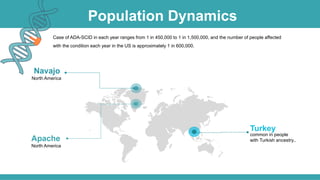
Navajo
North America
Apache
North America
Turkey
common in people
with Turkish ancestry..
Population Dynamics
Case of ADA-SCID in each year ranges from 1 in 450,000 to 1 in 1,500,000, and the number of people affected
with the condition each year in the US is approximately 1 in 600,000.
Molecular Reasons
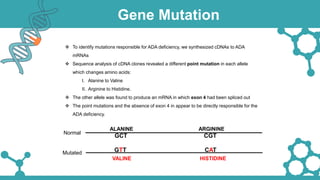
Gene Mutation
 To identify mutations responsible for ADA deficiency, we synthesized cDNAs to ADA
mRNAs
 Sequence analysis of cDNA clones revealed a different point mutation in each allele
which changes amino acids:
I. Alanine to Valine
II. Arginine to Histidine.
 The other allele was found to produce an mRNA in which exon 4 had been spliced out
 The point mutations and the absence of exon 4 in appear to be directly responsible for the
ADA deficiency.
GCT CGT
GTT CAT
ALANINE
HISTIDINEVALINE
ARGININE
Normal
Mutated
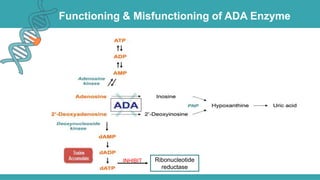
Functioning & Misfunctioning of ADA Enzyme
Ribonucleotide
reductase
INHIBIT
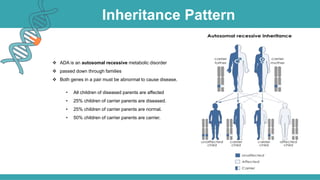
Inheritance Pattern
 ADA is an autosomal recessive metabolic disorder
 passed down through families
 Both genes in a pair must be abnormal to cause disease.
• All children of diseased parents are affected
• 25% children of carrier parents are diseased.
• 25% children of carrier parents are normal.
• 50% children of carrier parents are carrier.
Diagnosis
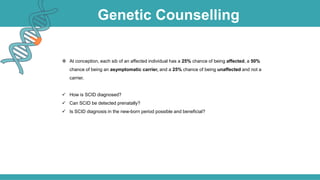
Genetic Counselling
 At conception, each sib of an affected individual has a 25% chance of being affected, a 50%
chance of being an asymptomatic carrier, and a 25% chance of being unaffected and not a
carrier.
 How is SCID diagnosed?
 Can SCID be detected prenatally?
 Is SCID diagnosis in the new-born period possible and beneficial?
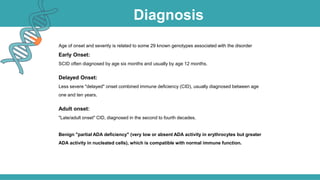
Diagnosis
Age of onset and severity is related to some 29 known genotypes associated with the disorder
Early Onset:
SCID often diagnosed by age six months and usually by age 12 months.
Delayed Onset:
Less severe "delayed" onset combined immune deficiency (CID), usually diagnosed between age
one and ten years.
Adult onset:
"Late/adult onset" CID, diagnosed in the second to fourth decades.
Benign "partial ADA deficiency" (very low or absent ADA activity in erythrocytes but greater
ADA activity in nucleated cells), which is compatible with normal immune function.
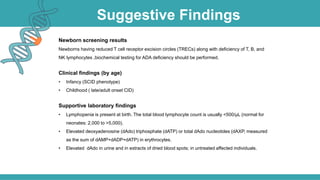
Suggestive Findings
Newborn screening results
Newborns having reduced T cell receptor excision circles (TRECs) along with deficiency of T, B, and
NK lymphocytes ,biochemical testing for ADA deficiency should be performed.
Clinical findings (by age)
• Infancy (SCID phenotype)
• Childhood ( late/adult onset CID)
Supportive laboratory findings
• Lymphopenia is present at birth. The total blood lymphocyte count is usually <500/µL (normal for
neonates: 2,000 to >5,000).
• Elevated deoxyadenosine (dAdo) triphosphate (dATP) or total dAdo nucleotides (dAXP, measured
as the sum of dAMP+dADP+dATP) in erythrocytes.
• Elevated dAdo in urine and in extracts of dried blood spots; in untreated affected individuals.
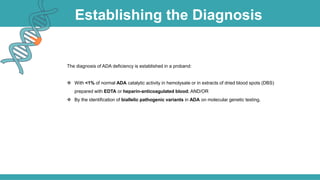
Establishing the Diagnosis
The diagnosis of ADA deficiency is established in a proband:
 With <1% of normal ADA catalytic activity in hemolysate or in extracts of dried blood spots (DBS)
prepared with EDTA or heparin-anticoagulated blood; AND/OR
 By the identification of biallelic pathogenic variants in ADA on molecular genetic testing.
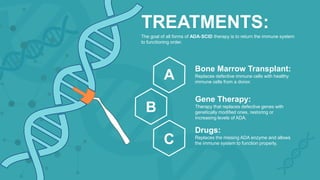
TREATMENTS:
The goal of all forms of ADA-SCID therapy is to return the immune system
to functioning order.
Replaces defective immune cells with healthy
immune cells from a donor.
Bone Marrow Transplant:
Therapy that replaces defective genes with
genetically modified ones, restoring or
increasing levels of ADA.
Gene Therapy:
Replaces the missing ADA enzyme and allows
the immune system to function properly.
Drugs:
A
B
C
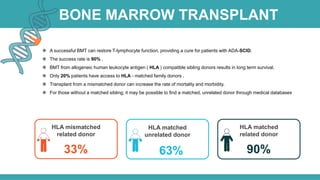
 A successful BMT can restore T-lymphocyte function, providing a cure for patients with ADA-SCID.
 The success rate is 90% .
 BMT from allogeneic human leukocyte antigen ( HLA ) compatible sibling donors results in long term survival.
 Only 20% patients have access to HLA - matched family donors .
 Transplant from a mismatched donor can increase the rate of mortality and morbidity.
 For those without a matched sibling, it may be possible to find a matched, unrelated donor through medical databases
63%33%
HLA matched
unrelated donor
HLA mismatched
related donor
90%
HLA matched
related donor
BONE MARROW TRANSPLANT
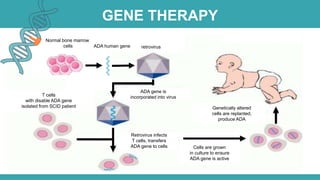
GENE THERAPY
Normal bone marrow
cells retrovirus
T cells
with disable ADA gene
isolated from SCID patient
ADA gene is
incorporated into virus
Retrovirus infects
T cells, transfers
ADA gene to cells
Genetically altered
cells are replanted,
produce ADA
Cells are grown
in culture to ensure
ADA gene is active
ADA human gene
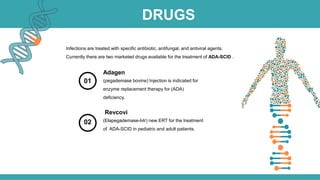
DRUGS
(pegademase bovine) Injection is indicated for
enzyme replacement therapy for (ADA)
deficiency.
Adagen
01
02 (Elapegademase-lvlr) new ERT for the treatment
of ADA-SCID in pediatric and adult patients.
Revcovi
Infections are treated with specific antibiotic, antifungal, and antiviral agents.
Currently there are two marketed drugs available for the treatment of ADA-SCID .
CONCLUSION
After bone marrow transplant ; there is 90%
chance of a child to live for 1 to 10 years. Gene
therapy, though still in the experimental stages,
appears to be a promising option.
REFERENCE & CITATION
 https://ghr.nlm.nih.gov/condition/adenosine-deaminase-deficiency
 http://omim.org/entry/102700
 https://rarediseases.info.nih.gov/diseases/5748/adenosine-deaminase-deficiency
 https://ojrd.biomedcentral.com/articles/10.1186/s13023-018-0807-5
 http://www.bloodjournal.org/content/114/17/3524?sso-checked=true
 http://www.bloodjournal.org/content/89/8/2849?sso-checked=true
 https://www.orpha.net/consor/cgi-bin/OC_Exp.php?Lng=EN&Expert=277
 https://www.uptodate.com/contents/adenosine-deaminase-deficiency-pathogenesis-clinical-manifestations-and-diagnosis
 https://www.webmd.com/a-to-z-guides/adenosine-deaminase-severe-combined-immunodeficiency#1
 https://www.ncbi.nlm.nih.gov/pubmed/8032366
 https://www.ncbi.nlm.nih.gov/books/NBK1483/
 https://www.ncbi.nlm.nih.gov/pubmed/3475710
 https://www.genecards.org/cgi-bin/carddisp.pl?gene=ADA
 https://myriadwomenshealth.com/diseases/adenosine-deaminase-deficiency/
Thank You
Any Questions???

Adenosine Deaminase Deficiency

  • 2.
    2www.yourwebsite.com Genetics Quaid - i- Azam University Islamabad
  • 3.
  • 4.
    Group Members: Areej Salman (Introduction) 01 UzmaKhalid (Frequency & Symptoms) 02 Umm E Kalsoom (Molecular Reasons) 03 Hira Sulaiman (Diagnosis & Counselling) 04 Noor Ul Ain (Treatment & Conclusion) 05
  • 5.
    CONTENT: What is ADAdeficiency? Discovery and Summary? ADA gene? Introduction: 01 Population dynamics of ADA & possible symptoms related to ADA deficiency. Frequency & Symptoms: 02 Causes and inheritance pattern, Mutations related to ADA deficiency. Molecular Reasons: 03 techniques to diagnose this disease & genetic counselling. Diagnosis & Counselling: 04 Possible treatment for ADA deficiency and conclusion. Treatment & Conclusion: 05
  • 6.
  • 7.
    What is ADAdeficiency?  Discovered by Eloise Giblett in 1972.  ADA deficiency or ADA-SCID or Bubble boy disorder.  Recognized as the first immunodeficiency disorder.  Accounts for 10-15% of all cases of SCID.  An autosomal recessive metabolic disorder causes immunodeficiency.  Rare occurring disease.  Both males and females are equally affected.  All racial and ethnic groups are affected
  • 8.
    Timeline Style 2000-2010 • 1stsuccessful GT trial for ADA- SCID reported • Newborn screening for SCID, pilot program,launched in Wisconsin • Newborn SCID screening recommended to US Dept of HHS 1970-1980 • 1st reported case of ADA- SCID • Boy in the Plastic Bubble movie raises SCID awareness. 1950 1st reported case of SCID, in Switzerland 1st successful human BMT for immune deficiency 1960-1970 • Enzyme replacement used to treat ADA-SCID • 1st gene therapy procedure (for ADA-SCID) 1990 History
  • 9.
    ADA Gene  ADAdeficiency is caused by mutation in ADA gene; Which normally form enzyme Adenosine Deaminase. CHROMOSOMAL LOCATION: Cytogenetic Location: 20q13.12, which is the long (q) arm of chromosome 20 at position 13.12. Coordinates: Chromosome 20: 44,619,522-44,651,699 (GRCh38/hg38) Size: 32,712 bases Orientation: Reverse strand
  • 10.
    Adenosine Deaminase  Presentin virtually all mammalian cells, its primary function in humans is the development and maintenance of the immune system.  Involved in purine metabolism.  Needed for the breakdown of adenosine from food and for the metabolism of nucleic acid in tissues.  ADA is present in all cell types; its enzyme activity differs considerably among tissues.  The highest amounts in humans are found in lymphoid tissues, particularly the thymus, and the gastrointestinal tract.
  • 11.
  • 12.
  • 13.
    Symptoms  The symptomsof adenosine deaminase deficiency (ADA deficiency) usually begin before 6 months of age. Some of them are as shown below: Developmental delays Recurrent infections Pneumonia Slowed growth Skin rashes Chronic diarrhea
  • 14.
    Non-immune defects  ADAis ubiquitously expressed in all cell types; when absent, the systemic metabolic toxicity is frequently associated with organ damage. These includes: Neurological abnormalities Behavioral impairments Skeletal alterations Pyloric stenosis. Hepatic and Renal disease
  • 15.
    Navajo North America Apache North America Turkey commonin people with Turkish ancestry.. Population Dynamics Case of ADA-SCID in each year ranges from 1 in 450,000 to 1 in 1,500,000, and the number of people affected with the condition each year in the US is approximately 1 in 600,000.
  • 16.
  • 17.
    Gene Mutation  Toidentify mutations responsible for ADA deficiency, we synthesized cDNAs to ADA mRNAs  Sequence analysis of cDNA clones revealed a different point mutation in each allele which changes amino acids: I. Alanine to Valine II. Arginine to Histidine.  The other allele was found to produce an mRNA in which exon 4 had been spliced out  The point mutations and the absence of exon 4 in appear to be directly responsible for the ADA deficiency. GCT CGT GTT CAT ALANINE HISTIDINEVALINE ARGININE Normal Mutated
  • 18.
    Functioning & Misfunctioningof ADA Enzyme Ribonucleotide reductase INHIBIT
  • 19.
    Inheritance Pattern  ADAis an autosomal recessive metabolic disorder  passed down through families  Both genes in a pair must be abnormal to cause disease. • All children of diseased parents are affected • 25% children of carrier parents are diseased. • 25% children of carrier parents are normal. • 50% children of carrier parents are carrier.
  • 20.
  • 21.
    Genetic Counselling  Atconception, each sib of an affected individual has a 25% chance of being affected, a 50% chance of being an asymptomatic carrier, and a 25% chance of being unaffected and not a carrier.  How is SCID diagnosed?  Can SCID be detected prenatally?  Is SCID diagnosis in the new-born period possible and beneficial?
  • 22.
    Diagnosis Age of onsetand severity is related to some 29 known genotypes associated with the disorder Early Onset: SCID often diagnosed by age six months and usually by age 12 months. Delayed Onset: Less severe "delayed" onset combined immune deficiency (CID), usually diagnosed between age one and ten years. Adult onset: "Late/adult onset" CID, diagnosed in the second to fourth decades. Benign "partial ADA deficiency" (very low or absent ADA activity in erythrocytes but greater ADA activity in nucleated cells), which is compatible with normal immune function.
  • 23.
    Suggestive Findings Newborn screeningresults Newborns having reduced T cell receptor excision circles (TRECs) along with deficiency of T, B, and NK lymphocytes ,biochemical testing for ADA deficiency should be performed. Clinical findings (by age) • Infancy (SCID phenotype) • Childhood ( late/adult onset CID) Supportive laboratory findings • Lymphopenia is present at birth. The total blood lymphocyte count is usually <500/µL (normal for neonates: 2,000 to >5,000). • Elevated deoxyadenosine (dAdo) triphosphate (dATP) or total dAdo nucleotides (dAXP, measured as the sum of dAMP+dADP+dATP) in erythrocytes. • Elevated dAdo in urine and in extracts of dried blood spots; in untreated affected individuals.
  • 24.
    Establishing the Diagnosis Thediagnosis of ADA deficiency is established in a proband:  With <1% of normal ADA catalytic activity in hemolysate or in extracts of dried blood spots (DBS) prepared with EDTA or heparin-anticoagulated blood; AND/OR  By the identification of biallelic pathogenic variants in ADA on molecular genetic testing.
  • 25.
    TREATMENTS: The goal ofall forms of ADA-SCID therapy is to return the immune system to functioning order. Replaces defective immune cells with healthy immune cells from a donor. Bone Marrow Transplant: Therapy that replaces defective genes with genetically modified ones, restoring or increasing levels of ADA. Gene Therapy: Replaces the missing ADA enzyme and allows the immune system to function properly. Drugs: A B C
  • 26.
     A successfulBMT can restore T-lymphocyte function, providing a cure for patients with ADA-SCID.  The success rate is 90% .  BMT from allogeneic human leukocyte antigen ( HLA ) compatible sibling donors results in long term survival.  Only 20% patients have access to HLA - matched family donors .  Transplant from a mismatched donor can increase the rate of mortality and morbidity.  For those without a matched sibling, it may be possible to find a matched, unrelated donor through medical databases 63%33% HLA matched unrelated donor HLA mismatched related donor 90% HLA matched related donor BONE MARROW TRANSPLANT
  • 27.
    GENE THERAPY Normal bonemarrow cells retrovirus T cells with disable ADA gene isolated from SCID patient ADA gene is incorporated into virus Retrovirus infects T cells, transfers ADA gene to cells Genetically altered cells are replanted, produce ADA Cells are grown in culture to ensure ADA gene is active ADA human gene
  • 28.
    DRUGS (pegademase bovine) Injectionis indicated for enzyme replacement therapy for (ADA) deficiency. Adagen 01 02 (Elapegademase-lvlr) new ERT for the treatment of ADA-SCID in pediatric and adult patients. Revcovi Infections are treated with specific antibiotic, antifungal, and antiviral agents. Currently there are two marketed drugs available for the treatment of ADA-SCID .
  • 29.
    CONCLUSION After bone marrowtransplant ; there is 90% chance of a child to live for 1 to 10 years. Gene therapy, though still in the experimental stages, appears to be a promising option.
  • 30.
    REFERENCE & CITATION https://ghr.nlm.nih.gov/condition/adenosine-deaminase-deficiency  http://omim.org/entry/102700  https://rarediseases.info.nih.gov/diseases/5748/adenosine-deaminase-deficiency  https://ojrd.biomedcentral.com/articles/10.1186/s13023-018-0807-5  http://www.bloodjournal.org/content/114/17/3524?sso-checked=true  http://www.bloodjournal.org/content/89/8/2849?sso-checked=true  https://www.orpha.net/consor/cgi-bin/OC_Exp.php?Lng=EN&Expert=277  https://www.uptodate.com/contents/adenosine-deaminase-deficiency-pathogenesis-clinical-manifestations-and-diagnosis  https://www.webmd.com/a-to-z-guides/adenosine-deaminase-severe-combined-immunodeficiency#1  https://www.ncbi.nlm.nih.gov/pubmed/8032366  https://www.ncbi.nlm.nih.gov/books/NBK1483/  https://www.ncbi.nlm.nih.gov/pubmed/3475710  https://www.genecards.org/cgi-bin/carddisp.pl?gene=ADA  https://myriadwomenshealth.com/diseases/adenosine-deaminase-deficiency/
  • 31.