MICROMANIPULATION
Teacher in-Charge- Dr. Nivedita Das
- Akshay More
OUTLINE
 What Is Micromanipulation?
 Micromanipulator
 Physical Micromanipulator
 Optical Micromanipulator
 Applications.
MICROMANIPULATION
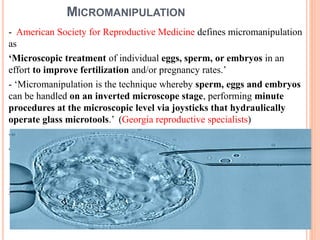
- American Society for Reproductive Medicine defines micromanipulation
as
‘Microscopic treatment of individual eggs, sperm, or embryos in an
effort to improve fertilization and/or pregnancy rates.’
- ‘Micromanipulation is the technique whereby sperm, eggs and embryos
can be handled on an inverted microscope stage, performing minute
procedures at the microscopic level via joysticks that hydraulically
operate glass microtools.’ (Georgia reproductive specialists)
- Cells are also manipulated.
-It can be performed by:
1) Touching the objects physically
e.g. Microinjection, Capillary Injection etc.
2) Trapping objects and Manipulation
e.g. Using optic, electric, magnetic or acoustic energy.
Micromanipulator
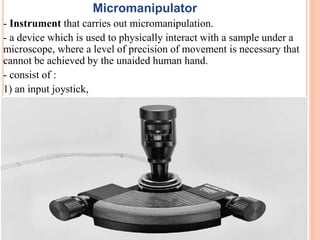
- Instrument that carries out micromanipulation.
- a device which is used to physically interact with a sample under a
microscope, where a level of precision of movement is necessary that
cannot be achieved by the unaided human hand.
- consist of :
1) an input joystick,
2) a mechanism for reducing the range of movement ( levers, pistons)
3) an output section with the means of holding a microtool to hold,
inject, cut or otherwise manipulate the object.
Based on their way of manipulating objects, two types:
1) Physical Micromanipulators
Include: Microinjection, Capillary injection.
2) Optical Micromanipulators
Include:
Laser Micromanipulation Systems (Optical tweezers)
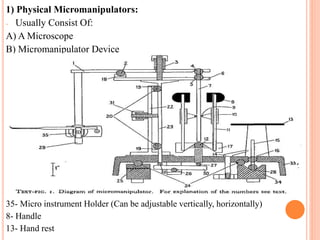
1) Physical Micromanipulators:
- Usually Consist Of:
A) A Microscope
B) Micromanipulator Device
35- Micro instrument Holder (Can be adjustable vertically, horizontally)
8- Handle
13- Hand rest
R. BARER & A. E. SAUNDERS SINGER (1980)
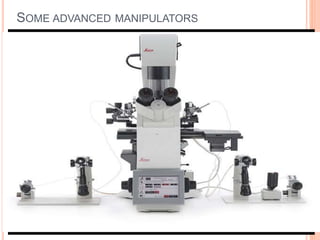
SOME ADVANCED MANIPULATORS
2) Laser Micromanipulators
- A light source of concentrated, coherent photons in a pencil like
beam signaled the advent of the field of optical
micromanipulation:
- moving or trapping objects non-invasively using light.
Optical Tweezers
- Used for trapping of cells first and then manipulation.
 Principle:
Light scattering should result in a force actually in the direction of
light propagation and any refraction of the light results in a force
attracting the particle (if of higher refractive index than its
surroundings) to the region of highest light intensity. The scattering
and gradient forces arise from the reflection and refraction of light.
*Choice Of laser system for micromanipulation:
- Should not absorbed by the sample; leads to damage/ optocution.
- When studying biological samples, the near infra-red wavelength
range of 750–1100 nm is a good choice due to the transparency of
many biological samples in this wavelength window.
- e.g. Infra-red trapping wavelengths of 830 nm and 970 nm is
shown to be optimum for E. coli and Chinese hamster ovary
(CHO) cells respectively.
*Operation:
Micromanipulation Of CHO
1) A neodymium laser is focused by a microscope objective.
2) The movement of the microscope stage is computer-controlled.
3) A rectangular glass capillary with a predetermined breaking point
is used which is filled with solution (transgene, fluorescent dye).
4) A single selected cell is fixed with the laser beam.
5) The capillary is broken at the predetermined breaking point
6) Manipulation is carried out. (attachment of fluorescent dyes,
transgene etc.)
Other Applications :
1) Study of motion of Kinesin molecule along a fixed microtubule
track.
2) To study the motion of RNA polymerase along DNA template.
3) FACS (Fluorescence Activated Cell Sorters).
Some Advanced Optical Tweezers:
APPLICATIONS OF MICROMANIPULATION
1) Drug Development and Toxicology
2) Basic Biological Research:
- used for inserting genes and small inhibitory RNAs3 into cells and
for screening gene functions.
3) Microassisted Fertilization:
-IVF, Intra Cytoplasmic Sperm Injection, Artificial Insemination.
4) Production of Transgenics:
- Transgenics like Cow, Buffalo
5) Electrophysiological Recording:
for recording bioelectrical signals in cells.
e.g. Patch Clamp Technique
- Low Resistance electrode used.
- Electrode placed onto the membrane of cell in such a way that a
giga-ohm resistance seal get formed
- either the voltage or current is clamped and respectively, either the
current or voltage is measured
- methods allow the recording of the activities of a single membrane
channel.
6) Cloning:
- Somatic Cell Nuclear Transfer (SCNT), Dolly.
7) Stem Cell Technology:
- Injection of a stem cell with specifically mutated gene.
- Gene Knockout.
8) Gene Therapy:
Foreign gene into somatic/stem cell Expression of genes.
e.g. Cystic Fibrosis.
REFERENCES:
1) Jurgen Frohlich&Helmut Konig, New techniques for isolation
of single prokaryotic cells, 2000, Federation of European
Microbiological Societies. Published by Elsevier Science.
2) Robert Barer & A.E. Saunders-Singers, A New Single-control
Micromanipulator, Q.J.M.S., Vol. 89, Third Series, No. 8.
3) Kishan Dholakia, Peter Reecea and Min Gu, Optical
micromanipulation, Chem. Soc. Rev., 2008, 37, 42–55.
4) John X. Zang& Kangpu Xu, Intracytoplasmic Sperm Injection
and other Micromanipulation Techniques for Assisted
Reproduction, GLOWM, April 2009.
5) Daniel Salamone&Romina Bevacqua, Recent advances in
micromanipulation and transgenesis in domestic mammals.,
2011, Acta Scientiae Veterinariae. 39(Suppl 1): s285 - s293.
Micromanipulation

Micromanipulation

  • 1.
    MICROMANIPULATION Teacher in-Charge- Dr.Nivedita Das - Akshay More
  • 2.
    OUTLINE  What IsMicromanipulation?  Micromanipulator  Physical Micromanipulator  Optical Micromanipulator  Applications.
  • 3.
    MICROMANIPULATION - American Societyfor Reproductive Medicine defines micromanipulation as ‘Microscopic treatment of individual eggs, sperm, or embryos in an effort to improve fertilization and/or pregnancy rates.’ - ‘Micromanipulation is the technique whereby sperm, eggs and embryos can be handled on an inverted microscope stage, performing minute procedures at the microscopic level via joysticks that hydraulically operate glass microtools.’ (Georgia reproductive specialists) - Cells are also manipulated. -It can be performed by: 1) Touching the objects physically e.g. Microinjection, Capillary Injection etc. 2) Trapping objects and Manipulation e.g. Using optic, electric, magnetic or acoustic energy.
  • 4.
    Micromanipulator - Instrument thatcarries out micromanipulation. - a device which is used to physically interact with a sample under a microscope, where a level of precision of movement is necessary that cannot be achieved by the unaided human hand. - consist of : 1) an input joystick, 2) a mechanism for reducing the range of movement ( levers, pistons) 3) an output section with the means of holding a microtool to hold, inject, cut or otherwise manipulate the object. Based on their way of manipulating objects, two types: 1) Physical Micromanipulators Include: Microinjection, Capillary injection. 2) Optical Micromanipulators Include: Laser Micromanipulation Systems (Optical tweezers)
  • 5.
    1) Physical Micromanipulators: -Usually Consist Of: A) A Microscope B) Micromanipulator Device 35- Micro instrument Holder (Can be adjustable vertically, horizontally) 8- Handle 13- Hand rest
  • 6.
    R. BARER &A. E. SAUNDERS SINGER (1980)
  • 8.
  • 9.
    2) Laser Micromanipulators -A light source of concentrated, coherent photons in a pencil like beam signaled the advent of the field of optical micromanipulation: - moving or trapping objects non-invasively using light. Optical Tweezers
  • 10.
    - Used fortrapping of cells first and then manipulation.  Principle: Light scattering should result in a force actually in the direction of light propagation and any refraction of the light results in a force attracting the particle (if of higher refractive index than its surroundings) to the region of highest light intensity. The scattering and gradient forces arise from the reflection and refraction of light.
  • 11.
    *Choice Of lasersystem for micromanipulation: - Should not absorbed by the sample; leads to damage/ optocution. - When studying biological samples, the near infra-red wavelength range of 750–1100 nm is a good choice due to the transparency of many biological samples in this wavelength window. - e.g. Infra-red trapping wavelengths of 830 nm and 970 nm is shown to be optimum for E. coli and Chinese hamster ovary (CHO) cells respectively. *Operation: Micromanipulation Of CHO 1) A neodymium laser is focused by a microscope objective. 2) The movement of the microscope stage is computer-controlled. 3) A rectangular glass capillary with a predetermined breaking point is used which is filled with solution (transgene, fluorescent dye). 4) A single selected cell is fixed with the laser beam.
  • 12.
    5) The capillaryis broken at the predetermined breaking point 6) Manipulation is carried out. (attachment of fluorescent dyes, transgene etc.) Other Applications : 1) Study of motion of Kinesin molecule along a fixed microtubule track. 2) To study the motion of RNA polymerase along DNA template. 3) FACS (Fluorescence Activated Cell Sorters). Some Advanced Optical Tweezers:
  • 13.
    APPLICATIONS OF MICROMANIPULATION 1)Drug Development and Toxicology 2) Basic Biological Research: - used for inserting genes and small inhibitory RNAs3 into cells and for screening gene functions. 3) Microassisted Fertilization: -IVF, Intra Cytoplasmic Sperm Injection, Artificial Insemination. 4) Production of Transgenics: - Transgenics like Cow, Buffalo 5) Electrophysiological Recording: for recording bioelectrical signals in cells. e.g. Patch Clamp Technique - Low Resistance electrode used. - Electrode placed onto the membrane of cell in such a way that a giga-ohm resistance seal get formed
  • 14.
    - either thevoltage or current is clamped and respectively, either the current or voltage is measured - methods allow the recording of the activities of a single membrane channel. 6) Cloning: - Somatic Cell Nuclear Transfer (SCNT), Dolly. 7) Stem Cell Technology: - Injection of a stem cell with specifically mutated gene. - Gene Knockout. 8) Gene Therapy: Foreign gene into somatic/stem cell Expression of genes. e.g. Cystic Fibrosis.
  • 15.
    REFERENCES: 1) Jurgen Frohlich&HelmutKonig, New techniques for isolation of single prokaryotic cells, 2000, Federation of European Microbiological Societies. Published by Elsevier Science. 2) Robert Barer & A.E. Saunders-Singers, A New Single-control Micromanipulator, Q.J.M.S., Vol. 89, Third Series, No. 8. 3) Kishan Dholakia, Peter Reecea and Min Gu, Optical micromanipulation, Chem. Soc. Rev., 2008, 37, 42–55. 4) John X. Zang& Kangpu Xu, Intracytoplasmic Sperm Injection and other Micromanipulation Techniques for Assisted Reproduction, GLOWM, April 2009. 5) Daniel Salamone&Romina Bevacqua, Recent advances in micromanipulation and transgenesis in domestic mammals., 2011, Acta Scientiae Veterinariae. 39(Suppl 1): s285 - s293.