Enzyme-Linked ImmunoSorbent Assay
(ELISA)
Lecturer: S. Pordel
M.Sc. of Immunology
INTRODUCTION TO ELISA
• ELISA, or enzyme-linked immunosorbent assay, are
immunological procedures in which the Ag- Ab
reaction is monitored by enzyme measurements.
• The term ELISA was first used by Engvall & Perlma
in 1971.
• It is useful & powerful method in estimating ng/mL to
pg/mL ordered materials in the solution.
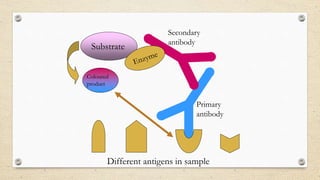
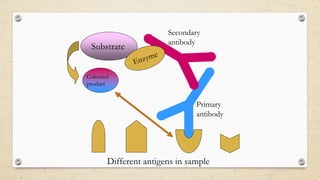
Substrate
Primary
antibody
Secondary
antibody
Different antigens in sample
Coloured
product
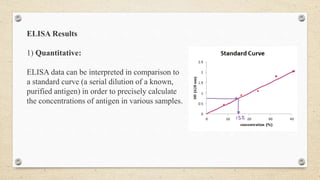
ELISA Results
1) Quantitative:
ELISA data can be interpreted in comparison to
a standard curve (a serial dilution of a known,
purified antigen) in order to precisely calculate
the concentrations of antigen in various samples.
2) Qualitative:
 ELISAs can also be used to achieve a yes or no answer indicating whether a
particular antigen is present in a sample, as compared to a blank well
containing no antigen or an unrelated control antigen.
 The cut-off is normally used for the best discrimination between "positive" and
"negative" samples.
 cut-off = Average of negative control.
 Test OD > CUT OFF = positive, Test OD < CUT OFF = Negative.
Four Typical ELISA Formats:
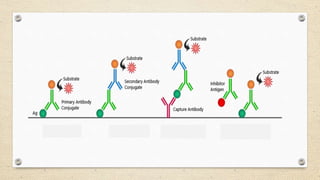
i. Direct ELISA
ii. Indirect ELISA
iii. Sandwich ELISA
iv. Competition ELISA
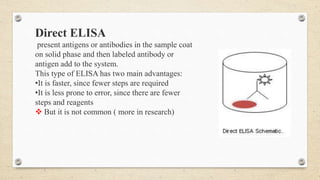
Direct ELISA
present antigens or antibodies in the sample coat
on solid phase and then labeled antibody or
antigen add to the system.
This type of ELISA has two main advantages:
•It is faster, since fewer steps are required
•It is less prone to error, since there are fewer
steps and reagents
 But it is not common ( more in research)
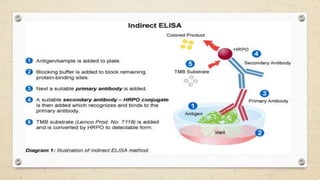
This method (Indirect ELISA) has several advantages:
• Increased sensitivity
• Flexibility, since different primary detection antibodies can be
used with a single labeled secondary antibody
• Cost savings, since fewer labeled antibodies are required
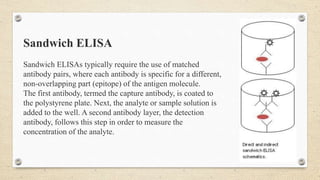
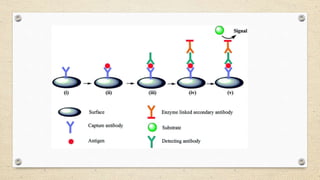
Sandwich ELISA
Sandwich ELISAs typically require the use of matched
antibody pairs, where each antibody is specific for a different,
non-overlapping part (epitope) of the antigen molecule.
The first antibody, termed the capture antibody, is coated to
the polystyrene plate. Next, the analyte or sample solution is
added to the well. A second antibody layer, the detection
antibody, follows this step in order to measure the
concentration of the analyte.
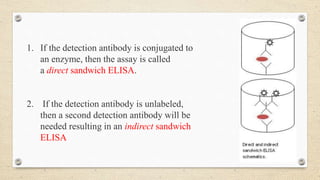
1. If the detection antibody is conjugated to
an enzyme, then the assay is called
a direct sandwich ELISA.
2. If the detection antibody is unlabeled,
then a second detection antibody will be
needed resulting in an indirect sandwich
ELISA
This type of assay (Sandwich ELISA) has several advantages:
• High specificity, since two antibodies are used the antigen/analyte is
specifically captured and detected.
• Suitable for complex samples, since the antigen does not require
purification prior to measurement
• Flexibility and sensitivity
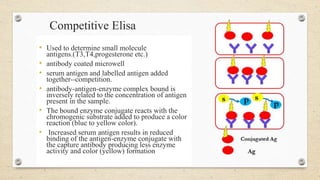
• Used to determine small molecule
antigens.(T3,T4,progesterone etc.)
• antibody coated microwell
• serum antigen and labelled antigen added
together--competition.
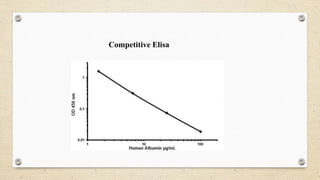
• antibody-antigen-enzyme complex bound is
inversely related to the concentration of antigen
present in the sample.
• The bound enzyme conjugate reacts with the
chromogenic substrate added to produce a color
reaction (blue to yellow color).
• Increased serum antigen results in reduced
binding of the antigen-enzyme conjugate with
the capture antibody producing less enzyme
activity and color (yellow) formation
Competitive Elisa
Competitive Elisa
Substrate
Primary
antibody
Secondary
antibody
Different antigens in sample
Coloured
product
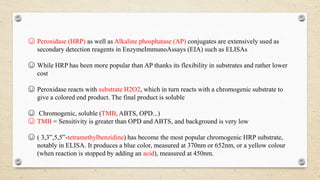
☺ Peroxidase (HRP) as well as Alkaline phosphatase (AP) conjugates are extensively used as
secondary detection reagents in EnzymeImmunoAssays (EIA) such as ELISAs
☺ While HRP has been more popular than AP thanks its flexibility in substrates and rather lower
cost
☺ Peroxidase reacts with substrate H2O2, which in turn reacts with a chromogenic substrate to
give a colored end product. The final product is soluble
☺ Chromogenic, soluble (TMB, ABTS, OPD...)
☺ TMB = Sensitivity is greater than OPD and ABTS, and background is very low
☺ ( 3,3‟,5,5‟-tetramethylbenzidine) has become the most popular chromogenic HRP substrate,
notably in ELISA. It produces a blue color, measured at 370nm or 652nm, or a yellow colour
(when reaction is stopped by adding an acid), measured at 450nm.
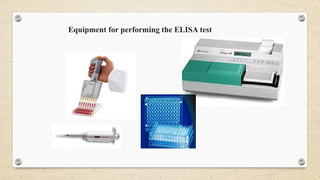
Equipment for performing the ELISA test
Elisa

Elisa

  • 1.
  • 2.
    INTRODUCTION TO ELISA •ELISA, or enzyme-linked immunosorbent assay, are immunological procedures in which the Ag- Ab reaction is monitored by enzyme measurements. • The term ELISA was first used by Engvall & Perlma in 1971. • It is useful & powerful method in estimating ng/mL to pg/mL ordered materials in the solution.
  • 3.
  • 4.
    ELISA Results 1) Quantitative: ELISAdata can be interpreted in comparison to a standard curve (a serial dilution of a known, purified antigen) in order to precisely calculate the concentrations of antigen in various samples.
  • 5.
    2) Qualitative:  ELISAscan also be used to achieve a yes or no answer indicating whether a particular antigen is present in a sample, as compared to a blank well containing no antigen or an unrelated control antigen.  The cut-off is normally used for the best discrimination between "positive" and "negative" samples.  cut-off = Average of negative control.  Test OD > CUT OFF = positive, Test OD < CUT OFF = Negative.
  • 6.
    Four Typical ELISAFormats: i. Direct ELISA ii. Indirect ELISA iii. Sandwich ELISA iv. Competition ELISA
  • 7.
    Direct ELISA present antigensor antibodies in the sample coat on solid phase and then labeled antibody or antigen add to the system. This type of ELISA has two main advantages: •It is faster, since fewer steps are required •It is less prone to error, since there are fewer steps and reagents  But it is not common ( more in research)
  • 9.
    This method (IndirectELISA) has several advantages: • Increased sensitivity • Flexibility, since different primary detection antibodies can be used with a single labeled secondary antibody • Cost savings, since fewer labeled antibodies are required
  • 10.
    Sandwich ELISA Sandwich ELISAstypically require the use of matched antibody pairs, where each antibody is specific for a different, non-overlapping part (epitope) of the antigen molecule. The first antibody, termed the capture antibody, is coated to the polystyrene plate. Next, the analyte or sample solution is added to the well. A second antibody layer, the detection antibody, follows this step in order to measure the concentration of the analyte.
  • 11.
    1. If thedetection antibody is conjugated to an enzyme, then the assay is called a direct sandwich ELISA. 2. If the detection antibody is unlabeled, then a second detection antibody will be needed resulting in an indirect sandwich ELISA
  • 12.
    This type ofassay (Sandwich ELISA) has several advantages: • High specificity, since two antibodies are used the antigen/analyte is specifically captured and detected. • Suitable for complex samples, since the antigen does not require purification prior to measurement • Flexibility and sensitivity
  • 14.
    • Used todetermine small molecule antigens.(T3,T4,progesterone etc.) • antibody coated microwell • serum antigen and labelled antigen added together--competition. • antibody-antigen-enzyme complex bound is inversely related to the concentration of antigen present in the sample. • The bound enzyme conjugate reacts with the chromogenic substrate added to produce a color reaction (blue to yellow color). • Increased serum antigen results in reduced binding of the antigen-enzyme conjugate with the capture antibody producing less enzyme activity and color (yellow) formation Competitive Elisa
  • 15.
  • 17.
  • 18.
    ☺ Peroxidase (HRP)as well as Alkaline phosphatase (AP) conjugates are extensively used as secondary detection reagents in EnzymeImmunoAssays (EIA) such as ELISAs ☺ While HRP has been more popular than AP thanks its flexibility in substrates and rather lower cost ☺ Peroxidase reacts with substrate H2O2, which in turn reacts with a chromogenic substrate to give a colored end product. The final product is soluble ☺ Chromogenic, soluble (TMB, ABTS, OPD...) ☺ TMB = Sensitivity is greater than OPD and ABTS, and background is very low ☺ ( 3,3‟,5,5‟-tetramethylbenzidine) has become the most popular chromogenic HRP substrate, notably in ELISA. It produces a blue color, measured at 370nm or 652nm, or a yellow colour (when reaction is stopped by adding an acid), measured at 450nm.
  • 19.