1
Dr. Omeed Akbar Ali
PhD. Clinical Biochemistry
Tikrit University - College of Medicine
Enzyme-linked immunosorbent assay
▪ ELISA is an antigen-antibody reaction.
✓ It is a common laboratory technique which is usually used to
measure the concentration of antibodies or antigens in the blood.
▪ELISA is a plate-based assay technique which is used for
detecting and quantifying substances such as peptides, proteins,
antibodies, and hormones.
✓An enzyme conjugated with an antibody reacts with colorless
substrate to generate a colored product.
✓ Such substrate is called chromogenic substrate.
2
1971
Peter Perlmann & Eva Engvall
Stockholm University
Sweden
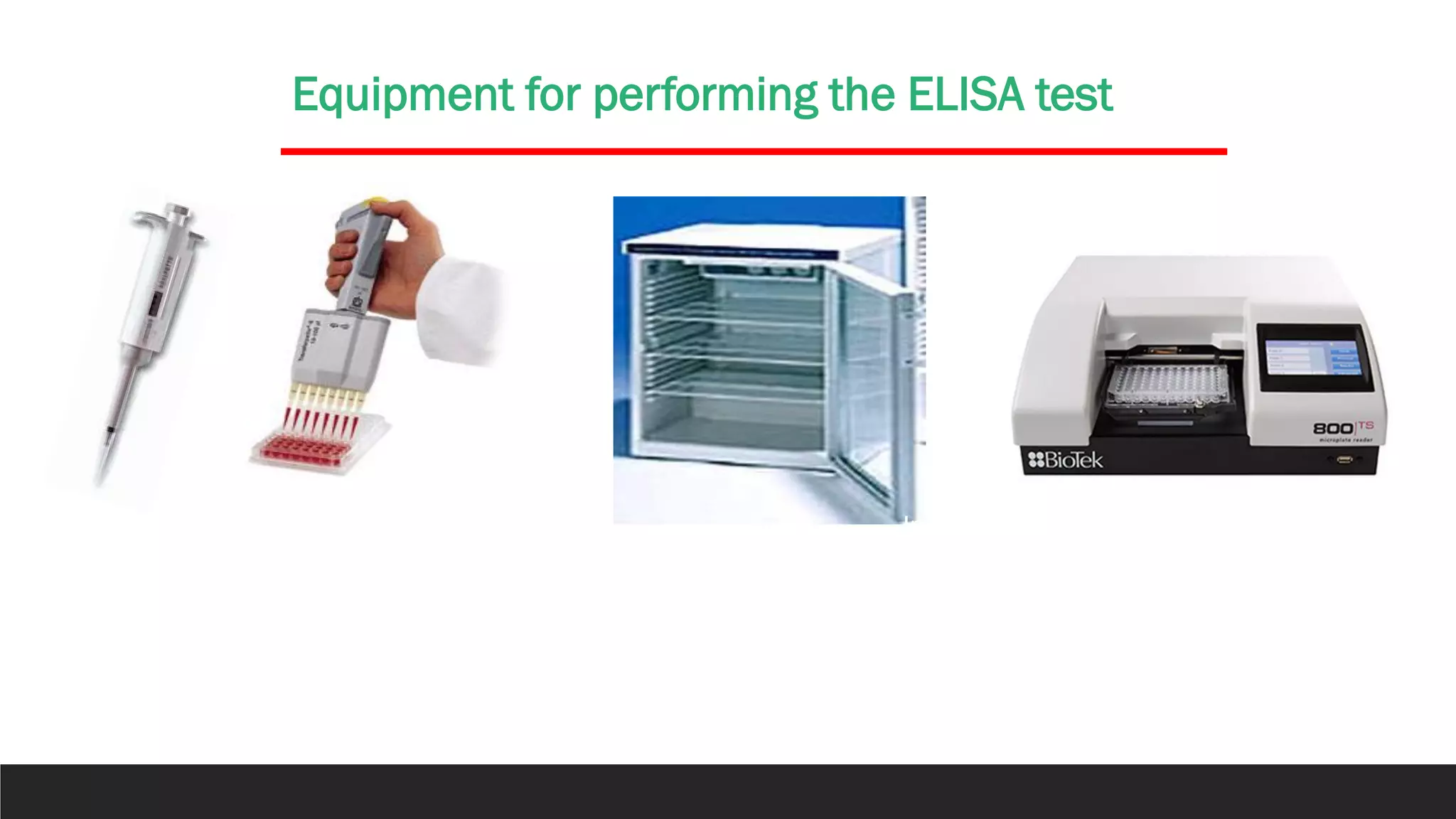
Equipment for performing the ELISA test
Pipettes
Incubator
ELISA reader
Principle
✓ELISAs are typically performed in 96-well polystyrene plates.
✓The serum is incubated in a well, and each well contains a different serum.
✓A positive control serum and a negative control serum would be included among the 96 samples being tested.
✓Antibodies or antigens present in serum are captured by corresponding antigen or antibody-coated onto the solid
surface.
✓After some time, the plate is washed to remove serum and unbound antibodies or antigens with a series of wash
buffer.
✓To detect the bound antibodies or antigens, secondary antibody that are attached to an enzyme such as peroxidase or
alkaline phosphatase are added to each well.
✓After an incubation period, the unbound secondary antibodies are washed off.
✓When a suitable substrate is added, the enzyme reacts with it to produce a color.
✓This color produced is measurable as a function or quantity of antigens or antibodies present in the given sample.
✓The intensity of color/ optical density is measured at 450nm.
✓The intensity of the color gives an indication of the amount of antigen or antibody. 4
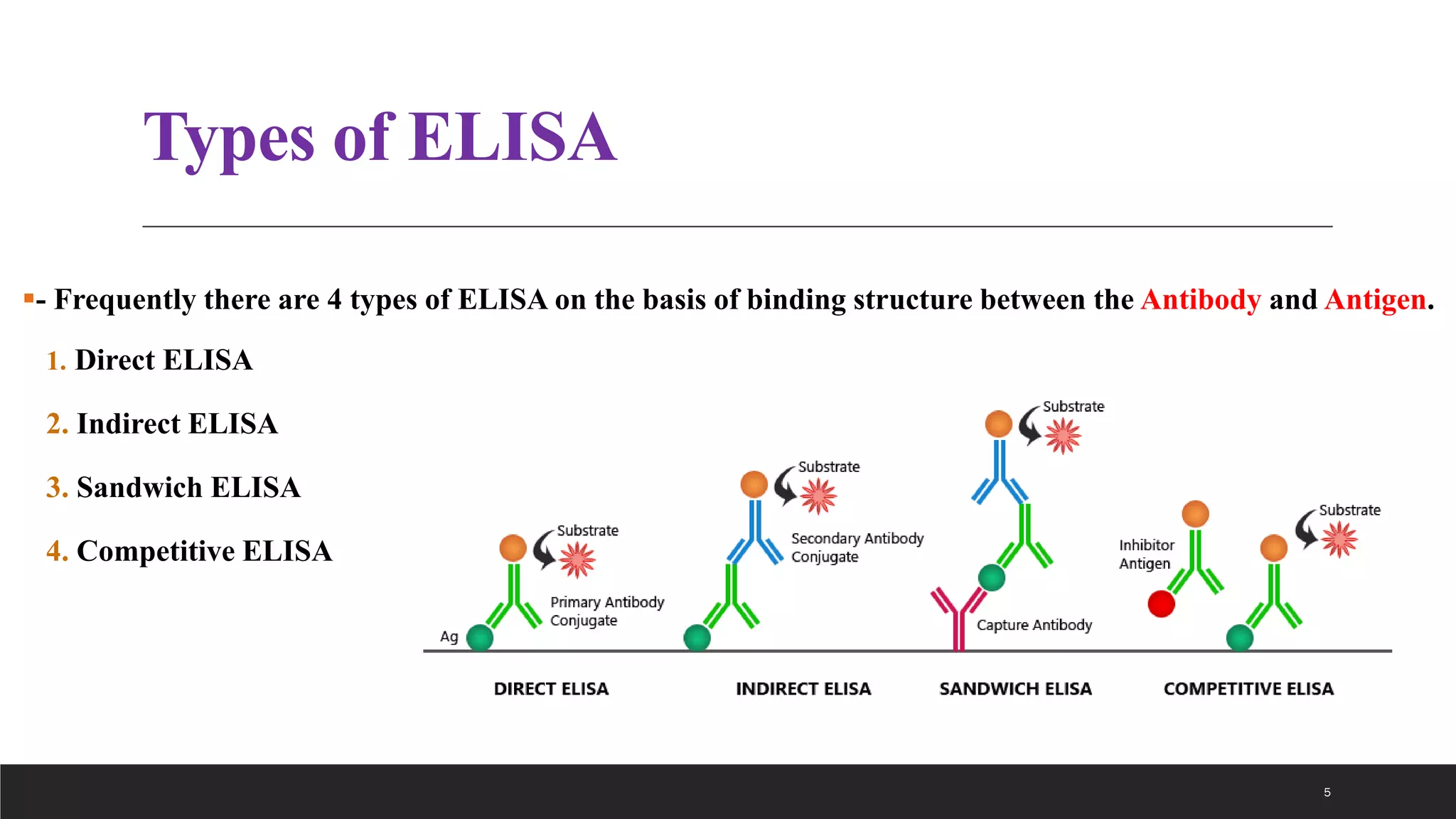
Types of ELISA
▪- Frequently there are 4 types of ELISA on the basis of binding structure between the Antibody and Antigen.
1. Direct ELISA
2. Indirect ELISA
3. Sandwich ELISA
4. Competitive ELISA
5
Direct ELISA
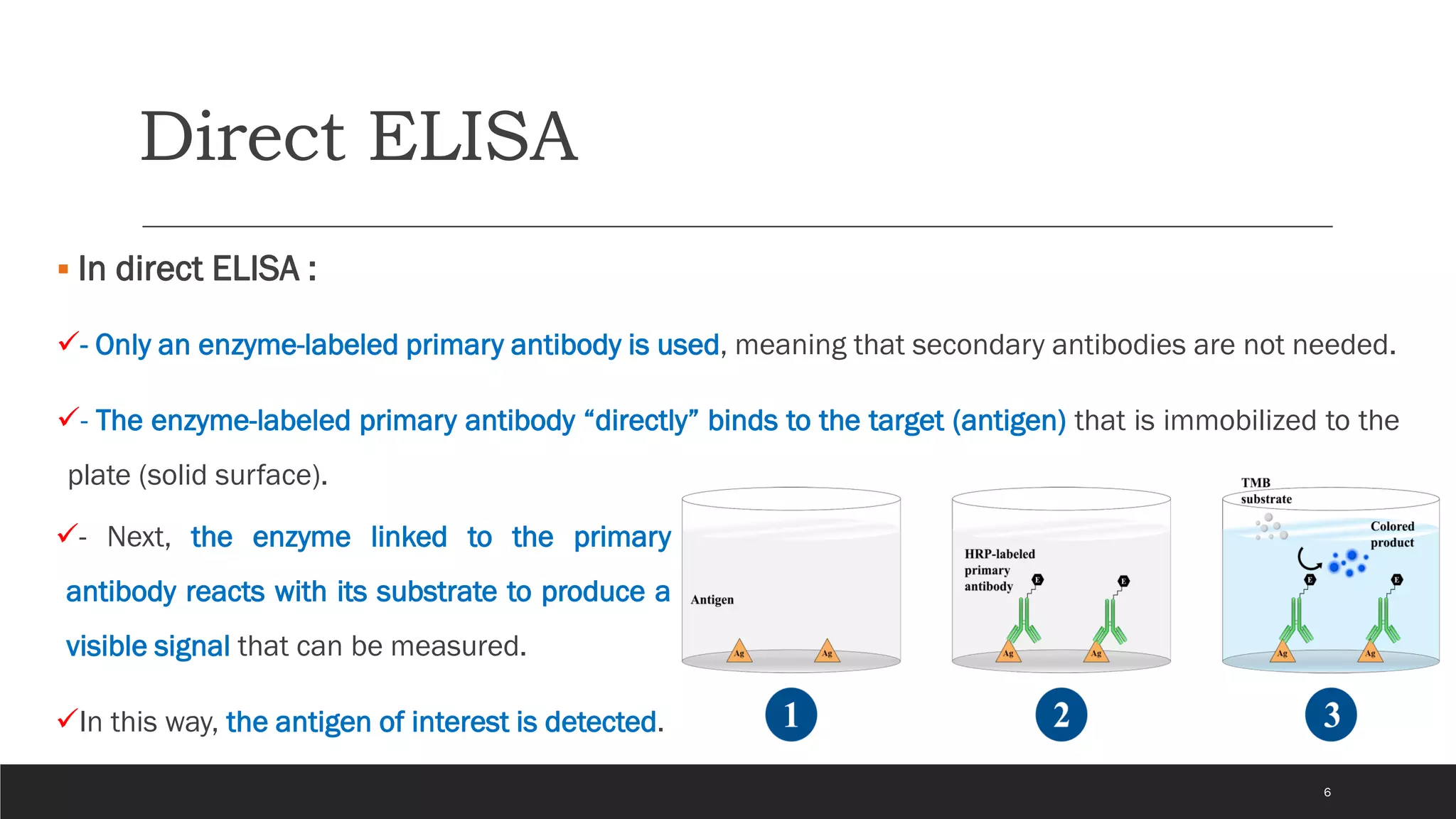
▪ In direct ELISA :
✓- Only an enzyme-labeled primary antibody is used, meaning that secondary antibodies are not needed.
✓- The enzyme-labeled primary antibody “directly” binds to the target (antigen) that is immobilized to the
plate (solid surface).
6
✓- Next, the enzyme linked to the primary
antibody reacts with its substrate to produce a
visible signal that can be measured.
✓In this way, the antigen of interest is detected.
Advantages and disadvantages of Direct ELISA
7
Indirect ELISA
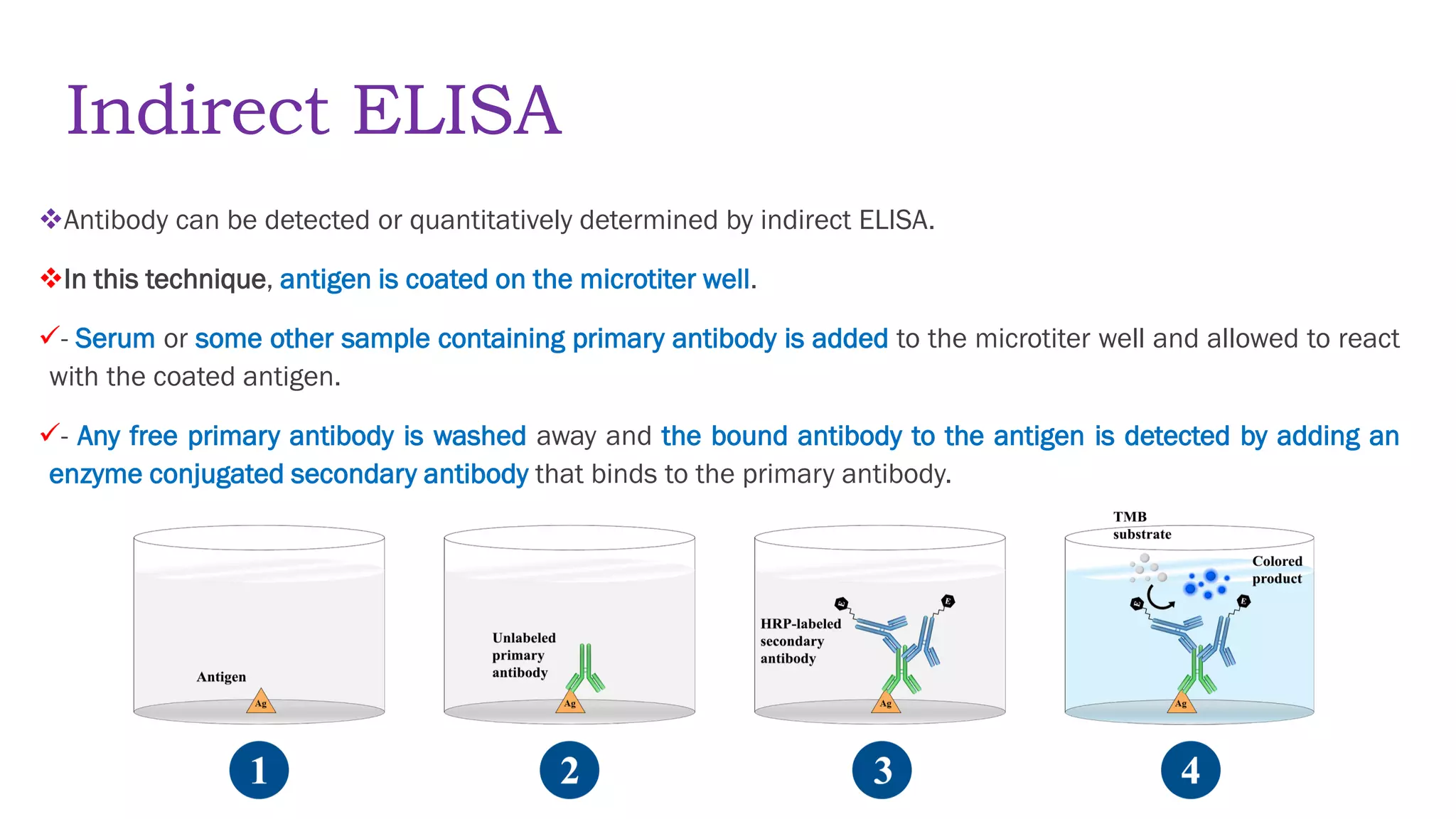
❖Antibody can be detected or quantitatively determined by indirect ELISA.
❖In this technique, antigen is coated on the microtiter well.
✓- Serum or some other sample containing primary antibody is added to the microtiter well and allowed to react
with the coated antigen.
✓- Any free primary antibody is washed away and the bound antibody to the antigen is detected by adding an
enzyme conjugated secondary antibody that binds to the primary antibody.
8
Indirect ELISA Cont….
9
✓- Unbound secondary antibody is then washed away and a specific substrate for the enzyme
is added.
✓- Enzyme hydrolyzes the substrate to form colored products.
✓- The amount of colored end product is measured by spectrophotometric plate readers that
can measure the absorbance of all the wells of 96-well plate.
Advantages and disadvantages of Indirect ELISA
10
Sandwich ELISA
❖- Antigen can be detected by sandwich ELISA.
❖- In this technique, antibody is coated on the microtiter well.
✓- A sample containing antigen is added to the well and allowed to react with the antibody
attached to the well, forming antigen-antibody complex.
✓- After the well is washed, a second enzyme-linked antibody specific for a different epitope on the
antigen is added and allowed to react with the bound antigen.
✓- Then after unbound secondary antibody is removed by washing.
✓- Finally substrate is added to the plate which is hydrolyzed by enzyme to form colored products.
11
12
Advantages and disadvantages of Sandwich ELISA
13
Competitive ELISA
❖- This test is used to measure the concentration of an antigen in a sample.
❖- In this test, antibody is first incubated in solution with a sample containing antigen.
✓- The antigen-antibody mixture is then added to the microtitre well which is coated with antigen.
✓- The more the antigen present in the sample, the less free antibody will be available to bind to
the antigen-coated well.
✓- After the well is washed, enzyme conjugated secondary antibody specific for isotype of the
primary antibody is added to determine the amount of primary antibody bound to the well.
✓- The higher the concentration of antigen in the sample, the lower the absorbance.
14
15
Advantages and disadvantages of Competitive ELISA
16
Applications
1-Screening donated blood for evidence of viral contamination by
◦ HIV-1 and HIV-2 (presence of anti-HIV antibodies)
◦ hepatitis C (presence of antibodies)
◦ hepatitis B (testing for both antibodies and a viral antigen)
2-Measuring hormone levels
◦ HCG (as a test for pregnancy)
◦ LH (determining the time of ovulation)
◦ TSH, T3 and T4 (for thyroid function)
◦ sexually-transmitted agents like HIV, syphilis and chlamydia
◦ hepatitis B and C
◦ Toxoplasma gondii
Detecting allergens in food and house dust
Measuring "rheumatoid factors" and other autoantibody in autoimmune diseases like
lupus erythematosus
Measuring toxins in contaminated food
3-Detecting infections
Applications
Thank You
That’s all

Lab 11 Lec_ELISA (2).pdf

  • 1.
    1 Dr. Omeed AkbarAli PhD. Clinical Biochemistry Tikrit University - College of Medicine
  • 2.
    Enzyme-linked immunosorbent assay ▪ELISA is an antigen-antibody reaction. ✓ It is a common laboratory technique which is usually used to measure the concentration of antibodies or antigens in the blood. ▪ELISA is a plate-based assay technique which is used for detecting and quantifying substances such as peptides, proteins, antibodies, and hormones. ✓An enzyme conjugated with an antibody reacts with colorless substrate to generate a colored product. ✓ Such substrate is called chromogenic substrate. 2 1971 Peter Perlmann & Eva Engvall Stockholm University Sweden
  • 3.
    Equipment for performingthe ELISA test Pipettes Incubator ELISA reader
  • 4.
    Principle ✓ELISAs are typicallyperformed in 96-well polystyrene plates. ✓The serum is incubated in a well, and each well contains a different serum. ✓A positive control serum and a negative control serum would be included among the 96 samples being tested. ✓Antibodies or antigens present in serum are captured by corresponding antigen or antibody-coated onto the solid surface. ✓After some time, the plate is washed to remove serum and unbound antibodies or antigens with a series of wash buffer. ✓To detect the bound antibodies or antigens, secondary antibody that are attached to an enzyme such as peroxidase or alkaline phosphatase are added to each well. ✓After an incubation period, the unbound secondary antibodies are washed off. ✓When a suitable substrate is added, the enzyme reacts with it to produce a color. ✓This color produced is measurable as a function or quantity of antigens or antibodies present in the given sample. ✓The intensity of color/ optical density is measured at 450nm. ✓The intensity of the color gives an indication of the amount of antigen or antibody. 4
  • 5.
    Types of ELISA ▪-Frequently there are 4 types of ELISA on the basis of binding structure between the Antibody and Antigen. 1. Direct ELISA 2. Indirect ELISA 3. Sandwich ELISA 4. Competitive ELISA 5
  • 6.
    Direct ELISA ▪ Indirect ELISA : ✓- Only an enzyme-labeled primary antibody is used, meaning that secondary antibodies are not needed. ✓- The enzyme-labeled primary antibody “directly” binds to the target (antigen) that is immobilized to the plate (solid surface). 6 ✓- Next, the enzyme linked to the primary antibody reacts with its substrate to produce a visible signal that can be measured. ✓In this way, the antigen of interest is detected.
  • 7.
  • 8.
    Indirect ELISA ❖Antibody canbe detected or quantitatively determined by indirect ELISA. ❖In this technique, antigen is coated on the microtiter well. ✓- Serum or some other sample containing primary antibody is added to the microtiter well and allowed to react with the coated antigen. ✓- Any free primary antibody is washed away and the bound antibody to the antigen is detected by adding an enzyme conjugated secondary antibody that binds to the primary antibody. 8
  • 9.
    Indirect ELISA Cont…. 9 ✓-Unbound secondary antibody is then washed away and a specific substrate for the enzyme is added. ✓- Enzyme hydrolyzes the substrate to form colored products. ✓- The amount of colored end product is measured by spectrophotometric plate readers that can measure the absorbance of all the wells of 96-well plate.
  • 10.
    Advantages and disadvantagesof Indirect ELISA 10
  • 11.
    Sandwich ELISA ❖- Antigencan be detected by sandwich ELISA. ❖- In this technique, antibody is coated on the microtiter well. ✓- A sample containing antigen is added to the well and allowed to react with the antibody attached to the well, forming antigen-antibody complex. ✓- After the well is washed, a second enzyme-linked antibody specific for a different epitope on the antigen is added and allowed to react with the bound antigen. ✓- Then after unbound secondary antibody is removed by washing. ✓- Finally substrate is added to the plate which is hydrolyzed by enzyme to form colored products. 11
  • 12.
  • 13.
    Advantages and disadvantagesof Sandwich ELISA 13
  • 14.
    Competitive ELISA ❖- Thistest is used to measure the concentration of an antigen in a sample. ❖- In this test, antibody is first incubated in solution with a sample containing antigen. ✓- The antigen-antibody mixture is then added to the microtitre well which is coated with antigen. ✓- The more the antigen present in the sample, the less free antibody will be available to bind to the antigen-coated well. ✓- After the well is washed, enzyme conjugated secondary antibody specific for isotype of the primary antibody is added to determine the amount of primary antibody bound to the well. ✓- The higher the concentration of antigen in the sample, the lower the absorbance. 14
  • 15.
  • 16.
    Advantages and disadvantagesof Competitive ELISA 16
  • 17.
    Applications 1-Screening donated bloodfor evidence of viral contamination by ◦ HIV-1 and HIV-2 (presence of anti-HIV antibodies) ◦ hepatitis C (presence of antibodies) ◦ hepatitis B (testing for both antibodies and a viral antigen) 2-Measuring hormone levels ◦ HCG (as a test for pregnancy) ◦ LH (determining the time of ovulation) ◦ TSH, T3 and T4 (for thyroid function)
  • 18.
    ◦ sexually-transmitted agentslike HIV, syphilis and chlamydia ◦ hepatitis B and C ◦ Toxoplasma gondii Detecting allergens in food and house dust Measuring "rheumatoid factors" and other autoantibody in autoimmune diseases like lupus erythematosus Measuring toxins in contaminated food 3-Detecting infections Applications
  • 19.