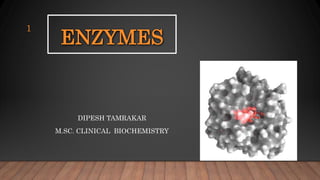
ENZYMES
DIPESH TAMRAKAR
M.SC. CLINICAL BIOCHEMISTRY
1
OVERVIEW
INTRODUCTION
DEFINITIONS
GENERAL PROPERTIES
CLASSIFICATION
MECHANISM OF ACTION
ENZYME ACTIVITY
ENZYME KINETICS
INTRODUCTION
2 fundamental conditions for life: self – replication and able to catalyze
chemical reactions
Enzymes are biocatalysts- the catalyst of life
Enzymes are central to every biochemical process
The study of enzymes has immense practical importance
The study of enzyme is called enzymology.
HISTORY OF ENZYMES
• Biological catalysis was first recognized and described in the late 1700s
(digestion of meat by gastric secretions)
• In the 1800s the conversion of starch to sugar by saliva and various plant
extracts were studied.
• In the 1850s, Louis Pasteur introduce the term “ferments” (fermentation of
sugar into alcohol by yeasts)
• Emil Fischer’s discovery, in 1894, that glycolytic enzymes can distinguish
between stereoisomeric sugars led to the formulation of his lock-and-key
hypothesis
• In 1897 Eduard Buchner discovered that yeast extracts could ferment sugar
to alcohol.
4
• Frederick W. Kühne later gave the name enzymes to the molecules
detected by Buchner.
• In 1926 the isolation and crystallization of urease by James Sumner.
• He postulated that all enzymes are protein.
• In 1930 protein nature of enzyme is widely accepted, after John Northrop
and Moses Kunitz crystallized pepsin, trypsin, and other digestive
enzymes and found them also to be protein
• In 1963 the first amino acid sequence of an enzyme, that of bovine
pancreatic ribonuclease A was reported.
• X-ray structure of an enzyme, that of hen egg white lysozyme was
elucidated in 1965.
5
DEFINITIONS
• (Greek: en, in+ zyme, yeast)
• Defined as biocatalysts synthesized by living cells.
• Enzymes are the proteins that speeds up the rate of a chemical reaction in a
living organism.
• An enzyme acts as catalyst for specific chemical reactions, converting a
specific set of reactants (called substrates) into specific products.
enzyme
• Substrate Product
6
CHEMICAL NATURE OF ENZYMES
• All the enzymes are proteins except ribozymes and number of enzymes
are obtained in crystalline form.
• It acts on substrate to change it in product.
• Their molecular weight ranges from few thousands to millions Daltons.
• Enzymes are far more efficient compared to non-enzyme catalysts.
• Enzymes are not consumed in the overall reaction.
• Enzymes accelerate the rate of reaction but does not alter the
equilibrium constant (K eq).
7
• Some enzymes does not require chemical groups for activity other
than their amino acid residues.
• Other enzyme require an additional chemical component called a
Cofactor and Coenzyme
• Some enzyme proteins are modified covalently by phosphorylation,
glycosylation, and other processes..
• They are colloidal in nature, heat labile & water-soluble.
• They can be precipitated by protein precipitating reagents
(ammonium sulfate or trichloroacetic acid).
8
STRUCTURE OF ENZYMES
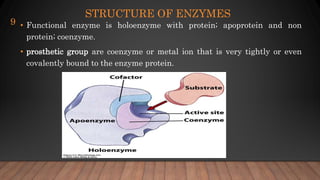
• Functional enzyme is holoenzyme with protein; apoprotein and non
protein; coenzyme.
• prosthetic group are coenzyme or metal ion that is very tightly or even
covalently bound to the enzyme protein.
9
• Single polypeptide; monomeric enzymes, e.g.trypsin ribonuclease.
• >1 polypeptide chain; oligomeric enzymes, e.g. lactate dehydrogenase,
hexokinase, etc.
• multienzyme complex possessing specific sites to catalyse different
rxn. e.g. fatty acid synthetase, carbamoyl phosphate synthetase II,
pyruvate dehydrogenase, prostaglandin synthase, etc.
• The complex becomes inactive when it is fractionated into smaller
units each bearing individual enzyme activity,
10
COFACTORS
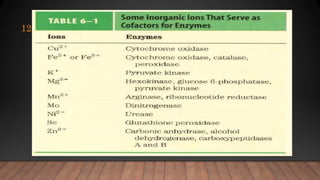
• The term co-factor is used as a collective term to include co-enzymes and
metal ions.
• Co-enzyme is an organic co-factor
• They help in either maintaining or producing (or both), active structural
conformation of the enzyme,
• They helps in formation of enzyme-substrate complex,
• Cofactors helps in making structural changes in substrate molecule,
• Cofactors accept or donate electrons, Activating or functioning as
nucleophiles, and
• Formation of ternary complexes with enzyme or substrate.
11
12
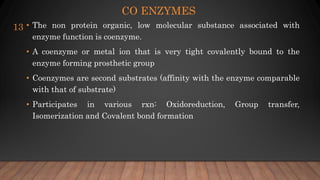
CO ENZYMES
• The non protein organic, low molecular substance associated with
enzyme function is coenzyme.
• A coenzyme or metal ion that is very tight covalently bound to the
enzyme forming prosthetic group
• Coenzymes are second substrates (affinity with the enzyme comparable
with that of substrate)
• Participates in various rxn: Oxidoreduction, Group transfer,
Isomerization and Covalent bond formation
13
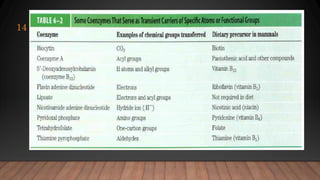
14
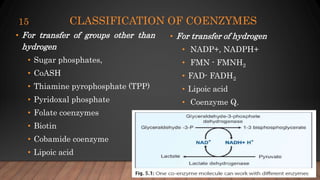
CLASSIFICATION OF COENZYMES
• For transfer of groups other than
hydrogen
• Sugar phosphates,
• CoASH
• Thiamine pyrophosphate (TPP)
• Pyridoxal phosphate
• Folate coenzymes
• Biotin
• Cobamide coenzyme
• Lipoic acid
• For transfer of hydrogen
• NADP+, NADPH+
• FMN - FMNH2
• FAD- FADH2
• Lipoic acid
• Coenzyme Q.
15
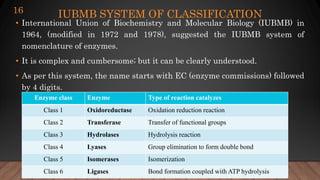
IUBMB SYSTEM OF CLASSIFICATION
• International Union of Biochemistry and Molecular Biology (IUBMB) in
1964, (modified in 1972 and 1978), suggested the IUBMB system of
nomenclature of enzymes.
• It is complex and cumbersome; but it can be clearly understood.
• As per this system, the name starts with EC (enzyme commissions) followed
by 4 digits.
Enzyme class Enzyme Type of reaction catalyzes
Class 1 Oxidoreductase Oxidation reduction reaction
Class 2 Transferase Transfer of functional groups
Class 3 Hydrolases Hydrolysis reaction
Class 4 Lyases Group elimination to form double bond
Class 5 Isomerases Isomerization
Class 6 Ligases Bond formation coupled with ATP hydrolysis
16
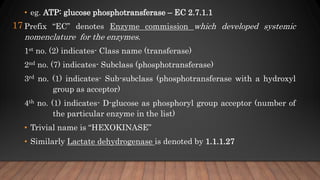
• eg. ATP: glucose phosphotransferase – EC 2.7.1.1
Prefix “EC” denotes Enzyme commission which developed systemic
nomenclature for the enzymes.
1st no. (2) indicates- Class name (transferase)
2nd no. (7) indicates- Subclass (phosphotransferase)
3rd no. (1) indicates- Sub-subclass (phosphotransferase with a hydroxyl
group as acceptor)
4th no. (1) indicates- D-glucose as phosphoryl group acceptor (number of
the particular enzyme in the list)
• Trivial name is “HEXOKINASE”
• Similarly Lactate dehydrogenase is denoted by 1.1.1.27
17
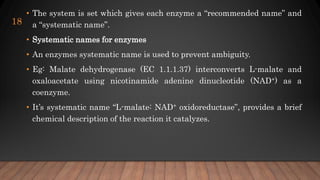
• The system is set which gives each enzyme a “recommended name” and
a “systematic name”.
• Systematic names for enzymes
• An enzymes systematic name is used to prevent ambiguity.
• Eg: Malate dehydrogenase (EC 1.1.1.37) interconverts L-malate and
oxaloacetate using nicotinamide adenine dinucleotide (NAD+) as a
coenzyme.
• It’s systematic name “L-malate: NAD+ oxidoreductase”, provides a brief
chemical description of the reaction it catalyzes.
18
• Recommended names:
• Recommended names are usually formed by adding the suffix “-
ase” to the name of the enzyme’s substrate or a phrase describing
it’s catalytic action
• urease (EC 3.5.1.5) catalyzes the hydrolysis of urea
• alcohol dehydrogenase (EC 1.1.1.1) oxidizes alcohols to their
corresponding aldehydes.
Exception: tyrosin, pepsin, papain (trivial name)
19
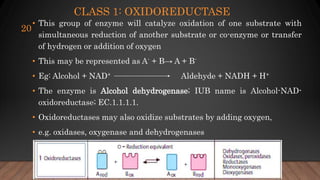
CLASS 1: OXIDOREDUCTASE
• This group of enzyme will catalyze oxidation of one substrate with
simultaneous reduction of another substrate or co-enzyme or transfer
of hydrogen or addition of oxygen
• This may be represented as A- + B→ A + B-
• Eg: Alcohol + NAD+ Aldehyde + NADH + H+
• The enzyme is Alcohol dehydrogenase; IUB name is Alcohol-NAD-
oxidoreductase; EC.1.1.1.1.
• Oxidoreductases may also oxidize substrates by adding oxygen,
• e.g. oxidases, oxygenase and dehydrogenases
20
CLASS 2: TRANSFERASES
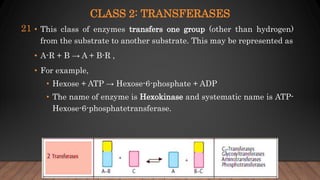
• This class of enzymes transfers one group (other than hydrogen)
from the substrate to another substrate. This may be represented as
• A-R + B → A + B-R ,
• For example,
• Hexose + ATP → Hexose-6-phosphate + ADP
• The name of enzyme is Hexokinase and systematic name is ATP-
Hexose-6-phosphatetransferase.
21
CLASS 3: HYDROLASES
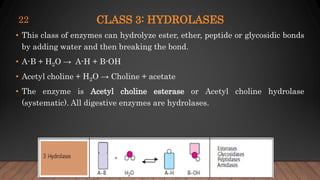
• This class of enzymes can hydrolyze ester, ether, peptide or glycosidic bonds
by adding water and then breaking the bond.
• A-B + H2O → A-H + B-OH
• Acetyl choline + H2O → Choline + acetate
• The enzyme is Acetyl choline esterase or Acetyl choline hydrolase
(systematic). All digestive enzymes are hydrolases.
22
CLASS 4: LYASES
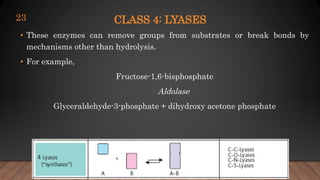
• These enzymes can remove groups from substrates or break bonds by
mechanisms other than hydrolysis.
• For example,
Fructose-1,6-bisphosphate
Aldolase
Glyceraldehyde-3-phosphate + dihydroxy acetone phosphate
23
CLASS 5: ISOMERASES
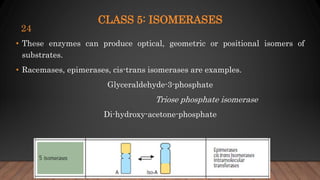
• These enzymes can produce optical, geometric or positional isomers of
substrates.
• Racemases, epimerases, cis-trans isomerases are examples.
Glyceraldehyde-3-phosphate
Triose phosphate isomerase
Di-hydroxy-acetone-phosphate
24
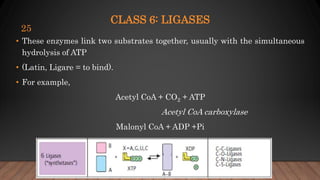
CLASS 6: LIGASES
• These enzymes link two substrates together, usually with the simultaneous
hydrolysis of ATP
• (Latin, Ligare = to bind).
• For example,
Acetyl CoA + CO2 + ATP
Acetyl CoA carboxylase
Malonyl CoA + ADP +Pi
25
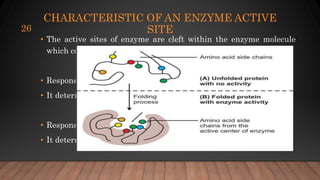
CHARACTERISTIC OF AN ENZYME ACTIVE
SITE
• The active sites of enzyme are cleft within the enzyme molecule
which consist of few amino acid residue only.
Catalytic site:
• Responsible for catalysis
• It determine reaction specificity
Binding Site
• Responsible for binding enzyme to substrate.
• It determine substrate specificity.
26
PROPERTIES OF ENZYMES
• Speed: Catalytic efficiency 103- 1015 Turn over number eg. Carbonic
anhydrase – 36,000,000/sec
• Specificity (highly specific): eg: urease, glucokinase
1. Stereospecific (exception: isomerase)
• Enzymes are also stereospecific catalysts that typically catalyze
reactions of only one stereoisomer of a given compound - for example,
D- but not L-sugars, L- but not D-amino acids;
• maltase catalyses the hydrolysis of alpha glycosides but not beta
glycosides
• Succinate dehydrogenase while acts on succinic acid will produce
only fumaric acid and not malic acid (isomer)
27
2. Reaction specific
• Same substrate can undergo different types of rxn, each
catalysed by separate enzyme
3. Substrate specific- (Active site)
• Absolute substrate specific- eg. glucokinase, urease
• Relative substrate specific – Pepin, chymotrypsin
• Broad specific - hexokinase
• Location – mostly localized in specific organelles within cell
compartment
• Regulation – activation/inhibition/rate of product respond to cell need
28
MODELS OF ACTIVE SITES
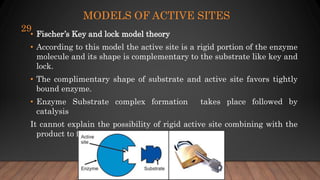
• Fischer’s Key and lock model theory
• According to this model the active site is a rigid portion of the enzyme
molecule and its shape is complementary to the substrate like key and
lock.
• The complimentary shape of substrate and active site favors tightly
bound enzyme.
• Enzyme Substrate complex formation takes place followed by
catalysis
It cannot explain the possibility of rigid active site combining with the
product to form substrate in reversible reaction
29
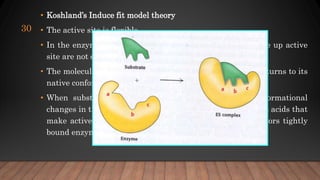
• Koshland’s Induce fit model theory
• The active site is flexible
• In the enzyme molecule the amino acid residues that make up active
site are not oriented properly in the absence of substrate.
• The molecule is unstable in the induce confirmation and returns to its
native conformation in the absence of substrate.
• When substrate combines with enzyme, it induces conformational
changes in the enzyme molecule in a such a way that amino acids that
make active site are shifted into correct orientation to favors tightly
bound enzyme substrate complex followed by catalysis
30
ENZYME CATALYSIS
• Enzyme catalysis is the increase in the rate of a chemical reaction by the active site
of a protein.
31
•1 Induced fit
•2 Mechanisms of an alternative
reaction route
 Proximity and orientation
 Proton donors or acceptors
 Electrostatic catalysis
 Covalent catalysis
 Metal ion catalysis
 Bond strain
 Quantum tunneling
 Active enzyme
•3 Examples of catalytic
mechanisms
 Triose phosphate isomerase
 Trypsin
 Aldolase
ENZYME ACT AS CATALYST
• A enzymes does not change the chemical reaction but it accelerates the
reaction.
• They are not consumed in overall reaction.
• But they undergo chemical or physical change during reaction and returns
to original state at the end of reaction.
• All enzymes are catalyst, but all catalyst are not enzyme.
• Transition state theory was proposed to explain action of catalyst.
32
33
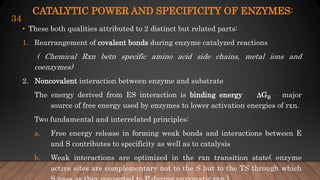
CATALYTIC POWER AND SPECIFICITY OF ENZYMES:
• These both qualities attributed to 2 distinct but related parts:
1. Rearrangement of covalent bonds during enzyme catalyzed reactions
( Chemical Rxn betn specific amino acid side chains, metal ions and
coenzymes)
2. Noncovalent interaction between enzyme and substrate
The energy derived from ES interaction is binding energy GB – major
source of free energy used by enzymes to lower activation energies of rxn.
Two fundamental and interrelated principles:
a. Free energy release in forming weak bonds and interactions between E
and S contributes to specificity as well as to catalysis
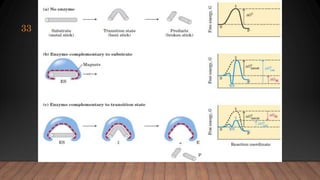
b. Weak interactions are optimized in the rxn transition state( enzyme
active sites are complementary not to the S but to the TS through which
34
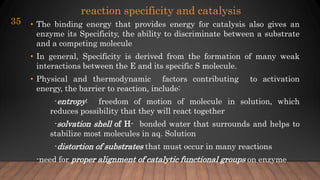
reaction specificity and catalysis
• The binding energy that provides energy for catalysis also gives an
enzyme its Specificity, the ability to discriminate between a substrate
and a competing molecule
• In general, Specificity is derived from the formation of many weak
interactions between the E and its specific S molecule.
• Physical and thermodynamic factors contributing to activation
energy, the barrier to reaction, include:
-entropy: freedom of motion of molecule in solution, which
reduces possibility that they will react together
-solvation shell of H- bonded water that surrounds and helps to
stabilize most molecules in aq. Solution
-distortion of substrates that must occur in many reactions
-need for proper alignment of catalytic functional groups on enzyme
35
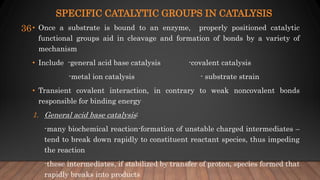
SPECIFIC CATALYTIC GROUPS IN CATALYSIS
• Once a substrate is bound to an enzyme, properly positioned catalytic
functional groups aid in cleavage and formation of bonds by a variety of
mechanism
• Include -general acid base catalysis -covalent catalysis
-metal ion catalysis - substrate strain
• Transient covalent interaction, in contrary to weak noncovalent bonds
responsible for binding energy
1. General acid base catalysis:
-many biochemical reaction-formation of unstable charged intermediates –
tend to break down rapidly to constituent reactant species, thus impeding
the reaction
-these intermediates, if stabilized by transfer of proton, species formed that
rapidly breaks into products
36
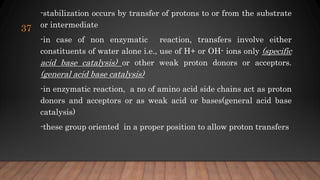
-stabilization occurs by transfer of protons to or from the substrate
or intermediate
-in case of non enzymatic reaction, transfers involve either
constituents of water alone i.e., use of H+ or OH- ions only (specific
acid base catalysis) or other weak proton donors or acceptors.
(general acid base catalysis)
-in enzymatic reaction, a no of amino acid side chains act as proton
donors and acceptors or as weak acid or bases(general acid base
catalysis)
-these group oriented in a proper position to allow proton transfers
37
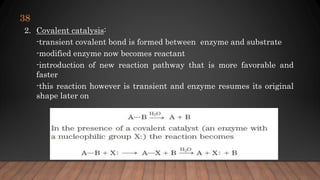
2. Covalent catalysis:
-transient covalent bond is formed between enzyme and substrate
-modified enzyme now becomes reactant
-introduction of new reaction pathway that is more favorable and
faster
-this reaction however is transient and enzyme resumes its original
shape later on
38
3. Metal ion catalysis:
-metals in metallozymes or metal activated enzymes participate in
catalysis in various ways:
-ionic interaction
-weak bonding interaction
-oxidation reduction reactions to bring about a rate enhancement
4. Substrate Strain:
- substrate is strained due to induced conformation change in the
enzyme leading formation of product
- the mechanism of lysozyme is due to combination of substrate
strain and acid base catalysis
39
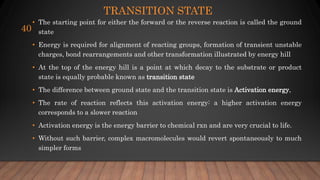
TRANSITION STATE
• The starting point for either the forward or the reverse reaction is called the ground
state
• Energy is required for alignment of reacting groups, formation of transient unstable
charges, bond rearrangements and other transformation illustrated by energy hill
• At the top of the energy hill is a point at which decay to the substrate or product
state is equally probable known as transition state
• The difference between ground state and the transition state is Activation energy,
• The rate of reaction reflects this activation energy: a higher activation energy
corresponds to a slower reaction
• Activation energy is the energy barrier to chemical rxn and are very crucial to life.
• Without such barrier, complex macromolecules would revert spontaneously to much
simpler forms
40
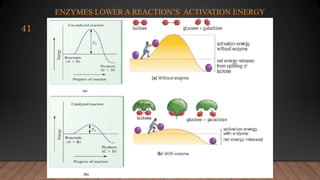
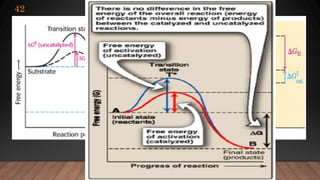
ENZYMES LOWER A REACTION’S ACTIVATION ENERGY
41
42
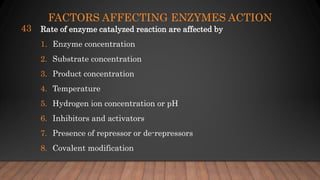
FACTORS AFFECTING ENZYMES ACTION
Rate of enzyme catalyzed reaction are affected by
1. Enzyme concentration
2. Substrate concentration
3. Product concentration
4. Temperature
5. Hydrogen ion concentration or pH
6. Inhibitors and activators
7. Presence of repressor or de-repressors
8. Covalent modification
43
ENZYME CONCENTRATION
• Rate of a reaction or velocity (V) is directly proportional to the enzyme
concentration, when sufficient substrate is present.
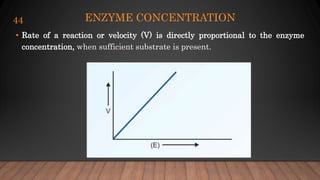
44
EFFECT OF SUBSTRATE CONCENTRATION
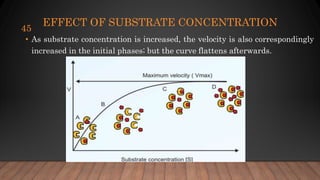
• As substrate concentration is increased, the velocity is also correspondingly
increased in the initial phases; but the curve flattens afterwards.
45
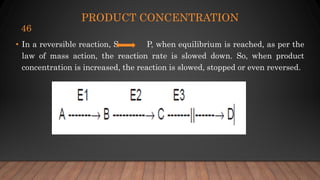
PRODUCT CONCENTRATION
• In a reversible reaction, S P, when equilibrium is reached, as per the
law of mass action, the reaction rate is slowed down. So, when product
concentration is increased, the reaction is slowed, stopped or even reversed.
46
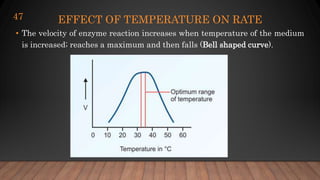
EFFECT OF TEMPERATURE ON RATE
• The velocity of enzyme reaction increases when temperature of the medium
is increased; reaches a maximum and then falls (Bell shaped curve).
47
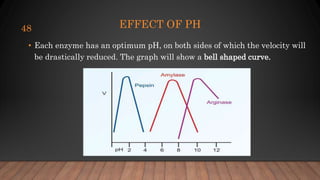
EFFECT OF PH
• Each enzyme has an optimum pH, on both sides of which the velocity will
be drastically reduced. The graph will show a bell shaped curve.
48
49

Enzymes

  • 1.
  • 2.
  • 3.
    INTRODUCTION 2 fundamental conditionsfor life: self – replication and able to catalyze chemical reactions Enzymes are biocatalysts- the catalyst of life Enzymes are central to every biochemical process The study of enzymes has immense practical importance The study of enzyme is called enzymology.
  • 4.
    HISTORY OF ENZYMES •Biological catalysis was first recognized and described in the late 1700s (digestion of meat by gastric secretions) • In the 1800s the conversion of starch to sugar by saliva and various plant extracts were studied. • In the 1850s, Louis Pasteur introduce the term “ferments” (fermentation of sugar into alcohol by yeasts) • Emil Fischer’s discovery, in 1894, that glycolytic enzymes can distinguish between stereoisomeric sugars led to the formulation of his lock-and-key hypothesis • In 1897 Eduard Buchner discovered that yeast extracts could ferment sugar to alcohol. 4
  • 5.
    • Frederick W.Kühne later gave the name enzymes to the molecules detected by Buchner. • In 1926 the isolation and crystallization of urease by James Sumner. • He postulated that all enzymes are protein. • In 1930 protein nature of enzyme is widely accepted, after John Northrop and Moses Kunitz crystallized pepsin, trypsin, and other digestive enzymes and found them also to be protein • In 1963 the first amino acid sequence of an enzyme, that of bovine pancreatic ribonuclease A was reported. • X-ray structure of an enzyme, that of hen egg white lysozyme was elucidated in 1965. 5
  • 6.
    DEFINITIONS • (Greek: en,in+ zyme, yeast) • Defined as biocatalysts synthesized by living cells. • Enzymes are the proteins that speeds up the rate of a chemical reaction in a living organism. • An enzyme acts as catalyst for specific chemical reactions, converting a specific set of reactants (called substrates) into specific products. enzyme • Substrate Product 6
  • 7.
    CHEMICAL NATURE OFENZYMES • All the enzymes are proteins except ribozymes and number of enzymes are obtained in crystalline form. • It acts on substrate to change it in product. • Their molecular weight ranges from few thousands to millions Daltons. • Enzymes are far more efficient compared to non-enzyme catalysts. • Enzymes are not consumed in the overall reaction. • Enzymes accelerate the rate of reaction but does not alter the equilibrium constant (K eq). 7
  • 8.
    • Some enzymesdoes not require chemical groups for activity other than their amino acid residues. • Other enzyme require an additional chemical component called a Cofactor and Coenzyme • Some enzyme proteins are modified covalently by phosphorylation, glycosylation, and other processes.. • They are colloidal in nature, heat labile & water-soluble. • They can be precipitated by protein precipitating reagents (ammonium sulfate or trichloroacetic acid). 8
  • 9.
    STRUCTURE OF ENZYMES •Functional enzyme is holoenzyme with protein; apoprotein and non protein; coenzyme. • prosthetic group are coenzyme or metal ion that is very tightly or even covalently bound to the enzyme protein. 9
  • 10.
    • Single polypeptide;monomeric enzymes, e.g.trypsin ribonuclease. • >1 polypeptide chain; oligomeric enzymes, e.g. lactate dehydrogenase, hexokinase, etc. • multienzyme complex possessing specific sites to catalyse different rxn. e.g. fatty acid synthetase, carbamoyl phosphate synthetase II, pyruvate dehydrogenase, prostaglandin synthase, etc. • The complex becomes inactive when it is fractionated into smaller units each bearing individual enzyme activity, 10
  • 11.
    COFACTORS • The termco-factor is used as a collective term to include co-enzymes and metal ions. • Co-enzyme is an organic co-factor • They help in either maintaining or producing (or both), active structural conformation of the enzyme, • They helps in formation of enzyme-substrate complex, • Cofactors helps in making structural changes in substrate molecule, • Cofactors accept or donate electrons, Activating or functioning as nucleophiles, and • Formation of ternary complexes with enzyme or substrate. 11
  • 12.
  • 13.
    CO ENZYMES • Thenon protein organic, low molecular substance associated with enzyme function is coenzyme. • A coenzyme or metal ion that is very tight covalently bound to the enzyme forming prosthetic group • Coenzymes are second substrates (affinity with the enzyme comparable with that of substrate) • Participates in various rxn: Oxidoreduction, Group transfer, Isomerization and Covalent bond formation 13
  • 14.
  • 15.
    CLASSIFICATION OF COENZYMES •For transfer of groups other than hydrogen • Sugar phosphates, • CoASH • Thiamine pyrophosphate (TPP) • Pyridoxal phosphate • Folate coenzymes • Biotin • Cobamide coenzyme • Lipoic acid • For transfer of hydrogen • NADP+, NADPH+ • FMN - FMNH2 • FAD- FADH2 • Lipoic acid • Coenzyme Q. 15
  • 16.
    IUBMB SYSTEM OFCLASSIFICATION • International Union of Biochemistry and Molecular Biology (IUBMB) in 1964, (modified in 1972 and 1978), suggested the IUBMB system of nomenclature of enzymes. • It is complex and cumbersome; but it can be clearly understood. • As per this system, the name starts with EC (enzyme commissions) followed by 4 digits. Enzyme class Enzyme Type of reaction catalyzes Class 1 Oxidoreductase Oxidation reduction reaction Class 2 Transferase Transfer of functional groups Class 3 Hydrolases Hydrolysis reaction Class 4 Lyases Group elimination to form double bond Class 5 Isomerases Isomerization Class 6 Ligases Bond formation coupled with ATP hydrolysis 16
  • 17.
    • eg. ATP:glucose phosphotransferase – EC 2.7.1.1 Prefix “EC” denotes Enzyme commission which developed systemic nomenclature for the enzymes. 1st no. (2) indicates- Class name (transferase) 2nd no. (7) indicates- Subclass (phosphotransferase) 3rd no. (1) indicates- Sub-subclass (phosphotransferase with a hydroxyl group as acceptor) 4th no. (1) indicates- D-glucose as phosphoryl group acceptor (number of the particular enzyme in the list) • Trivial name is “HEXOKINASE” • Similarly Lactate dehydrogenase is denoted by 1.1.1.27 17
  • 18.
    • The systemis set which gives each enzyme a “recommended name” and a “systematic name”. • Systematic names for enzymes • An enzymes systematic name is used to prevent ambiguity. • Eg: Malate dehydrogenase (EC 1.1.1.37) interconverts L-malate and oxaloacetate using nicotinamide adenine dinucleotide (NAD+) as a coenzyme. • It’s systematic name “L-malate: NAD+ oxidoreductase”, provides a brief chemical description of the reaction it catalyzes. 18
  • 19.
    • Recommended names: •Recommended names are usually formed by adding the suffix “- ase” to the name of the enzyme’s substrate or a phrase describing it’s catalytic action • urease (EC 3.5.1.5) catalyzes the hydrolysis of urea • alcohol dehydrogenase (EC 1.1.1.1) oxidizes alcohols to their corresponding aldehydes. Exception: tyrosin, pepsin, papain (trivial name) 19
  • 20.
    CLASS 1: OXIDOREDUCTASE •This group of enzyme will catalyze oxidation of one substrate with simultaneous reduction of another substrate or co-enzyme or transfer of hydrogen or addition of oxygen • This may be represented as A- + B→ A + B- • Eg: Alcohol + NAD+ Aldehyde + NADH + H+ • The enzyme is Alcohol dehydrogenase; IUB name is Alcohol-NAD- oxidoreductase; EC.1.1.1.1. • Oxidoreductases may also oxidize substrates by adding oxygen, • e.g. oxidases, oxygenase and dehydrogenases 20
  • 21.
    CLASS 2: TRANSFERASES •This class of enzymes transfers one group (other than hydrogen) from the substrate to another substrate. This may be represented as • A-R + B → A + B-R , • For example, • Hexose + ATP → Hexose-6-phosphate + ADP • The name of enzyme is Hexokinase and systematic name is ATP- Hexose-6-phosphatetransferase. 21
  • 22.
    CLASS 3: HYDROLASES •This class of enzymes can hydrolyze ester, ether, peptide or glycosidic bonds by adding water and then breaking the bond. • A-B + H2O → A-H + B-OH • Acetyl choline + H2O → Choline + acetate • The enzyme is Acetyl choline esterase or Acetyl choline hydrolase (systematic). All digestive enzymes are hydrolases. 22
  • 23.
    CLASS 4: LYASES •These enzymes can remove groups from substrates or break bonds by mechanisms other than hydrolysis. • For example, Fructose-1,6-bisphosphate Aldolase Glyceraldehyde-3-phosphate + dihydroxy acetone phosphate 23
  • 24.
    CLASS 5: ISOMERASES •These enzymes can produce optical, geometric or positional isomers of substrates. • Racemases, epimerases, cis-trans isomerases are examples. Glyceraldehyde-3-phosphate Triose phosphate isomerase Di-hydroxy-acetone-phosphate 24
  • 25.
    CLASS 6: LIGASES •These enzymes link two substrates together, usually with the simultaneous hydrolysis of ATP • (Latin, Ligare = to bind). • For example, Acetyl CoA + CO2 + ATP Acetyl CoA carboxylase Malonyl CoA + ADP +Pi 25
  • 26.
    CHARACTERISTIC OF ANENZYME ACTIVE SITE • The active sites of enzyme are cleft within the enzyme molecule which consist of few amino acid residue only. Catalytic site: • Responsible for catalysis • It determine reaction specificity Binding Site • Responsible for binding enzyme to substrate. • It determine substrate specificity. 26
  • 27.
    PROPERTIES OF ENZYMES •Speed: Catalytic efficiency 103- 1015 Turn over number eg. Carbonic anhydrase – 36,000,000/sec • Specificity (highly specific): eg: urease, glucokinase 1. Stereospecific (exception: isomerase) • Enzymes are also stereospecific catalysts that typically catalyze reactions of only one stereoisomer of a given compound - for example, D- but not L-sugars, L- but not D-amino acids; • maltase catalyses the hydrolysis of alpha glycosides but not beta glycosides • Succinate dehydrogenase while acts on succinic acid will produce only fumaric acid and not malic acid (isomer) 27
  • 28.
    2. Reaction specific •Same substrate can undergo different types of rxn, each catalysed by separate enzyme 3. Substrate specific- (Active site) • Absolute substrate specific- eg. glucokinase, urease • Relative substrate specific – Pepin, chymotrypsin • Broad specific - hexokinase • Location – mostly localized in specific organelles within cell compartment • Regulation – activation/inhibition/rate of product respond to cell need 28
  • 29.
    MODELS OF ACTIVESITES • Fischer’s Key and lock model theory • According to this model the active site is a rigid portion of the enzyme molecule and its shape is complementary to the substrate like key and lock. • The complimentary shape of substrate and active site favors tightly bound enzyme. • Enzyme Substrate complex formation takes place followed by catalysis It cannot explain the possibility of rigid active site combining with the product to form substrate in reversible reaction 29
  • 30.
    • Koshland’s Inducefit model theory • The active site is flexible • In the enzyme molecule the amino acid residues that make up active site are not oriented properly in the absence of substrate. • The molecule is unstable in the induce confirmation and returns to its native conformation in the absence of substrate. • When substrate combines with enzyme, it induces conformational changes in the enzyme molecule in a such a way that amino acids that make active site are shifted into correct orientation to favors tightly bound enzyme substrate complex followed by catalysis 30
  • 31.
    ENZYME CATALYSIS • Enzymecatalysis is the increase in the rate of a chemical reaction by the active site of a protein. 31 •1 Induced fit •2 Mechanisms of an alternative reaction route  Proximity and orientation  Proton donors or acceptors  Electrostatic catalysis  Covalent catalysis  Metal ion catalysis  Bond strain  Quantum tunneling  Active enzyme •3 Examples of catalytic mechanisms  Triose phosphate isomerase  Trypsin  Aldolase
  • 32.
    ENZYME ACT ASCATALYST • A enzymes does not change the chemical reaction but it accelerates the reaction. • They are not consumed in overall reaction. • But they undergo chemical or physical change during reaction and returns to original state at the end of reaction. • All enzymes are catalyst, but all catalyst are not enzyme. • Transition state theory was proposed to explain action of catalyst. 32
  • 33.
  • 34.
    CATALYTIC POWER ANDSPECIFICITY OF ENZYMES: • These both qualities attributed to 2 distinct but related parts: 1. Rearrangement of covalent bonds during enzyme catalyzed reactions ( Chemical Rxn betn specific amino acid side chains, metal ions and coenzymes) 2. Noncovalent interaction between enzyme and substrate The energy derived from ES interaction is binding energy GB – major source of free energy used by enzymes to lower activation energies of rxn. Two fundamental and interrelated principles: a. Free energy release in forming weak bonds and interactions between E and S contributes to specificity as well as to catalysis b. Weak interactions are optimized in the rxn transition state( enzyme active sites are complementary not to the S but to the TS through which 34
  • 35.
    reaction specificity andcatalysis • The binding energy that provides energy for catalysis also gives an enzyme its Specificity, the ability to discriminate between a substrate and a competing molecule • In general, Specificity is derived from the formation of many weak interactions between the E and its specific S molecule. • Physical and thermodynamic factors contributing to activation energy, the barrier to reaction, include: -entropy: freedom of motion of molecule in solution, which reduces possibility that they will react together -solvation shell of H- bonded water that surrounds and helps to stabilize most molecules in aq. Solution -distortion of substrates that must occur in many reactions -need for proper alignment of catalytic functional groups on enzyme 35
  • 36.
    SPECIFIC CATALYTIC GROUPSIN CATALYSIS • Once a substrate is bound to an enzyme, properly positioned catalytic functional groups aid in cleavage and formation of bonds by a variety of mechanism • Include -general acid base catalysis -covalent catalysis -metal ion catalysis - substrate strain • Transient covalent interaction, in contrary to weak noncovalent bonds responsible for binding energy 1. General acid base catalysis: -many biochemical reaction-formation of unstable charged intermediates – tend to break down rapidly to constituent reactant species, thus impeding the reaction -these intermediates, if stabilized by transfer of proton, species formed that rapidly breaks into products 36
  • 37.
    -stabilization occurs bytransfer of protons to or from the substrate or intermediate -in case of non enzymatic reaction, transfers involve either constituents of water alone i.e., use of H+ or OH- ions only (specific acid base catalysis) or other weak proton donors or acceptors. (general acid base catalysis) -in enzymatic reaction, a no of amino acid side chains act as proton donors and acceptors or as weak acid or bases(general acid base catalysis) -these group oriented in a proper position to allow proton transfers 37
  • 38.
    2. Covalent catalysis: -transientcovalent bond is formed between enzyme and substrate -modified enzyme now becomes reactant -introduction of new reaction pathway that is more favorable and faster -this reaction however is transient and enzyme resumes its original shape later on 38
  • 39.
    3. Metal ioncatalysis: -metals in metallozymes or metal activated enzymes participate in catalysis in various ways: -ionic interaction -weak bonding interaction -oxidation reduction reactions to bring about a rate enhancement 4. Substrate Strain: - substrate is strained due to induced conformation change in the enzyme leading formation of product - the mechanism of lysozyme is due to combination of substrate strain and acid base catalysis 39
  • 40.
    TRANSITION STATE • Thestarting point for either the forward or the reverse reaction is called the ground state • Energy is required for alignment of reacting groups, formation of transient unstable charges, bond rearrangements and other transformation illustrated by energy hill • At the top of the energy hill is a point at which decay to the substrate or product state is equally probable known as transition state • The difference between ground state and the transition state is Activation energy, • The rate of reaction reflects this activation energy: a higher activation energy corresponds to a slower reaction • Activation energy is the energy barrier to chemical rxn and are very crucial to life. • Without such barrier, complex macromolecules would revert spontaneously to much simpler forms 40
  • 41.
    ENZYMES LOWER AREACTION’S ACTIVATION ENERGY 41
  • 42.
  • 43.
    FACTORS AFFECTING ENZYMESACTION Rate of enzyme catalyzed reaction are affected by 1. Enzyme concentration 2. Substrate concentration 3. Product concentration 4. Temperature 5. Hydrogen ion concentration or pH 6. Inhibitors and activators 7. Presence of repressor or de-repressors 8. Covalent modification 43
  • 44.
    ENZYME CONCENTRATION • Rateof a reaction or velocity (V) is directly proportional to the enzyme concentration, when sufficient substrate is present. 44
  • 45.
    EFFECT OF SUBSTRATECONCENTRATION • As substrate concentration is increased, the velocity is also correspondingly increased in the initial phases; but the curve flattens afterwards. 45
  • 46.
    PRODUCT CONCENTRATION • Ina reversible reaction, S P, when equilibrium is reached, as per the law of mass action, the reaction rate is slowed down. So, when product concentration is increased, the reaction is slowed, stopped or even reversed. 46
  • 47.
    EFFECT OF TEMPERATUREON RATE • The velocity of enzyme reaction increases when temperature of the medium is increased; reaches a maximum and then falls (Bell shaped curve). 47
  • 48.
    EFFECT OF PH •Each enzyme has an optimum pH, on both sides of which the velocity will be drastically reduced. The graph will show a bell shaped curve. 48
  • 49.

Editor's Notes

  • #10 Prosthetic group is nonprotein moiety tightly (covalently) binds with the apoenzyme
  • #11 When many different enzyme catalysing reaction sites are located at different sites of the same macromolecule Each single polypeptide chain of oligomeric enzymes is called as subunit.
  • #12 A ternary complex is a protein complex containing three different molecules that are bound together
  • #14 Coenzymes of Bcomplex vitamins and coenzymes not related to Bcomplex vitamins: ATP UDP CDP
  • #15 The water-soluble B vitamins supply important components of numerous coenzymes. Nicotinamide is a component of the redox coenzymes NAD and NADP , whereas riboflavin is a component of the redox coenzymes FMN and FAD. Pantothenic acid is a component of the acyl group carrier coenzyme A. As its yrophosphate, thiamin participates in decarboxylation of a-keto acids, and the folic acid and cobamide coenzymes function in one-carbon metabolism. In addition, several coenzymes contain the adenine, ribose, and phosphoryl moieties of AMP or ADP
  • #27 These amino acids are arranged in a very precise manner so that only specific substrate can bind at the active site
  • #29 amino acids in enzyme undergo transamination and deamination, racemization
  • #30 Irrespective of the size, binding occurs at a special and specific region known as the active site. A cleft or pocket in the surface of the enzyme usually hydrophilic. Often makes up 10 to 20 % volume of entire enzyme
  • #31 Hexokinase has a large induced fit motion that closes over the substrates adenosine triphosphate and xylose.
  • #32 Triose phosphate isomerase catalyses the reversible interconvertion of the two triose phosphates isomers dihydroxyacetone phosphate and D-glyceraldehyde 3-phosphate. Trypsin serine protease that cleaves protein substrates after lysine or arginine residues using a catalytic triad to perform covalent catalysis, and an oxyanion hole to stabilise charge-buildup on the transition states. Aldolase catalyses the breakdown of fructose 1,6-bisphosphate (F-1,6-BP) into glyceraldehyde 3-phosphate and dihydroxyacetone phosphate (DHAP).
  • #35 Chemical rxn take place between substrates and enzymes functional group. Catalytic functional groups may form a transient covalent bond with S and activate it for rxn.in many case, these rxn occur only in the enzyme active site. Covalent interactions lower the activation energy; accelerate the rxn. Much of energy required to lower activation energies is derived from weak , noncovalent interactions between S and enzyme. Interaction is mediated by H bond ionic interactions. ES complex is accompanied by release of small amount of free energy that provides a degree of stability to interaction.
  • #43 ES & EP unstable reaction intermediates occupies space in reaction coordinate diagram. Several steps occurs in rxn, overall rate is determined by the step with the highest activation energy: rate-limiting step.(highest energy point in diagram for interconversion of S and P
  • #45 this property is made use of in determining the level of particular enzyme in plasma, serum or tissues.
  • #46 About A, B, C and D The maximum velocity obtain is called vmax
  • #48 The temperature at which maximum amount of the substrate is converted to the product per unit time is called optimum temp. se