ENZYME LECTURE 1
FIRST YEAR MBBS
PESHAWAR MEDICAL COLLGE
DATE 4.7.21
DR SADIA HAROON
PROF OF BIOCHEMISTRY
CONTENTS
Chemistry
Classification
Properties
Coenzymes
cofactors
CHEMISTRY
Introduction
 Enzymes are biological catalysts that speed
up the rate of the biochemical reaction.
 Most enzymes are three dimensional globular
proteins (tertiary and quaternary structure).
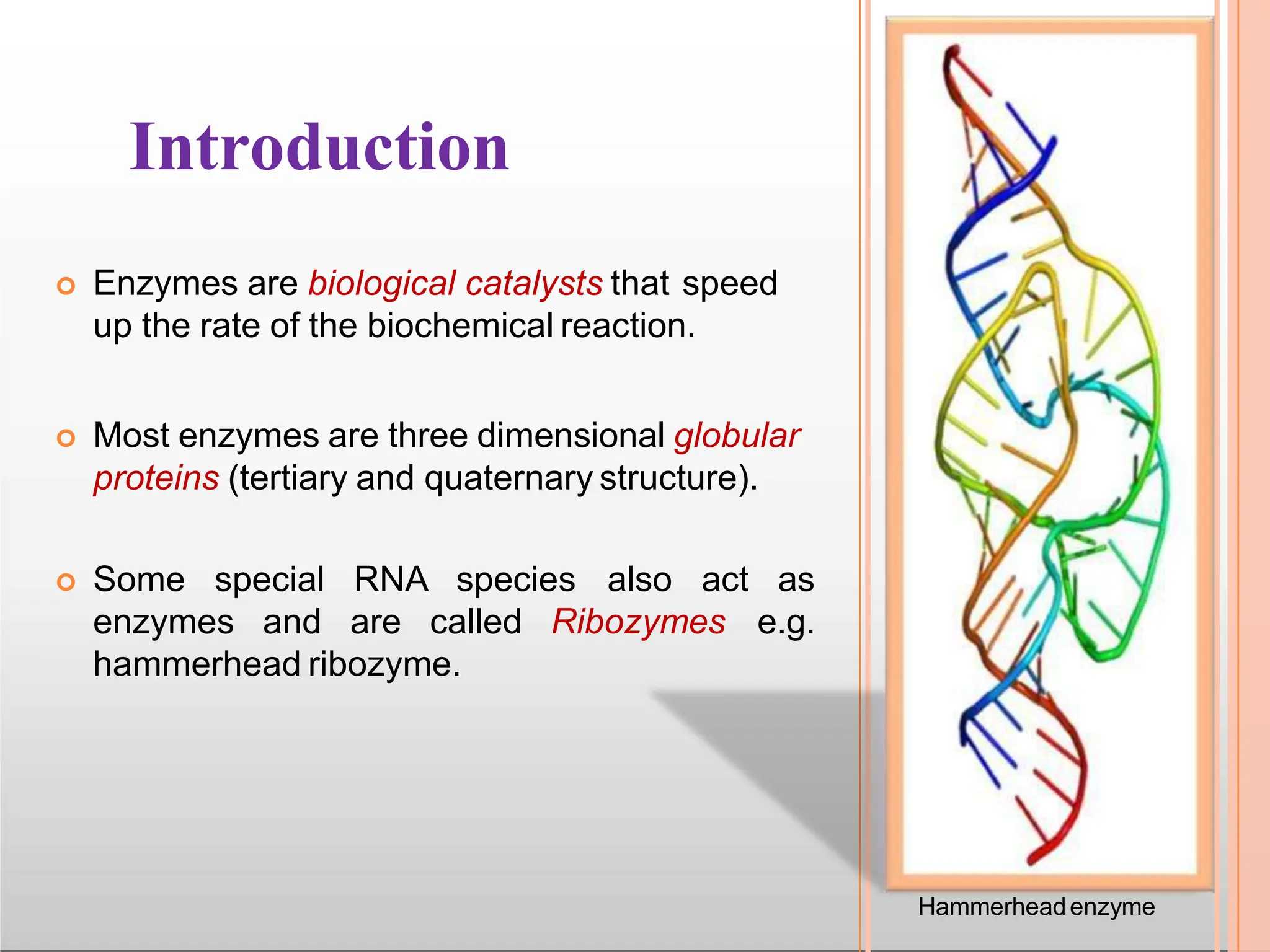
 Some special RNA species
enzymes and are called Ribozymes
also act as
e.g.
hammerhead ribozyme.
Hammerheadenzyme
STRUCTURE OF ENZYMES
 The active site of an enzyme is the region that binds
substrates, co-factors and prosthetic groups and contains
residue that helps to hold the substrate.
 Active sites generally occupy less than 5% of the total surface
area of enzyme.
 Active site has a specific shape due to tertiary structure of
protein.
 A change in the shape of protein affects the shape of active
site and function of the enzyme.
• Enzymes may be defined as biocatalysts synthesized
by living cells. They are protein in nature, colloidal
and thermolabile in character, and specific in action.
• A catalyst is defined as a substance that increases the
velocity or rate of a chemical reaction without itself
undergoing any change in the overall process.
• Friedrich Wilhelm Kuhne (1878) – given the name
ENZYME (En = in ; Zyme = yeast)
• James B. Sumner (1926) - first isolated & crystallized
urease from jack bean and identified protein.
ACTIVE SITE
It chooses the substrate
and binds it to active site.
It performs the catalytic
action of enzyme.
o Active site can be further divided into:
Active Site
Binding Site Catalytic Site
CO-FACTORS
o Co-factor is the non protein molecule which carries out
chemical reactions that can not be performed by standard 20
amino acids.
o Co-factors are of two types:
 Organic co-factors
 Inorganic cofactors
INORGANIC CO-FACTORS
o These are the inorganic molecules required for the proper
activity of enzymes.
Examples:

ORGANIC CO-FACTORS
o These are the organic molecules required for the proper
activity of enzymes.
Example:
 Glycogen phosphorylase requires the small organic
molecule pyridoxal phosphate.
 Enzyme carbonic anhydrase requires Zn for it‟sactivity.
Hexokinase has co-factor Mg
++
++
TYPES OF ORGANIC CO-FACTORS
Prosthetic Group Coenzyme
o A prosthetic group is a o A coenzyme is loosely tightly bound
organic co- bound organic co-facto+r. factor e.g. Flavins, heme
E.g. NAD+
groups and biotin.
co-factor removed is designated as
 An enzyme with i
t
s
‟
apoenzyme.
 The complete complex of a protein with all necessary small
organic molecules, metal ions and other components is
termed as holoenzyme of holoprotein.
Types of co-factors Continued…
SUBSTRATE
 The reactant in biochemical reaction is termed as substrate.
 When a substrate binds to an enzyme it forms an enzyme-
substrate complex.
Enzyme
Joins
Substrate
SITES OF ENZYME SYNTHESIS
o Enzymes are synthesized by ribosomes which are attached to
the rough endoplasmic reticulum.
o Information for the synthesis of enzyme is carried by DNA.
o Amino acids are bonded together to form specific enzyme
according to the DNA‟scodes.
INTRACELLULAR AND
EXTRACELLULAR ENZYMES
o Intracellular enzymes are synthesized and retained in the cell
for the use of cell itself.
o They are found in the cytoplasm, nucleus, mitochondria and
chloroplast.
Example :
 Oxydoreductase catalyses biological oxidation.
 Enzymes involved in reduction in the mitochondria.
in the cell but
o Extracellular enzymes are synthesized
secreted from the cell to work externally.
Example :
 Digestive enzyme produced by the pancreas, are not used by
the cells in the pancreas but are transported to the
duodenum.
CHARACTERISTICS
 Enzymes speed up the reaction by lowering the activation
energy of the reaction.
 Their presence does not effect the nature and properties of
end product.
 They are highly specific in their action that is each enzyme
can catalyze one kind of substrate.
 Small amount of enzymes can accelerate chemical reactions.
 Enzymes are sensitive to change in pH, temperature and
substrate concentration.
 Turnover number is defined as the number of substrate
molecules transformed per minute by one enzyme molecule.
Catalase turnover number = 6 x10⁶/min
NOMENCLATURE OF ENZYMES
o An enzyme is named according to the name of the substrate it
catalyses.
o Some enzymes were named before a systematic way of
naming enzyme was formed.
Example: pepsin, trypsin and rennin
o By adding suffix -ase at the end of the name of the
substrate, enzymes are named.
o Enzyme for catalyzing the hydrolysis is termed as hydrolase.
Example :
maltose + water glucose + glucose
maltase
EXAMPLES
substrate enzymes products
lactose lactase glucose + galactose
maltose maltase Glucose
cellulose cellulase Glucose
lipid lipase Glycerol + fatty acid
starch amylase Maltose
protein protease Peptides +
polypeptide
CLASSIFICATION
CLASSIFICATION OF ENZYMES
 A systematic classification of enzymes has been developed by
International Enzyme Commission.
 This classification is based on the type of reactions catalyzed
by enzymes.
 There are six major classes.
 Each class is further divided into sub classes, sub sub-classes
and so on, to describe the huge number of different enzyme-
catalyzed reactions.
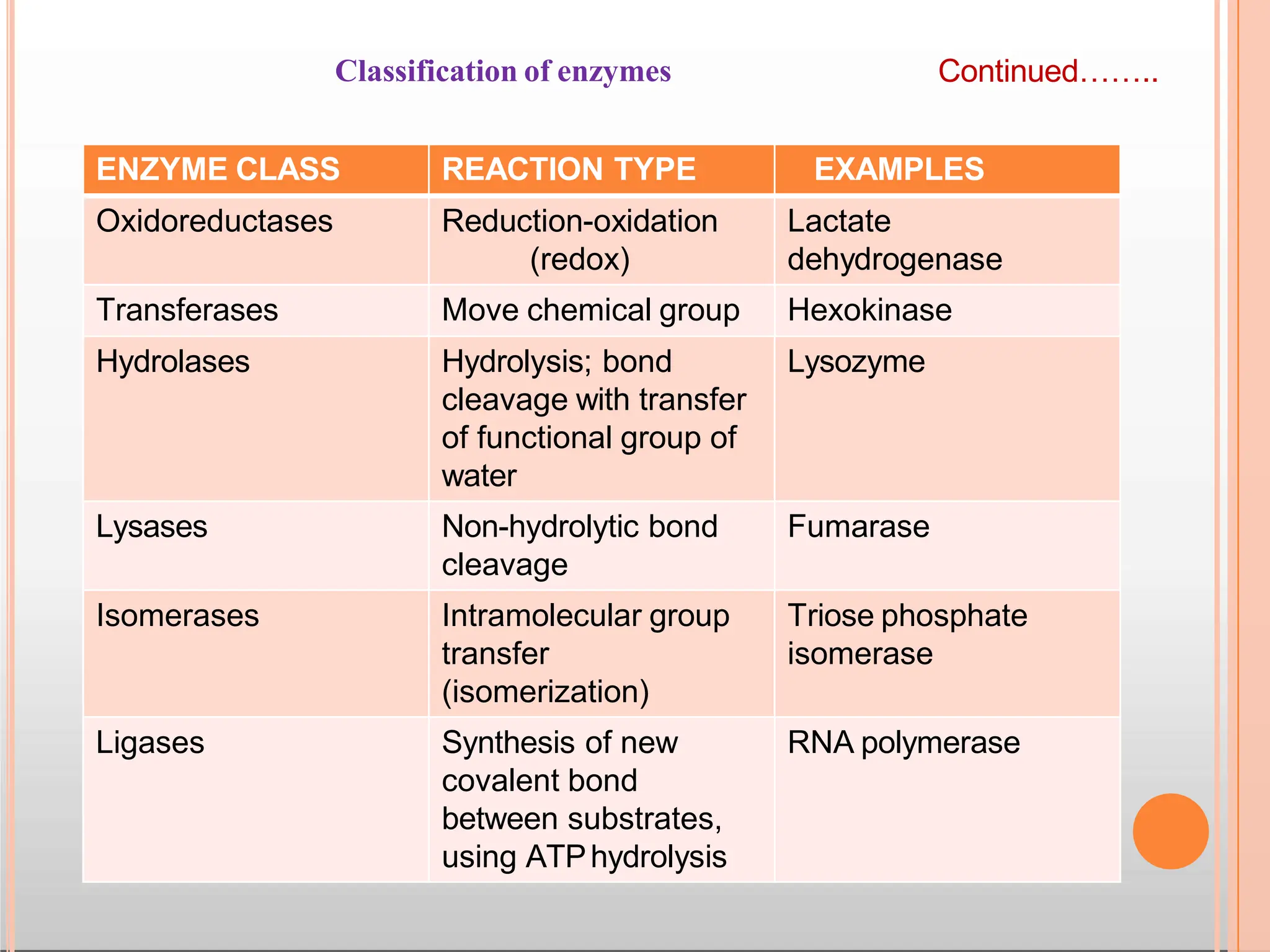
ENZYME CLASS REACTION TYPE EXAMPLES
Oxidoreductases Reduction-oxidation
(redox)
Lactate
dehydrogenase
Transferases Move chemical group Hexokinase
Hydrolases Hydrolysis; bond
cleavage with transfer
of functional group of
water
Lysozyme
Lysases Non-hydrolytic bond
cleavage
Fumarase
Isomerases Intramolecular group
transfer
(isomerization)
Triose phosphate
isomerase
Ligases Synthesis of new
covalent bond
between substrates,
using ATPhydrolysis
RNA polymerase
Continued……..
Classification of enzymes
NOMENCLATURE AND CLASSIFICATION
1. Substrate acted upon by the enzyme:
• named the enzymes by adding the “ase” in the name
of the substrate catalyzed
Eg., carbohydrates – carbohydrases
proteins - proteinases,
lipids – lipases
nucleic acids - nucleases
A few of the names were even more specific like
Eg., maltase - acting upon maltose
sucrase - upon sucrose
urease - upon urea etc.
2. Type of reaction catalyzed:
• The enzymes are named by adding the “ase” in the
name of the reaction
Eg., Hydrolases - catalyzing hydrolysis
Isomerases – isomerization
Oxidases – catalyzing oxidation
Dehydrogenases – catalyzing dehydrogenation
Transaminases – catalyzing transamination
Phosphorylases - catalyzing phosphorylation etc.
3. Substrate acted upon and type of reaction catalyzed:
• The names of some enzymes give clue of both the
substrate utilized and the type of reaction catalyzed.
Eg., succinic dehydrogenase – catalyzes dehydrogenation of
the substrate succinic acid.
L-glutamic dehydrogenase – catalyzes
dehydrogenation reaction involving L-glutamic acid.
4. Substance that is synthesized:
•A few enzymes have been named by adding the
“ase” to the name of the substance synthesized
Eg., rhodonase - forms rhodonate from hydrocyanic
acid and sodium thiosulphate
fumarase - forms fumarate from L-malate.
5. Endoenyzmes and exoenyzmes:
• enzymes that act within the cells in which they are
produced - intracellular enzymes or endoenzymes
Eg., plant enzymes and metabolic enzymes
• Enzymes which are liberated by living cells, catalyze
useful reactions outside the cell in its environment -
extracellular enzymes or exoenzymes
Eg., bacterial enzymes, fungal enzymes, digestive tract
enzymes
INTERNA
TIONAL UNION OF BIOCHEMISTRY (IUB)
NOMENCLAURE AND CLASSIFICATION
• The chemical reaction catalyzed is the specific
property which distinguishes one enzyme from
another.
• In 1961, IUB used this criterion as a basis for the
classification and naming of enzymes.
• According to IUB, the reactions and the enzymes
catalyzing them are divided into 6 major classes, each
with 4 to 13 subclasses.
1. Oxidoreductases
2. Transferases
3. Hydrolases
4. Lyases or Desmolases
5. Isomerases
6. Ligases or Synthetases
1. Oxidoreductases:
• Enzymes which bring about oxidation-reduction
reactions between two substrates.
• Groups to be present in the substrate: CH—OH, C=O,
CH—CH, CH—NH2 and CH=NH groups
• Eg., Alcohol dehydrogenase, Acyl-CoA dehydrogenase,
Cytochrome oxidase etc.,
2. Transferases:
• Enzymes which catalyze the transfer of a group, G
(other than hydrogen) between a pair of substrates, S
and S′ are called transferases
S—G + S′ -----------→ S + S′—G
• These enzymes catalyze the transfer of one-carbon
groups, aldehydic or ketonic residues and acyl,
glycosyl, alkyl, phosphorus or sulfur-containing groups
• Eg., Acyltransferases, Glycosyltransferases, Hexokinase
3. Hydrolases:
• These catalyze the hydrolysis of their substrates by
adding constituents of water across the bond they
split.
• The substrates include ester, glycosyl, ether, peptide,
acid-anhydride, C—C, halide and P—N bonds.
• e.g., glucose-6-phosphatase, pepsin, trypsin,
esterases, glycoside hydrolases
4. Lyases (Desmolases):
• These are those enzymes which catalyze the
removal of groups from substrates by mechanisms
other than hydrolysis, leaving double bonds.
• These include enzymes acting on C—C, C—O, C—N,
C—S and C—halide bonds.
• Eg., Aldolase, Fumarase, Histidase etc.,
5. Isomerases:
1. These catalyze interconversion of optical, geometric
or positional isomers by intramolecular
rearrangement of atoms or groups.
2. Eg., Alanine racemase, Retinene isomerase,
Glucosephosphate isomerase etc.,
6. Ligases:
• These are the enzymes catalyzing the linking together
of two compounds utilizing the energy made available
due to simultaneous breaking of a pyrophosphate
bond in ATP or a similar compound.
• This category includes enzymes catalyzing reactions
forming C—O, C—S, C—N and C—C bonds.
• Eg., Acetyl-CoA synthetase, Glutamine synthetase etc.,
CHEMICAL NATURE OF ENZYMES
1. Simple-protein enzymes.
• These contain simple proteins only e.g., urease,
amylase, papain etc.
2. Complex-protein enzymes.
• These contain conjugated proteins i.e., they have a protein part called
apoenzyme and a nonprotein part called prosthetic group associated
with the protein unit. The two parts constitute what is called a
holoenzyme
• The activity of an enzyme depends on the prosthetic
group that is tightly associated with the apoenzyme.
• But sometimes the prosthetic group is loosely bound
to the protein unit and can be separated by dialysis
and yet indispensable for the enzyme activity.
• In that case, this dialyzable prosthetic group is called
as a coenzyme (organic nature) or cofactor (inorganic
nature).
Structure of enzyme
Apozyme and Halonzyme
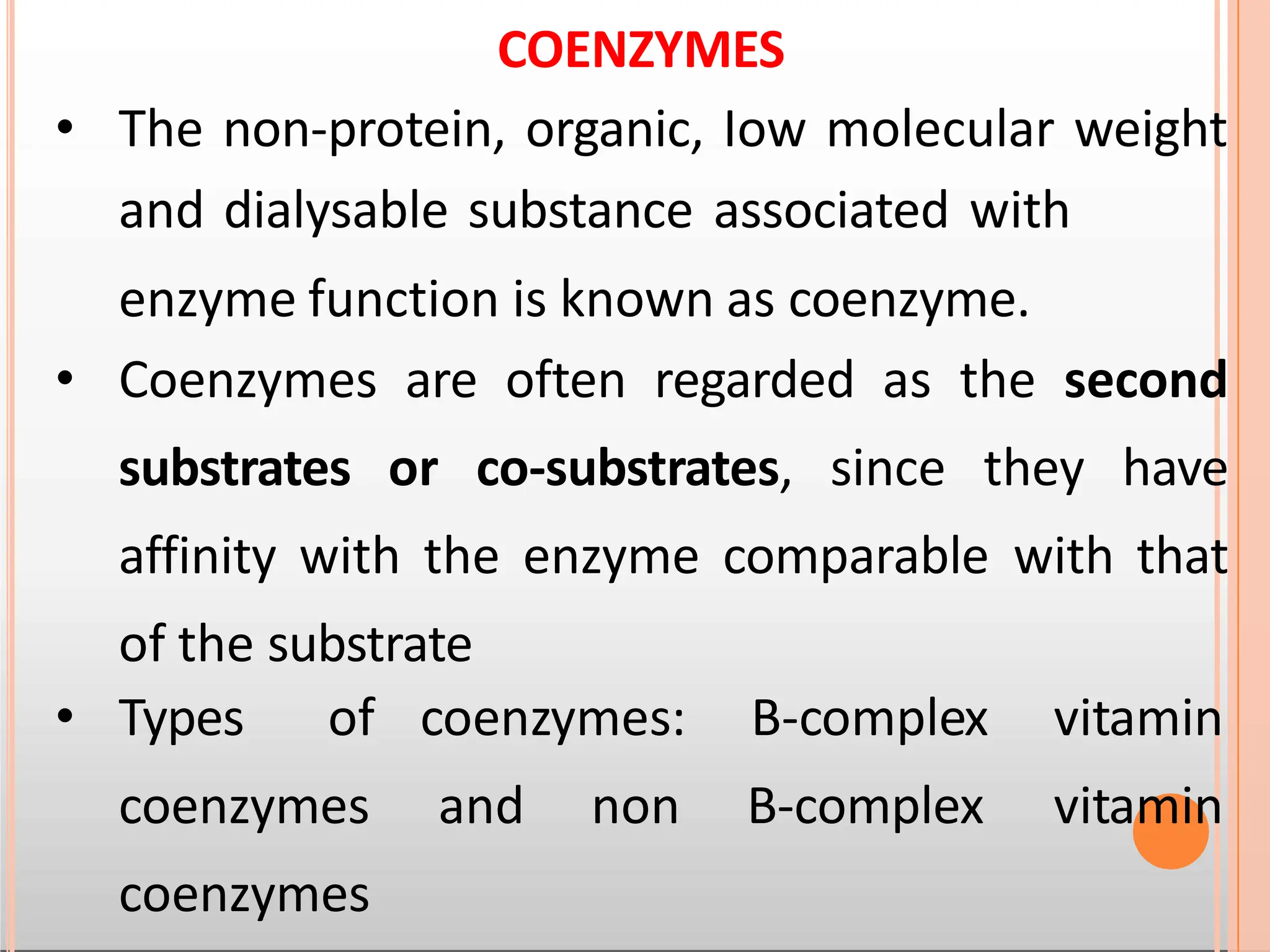
COENZYMES
• The non-protein, organic, Iow molecular weight
and dialysable substance associated with
enzyme function is known as coenzyme.
• Coenzymes are often regarded as the second
substrates or co-substrates, since they have
affinity with the enzyme comparable with that
of the substrate
coenzymes:
and non
B-complex
B-complex
vitamin
vitamin
• Types of
coenzymes
coenzymes
Coenzymes
Coenzymes: smaller molecules that aid in enzyme
chemistry.
Enzymes can:
a. Carry out acid-base reactions
b. Transient covalent bonds
c. Charge-charge interactions
Enzymes can not do:
d. Oxidation -Reduction reactions
e. Carbon group transfers
Prosthetic group - permanently associated with an enzyme
or transiently associated.
Holoenzyme: catalytically active enzyme with cofactor.
Apoenzyme: Enzyme without its cofactor
Coenzymes
• Enzymes functional groups takes part in acid-base reaction, to
form transient bonds with substrate or take part in charge –
charge interactions. They are less stable for catalyzing Redox
reaction or transfer of a chemical group.
• Such reactions are carried out by small molecules called cofactors
• Cofactors may be metal ions, such as the Zn2+ required for the
catalytic activity of carboxypeptidase A, or organic molecules
COFACTORS
• The non-protein, inorganic, Iow molecular weight
and dialysable substance associated with enzyme
function is known as cofactors.
• Most of the cofactors are metal ions
• Metal activated enzymes: In these enzymes, the
metals form a loose and easily dissociable
complex.
• Eg., ATPase (Mg2+ and Ca2+, Enolase (Mg2+)
• Metalloenzymes: In this case metal ion is bound
tightly to the enzyme and is not dissociated
Eg., alcohol dehydrogenase, carbonic anhydrase,
alkaline phosphatase, carboxypeptidase and aldolase
contain zinc.
Phenol oxidase (copper)
Pyruvate oxidase (manganese)
Xanthine oxidase (molybdenum)
Cytochrome oxidase (iron and copper).
ACTIVE SITE
The active site (or active center) of an
enzyme represents as the small region
at which the substrate binds and
participates in the catalysis
Salient features:
• The existence of active site is due
to the tertiary structure of protein.
• Made up of amino acids which are
far from each other in the linear
sequence of amino acids.
• Active sites are regarded as clefts or crevices or
pockets occupying a small region in a big enzyme
molecule.
• The active site is not rigid, it is flexible to promote the
specific substrate binding
• Enzymes are specific in their function due to the
existence of active sites.
• Active site possesses a substrate binding site and a
catalytic site.
• The coenzymes or cofactors on which some
enzymes depend are present as a part of the
catalytic site.
• The substrate binds at the active site by weak
noncovalent bonds.
• The commonly found amino acids at the active
sites are serine(mostly found), aspartate, histidine,
cysteine, lysine, arginine, glutamate, tyrosine .
• The substrate binds the enzyme (E) at the active
site to form enzyme-substrate complex (ES). The
product (P) is released after the catalysis and the
enzyme is available for reuse.
ACTIVATION
ACTIVATION
 Activation is defined as the conversion of an inactive form of
an enzyme to active form which processes the metabolic
activity.
TYPES OFACTIV
ATION
 Activation by co-factors.
 Conversion of an enzyme precursor.
ACTIVATION BY CO FACTORS
 Many enzymes are activated by co-factors.
Examples:
 DNA polymerase is a holoenzyme that catalyzes the
polymerization of de -oxyribonucleotide into a DNA strand. It
uses Mg- ion for catalytic activity.
 Horse liver dehydrogenase uses Zn- ion for it‟sactivation.
CONVERSION OF AN ENZYME
PRECURSOR
 Specific proteolysis is a common method of activating
enzymes and other proteins in biological system.
Example:
 The generation of trypsin from trypsinogen leads to the
activation of other zymogens.
ZYMOGEN ACTIVATION BY
PROTEOLYTIC CLEAVAGE
ENZYME SPECIFICITY
ENZYME SPECIFICITY
 Enzymes are highly specific in nature, interacting with one or
few substrates and catalyzing only one type of chemical
reaction.
 Substrate specificity is due to complete fitting of active site
and substrate .
Example:
 Oxydoreductase do not catalyze hydrolase reactions and
hydrolase do not catalyze reaction involving oxidation and
reduction.
TYPES OF ENZYME SPECIFICITY
 Enzymes show different degrees of specificity:
 Bond specificity.
 Group specificity.
 Absolute specificity.
 Optical or stereo-specificity.
 Dual specificity.
BOND SPECIFICITY
 In this type, enzyme actson substrates that are similar in
structure and contain the same type of bond.
Example :
 Amylase which acts on α
-1-4 glycosidic ,bond in starch
dextrin and glycogen, shows bond specificity.
GROUP SPECIFICITY
 In this type of specificity, the enzyme is specific not only to the
type of bond but also to the structure surroundingit.
Example:
 Pepsin is an endopeptidase enzyme, that hydrolyzes central
peptide bonds in which the amino group belongs to aromatic
amino acids e. g phenyl alanine, tyrosine and tryptophan.
SUBSTRATE SPECIFICITY
 In this type of specificity ,the enzymes acts only on one
substrate
Example :
 Uricase ,which acts only on uric acid, shows substrate
specificity.
 Maltase , which acts only on maltose, shows substrate
specificity.
OPTICAL / STEREO-SPECIFICITY
 In this type of specificity , the enzyme is not specific to
substrate but also to its optical configuration
Example:
 D amino acid oxidase acts only on D amino acids.
 L amino acid oxidase acts only on L aminoacids.
DUAL SPECIFICITY
 There are two types of dual specificity.
may act on one substrate by two different
 The enzyme
reaction types.
Example:
 Isocitrate dehydrogenase enzyme acts on isocitrate (one
substrate) by oxidation followed by decarboxylation(two
different reaction types) .
 The enzyme may act on two substrates by one reaction type
Example:
• Xanthine oxidase enzyme acts on xanthine and
hypoxanthine(two substrates) by oxidation (one reaction type)
DUAL SPECIFICITY
REFERENCES
 Woodbury.: Biochemistry for the Pharmaceutical
Sciences
 Lehninger.: Principles of biochemistry
 Lippincott.: Biochemistry
 Harper's Illustrated Biochemistry
 MushtaqAhmed.: Essentials of Medical
Biochemistry
 Pfeiffer, J.: Enzymes, the Physics and Chemistry of
Life
 Martinek, R.: Practical Clinical Enzymology
ENZYMES LECTURE 1-converted.ppbbbbbbbbbtx

ENZYMES LECTURE 1-converted.ppbbbbbbbbbtx

  • 1.
    ENZYME LECTURE 1 FIRSTYEAR MBBS PESHAWAR MEDICAL COLLGE DATE 4.7.21 DR SADIA HAROON PROF OF BIOCHEMISTRY
  • 2.
  • 3.
  • 4.
    Introduction  Enzymes arebiological catalysts that speed up the rate of the biochemical reaction.  Most enzymes are three dimensional globular proteins (tertiary and quaternary structure).  Some special RNA species enzymes and are called Ribozymes also act as e.g. hammerhead ribozyme. Hammerheadenzyme
  • 5.
    STRUCTURE OF ENZYMES The active site of an enzyme is the region that binds substrates, co-factors and prosthetic groups and contains residue that helps to hold the substrate.  Active sites generally occupy less than 5% of the total surface area of enzyme.  Active site has a specific shape due to tertiary structure of protein.  A change in the shape of protein affects the shape of active site and function of the enzyme.
  • 6.
    • Enzymes maybe defined as biocatalysts synthesized by living cells. They are protein in nature, colloidal and thermolabile in character, and specific in action. • A catalyst is defined as a substance that increases the velocity or rate of a chemical reaction without itself undergoing any change in the overall process. • Friedrich Wilhelm Kuhne (1878) – given the name ENZYME (En = in ; Zyme = yeast) • James B. Sumner (1926) - first isolated & crystallized urease from jack bean and identified protein.
  • 7.
    ACTIVE SITE It choosesthe substrate and binds it to active site. It performs the catalytic action of enzyme. o Active site can be further divided into: Active Site Binding Site Catalytic Site
  • 8.
    CO-FACTORS o Co-factor isthe non protein molecule which carries out chemical reactions that can not be performed by standard 20 amino acids. o Co-factors are of two types:  Organic co-factors  Inorganic cofactors
  • 9.
    INORGANIC CO-FACTORS o Theseare the inorganic molecules required for the proper activity of enzymes. Examples:  ORGANIC CO-FACTORS o These are the organic molecules required for the proper activity of enzymes. Example:  Glycogen phosphorylase requires the small organic molecule pyridoxal phosphate.  Enzyme carbonic anhydrase requires Zn for it‟sactivity. Hexokinase has co-factor Mg ++ ++
  • 10.
    TYPES OF ORGANICCO-FACTORS Prosthetic Group Coenzyme o A prosthetic group is a o A coenzyme is loosely tightly bound organic co- bound organic co-facto+r. factor e.g. Flavins, heme E.g. NAD+ groups and biotin.
  • 11.
    co-factor removed isdesignated as  An enzyme with i t s ‟ apoenzyme.  The complete complex of a protein with all necessary small organic molecules, metal ions and other components is termed as holoenzyme of holoprotein. Types of co-factors Continued…
  • 12.
    SUBSTRATE  The reactantin biochemical reaction is termed as substrate.  When a substrate binds to an enzyme it forms an enzyme- substrate complex. Enzyme Joins Substrate
  • 13.
    SITES OF ENZYMESYNTHESIS o Enzymes are synthesized by ribosomes which are attached to the rough endoplasmic reticulum. o Information for the synthesis of enzyme is carried by DNA. o Amino acids are bonded together to form specific enzyme according to the DNA‟scodes.
  • 14.
    INTRACELLULAR AND EXTRACELLULAR ENZYMES oIntracellular enzymes are synthesized and retained in the cell for the use of cell itself. o They are found in the cytoplasm, nucleus, mitochondria and chloroplast. Example :  Oxydoreductase catalyses biological oxidation.  Enzymes involved in reduction in the mitochondria. in the cell but o Extracellular enzymes are synthesized secreted from the cell to work externally. Example :  Digestive enzyme produced by the pancreas, are not used by the cells in the pancreas but are transported to the duodenum.
  • 15.
    CHARACTERISTICS  Enzymes speedup the reaction by lowering the activation energy of the reaction.  Their presence does not effect the nature and properties of end product.  They are highly specific in their action that is each enzyme can catalyze one kind of substrate.  Small amount of enzymes can accelerate chemical reactions.  Enzymes are sensitive to change in pH, temperature and substrate concentration.  Turnover number is defined as the number of substrate molecules transformed per minute by one enzyme molecule. Catalase turnover number = 6 x10⁶/min
  • 16.
    NOMENCLATURE OF ENZYMES oAn enzyme is named according to the name of the substrate it catalyses. o Some enzymes were named before a systematic way of naming enzyme was formed. Example: pepsin, trypsin and rennin o By adding suffix -ase at the end of the name of the substrate, enzymes are named. o Enzyme for catalyzing the hydrolysis is termed as hydrolase. Example : maltose + water glucose + glucose maltase
  • 17.
    EXAMPLES substrate enzymes products lactoselactase glucose + galactose maltose maltase Glucose cellulose cellulase Glucose lipid lipase Glycerol + fatty acid starch amylase Maltose protein protease Peptides + polypeptide
  • 18.
  • 19.
    CLASSIFICATION OF ENZYMES A systematic classification of enzymes has been developed by International Enzyme Commission.  This classification is based on the type of reactions catalyzed by enzymes.  There are six major classes.  Each class is further divided into sub classes, sub sub-classes and so on, to describe the huge number of different enzyme- catalyzed reactions.
  • 20.
    ENZYME CLASS REACTIONTYPE EXAMPLES Oxidoreductases Reduction-oxidation (redox) Lactate dehydrogenase Transferases Move chemical group Hexokinase Hydrolases Hydrolysis; bond cleavage with transfer of functional group of water Lysozyme Lysases Non-hydrolytic bond cleavage Fumarase Isomerases Intramolecular group transfer (isomerization) Triose phosphate isomerase Ligases Synthesis of new covalent bond between substrates, using ATPhydrolysis RNA polymerase Continued…….. Classification of enzymes
  • 21.
    NOMENCLATURE AND CLASSIFICATION 1.Substrate acted upon by the enzyme: • named the enzymes by adding the “ase” in the name of the substrate catalyzed Eg., carbohydrates – carbohydrases proteins - proteinases, lipids – lipases nucleic acids - nucleases A few of the names were even more specific like Eg., maltase - acting upon maltose sucrase - upon sucrose urease - upon urea etc.
  • 22.
    2. Type ofreaction catalyzed: • The enzymes are named by adding the “ase” in the name of the reaction Eg., Hydrolases - catalyzing hydrolysis Isomerases – isomerization Oxidases – catalyzing oxidation Dehydrogenases – catalyzing dehydrogenation Transaminases – catalyzing transamination Phosphorylases - catalyzing phosphorylation etc.
  • 23.
    3. Substrate actedupon and type of reaction catalyzed: • The names of some enzymes give clue of both the substrate utilized and the type of reaction catalyzed. Eg., succinic dehydrogenase – catalyzes dehydrogenation of the substrate succinic acid. L-glutamic dehydrogenase – catalyzes dehydrogenation reaction involving L-glutamic acid.
  • 24.
    4. Substance thatis synthesized: •A few enzymes have been named by adding the “ase” to the name of the substance synthesized Eg., rhodonase - forms rhodonate from hydrocyanic acid and sodium thiosulphate fumarase - forms fumarate from L-malate.
  • 25.
    5. Endoenyzmes andexoenyzmes: • enzymes that act within the cells in which they are produced - intracellular enzymes or endoenzymes Eg., plant enzymes and metabolic enzymes • Enzymes which are liberated by living cells, catalyze useful reactions outside the cell in its environment - extracellular enzymes or exoenzymes Eg., bacterial enzymes, fungal enzymes, digestive tract enzymes
  • 26.
    INTERNA TIONAL UNION OFBIOCHEMISTRY (IUB) NOMENCLAURE AND CLASSIFICATION • The chemical reaction catalyzed is the specific property which distinguishes one enzyme from another. • In 1961, IUB used this criterion as a basis for the classification and naming of enzymes. • According to IUB, the reactions and the enzymes catalyzing them are divided into 6 major classes, each with 4 to 13 subclasses.
  • 27.
    1. Oxidoreductases 2. Transferases 3.Hydrolases 4. Lyases or Desmolases 5. Isomerases 6. Ligases or Synthetases
  • 28.
    1. Oxidoreductases: • Enzymeswhich bring about oxidation-reduction reactions between two substrates. • Groups to be present in the substrate: CH—OH, C=O, CH—CH, CH—NH2 and CH=NH groups • Eg., Alcohol dehydrogenase, Acyl-CoA dehydrogenase, Cytochrome oxidase etc.,
  • 29.
    2. Transferases: • Enzymeswhich catalyze the transfer of a group, G (other than hydrogen) between a pair of substrates, S and S′ are called transferases S—G + S′ -----------→ S + S′—G • These enzymes catalyze the transfer of one-carbon groups, aldehydic or ketonic residues and acyl, glycosyl, alkyl, phosphorus or sulfur-containing groups • Eg., Acyltransferases, Glycosyltransferases, Hexokinase
  • 30.
    3. Hydrolases: • Thesecatalyze the hydrolysis of their substrates by adding constituents of water across the bond they split. • The substrates include ester, glycosyl, ether, peptide, acid-anhydride, C—C, halide and P—N bonds. • e.g., glucose-6-phosphatase, pepsin, trypsin, esterases, glycoside hydrolases
  • 31.
    4. Lyases (Desmolases): •These are those enzymes which catalyze the removal of groups from substrates by mechanisms other than hydrolysis, leaving double bonds. • These include enzymes acting on C—C, C—O, C—N, C—S and C—halide bonds. • Eg., Aldolase, Fumarase, Histidase etc.,
  • 32.
    5. Isomerases: 1. Thesecatalyze interconversion of optical, geometric or positional isomers by intramolecular rearrangement of atoms or groups. 2. Eg., Alanine racemase, Retinene isomerase, Glucosephosphate isomerase etc.,
  • 33.
    6. Ligases: • Theseare the enzymes catalyzing the linking together of two compounds utilizing the energy made available due to simultaneous breaking of a pyrophosphate bond in ATP or a similar compound. • This category includes enzymes catalyzing reactions forming C—O, C—S, C—N and C—C bonds. • Eg., Acetyl-CoA synthetase, Glutamine synthetase etc.,
  • 34.
    CHEMICAL NATURE OFENZYMES 1. Simple-protein enzymes. • These contain simple proteins only e.g., urease, amylase, papain etc. 2. Complex-protein enzymes. • These contain conjugated proteins i.e., they have a protein part called apoenzyme and a nonprotein part called prosthetic group associated with the protein unit. The two parts constitute what is called a holoenzyme
  • 35.
    • The activityof an enzyme depends on the prosthetic group that is tightly associated with the apoenzyme. • But sometimes the prosthetic group is loosely bound to the protein unit and can be separated by dialysis and yet indispensable for the enzyme activity. • In that case, this dialyzable prosthetic group is called as a coenzyme (organic nature) or cofactor (inorganic nature).
  • 36.
  • 37.
    COENZYMES • The non-protein,organic, Iow molecular weight and dialysable substance associated with enzyme function is known as coenzyme. • Coenzymes are often regarded as the second substrates or co-substrates, since they have affinity with the enzyme comparable with that of the substrate coenzymes: and non B-complex B-complex vitamin vitamin • Types of coenzymes coenzymes
  • 38.
    Coenzymes Coenzymes: smaller moleculesthat aid in enzyme chemistry. Enzymes can: a. Carry out acid-base reactions b. Transient covalent bonds c. Charge-charge interactions Enzymes can not do: d. Oxidation -Reduction reactions e. Carbon group transfers Prosthetic group - permanently associated with an enzyme or transiently associated. Holoenzyme: catalytically active enzyme with cofactor. Apoenzyme: Enzyme without its cofactor
  • 39.
    Coenzymes • Enzymes functionalgroups takes part in acid-base reaction, to form transient bonds with substrate or take part in charge – charge interactions. They are less stable for catalyzing Redox reaction or transfer of a chemical group. • Such reactions are carried out by small molecules called cofactors • Cofactors may be metal ions, such as the Zn2+ required for the catalytic activity of carboxypeptidase A, or organic molecules
  • 42.
    COFACTORS • The non-protein,inorganic, Iow molecular weight and dialysable substance associated with enzyme function is known as cofactors. • Most of the cofactors are metal ions • Metal activated enzymes: In these enzymes, the metals form a loose and easily dissociable complex. • Eg., ATPase (Mg2+ and Ca2+, Enolase (Mg2+)
  • 43.
    • Metalloenzymes: Inthis case metal ion is bound tightly to the enzyme and is not dissociated Eg., alcohol dehydrogenase, carbonic anhydrase, alkaline phosphatase, carboxypeptidase and aldolase contain zinc. Phenol oxidase (copper) Pyruvate oxidase (manganese) Xanthine oxidase (molybdenum) Cytochrome oxidase (iron and copper).
  • 44.
    ACTIVE SITE The activesite (or active center) of an enzyme represents as the small region at which the substrate binds and participates in the catalysis Salient features: • The existence of active site is due to the tertiary structure of protein. • Made up of amino acids which are far from each other in the linear sequence of amino acids.
  • 45.
    • Active sitesare regarded as clefts or crevices or pockets occupying a small region in a big enzyme molecule. • The active site is not rigid, it is flexible to promote the specific substrate binding • Enzymes are specific in their function due to the existence of active sites.
  • 46.
    • Active sitepossesses a substrate binding site and a catalytic site. • The coenzymes or cofactors on which some enzymes depend are present as a part of the catalytic site. • The substrate binds at the active site by weak noncovalent bonds.
  • 47.
    • The commonlyfound amino acids at the active sites are serine(mostly found), aspartate, histidine, cysteine, lysine, arginine, glutamate, tyrosine . • The substrate binds the enzyme (E) at the active site to form enzyme-substrate complex (ES). The product (P) is released after the catalysis and the enzyme is available for reuse.
  • 48.
  • 49.
    ACTIVATION  Activation isdefined as the conversion of an inactive form of an enzyme to active form which processes the metabolic activity. TYPES OFACTIV ATION  Activation by co-factors.  Conversion of an enzyme precursor.
  • 50.
    ACTIVATION BY COFACTORS  Many enzymes are activated by co-factors. Examples:  DNA polymerase is a holoenzyme that catalyzes the polymerization of de -oxyribonucleotide into a DNA strand. It uses Mg- ion for catalytic activity.  Horse liver dehydrogenase uses Zn- ion for it‟sactivation.
  • 51.
    CONVERSION OF ANENZYME PRECURSOR  Specific proteolysis is a common method of activating enzymes and other proteins in biological system. Example:  The generation of trypsin from trypsinogen leads to the activation of other zymogens.
  • 52.
  • 53.
  • 54.
    ENZYME SPECIFICITY  Enzymesare highly specific in nature, interacting with one or few substrates and catalyzing only one type of chemical reaction.  Substrate specificity is due to complete fitting of active site and substrate . Example:  Oxydoreductase do not catalyze hydrolase reactions and hydrolase do not catalyze reaction involving oxidation and reduction.
  • 55.
    TYPES OF ENZYMESPECIFICITY  Enzymes show different degrees of specificity:  Bond specificity.  Group specificity.  Absolute specificity.  Optical or stereo-specificity.  Dual specificity.
  • 56.
    BOND SPECIFICITY  Inthis type, enzyme actson substrates that are similar in structure and contain the same type of bond. Example :  Amylase which acts on α -1-4 glycosidic ,bond in starch dextrin and glycogen, shows bond specificity.
  • 57.
    GROUP SPECIFICITY  Inthis type of specificity, the enzyme is specific not only to the type of bond but also to the structure surroundingit. Example:  Pepsin is an endopeptidase enzyme, that hydrolyzes central peptide bonds in which the amino group belongs to aromatic amino acids e. g phenyl alanine, tyrosine and tryptophan.
  • 58.
    SUBSTRATE SPECIFICITY  Inthis type of specificity ,the enzymes acts only on one substrate Example :  Uricase ,which acts only on uric acid, shows substrate specificity.  Maltase , which acts only on maltose, shows substrate specificity.
  • 59.
    OPTICAL / STEREO-SPECIFICITY In this type of specificity , the enzyme is not specific to substrate but also to its optical configuration Example:  D amino acid oxidase acts only on D amino acids.  L amino acid oxidase acts only on L aminoacids.
  • 60.
    DUAL SPECIFICITY  Thereare two types of dual specificity. may act on one substrate by two different  The enzyme reaction types. Example:  Isocitrate dehydrogenase enzyme acts on isocitrate (one substrate) by oxidation followed by decarboxylation(two different reaction types) .
  • 61.
     The enzymemay act on two substrates by one reaction type Example: • Xanthine oxidase enzyme acts on xanthine and hypoxanthine(two substrates) by oxidation (one reaction type) DUAL SPECIFICITY
  • 62.
    REFERENCES  Woodbury.: Biochemistryfor the Pharmaceutical Sciences  Lehninger.: Principles of biochemistry  Lippincott.: Biochemistry  Harper's Illustrated Biochemistry  MushtaqAhmed.: Essentials of Medical Biochemistry  Pfeiffer, J.: Enzymes, the Physics and Chemistry of Life  Martinek, R.: Practical Clinical Enzymology