Kushal kumar
Definition
■ Enucleation :
– it is the surgical removal of the entire
globe from the orbit.
■ Evisceration
– it is the surgical removal of entire
content of the globe leaving the scleral
shell.
Indication
■ Enucleation & Evisceration
– Pain full blind eye
– Intraocular tumours
■ Retinoblastoma
■ Malignant melanoma
– Severe trauma with risk of sympathetic
ophthalmia
– Phthisis bulbi
– Microphthalmia
– Endophthalmitis/ panophthalmitis
– Cosmetic deformity
■ Indication for eye donation from cadaver is
presently the most common indication for
enucleation
■ in cases of suspected or documented intra ocular
malignant tumours evisceration is contraindicated.
■ So a pre operative ocular ultra sound is mandatory
to rule out occult malignancy
■ Similarly evisceration should not be used in
atrophicbulbi and hypoplasia in childhood because
an adequate sized implant cannot b placed inside
the scleral shell and an eye with atrophicbulbi may
harbor and unsuspected malignancy.
Surgery
■ Anastheasia
– Local anesthesia
– General anasthesia may be given for
psycological and occasionally for medical
reasons
– 0.5% bupivacaine with 1:1,00,000 adrenaline
is used
– Most evisceration surgeries are performed
under LA with IV sedations
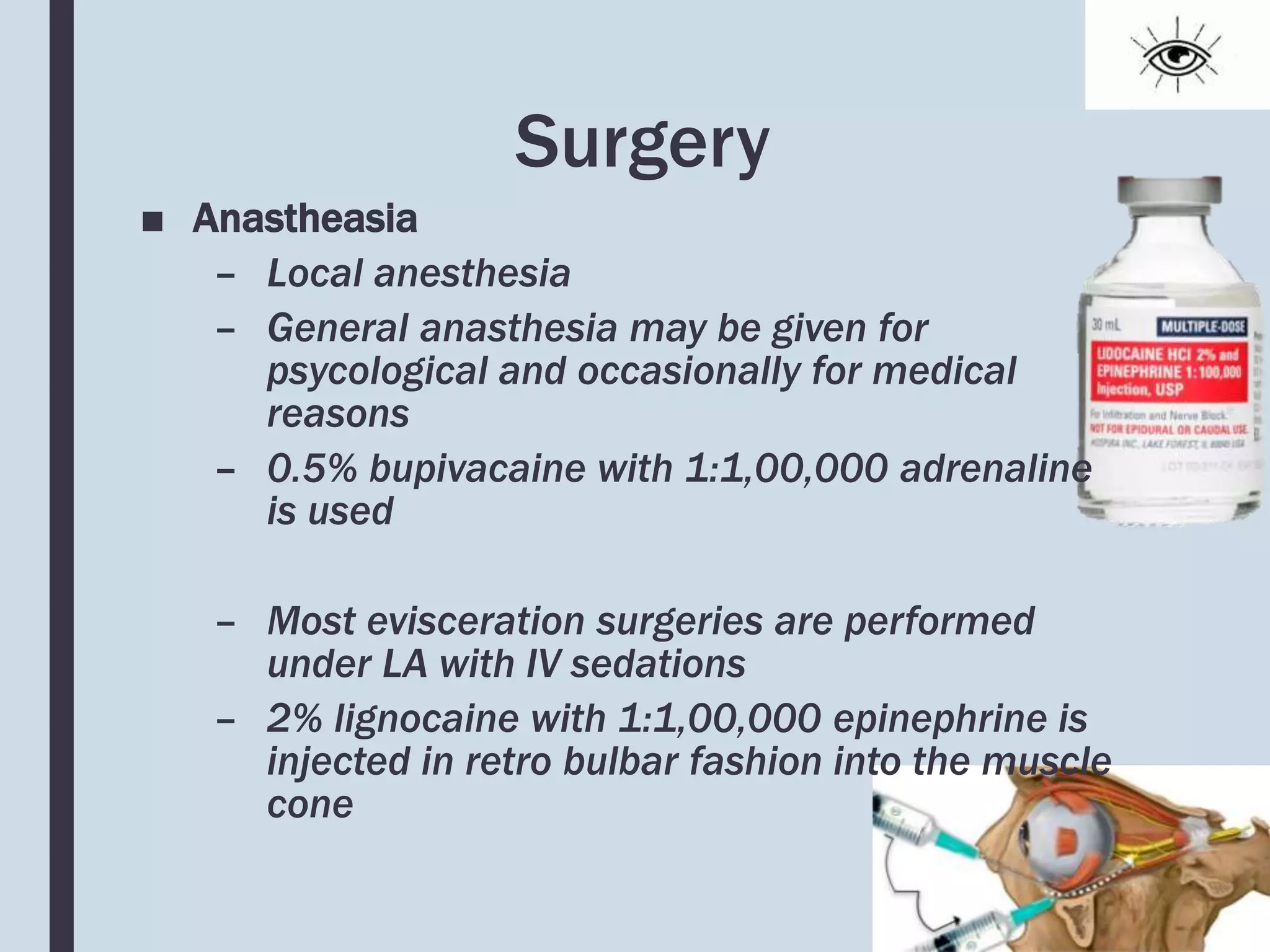
– 2% lignocaine with 1:1,00,000 epinephrine is
injected in retro bulbar fashion into the muscle
cone
Specific techniques
■ Enucleation
– A self retaining speculum is placed to expose
the entire epibulbar surface
– 360˚ conjunctival peritomy is performed
– Tenons facia is bluntly dissected away from
the sclera in all four quadrants
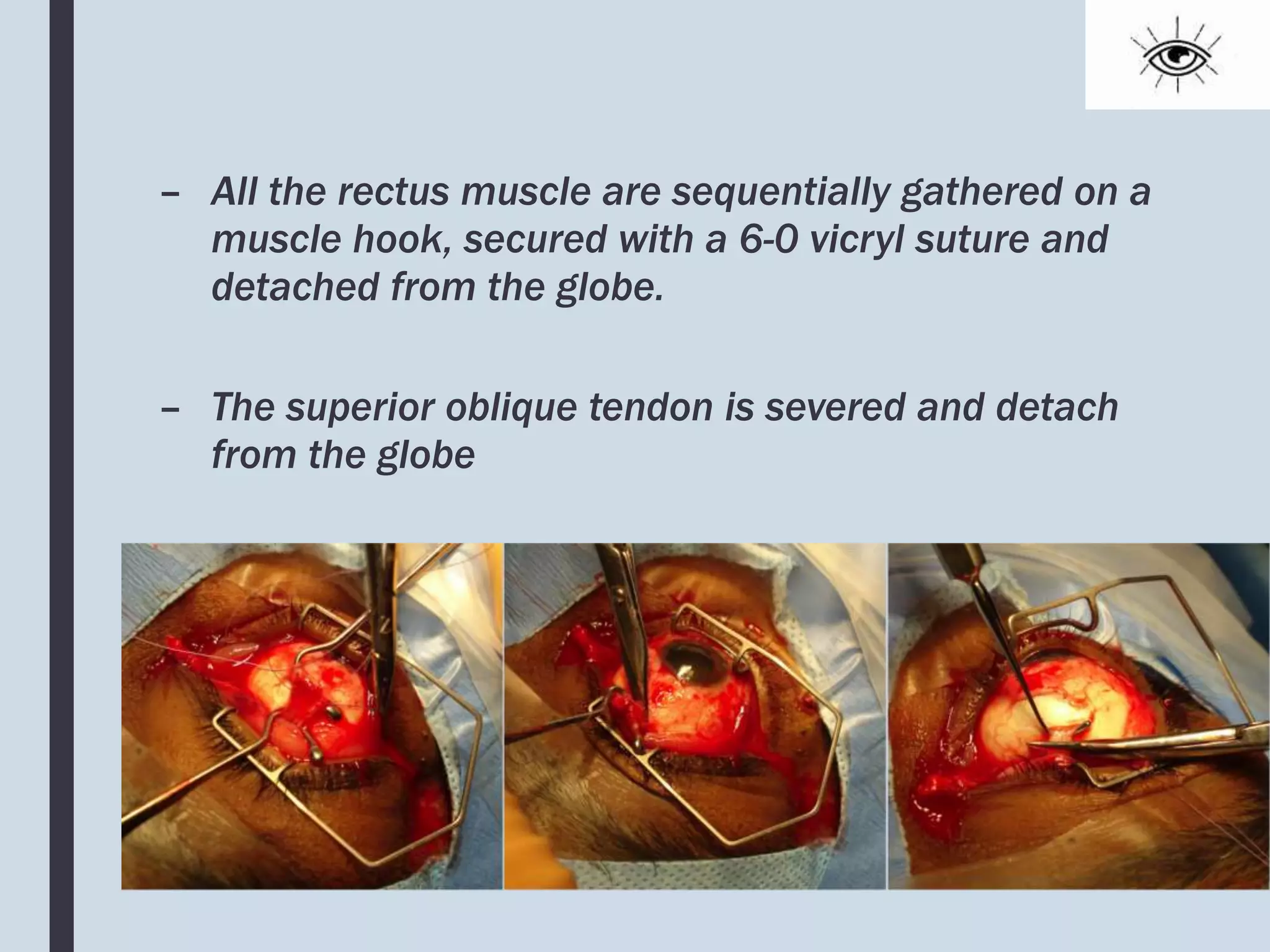
– All the rectus muscle are sequentially gathered on a
muscle hook, secured with a 6-0 vicryl suture and
detached from the globe.
– The superior oblique tendon is severed and detach
from the globe
– The inferior oblique muscle should be hooked and
secured with a 6-0 vicryl suture, detached and saved for
later attachment to the inferior border of lateral rectus
muscle
– The optic nerve is severed
■ Anterior traction on the globe is useful when cutting the
optic nerve and can be achieved with a curved hemostat
applied to the medial rectus tendon
■ The eye ball is prolapsed out by stretching and pushing
down the eye speculum. The eye ball is pulled out with
the help of suture passed through muscle stump.
■ Eye ball is pulled out of the orbit by incising the
remaining tissue adherent to it, and hemostasis is
achieved by packing the orbital cavity with a wet pack
and pressing it back
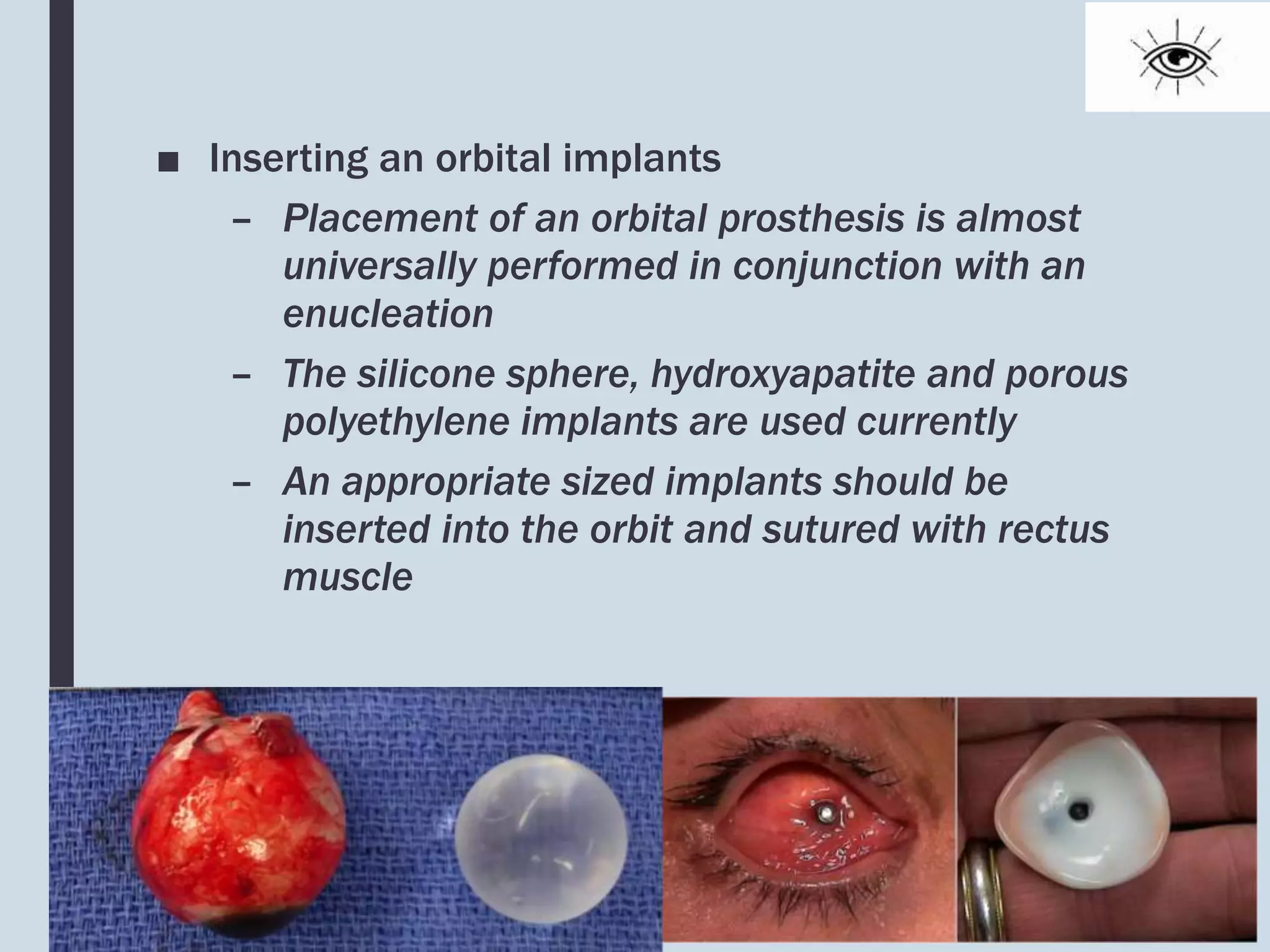
■ Inserting an orbital implants
– Placement of an orbital prosthesis is almost
universally performed in conjunction with an
enucleation
– The silicone sphere, hydroxyapatite and porous
polyethylene implants are used currently
– An appropriate sized implants should be
inserted into the orbit and sutured with rectus
muscle
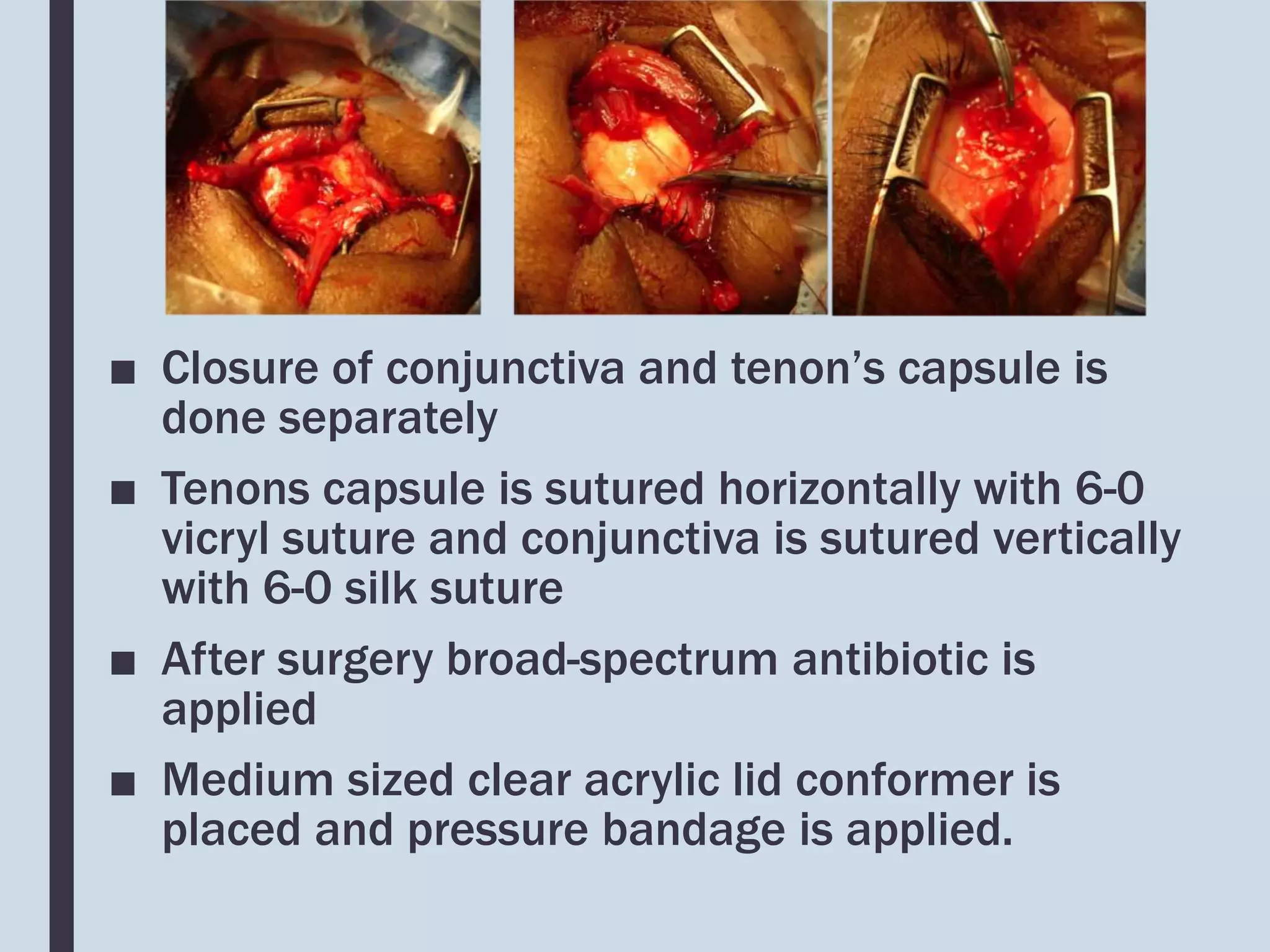
■ Closure of conjunctiva and tenon’s capsule is
done separately
■ Tenons capsule is sutured horizontally with 6-0
vicryl suture and conjunctiva is sutured vertically
with 6-0 silk suture
■ After surgery broad-spectrum antibiotic is
applied
■ Medium sized clear acrylic lid conformer is
placed and pressure bandage is applied.
■ Evisceration
– 360˚ conjunctival peritomy is performed
– Tenons fascia is separated from the underlying
sclera in all 4 quadrants
– A full thickness incision around the corneal
limbus is made with a scalpel blade and
corneal button is removed
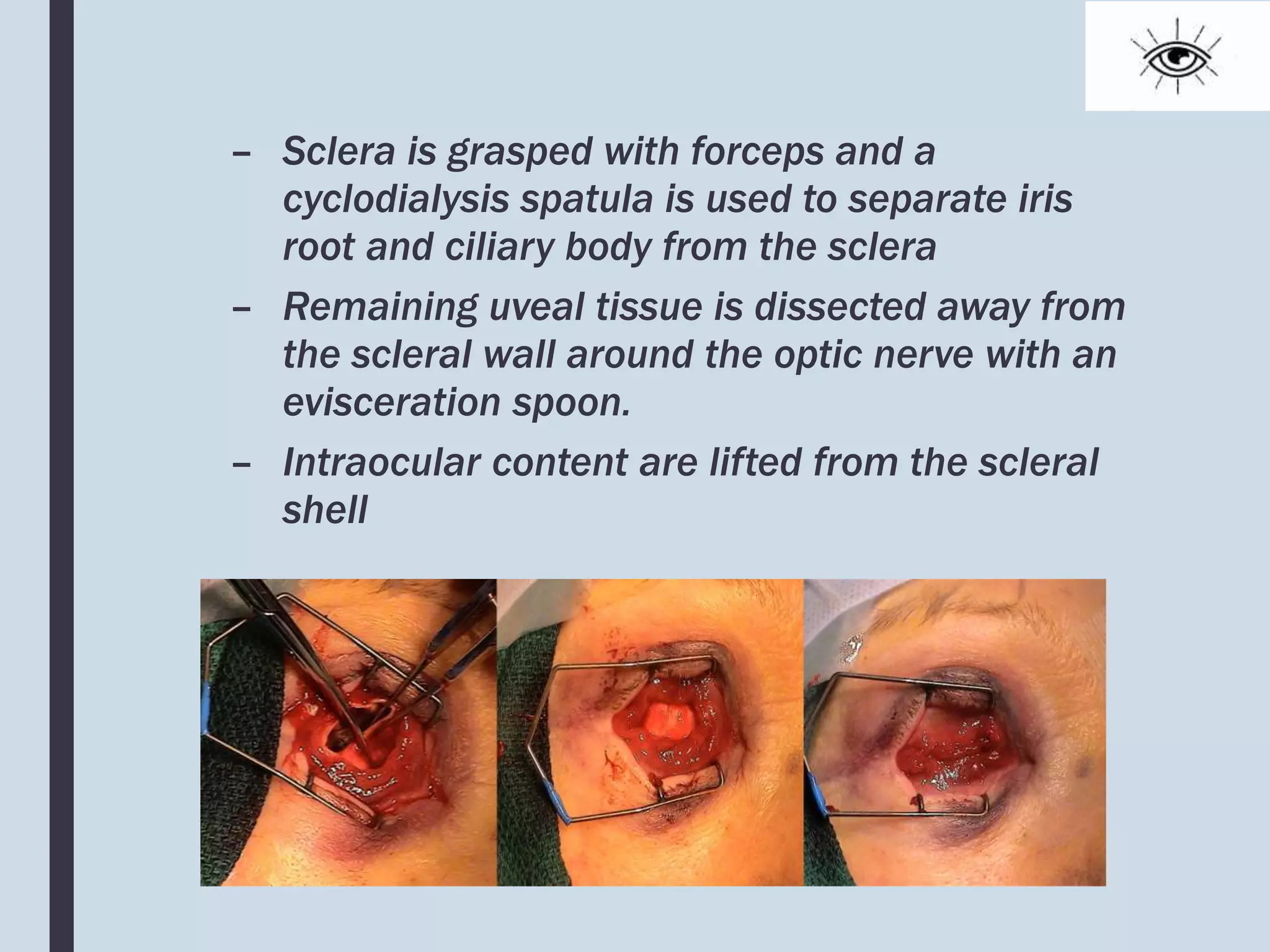
– Sclera is grasped with forceps and a
cyclodialysis spatula is used to separate iris
root and ciliary body from the sclera
– Remaining uveal tissue is dissected away from
the scleral wall around the optic nerve with an
evisceration spoon.
– Intraocular content are lifted from the scleral
shell
– Cotton tip applicator saturated with 70%
ethanol is used to cleanse the scleral shell
– A PMMA spherical implant is placed in the
eviscerated scleral shell
– Scleral edges are closed with 6-0 vicryl
sutured
– Conjunctiva is closed with 6-0 plain gut suture
– Dressing and post op care is same as
enucleation
Enucleation
Evisceration
Complication
■ Early enucleation complications
– Hemorrhage
– Infection
– Orbital apex injury
■ Early evisceration complication
– Evisceration is usually not associated with
complications of orbital apex injury or intra cranial
spread of infection through optic nerve.
– Bleeding is less likely than enucleation
– Implant exposure and extrusion however are more likely
■ Late enucleation complications
– Implant migration and extrusion
– Volume deficit of implant
– Contracted socket
– Eyelid malposition
– Painful socket and persistent discharge
Enucleation and evisceration

Enucleation and evisceration

  • 1.
  • 2.
    Definition ■ Enucleation : –it is the surgical removal of the entire globe from the orbit. ■ Evisceration – it is the surgical removal of entire content of the globe leaving the scleral shell.
  • 3.
    Indication ■ Enucleation &Evisceration – Pain full blind eye – Intraocular tumours ■ Retinoblastoma ■ Malignant melanoma – Severe trauma with risk of sympathetic ophthalmia – Phthisis bulbi – Microphthalmia – Endophthalmitis/ panophthalmitis – Cosmetic deformity
  • 4.
    ■ Indication foreye donation from cadaver is presently the most common indication for enucleation ■ in cases of suspected or documented intra ocular malignant tumours evisceration is contraindicated. ■ So a pre operative ocular ultra sound is mandatory to rule out occult malignancy ■ Similarly evisceration should not be used in atrophicbulbi and hypoplasia in childhood because an adequate sized implant cannot b placed inside the scleral shell and an eye with atrophicbulbi may harbor and unsuspected malignancy.
  • 5.
    Surgery ■ Anastheasia – Localanesthesia – General anasthesia may be given for psycological and occasionally for medical reasons – 0.5% bupivacaine with 1:1,00,000 adrenaline is used – Most evisceration surgeries are performed under LA with IV sedations – 2% lignocaine with 1:1,00,000 epinephrine is injected in retro bulbar fashion into the muscle cone
  • 6.
    Specific techniques ■ Enucleation –A self retaining speculum is placed to expose the entire epibulbar surface – 360˚ conjunctival peritomy is performed – Tenons facia is bluntly dissected away from the sclera in all four quadrants
  • 7.
    – All therectus muscle are sequentially gathered on a muscle hook, secured with a 6-0 vicryl suture and detached from the globe. – The superior oblique tendon is severed and detach from the globe
  • 8.
    – The inferioroblique muscle should be hooked and secured with a 6-0 vicryl suture, detached and saved for later attachment to the inferior border of lateral rectus muscle – The optic nerve is severed
  • 9.
    ■ Anterior tractionon the globe is useful when cutting the optic nerve and can be achieved with a curved hemostat applied to the medial rectus tendon ■ The eye ball is prolapsed out by stretching and pushing down the eye speculum. The eye ball is pulled out with the help of suture passed through muscle stump. ■ Eye ball is pulled out of the orbit by incising the remaining tissue adherent to it, and hemostasis is achieved by packing the orbital cavity with a wet pack and pressing it back
  • 10.
    ■ Inserting anorbital implants – Placement of an orbital prosthesis is almost universally performed in conjunction with an enucleation – The silicone sphere, hydroxyapatite and porous polyethylene implants are used currently – An appropriate sized implants should be inserted into the orbit and sutured with rectus muscle
  • 11.
    ■ Closure ofconjunctiva and tenon’s capsule is done separately ■ Tenons capsule is sutured horizontally with 6-0 vicryl suture and conjunctiva is sutured vertically with 6-0 silk suture ■ After surgery broad-spectrum antibiotic is applied ■ Medium sized clear acrylic lid conformer is placed and pressure bandage is applied.
  • 12.
    ■ Evisceration – 360˚conjunctival peritomy is performed – Tenons fascia is separated from the underlying sclera in all 4 quadrants – A full thickness incision around the corneal limbus is made with a scalpel blade and corneal button is removed
  • 13.
    – Sclera isgrasped with forceps and a cyclodialysis spatula is used to separate iris root and ciliary body from the sclera – Remaining uveal tissue is dissected away from the scleral wall around the optic nerve with an evisceration spoon. – Intraocular content are lifted from the scleral shell
  • 14.
    – Cotton tipapplicator saturated with 70% ethanol is used to cleanse the scleral shell – A PMMA spherical implant is placed in the eviscerated scleral shell – Scleral edges are closed with 6-0 vicryl sutured – Conjunctiva is closed with 6-0 plain gut suture – Dressing and post op care is same as enucleation
  • 15.
  • 16.
  • 17.
    Complication ■ Early enucleationcomplications – Hemorrhage – Infection – Orbital apex injury ■ Early evisceration complication – Evisceration is usually not associated with complications of orbital apex injury or intra cranial spread of infection through optic nerve. – Bleeding is less likely than enucleation – Implant exposure and extrusion however are more likely
  • 18.
    ■ Late enucleationcomplications – Implant migration and extrusion – Volume deficit of implant – Contracted socket – Eyelid malposition – Painful socket and persistent discharge