PERIOCULAR MALPOSITIONS AND
INVOLUTIONAL CHANGES
PRESENTER: DR.MUGABI BARNABAS
MUKAABYA
MODERATOR:DR.LUSOBYA REBECCA
20TH/04/2023
OUTLINE
• ECTROPION
• History and examination
• Risk factors
• Pathophysiology
• Types of ectropion
• ENTROPION
• Special tests
• Types of ectropion
• SYMBLEPHARON
• Definitoin
• Etiology
• Pathophysiology
• Management
• Complications
• prognosis
ECTROPION
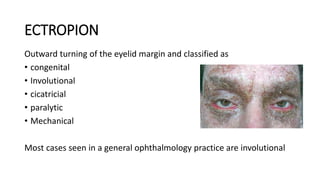
Outward turning of the eyelid margin and classified as
• congenital
• Involutional
• cicatricial
• paralytic
• Mechanical
Most cases seen in a general ophthalmology practice are involutional
ECTROPION
• History and Examination
• History of the presenting condition
• General medical history.
• A detailed ocular exam including:
₋ visual acuity
₋ ocular motility
₋ slit-lamp examination
₋ testing of tearing and protective mechanisms should be performed
ECTROPION
• Physical examination
• Facial architecture
• Facial nerve palsy
• Eyelid laxity
• Eyelid pathology
• Punctal ectropion
• Ocular surface
ECTROPION
• Risk factors
• Age (gravity, loss of elasticity)
• Eyelid rubbing
• Repeated eyelid pulling (ex. contact-lens use)
• Floppy eyelid syndrome
• Long term use of eye drops
• Skin conditions which involve the eyelid
• Trauma
• Prior Eyelid Surgery
ECTROPION
• Pathophysiology
• In involutional ectropion,
the tarsoligamentous sling
becomes lax.
• In paralytic ectropion, orbicularis
muscle tone is weak or absent due
to facial nerve palsy.
ECTROPION
• Pathophysiology
• In cicatricial ectropion, the anterior
or middle lamellae are shortened due
to scarring.
• Midfacial hypoplasia results in both
decreased lower eyelid support and
increased propensity for lower eyelid
retraction
ECTROPION
• Involutional ectropion
• Results from horizontal eyelid laxity
in the medial or lateral canthal tendons
or both.
• Leads to loss of eyelid apposition to the
globe and eversion of the eyelid margin
• Chronic conjunctival inflammation with
hypertrophy and keratinization
• usually occurs in the lower eyelid
ECTROPION
• Involutional ectropion
• Management
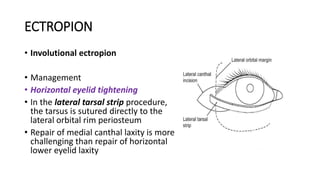
• Horizontal eyelid tightening
• In the lateral tarsal strip procedure,
the tarsus is sutured directly to the
lateral orbital rim periosteum
• Repair of medial canthal laxity is more
challenging than repair of horizontal
lower eyelid laxity
ECTROPION
• Involutional ectropion
• Management
• Medial spindle procedure
• In cases of mild medial ectropion
with punctal eversion
• The procedure involves a horizontal
fusiform excision of conjunctiva and
eyelid retractors 4 mm inferior to the
puncta, followed by inverting sutures
for closure
ECTROPION
• Management
• Repair of lower eyelid retractors
ECTROPION
• Cicatricial Ectropion
• Cicatricial ectropion of the upper or
lower eyelid occurs when there is a
deficiency of skin
• chronic inflammation of the eyelid
from dermatologic conditions such
as rosacea, atopic dermatitis,…
• Management consists of:
• addressing the under lying cause
• conservative medical protection of the cornea.
ECTROPION
• Cicatricial Ectropion
• Management…
• 3-step procedure:
Vertical cicatricial traction is surgically released through an anterior
approach.
The eyelid is horizontally tightened.
The anterior lamella is vertically augmented by means of a midface-l
ift, full-t hickness skin graft, or adjacent tissue transfer, and the eyelid
is placed on superior traction with a suture.
ECTROPION
• Cicatricial Ectropion
• Management
• Treatment of cicatricial ectropion
or retraction of the upper eyelid
usually requires only release of
traction and augmentation of the
vertically shortened anterior lamella
with a full- thickness skin graft.
• The postauricular, preauricular, supraclavicular, and medial upper arm
areas are potential donor sites,upper eyelid skin from the fellow eye
ECTROPION
• Mechanical Ectropion
• Mechanical ectropion is usually
caused by the gravitational effect
of a bulky eyelid mass.
• Other causes include:
• fluid accumulation
• herniated orbital fat
• poorly fitted spectacles.
• Treatment is focused on addressing the underlying etiology.
ECTROPION
• Paralytic Ectropion
• Paralytic ectropion usually follows CN VII paralysis or palsy
• concomitant upper eyelid lagophthalmos
• Poor blinking and eyelid closure
• frequent reports of tearing in these patients.
• Neurologic evaluation may be needed to determine the cause of the
CN VII paralysis.
ECTROPION
• Paralytic Ectropion
• In cases resulting from stroke or intracranial surgery, clinical
evaluation of corneal sensation is indicated
• Management
• Lubricating drops
• viscous tear supplementation
• ointments
• taping of the temporal half of the lower eyelid
• moisture chambers can be used.
ECTROPION
• Paralytic Ectropion
• Long- term or permanent paralysis
• tarsorrhaphy
• medial or lateral canthoplasty
• suspension procedures
• horizontal tightening procedures are useful.
ECTROPION
• Paralytic Ectropion
• A “temporary tarsorrhaphy”:
• Nonabsorbable sutures between the upper and lower eyelid margins.
• injection of botulinum toxin into the levator muscle
• Permanent tarsorrhaphy involves de-epithelialization of the upper
and lower eyelid margins, avoiding the lash follicles.
ECTROPION
• Paralytic Ectropion
• Occasionally, a fascia lata or silicone suspension sling of the lower
eyelid may be indicated.
• Vertical elevation of the lower eyelid is useful in reducing exposure of
the inferior cornea.
• recession of the lower eyelid retractors
• spacer graft.
• Surgical midface elevation
ENTROPION
• Introduction
• Entropion is an inversion of the eyelid margin.
• Lower eyelid entropion is much more common than upper eyelid
entropion
• unilateral or bilateral
ENTROPION
• Classified as:
• congenital
• involutional
• acute spastic
• cicatricial
ENTROPION
• Special Tests
• Horizontal lid laxity can be evaluated
with the snap back test.
• Lower lid retractor function is evaluated
by measuring lower lid excursion in downgaze.
• Spastic entropion can be elicited by forcefully
closing the eyelids, causing override of the
pretarsal orbicularis oculi by the preseptal orbicularis.
ENTROPION
• Involutional Entropion
• occurs in the lower eyelids
• Causative factors include:
• horizontal laxity of the eyelid
• attenuation or disinsertion of eyelid retractors
• and overriding by the preseptal orbicularis oculi muscle.
• Histologic examination of tarsal plates showed degenerated and
disorganized collagen fibers with abnormal elastogenesis.
• snapback and distraction testing
ENTROPION
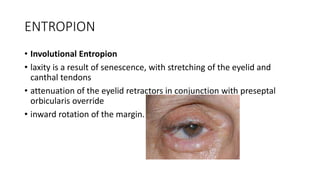
• Involutional Entropion
• laxity is a result of senescence, with stretching of the eyelid and
canthal tendons
• attenuation of the eyelid retractors in conjunction with preseptal
orbicularis override
• inward rotation of the margin.
ENTROPION
• Involutional Entropion
• Several clinical clues may suggest disinsertion of the retractors:
• a white subconjunctival line several millimeters below the inferior
tarsal border
• a deeper- than- normal inferior fornix
• elevation of the lower eyelid
• minimal movement of the lower eyelid on downgaze
ENTROPION
• Management:
• a combination of procedures is necessary
• Procedures to repair involutional entropion of the lower eyelid:
• Temporizing measures
• Lubrication and a bandage contact lens
• Rotational suture techniques
• Recurrance if used in isolation
ENTROPION
• Management:
• Surgical repair
• Direct repair of lower eyelid retractor defects through a skin incision
or a transconjunctival approach
• a small amount of preseptal orbicularis oculi muscle can be removed
• Reinsertion of the eyelid retractors and limited myectomy of the
orbicularis in conjunction with a lower eyelid shortening procedure
ENTROPION
• Acute Spastic Entropion
• Acute spastic entropion arises from ocular irritation or inflammation
• Sustained contraction of the orbicularis oculi muscle leads to inward
rotation of the eyelid margin
• Taping of the entropic eyelid to evert the margin, cautery, or various
rotational suture techniques
• botulinum toxin injection
ENTROPION
• Cicatricial Entropion
• cicatricial entropion is caused by vertical tarsoconjunctival
contracture and internal rotation of the eyelid margin
• Conditions that may lead to cicatricial entropion include:
• autoimmune
• inflammatory
• infectious
• surgical
• traumatic
ENTROPION
Cicatricial Entropion
• The long-term use of topical glaucoma medications, especially miotics
and prostaglandins
• Distinguishing cicatricial entropion from involutional entropion:
• digital eversion
• inspection of the posterior lamella may reveal scarring of the tarsal
conjunctiva in cases of cicatricial entropion.
ENTROPION
• Cicatricial Entropion
• Management
• careful preoperative evaluation
• lubricating drops and ointments, barriers to symblepharon formation,
and eyelash ablation with lash cautery
• topical and systemic medications until a state of stability is attained.
• The tarsal fracture operation is useful in cases of mild to moderate
cicatricial entropion (marginal entropion)
ENTROPION
• Cicatricial Entropion
• Management
• A posterior horizontal tarsal incision is made 2 mm distal to the eyelid
margin.
• Eyelid margin is rotated away from the globe.
• The eyelid position is stabilized with everting sutures.
ENTROPION
• Cicatricial Entropion
• Management
• Incase of tarsal scarring:
• In the upper eyelid, tarsoconjunctival and other mucosal grafts are
useful tarsal substitutes.
• In the lower eyelid, autogenous ear cartilage, preserved scleral grafts,
and hard- palate mucosa have been used.
SYMBLEPHARON
• Symblepharon is an adhesion between conjunctival surfaces.
• It can occur as a result of inflammation, infection, trauma, or previous
surgery
• Conjunctival Z- plasties
• More extensive symblepharon formation requires a full-t hickness
conjunctival graft or flap, a partial-t hickness buccal mucous
membrane graft, or an amniotic membrane graft.
SYMBLEPHARON
• Definition
• Symblepharon is a pathologic condition where the bulbar and
palpebral conjunctiva form an abnormal adhesion to one another.
SYMBLEPHARON
• Etiology
• Immune mediated inflammatory conditions include:
• Steven-Johnson Syndrome/Toxic Epidermal Necrolysis
• Ocular cicatricial pemphigoid
• Sarcoid
• Granulomatosis with Polyangiitis
• Chronic Graft-versus-host disease
• Paraneoplastic Mucous Membrane Pemphigoid
• Lichen Planus
• Recessive Dystrophic Epidermolysis Bullosa
SYMBLEPHARON
• Etiology
• Infections from both bacteria and viruses
• Trauma
• Congenital symblepharon
SYMBLEPHARON
• Pathophysiology
• Symblepharon occurs from an
abnormal healing process after
injury to the conjunctiva.
• loss of epithelial cells from both
the bulbar and palpebral conjunctiva
• an abnormal adhesion between the
bulbar and palpebral conjunctiva.
SYMBLEPHARON
• Diagnosis
• History
• dry eyes
• burning sensation
• photophobia
• decreased vision.
SYMBLEPHARON
• Diagnosis
• Physical examination
• small adhesion between the two layers of conjunctiva
• fornix of the eye may become obliterated
• cicatricial entropion
• permanent lagophthalmos
• exposure of the cornea.
SYMBLEPHARON
• Management
• Medical therapy
• Aims to prevent or decrease symblepharon formation
• to treat the underlying pathology.
• immune modulating therapy
• Steroids and other immuno-suppressive drugs
• preservative free artificial tears and eye lubricants.
SYMBLEPHARON
• Management
• Surgery
• tissue grafting to the affected areas, and reconstruction of a normal fornix.
• cicatrix lysis and intraoperative mitomycin C (MMC)
• reconstruction using tissue grafts from either oral mucosal transplantation
and autografting
• Cultivated limbal stem cell transplantation
Symblepharon
Oral mucus membrane grafts for total symblepharon
management
surgery
limbal stem cell transplantation
SYMBLEPHARON
• Complications
• The adhesion can encroach on the limbus and grow over the cornea,
leading to vision loss.
• The adhesions can also decrease eye movement
• Diplopia
• prevent the normal functioning of the eyelids through mechanical
forces
SYMBLEPHARON
• Prognosis
• mild and cause no symptoms or damage to the eye.
• permanent blindness, in others there may be full resolution with
good visual outcome.
REFERENCES
• KANSKI
• AAO
• EYEWIKI
• PUBMED ARTICLES

PERIOCULAR MALPOSITIONS AND INVOLUTIONAL CHANGES.pptx

  • 1.
    PERIOCULAR MALPOSITIONS AND INVOLUTIONALCHANGES PRESENTER: DR.MUGABI BARNABAS MUKAABYA MODERATOR:DR.LUSOBYA REBECCA 20TH/04/2023
  • 2.
    OUTLINE • ECTROPION • Historyand examination • Risk factors • Pathophysiology • Types of ectropion • ENTROPION • Special tests • Types of ectropion • SYMBLEPHARON • Definitoin • Etiology • Pathophysiology • Management • Complications • prognosis
  • 3.
    ECTROPION Outward turning ofthe eyelid margin and classified as • congenital • Involutional • cicatricial • paralytic • Mechanical Most cases seen in a general ophthalmology practice are involutional
  • 4.
    ECTROPION • History andExamination • History of the presenting condition • General medical history. • A detailed ocular exam including: ₋ visual acuity ₋ ocular motility ₋ slit-lamp examination ₋ testing of tearing and protective mechanisms should be performed
  • 5.
    ECTROPION • Physical examination •Facial architecture • Facial nerve palsy • Eyelid laxity • Eyelid pathology • Punctal ectropion • Ocular surface
  • 6.
    ECTROPION • Risk factors •Age (gravity, loss of elasticity) • Eyelid rubbing • Repeated eyelid pulling (ex. contact-lens use) • Floppy eyelid syndrome • Long term use of eye drops • Skin conditions which involve the eyelid • Trauma • Prior Eyelid Surgery
  • 7.
    ECTROPION • Pathophysiology • Ininvolutional ectropion, the tarsoligamentous sling becomes lax. • In paralytic ectropion, orbicularis muscle tone is weak or absent due to facial nerve palsy.
  • 8.
    ECTROPION • Pathophysiology • Incicatricial ectropion, the anterior or middle lamellae are shortened due to scarring. • Midfacial hypoplasia results in both decreased lower eyelid support and increased propensity for lower eyelid retraction
  • 9.
    ECTROPION • Involutional ectropion •Results from horizontal eyelid laxity in the medial or lateral canthal tendons or both. • Leads to loss of eyelid apposition to the globe and eversion of the eyelid margin • Chronic conjunctival inflammation with hypertrophy and keratinization • usually occurs in the lower eyelid
  • 10.
    ECTROPION • Involutional ectropion •Management • Horizontal eyelid tightening • In the lateral tarsal strip procedure, the tarsus is sutured directly to the lateral orbital rim periosteum • Repair of medial canthal laxity is more challenging than repair of horizontal lower eyelid laxity
  • 11.
    ECTROPION • Involutional ectropion •Management • Medial spindle procedure • In cases of mild medial ectropion with punctal eversion • The procedure involves a horizontal fusiform excision of conjunctiva and eyelid retractors 4 mm inferior to the puncta, followed by inverting sutures for closure
  • 12.
    ECTROPION • Management • Repairof lower eyelid retractors
  • 13.
    ECTROPION • Cicatricial Ectropion •Cicatricial ectropion of the upper or lower eyelid occurs when there is a deficiency of skin • chronic inflammation of the eyelid from dermatologic conditions such as rosacea, atopic dermatitis,… • Management consists of: • addressing the under lying cause • conservative medical protection of the cornea.
  • 14.
    ECTROPION • Cicatricial Ectropion •Management… • 3-step procedure: Vertical cicatricial traction is surgically released through an anterior approach. The eyelid is horizontally tightened. The anterior lamella is vertically augmented by means of a midface-l ift, full-t hickness skin graft, or adjacent tissue transfer, and the eyelid is placed on superior traction with a suture.
  • 15.
    ECTROPION • Cicatricial Ectropion •Management • Treatment of cicatricial ectropion or retraction of the upper eyelid usually requires only release of traction and augmentation of the vertically shortened anterior lamella with a full- thickness skin graft. • The postauricular, preauricular, supraclavicular, and medial upper arm areas are potential donor sites,upper eyelid skin from the fellow eye
  • 16.
    ECTROPION • Mechanical Ectropion •Mechanical ectropion is usually caused by the gravitational effect of a bulky eyelid mass. • Other causes include: • fluid accumulation • herniated orbital fat • poorly fitted spectacles. • Treatment is focused on addressing the underlying etiology.
  • 17.
    ECTROPION • Paralytic Ectropion •Paralytic ectropion usually follows CN VII paralysis or palsy • concomitant upper eyelid lagophthalmos • Poor blinking and eyelid closure • frequent reports of tearing in these patients. • Neurologic evaluation may be needed to determine the cause of the CN VII paralysis.
  • 18.
    ECTROPION • Paralytic Ectropion •In cases resulting from stroke or intracranial surgery, clinical evaluation of corneal sensation is indicated • Management • Lubricating drops • viscous tear supplementation • ointments • taping of the temporal half of the lower eyelid • moisture chambers can be used.
  • 19.
    ECTROPION • Paralytic Ectropion •Long- term or permanent paralysis • tarsorrhaphy • medial or lateral canthoplasty • suspension procedures • horizontal tightening procedures are useful.
  • 20.
    ECTROPION • Paralytic Ectropion •A “temporary tarsorrhaphy”: • Nonabsorbable sutures between the upper and lower eyelid margins. • injection of botulinum toxin into the levator muscle • Permanent tarsorrhaphy involves de-epithelialization of the upper and lower eyelid margins, avoiding the lash follicles.
  • 21.
    ECTROPION • Paralytic Ectropion •Occasionally, a fascia lata or silicone suspension sling of the lower eyelid may be indicated. • Vertical elevation of the lower eyelid is useful in reducing exposure of the inferior cornea. • recession of the lower eyelid retractors • spacer graft. • Surgical midface elevation
  • 22.
    ENTROPION • Introduction • Entropionis an inversion of the eyelid margin. • Lower eyelid entropion is much more common than upper eyelid entropion • unilateral or bilateral
  • 23.
    ENTROPION • Classified as: •congenital • involutional • acute spastic • cicatricial
  • 24.
    ENTROPION • Special Tests •Horizontal lid laxity can be evaluated with the snap back test. • Lower lid retractor function is evaluated by measuring lower lid excursion in downgaze. • Spastic entropion can be elicited by forcefully closing the eyelids, causing override of the pretarsal orbicularis oculi by the preseptal orbicularis.
  • 25.
    ENTROPION • Involutional Entropion •occurs in the lower eyelids • Causative factors include: • horizontal laxity of the eyelid • attenuation or disinsertion of eyelid retractors • and overriding by the preseptal orbicularis oculi muscle. • Histologic examination of tarsal plates showed degenerated and disorganized collagen fibers with abnormal elastogenesis. • snapback and distraction testing
  • 26.
    ENTROPION • Involutional Entropion •laxity is a result of senescence, with stretching of the eyelid and canthal tendons • attenuation of the eyelid retractors in conjunction with preseptal orbicularis override • inward rotation of the margin.
  • 27.
    ENTROPION • Involutional Entropion •Several clinical clues may suggest disinsertion of the retractors: • a white subconjunctival line several millimeters below the inferior tarsal border • a deeper- than- normal inferior fornix • elevation of the lower eyelid • minimal movement of the lower eyelid on downgaze
  • 28.
    ENTROPION • Management: • acombination of procedures is necessary • Procedures to repair involutional entropion of the lower eyelid: • Temporizing measures • Lubrication and a bandage contact lens • Rotational suture techniques • Recurrance if used in isolation
  • 29.
    ENTROPION • Management: • Surgicalrepair • Direct repair of lower eyelid retractor defects through a skin incision or a transconjunctival approach • a small amount of preseptal orbicularis oculi muscle can be removed • Reinsertion of the eyelid retractors and limited myectomy of the orbicularis in conjunction with a lower eyelid shortening procedure
  • 30.
    ENTROPION • Acute SpasticEntropion • Acute spastic entropion arises from ocular irritation or inflammation • Sustained contraction of the orbicularis oculi muscle leads to inward rotation of the eyelid margin • Taping of the entropic eyelid to evert the margin, cautery, or various rotational suture techniques • botulinum toxin injection
  • 31.
    ENTROPION • Cicatricial Entropion •cicatricial entropion is caused by vertical tarsoconjunctival contracture and internal rotation of the eyelid margin • Conditions that may lead to cicatricial entropion include: • autoimmune • inflammatory • infectious • surgical • traumatic
  • 32.
    ENTROPION Cicatricial Entropion • Thelong-term use of topical glaucoma medications, especially miotics and prostaglandins • Distinguishing cicatricial entropion from involutional entropion: • digital eversion • inspection of the posterior lamella may reveal scarring of the tarsal conjunctiva in cases of cicatricial entropion.
  • 33.
    ENTROPION • Cicatricial Entropion •Management • careful preoperative evaluation • lubricating drops and ointments, barriers to symblepharon formation, and eyelash ablation with lash cautery • topical and systemic medications until a state of stability is attained. • The tarsal fracture operation is useful in cases of mild to moderate cicatricial entropion (marginal entropion)
  • 34.
    ENTROPION • Cicatricial Entropion •Management • A posterior horizontal tarsal incision is made 2 mm distal to the eyelid margin. • Eyelid margin is rotated away from the globe. • The eyelid position is stabilized with everting sutures.
  • 35.
    ENTROPION • Cicatricial Entropion •Management • Incase of tarsal scarring: • In the upper eyelid, tarsoconjunctival and other mucosal grafts are useful tarsal substitutes. • In the lower eyelid, autogenous ear cartilage, preserved scleral grafts, and hard- palate mucosa have been used.
  • 36.
    SYMBLEPHARON • Symblepharon isan adhesion between conjunctival surfaces. • It can occur as a result of inflammation, infection, trauma, or previous surgery • Conjunctival Z- plasties • More extensive symblepharon formation requires a full-t hickness conjunctival graft or flap, a partial-t hickness buccal mucous membrane graft, or an amniotic membrane graft.
  • 37.
    SYMBLEPHARON • Definition • Symblepharonis a pathologic condition where the bulbar and palpebral conjunctiva form an abnormal adhesion to one another.
  • 38.
    SYMBLEPHARON • Etiology • Immunemediated inflammatory conditions include: • Steven-Johnson Syndrome/Toxic Epidermal Necrolysis • Ocular cicatricial pemphigoid • Sarcoid • Granulomatosis with Polyangiitis • Chronic Graft-versus-host disease • Paraneoplastic Mucous Membrane Pemphigoid • Lichen Planus • Recessive Dystrophic Epidermolysis Bullosa
  • 39.
    SYMBLEPHARON • Etiology • Infectionsfrom both bacteria and viruses • Trauma • Congenital symblepharon
  • 40.
    SYMBLEPHARON • Pathophysiology • Symblepharonoccurs from an abnormal healing process after injury to the conjunctiva. • loss of epithelial cells from both the bulbar and palpebral conjunctiva • an abnormal adhesion between the bulbar and palpebral conjunctiva.
  • 41.
    SYMBLEPHARON • Diagnosis • History •dry eyes • burning sensation • photophobia • decreased vision.
  • 42.
    SYMBLEPHARON • Diagnosis • Physicalexamination • small adhesion between the two layers of conjunctiva • fornix of the eye may become obliterated • cicatricial entropion • permanent lagophthalmos • exposure of the cornea.
  • 43.
    SYMBLEPHARON • Management • Medicaltherapy • Aims to prevent or decrease symblepharon formation • to treat the underlying pathology. • immune modulating therapy • Steroids and other immuno-suppressive drugs • preservative free artificial tears and eye lubricants.
  • 44.
    SYMBLEPHARON • Management • Surgery •tissue grafting to the affected areas, and reconstruction of a normal fornix. • cicatrix lysis and intraoperative mitomycin C (MMC) • reconstruction using tissue grafts from either oral mucosal transplantation and autografting • Cultivated limbal stem cell transplantation
  • 45.
    Symblepharon Oral mucus membranegrafts for total symblepharon management surgery limbal stem cell transplantation
  • 46.
    SYMBLEPHARON • Complications • Theadhesion can encroach on the limbus and grow over the cornea, leading to vision loss. • The adhesions can also decrease eye movement • Diplopia • prevent the normal functioning of the eyelids through mechanical forces
  • 47.
    SYMBLEPHARON • Prognosis • mildand cause no symptoms or damage to the eye. • permanent blindness, in others there may be full resolution with good visual outcome.
  • 48.
    REFERENCES • KANSKI • AAO •EYEWIKI • PUBMED ARTICLES