Methods in Enterprises
2
Software Lifecycle
Software Layer
Requirement Architecture Development Operation
Business
Model
Application
UI
Logic
Data
Platform and
Infrastructure
Management
BPM
BA
UX
SOA
EIM
MDD / TDD / XP
EA
PMBOK / CMMI-DEV ITIL
Scrum / Kanban
Business/ITStrategy
Business-IT Alignment
3
Business
Process
Business
Environment
IT
Technology
IT System
Application
Data
Infrastructure
IT
Strategy
Business
Strategy
EABusiness Strategy
Planning Method
Business Process
Management Method
IT Strategy
Planning Method
Business
Analysis
Method
Software
Engineering
Method
Enterprise
Architecture Method
Software Project
Enterprise Method
Architecture
4
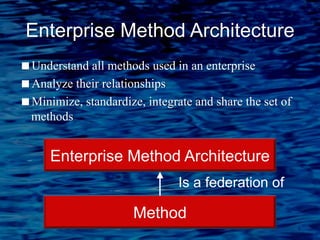
Understand all methods used in an
enterprise
Analyze their relationships
Minimize, standardize, integrate and share
the set of methods
Enterprise Method Architecture
Method
Is a federation of
Example: US DoD
5
Do methods produce
consistent models across
different views (e.g. across
process, information, use case)?
Do methods produce
models traceable across
different abstraction
Example: DoDAF Meta Model
(DM2)
6
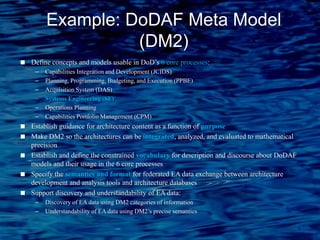
 Define concepts and models usable in DoD’s 6 core processes:
– Capabilities Integration and Development (JCIDS)
– Planning, Programming, Budgeting, and Execution (PPBE)
– Acquisition System (DAS)
– Systems Engineering (SE)
– Operations Planning
– Capabilities Portfolio Management (CPM)
 Establish guidance for architecture content as a function of purpose
 Make DM2 so the architectures can be integrated, analyzed, and
evaluated to mathematical precision
 Establish and define the constrained vocabulary for description and
discourse about DoDAF models and their usage in the 6 core processes
 Specify the semantics and format for federated EA data exchange
between architecture development and analysis tools and architecture
databases
 Support discovery and understandability of EA data:
– Discovery of EA data using DM2 categories of information
– Understandability of EA data using DM2’s precise semantics
Methods Integration
7
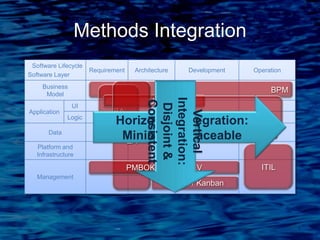
Software Lifecycle
Software Layer
Requirement Architecture Development Operation
Business
Model
Application
UI
Logic
Data
Platform and
Infrastructure
Management
BPM
BA
UX
SOA
EIM
MDD / TDD / XP
EA
PMBOK / CMMI-DEV ITIL
Scrum / Kanban
Horizontal Integration:
Minimal & Traceable
VerticalIntegration:
Disjoint&Consistent
Essence Approach to EMA
8
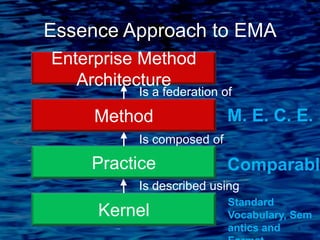
Practice
Is composed of
Kernel
Is described using
Enterprise Method Architecture
Method
Is a federation of
Comparable
M. E. C. E.
Standard Vocabulary,
Semantics and Format
Essence Approach to EMA
9
Essence Kernel
(IFaP)
New emerging best practices
New demands for methods
(e.g., cloud migration, big data analytics, enterprise mobility)
Hour Glass Model of Middle Out Architecture
Advantage of Essence
Approach
10
Kernel-Based
Practices
Diverse,
Yet Coherent
Practices
Integration
into Method
Minimal,
Yet Sufficient
Methods
Integration
across
Enterprise
M. E. C. E
Agile
Transitions of
Enterprise
Method
Architecture
Adaptive &
Innovative
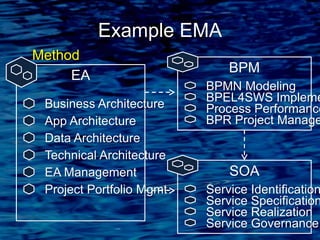
Example EMA
11
EA
Business Architecture
App Architecture
Data Architecture
Technical Architecture
EA Management
Project Portfolio Mgmt
BPM
BPMN Modeling
BPEL4SWS Implementation
Process Performance Mgmt
BPR Project Management
SOA
Service Identification
Service Specification
Service Realization
Service Governance
Method
Method
12
BPM
BPMN Modeling
BPEL4SWS Implementation
Process Performance Mgmt
BPR Project Management
Method
Practice
Practice
Practice
Practice
BPMN Modeling
Practice Template
13
Opportunity
Stakeholder
Requirements
Software System
Work
Team
Way of Working
Practice
Kernel
Alphas
Explore Possibilities
Understand
Stakeholder Needs
Understand the
Requirements
Shape the System
Prepare to Do the Work
Coordinate Activities
Track Progress
Kernel
Activity
Spaces
BPMN Modeling
Practice Instantiation
14
Opportunity
Stakeholder
Requirements
Software System
Work
Team
Way of Working
Process Goals aligned with Business Strategy
Process Owner and Actors
Process KPIs
BPMN 2.0 Models
executable on the Process Engine
As-Is Process Analysis,
To-Be Process Design and Simulation
Cross-Functional Team with
Process Actors and Process Engineers
Process Modeling Heuristics, Patterns and Tool
Alphas
Work
Products
BPMN Modeling
Practice Instantiation
15
Conduct Benchmarking of Global Best Practices
Analyze Business Strategies and
Process Capabilities to Improve
Analyze the Current Process and
Set Improvement Goals and KPIs
Design and Simulate the To-Be Process and Develop the
Implementation Plan
Justify ROI of the Process Modeling Project,
Organize and Train the Team
Develop the Process Modeling Project Plan
Track the Process Modeling Project
Explore Possibilities
Understand
Stakeholder Needs
Understand the
Requirements
Shape the System
Prepare to Do the Work
Coordinate Activities
Track Progress
Activity
Spaces
Activities
BPMN Modeling
Practice Instantiation
16
Analyze Business Strategies and
Process Capabilities to Improve
Analyze the Current Process and
Set Improvement Goals and KPIs
Design and Simulate the To-Be Process and
Develop the Implementation Plan
Justify ROI of the Process Modeling Project,
Organize and Train the Team
Develop the Process Modeling Project Plan
Track the Process Modeling Project
Conduct Benchmarking of Global Best
Practices
Activities
Process KPIsRequirements
Conceived
Bounded
Coherent
Acceptable
Alpha
States
Process Analysis,
Design, Simulation
Work
Initiated
Prepared
Started
Under Control
Concluded
Closed
Method Composition
17
Practice
Competency
Institutionalization of EMA
18
Enterprise Method
Architecture
Practice
Kernel
Method
Corporate
Business Process
Workforce
Competency
Training Program
Organization &
Job/Role Design
Reusable
SW Asset
(e.g. Patterns)
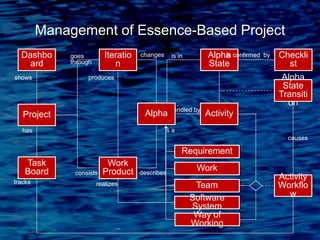
Management of Essence-Based Project
19
Project
Alpha
State
Activity
Workflow
consistsof
goes through
describes
produces
is in
Requirement
Work
Software System
Team
is a
Activityis handled by
Alpha State
Transition
Task Board
shows
Dashboard
Work
Product
Iteration
has
Way of Working
Alpha
causes
Checklist
is confirmed bychanges
realizestracks
Case Study
BPMN Modeling
Analyze Business Strategies and
Process Capabilities to Improve
Analyze the Current Process and
Set Improvement Goals and KPIs
Design and Simulate the To-Be Process and
Develop the Implementation Plan
Conduct Benchmarking of Global Best
Practices Process KPIsRequirements
Conceived
Bounded
Coherent
Acceptable
Design
Business
Process
Case Study
BPMN Modeling
Analyze Business Strategies and
Process Capabilities to Improve
Analyze the Current Process and
Set Improvement Goals and KPIs
Design and Simulate the To-Be Process
and Develop the Implementation Plan
Conduct Benchmarking of Global Best
Practices ProcessKPIsRequirements
Conceived
Bounded
Coherent
Acceptable
Design
Business
Process
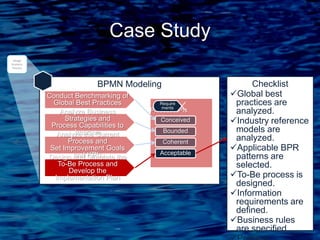
Checklist
Process goals are
determined.
As-Is process is described.
Process problems are
identified.
Root causes of the
problems are identified.
Process KPIs are defined.
Target KPIs are set.
Case Study
Analyze the Current Process and
Set Improvement Goals and KPIs
ProcessKPIsRequirements
Coherent
Checklist
Process goals are
determined.
As-Is process is described.
Process problems are
identified.
Root causes of the
problems are identified.
Process KPIs are defined.
Target KPIs are set.
Case Study
BPMN Modeling
Analyze Business Strategies and
Process Capabilities to Improve
Analyze the Current Process and
Set Improvement Goals and KPIs
Design and Simulate the To-Be Process
and Develop the Implementation Plan
Conduct Benchmarking of Global Best
Practices ProcessKPIsRequirements
Conceived
Bounded
Coherent
Acceptable
Design
Business
Process
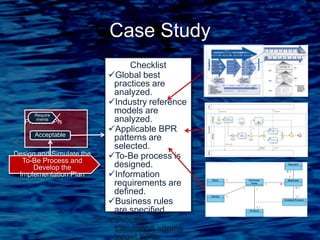
Checklist
Global best practices are
analyzed.
Industry reference models
are analyzed.
Applicable BPR patterns are
selected.
To-Be process is designed.
Information requirements
are defined.
Business rules are
specified.
Process simulation attains
target KPIs.
Organization and jobs are
designed.
Case Study
Design and Simulate the To-Be Process
and Develop the Implementation Plan
ProcessKPIsRequirements
Acceptable
Checklist
Global best practices are
analyzed.
Industry reference models
are analyzed.
Applicable BPR patterns are
selected.
To-Be process is designed.
Information requirements
are defined.
Business rules are
specified.
Process simulation attains
target KPIs.
Organization and jobs are
designed.
Conclusion
We need to build a library of practices using the
common kernel,
not just for software engineering, but also for
other disciplines essential for business-IT
alignment
We need to develop an easy-to-use tool to
compose practices into a method, and a
marketplace where global best practices can be
traded.
We need to produce success cases of developing
and managing Enterprise Method Architectures
based on Essence.
We need to extend the kernel to accommodate
ever expanding use cases and technologies of
software.
25
Thank YOU!
26

Essence Kernel-Based Enterprise Method Architecture

  • 2.
    Methods in Enterprises 2 SoftwareLifecycle Software Layer Requirement Architecture Development Operation Business Model Application UI Logic Data Platform and Infrastructure Management BPM BA UX SOA EIM MDD / TDD / XP EA PMBOK / CMMI-DEV ITIL Scrum / Kanban Business/ITStrategy
  • 3.
    Business-IT Alignment 3 Business Process Business Environment IT Technology IT System Application Data Infrastructure IT Strategy Business Strategy EABusinessStrategy Planning Method Business Process Management Method IT Strategy Planning Method Business Analysis Method Software Engineering Method Enterprise Architecture Method Software Project
  • 4.
    Enterprise Method Architecture 4 Understand allmethods used in an enterprise Analyze their relationships Minimize, standardize, integrate and share the set of methods Enterprise Method Architecture Method Is a federation of
  • 5.
    Example: US DoD 5 Domethods produce consistent models across different views (e.g. across process, information, use case)? Do methods produce models traceable across different abstraction
  • 6.
    Example: DoDAF MetaModel (DM2) 6  Define concepts and models usable in DoD’s 6 core processes: – Capabilities Integration and Development (JCIDS) – Planning, Programming, Budgeting, and Execution (PPBE) – Acquisition System (DAS) – Systems Engineering (SE) – Operations Planning – Capabilities Portfolio Management (CPM)  Establish guidance for architecture content as a function of purpose  Make DM2 so the architectures can be integrated, analyzed, and evaluated to mathematical precision  Establish and define the constrained vocabulary for description and discourse about DoDAF models and their usage in the 6 core processes  Specify the semantics and format for federated EA data exchange between architecture development and analysis tools and architecture databases  Support discovery and understandability of EA data: – Discovery of EA data using DM2 categories of information – Understandability of EA data using DM2’s precise semantics
  • 7.
    Methods Integration 7 Software Lifecycle SoftwareLayer Requirement Architecture Development Operation Business Model Application UI Logic Data Platform and Infrastructure Management BPM BA UX SOA EIM MDD / TDD / XP EA PMBOK / CMMI-DEV ITIL Scrum / Kanban Horizontal Integration: Minimal & Traceable VerticalIntegration: Disjoint&Consistent
  • 8.
    Essence Approach toEMA 8 Practice Is composed of Kernel Is described using Enterprise Method Architecture Method Is a federation of Comparable M. E. C. E. Standard Vocabulary, Semantics and Format
  • 9.
    Essence Approach toEMA 9 Essence Kernel (IFaP) New emerging best practices New demands for methods (e.g., cloud migration, big data analytics, enterprise mobility) Hour Glass Model of Middle Out Architecture
  • 10.
    Advantage of Essence Approach 10 Kernel-Based Practices Diverse, YetCoherent Practices Integration into Method Minimal, Yet Sufficient Methods Integration across Enterprise M. E. C. E Agile Transitions of Enterprise Method Architecture Adaptive & Innovative
  • 11.
    Example EMA 11 EA Business Architecture AppArchitecture Data Architecture Technical Architecture EA Management Project Portfolio Mgmt BPM BPMN Modeling BPEL4SWS Implementation Process Performance Mgmt BPR Project Management SOA Service Identification Service Specification Service Realization Service Governance Method
  • 12.
    Method 12 BPM BPMN Modeling BPEL4SWS Implementation ProcessPerformance Mgmt BPR Project Management Method Practice Practice Practice Practice
  • 13.
    BPMN Modeling Practice Template 13 Opportunity Stakeholder Requirements SoftwareSystem Work Team Way of Working Practice Kernel Alphas Explore Possibilities Understand Stakeholder Needs Understand the Requirements Shape the System Prepare to Do the Work Coordinate Activities Track Progress Kernel Activity Spaces
  • 14.
    BPMN Modeling Practice Instantiation 14 Opportunity Stakeholder Requirements SoftwareSystem Work Team Way of Working Process Goals aligned with Business Strategy Process Owner and Actors Process KPIs BPMN 2.0 Models executable on the Process Engine As-Is Process Analysis, To-Be Process Design and Simulation Cross-Functional Team with Process Actors and Process Engineers Process Modeling Heuristics, Patterns and Tool Alphas Work Products
  • 15.
    BPMN Modeling Practice Instantiation 15 ConductBenchmarking of Global Best Practices Analyze Business Strategies and Process Capabilities to Improve Analyze the Current Process and Set Improvement Goals and KPIs Design and Simulate the To-Be Process and Develop the Implementation Plan Justify ROI of the Process Modeling Project, Organize and Train the Team Develop the Process Modeling Project Plan Track the Process Modeling Project Explore Possibilities Understand Stakeholder Needs Understand the Requirements Shape the System Prepare to Do the Work Coordinate Activities Track Progress Activity Spaces Activities
  • 16.
    BPMN Modeling Practice Instantiation 16 AnalyzeBusiness Strategies and Process Capabilities to Improve Analyze the Current Process and Set Improvement Goals and KPIs Design and Simulate the To-Be Process and Develop the Implementation Plan Justify ROI of the Process Modeling Project, Organize and Train the Team Develop the Process Modeling Project Plan Track the Process Modeling Project Conduct Benchmarking of Global Best Practices Activities Process KPIsRequirements Conceived Bounded Coherent Acceptable Alpha States Process Analysis, Design, Simulation Work Initiated Prepared Started Under Control Concluded Closed
  • 17.
  • 18.
    Institutionalization of EMA 18 EnterpriseMethod Architecture Practice Kernel Method Corporate Business Process Workforce Competency Training Program Organization & Job/Role Design Reusable SW Asset (e.g. Patterns)
  • 19.
    Management of Essence-BasedProject 19 Project Alpha State Activity Workflow consistsof goes through describes produces is in Requirement Work Software System Team is a Activityis handled by Alpha State Transition Task Board shows Dashboard Work Product Iteration has Way of Working Alpha causes Checklist is confirmed bychanges realizestracks
  • 20.
    Case Study BPMN Modeling AnalyzeBusiness Strategies and Process Capabilities to Improve Analyze the Current Process and Set Improvement Goals and KPIs Design and Simulate the To-Be Process and Develop the Implementation Plan Conduct Benchmarking of Global Best Practices Process KPIsRequirements Conceived Bounded Coherent Acceptable Design Business Process
  • 21.
    Case Study BPMN Modeling AnalyzeBusiness Strategies and Process Capabilities to Improve Analyze the Current Process and Set Improvement Goals and KPIs Design and Simulate the To-Be Process and Develop the Implementation Plan Conduct Benchmarking of Global Best Practices ProcessKPIsRequirements Conceived Bounded Coherent Acceptable Design Business Process Checklist Process goals are determined. As-Is process is described. Process problems are identified. Root causes of the problems are identified. Process KPIs are defined. Target KPIs are set.
  • 22.
    Case Study Analyze theCurrent Process and Set Improvement Goals and KPIs ProcessKPIsRequirements Coherent Checklist Process goals are determined. As-Is process is described. Process problems are identified. Root causes of the problems are identified. Process KPIs are defined. Target KPIs are set.
  • 23.
    Case Study BPMN Modeling AnalyzeBusiness Strategies and Process Capabilities to Improve Analyze the Current Process and Set Improvement Goals and KPIs Design and Simulate the To-Be Process and Develop the Implementation Plan Conduct Benchmarking of Global Best Practices ProcessKPIsRequirements Conceived Bounded Coherent Acceptable Design Business Process Checklist Global best practices are analyzed. Industry reference models are analyzed. Applicable BPR patterns are selected. To-Be process is designed. Information requirements are defined. Business rules are specified. Process simulation attains target KPIs. Organization and jobs are designed.
  • 24.
    Case Study Design andSimulate the To-Be Process and Develop the Implementation Plan ProcessKPIsRequirements Acceptable Checklist Global best practices are analyzed. Industry reference models are analyzed. Applicable BPR patterns are selected. To-Be process is designed. Information requirements are defined. Business rules are specified. Process simulation attains target KPIs. Organization and jobs are designed.
  • 25.
    Conclusion We need tobuild a library of practices using the common kernel, not just for software engineering, but also for other disciplines essential for business-IT alignment We need to develop an easy-to-use tool to compose practices into a method, and a marketplace where global best practices can be traded. We need to produce success cases of developing and managing Enterprise Method Architectures based on Essence. We need to extend the kernel to accommodate ever expanding use cases and technologies of software. 25
  • 26.