Business Analysis Techniques
   …you can never have too many tools
                                  Paul Turner


                                       Edinburgh 12th April 2012

© Assist Knowledge Development, 2012                               Business Analysis Techniques/1
Business analysis - definitions

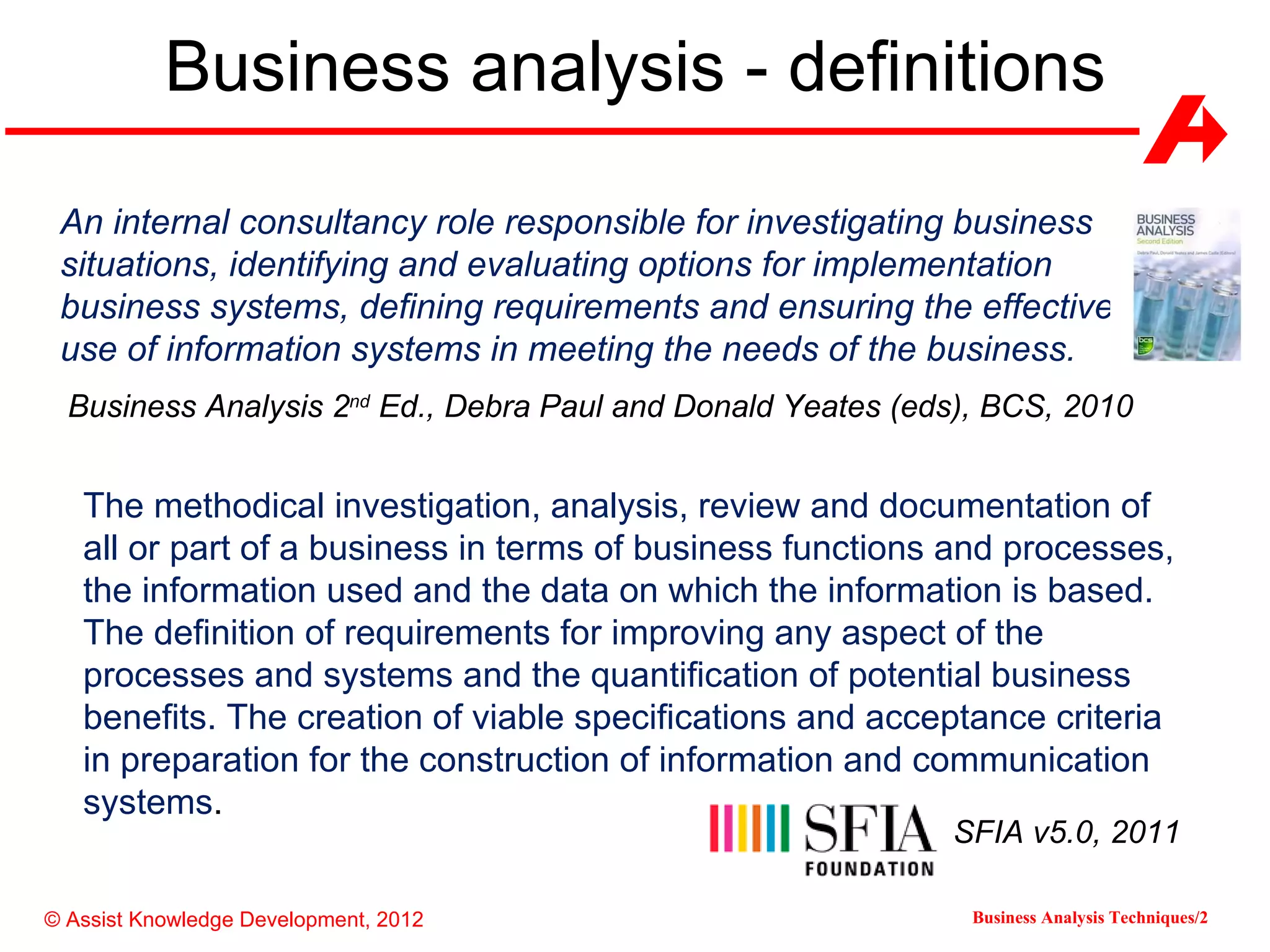
 An internal consultancy role responsible for investigating business
 situations, identifying and evaluating options for implementation
 business systems, defining requirements and ensuring the effective
 use of information systems in meeting the needs of the business.
  Business Analysis 2nd Ed., Debra Paul and Donald Yeates (eds), BCS, 2010


   The methodical investigation, analysis, review and documentation of
   all or part of a business in terms of business functions and processes,
   the information used and the data on which the information is based.
   The definition of requirements for improving any aspect of the
   processes and systems and the quantification of potential business
   benefits. The creation of viable specifications and acceptance criteria
   in preparation for the construction of information and communication
   systems.
                                                             SFIA v5.0, 2011

© Assist Knowledge Development, 2012                           Business Analysis Techniques/2
An alternative definition


© Assist Knowledge Development, 2012   Business Analysis Techniques/3
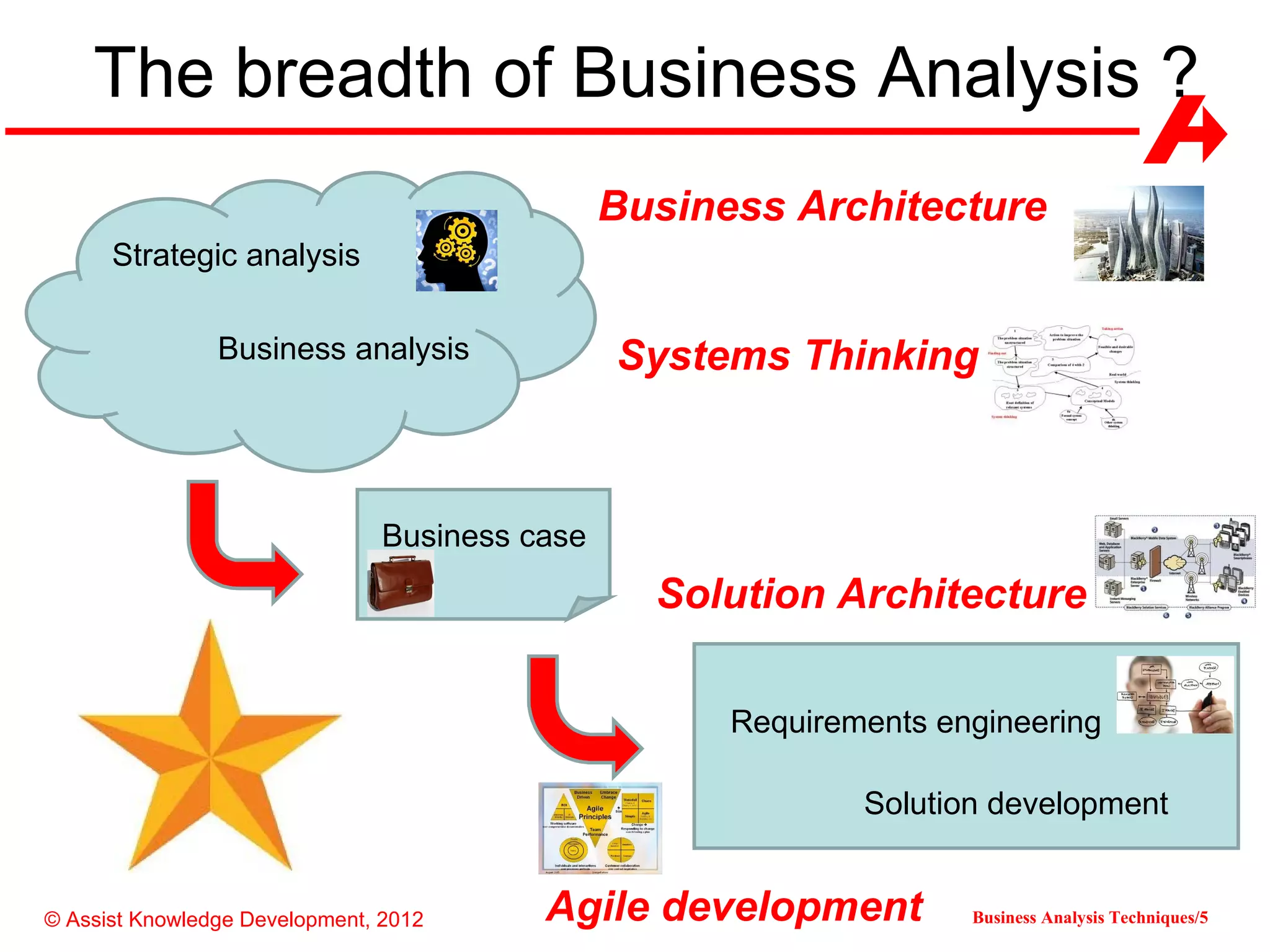
The breadth of Business Analysis ?

      Strategic analysis

                Business analysis


                                Business case


                                                Requirements engineering

                                                        Solution development


© Assist Knowledge Development, 2012                           Business Analysis Techniques/4
The breadth of Business Analysis ?
                                                Business Architecture
      Strategic analysis

                Business analysis               Systems Thinking


                                Business case
                                                  Solution Architecture

                                                      Requirements engineering

                                                              Solution development


© Assist Knowledge Development, 2012      Agile development          Business Analysis Techniques/5
BA techniques in context

                                              Context


                    Rationale
                                  +    Lifecycle
                                                   +    Roles
                                                                +   Deliverables


                                           Techniques


© Assist Knowledge Development, 2012                                      Business Analysis Techniques/6
BA techniques in context

                                              Context


                    Rationale
                                  +    Lifecycle
                                                   +    Roles
                                                                +   Deliverables


                                           Techniques


© Assist Knowledge Development, 2012                                      Business Analysis Techniques/7
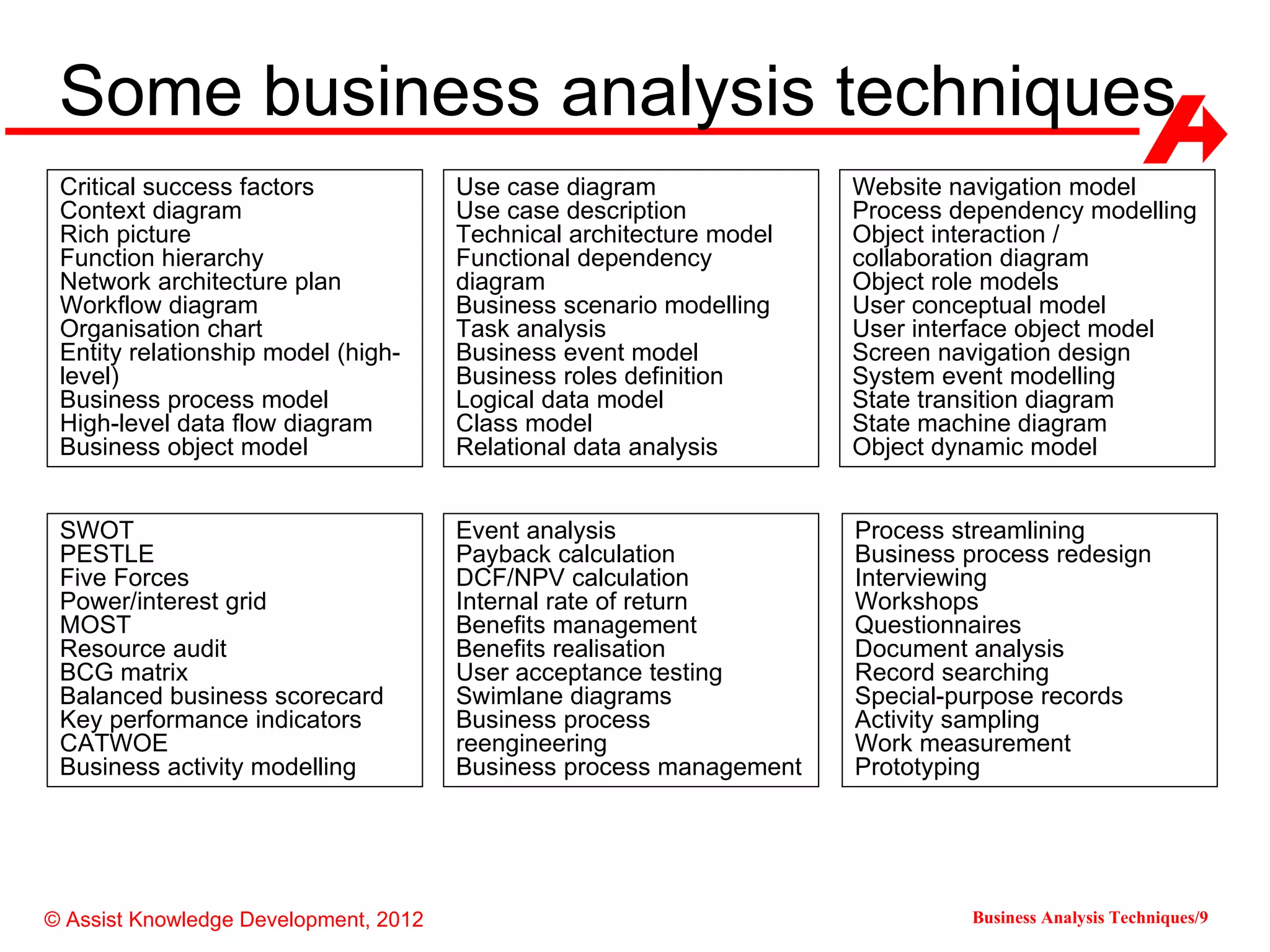
Some business analysis techniques


© Assist Knowledge Development, 2012   Business Analysis Techniques/8
Some business analysis techniques
 Critical success factors              Use case diagram               Website navigation model
 Context diagram                       Use case description           Process dependency modelling
 Rich picture                          Technical architecture model   Object interaction /
 Function hierarchy                    Functional dependency          collaboration diagram
 Network architecture plan             diagram                        Object role models
 Workflow diagram                      Business scenario modelling    User conceptual model
 Organisation chart                    Task analysis                  User interface object model
 Entity relationship model (high-      Business event model           Screen navigation design
 level)                                Business roles definition      System event modelling
 Business process model                Logical data model             State transition diagram
 High-level data flow diagram          Class model                    State machine diagram
 Business object model                 Relational data analysis       Object dynamic model


 SWOT                                  Event analysis                 Process streamlining
 PESTLE                                Payback calculation            Business process redesign
 Five Forces                           DCF/NPV calculation            Interviewing
 Power/interest grid                   Internal rate of return        Workshops
 MOST                                  Benefits management            Questionnaires
 Resource audit                        Benefits realisation           Document analysis
 BCG matrix                            User acceptance testing        Record searching
 Balanced business scorecard           Swimlane diagrams              Special-purpose records
 Key performance indicators            Business process               Activity sampling
 CATWOE                                reengineering                  Work measurement
 Business activity modelling           Business process management    Prototyping


© Assist Knowledge Development, 2012                                           Business Analysis Techniques/9
More business analysis techniques

              Give up yet?               Aargh!
              Brainstorming              Cost/benefit analysis
              Round-robin                Impact analysis
              Columns and clusters       Gap analysis
              Bodyguards and assassins   Standard costing
              Vernissage                 Marginal costing
              Talking wall               Absorption costing
              Force-field analysis       Ratio analysis
              Greenfield site            MoSCoW
              Transporter                Organisation diagram
              Prioritisation             Report writing
              Time beam                  Presentation techniques


             And even then people said “ You’ve missed …….”


© Assist Knowledge Development, 2012                       Business Analysis Techniques/10
The role of the business analyst

                                       Investigating
                                       the situation               Analysing
                                                                    strategy

                                                       Modelling
                                                        business
                                                       processes

                                                                      Stimulating
                                                                       thinking


                                                                   Developing
          Business
                                            Specifying              business
           analyst
                                           information                case
                                             systems


© Assist Knowledge Development, 2012                                  Business Analysis Techniques/11
Investigating the situation
                                              Questionnaires           <<extend>>

                                                                                Interviewing

                                                                          <<extend>>

                                                             Workshops


                                        Special-purpose
                                           records

                                               <<extend>>          <<extend>>

                                                   Activity sampling
                                                                       <<extend>>

                                                                                       Work
                                                                                    measurement
        Business                        Record
                                       searching
         analyst                                         <<extend>>

                                                              Document
                                                               analysis


© Assist Knowledge Development, 2012                                                   Business Analysis Techniques/12
Analysing strategy

                                                  Five forces

                                                                             PESTLE

                                              <<extend>>
                                                             <<extend>>

                                                                                 MOST
                                                                <<extend>>

                                       SWOT


                                                             <<extend>>
                                                                             Resource
                                                <<extend>>                     audit
Business
 analyst
                                                           CATWOE


© Assist Knowledge Development, 2012                                             Business Analysis Techniques/13
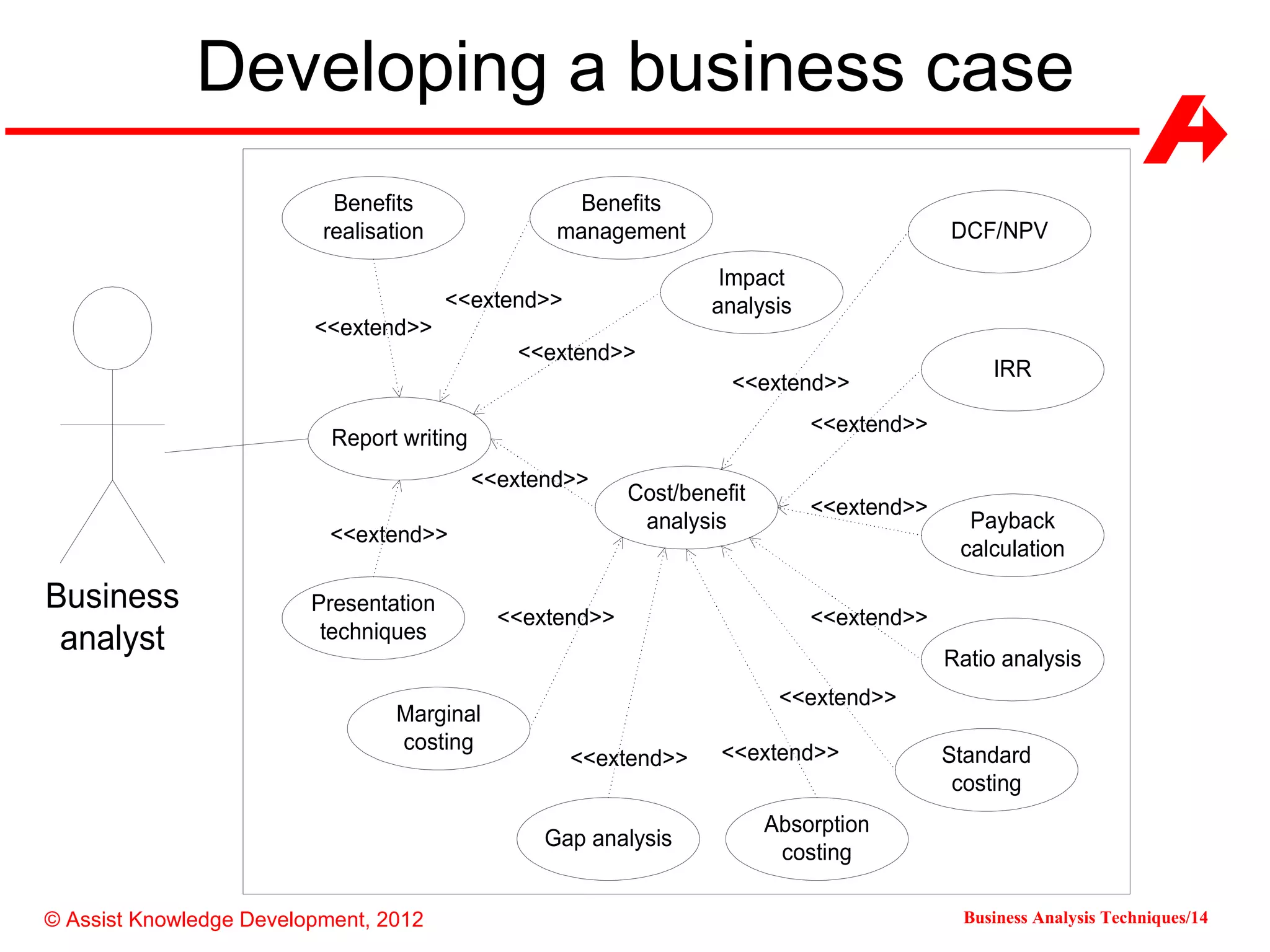
Developing a business case
                           Benefits                 Benefits
                          realisation              management                              DCF/NPV
                                                                    Impact
                                        <<extend>>                 analysis
                         <<extend>>
                                               <<extend>>
                                                                                                IRR
                                                                     <<extend>>
                                                                              <<extend>>
                           Report writing
                                            <<extend>>
                                                           Cost/benefit
                                                                              <<extend>>
                                                            analysis                         Payback
                           <<extend>>
                                                                                            calculation

Business                 Presentation
                                              <<extend>>                      <<extend>>
 analyst                  techniques
                                                                                           Ratio analysis
                                                                           <<extend>>
                                 Marginal
                                 costing                            <<extend>>
                                                     <<extend>>                            Standard
                                                                                            costing
                                                                          Absorption
                                                  Gap analysis
                                                                           costing

© Assist Knowledge Development, 2012                                                        Business Analysis Techniques/14
Finding reasons not to


© Assist Knowledge Development, 2012   Business Analysis Techniques/15
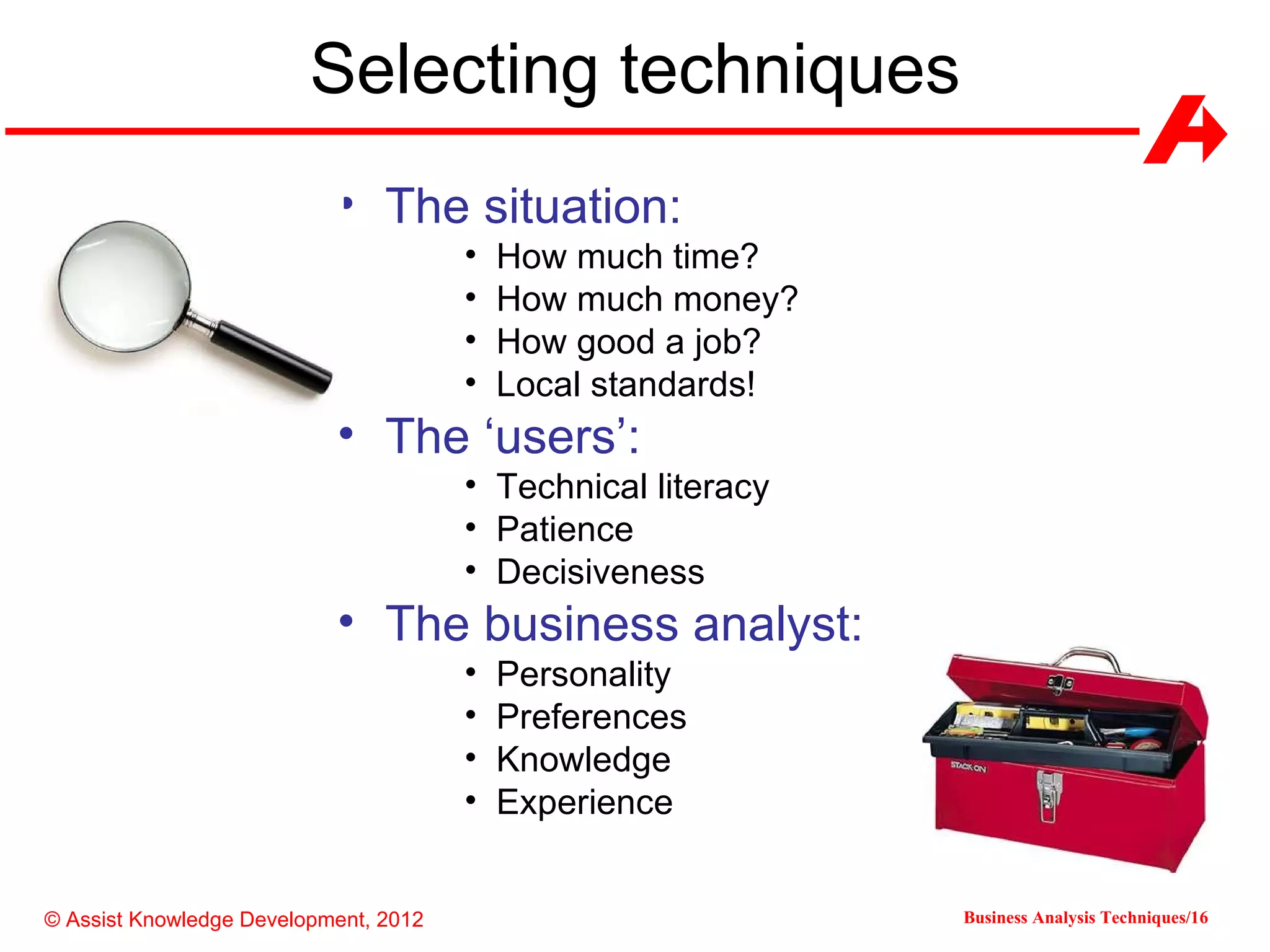
Selecting techniques
                           • The situation:
                                       •   How much time?
                                       •   How much money?
                                       •   How good a job?
                                       •   Local standards!
                           • The ‘users’:
                                       • Technical literacy
                                       • Patience
                                       • Decisiveness
                           • The business analyst:
                                       •   Personality
                                       •   Preferences
                                       •   Knowledge
                                       •   Experience


© Assist Knowledge Development, 2012                          Business Analysis Techniques/16
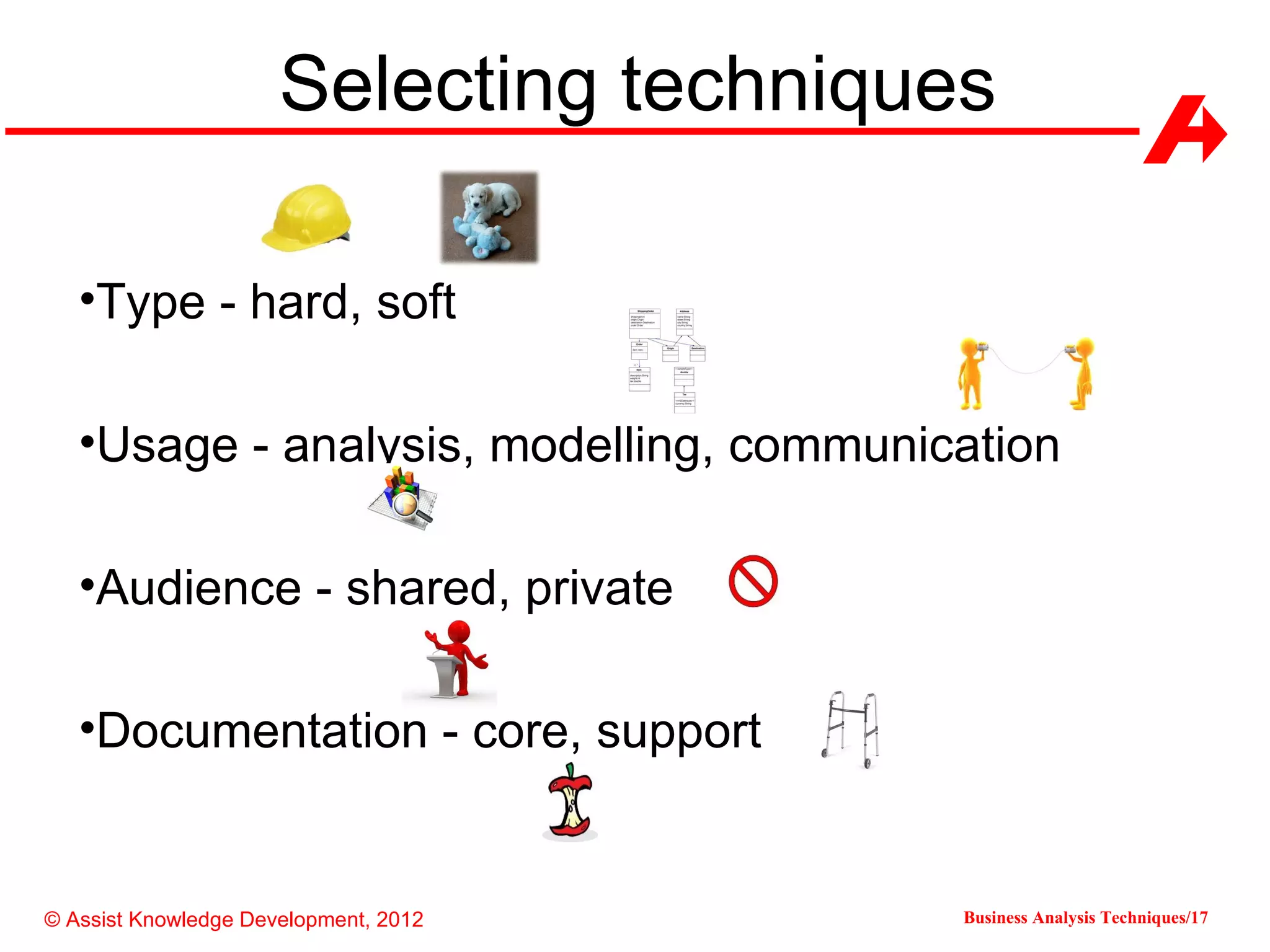
Selecting techniques

   •Type - hard, soft

   •Usage - analysis, modelling, communication

   •Audience - shared, private

   •Documentation - core, support


© Assist Knowledge Development, 2012     Business Analysis Techniques/17
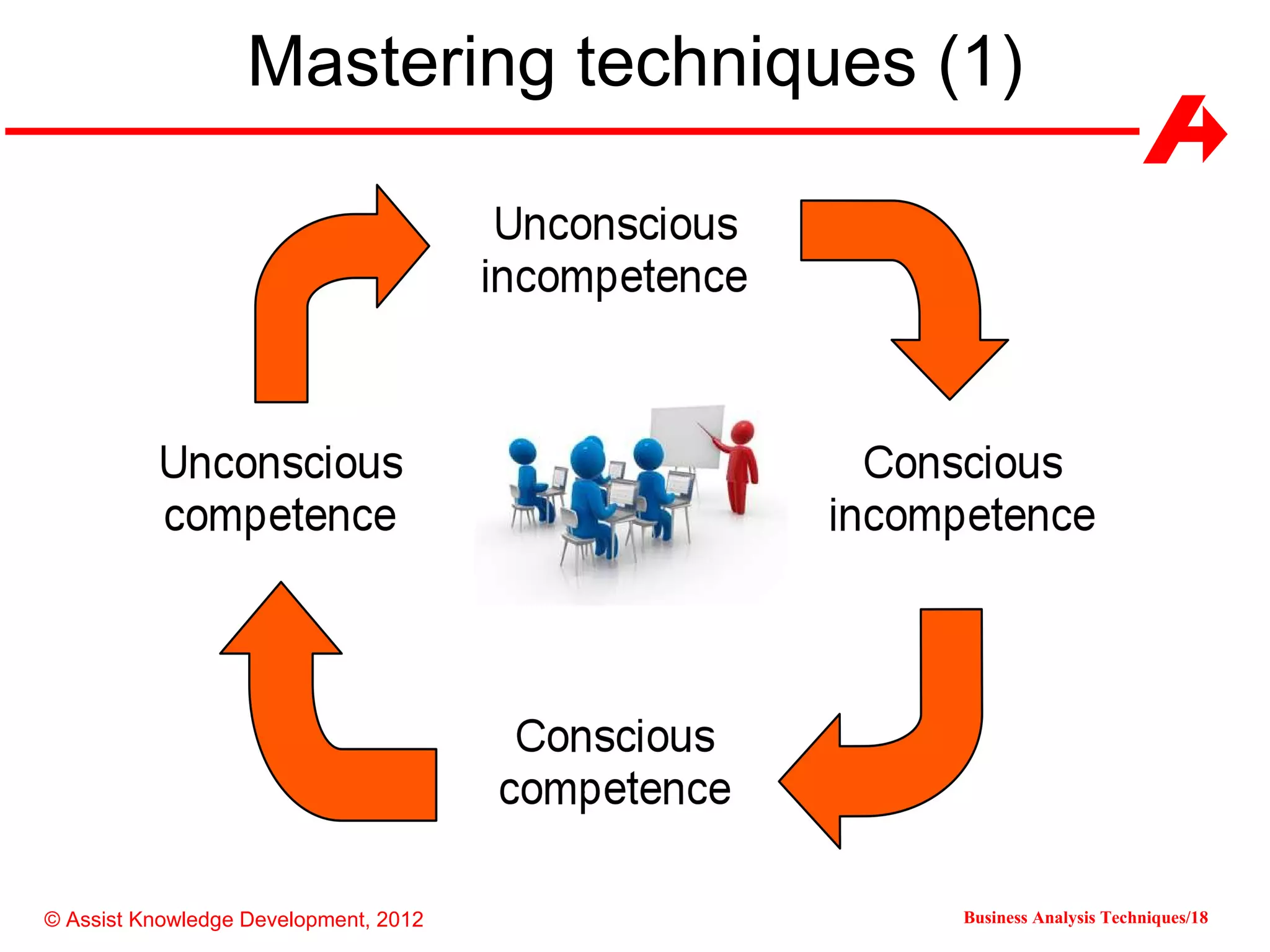
Mastering techniques (1)


© Assist Knowledge Development, 2012     Business Analysis Techniques/18
Mastering techniques (2)

                               Networking


                                                        Work
                                                      Experience


                                            Private
                                             study
            Courses
© Assist Knowledge Development, 2012                  Business Analysis Techniques/19
A basic toolkit

   Business
    Strategy       Investigate        Consider       Analyse            Evaluate        Define              Manage
      and           Situation        Perspectives     Needs              options      Requirements          Change
   Objectives


 PESTLE           Rich pictures      Stakeholder    Gap analysis        Feasibility    Scenarios           Cultural web
                                     Management                         Analysis
 MOST             Interviews                        Value chain                        Storyboarding       Learning cycle
                                     CATWOE         Analysis            Impact
 SWOT             Workshops                                             Analysis       Prototyping         SARAH
                                     PARADE
                                                    Organisation
 Resource Audit   Context diagrams                  Diagraming          Investment     MoSCoW              Benefits
                                     BAMs                               Appraisal                          Realisation
 POP-IT model
                                                    Process Modelling
                                     RASCI                              Business       Timeboxing
                                                    CRUD Matrix         case


© Assist Knowledge Development, 2012                                                       Business Analysis Techniques/20
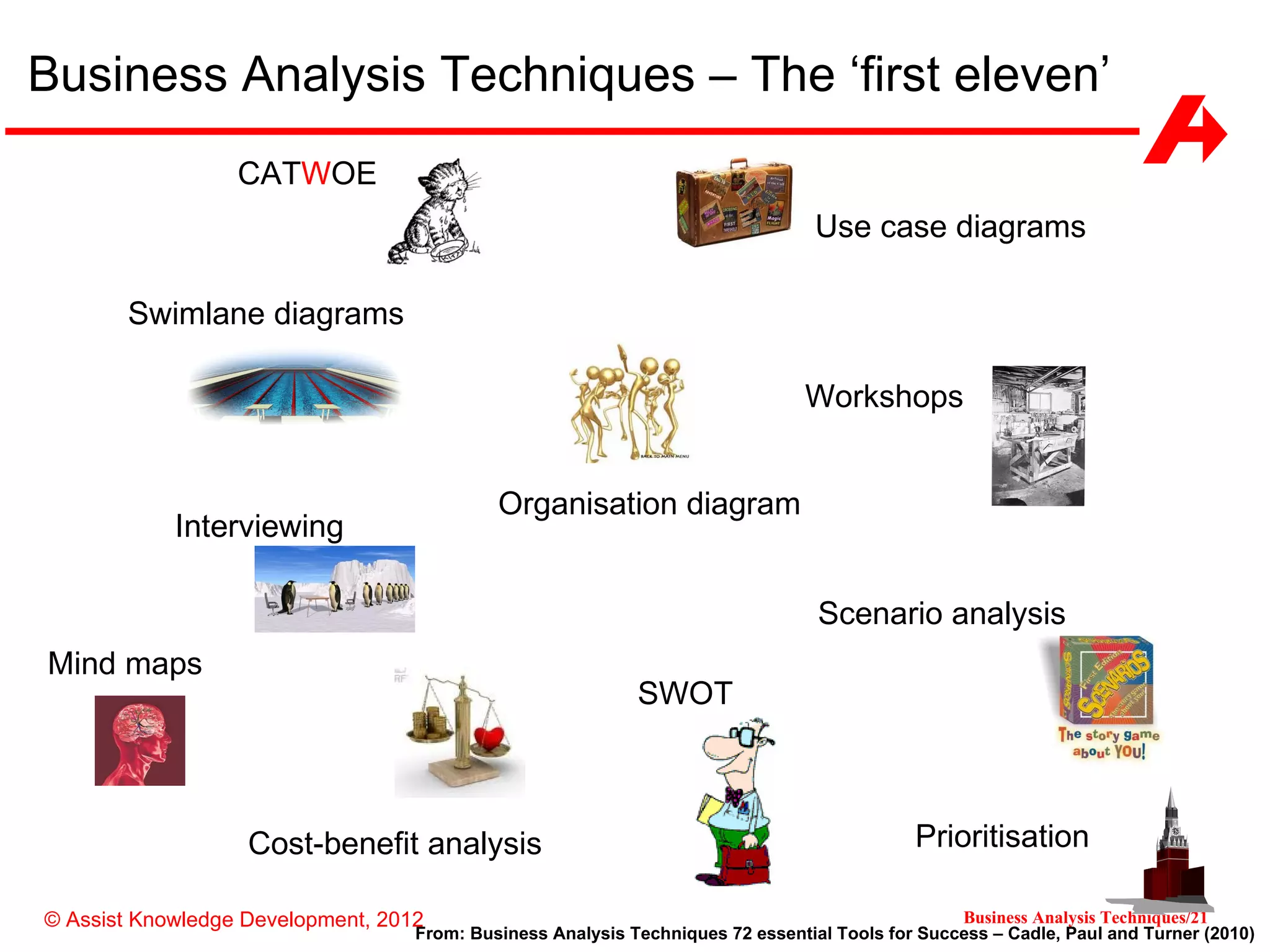
Business Analysis Techniques – The ‘first eleven’
                  CATWOE
                                                                                 Use case diagrams

       Swimlane diagrams

                                                                                Workshops


                                            Organisation diagram
            Interviewing

                                                                                 Scenario analysis
Mind maps
                                                            SWOT


                   Cost-benefit analysis                                                    Prioritisation

© Assist Knowledge Development, 2012                                                             Business Analysis Techniques/21
                                   From: Business Analysis Techniques 72 essential Tools for Success – Cadle, Paul and Turner (2010)
So why not try
                         some out
                        for yourself!

© Assist Knowledge Development, 2012   Business Analysis Techniques/22
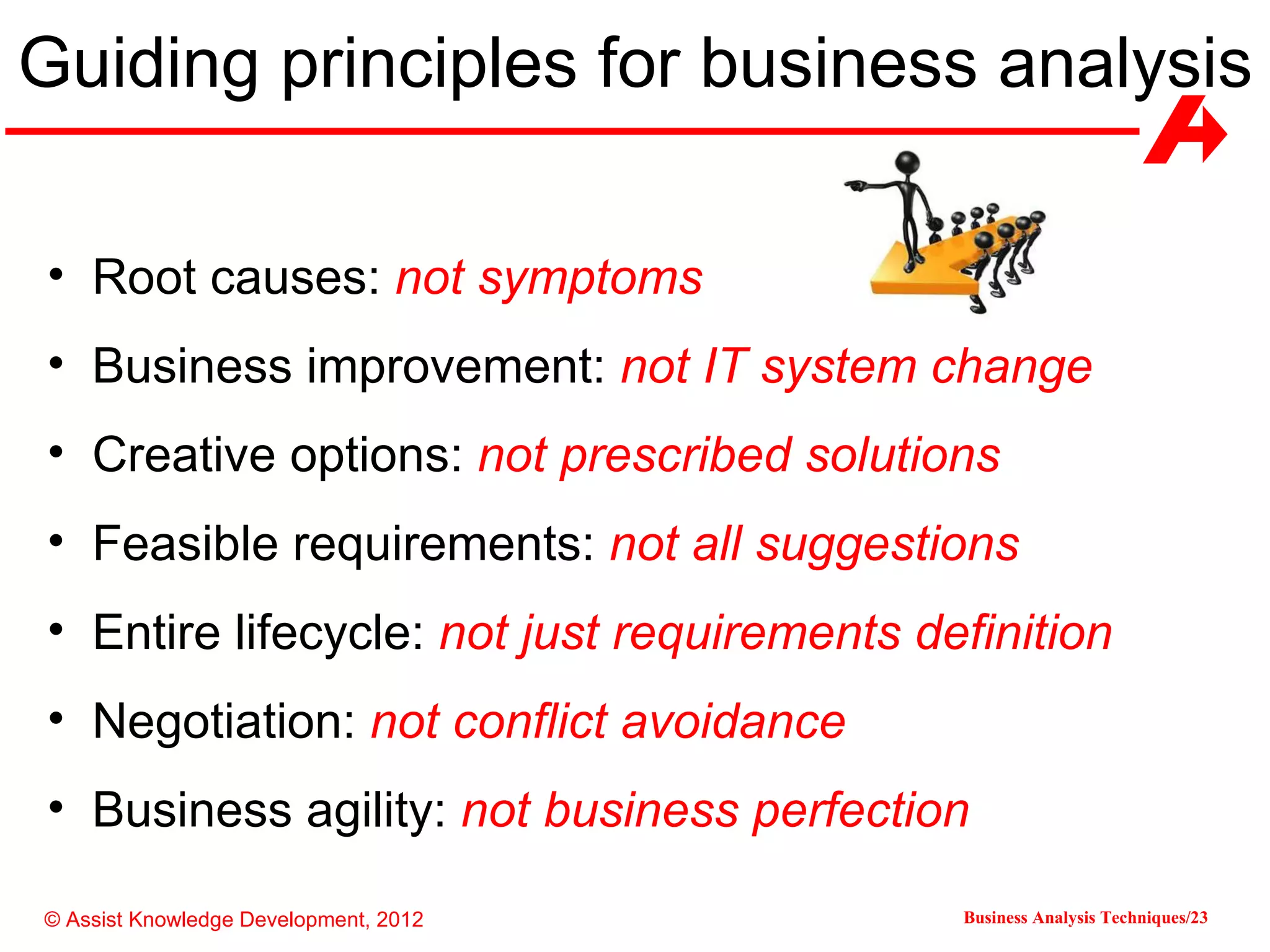
Guiding principles for business analysis

• Root causes: not symptoms
• Business improvement: not IT system change
• Creative options: not prescribed solutions
• Feasible requirements: not all suggestions
• Entire lifecycle: not just requirements definition
• Negotiation: not conflict avoidance
• Business agility: not business perfection

© Assist Knowledge Development, 2012        Business Analysis Techniques/23
BA of the Year Award 2012


  • Will be presented at the Business Analysis Conference
    Europe in London on 25th September 2012

  • Five finalists get free entry to the Conference from 24th to
    26th September 2012

  • Application form from: chris.martin@assistkd.com

  • Closing date for entries: 20th July 2012


            Award sponsored by:

© Assist Knowledge Development, 2012                 Business Analysis Techniques/24
Business Analysis Techniques
   …you can never have too many tools
                                  Paul Turner


                                       paul.turner@assistkd.com

© Assist Knowledge Development, 2012                              Business Analysis Techniques/25

Business Analysis Techniques

  • 1.
    Business Analysis Techniques …you can never have too many tools Paul Turner Edinburgh 12th April 2012 © Assist Knowledge Development, 2012 Business Analysis Techniques/1
  • 2.
    Business analysis -definitions An internal consultancy role responsible for investigating business situations, identifying and evaluating options for implementation business systems, defining requirements and ensuring the effective use of information systems in meeting the needs of the business. Business Analysis 2nd Ed., Debra Paul and Donald Yeates (eds), BCS, 2010 The methodical investigation, analysis, review and documentation of all or part of a business in terms of business functions and processes, the information used and the data on which the information is based. The definition of requirements for improving any aspect of the processes and systems and the quantification of potential business benefits. The creation of viable specifications and acceptance criteria in preparation for the construction of information and communication systems. SFIA v5.0, 2011 © Assist Knowledge Development, 2012 Business Analysis Techniques/2
  • 3.
    An alternative definition ©Assist Knowledge Development, 2012 Business Analysis Techniques/3
  • 4.
    The breadth ofBusiness Analysis ? Strategic analysis Business analysis Business case Requirements engineering Solution development © Assist Knowledge Development, 2012 Business Analysis Techniques/4
  • 5.
    The breadth ofBusiness Analysis ? Business Architecture Strategic analysis Business analysis Systems Thinking Business case Solution Architecture Requirements engineering Solution development © Assist Knowledge Development, 2012 Agile development Business Analysis Techniques/5
  • 6.
    BA techniques incontext Context Rationale + Lifecycle + Roles + Deliverables Techniques © Assist Knowledge Development, 2012 Business Analysis Techniques/6
  • 7.
    BA techniques incontext Context Rationale + Lifecycle + Roles + Deliverables Techniques © Assist Knowledge Development, 2012 Business Analysis Techniques/7
  • 8.
    Some business analysistechniques © Assist Knowledge Development, 2012 Business Analysis Techniques/8
  • 9.
    Some business analysistechniques Critical success factors Use case diagram Website navigation model Context diagram Use case description Process dependency modelling Rich picture Technical architecture model Object interaction / Function hierarchy Functional dependency collaboration diagram Network architecture plan diagram Object role models Workflow diagram Business scenario modelling User conceptual model Organisation chart Task analysis User interface object model Entity relationship model (high- Business event model Screen navigation design level) Business roles definition System event modelling Business process model Logical data model State transition diagram High-level data flow diagram Class model State machine diagram Business object model Relational data analysis Object dynamic model SWOT Event analysis Process streamlining PESTLE Payback calculation Business process redesign Five Forces DCF/NPV calculation Interviewing Power/interest grid Internal rate of return Workshops MOST Benefits management Questionnaires Resource audit Benefits realisation Document analysis BCG matrix User acceptance testing Record searching Balanced business scorecard Swimlane diagrams Special-purpose records Key performance indicators Business process Activity sampling CATWOE reengineering Work measurement Business activity modelling Business process management Prototyping © Assist Knowledge Development, 2012 Business Analysis Techniques/9
  • 10.
    More business analysistechniques Give up yet? Aargh! Brainstorming Cost/benefit analysis Round-robin Impact analysis Columns and clusters Gap analysis Bodyguards and assassins Standard costing Vernissage Marginal costing Talking wall Absorption costing Force-field analysis Ratio analysis Greenfield site MoSCoW Transporter Organisation diagram Prioritisation Report writing Time beam Presentation techniques And even then people said “ You’ve missed …….” © Assist Knowledge Development, 2012 Business Analysis Techniques/10
  • 11.
    The role ofthe business analyst Investigating the situation Analysing strategy Modelling business processes Stimulating thinking Developing Business Specifying business analyst information case systems © Assist Knowledge Development, 2012 Business Analysis Techniques/11
  • 12.
    Investigating the situation Questionnaires <<extend>> Interviewing <<extend>> Workshops Special-purpose records <<extend>> <<extend>> Activity sampling <<extend>> Work measurement Business Record searching analyst <<extend>> Document analysis © Assist Knowledge Development, 2012 Business Analysis Techniques/12
  • 13.
    Analysing strategy Five forces PESTLE <<extend>> <<extend>> MOST <<extend>> SWOT <<extend>> Resource <<extend>> audit Business analyst CATWOE © Assist Knowledge Development, 2012 Business Analysis Techniques/13
  • 14.
    Developing a businesscase Benefits Benefits realisation management DCF/NPV Impact <<extend>> analysis <<extend>> <<extend>> IRR <<extend>> <<extend>> Report writing <<extend>> Cost/benefit <<extend>> analysis Payback <<extend>> calculation Business Presentation <<extend>> <<extend>> analyst techniques Ratio analysis <<extend>> Marginal costing <<extend>> <<extend>> Standard costing Absorption Gap analysis costing © Assist Knowledge Development, 2012 Business Analysis Techniques/14
  • 15.
    Finding reasons notto © Assist Knowledge Development, 2012 Business Analysis Techniques/15
  • 16.
    Selecting techniques • The situation: • How much time? • How much money? • How good a job? • Local standards! • The ‘users’: • Technical literacy • Patience • Decisiveness • The business analyst: • Personality • Preferences • Knowledge • Experience © Assist Knowledge Development, 2012 Business Analysis Techniques/16
  • 17.
    Selecting techniques •Type - hard, soft •Usage - analysis, modelling, communication •Audience - shared, private •Documentation - core, support © Assist Knowledge Development, 2012 Business Analysis Techniques/17
  • 18.
    Mastering techniques (1) ©Assist Knowledge Development, 2012 Business Analysis Techniques/18
  • 19.
    Mastering techniques (2) Networking Work Experience Private study Courses © Assist Knowledge Development, 2012 Business Analysis Techniques/19
  • 20.
    A basic toolkit Business Strategy Investigate Consider Analyse Evaluate Define Manage and Situation Perspectives Needs options Requirements Change Objectives PESTLE Rich pictures Stakeholder Gap analysis Feasibility Scenarios Cultural web Management Analysis MOST Interviews Value chain Storyboarding Learning cycle CATWOE Analysis Impact SWOT Workshops Analysis Prototyping SARAH PARADE Organisation Resource Audit Context diagrams Diagraming Investment MoSCoW Benefits BAMs Appraisal Realisation POP-IT model Process Modelling RASCI Business Timeboxing CRUD Matrix case © Assist Knowledge Development, 2012 Business Analysis Techniques/20
  • 21.
    Business Analysis Techniques– The ‘first eleven’ CATWOE Use case diagrams Swimlane diagrams Workshops Organisation diagram Interviewing Scenario analysis Mind maps SWOT Cost-benefit analysis Prioritisation © Assist Knowledge Development, 2012 Business Analysis Techniques/21 From: Business Analysis Techniques 72 essential Tools for Success – Cadle, Paul and Turner (2010)
  • 22.
    So why nottry some out for yourself! © Assist Knowledge Development, 2012 Business Analysis Techniques/22
  • 23.
    Guiding principles forbusiness analysis • Root causes: not symptoms • Business improvement: not IT system change • Creative options: not prescribed solutions • Feasible requirements: not all suggestions • Entire lifecycle: not just requirements definition • Negotiation: not conflict avoidance • Business agility: not business perfection © Assist Knowledge Development, 2012 Business Analysis Techniques/23
  • 24.
    BA of theYear Award 2012 • Will be presented at the Business Analysis Conference Europe in London on 25th September 2012 • Five finalists get free entry to the Conference from 24th to 26th September 2012 • Application form from: chris.martin@assistkd.com • Closing date for entries: 20th July 2012 Award sponsored by: © Assist Knowledge Development, 2012 Business Analysis Techniques/24
  • 25.
    Business Analysis Techniques …you can never have too many tools Paul Turner paul.turner@assistkd.com © Assist Knowledge Development, 2012 Business Analysis Techniques/25

Editor's Notes

  • #2 BA Techniques When asked to give this talk, was looking for an angle. Thought at first might shine a ‘narrow beam’ on just one or two techniques. But which ones? At least someone in this audience would be expert and so bored by this. Then asked some of my colleagues to brainstorm – technique there! – list of all the BA techniques they’d ever heard of . A lot of techniques suggested, so I decided to do a survey of the field, as it were, and make some suggestions about where and how the various techniques might be used. So that’s the outline of my presentation.
  • #3 BA Techniques
  • #4 BA Techniques
  • #9 BA Techniques
  • #10 BA Techniques
  • #11 BA Techniques
  • #12 BA Techniques NOTE – SLIDE BUILDS – PICTURE APPEARS ON MOUSE CLICK To try to make sense of this, I decided to think about what business analysts actually do. I divided their work into six broad areas. These are not meant to be definitive, they’re only my classification for this talk. I’m sure we could debate this for hours and there are undoubtedly better classifications possible but just bear with me for this evening! DISPLAY USE CASE DIAGRAM. I – or to be absolutely honest, my colleague Debbie Paul - suggested using a use case context diagram for this and that’s what we have here. TALK THROUGH CLASSIFICATIONS AND WHAT’S INCLUDED IN EACH.
  • #13 BA Techniques The first group of techniques are used to investigate the situation, to get at the facts – and opinions – that are relevant to the business issue we’re studying. In the ISEB BA diploma, this is called ‘elicitation’ and in the ISEB IS Consultancy Practice Certificate it’s called ‘Data Collection’. But what’s in a name? You’ll notice that I’ve used the use case ‘extend’ construct in some places here. The idea is that all of these techniques can stand alone but they can also be used to build on others. For instance, you might hold a workshop and then decide to pursue some issues in more detail using one-to-one interviews. Or vice-versa probably, though that’s not shown on the diagram. I would guess that interviews and workshops are the most-used techniques here, with others taking a supporting role.
  • #14 BA Techniques Next, let’s look at some strategic analysis tools. Again, all of these can be used on their own but I’ve also shown them feeding in to a SWOT analysis. Everyone know what a SWOT analysis is? EXPLAIN SWOT CONCEPT IF REQUIRED. Very often, SWOTS are constructed by just brainstorming but we’ve found that using the other techniques to understand the internal and external environment makes for a more structured and powerful analysis. CATWOE – if you haven’t met it before – comes from the world of Soft Systems. The most important element is the Weltanshauung or World View and this is relevant in understanding strategy as, sometimes, it is a difference of world view within the management team of an organisation that leads to problems. Or where the world view is completely out of step with the real world.
  • #15 BA Techniques Next, we have the important work of business case construction. I know that some business analysts get involved in this, while others contribute to business cases created elsewhere – by the project sponsor for example. But either way, I think that BAs need to have an understanding of the concepts involved. You’ll notice that extending the cost/benefit analysis are a number of scary-sounding accounting techniques. You may, as a BA, use the services of your management accountants to do these analyses properly but you do, I think, need to understand the principles involved so you can discuss the results meaningfully with the accountants. And, as the slide shows, you do need the ability to put your ideas over both in writing and in a presentation.
  • #17 BA Techniques OK, so there you have it – a vast array of techniques. So how do you decide which to use when? I think there are three criteria to consider: The situation – TALK THROUGH THIS The ‘users’ – TALK THROUGH THIS The business analyst – TALK THROUGH THIS. MAKE THE POINT THAT WHAT WORKS FOR ONE PERSON WILL COMPLETELY FAIL FOR ANOTHER. IMPORTANT NOT TO GO OFF AT HALF-COCK AND RUIN YOUR CREDIBILITY.
  • #19 BA Techniques NOTE – SLIDE BUILDS – PICTURE APPEARS ON MOUSE CLICK So how do we learn to use these techniques effectively? DISPLAY PICTURE. I guess most of us have seen this model of the skills development process. And I guess also that, for each of the techniques I’ve presented, we’re all going to be somewhere or other on the model. At least after this talk, we’ll all be in a state of conscious incompetence in that there will be some techniques we’ve only just heard of and will want to examine further.
  • #20 BA Techniques Essentially, there are four ways of developing our mastery of the various techniques: Courses are an obvious one and, for some techniques, they really are essential. I think, for instance, that learning how to use CATWOE or build a business activity model is best done with someone at hand who can advise and guide you on what do to. But for many techniques, private study is just as good. The main difficulty is finding suitable reference sources and I have to admit that BA techniques are scattered about all over the place. But the references in the BCS Business Analysis book provide a starting point and there is always the internet. Thirdly, discuss with your colleagues and network e.g. IIBA events. I actually believe, though, that you learn best by trying things out. Ideally, you can find someone in your organisation who is good at a particular technique and get some mentoring from them. Short of that, find a small, safe issue, on which to practise. Sometimes, you’ll find that a particular technique doesn’t work for you – I can’t seem to get on with mind-maps, for instance, which is probably why I’ve left them out of this presentation.
  • #21 BA Techniques Just to summarise this, then, I’ve put together what I call a basic toolkit of techniques that I think all BAs ought to master. I’ve treated my six areas sequentially here but, of course, this is an over-simplification. Also, some techniques can be used in other places – you might well use MoSCoW, for instance, in a workshop to get people thinking about the priority they assign to things. I’m sure each of you has a favourite technique that you’d want to see in these lists – and you’re view is as valid as mine here.
  • #23 BA Techniques
  • #26 BA Techniques When asked to give this talk, was looking for an angle. Thought at first might shine a ‘narrow beam’ on just one or two techniques. But which ones? At least someone in this audience would be expert and so bored by this. Then asked some of my colleagues to brainstorm – technique there! – list of all the BA techniques they’d ever heard of . A lot of techniques suggested, so I decided to do a survey of the field, as it were, and make some suggestions about where and how the various techniques might be used. So that’s the outline of my presentation.