ENTERICFEVER
INTRODUCTION
Fever (Caused) by Infection in Intestine
An Acute Generalized Infection of Intestinal
Lymphoid RES , Gall Bladder Tissues
Typhoid
Paratyphoid
– 90 % cases
‐ 10 % cases
HISTORICAL
BACKGROUND
• Typhoid = Typhus ( Rickettsial ) like
• Typhos (Gk) = Smoke (cause), Cloudy (sensorium)
• Phytos (Gk) = Putrefaction (of food as cause)
THE ORGANISM
• Gram Negative, Nonacid fast, Noncapsulated,
Nonsporing bacilli
•
•
A Very Die hard Organism ‐ Life long carriers
Types :
–
–
–
–
Salmonella
Salmonella
Salmonella
Salmonella
typhi
paratyphoid
paratyphoid
paratyphoid
A
B
C
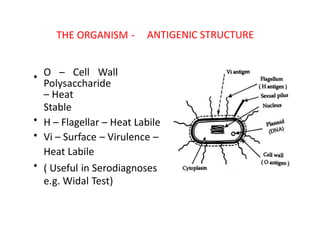
THE ORGANISM ‐ ANTIGENIC STRUCTURE
• O – Cell Wall
Polysaccharide
– Heat
Stable
H – Flagellar – Heat Labile
Vi – Surface – Virulence –
Heat Labile
( Useful in Serodiagnoses
e.g. Widal Test)
•
•
•
EPIDEMIOLOGY
Occurs Exclusively in Humans
Spread – Contaminated Food, Milk, Water
‐ By Flies from Human Excreta to Food
‐ Poor Personal Hygiene
‐ Poor Sanitation
Age – Older Children, Young Adults
<5 Years = only 10 %
<2 Years = only 2 %
Gender ‐ Equal
EPIDEMIOLOGY – CONT..
Areas – Underdeveloped, Poor
Annual Occurrence – Throughout the year
Peak Time – July to August
(Summer/Early Rains)
Incubation Period – 1 to 2 weeks (3‐60
days)
Infectivity Period – Long (>2 to 3 m)
Carriers (5%) – 20‐50 years; Females
more
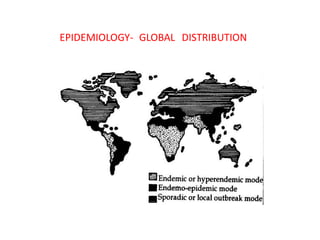
EPIDEMIOLOGY- GLOBAL DISTRIBUTION
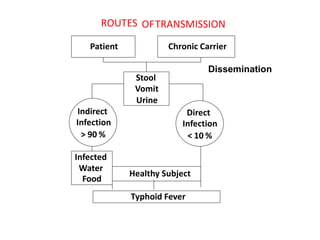
ROUTES OFTRANSMISSION
Dissemination
Indirect
Infection
Direct
Infection
> 90 % < 10 %
Typhoid Fever
Infected
Water
Food
Healthy Subject
Patient Chronic Carrier
Stool
Vomit
Urine
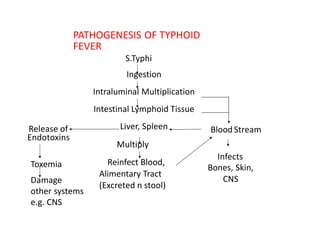
PATHOGENESIS OF TYPHOID
FEVER
S.Typhi
Ingestion
Intraluminal Multiplication
Intestinal Lymphoid Tissue
Liver, Spleen
Multiply
Reinfect Blood,
Alimentary Tract
(Excreted n stool)
Release of
Endotoxins
Blood Stream
Infects
Bones, Skin,
CNS
Toxemia
Damage
other systems
e.g. CNS
Clinical Features
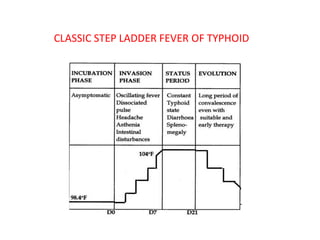
• • Fever :
– Acute Onset
– Continuous (+ Morning Remission )
– Moderate To High Grade
– Persisting since 6‐7 Days
– Classic Step Ladder Pattern Not Seen in
children
IAP UG Teaching slides 2015-16
CLASSIC STEP LADDER FEVER OF TYPHOID
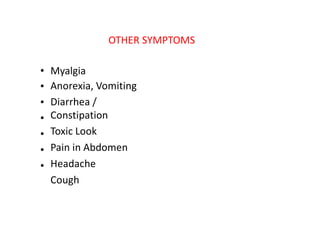
OTHER SYMPTOMS
•
•
•
•
•
•
•
Myalgia
Anorexia, Vomiting
Diarrhea /
Constipation
Toxic Look
Pain in Abdomen
Headache
Cough
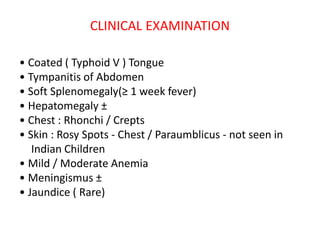
CLINICAL EXAMINATION
• Coated ( Typhoid V ) Tongue
• Tympanitis of Abdomen
• Soft Splenomegaly(≥ 1 week fever)
• Hepatomegaly ±
• Chest : Rhonchi / Crepts
• Skin : Rosy Spots ‐ Chest / Paraumblicus ‐ not seen in
Indian Children
• Mild / Moderate Anemia
• Meningismus ±
• Jaundice ( Rare)
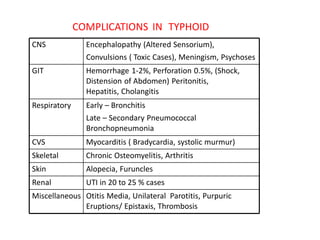
COMPLICATIONS IN TYPHOID
CNS Encephalopathy (Altered Sensorium),
Convulsions ( Toxic Cases), Meningism, Psychoses
GIT Hemorrhage 1‐2%, Perforation 0.5%, (Shock,
Distension of Abdomen) Peritonitis,
Hepatitis, Cholangitis
Respiratory Early – Bronchitis
Late – Secondary Pneumococcal
Bronchopneumonia
CVS Myocarditis ( Bradycardia, systolic murmur)
Skeletal Chronic Osteomyelitis, Arthritis
Skin Alopecia, Furuncles
Renal UTI in 20 to 25 % cases
Miscellaneous Otitis Media, Unilateral Parotitis, Purpuric
Eruptions/ Epistaxis, Thrombosis
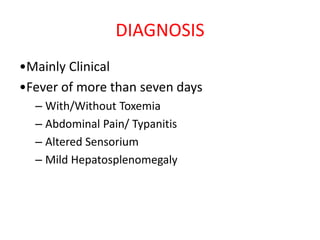
DIAGNOSIS
•Mainly Clinical
•Fever of more than seven days
– With/Without Toxemia
– Abdominal Pain/ Typanitis
– Altered Sensorium
– Mild Hepatosplenomegaly
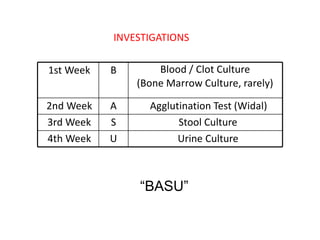
INVESTIGATIONS
“BASU”
1st Week B Blood / Clot Culture
(Bone Marrow Culture, rarely)
2nd Week A Agglutination Test (Widal)
3rd Week S Stool Culture
4th Week U Urine Culture
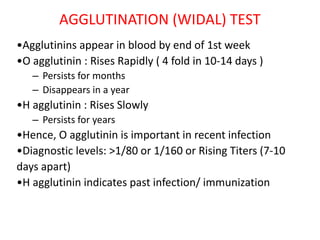
AGGLUTINATION (WIDAL) TEST
•Agglutinins appear in blood by end of 1st week
•O agglutinin : Rises Rapidly ( 4 fold in 10‐14 days )
– Persists for months
– Disappears in a year
•H agglutinin : Rises Slowly
– Persists for years
•Hence, O agglutinin is important in recent infection
•Diagnostic levels: >1/80 or 1/160 or Rising Titers (7‐10
days apart)
•H agglutinin indicates past infection/ immunization
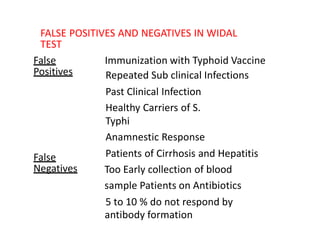
FALSE POSITIVES AND NEGATIVES IN WIDAL
TEST
False
Positives
Immunization with Typhoid Vaccine
Repeated Sub clinical Infections
Past Clinical Infection
Healthy Carriers of S.
Typhi
Anamnestic Response
Patients of Cirrhosis and Hepatitis
Too Early collection of blood
sample Patients on Antibiotics
5 to 10 % do not respond by
antibody formation
False
Negatives
NON SPECIFIC LAB FINDINGS IN TYPHOID FEVER
Mild Normochromic Anemia
Mild Thrombocytopenia
Leucopenia / Leucocytosis
Eosinopenia – Presence heralds recovery
An Increased ESR
Laboratory Evidence of Mild DIC
Hyponatremia and Hypokalemia
Elevation of Liver Enzymes
Urine : Some Proteins and White Cells
Stool : Leucocytes and Blood common
•
•
•
•
•
•
•
•
•
•
DIFFERENTIAL DIAGNOSIS
Infective Diarrhea : Stool Examination
Viral Fever : Self limiting (< 7 days)
UTI : Urinalysis
Malaria : Blood smear examination
Miliary TB : F/H, CXR, Mantoux
Appendicitis : White cell count
Bacterial Endocarditis : Blood Culture
Viral Hepatitis : LFTs
Kala – Azar : Double rise temperature,
no toxemia
IAP UG Teaching slides 2015-16
•
•
•
•
•
•
•
•
• good appetite,
23
TREATMENT ‐ GENERAL
•Tepid Sponging
•Paracetamol
•Adequate water and food intake
•Hospitalize if : Toxemic / complications
‐ NeedsFluids/Therapyby IV Route
TREATMENT ‐ MEDICAL
Uncomplicated Typhoid fever
•Fully sensitive:
‐ Chloramphenicol or Amoxicillin
as
‐ Fluoroquinolone as second line
•MDR:
first line
‐ Fluoroquinolone or Cefixime as first line
‐ Azithromycin as second line
•Quinolone resistant:
‐ Azithromycin or Ceftriaxone as first line
‐ Cefixime as second line
TREATMENT ‐ MEDICAL
Complicated/Severe Typhoid fever
•Fully sensitive:
‐ Ceftriaxone as first line
‐ Fluoroquinolone as second line
•MDR:
‐ Fluoroquinolone as first line
‐ Ceftriaxone/Cefotaxime as second lIne
•Quinolone resistant:
‐ Ceftriaxone as first line
‐ Azithromycin or Gatifloxacin as second line
TREATMENT – MEDICAL – CONT..
• Chloramphenicol: 50‐75mg/kg/day for 14‐21 days
• Cefixime: 15‐20 mg / kg/day/O in 2 doses x 7‐14 days
• Ceftriaxone: 80‐100 mg/kg/day/IV in 2 doses x 10‐14
days
• Cefotaxime: 100mg/kg/day/IV in two doses x 10‐14
days
• Azithromycin: 20mg/kg/day/O single dose x 7 days
• Ofloxacin/Ciprofloxacin: 15mg/kg/day for 10‐14 days
• Gatifloxacin: 10mg/kg/day for 7 days
Treatment of Comlications
• HAEMORRHAGE
– Bed rest / foot end raised
– Nothing orally
– Repeated blood
transfusions
– Morphine sc.
• ENCEPHALOPATHY
– Anticonvulsants
– Dexamethasone
• PNEUMONIA
–↑ Antimicrobial spectrum
• ANAEMIA : Blood
replacement
• INTESTINAL PERFORATION
–Surgical intervention
–Clindamycin /
Metronidazole
Prevention
• Personal Hygiene
• Safe drinking water and food habits
• Avoid unpasteurized dairy products
• Public health measures for
– Disposal of Excreta
– Ban on sale of contaminated food
• Tracing & Treatment of Carriers
• Active immunization with vaccine
Carriers
• Convalescent carrier: Patients who continue to shed bacilli
in feaces for 3 weeks to 3 months after cure
• Temporary carrier: Those who shed for 3 months to 1 year
• Chronic Carrier: Those who shed more than 1 year (2 – 4%
patients become chronic carrier)
• Healthy carrier / Intermittent carrier:
– Harbours infection without suffering from the disease
– Bacilli persists in gall bladder or kidney
• Treatment:
– Prolonged treatment with quinolones orCephalosporins
– May require gall bladder removal
Typhoid Vaccine
•Two Typhoid conjugate vaccines currently
available
(Typbar‐TCV, PedaTyph)
‐ PedaTyph not yet approved
‐ First does at 9‐12 months of age with at least
4 wks. interval with MMR vaccine
‐ Booster dose at 2yrs of age
•Booster dose can be either conjugate vaccine or
Vi‐Polysaccharide vaccine
Typhoid Vaccine
•Those receiving booster Vi‐PS vaccine need
revaccination every 3yrs
•Need for further boosters after conjugate
vaccine is not yet determined

Enteric Fever in Children -Recent UPdate.pptx

  • 1.
  • 2.
    INTRODUCTION Fever (Caused) byInfection in Intestine An Acute Generalized Infection of Intestinal Lymphoid RES , Gall Bladder Tissues Typhoid Paratyphoid – 90 % cases ‐ 10 % cases
  • 3.
    HISTORICAL BACKGROUND • Typhoid =Typhus ( Rickettsial ) like • Typhos (Gk) = Smoke (cause), Cloudy (sensorium) • Phytos (Gk) = Putrefaction (of food as cause)
  • 4.
    THE ORGANISM • GramNegative, Nonacid fast, Noncapsulated, Nonsporing bacilli • • A Very Die hard Organism ‐ Life long carriers Types : – – – – Salmonella Salmonella Salmonella Salmonella typhi paratyphoid paratyphoid paratyphoid A B C
  • 5.
    THE ORGANISM ‐ANTIGENIC STRUCTURE • O – Cell Wall Polysaccharide – Heat Stable H – Flagellar – Heat Labile Vi – Surface – Virulence – Heat Labile ( Useful in Serodiagnoses e.g. Widal Test) • • •
  • 6.
    EPIDEMIOLOGY Occurs Exclusively inHumans Spread – Contaminated Food, Milk, Water ‐ By Flies from Human Excreta to Food ‐ Poor Personal Hygiene ‐ Poor Sanitation Age – Older Children, Young Adults <5 Years = only 10 % <2 Years = only 2 % Gender ‐ Equal
  • 7.
    EPIDEMIOLOGY – CONT.. Areas– Underdeveloped, Poor Annual Occurrence – Throughout the year Peak Time – July to August (Summer/Early Rains) Incubation Period – 1 to 2 weeks (3‐60 days) Infectivity Period – Long (>2 to 3 m) Carriers (5%) – 20‐50 years; Females more
  • 8.
  • 9.
    ROUTES OFTRANSMISSION Dissemination Indirect Infection Direct Infection > 90% < 10 % Typhoid Fever Infected Water Food Healthy Subject Patient Chronic Carrier Stool Vomit Urine
  • 10.
    PATHOGENESIS OF TYPHOID FEVER S.Typhi Ingestion IntraluminalMultiplication Intestinal Lymphoid Tissue Liver, Spleen Multiply Reinfect Blood, Alimentary Tract (Excreted n stool) Release of Endotoxins Blood Stream Infects Bones, Skin, CNS Toxemia Damage other systems e.g. CNS
  • 11.
    Clinical Features • •Fever : – Acute Onset – Continuous (+ Morning Remission ) – Moderate To High Grade – Persisting since 6‐7 Days – Classic Step Ladder Pattern Not Seen in children
  • 12.
    IAP UG Teachingslides 2015-16 CLASSIC STEP LADDER FEVER OF TYPHOID
  • 13.
    OTHER SYMPTOMS • • • • • • • Myalgia Anorexia, Vomiting Diarrhea/ Constipation Toxic Look Pain in Abdomen Headache Cough
  • 14.
    CLINICAL EXAMINATION • Coated( Typhoid V ) Tongue • Tympanitis of Abdomen • Soft Splenomegaly(≥ 1 week fever) • Hepatomegaly ± • Chest : Rhonchi / Crepts • Skin : Rosy Spots ‐ Chest / Paraumblicus ‐ not seen in Indian Children • Mild / Moderate Anemia • Meningismus ± • Jaundice ( Rare)
  • 15.
    COMPLICATIONS IN TYPHOID CNSEncephalopathy (Altered Sensorium), Convulsions ( Toxic Cases), Meningism, Psychoses GIT Hemorrhage 1‐2%, Perforation 0.5%, (Shock, Distension of Abdomen) Peritonitis, Hepatitis, Cholangitis Respiratory Early – Bronchitis Late – Secondary Pneumococcal Bronchopneumonia CVS Myocarditis ( Bradycardia, systolic murmur) Skeletal Chronic Osteomyelitis, Arthritis Skin Alopecia, Furuncles Renal UTI in 20 to 25 % cases Miscellaneous Otitis Media, Unilateral Parotitis, Purpuric Eruptions/ Epistaxis, Thrombosis
  • 16.
    DIAGNOSIS •Mainly Clinical •Fever ofmore than seven days – With/Without Toxemia – Abdominal Pain/ Typanitis – Altered Sensorium – Mild Hepatosplenomegaly
  • 17.
    INVESTIGATIONS “BASU” 1st Week BBlood / Clot Culture (Bone Marrow Culture, rarely) 2nd Week A Agglutination Test (Widal) 3rd Week S Stool Culture 4th Week U Urine Culture
  • 18.
    AGGLUTINATION (WIDAL) TEST •Agglutininsappear in blood by end of 1st week •O agglutinin : Rises Rapidly ( 4 fold in 10‐14 days ) – Persists for months – Disappears in a year •H agglutinin : Rises Slowly – Persists for years •Hence, O agglutinin is important in recent infection •Diagnostic levels: >1/80 or 1/160 or Rising Titers (7‐10 days apart) •H agglutinin indicates past infection/ immunization
  • 19.
    FALSE POSITIVES ANDNEGATIVES IN WIDAL TEST False Positives Immunization with Typhoid Vaccine Repeated Sub clinical Infections Past Clinical Infection Healthy Carriers of S. Typhi Anamnestic Response Patients of Cirrhosis and Hepatitis Too Early collection of blood sample Patients on Antibiotics 5 to 10 % do not respond by antibody formation False Negatives
  • 20.
    NON SPECIFIC LABFINDINGS IN TYPHOID FEVER Mild Normochromic Anemia Mild Thrombocytopenia Leucopenia / Leucocytosis Eosinopenia – Presence heralds recovery An Increased ESR Laboratory Evidence of Mild DIC Hyponatremia and Hypokalemia Elevation of Liver Enzymes Urine : Some Proteins and White Cells Stool : Leucocytes and Blood common • • • • • • • • • •
  • 21.
    DIFFERENTIAL DIAGNOSIS Infective Diarrhea: Stool Examination Viral Fever : Self limiting (< 7 days) UTI : Urinalysis Malaria : Blood smear examination Miliary TB : F/H, CXR, Mantoux Appendicitis : White cell count Bacterial Endocarditis : Blood Culture Viral Hepatitis : LFTs Kala – Azar : Double rise temperature, no toxemia IAP UG Teaching slides 2015-16 • • • • • • • • • good appetite, 23
  • 22.
    TREATMENT ‐ GENERAL •TepidSponging •Paracetamol •Adequate water and food intake •Hospitalize if : Toxemic / complications ‐ NeedsFluids/Therapyby IV Route
  • 23.
    TREATMENT ‐ MEDICAL UncomplicatedTyphoid fever •Fully sensitive: ‐ Chloramphenicol or Amoxicillin as ‐ Fluoroquinolone as second line •MDR: first line ‐ Fluoroquinolone or Cefixime as first line ‐ Azithromycin as second line •Quinolone resistant: ‐ Azithromycin or Ceftriaxone as first line ‐ Cefixime as second line
  • 24.
    TREATMENT ‐ MEDICAL Complicated/SevereTyphoid fever •Fully sensitive: ‐ Ceftriaxone as first line ‐ Fluoroquinolone as second line •MDR: ‐ Fluoroquinolone as first line ‐ Ceftriaxone/Cefotaxime as second lIne •Quinolone resistant: ‐ Ceftriaxone as first line ‐ Azithromycin or Gatifloxacin as second line
  • 25.
    TREATMENT – MEDICAL– CONT.. • Chloramphenicol: 50‐75mg/kg/day for 14‐21 days • Cefixime: 15‐20 mg / kg/day/O in 2 doses x 7‐14 days • Ceftriaxone: 80‐100 mg/kg/day/IV in 2 doses x 10‐14 days • Cefotaxime: 100mg/kg/day/IV in two doses x 10‐14 days • Azithromycin: 20mg/kg/day/O single dose x 7 days • Ofloxacin/Ciprofloxacin: 15mg/kg/day for 10‐14 days • Gatifloxacin: 10mg/kg/day for 7 days
  • 26.
    Treatment of Comlications •HAEMORRHAGE – Bed rest / foot end raised – Nothing orally – Repeated blood transfusions – Morphine sc. • ENCEPHALOPATHY – Anticonvulsants – Dexamethasone • PNEUMONIA –↑ Antimicrobial spectrum • ANAEMIA : Blood replacement • INTESTINAL PERFORATION –Surgical intervention –Clindamycin / Metronidazole
  • 27.
    Prevention • Personal Hygiene •Safe drinking water and food habits • Avoid unpasteurized dairy products • Public health measures for – Disposal of Excreta – Ban on sale of contaminated food • Tracing & Treatment of Carriers • Active immunization with vaccine
  • 28.
    Carriers • Convalescent carrier:Patients who continue to shed bacilli in feaces for 3 weeks to 3 months after cure • Temporary carrier: Those who shed for 3 months to 1 year • Chronic Carrier: Those who shed more than 1 year (2 – 4% patients become chronic carrier) • Healthy carrier / Intermittent carrier: – Harbours infection without suffering from the disease – Bacilli persists in gall bladder or kidney • Treatment: – Prolonged treatment with quinolones orCephalosporins – May require gall bladder removal
  • 29.
    Typhoid Vaccine •Two Typhoidconjugate vaccines currently available (Typbar‐TCV, PedaTyph) ‐ PedaTyph not yet approved ‐ First does at 9‐12 months of age with at least 4 wks. interval with MMR vaccine ‐ Booster dose at 2yrs of age •Booster dose can be either conjugate vaccine or Vi‐Polysaccharide vaccine
  • 30.
    Typhoid Vaccine •Those receivingbooster Vi‐PS vaccine need revaccination every 3yrs •Need for further boosters after conjugate vaccine is not yet determined