Ramesh Parajuli
MS (ORL-HNS)
Chitwan Medical College Teaching Hospital, Bharatpur-10, Chitwan, Nepal
DEAF CHILD
Definition
Importance of early diagnosis
Methods of screening
Clinical evaluation
Diagnostic methods
Management
Contents
IDEA (Individuals with Disabilities Education Act) 2007 defines
hearing loss:
- Deaf child is one who cannot understand spoken communication
even with a hearing aid.
- A hard of hearing child is one who can hear spoken
communication, but this does not necessarily mean that he
understands it.
Definition
Permanent childhood hearing impairment (PCHI): confirmed
permanent B/L hearing impairment exceeding 40 dBHL (average
of pure tone thresholds at 0.5,1,2 & 4 kHz in better hearing ear).
Congenital or acquired
Prelingual deafness Vs postlingual deafness
-for the child’s education and management
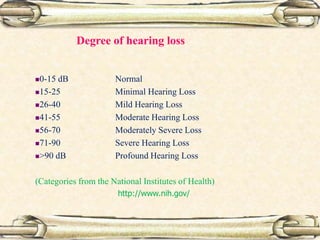
Degree of hearing loss
0-15 dB Normal
15-25 Minimal Hearing Loss
26-40 Mild Hearing Loss
41-55 Moderate Hearing Loss
56-70 Moderately Severe Loss
71-90 Severe Hearing Loss
>90 dB Profound Hearing Loss
(Categories from the National Institutes of Health)
http://www.nih.gov/
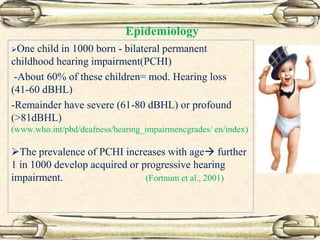
Epidemiology
One child in 1000 born - bilateral permanent
childhood hearing impairment(PCHI)
-About 60% of these children= mod. Hearing loss
(41-60 dBHL)
-Remainder have severe (61-80 dBHL) or profound
(>81dBHL)
(www.who.int/pbd/deafness/hearing_impairmencgrades/ en/index)
The prevalence of PCHI increases with age further
1 in 1000 develop acquired or progressive hearing
impairment. (Fortnum et al., 2001)
PCHI – one of the most common abnormality present at birth
The prevalence of hearing loss- greater than that of most other
diseases and syndromes (eg, phenylketonuria, sickle cell disease)
screened at birth.
Two thirds of people with moderate to severe hearing impairment
live in developing countries.
In developing countries-infection
congenital- rubella and CMV
acquired – mumps, measles, meningitis & COM
In developed countries- about half of PCHI—genetic cause
(www.who.int)
Terminology:
Bilateral Permanent childhood hearing loss (PCHL)
- Hearing loss >40 dB at (0.5k,1k,2k,4k ) – better ear
- 60 % children–mod CHL
Acquired/Late onset permanent hearing loss
- Postnatal/after birth
Unilateral permanent hearing loss
- Inability to hear from deaf side
- Difficulty – hearing – speech in noise
- Poor localization of sound
Auditory neuropathy/ Dyssynchrony (AN/AD)
- Damage to inner hair cells, synaptic junction, auditory
neurons in spiral ganglion
- Clinical test: normal OAE/ absent or abnormal ABR
- 10 % children - confirmed PCHL - Auditory neuropathy
- Found predominantly in NICU population
 Temporary childhood hearing loss
- OME – extremely common
- Major risk factors – season, passive smoking, bottle feed
URTI, NICU admission
- Speech and language delay
The High-Risk Register (HRR)
Prior to implementation of universal newborn hearing screening
Infants identified at high risk for hearing loss – high risk register
(HRR)screened
The risk factors for newborn:
(Joint Committee on Infant Hearing (JCIH) 2000 Position Statement)
Family h/o permanent childhood sensorineural hearing loss
In utero infection - cytomegalovirus, rubella, toxoplasmosis or herpes
Craniofacial anomalies- morphological abnormalities of the pinna & EAC
Neonatal indicators - hyperbilirubinemia, persistent pulmonary
hypertension of the newborn (PPHN), mechanical ventilation
Postnatal infections - bacterial meningitis
Stigmata/ findings syndrome - SNHL or CHL or Eustachian tube
dysfunction
Parental or caregiver concern regarding hearing, speech, language,
and/or developmental delay
Head trauma
Recurrent or persistent otitis media with effusion lasting for at least 3
months
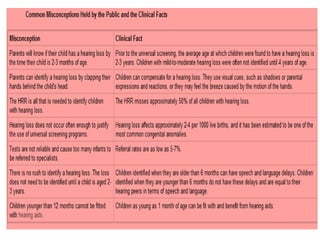
Screening by high risk register alone can only identify 15-20% of
new born babies requiring help (NIH, 1993)
Prior to implementation of universal newborn screening - testing
conducted only on infants meeting the criteria of the high-risk register
(HRR).
HRR - as many as 50% of infants born with hearing loss have no
known risk factors.
 Reliable screening tests available- minimizes referral rates and
maximize sensitivity and specificity.
Universal newborn hearing screening (UNHS)
National Institute for deafness and other communicative disorders (NIDCD)
- consensus conference – on early identification of hearing loss – 1993
Recommended – UNHS
- Screening 1st three months of life
- Taken up by various agencies –
American academy of otolaryngology- HNS
American academy of speech and language
American academy of audiology
•“Pass” or “Refer,”
•“Refer” –
follow up testing
confirmed  referral to otolaryngologist
Initially –
- In 1988 -hearing loss identified in children in the USA- 2.5 yrs
- Severe to profound hearing loss or with multiple disabilities identified at or
before age 2.5 yrs
- Mild-to-moderate: not identified until school
Universal newborn hearing screening program 1997-2001
Mean age of diagnosis - 3.9 months
Mean age of intervention - 6.1 months (Connolly et al., 2005)
Efficacy of Early Identification and Intervention
Definition of early identification and intervention - evolved over the
years
Early identification -defined as intervention before the age of 18
months
The implementation of universal screening programs definition of
early identification and intervention re-examined
 Early identification - diagnosis as early as age 3 months
Early intervention - by age 6 months
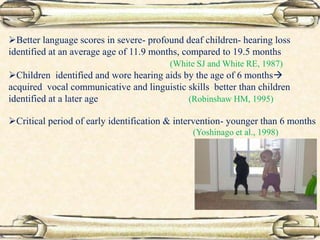
Better language scores in severe- profound deaf children- hearing loss
identified at an average age of 11.9 months, compared to 19.5 months
(White SJ and White RE, 1987)
Children identified and wore hearing aids by the age of 6 months
acquired vocal communicative and linguistic skills better than children
identified at a later age (Robinshaw HM, 1995)
Critical period of early identification & intervention- younger than 6 months
(Yoshinago et al., 1998)
The ability to hear during the early years of life is critical
for the development of speech, language & cognition
Infants who are not identified before 6 monthsdelay in
speech and language development
Intervention at or before 6 monthschild with impaired
hearing to develop normal speech and language, alongside
his or her hearing peers
Early identification-development of expressive, receptive
language, cognition, behaviour, personality development
(Davis et al., 1992)
Delayed Diagnosis
Permanently impaired speech and language skills
Reduced intellectual ability
Lowered adult earnings
More limited social skill development
(Joint Committee on Infant Hearing (JCIH) 2007 Position Statement)
1. Definition of targeted hearing loss expanded to include neural hearing loss
(eg. auditory neuropathy/dyssynchrony)
2. Separate protocols for neonatal intensive care units (NICUs) and well-baby
nurseries. ABR screenings for all NICU babies, as well as babies admitted for
>5 daysneural hearing loss will not be missed.
3. Referrals for all infants who do not pass ABR screening in the NICU.
4. Rescreening of all infants should include re-evaluation of both ears, even if the
infant only failed one ear in the initial screening.
5. Audiologists with expertise in evaluating newborns should conduct diagnostic
evaluations.
(Joint Committee on Infant Hearing (JCIH) 2007 Position Statement)
6. Children identified with hearing loss  fit amplification within 1 month of
diagnosis.
7. A genetics consultation to families of infants with hearing loss.
8. Children with hearing loss should evaluation by an otolaryngologist &
ophthalmologist.
9. Children with any degree of bilateral or unilateral hearing loss consider early
intervention services
10. Families all communication options and available hearing technologies
11. Early intervention services  by professionals with expertise in hearing loss
Methods of Screening
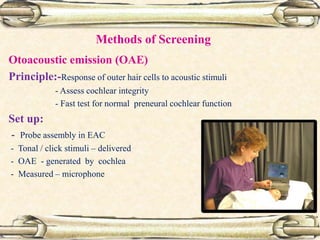
Otoacoustic emission (OAE)
Principle:-Response of outer hair cells to acoustic stimuli
- Assess cochlear integrity
- Fast test for normal preneural cochlear function
Set up:
- Probe assembly in EAC
- Tonal / click stimuli – delivered
- OAE - generated by cochlea
- Measured – microphone
If middle ear normal assesses cochlear function in
frequency range 0.5-6kHz
-Fast, efficient, frequency specific
Limitations:
- Efficacy reduced by contamination of low frequency
noise in busy nursery, wax/debris in EAC
- Middle ear pathology
- Auditory neuropathy-OAE may be normal ABR
- Stay in NICU >5 days ABR
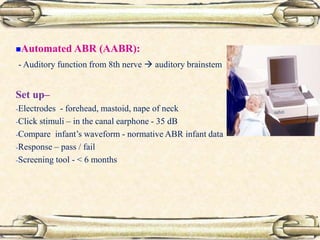
Automated ABR (AABR):
- Auditory function from 8th nerve  auditory brainstem
Set up–
-Electrodes - forehead, mastoid, nape of neck
-Click stimuli – in the canal earphone - 35 dB
-Compare infant’s waveform - normative ABR infant data
-Response – pass / fail
-Screening tool - < 6 months
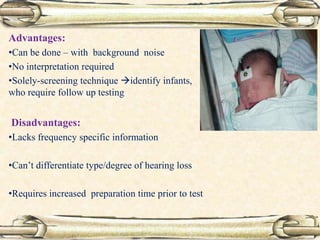
Advantages:
•Can be done – with background noise
•No interpretation required
•Solely-screening technique identify infants,
who require follow up testing
Disadvantages:
•Lacks frequency specific information
•Can’t differentiate type/degree of hearing loss
•Requires increased preparation time prior to test
Diagnostic auditory brainstem reflex:
-Not used in UNHS because of length of
procedure, cost, audiologist
-Unlike AABR-35 dB, Intensity of stimuli –
varied – manual ABR
-Allows to know – severity of hearing loss
-Type of hearing loss
-Not used for screening but for follow up
Follow – up testing
Infants who do not “pass” F/U at 1 month
interval
F/U allowsmultiple testing sessions, medical
intervention, parental counseling, appropriate
amplification before age of 6 months
If f/u delayed – need for sedation increases
If infant fail 2nd screening session – diagnostic
ABR/ OAE
Auditory neuropathy/dyssynchrony- Normal OAE
but abnormal ABR
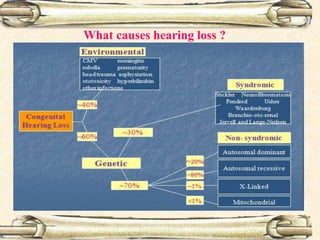
What causes hearing loss ?
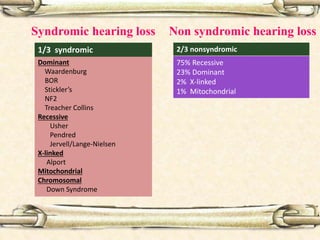
Syndromic hearing loss
Dominant
Waardenburg
BOR
Stickler’s
NF2
Treacher Collins
Recessive
Usher
Pendred
Jervell/Lange-Nielsen
X-linked
Alport
Mitochondrial
Chromosomal
Down Syndrome
Non syndromic hearing loss
75% Recessive
23% Dominant
2% X-linked
1% Mitochondrial
1/3 syndromic 2/3 nonsyndromic
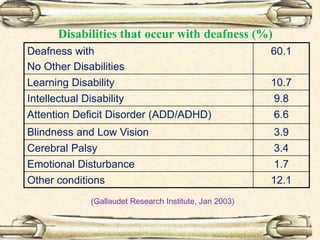
Disabilities that occur with deafness (%)
Deafness with
No Other Disabilities
60.1
Learning Disability 10.7
Intellectual Disability 9.8
Attention Deficit Disorder (ADD/ADHD) 6.6
Blindness and Low Vision 3.9
Cerebral Palsy 3.4
Emotional Disturbance 1.7
Other conditions 12.1
(Gallaudet Research Institute, Jan 2003)
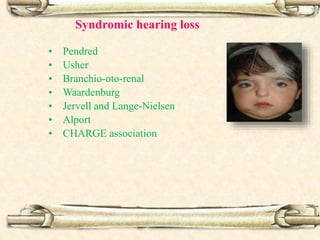
Syndromic hearing loss
• Pendred
• Usher
• Branchio-oto-renal
• Waardenburg
• Jervell and Lange-Nielsen
• Alport
• CHARGE association
Non syndromic hearing loss
• Isolated genetic HL without
any other recognized
abnormalities
• Two thirds of all congenital
SNHL
• Over 50 genes; new ones
discovered every year
• Testing available for only a
small few
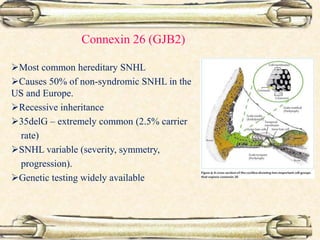
Connexin 26 (GJB2)
Most common hereditary SNHL
Causes 50% of non-syndromic SNHL in the
US and Europe.
Recessive inheritance
35delG – extremely common (2.5% carrier
rate)
SNHL variable (severity, symmetry,
progression).
Genetic testing widely available
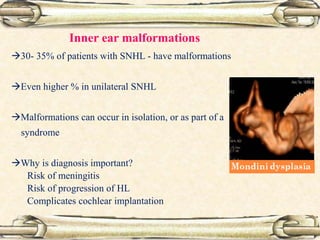
Inner ear malformations
30- 35% of patients with SNHL - have malformations
Even higher % in unilateral SNHL
Malformations can occur in isolation, or as part of a
syndrome
Why is diagnosis important?
Risk of meningitis
Risk of progression of HL
Complicates cochlear implantation
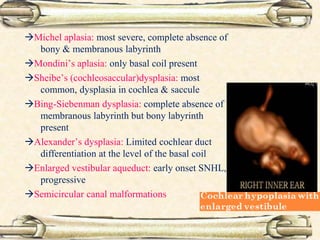
Michel aplasia: most severe, complete absence of
bony & membranous labyrinth
Mondini’s aplasia: only basal coil present
Sheibe’s (cochleosaccular)dysplasia: most
common, dysplasia in cochlea & saccule
Bing-Siebenman dysplasia: complete absence of
membranous labyrinth but bony labyrinth
present
Alexander’s dysplasia: Limited cochlear duct
differentiation at the level of the basal coil
Enlarged vestibular aqueduct: early onset SNHL,
progressive
Semicircular canal malformations
Evaluation
History:
Presentation depends on:
- Degree of hearing loss
- Patient’s age
- When hearing loss began ?
- Threshold of suspicion by parents
- Presence of identifiable risk factors
2/3 rd cases - parent’s 1st suspicion
10 % cases - Paediatrician
15 % cases - health caregivers
Meantime b/w 1st suspicion and diagnosis – 9 months
Evaluation of hearing loss:
Concern over child’s hearing
Behavioural problems/personality defects
Congenital/postnatal - profound deafness - loss
of cooing by age of 6–9 months
Minor speech impediments, school failure
Mental retardation, autism, attention deficits,
adjustment disorders
History & Physical Examination
History:
Characterize onset
Identify risk factors and exposures
Identify family history of SNHL
•Infections, other systemic diseases
•Trauma, infections, diabetes, blood dyscrasias,
autoimmune, malignancy, meningitis, middle ear
disease, noise exposure
•Balance problems, learning problems, speech
delay
•Any prior testing
-Changes, progression, fluctuation
•Other symptoms- Visual, balance, tinnitus
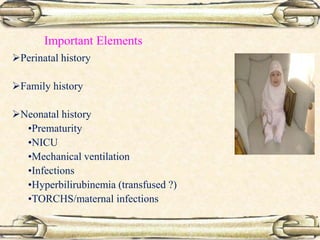
Important Elements
Perinatal history
Family history
Neonatal history
•Prematurity
•NICU
•Mechanical ventilation
•Infections
•Hyperbilirubinemia (transfused ?)
•TORCHS/maternal infections
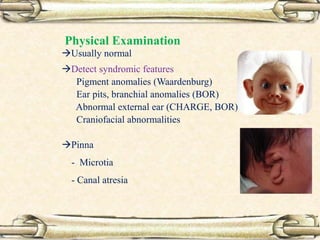
Physical Examination
Usually normal
Detect syndromic features
– Pigment anomalies (Waardenburg)
– Ear pits, branchial anomalies (BOR)
– Abnormal external ear (CHARGE, BOR)
– Craniofacial abnormalities
– Pinna
- Microtia
- Canal atresia
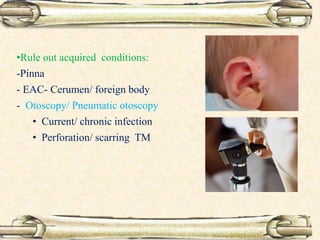
•Rule out acquired conditions:
-Pinna
- EAC- Cerumen/ foreign body
- Otoscopy/ Pneumatic otoscopy
• Current/ chronic infection
• Perforation/ scarring TM
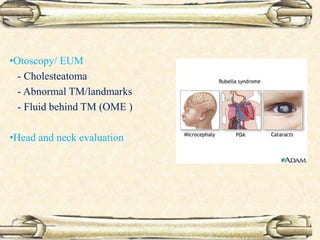
•Otoscopy/ EUM
- Cholesteatoma
- Abnormal TM/landmarks
- Fluid behind TM (OME )
•Head and neck evaluation
Aim of aetiological investigations
Aim:
- Try answer parents – “why is my child deaf ? ”
- Identify and treat medical conditions
- Assist early decision making
Appropriate communication modes
Educational placement & counselling
- To inform genetic counselling
- Epidemiological research
Laboratory Studies
•Depending - patient's history & physical findings biochemical
evidence
•Diagnosis of SNHL -
•Testing thyroid function, measuring BUN and creatinine levels and urinalysis.
•ECG - diagnosing – arrhythmia- Jervell Lange-Nielsen syndrome
• B/L hearing loss - (eg, ESR)
•Autoimmune inner ear disease
•Genetic screen
•Serology (suspected viral, autoimmune, syphilitic)
•CBC
Risk of thalassemia or sickle cell disease
Macro thrombocytopenia & leukocyte inclusions (a/w Alport syndrome)
•Biochemistry
BUN & electrolyte abnormalities with renal dysfunction (e.g., Alport syndrome)
Lipid profile
Glucose
•Thyroid function tests
Congenital or acquired hypothyroidism
Pendred syndrome
•Autoimmune work-up
ESR
Immunoglobulin
Complement
• Non-contrast CT of temporal bone
Gold standard
Quick but may require sedation
Involves ionizing radiation
Excellent for almost all causes
• MRI
Detect abnormality of CNS
Certainly indicated in some unusual cases
(Russo et al., 2006)
Genetic evaluation: Why?
•Inheritance patterns
•Recognizing genetic syndromes
•To perform genetic testing
•To conduct genetic counselling
(McCallum et al., 2006)
Arousal test:
Sound stimuli light sleep arousal
Auditory response cradle(ARC):
Baby in cradle-behaviour in response to sound
stimulustrunk & limb movement, head jerk and
respiration
Assessment of hearing
Audiometric Evaluation: when & what to do ?
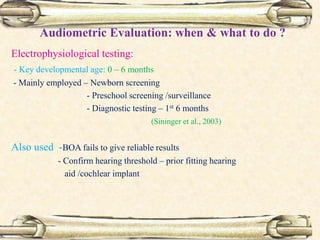
Electrophysiological testing:
- Key developmental age: 0 – 6 months
- Mainly employed – Newborn screening
- Preschool screening /surveillance
- Diagnostic testing – 1st 6 months
(Sininger et al., 2003)
Also used -BOA fails to give reliable results
- Confirm hearing threshold – prior fitting hearing
aid /cochlear implant
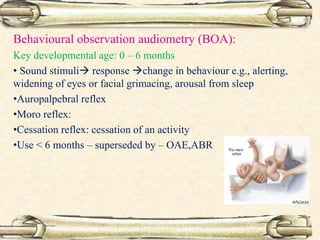
Behavioural observation audiometry (BOA):
Key developmental age: 0 – 6 months
• Sound stimuli response change in behaviour e.g., alerting,
widening of eyes or facial grimacing, arousal from sleep
•Auropalpebral reflex
•Moro reflex:
•Cessation reflex: cessation of an activity
•Use < 6 months – superseded by – OAE,ABR
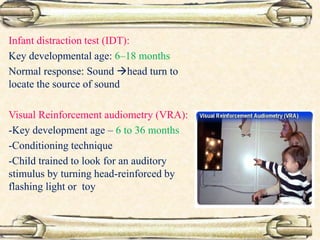
Infant distraction test (IDT):
Key developmental age: 6–18 months
Normal response: Sound head turn to
locate the source of sound
Visual Reinforcement audiometry (VRA):
-Key development age – 6 to 36 months
-Conditioning technique
-Child trained to look for an auditory
stimulus by turning head-reinforced by
flashing light or toy
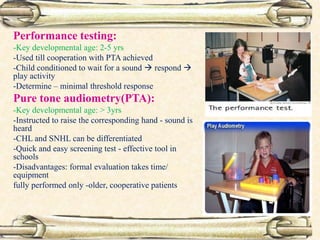
Performance testing:
-Key developmental age: 2-5 yrs
-Used till cooperation with PTA achieved
-Child conditioned to wait for a sound  respond 
play activity
-Determine – minimal threshold response
Pure tone audiometry(PTA):
-Key developmental age: > 3yrs
-Instructed to raise the corresponding hand - sound is
heard
-CHL and SNHL can be differentiated
-Quick and easy screening test - effective tool in
schools
-Disadvantages: formal evaluation takes time/
equipment
fully performed only -older, cooperative patients
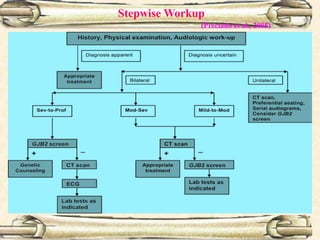
Stepwise Workup
(Preciado et al., 2005)
Algorithm
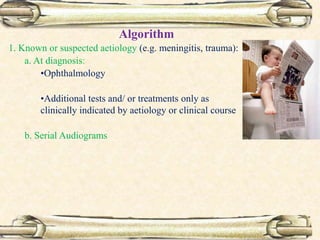
1. Known or suspected aetiology (e.g. meningitis, trauma):
a. At diagnosis:
•Ophthalmology
•Additional tests and/ or treatments only as
clinically indicated by aetiology or clinical course
b. Serial Audiograms
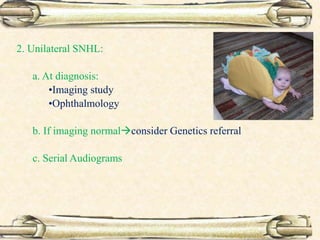
2. Unilateral SNHL:
a. At diagnosis:
•Imaging study
•Ophthalmology
b. If imaging normalconsider Genetics referral
c. Serial Audiograms
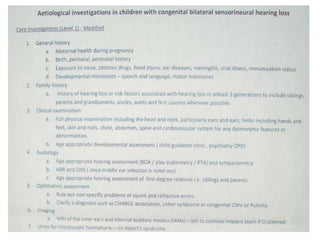
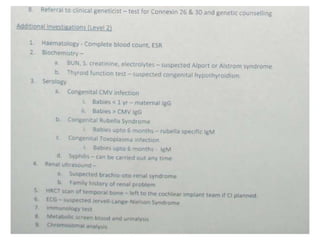
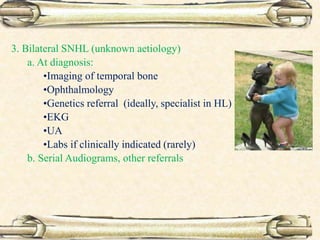
3. Bilateral SNHL (unknown aetiology)
a. At diagnosis:
•Imaging of temporal bone
•Ophthalmology
•Genetics referral (ideally, specialist in HL)
•EKG
•UA
•Labs if clinically indicated (rarely)
b. Serial Audiograms, other referrals
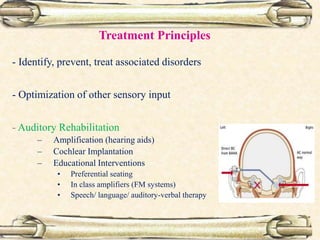
Treatment Principles
- Identify, prevent, treat associated disorders
- Optimization of other sensory input
- Auditory Rehabilitation
– Amplification (hearing aids)
– Cochlear Implantation
– Educational Interventions
• Preferential seating
• In class amplifiers (FM systems)
• Speech/ language/ auditory-verbal therapy
Management of associated disorders
• Cardiac (prolonged QT) – awareness, medication
• Meningitis vaccinations:
– SNHL population, particularly those with
malformations, at higher risk than general population
• Thyroid disease
• Meningitis – steroids reduce the incidence of SNHL and
improve survival
• Sudden SNHL – high dose steroids +/- antivirals may
improve recovery of hearing if begun promptly
(controversy)
Management
Deafness heavy social & economic burden on individual, family,
community & country
Multidisciplinary approach:
Parents’ reaction to the diagnosis:
-Shock, denial, anger, acceptance
-Dealt sympathetically
Subsequent management of the hearing impaired child:
1.Appropriate hearing aid selection
2.Promotion of the development of language & communication skills
and if possible, speech development
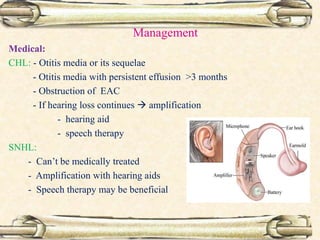
Management
Medical:
CHL: - Otitis media or its sequelae
- Otitis media with persistent effusion >3 months
- Obstruction of EAC
- If hearing loss continues  amplification
- hearing aid
- speech therapy
SNHL:
- Can’t be medically treated
- Amplification with hearing aids
- Speech therapy may be beneficial
Surgical management:
-Some causes of CHL
-Persistent chronic or recurrent otitis media
-Cholesteatoma
-Bone-anchored hearing aid (BAHA):
- Microtia
- Anotia - auricular reconstruction
- Persistent otorrhea
SNHL can not be treated with surgical means other than cochlear
implantation
Hearing aids
• SNHLcan’t be corrected to normal by any form of medical or
surgical Rx
• Some CHL- congenital abnormalities of the EAC & middle ear not
suitable for surgical Rx
• Birth of totally deaf child-rarehigh powered hearing aids for
residual hearing
• Types of hearing aids:
(I) Personal hearing aids: body worn aids, behind the ear aids, BAHA
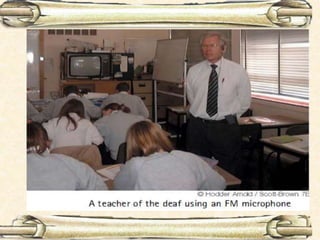
(II) Aids not entirely worn by the listener: speech trainer, group hearing
aids, Radio (FM) hearing aids, infrared hearing aid system, loop
system
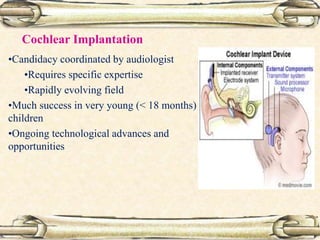
Cochlear Implantation
•Candidacy coordinated by audiologist
•Requires specific expertise
•Rapidly evolving field
•Much success in very young (< 18 months)
children
•Ongoing technological advances and
opportunities
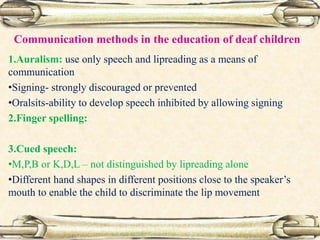
Communication methods in the education of deaf children
1.Auralism: use only speech and lipreading as a means of
communication
•Signing- strongly discouraged or prevented
•Oralsits-ability to develop speech inhibited by allowing signing
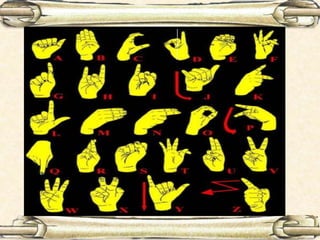
2.Finger spelling:
3.Cued speech:
•M,P,B or K,D,L – not distinguished by lipreading alone
•Different hand shapes in different positions close to the speaker’s
mouth to enable the child to discriminate the lip movement
4.Signing system (manualism):
British sign language, American sign language
5.Total communication:
Uses any and all modes of communication (combination of speech,
gestures, signing, finger spelling, speech reading/lip reading, reading
and writing)
Controversy:
•Sensory inputs (auditory & visual)enhances language development
•Total communicationimpair speech developement
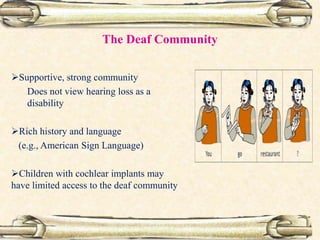
The Deaf Community
Supportive, strong community
Does not view hearing loss as a
disability
Rich history and language
(e.g., American Sign Language)
Children with cochlear implants may
have limited access to the deaf community
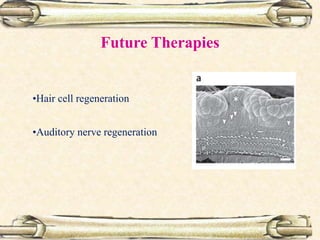
Future Therapies
•Hair cell regeneration
•Auditory nerve regeneration
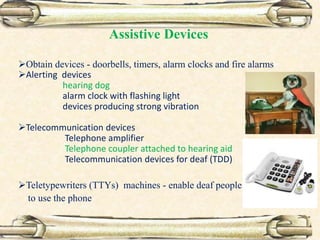
Assistive Devices
Obtain devices - doorbells, timers, alarm clocks and fire alarms
Alerting devices
hearing dog
alarm clock with flashing light
devices producing strong vibration
Telecommunication devices
Telephone amplifier
Telephone coupler attached to hearing aid
Telecommunication devices for deaf (TDD)
Teletypewriters (TTYs) machines - enable deaf people
to use the phone
Follow-up
 Deaf childFollow up
Audiologist:
- Monitor progression
- Hearing loss
- Refit hearing aids - match changing losses/ growth of ears
Pediatricians:
Monitor linguistic/ social development
Children who are deaf or hard of hearing are at particular risk
for abuse
ThankYouKanyam, tea garden, Nepal

The deaf child

  • 1.
    Ramesh Parajuli MS (ORL-HNS) ChitwanMedical College Teaching Hospital, Bharatpur-10, Chitwan, Nepal DEAF CHILD
  • 2.
    Definition Importance of earlydiagnosis Methods of screening Clinical evaluation Diagnostic methods Management Contents
  • 3.
    IDEA (Individuals withDisabilities Education Act) 2007 defines hearing loss: - Deaf child is one who cannot understand spoken communication even with a hearing aid. - A hard of hearing child is one who can hear spoken communication, but this does not necessarily mean that he understands it. Definition
  • 4.
    Permanent childhood hearingimpairment (PCHI): confirmed permanent B/L hearing impairment exceeding 40 dBHL (average of pure tone thresholds at 0.5,1,2 & 4 kHz in better hearing ear). Congenital or acquired Prelingual deafness Vs postlingual deafness -for the child’s education and management
  • 5.
    Degree of hearingloss 0-15 dB Normal 15-25 Minimal Hearing Loss 26-40 Mild Hearing Loss 41-55 Moderate Hearing Loss 56-70 Moderately Severe Loss 71-90 Severe Hearing Loss >90 dB Profound Hearing Loss (Categories from the National Institutes of Health) http://www.nih.gov/
  • 7.
    Epidemiology One child in1000 born - bilateral permanent childhood hearing impairment(PCHI) -About 60% of these children= mod. Hearing loss (41-60 dBHL) -Remainder have severe (61-80 dBHL) or profound (>81dBHL) (www.who.int/pbd/deafness/hearing_impairmencgrades/ en/index) The prevalence of PCHI increases with age further 1 in 1000 develop acquired or progressive hearing impairment. (Fortnum et al., 2001)
  • 8.
    PCHI – oneof the most common abnormality present at birth The prevalence of hearing loss- greater than that of most other diseases and syndromes (eg, phenylketonuria, sickle cell disease) screened at birth.
  • 9.
    Two thirds ofpeople with moderate to severe hearing impairment live in developing countries. In developing countries-infection congenital- rubella and CMV acquired – mumps, measles, meningitis & COM In developed countries- about half of PCHI—genetic cause (www.who.int)
  • 10.
    Terminology: Bilateral Permanent childhoodhearing loss (PCHL) - Hearing loss >40 dB at (0.5k,1k,2k,4k ) – better ear - 60 % children–mod CHL Acquired/Late onset permanent hearing loss - Postnatal/after birth Unilateral permanent hearing loss - Inability to hear from deaf side - Difficulty – hearing – speech in noise - Poor localization of sound
  • 11.
    Auditory neuropathy/ Dyssynchrony(AN/AD) - Damage to inner hair cells, synaptic junction, auditory neurons in spiral ganglion - Clinical test: normal OAE/ absent or abnormal ABR - 10 % children - confirmed PCHL - Auditory neuropathy - Found predominantly in NICU population  Temporary childhood hearing loss - OME – extremely common - Major risk factors – season, passive smoking, bottle feed URTI, NICU admission - Speech and language delay
  • 12.
    The High-Risk Register(HRR) Prior to implementation of universal newborn hearing screening Infants identified at high risk for hearing loss – high risk register (HRR)screened The risk factors for newborn: (Joint Committee on Infant Hearing (JCIH) 2000 Position Statement) Family h/o permanent childhood sensorineural hearing loss In utero infection - cytomegalovirus, rubella, toxoplasmosis or herpes Craniofacial anomalies- morphological abnormalities of the pinna & EAC Neonatal indicators - hyperbilirubinemia, persistent pulmonary hypertension of the newborn (PPHN), mechanical ventilation Postnatal infections - bacterial meningitis
  • 13.
    Stigmata/ findings syndrome- SNHL or CHL or Eustachian tube dysfunction Parental or caregiver concern regarding hearing, speech, language, and/or developmental delay Head trauma Recurrent or persistent otitis media with effusion lasting for at least 3 months Screening by high risk register alone can only identify 15-20% of new born babies requiring help (NIH, 1993)
  • 14.
    Prior to implementationof universal newborn screening - testing conducted only on infants meeting the criteria of the high-risk register (HRR). HRR - as many as 50% of infants born with hearing loss have no known risk factors.  Reliable screening tests available- minimizes referral rates and maximize sensitivity and specificity.
  • 15.
    Universal newborn hearingscreening (UNHS) National Institute for deafness and other communicative disorders (NIDCD) - consensus conference – on early identification of hearing loss – 1993 Recommended – UNHS - Screening 1st three months of life - Taken up by various agencies – American academy of otolaryngology- HNS American academy of speech and language American academy of audiology •“Pass” or “Refer,” •“Refer” – follow up testing confirmed  referral to otolaryngologist
  • 16.
    Initially – - In1988 -hearing loss identified in children in the USA- 2.5 yrs - Severe to profound hearing loss or with multiple disabilities identified at or before age 2.5 yrs - Mild-to-moderate: not identified until school Universal newborn hearing screening program 1997-2001 Mean age of diagnosis - 3.9 months Mean age of intervention - 6.1 months (Connolly et al., 2005) Efficacy of Early Identification and Intervention
  • 17.
    Definition of earlyidentification and intervention - evolved over the years Early identification -defined as intervention before the age of 18 months The implementation of universal screening programs definition of early identification and intervention re-examined  Early identification - diagnosis as early as age 3 months Early intervention - by age 6 months
  • 18.
    Better language scoresin severe- profound deaf children- hearing loss identified at an average age of 11.9 months, compared to 19.5 months (White SJ and White RE, 1987) Children identified and wore hearing aids by the age of 6 months acquired vocal communicative and linguistic skills better than children identified at a later age (Robinshaw HM, 1995) Critical period of early identification & intervention- younger than 6 months (Yoshinago et al., 1998)
  • 19.
    The ability tohear during the early years of life is critical for the development of speech, language & cognition Infants who are not identified before 6 monthsdelay in speech and language development Intervention at or before 6 monthschild with impaired hearing to develop normal speech and language, alongside his or her hearing peers Early identification-development of expressive, receptive language, cognition, behaviour, personality development (Davis et al., 1992)
  • 20.
    Delayed Diagnosis Permanently impairedspeech and language skills Reduced intellectual ability Lowered adult earnings More limited social skill development
  • 21.
    (Joint Committee onInfant Hearing (JCIH) 2007 Position Statement) 1. Definition of targeted hearing loss expanded to include neural hearing loss (eg. auditory neuropathy/dyssynchrony) 2. Separate protocols for neonatal intensive care units (NICUs) and well-baby nurseries. ABR screenings for all NICU babies, as well as babies admitted for >5 daysneural hearing loss will not be missed. 3. Referrals for all infants who do not pass ABR screening in the NICU. 4. Rescreening of all infants should include re-evaluation of both ears, even if the infant only failed one ear in the initial screening. 5. Audiologists with expertise in evaluating newborns should conduct diagnostic evaluations.
  • 22.
    (Joint Committee onInfant Hearing (JCIH) 2007 Position Statement) 6. Children identified with hearing loss  fit amplification within 1 month of diagnosis. 7. A genetics consultation to families of infants with hearing loss. 8. Children with hearing loss should evaluation by an otolaryngologist & ophthalmologist. 9. Children with any degree of bilateral or unilateral hearing loss consider early intervention services 10. Families all communication options and available hearing technologies 11. Early intervention services  by professionals with expertise in hearing loss
  • 23.
    Methods of Screening Otoacousticemission (OAE) Principle:-Response of outer hair cells to acoustic stimuli - Assess cochlear integrity - Fast test for normal preneural cochlear function Set up: - Probe assembly in EAC - Tonal / click stimuli – delivered - OAE - generated by cochlea - Measured – microphone
  • 24.
    If middle earnormal assesses cochlear function in frequency range 0.5-6kHz -Fast, efficient, frequency specific Limitations: - Efficacy reduced by contamination of low frequency noise in busy nursery, wax/debris in EAC - Middle ear pathology - Auditory neuropathy-OAE may be normal ABR - Stay in NICU >5 days ABR
  • 25.
    Automated ABR (AABR): -Auditory function from 8th nerve  auditory brainstem Set up– -Electrodes - forehead, mastoid, nape of neck -Click stimuli – in the canal earphone - 35 dB -Compare infant’s waveform - normative ABR infant data -Response – pass / fail -Screening tool - < 6 months
  • 26.
    Advantages: •Can be done– with background noise •No interpretation required •Solely-screening technique identify infants, who require follow up testing Disadvantages: •Lacks frequency specific information •Can’t differentiate type/degree of hearing loss •Requires increased preparation time prior to test
  • 27.
    Diagnostic auditory brainstemreflex: -Not used in UNHS because of length of procedure, cost, audiologist -Unlike AABR-35 dB, Intensity of stimuli – varied – manual ABR -Allows to know – severity of hearing loss -Type of hearing loss -Not used for screening but for follow up
  • 28.
    Follow – uptesting Infants who do not “pass” F/U at 1 month interval F/U allowsmultiple testing sessions, medical intervention, parental counseling, appropriate amplification before age of 6 months If f/u delayed – need for sedation increases If infant fail 2nd screening session – diagnostic ABR/ OAE Auditory neuropathy/dyssynchrony- Normal OAE but abnormal ABR
  • 30.
  • 31.
    Syndromic hearing loss Dominant Waardenburg BOR Stickler’s NF2 TreacherCollins Recessive Usher Pendred Jervell/Lange-Nielsen X-linked Alport Mitochondrial Chromosomal Down Syndrome Non syndromic hearing loss 75% Recessive 23% Dominant 2% X-linked 1% Mitochondrial 1/3 syndromic 2/3 nonsyndromic
  • 32.
    Disabilities that occurwith deafness (%) Deafness with No Other Disabilities 60.1 Learning Disability 10.7 Intellectual Disability 9.8 Attention Deficit Disorder (ADD/ADHD) 6.6 Blindness and Low Vision 3.9 Cerebral Palsy 3.4 Emotional Disturbance 1.7 Other conditions 12.1 (Gallaudet Research Institute, Jan 2003)
  • 33.
    Syndromic hearing loss •Pendred • Usher • Branchio-oto-renal • Waardenburg • Jervell and Lange-Nielsen • Alport • CHARGE association
  • 34.
    Non syndromic hearingloss • Isolated genetic HL without any other recognized abnormalities • Two thirds of all congenital SNHL • Over 50 genes; new ones discovered every year • Testing available for only a small few
  • 35.
    Connexin 26 (GJB2) Mostcommon hereditary SNHL Causes 50% of non-syndromic SNHL in the US and Europe. Recessive inheritance 35delG – extremely common (2.5% carrier rate) SNHL variable (severity, symmetry, progression). Genetic testing widely available
  • 36.
    Inner ear malformations 30-35% of patients with SNHL - have malformations Even higher % in unilateral SNHL Malformations can occur in isolation, or as part of a syndrome Why is diagnosis important? Risk of meningitis Risk of progression of HL Complicates cochlear implantation
  • 37.
    Michel aplasia: mostsevere, complete absence of bony & membranous labyrinth Mondini’s aplasia: only basal coil present Sheibe’s (cochleosaccular)dysplasia: most common, dysplasia in cochlea & saccule Bing-Siebenman dysplasia: complete absence of membranous labyrinth but bony labyrinth present Alexander’s dysplasia: Limited cochlear duct differentiation at the level of the basal coil Enlarged vestibular aqueduct: early onset SNHL, progressive Semicircular canal malformations
  • 38.
    Evaluation History: Presentation depends on: -Degree of hearing loss - Patient’s age - When hearing loss began ? - Threshold of suspicion by parents - Presence of identifiable risk factors 2/3 rd cases - parent’s 1st suspicion 10 % cases - Paediatrician 15 % cases - health caregivers Meantime b/w 1st suspicion and diagnosis – 9 months
  • 39.
    Evaluation of hearingloss: Concern over child’s hearing Behavioural problems/personality defects Congenital/postnatal - profound deafness - loss of cooing by age of 6–9 months Minor speech impediments, school failure Mental retardation, autism, attention deficits, adjustment disorders
  • 40.
    History & PhysicalExamination History: Characterize onset Identify risk factors and exposures Identify family history of SNHL •Infections, other systemic diseases •Trauma, infections, diabetes, blood dyscrasias, autoimmune, malignancy, meningitis, middle ear disease, noise exposure •Balance problems, learning problems, speech delay •Any prior testing -Changes, progression, fluctuation •Other symptoms- Visual, balance, tinnitus
  • 41.
    Important Elements Perinatal history Familyhistory Neonatal history •Prematurity •NICU •Mechanical ventilation •Infections •Hyperbilirubinemia (transfused ?) •TORCHS/maternal infections
  • 42.
    Physical Examination Usually normal Detectsyndromic features – Pigment anomalies (Waardenburg) – Ear pits, branchial anomalies (BOR) – Abnormal external ear (CHARGE, BOR) – Craniofacial abnormalities – Pinna - Microtia - Canal atresia
  • 43.
    •Rule out acquiredconditions: -Pinna - EAC- Cerumen/ foreign body - Otoscopy/ Pneumatic otoscopy • Current/ chronic infection • Perforation/ scarring TM
  • 44.
    •Otoscopy/ EUM - Cholesteatoma -Abnormal TM/landmarks - Fluid behind TM (OME ) •Head and neck evaluation
  • 45.
    Aim of aetiologicalinvestigations Aim: - Try answer parents – “why is my child deaf ? ” - Identify and treat medical conditions - Assist early decision making Appropriate communication modes Educational placement & counselling - To inform genetic counselling - Epidemiological research
  • 46.
    Laboratory Studies •Depending -patient's history & physical findings biochemical evidence •Diagnosis of SNHL - •Testing thyroid function, measuring BUN and creatinine levels and urinalysis. •ECG - diagnosing – arrhythmia- Jervell Lange-Nielsen syndrome • B/L hearing loss - (eg, ESR) •Autoimmune inner ear disease •Genetic screen
  • 47.
    •Serology (suspected viral,autoimmune, syphilitic) •CBC Risk of thalassemia or sickle cell disease Macro thrombocytopenia & leukocyte inclusions (a/w Alport syndrome) •Biochemistry BUN & electrolyte abnormalities with renal dysfunction (e.g., Alport syndrome) Lipid profile Glucose •Thyroid function tests Congenital or acquired hypothyroidism Pendred syndrome •Autoimmune work-up ESR Immunoglobulin Complement
  • 48.
    • Non-contrast CTof temporal bone Gold standard Quick but may require sedation Involves ionizing radiation Excellent for almost all causes • MRI Detect abnormality of CNS Certainly indicated in some unusual cases (Russo et al., 2006)
  • 49.
    Genetic evaluation: Why? •Inheritancepatterns •Recognizing genetic syndromes •To perform genetic testing •To conduct genetic counselling (McCallum et al., 2006)
  • 50.
    Arousal test: Sound stimulilight sleep arousal Auditory response cradle(ARC): Baby in cradle-behaviour in response to sound stimulustrunk & limb movement, head jerk and respiration Assessment of hearing
  • 51.
    Audiometric Evaluation: when& what to do ? Electrophysiological testing: - Key developmental age: 0 – 6 months - Mainly employed – Newborn screening - Preschool screening /surveillance - Diagnostic testing – 1st 6 months (Sininger et al., 2003) Also used -BOA fails to give reliable results - Confirm hearing threshold – prior fitting hearing aid /cochlear implant
  • 52.
    Behavioural observation audiometry(BOA): Key developmental age: 0 – 6 months • Sound stimuli response change in behaviour e.g., alerting, widening of eyes or facial grimacing, arousal from sleep •Auropalpebral reflex •Moro reflex: •Cessation reflex: cessation of an activity •Use < 6 months – superseded by – OAE,ABR
  • 53.
    Infant distraction test(IDT): Key developmental age: 6–18 months Normal response: Sound head turn to locate the source of sound Visual Reinforcement audiometry (VRA): -Key development age – 6 to 36 months -Conditioning technique -Child trained to look for an auditory stimulus by turning head-reinforced by flashing light or toy
  • 54.
    Performance testing: -Key developmentalage: 2-5 yrs -Used till cooperation with PTA achieved -Child conditioned to wait for a sound  respond  play activity -Determine – minimal threshold response Pure tone audiometry(PTA): -Key developmental age: > 3yrs -Instructed to raise the corresponding hand - sound is heard -CHL and SNHL can be differentiated -Quick and easy screening test - effective tool in schools -Disadvantages: formal evaluation takes time/ equipment fully performed only -older, cooperative patients
  • 55.
  • 58.
    Algorithm 1. Known orsuspected aetiology (e.g. meningitis, trauma): a. At diagnosis: •Ophthalmology •Additional tests and/ or treatments only as clinically indicated by aetiology or clinical course b. Serial Audiograms
  • 59.
    2. Unilateral SNHL: a.At diagnosis: •Imaging study •Ophthalmology b. If imaging normalconsider Genetics referral c. Serial Audiograms
  • 60.
    3. Bilateral SNHL(unknown aetiology) a. At diagnosis: •Imaging of temporal bone •Ophthalmology •Genetics referral (ideally, specialist in HL) •EKG •UA •Labs if clinically indicated (rarely) b. Serial Audiograms, other referrals
  • 61.
    Treatment Principles - Identify,prevent, treat associated disorders - Optimization of other sensory input - Auditory Rehabilitation – Amplification (hearing aids) – Cochlear Implantation – Educational Interventions • Preferential seating • In class amplifiers (FM systems) • Speech/ language/ auditory-verbal therapy
  • 62.
    Management of associateddisorders • Cardiac (prolonged QT) – awareness, medication • Meningitis vaccinations: – SNHL population, particularly those with malformations, at higher risk than general population • Thyroid disease • Meningitis – steroids reduce the incidence of SNHL and improve survival • Sudden SNHL – high dose steroids +/- antivirals may improve recovery of hearing if begun promptly (controversy)
  • 63.
    Management Deafness heavy social& economic burden on individual, family, community & country Multidisciplinary approach: Parents’ reaction to the diagnosis: -Shock, denial, anger, acceptance -Dealt sympathetically Subsequent management of the hearing impaired child: 1.Appropriate hearing aid selection 2.Promotion of the development of language & communication skills and if possible, speech development
  • 64.
    Management Medical: CHL: - Otitismedia or its sequelae - Otitis media with persistent effusion >3 months - Obstruction of EAC - If hearing loss continues  amplification - hearing aid - speech therapy SNHL: - Can’t be medically treated - Amplification with hearing aids - Speech therapy may be beneficial
  • 65.
    Surgical management: -Some causesof CHL -Persistent chronic or recurrent otitis media -Cholesteatoma -Bone-anchored hearing aid (BAHA): - Microtia - Anotia - auricular reconstruction - Persistent otorrhea SNHL can not be treated with surgical means other than cochlear implantation
  • 66.
    Hearing aids • SNHLcan’tbe corrected to normal by any form of medical or surgical Rx • Some CHL- congenital abnormalities of the EAC & middle ear not suitable for surgical Rx • Birth of totally deaf child-rarehigh powered hearing aids for residual hearing • Types of hearing aids: (I) Personal hearing aids: body worn aids, behind the ear aids, BAHA (II) Aids not entirely worn by the listener: speech trainer, group hearing aids, Radio (FM) hearing aids, infrared hearing aid system, loop system
  • 68.
    Cochlear Implantation •Candidacy coordinatedby audiologist •Requires specific expertise •Rapidly evolving field •Much success in very young (< 18 months) children •Ongoing technological advances and opportunities
  • 69.
    Communication methods inthe education of deaf children 1.Auralism: use only speech and lipreading as a means of communication •Signing- strongly discouraged or prevented •Oralsits-ability to develop speech inhibited by allowing signing 2.Finger spelling: 3.Cued speech: •M,P,B or K,D,L – not distinguished by lipreading alone •Different hand shapes in different positions close to the speaker’s mouth to enable the child to discriminate the lip movement
  • 71.
    4.Signing system (manualism): Britishsign language, American sign language 5.Total communication: Uses any and all modes of communication (combination of speech, gestures, signing, finger spelling, speech reading/lip reading, reading and writing) Controversy: •Sensory inputs (auditory & visual)enhances language development •Total communicationimpair speech developement
  • 72.
    The Deaf Community Supportive,strong community Does not view hearing loss as a disability Rich history and language (e.g., American Sign Language) Children with cochlear implants may have limited access to the deaf community
  • 73.
    Future Therapies •Hair cellregeneration •Auditory nerve regeneration
  • 74.
    Assistive Devices Obtain devices- doorbells, timers, alarm clocks and fire alarms Alerting devices hearing dog alarm clock with flashing light devices producing strong vibration Telecommunication devices Telephone amplifier Telephone coupler attached to hearing aid Telecommunication devices for deaf (TDD) Teletypewriters (TTYs) machines - enable deaf people to use the phone
  • 75.
    Follow-up  Deaf childFollowup Audiologist: - Monitor progression - Hearing loss - Refit hearing aids - match changing losses/ growth of ears Pediatricians: Monitor linguistic/ social development Children who are deaf or hard of hearing are at particular risk for abuse
  • 76.