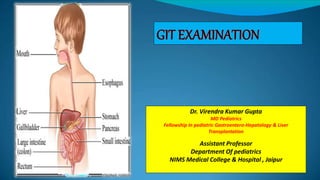
Dr. Virendra Kumar Gupta
MD Pediatrics
Fellowship In pediatric Gastroentero-Hepatology & Liver
Transplantation
Assistant Professor
Department Of pediatrics
NIMS Medical College & Hospital , Jaipur
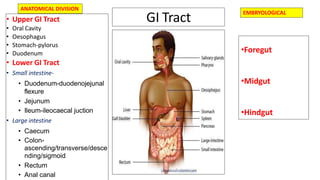
GI Tract• Upper GI Tract
• Oral Cavity
• Oesophagus
• Stomach-pylorus
• Duodenum
• Lower GI Tract
• Small intestine-
• Duodenum-duodenojejunal
flexure
• Jejunum
• Ileum-ileocaecal juction
• Large intestine
• Caecum
• Colon-
ascending/transverse/desce
nding/sigmoid
• Rectum
• Anal canal
•Foregut
•Midgut
•Hindgut
ANATOMICAL DIVISION
EMBRYOLOGICAL
SIGNS AND SYMPTOMS OF DIGESTIVE DISORDERS
• Stomach pain
• Nausea
• Vomiting
• Diarrhoea
• Constipation
• Abdominal Distension
• Bleeding
• Problems with appetite
• Dysphagia
PEDIATRIC DIGESTIVE DISORDERS
• Abdominal pain
• Celiac disease
• Colitis
• Constipation
• Crohn’s disease
• Dysphagia
• Esophagitis
• Feeding problems, or failure to thrive
• Food allergies
• Gallbladder diseases
• Gastrointestinal bleeding
• Gastroparesis
• GERD
• Hirshsprung’s disease
• Iron deficiency anemia
• Irritable bowel syndrome
• Inflammatory bowel disease
• Intestinal pseudo-obstruction
• Liver disease
• Motility disorders
• Pancreatic diseases
• Peptic ulcers
• Polyps
• Obesity
• Oesophageal/gastric varisces
• Short bowel syndrome
Before starting GI Examination
Wash hands / warm them
Proceed calmly / don’t make sudden moves
Shake hands and offer some candy or toy
Introduce yourself / explain what you are going to do (older child/
parents)
Ask the patient to point to the part which is tender(can be unreliable)
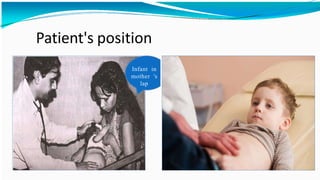
Position the patient (depends upon child’s comfort)
Expose the patient on required basis
Approach from right side of the patient
Gather as much data as possible by observation first
Alter the sequence of examination if required but present it in a sequential
manner
Order of exam:least distressing to most distressing
COMPONENTS OF GIT EXAMINATION
General Physical Examination
Oral cavity examination
Abdominal examination
Genitalia examination
Rectal examination
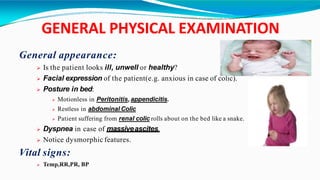
GENERAL PHYSICAL EXAMINATION
General appearance:
 Is the patient looks ill, unwell or healthy?
 Facial expression of the patient(e.g. anxious in case of colic).
 Posture in bed:
 Motionless in Peritonitis, appendicitis.
 Restless in abdominal Colic
 Patient suffering from renal colic rolls about on the bed like a snake.
 Dyspnea in case of massiveascites.
 Notice dysmorphic features.
Vital signs:
 Temp,RR,PR, BP
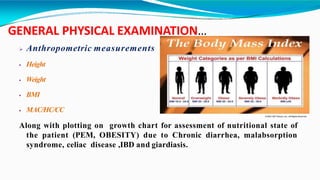
GENERAL PHYSICAL EXAMINATION…
 Anthropometric measurements
 Height
 Weight
 BMI
 MAC/HC/CC
Along with plotting on growth chart for assessment of nutritional state of
the patient (PEM, OBESITY) due to Chronic diarrhea, malabsorption
syndrome, celiac disease ,IBD and giardiasis.
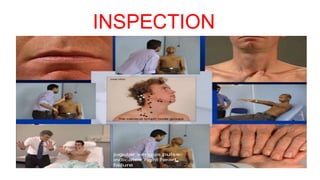
INSPECTION
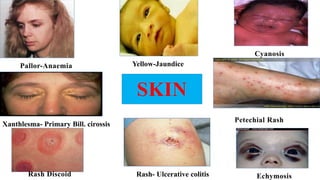
SKIN
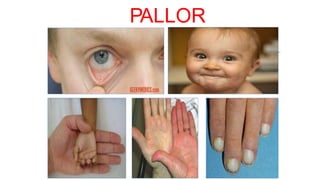
Pallor-Anaemia
EchymosisRash Discoid Rash- Ulcerative colitis
Petechial Rash
Cyanosis
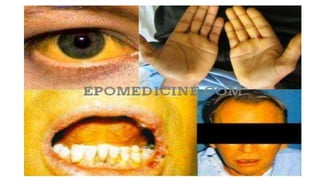
Yellow-Jaundice
Xanthlesma- Primary Bill. cirossis
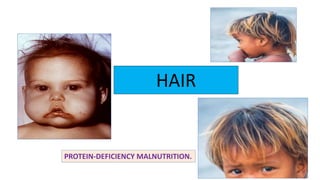
PROTEIN-DEFICIENCY MALNUTRITION.
HAIR
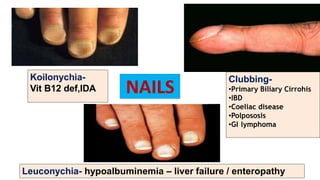
NAILS
Koilonychia-
Vit B12 def,IDA
Clubbing-
•Primary Biliary Cirrohis
•IBD
•Coeliac disease
•Polpososis
•GI lymphoma
Leuconychia- hypoalbuminemia – liver failure / enteropathy
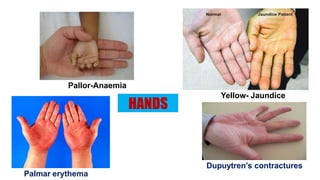
HANDS
Palmar erythema
Dupuytren’s contractures
Pallor-Anaemia
Yellow- Jaundice
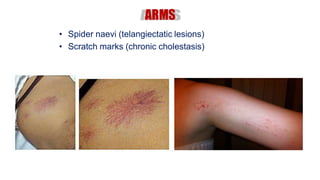
ARMS
• Spider naevi (telangiectatic lesions)
• Scratch marks (chronic cholestasis)
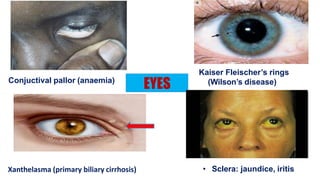
Xanthelasma (primary biliary cirrhosis)
EYESConjuctival pallor (anaemia)
• Sclera: jaundice, iritis
Kaiser Fleischer’s rings
(Wilson’s disease)
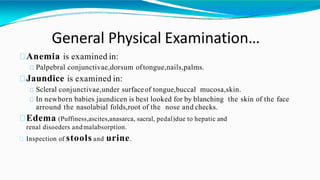
General Physical Examination…
Anemia is examined in:
Palpebral conjunctivae,dorsum oftongue,nails,palms.
Jaundice is examined in:
Scleral conjunctivae,under surfaceof tongue,buccal mucosa,skin.
In newborn babies jaundicen is best looked for by blanching the skin of the face
arround the nasolabial folds,root of the nose and checks.
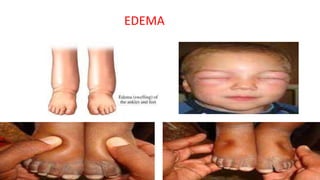
Edema (Puffiness,ascites,anasarca, sacral, pedal)due to hepatic and
renal disoeders andmalabsorption.
Inspection of stools and urine.
localised
PALLOR
EDEMA
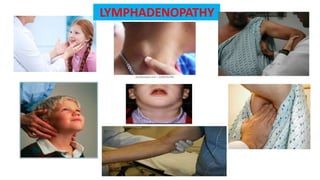
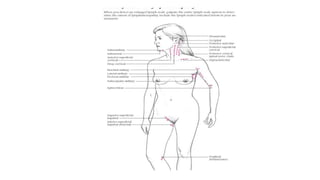
LYMPHADENOPATHY
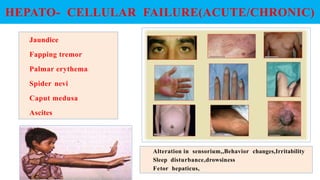
Jaundice
Fapping tremor
Palmar erythema
Spider nevi
Caput medusa
Ascites
HEPATO- CELLULAR FAILURE(ACUTE/CHRONIC)
Alteration in sensorium,,Behavior changes,Irritability
Sleep disturbance,drowsiness
Fetor hepaticus,
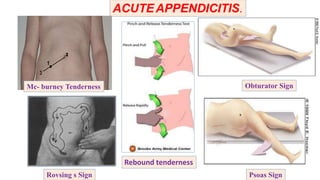
ACUTEAPPENDICITIS.
Mc- burney Tenderness
Rovsing s Sign
Obturator Sign
Psoas Sign
Rebound tenderness
Examinationof :
1- Oralcavity.
2- Abdomen.
3- Rectum.
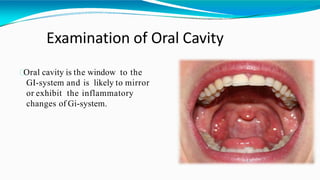
Examination of Oral Cavity
Oral cavity is the window to the
GI-system and is likely to mirror
or exhibit the inflammatory
changes of Gi-system.
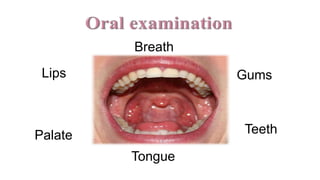
Lips Gums
Teeth
Tongue
Palate
Breath
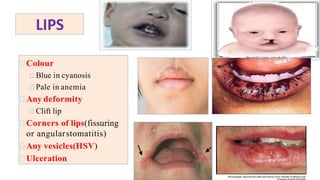
LIPS
Colour
Blue in cyanosis
Pale in anemia
Any deformity
Clift lip
Corners of lips(fissuring
or angularstomatitis)
Any vesicles(HSV)
Ulceration
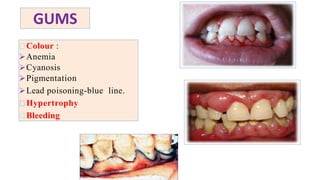
GUMS
Colour :
Anemia
Cyanosis
Pigmentation
Lead poisoning-blue line.
Hypertrophy
Bleeding
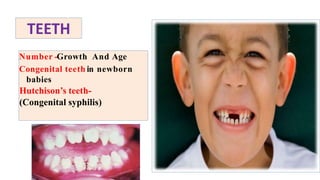
TEETH
Number -Growth And Age
Congenital teeth in newborn
babies
Hutchison’s teeth-
(Congenital syphilis)
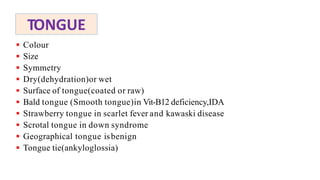
TONGUE
 Colour
 Size
 Symmetry
 Dry(dehydration)or wet
 Surface of tongue(coated or raw)
 Bald tongue (Smooth tongue)in Vit-B12 deficiency,IDA
 Strawberry tongue in scarlet fever and kawaski disease
 Scrotal tongue in down syndrome
 Geographical tongue isbenign
 Tongue tie(ankyloglossia)
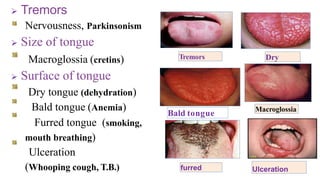
Tremors Dry
Macroglossia
 Tremors
Nervousness, Parkinsonism
 Size of tongue
Macroglossia (cretins)
 Surface of tongue
Dry tongue (dehydration)
Bald tongue (Anemia)
Furred tongue (smoking,
mouth breathing)
Ulceration
(Whooping cough, T.B.) furred Ulceration
Bald tongue
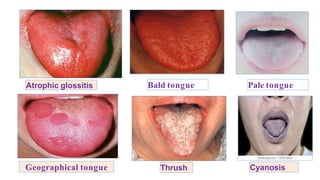
Atrophic glossitis
ThrushGeographical tongue
Bald tongue Pale tongue
Cyanosis
PALATES,ORO-PHARYNX MOUTH
Oral cavity and oro-pharynx is examined with the help of a tongue
depressor for:
• Colour
• Ulcers
• Deformity
• Inflammatory changes
Thrush(oral candidiasis)
Membranouspharyngitis in strep,diphtheria,infecious mononucleosis
ABDOMINAL
EXAMINATION
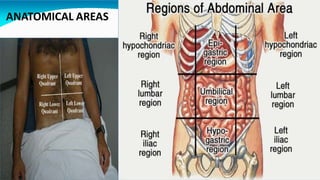
ANATOMICAL AREAS
Order of examination
Inspection
Auscultation
Palpation
Percussion
Patient's position
Infant in
mother
's lap
Infant in
mother 's
lap
INSPECTION :General
1.General condition
2.Jaundice
3. Pallor
4. Vircow’s Node: left supraclavicular LN enlargement.
5. Clubbing, palmar erythem, white nails, duptryn contracture.
6.Odema.
7.Gynecomastia
8. Mouth ulcers of IBD, Peutz-gagher perioral pigmentation,
talangiectasia , MOUTH THRUSH.
INSPECTION: Abdomen
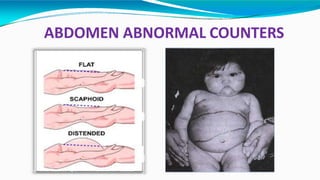
Size & Shape (abdominal Contour) (up to 3Ys its protuberant)
Any distension(localized orgeneralized)
Skin: Tone/Colour/ Scar/Striae
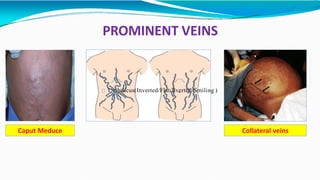
Prominent veins
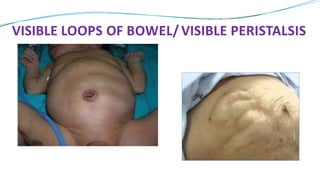
Visible loops of bowel/visible peristalsis
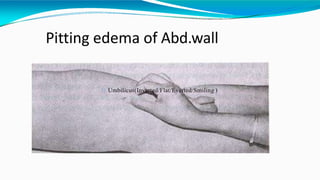
Oedema
Movements with Respiration
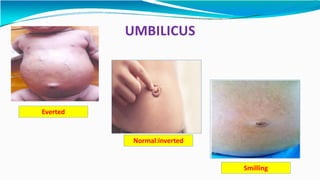
Umbilicus(Inverted/Flat/Everted/Smiling )
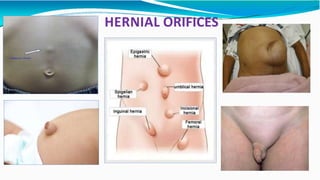
Hernial orifices
ABDOMEN ABNORMAL COUNTERS
CAUSES OF DISTENSION
• Gross distension (5 F)
• Fluid
• Flatus
• Feces
• Fetus
• Fat
• Localized distension
• Loculated fluid
• Mass
• Hernia
• Organomegaly
• Impacted feces
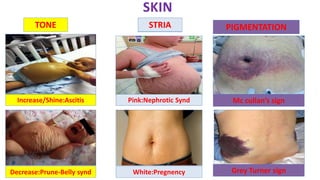
SKIN
TONE
Increase/Shine:Ascitis
Decrease:Prune-Belly synd
STRIA
Pink:Nephrotic Synd
White:Pregnency
PIGMENTATIONSTRIA
Mc cullan’s sign
Grey Turner sign
PROMINENT VEINS
Caput Meduce Collateral veins
Umbilicus(Inverted/Flat/Everted/Smiling )
VISIBLE LOOPS OF BOWEL/VISIBLE PERISTALSIS
Pitting edema of Abd.wall
Umbilicus(Inverted/Flat/Everted/Smiling )
UMBILICUS
Everted
Smilling
Normal:inverted
HERNIAL ORIFICES
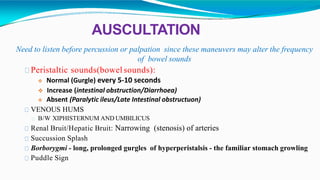
AUSCULTATION
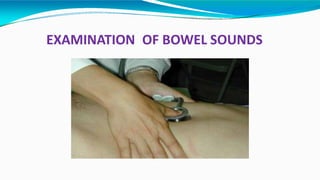
Need to listen before percussion or palpation since these maneuvers may alter the frequency
of bowel sounds
Peristaltic sounds(bowel sounds):
 Normal (Gurgle) every 5-10 seconds
 Increase (intestinal obstruction/Diarrhoea)
 Absent (Paralytic ileus/Late Intestinal obstructuon)
VENOUS HUMS
B/W XIPHISTERNUM AND UMBILICUS
Renal Bruit/Hepatic Bruit: Narrowing (stenosis) of arteries
Succussion Splash
Borborygmi - long, prolonged gurgles of hyperperistalsis - the familiar stomach growling
Puddle Sign
EXAMINATION OF BOWEL SOUNDS
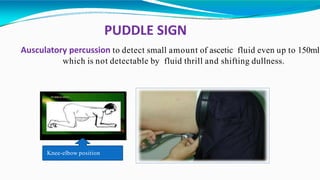
Ausculatory percussion to detect small amount of ascetic fluid even up to 150ml
which is not detectable by fluid thrill and shifting dullness.
Knee-elbow position
PUDDLE SIGN
PALPATION
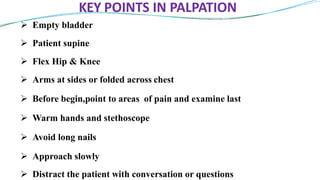
KEY POINTS IN PALPATION
 Empty bladder
 Patient supine
 Flex Hip & Knee
 Arms at sides or folded across chest
 Before begin,point to areas of pain and examine last
 Warm hands and stethoscope
 Avoid long nails
 Approach slowly
 Distract the patient with conversation or questions
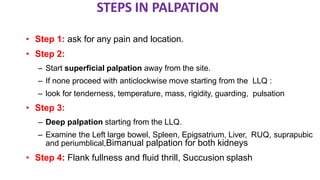
• Step 1: ask for any pain and location.
• Step 2:
– Start superficial palpation away from the site.
– If none proceed with anticlockwise move starting from the LLQ :
– look for tenderness, temperature, mass, rigidity, guarding, pulsation
• Step 3:
– Deep palpation starting from the LLQ.
– Examine the Left large bowel, Spleen, Epigsatrium, Liver, RUQ, suprapubic
and periumblical,Bimanual palpation for both kidneys
• Step 4: Flank fullness and fluid thrill, Succusion splash
STEPS IN PALPATION
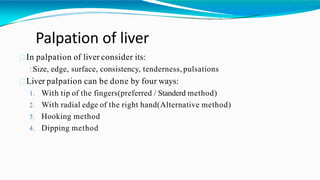
Palpation of liver
In palpation of liver consider its:
Size, edge, surface, consistency, tenderness, pulsations
Liver palpation can be done by four ways:
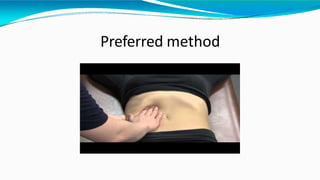
1. With tip of the fingers(preferred / Standerd method)
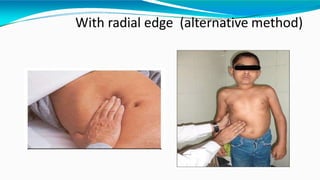
2. With radial edge of the right hand(Alternative method)
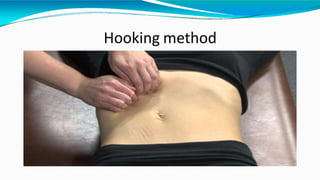
3. Hooking method
4. Dipping method
Preferred method
With radial edge (alternative method)
Hooking method
Dipping method of palpation
In cases of massiveascites.
How to dothis:
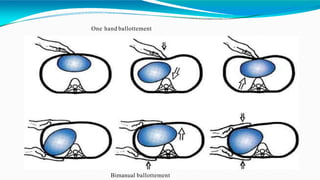
Placing hand over the abdomen and making quick and gentle dipping movements
(also known as one hand ballottement)
Also with bimanual ballottement.
One hand ballottement
Bimanual ballottement
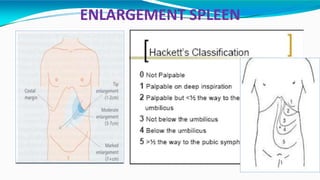
ENLARGEMENT SPLEEN
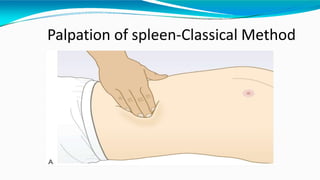
Palpation of spleen-Classical Method
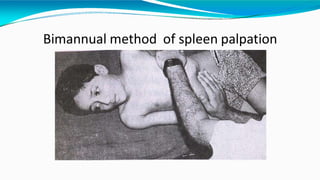
Bimannual method of spleen palpation
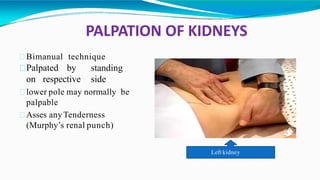
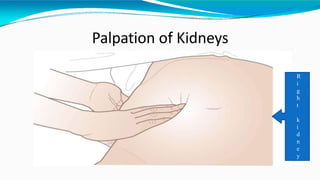
PALPATION OF KIDNEYS
Bimanual technique
Palpated by standing
on respective side
lower pole may normally be
palpable
Asses anyTenderness
(Murphy’s renal punch)
Left kidney
Palpation of Kidneys
R
i
g
h
t
k
i
d
n
e
y
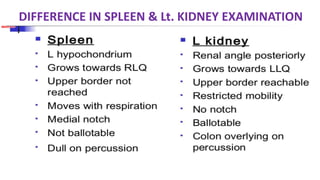
DIFFERENCE IN SPLEEN & Lt. KIDNEY EXAMINATION
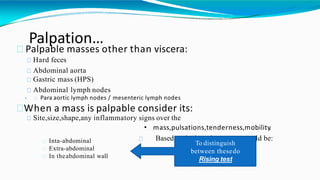
Palpation…
Palpable masses other than viscera:
Hard feces
Abdominal aorta
Gastric mass (HPS)
Abdominal lymph nodes
• Para aortic lymph nodes / mesenteric lymph nodes
When a mass is palpable consider its:
Site,size,shape,any inflammatory signs over the
• mass,pulsations,tenderness,mobility.
Based on its location a mass could be:Inta-abdominal
Extra-abdominal
In theabdominal wall
To distinguish
between thesedo
Rising test
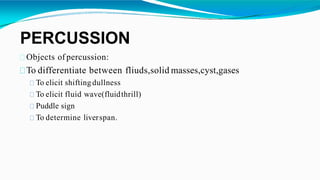
PERCUSSION
Objects of percussion:
To differentiate between fliuds,solid masses,cyst,gases
To elicit shiftingdullness
To elicit fluid wave(fluidthrill)
Puddle sign
To determine liverspan.
PERCUSSION…
LIVER
Percuss for both upper and lower borders
Spleen
Start percussing from RIF to LHC
Place left middle finger parallel to the LCM
Urinary Bladder
Percuss from epigastrium towards hypogastrium
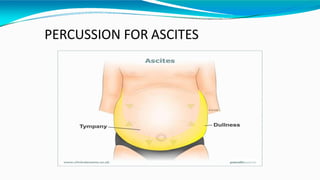
PERCUSSION FOR ASCITES
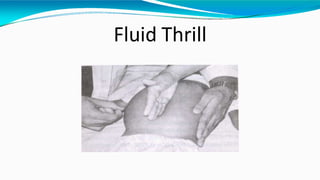
Fluid Thrill
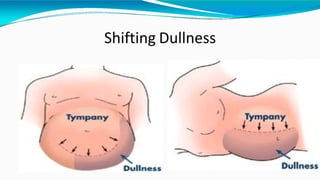
Shifting Dullness
Spleen
 Nixon technique: patient in the right lateral position. Percuss the
upper border in post axillary line. And the lower border obliquely from
below costal margin. [ sensitivity specificity]
 Castell technique: patient in the supine position. Percuss the lowest
intercostal space [8th or 9th] in the anterior axillary line. Ask patient to
take strong inspiration during percussion, if dull =splenomegaly. [
sensitivity specificity]
4
Spleen
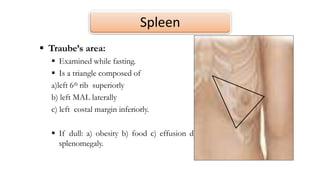
 Traube’s area:
 Examined while fasting.
 Is a triangle composed of
a)left 6th rib superiorly
b) left MAL laterally
c) left costal margin inferiorly.
 If dull: a) obesity b) food c) effusion d)
splenomegaly.
Examination of Genitalia and Groin
Male
Urethral orifice (hypospadias,epispadias)
Size of penis:
Penile length less than 2cm in infants is defined as micro- penia
Genitalia…
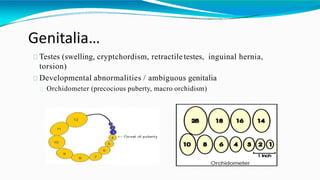
Testes (swelling, cryptchordism, retractile testes, inguinal hernia,
torsion)
Developmental abnormalities / ambiguous genitalia
Orchidometer (precocious puberty, macro orchidism)
Examination of Genitalia and Groin
Female
Vulva
Vagina (discharge, FB, suspected abuse)
Clitoris
Developmental abnormalities / ambiguous genitalia
Rectal examination
Normally done in
Acute abdomen
Chronic constipation
Rectal bleeding
Look for
Tone of anal sphincter and tenderness (anal stenosis loose patulous anus
[myelomeningocele], imperforate anus)
Masses ( feces, polyps, teratomas, foreign bodies)
Local abdominal tenderness
Blood or other staining
Rectal prolapse
Perianal area (thread worms, skin tags, protruding polyps, anal fissures, fecal
soiling)
Pediatric git examination

Pediatric git examination

  • 1.
    Dr. Virendra KumarGupta MD Pediatrics Fellowship In pediatric Gastroentero-Hepatology & Liver Transplantation Assistant Professor Department Of pediatrics NIMS Medical College & Hospital , Jaipur
  • 2.
    GI Tract• UpperGI Tract • Oral Cavity • Oesophagus • Stomach-pylorus • Duodenum • Lower GI Tract • Small intestine- • Duodenum-duodenojejunal flexure • Jejunum • Ileum-ileocaecal juction • Large intestine • Caecum • Colon- ascending/transverse/desce nding/sigmoid • Rectum • Anal canal •Foregut •Midgut •Hindgut ANATOMICAL DIVISION EMBRYOLOGICAL
  • 3.
    SIGNS AND SYMPTOMSOF DIGESTIVE DISORDERS • Stomach pain • Nausea • Vomiting • Diarrhoea • Constipation • Abdominal Distension • Bleeding • Problems with appetite • Dysphagia
  • 4.
    PEDIATRIC DIGESTIVE DISORDERS •Abdominal pain • Celiac disease • Colitis • Constipation • Crohn’s disease • Dysphagia • Esophagitis • Feeding problems, or failure to thrive • Food allergies • Gallbladder diseases • Gastrointestinal bleeding • Gastroparesis • GERD • Hirshsprung’s disease • Iron deficiency anemia • Irritable bowel syndrome • Inflammatory bowel disease • Intestinal pseudo-obstruction • Liver disease • Motility disorders • Pancreatic diseases • Peptic ulcers • Polyps • Obesity • Oesophageal/gastric varisces • Short bowel syndrome
  • 5.
    Before starting GIExamination Wash hands / warm them Proceed calmly / don’t make sudden moves Shake hands and offer some candy or toy Introduce yourself / explain what you are going to do (older child/ parents) Ask the patient to point to the part which is tender(can be unreliable) Position the patient (depends upon child’s comfort) Expose the patient on required basis Approach from right side of the patient Gather as much data as possible by observation first Alter the sequence of examination if required but present it in a sequential manner Order of exam:least distressing to most distressing
  • 6.
    COMPONENTS OF GITEXAMINATION General Physical Examination Oral cavity examination Abdominal examination Genitalia examination Rectal examination
  • 7.
    GENERAL PHYSICAL EXAMINATION Generalappearance:  Is the patient looks ill, unwell or healthy?  Facial expression of the patient(e.g. anxious in case of colic).  Posture in bed:  Motionless in Peritonitis, appendicitis.  Restless in abdominal Colic  Patient suffering from renal colic rolls about on the bed like a snake.  Dyspnea in case of massiveascites.  Notice dysmorphic features. Vital signs:  Temp,RR,PR, BP
  • 8.
    GENERAL PHYSICAL EXAMINATION… Anthropometric measurements  Height  Weight  BMI  MAC/HC/CC Along with plotting on growth chart for assessment of nutritional state of the patient (PEM, OBESITY) due to Chronic diarrhea, malabsorption syndrome, celiac disease ,IBD and giardiasis.
  • 9.
  • 10.
    SKIN Pallor-Anaemia EchymosisRash Discoid Rash-Ulcerative colitis Petechial Rash Cyanosis Yellow-Jaundice Xanthlesma- Primary Bill. cirossis
  • 11.
  • 12.
    NAILS Koilonychia- Vit B12 def,IDA Clubbing- •PrimaryBiliary Cirrohis •IBD •Coeliac disease •Polpososis •GI lymphoma Leuconychia- hypoalbuminemia – liver failure / enteropathy
  • 13.
  • 14.
    ARMS • Spider naevi(telangiectatic lesions) • Scratch marks (chronic cholestasis)
  • 15.
    Xanthelasma (primary biliarycirrhosis) EYESConjuctival pallor (anaemia) • Sclera: jaundice, iritis Kaiser Fleischer’s rings (Wilson’s disease)
  • 16.
    General Physical Examination… Anemiais examined in: Palpebral conjunctivae,dorsum oftongue,nails,palms. Jaundice is examined in: Scleral conjunctivae,under surfaceof tongue,buccal mucosa,skin. In newborn babies jaundicen is best looked for by blanching the skin of the face arround the nasolabial folds,root of the nose and checks. Edema (Puffiness,ascites,anasarca, sacral, pedal)due to hepatic and renal disoeders andmalabsorption. Inspection of stools and urine.
  • 17.
  • 19.
  • 20.
  • 22.
    Jaundice Fapping tremor Palmar erythema Spidernevi Caput medusa Ascites HEPATO- CELLULAR FAILURE(ACUTE/CHRONIC) Alteration in sensorium,,Behavior changes,Irritability Sleep disturbance,drowsiness Fetor hepaticus,
  • 23.
    ACUTEAPPENDICITIS. Mc- burney Tenderness Rovsings Sign Obturator Sign Psoas Sign Rebound tenderness
  • 24.
  • 25.
    Examination of OralCavity Oral cavity is the window to the GI-system and is likely to mirror or exhibit the inflammatory changes of Gi-system.
  • 26.
  • 27.
    LIPS Colour Blue in cyanosis Palein anemia Any deformity Clift lip Corners of lips(fissuring or angularstomatitis) Any vesicles(HSV) Ulceration
  • 28.
  • 29.
    TEETH Number -Growth AndAge Congenital teeth in newborn babies Hutchison’s teeth- (Congenital syphilis)
  • 30.
    TONGUE  Colour  Size Symmetry  Dry(dehydration)or wet  Surface of tongue(coated or raw)  Bald tongue (Smooth tongue)in Vit-B12 deficiency,IDA  Strawberry tongue in scarlet fever and kawaski disease  Scrotal tongue in down syndrome  Geographical tongue isbenign  Tongue tie(ankyloglossia)
  • 31.
    Tremors Dry Macroglossia  Tremors Nervousness,Parkinsonism  Size of tongue Macroglossia (cretins)  Surface of tongue Dry tongue (dehydration) Bald tongue (Anemia) Furred tongue (smoking, mouth breathing) Ulceration (Whooping cough, T.B.) furred Ulceration Bald tongue
  • 32.
  • 33.
    PALATES,ORO-PHARYNX MOUTH Oral cavityand oro-pharynx is examined with the help of a tongue depressor for: • Colour • Ulcers • Deformity • Inflammatory changes Thrush(oral candidiasis) Membranouspharyngitis in strep,diphtheria,infecious mononucleosis
  • 34.
  • 35.
  • 36.
  • 37.
    Patient's position Infant in mother 'slap Infant in mother 's lap
  • 38.
    INSPECTION :General 1.General condition 2.Jaundice 3.Pallor 4. Vircow’s Node: left supraclavicular LN enlargement. 5. Clubbing, palmar erythem, white nails, duptryn contracture. 6.Odema. 7.Gynecomastia 8. Mouth ulcers of IBD, Peutz-gagher perioral pigmentation, talangiectasia , MOUTH THRUSH.
  • 39.
    INSPECTION: Abdomen Size &Shape (abdominal Contour) (up to 3Ys its protuberant) Any distension(localized orgeneralized) Skin: Tone/Colour/ Scar/Striae Prominent veins Visible loops of bowel/visible peristalsis Oedema Movements with Respiration Umbilicus(Inverted/Flat/Everted/Smiling ) Hernial orifices
  • 40.
  • 41.
    CAUSES OF DISTENSION •Gross distension (5 F) • Fluid • Flatus • Feces • Fetus • Fat • Localized distension • Loculated fluid • Mass • Hernia • Organomegaly • Impacted feces
  • 42.
  • 43.
    PROMINENT VEINS Caput MeduceCollateral veins Umbilicus(Inverted/Flat/Everted/Smiling )
  • 44.
    VISIBLE LOOPS OFBOWEL/VISIBLE PERISTALSIS
  • 45.
    Pitting edema ofAbd.wall Umbilicus(Inverted/Flat/Everted/Smiling )
  • 46.
  • 47.
  • 48.
    AUSCULTATION Need to listenbefore percussion or palpation since these maneuvers may alter the frequency of bowel sounds Peristaltic sounds(bowel sounds):  Normal (Gurgle) every 5-10 seconds  Increase (intestinal obstruction/Diarrhoea)  Absent (Paralytic ileus/Late Intestinal obstructuon) VENOUS HUMS B/W XIPHISTERNUM AND UMBILICUS Renal Bruit/Hepatic Bruit: Narrowing (stenosis) of arteries Succussion Splash Borborygmi - long, prolonged gurgles of hyperperistalsis - the familiar stomach growling Puddle Sign
  • 49.
  • 50.
    Ausculatory percussion todetect small amount of ascetic fluid even up to 150ml which is not detectable by fluid thrill and shifting dullness. Knee-elbow position PUDDLE SIGN
  • 51.
  • 52.
    KEY POINTS INPALPATION  Empty bladder  Patient supine  Flex Hip & Knee  Arms at sides or folded across chest  Before begin,point to areas of pain and examine last  Warm hands and stethoscope  Avoid long nails  Approach slowly  Distract the patient with conversation or questions
  • 53.
    • Step 1:ask for any pain and location. • Step 2: – Start superficial palpation away from the site. – If none proceed with anticlockwise move starting from the LLQ : – look for tenderness, temperature, mass, rigidity, guarding, pulsation • Step 3: – Deep palpation starting from the LLQ. – Examine the Left large bowel, Spleen, Epigsatrium, Liver, RUQ, suprapubic and periumblical,Bimanual palpation for both kidneys • Step 4: Flank fullness and fluid thrill, Succusion splash STEPS IN PALPATION
  • 54.
    Palpation of liver Inpalpation of liver consider its: Size, edge, surface, consistency, tenderness, pulsations Liver palpation can be done by four ways: 1. With tip of the fingers(preferred / Standerd method) 2. With radial edge of the right hand(Alternative method) 3. Hooking method 4. Dipping method
  • 55.
  • 56.
    With radial edge(alternative method)
  • 57.
  • 58.
    Dipping method ofpalpation In cases of massiveascites. How to dothis: Placing hand over the abdomen and making quick and gentle dipping movements (also known as one hand ballottement) Also with bimanual ballottement.
  • 59.
  • 60.
  • 61.
  • 62.
    Bimannual method ofspleen palpation
  • 63.
    PALPATION OF KIDNEYS Bimanualtechnique Palpated by standing on respective side lower pole may normally be palpable Asses anyTenderness (Murphy’s renal punch) Left kidney
  • 64.
  • 65.
    DIFFERENCE IN SPLEEN& Lt. KIDNEY EXAMINATION
  • 66.
    Palpation… Palpable masses otherthan viscera: Hard feces Abdominal aorta Gastric mass (HPS) Abdominal lymph nodes • Para aortic lymph nodes / mesenteric lymph nodes When a mass is palpable consider its: Site,size,shape,any inflammatory signs over the • mass,pulsations,tenderness,mobility. Based on its location a mass could be:Inta-abdominal Extra-abdominal In theabdominal wall To distinguish between thesedo Rising test
  • 67.
    PERCUSSION Objects of percussion: Todifferentiate between fliuds,solid masses,cyst,gases To elicit shiftingdullness To elicit fluid wave(fluidthrill) Puddle sign To determine liverspan.
  • 68.
    PERCUSSION… LIVER Percuss for bothupper and lower borders Spleen Start percussing from RIF to LHC Place left middle finger parallel to the LCM Urinary Bladder Percuss from epigastrium towards hypogastrium
  • 69.
  • 70.
  • 71.
  • 72.
    Spleen  Nixon technique:patient in the right lateral position. Percuss the upper border in post axillary line. And the lower border obliquely from below costal margin. [ sensitivity specificity]  Castell technique: patient in the supine position. Percuss the lowest intercostal space [8th or 9th] in the anterior axillary line. Ask patient to take strong inspiration during percussion, if dull =splenomegaly. [ sensitivity specificity] 4
  • 73.
    Spleen  Traube’s area: Examined while fasting.  Is a triangle composed of a)left 6th rib superiorly b) left MAL laterally c) left costal margin inferiorly.  If dull: a) obesity b) food c) effusion d) splenomegaly.
  • 74.
    Examination of Genitaliaand Groin Male Urethral orifice (hypospadias,epispadias) Size of penis: Penile length less than 2cm in infants is defined as micro- penia
  • 75.
    Genitalia… Testes (swelling, cryptchordism,retractile testes, inguinal hernia, torsion) Developmental abnormalities / ambiguous genitalia Orchidometer (precocious puberty, macro orchidism)
  • 76.
    Examination of Genitaliaand Groin Female Vulva Vagina (discharge, FB, suspected abuse) Clitoris Developmental abnormalities / ambiguous genitalia
  • 77.
    Rectal examination Normally donein Acute abdomen Chronic constipation Rectal bleeding Look for Tone of anal sphincter and tenderness (anal stenosis loose patulous anus [myelomeningocele], imperforate anus) Masses ( feces, polyps, teratomas, foreign bodies) Local abdominal tenderness Blood or other staining Rectal prolapse Perianal area (thread worms, skin tags, protruding polyps, anal fissures, fecal soiling)