Neonatal sepsis (NS)
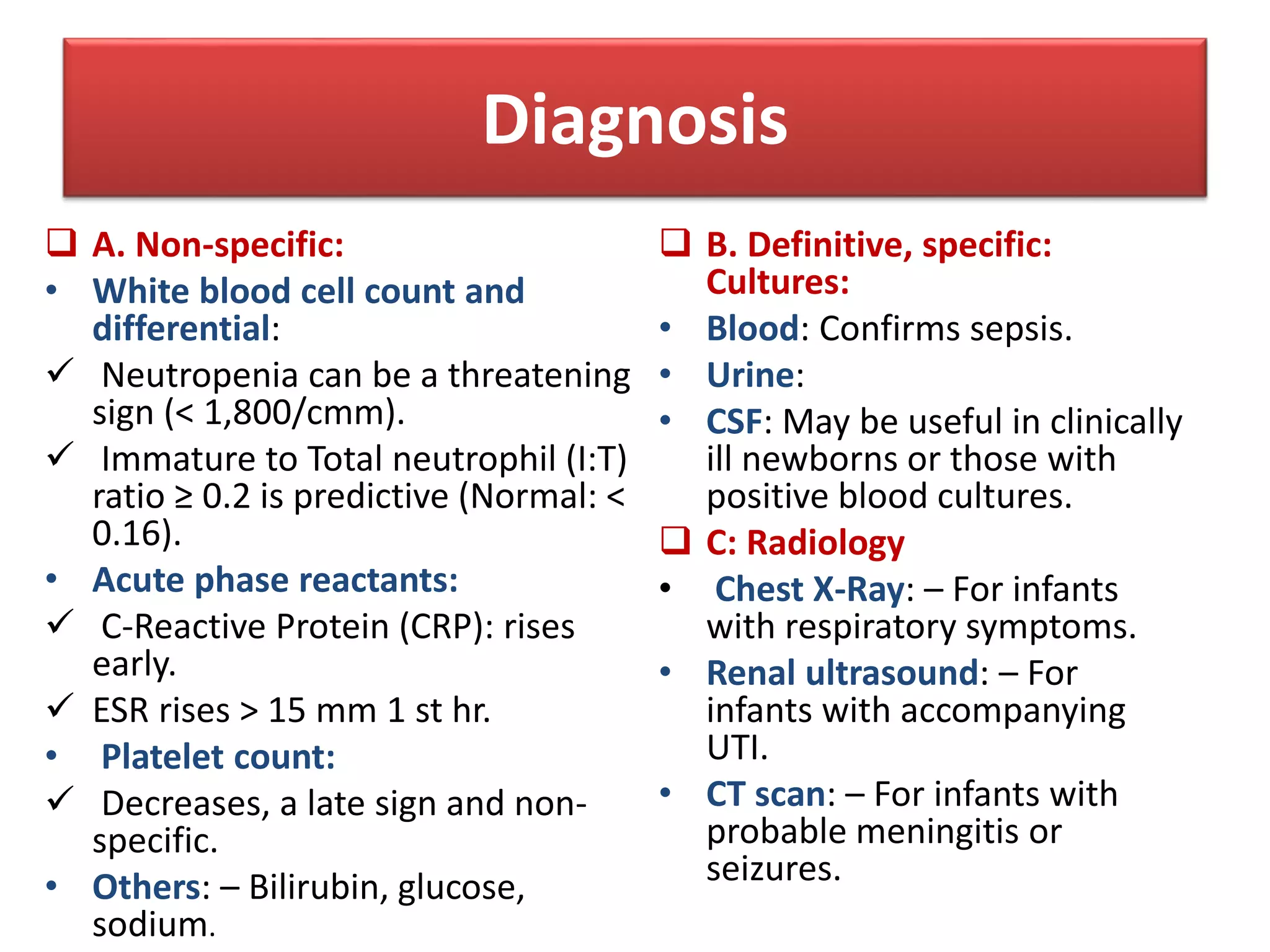
• Neonatal sepsis (NS) is defined as clinical
syndrome of bacteremia with systemic signs
and symptoms of infection in the first four
weeks of life.
ETIOLOGY
• Common organisms identified:
• 1. Escherichia coli.
• 2. Group B Streptococci.
• 3. Listeria monocytogenes.
 4.Others:
 Coagulase negative staphylococci.
 Streptococcus pneumoniae.
 Klebsiella pneumoniae.
 Acinetobacter species.
 Pseudomonas aeruginosa.
 Candida.
EPIDEMIOLOGY
• Incidence: 1-8 cases per 1,000 live births.
• Mortality: 13-70% world wide.
• 13-15% of all neonatal deaths (USA) (8 th
cause).
• Sex: Males > Females.
• Age: premature infants
Pathogenesis
• Neonatal infections are unique in several ways:
1. Infectious agents can be transmitted from the mother to the fetus or newborn infant by
diverse modes.
2. Newborn infants are less capable of responding to infection because of 1 or more
immunologic deficiencies.
3. Coexisting conditions often complicate the diagnosis and management of neonatal
infections.
4. The clinical manifestations of newborn infections vary and include subclinical infection,
mild to severe manifestations of focal or systemic infection, and, rarely, congenital
syndromes resulting from in utero infection. The timing of exposure, inoculum size, immune
status, and virulence of the etiologic agent influence the expression of disease.
5. Maternal infection that is the source of transplacental fetal infection is often undiagnosed
during pregnancy because the mother was either asymptomatic or had nonspecific signs
and symptoms at the time of acute infection.
6. A wide variety of etiologic agents infect the newborn, including bacteria, viruses, fungi,
protozoa, and mycoplasmas.
7. Immature, very low birthweight (VLBW) newborns have improved survival but remain in the
hospital for a long time in an environment that puts them at continuous risk for acquired
infections.
Classification
• Neonatal sepsis include the following:
• Congenital infection —major risk factor is maternal
infection.
 Early-onset sepsis (birth to 7 days)—transplacental,
ascending, or intrapartum.
 manifests as: 1. Pneumonia (Frequently) 2. Less commonly
as: • Septicemia. • Meningitis.
 Late-onset sepsis (8 to 28 days)—acquired in hospital,
home, or community
 manifests as: 1.Septicemia. 2.hematogenous seeding may
result in focal infections, such as meningitis (in 75% of
cases), osteomyelitis (group B streptococci, S. aureus),
arthritis (gonococcus, S. aureus, Candida albicans, gram-
negative bacteria), and urinary tract infection (gram-
negative bacteria).
Early Versus Late Neonatal Sepsis
Risk Factors Pathogens Symptoms Treatment
Early onset
Prematurity #1
Chorioamnionitis
Prolonged rupture
of membranes
(>18 h)
Maternal
colonization with
known pathogens
(e.g., GBS)
Most commonly:
Escherichia coli and GBS
Also, Streptococcus sp.,
Listeria monocytogenes,
and nontypeable
Haemophilus influenzae
95% show symptoms within
first 72 h of life
Bacteremia in 80%
Pneumonia in 7%–10%
If bacteremia, meningitis in
5%–15%
Nonspecific symptoms most
common—in severe cases,
apnea, hypotension, DIC
Ampicillin and gentamicin ×
48–72 h for rule out, 7–10 d
if positive cultures or high
degree of suspicion
Treat meningitis × 14–21 d
Mortality 5%–20%
Late onset
Prematurity
Invasive
procedures and
devices (e.g.
catheters,
ventilators, VP
shunts)
Coagulase negative
Staphylococcus aureus
most common (CONS)
Others: S. aureus, GBS,
Enterococcus, Candida, E.
Coli
Onset more insidious, fever
frequent
66% have bacteremia,
20%–30% have meningitis
Treatment based on
culture-proven or
suspected pathogen
Handwashing most
effective intervention to
decrease nosocomial
infection rate
DIC, disseminated intravascular coagulation; GBS, group B Streptococcus; VP, ventriculoperitoneal.
CLINICAL FEATURES
• Manifestations of neonatal sepsis are usually VAGUE and
demand A HIGH INDEX OF SUSPICION for early diagnosis.
• Most common manifestations include:
• 1. Respiratory distress in early onset NS.
• 2. Altered feeding behavior in a well established feeding
newborn (aspiration, vomiting, etc).
• 3. Baby who was active, suddenly or gradually becomes
lethargic, inactive or unresponsive and refuses to suckle.
• 4. Temperature instability: Hypo- or hyperthermia.
• 5. Skin: Poor peripheral perfusion, cyanosis, pallor,
petechiae, rashes, or jaundice.
• 6. Metabolic:Hypo- or hyperglycemia or metabolic acidosis.
Diagnosis
 A. Non-specific:
• White blood cell count and
differential:
 Neutropenia can be a threatening
sign (< 1,800/cmm).
 Immature to Total neutrophil (I:T)
ratio ≥ 0.2 is predictive (Normal: ˂
0.16).
• Acute phase reactants:
 C-Reactive Protein (CRP): rises
early.
 ESR rises > 15 mm 1 st hr.
• Platelet count:
 Decreases, a late sign and non-
specific.
• Others: – Bilirubin, glucose,
sodium.
 B. Definitive, specific:
Cultures:
• Blood: Confirms sepsis.
• Urine:
• CSF: May be useful in clinically
ill newborns or those with
positive blood cultures.
 C: Radiology
• Chest X-Ray: – For infants
with respiratory symptoms.
• Renal ultrasound: – For
infants with accompanying
UTI.
• CT scan: – For infants with
probable meningitis or
seizures.
Differential Diagnosis
• Respiratory distress syndrome (RDS).
• Metabolic diseases.
• Hematologic diseases.
• CNS diseases.
• Cardiac diseases.
• Other infections (e.g. ToRCH infections).
TREATMENT
• 1. Antibiotics:
Should be based on culture & sensitivity
Antibiotics are used to suppress bacterial growth,
allowing the infant's defense mechanisms time to
respond.
• 2. Supportive therapy
In addition, support measures, such as assisted
ventilation and cardiovascular support, are
equally important to the management of the
infant.
• 1. Antibiotics:
• A combination of ampicillin and an
aminoglycoside (usually gentamicin) for 10 to 14
days is effective treatment against most
organisms responsible for early-onset sepsis.
• The combination of ampicillin and cefotaxime
also is proposed as an alternative method of
treatment.
• If meningitis is present, the treatment should be
extended to 21 days or 14 days after a negative
result from a CSF culture.
• 2. Supportive therapy
• Respiratory: Oxygen and ventilation as necessary.
• Cardiovascular: Support blood pressure with
volume expanders.
• Hematologic: Treat DIC.
• CNS: Treat seizures with phenobarbital.
• Metabolic: Correct hypo-/hyperglycemia and
metabolic acidosis.
PREVENTION
• Good antenatal care.
• Maternal infections diagnosed and treated
early.
• Babies should be breastfed early.
• Infection control policies applied in the unit
THANKS FOR YOUR
Attention

Neonatal sepsis

  • 2.
    Neonatal sepsis (NS) •Neonatal sepsis (NS) is defined as clinical syndrome of bacteremia with systemic signs and symptoms of infection in the first four weeks of life.
  • 3.
    ETIOLOGY • Common organismsidentified: • 1. Escherichia coli. • 2. Group B Streptococci. • 3. Listeria monocytogenes.  4.Others:  Coagulase negative staphylococci.  Streptococcus pneumoniae.  Klebsiella pneumoniae.  Acinetobacter species.  Pseudomonas aeruginosa.  Candida.
  • 4.
    EPIDEMIOLOGY • Incidence: 1-8cases per 1,000 live births. • Mortality: 13-70% world wide. • 13-15% of all neonatal deaths (USA) (8 th cause). • Sex: Males > Females. • Age: premature infants
  • 5.
    Pathogenesis • Neonatal infectionsare unique in several ways: 1. Infectious agents can be transmitted from the mother to the fetus or newborn infant by diverse modes. 2. Newborn infants are less capable of responding to infection because of 1 or more immunologic deficiencies. 3. Coexisting conditions often complicate the diagnosis and management of neonatal infections. 4. The clinical manifestations of newborn infections vary and include subclinical infection, mild to severe manifestations of focal or systemic infection, and, rarely, congenital syndromes resulting from in utero infection. The timing of exposure, inoculum size, immune status, and virulence of the etiologic agent influence the expression of disease. 5. Maternal infection that is the source of transplacental fetal infection is often undiagnosed during pregnancy because the mother was either asymptomatic or had nonspecific signs and symptoms at the time of acute infection. 6. A wide variety of etiologic agents infect the newborn, including bacteria, viruses, fungi, protozoa, and mycoplasmas. 7. Immature, very low birthweight (VLBW) newborns have improved survival but remain in the hospital for a long time in an environment that puts them at continuous risk for acquired infections.
  • 6.
    Classification • Neonatal sepsisinclude the following: • Congenital infection —major risk factor is maternal infection.  Early-onset sepsis (birth to 7 days)—transplacental, ascending, or intrapartum.  manifests as: 1. Pneumonia (Frequently) 2. Less commonly as: • Septicemia. • Meningitis.  Late-onset sepsis (8 to 28 days)—acquired in hospital, home, or community  manifests as: 1.Septicemia. 2.hematogenous seeding may result in focal infections, such as meningitis (in 75% of cases), osteomyelitis (group B streptococci, S. aureus), arthritis (gonococcus, S. aureus, Candida albicans, gram- negative bacteria), and urinary tract infection (gram- negative bacteria).
  • 7.
    Early Versus LateNeonatal Sepsis Risk Factors Pathogens Symptoms Treatment Early onset Prematurity #1 Chorioamnionitis Prolonged rupture of membranes (>18 h) Maternal colonization with known pathogens (e.g., GBS) Most commonly: Escherichia coli and GBS Also, Streptococcus sp., Listeria monocytogenes, and nontypeable Haemophilus influenzae 95% show symptoms within first 72 h of life Bacteremia in 80% Pneumonia in 7%–10% If bacteremia, meningitis in 5%–15% Nonspecific symptoms most common—in severe cases, apnea, hypotension, DIC Ampicillin and gentamicin × 48–72 h for rule out, 7–10 d if positive cultures or high degree of suspicion Treat meningitis × 14–21 d Mortality 5%–20% Late onset Prematurity Invasive procedures and devices (e.g. catheters, ventilators, VP shunts) Coagulase negative Staphylococcus aureus most common (CONS) Others: S. aureus, GBS, Enterococcus, Candida, E. Coli Onset more insidious, fever frequent 66% have bacteremia, 20%–30% have meningitis Treatment based on culture-proven or suspected pathogen Handwashing most effective intervention to decrease nosocomial infection rate DIC, disseminated intravascular coagulation; GBS, group B Streptococcus; VP, ventriculoperitoneal.
  • 8.
    CLINICAL FEATURES • Manifestationsof neonatal sepsis are usually VAGUE and demand A HIGH INDEX OF SUSPICION for early diagnosis. • Most common manifestations include: • 1. Respiratory distress in early onset NS. • 2. Altered feeding behavior in a well established feeding newborn (aspiration, vomiting, etc). • 3. Baby who was active, suddenly or gradually becomes lethargic, inactive or unresponsive and refuses to suckle. • 4. Temperature instability: Hypo- or hyperthermia. • 5. Skin: Poor peripheral perfusion, cyanosis, pallor, petechiae, rashes, or jaundice. • 6. Metabolic:Hypo- or hyperglycemia or metabolic acidosis.
  • 9.
    Diagnosis  A. Non-specific: •White blood cell count and differential:  Neutropenia can be a threatening sign (< 1,800/cmm).  Immature to Total neutrophil (I:T) ratio ≥ 0.2 is predictive (Normal: ˂ 0.16). • Acute phase reactants:  C-Reactive Protein (CRP): rises early.  ESR rises > 15 mm 1 st hr. • Platelet count:  Decreases, a late sign and non- specific. • Others: – Bilirubin, glucose, sodium.  B. Definitive, specific: Cultures: • Blood: Confirms sepsis. • Urine: • CSF: May be useful in clinically ill newborns or those with positive blood cultures.  C: Radiology • Chest X-Ray: – For infants with respiratory symptoms. • Renal ultrasound: – For infants with accompanying UTI. • CT scan: – For infants with probable meningitis or seizures.
  • 10.
    Differential Diagnosis • Respiratorydistress syndrome (RDS). • Metabolic diseases. • Hematologic diseases. • CNS diseases. • Cardiac diseases. • Other infections (e.g. ToRCH infections).
  • 11.
    TREATMENT • 1. Antibiotics: Shouldbe based on culture & sensitivity Antibiotics are used to suppress bacterial growth, allowing the infant's defense mechanisms time to respond. • 2. Supportive therapy In addition, support measures, such as assisted ventilation and cardiovascular support, are equally important to the management of the infant.
  • 12.
    • 1. Antibiotics: •A combination of ampicillin and an aminoglycoside (usually gentamicin) for 10 to 14 days is effective treatment against most organisms responsible for early-onset sepsis. • The combination of ampicillin and cefotaxime also is proposed as an alternative method of treatment. • If meningitis is present, the treatment should be extended to 21 days or 14 days after a negative result from a CSF culture.
  • 13.
    • 2. Supportivetherapy • Respiratory: Oxygen and ventilation as necessary. • Cardiovascular: Support blood pressure with volume expanders. • Hematologic: Treat DIC. • CNS: Treat seizures with phenobarbital. • Metabolic: Correct hypo-/hyperglycemia and metabolic acidosis.
  • 14.
    PREVENTION • Good antenatalcare. • Maternal infections diagnosed and treated early. • Babies should be breastfed early. • Infection control policies applied in the unit
  • 15.