English Phonetics and
Phonology of Reading

       Week 3
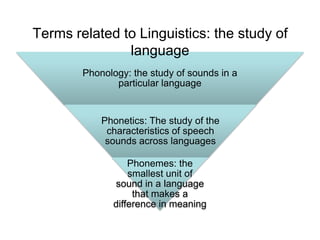
Terms related to Linguistics: the study of
               language
        Phonology: the study of sounds in a
               particular language


            Phonetics: The study of the
             characteristics of speech
             sounds across languages

                  Phonemes: the
                  smallest unit of
              sound in a language
                   that makes a
              difference in meaning
Voiced and Voiceless
          Consonants
• The air from the lungs doesn‟t vibrate
  vocal cords- Voiceless
• The air from the lungs repeatedly
  vibrates vocal cords as it passes
  through, creating a vibration effect-
  Voiced
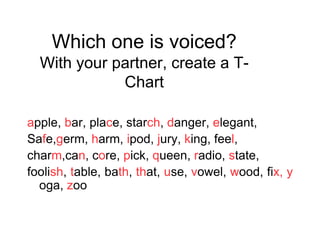
Which one is voiced?
  With your partner, create a T-
             Chart

apple, bar, place, starch, danger, elegant,
Safe,germ, harm, ipod, jury, king, feel,
charm,can, core, pick, queen, radio, state,
foolish, table, bath, that, use, vowel, wood, fix, y
  oga, zoo
Consonants
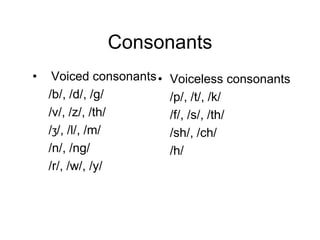
•    Voiced consonants •   Voiceless consonants
    /b/, /d/, /g/          /p/, /t/, /k/
    /v/, /z/, /th/         /f/, /s/, /th/
    /ʒ/, /l/, /m/          /sh/, /ch/
    /n/, /ng/              /h/
    /r/, /w/, /y/
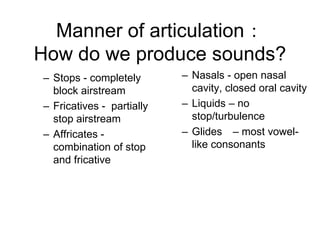
Manner of articulation:
How do we produce sounds?
– Stops - completely       – Nasals - open nasal
  block airstream            cavity, closed oral cavity
– Fricatives - partially   – Liquids – no
  stop airstream             stop/turbulence
– Affricates -             – Glides – most vowel-
  combination of stop        like consonants
  and fricative
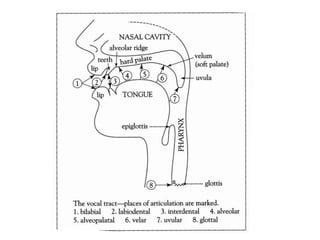
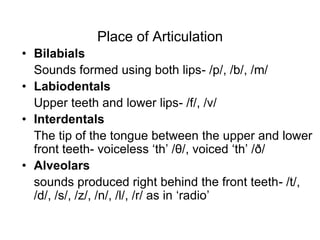
Place of Articulation
• Bilabials
  Sounds formed using both lips- /p/, /b/, /m/
• Labiodentals
  Upper teeth and lower lips- /f/, /v/
• Interdentals
  The tip of the tongue between the upper and lower
  front teeth- voiceless „th‟ /θ/, voiced „th‟ /ð/
• Alveolars
  sounds produced right behind the front teeth- /t/,
  /d/, /s/, /z/, /n/, /l/, /r/ as in „radio‟
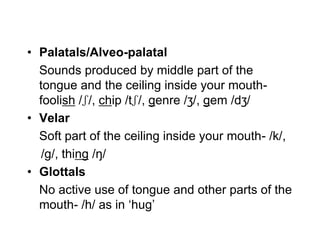
• Palatals/Alveo-palatal
  Sounds produced by middle part of the
  tongue and the ceiling inside your mouth-
  foolish /ʃ/, chip /tʃ/, genre /ʒ/, gem /dʒ/
• Velar
  Soft part of the ceiling inside your mouth- /k/,
   /g/, thing /ŋ/
• Glottals
  No active use of tongue and other parts of the
  mouth- /h/ as in „hug‟
Manner and Place of Articulation
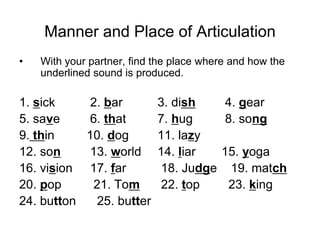
•   With your partner, find the place where and how the
    underlined sound is produced.

1. sick     2. bar          3. dish       4. gear
5. save     6. that         7. hug        8. song
9. thin    10. dog          11. lazy
12. son     13. world       14. liar     15. yoga
16. vision 17. far           18. Judge    19. match
20. pop     21. Tom          22. top      23. king
24. button   25. butter
Manner and Place of Articulation -
                Answers
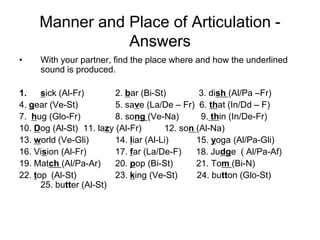
•    With your partner, find the place where and how the underlined
     sound is produced.

1.    sick (Al-Fr)       2. bar (Bi-St)         3. dish (Al/Pa –Fr)
4. gear (Ve-St)          5. save (La/De – Fr) 6. that (In/Dd – F)
7. hug (Glo-Fr)          8. song (Ve-Na)        9. thin (In/De-Fr)
10. Dog (Al-St) 11. lazy (Al-Fr)       12. son (Al-Na)
13. world (Ve-Gli)       14. liar (Al-Li)      15. yoga (Al/Pa-Gli)
16. Vision (Al-Fr)       17. far (La/De-F)     18. Judge ( Al/Pa-Af)
19. Match (Al/Pa-Ar)     20. pop (Bi-St)       21. Tom (Bi-N)
22. top (Al-St)          23. king (Ve-St)      24. button (Glo-St)
      25. butter (Al-St)
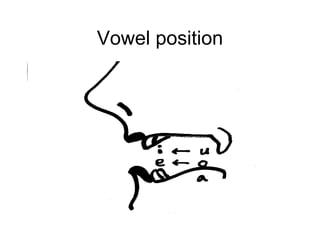
Vowels: Classified by position
         of tongue
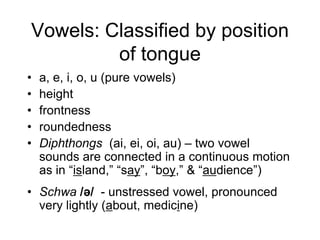
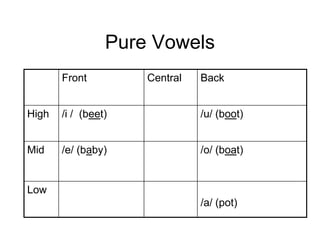
•   a, e, i, o, u (pure vowels)
•   height
•   frontness
•   roundedness
•   Diphthongs (ai, ei, oi, au) – two vowel
    sounds are connected in a continuous motion
    as in “island,” “say”, “boy,” & “audience”)
• Schwa /ə/ - unstressed vowel, pronounced
  very lightly (about, medicine)
Pure Vowels
       Front         Central   Back


High   /i / (beet)             /u/ (boot)


Mid    /e/ (baby)              /o/ (boat)


Low
                               /a/ (pot)
Vowel position
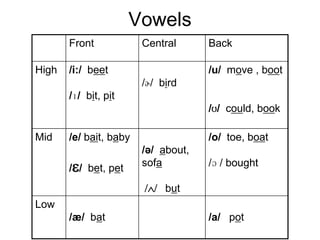
Vowels
       Front            Central      Back

High   /i:/ beet                     /u/ move , boot
                        /ɚ/ bird
       /ɪ/ bit, pit
                                     /ʊ/ could, book

Mid    /e/ bait, baby                /o/ toe, boat
                        /ə/ about,
       // bet, pet     sofa         /ɔ / bought

                        //but
Low
       /æ/ bat                       /a/ pot
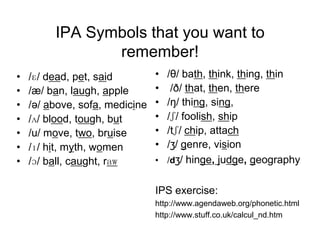
IPA Symbols that you want to
                remember!
•   /ɛ/ dead, pet, said         • /θ/ bath, think, thing, thin
•   /æ/ ban, laugh, apple       •  /ð/ that, then, there
•   /ə/ above, sofa, medicine   • /ŋ/ thing, sing,
•   /ʌ/ blood, tough, but       • /ʃ/ foolish, ship
•   /u/ move, two, bruise       • /tʃ/ chip, attach
•   /ɪ/ hit, myth, women        • /ʒ/ genre, vision
•   /ɔ/ ball, caught, raw       • /dʒ/ hinge, judge, geography


                                IPS exercise:
                                http://www.agendaweb.org/phonetic.html
                                http://www.stuff.co.uk/calcul_nd.htm
Thumb challenge!
• Find a partner
• You and your partner hold the opposite
  side of the strip where it says „start‟
• One of you start translating the IPA
  symbols on the strip to English words
• If you run into a symbol that you fail to
  translate, your partner will take over and
  start translating the symbol you failed
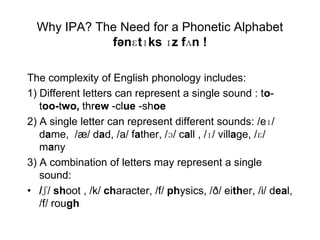
Why IPA? The Need for a Phonetic Alphabet
             fənɛtɪks ɪz fʌn !

The complexity of English phonology includes:
1) Different letters can represent a single sound : to-
   too-two, threw -clue -shoe
2) A single letter can represent different sounds: /eɪ/
   dame, /æ/ dad, /a/ father, /ɔ/ call , /ɪ/ village, /ɛ/
   many
3) A combination of letters may represent a single
   sound:
• /ʃ/ shoot , /k/ character, /f/ physics, /ð/ either, /i/ deal,
   /f/ rough
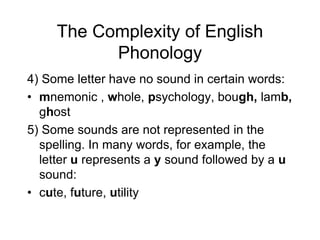
The Complexity of English
           Phonology
4) Some letter have no sound in certain words:
• mnemonic , whole, psychology, bough, lamb,
  ghost
5) Some sounds are not represented in the
  spelling. In many words, for example, the
  letter u represents a y sound followed by a u
  sound:
• cute, future, utility
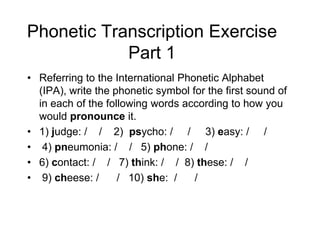
Phonetic Transcription Exercise
            Part 1
• Referring to the International Phonetic Alphabet
  (IPA), write the phonetic symbol for the first sound of
  in each of the following words according to how you
  would pronounce it.
• 1) judge: / / 2) psycho: / / 3) easy: / /
• 4) pneumonia: / / 5) phone: / /
• 6) contact: / / 7) think: / / 8) these: / /
• 9) cheese: /      / 10) she: /    /
Phonetic Transcription Exercise
             Part 2
• Referring to the International Phonetic Alphabet
  (IPA), transcribe the following words. Remember,
  you‟re transcribing the sounds you hear when you
  say the word, not the letters themselves!
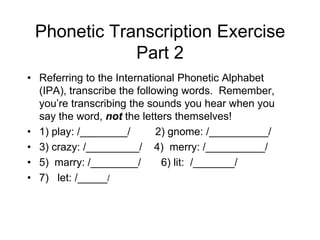
• 1) play: /________/        2) gnome: /__________/
• 3) crazy: /_________/ 4) merry: /__________/
• 5) marry: /________/        6) lit: /_______/
• 7) let: /_____/
Phonetic Transcription
        Exercise Part 3
• Try your hand at deciphering the
  phonetic alphabet. Write the following
  sentence using “our” alphabet (the
  Roman alphabet):
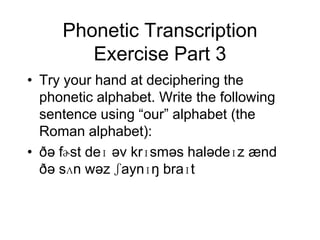
• ðə fɚst deɪ əv krɪsməs halədeɪz ænd
  ðə sʌn wəz ʃaynɪŋ braɪt
Phonetic Transcription Exercise Part 4 : Using
     the IPA to analyze students‟ speech

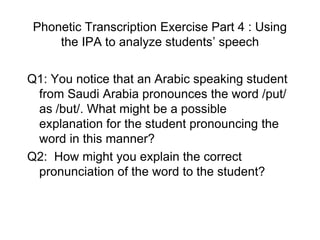
Q1: You notice that an Arabic speaking student
 from Saudi Arabia pronounces the word /put/
 as /but/. What might be a possible
 explanation for the student pronouncing the
 word in this manner?
Q2: How might you explain the correct
 pronunciation of the word to the student?
In-Class Activity: Using the IPA to
       analyze students‟ speech
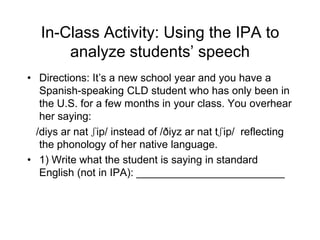
• Directions: It‟s a new school year and you have a
   Spanish-speaking CLD student who has only been in
   the U.S. for a few months in your class. You overhear
   her saying:
  /diys ar nat ʃip/ instead of /ðiyz ar nat tʃip/ reflecting
   the phonology of her native language.
• 1) Write what the student is saying in standard
   English (not in IPA): _________________________
In-Class Activity directions
           continued
• Select 2 phonemes that she‟s
  pronouncing in a non-native like way
  and discuss how you might help her
  with her pronunciation difficulties. Be
  sure to refer to your place and manner
  of articulation charts when deciding
  what advice you‟ll give her.
2 Phonemes Mispronounced
• 1) Phoneme student is pronouncing: /______/
  Native-like pronunciation: /______/
• Pronunciation suggestions for the
  student:____________________________________
  __________________________________________
• 2) Phoneme student is pronouncing: /______/
  Native-like pronunciation: /______/
• Pronunciation suggestions for the
  student:____________________________________
  __________________________________________
Chapter 4: Phonology of
       Reading

        Week 3
Content Objectives
Our mission for this session is to:
   – Define phonology and related terms in relation to
     reading.
   – Examine two views or perspectives on
     phonemic awareness.
   – Explore the linguistic and practical implications of
     teaching phonemic awareness.
Key Concepts
•   Phonology
•   Phonological awareness
•   Phonemic awareness ( 2 views)
•   Linguistic considerations (allophones,
    dialectical variations)
Phonology & Phonological Awareness:


  Phonology: The study of the system and patterns
  of sounds in a particular language

  Phonological awareness: the Ability to
  distinguish larger units of speech
                  EX: the reader‟s capacity to
  understand the                      relationships:

   Between the words intervene and intervention
Explicit Teaching of Phonemic Awareness:
             Linguistic Concerns

• Phonemes as perceptual units versus
  physical realities (i.e. Phonemes are not
  always pronounced the same way)
  – Allophones: phonetic variations/variants of
    phonemes (e.g., “pin – spin”, “bat – bad”).
  – Do not maintain their physical properties.
     • bitten, better, butter (the “tt” is a flap sound in
       Am. Eng)
Explicit Teaching of Phonemic
                 Awareness:
           Linguistic Concerns
• Phonological differences in languages.
Ex. /d/ and /ð/ as in
  “den” and “then” = 2 different phonemes
  in standard English, but allophones of
  the same phoneme in Spanish.
• Is minimal pair useful? Why/why not?
Organizing Pocket!
• Each group will be provided with an envelop
  with word strips in
• On each strip, you will find a word, definition
  or examples that are related to a manner of
  articulation, special vowels or phonemic
  awareness.
• Find the matching strips and put them in a
  pocket
• Pass your pocket sheet to the group on the
  right for the assessment

Su2012 ss phonology(2)

  • 1.
  • 2.
    Terms related toLinguistics: the study of language Phonology: the study of sounds in a particular language Phonetics: The study of the characteristics of speech sounds across languages Phonemes: the smallest unit of sound in a language that makes a difference in meaning
  • 3.
    Voiced and Voiceless Consonants • The air from the lungs doesn‟t vibrate vocal cords- Voiceless • The air from the lungs repeatedly vibrates vocal cords as it passes through, creating a vibration effect- Voiced
  • 4.
    Which one isvoiced? With your partner, create a T- Chart apple, bar, place, starch, danger, elegant, Safe,germ, harm, ipod, jury, king, feel, charm,can, core, pick, queen, radio, state, foolish, table, bath, that, use, vowel, wood, fix, y oga, zoo
  • 5.
    Consonants • Voiced consonants • Voiceless consonants /b/, /d/, /g/ /p/, /t/, /k/ /v/, /z/, /th/ /f/, /s/, /th/ /ʒ/, /l/, /m/ /sh/, /ch/ /n/, /ng/ /h/ /r/, /w/, /y/
  • 6.
    Manner of articulation: Howdo we produce sounds? – Stops - completely – Nasals - open nasal block airstream cavity, closed oral cavity – Fricatives - partially – Liquids – no stop airstream stop/turbulence – Affricates - – Glides – most vowel- combination of stop like consonants and fricative
  • 8.
    Place of Articulation •Bilabials Sounds formed using both lips- /p/, /b/, /m/ • Labiodentals Upper teeth and lower lips- /f/, /v/ • Interdentals The tip of the tongue between the upper and lower front teeth- voiceless „th‟ /θ/, voiced „th‟ /ð/ • Alveolars sounds produced right behind the front teeth- /t/, /d/, /s/, /z/, /n/, /l/, /r/ as in „radio‟
  • 9.
    • Palatals/Alveo-palatal Sounds produced by middle part of the tongue and the ceiling inside your mouth- foolish /ʃ/, chip /tʃ/, genre /ʒ/, gem /dʒ/ • Velar Soft part of the ceiling inside your mouth- /k/, /g/, thing /ŋ/ • Glottals No active use of tongue and other parts of the mouth- /h/ as in „hug‟
  • 10.
    Manner and Placeof Articulation • With your partner, find the place where and how the underlined sound is produced. 1. sick 2. bar 3. dish 4. gear 5. save 6. that 7. hug 8. song 9. thin 10. dog 11. lazy 12. son 13. world 14. liar 15. yoga 16. vision 17. far 18. Judge 19. match 20. pop 21. Tom 22. top 23. king 24. button 25. butter
  • 11.
    Manner and Placeof Articulation - Answers • With your partner, find the place where and how the underlined sound is produced. 1. sick (Al-Fr) 2. bar (Bi-St) 3. dish (Al/Pa –Fr) 4. gear (Ve-St) 5. save (La/De – Fr) 6. that (In/Dd – F) 7. hug (Glo-Fr) 8. song (Ve-Na) 9. thin (In/De-Fr) 10. Dog (Al-St) 11. lazy (Al-Fr) 12. son (Al-Na) 13. world (Ve-Gli) 14. liar (Al-Li) 15. yoga (Al/Pa-Gli) 16. Vision (Al-Fr) 17. far (La/De-F) 18. Judge ( Al/Pa-Af) 19. Match (Al/Pa-Ar) 20. pop (Bi-St) 21. Tom (Bi-N) 22. top (Al-St) 23. king (Ve-St) 24. button (Glo-St) 25. butter (Al-St)
  • 12.
    Vowels: Classified byposition of tongue • a, e, i, o, u (pure vowels) • height • frontness • roundedness • Diphthongs (ai, ei, oi, au) – two vowel sounds are connected in a continuous motion as in “island,” “say”, “boy,” & “audience”) • Schwa /ə/ - unstressed vowel, pronounced very lightly (about, medicine)
  • 13.
    Pure Vowels Front Central Back High /i / (beet) /u/ (boot) Mid /e/ (baby) /o/ (boat) Low /a/ (pot)
  • 14.
  • 15.
    Vowels Front Central Back High /i:/ beet /u/ move , boot /ɚ/ bird /ɪ/ bit, pit /ʊ/ could, book Mid /e/ bait, baby /o/ toe, boat /ə/ about, // bet, pet sofa /ɔ / bought //but Low /æ/ bat /a/ pot
  • 16.
    IPA Symbols thatyou want to remember! • /ɛ/ dead, pet, said • /θ/ bath, think, thing, thin • /æ/ ban, laugh, apple • /ð/ that, then, there • /ə/ above, sofa, medicine • /ŋ/ thing, sing, • /ʌ/ blood, tough, but • /ʃ/ foolish, ship • /u/ move, two, bruise • /tʃ/ chip, attach • /ɪ/ hit, myth, women • /ʒ/ genre, vision • /ɔ/ ball, caught, raw • /dʒ/ hinge, judge, geography IPS exercise: http://www.agendaweb.org/phonetic.html http://www.stuff.co.uk/calcul_nd.htm
  • 17.
    Thumb challenge! • Finda partner • You and your partner hold the opposite side of the strip where it says „start‟ • One of you start translating the IPA symbols on the strip to English words • If you run into a symbol that you fail to translate, your partner will take over and start translating the symbol you failed
  • 18.
    Why IPA? TheNeed for a Phonetic Alphabet fənɛtɪks ɪz fʌn ! The complexity of English phonology includes: 1) Different letters can represent a single sound : to- too-two, threw -clue -shoe 2) A single letter can represent different sounds: /eɪ/ dame, /æ/ dad, /a/ father, /ɔ/ call , /ɪ/ village, /ɛ/ many 3) A combination of letters may represent a single sound: • /ʃ/ shoot , /k/ character, /f/ physics, /ð/ either, /i/ deal, /f/ rough
  • 19.
    The Complexity ofEnglish Phonology 4) Some letter have no sound in certain words: • mnemonic , whole, psychology, bough, lamb, ghost 5) Some sounds are not represented in the spelling. In many words, for example, the letter u represents a y sound followed by a u sound: • cute, future, utility
  • 20.
    Phonetic Transcription Exercise Part 1 • Referring to the International Phonetic Alphabet (IPA), write the phonetic symbol for the first sound of in each of the following words according to how you would pronounce it. • 1) judge: / / 2) psycho: / / 3) easy: / / • 4) pneumonia: / / 5) phone: / / • 6) contact: / / 7) think: / / 8) these: / / • 9) cheese: / / 10) she: / /
  • 21.
    Phonetic Transcription Exercise Part 2 • Referring to the International Phonetic Alphabet (IPA), transcribe the following words. Remember, you‟re transcribing the sounds you hear when you say the word, not the letters themselves! • 1) play: /________/ 2) gnome: /__________/ • 3) crazy: /_________/ 4) merry: /__________/ • 5) marry: /________/ 6) lit: /_______/ • 7) let: /_____/
  • 22.
    Phonetic Transcription Exercise Part 3 • Try your hand at deciphering the phonetic alphabet. Write the following sentence using “our” alphabet (the Roman alphabet): • ðə fɚst deɪ əv krɪsməs halədeɪz ænd ðə sʌn wəz ʃaynɪŋ braɪt
  • 23.
    Phonetic Transcription ExercisePart 4 : Using the IPA to analyze students‟ speech Q1: You notice that an Arabic speaking student from Saudi Arabia pronounces the word /put/ as /but/. What might be a possible explanation for the student pronouncing the word in this manner? Q2: How might you explain the correct pronunciation of the word to the student?
  • 24.
    In-Class Activity: Usingthe IPA to analyze students‟ speech • Directions: It‟s a new school year and you have a Spanish-speaking CLD student who has only been in the U.S. for a few months in your class. You overhear her saying: /diys ar nat ʃip/ instead of /ðiyz ar nat tʃip/ reflecting the phonology of her native language. • 1) Write what the student is saying in standard English (not in IPA): _________________________
  • 25.
    In-Class Activity directions continued • Select 2 phonemes that she‟s pronouncing in a non-native like way and discuss how you might help her with her pronunciation difficulties. Be sure to refer to your place and manner of articulation charts when deciding what advice you‟ll give her.
  • 26.
    2 Phonemes Mispronounced •1) Phoneme student is pronouncing: /______/ Native-like pronunciation: /______/ • Pronunciation suggestions for the student:____________________________________ __________________________________________ • 2) Phoneme student is pronouncing: /______/ Native-like pronunciation: /______/ • Pronunciation suggestions for the student:____________________________________ __________________________________________
  • 27.
    Chapter 4: Phonologyof Reading Week 3
  • 28.
    Content Objectives Our missionfor this session is to: – Define phonology and related terms in relation to reading. – Examine two views or perspectives on phonemic awareness. – Explore the linguistic and practical implications of teaching phonemic awareness.
  • 29.
    Key Concepts • Phonology • Phonological awareness • Phonemic awareness ( 2 views) • Linguistic considerations (allophones, dialectical variations)
  • 30.
    Phonology & PhonologicalAwareness: Phonology: The study of the system and patterns of sounds in a particular language Phonological awareness: the Ability to distinguish larger units of speech EX: the reader‟s capacity to understand the relationships: Between the words intervene and intervention
  • 31.
    Explicit Teaching ofPhonemic Awareness: Linguistic Concerns • Phonemes as perceptual units versus physical realities (i.e. Phonemes are not always pronounced the same way) – Allophones: phonetic variations/variants of phonemes (e.g., “pin – spin”, “bat – bad”). – Do not maintain their physical properties. • bitten, better, butter (the “tt” is a flap sound in Am. Eng)
  • 32.
    Explicit Teaching ofPhonemic Awareness: Linguistic Concerns • Phonological differences in languages. Ex. /d/ and /ð/ as in “den” and “then” = 2 different phonemes in standard English, but allophones of the same phoneme in Spanish. • Is minimal pair useful? Why/why not?
  • 33.
    Organizing Pocket! • Eachgroup will be provided with an envelop with word strips in • On each strip, you will find a word, definition or examples that are related to a manner of articulation, special vowels or phonemic awareness. • Find the matching strips and put them in a pocket • Pass your pocket sheet to the group on the right for the assessment