Paper II Language
Unit III
Prepared by Dr. Abha Pandey
Professor, Department of English
for MA IV Sem students
April 2020
 The unit that is next in hierarchy to speech
sound is the syllable.
 Syllable is the next higher unit than the
phoneme. Man -/mæn/
 A word consists of one or more than one
syllables
 rat- /ræt/ has one syllable (monosyllable),
redeem- / ri -di:m / has two syllables
(disyllable), humanist /hju-mə-nist / has three
syllables (trisyllable)
 Syllable is marked with a hyphen thus: tai-lor,
cu-cum-ber, pho-ne-tics and so on.
 Count and mark the syllable
 Cat Boar
 Catch beard
 car batch
 Bargain casting
 Categorical beginning
 Its not always easy to point out where on a
syllable ends and where the next one begins.
 Cigarette shoud be /si-gə-ret/ or /sig-ə-ret/?
 Examination: x represents two sounds- [g] and
[z]. A phonetic transcription is required for
marking the syllable division.
 It can’t be divided as /i-gzæ-mi-nei-ʃn/
 English does not allow these two consonants to
begin a syllable.

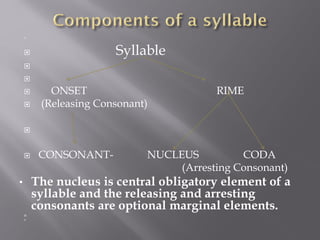
 Syllable


 ONSET RIME
 (Releasing Consonant)

 CONSONANT- NUCLEUS CODA
(Arresting Consonant)
• The nucleus is central obligatory element of a
syllable and the releasing and arresting
consonants are optional marginal elements.


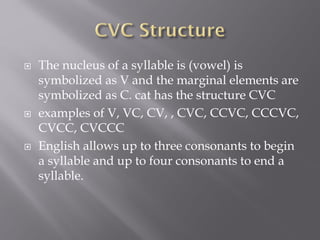
 The nucleus of a syllable is (vowel) is
symbolized as V and the marginal elements are
symbolized as C. cat has the structure CVC
 examples of V, VC, CV, , CVC, CCVC, CCCVC,
CVCC, CVCCC
 English allows up to three consonants to begin
a syllable and up to four consonants to end a
syllable.
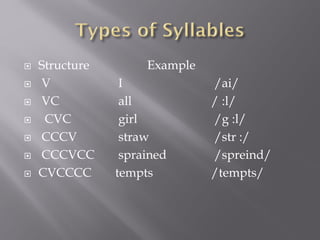
 Structure Example
 V I /ai/
 VC all / :l/
 CVC girl /g :l/
 CCCV straw /str :/
 CCCVCC sprained /spreind/
 CVCCCC tempts /tempts/
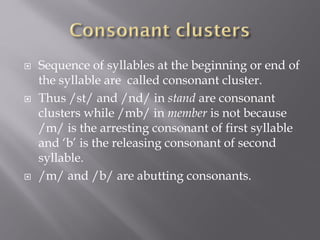
 Sequence of syllables at the beginning or end of
the syllable are called consonant cluster.
 Thus /st/ and /nd/ in stand are consonant
clusters while /mb/ in member is not because
/m/ is the arresting consonant of first syllable
and ‘b’ is the releasing consonant of second
syllable.
 /m/ and /b/ are abutting consonants.
 Consonants which occur together in a
word but form part of two different
syllablesSend-/send/
 number -/nʌm-bə/
 /nd/ in send and /m/ and /b/ in
number are abutting consonants
 Syllable that ends in a consonant is a
closed syllable and one that ends in a
vowel is an open syllable. Eg. Bad,
good- closed, she, to –open.
 There are some syllables in which the nucleus
is a consonant such as /n/ /l/ /m/
 These are called Syllabic Consonants
 Nucleus of some syllables are occupied by
certain consonants which function like vowels.
 button /bʌtn/ /bʌ -tn/
 bottle /bɒtl/ /bɒ -tl/
 rhythm /riðm/ /ri-ðm/
 In syllable structure the syllabic consonants are
marked as V.
 Balasubramanian.,T. A Textbook of English
Phonetics for Indian Students. Macmillan India
Ltd. 1981. pp. 64-69.
 Jones, Daniel, The Pronunciation of English, Eigth
edition, Cambridge, Cambridge University
Press, 1956.

Syllable

  • 1.
    Paper II Language UnitIII Prepared by Dr. Abha Pandey Professor, Department of English for MA IV Sem students April 2020
  • 2.
     The unitthat is next in hierarchy to speech sound is the syllable.  Syllable is the next higher unit than the phoneme. Man -/mæn/  A word consists of one or more than one syllables  rat- /ræt/ has one syllable (monosyllable), redeem- / ri -di:m / has two syllables (disyllable), humanist /hju-mə-nist / has three syllables (trisyllable)
  • 3.
     Syllable ismarked with a hyphen thus: tai-lor, cu-cum-ber, pho-ne-tics and so on.  Count and mark the syllable  Cat Boar  Catch beard  car batch  Bargain casting  Categorical beginning
  • 4.
     Its notalways easy to point out where on a syllable ends and where the next one begins.  Cigarette shoud be /si-gə-ret/ or /sig-ə-ret/?  Examination: x represents two sounds- [g] and [z]. A phonetic transcription is required for marking the syllable division.  It can’t be divided as /i-gzæ-mi-nei-ʃn/  English does not allow these two consonants to begin a syllable.
  • 5.
      Syllable    ONSETRIME  (Releasing Consonant)   CONSONANT- NUCLEUS CODA (Arresting Consonant) • The nucleus is central obligatory element of a syllable and the releasing and arresting consonants are optional marginal elements.  
  • 6.
     The nucleusof a syllable is (vowel) is symbolized as V and the marginal elements are symbolized as C. cat has the structure CVC  examples of V, VC, CV, , CVC, CCVC, CCCVC, CVCC, CVCCC  English allows up to three consonants to begin a syllable and up to four consonants to end a syllable.
  • 7.
     Structure Example V I /ai/  VC all / :l/  CVC girl /g :l/  CCCV straw /str :/  CCCVCC sprained /spreind/  CVCCCC tempts /tempts/
  • 8.
     Sequence ofsyllables at the beginning or end of the syllable are called consonant cluster.  Thus /st/ and /nd/ in stand are consonant clusters while /mb/ in member is not because /m/ is the arresting consonant of first syllable and ‘b’ is the releasing consonant of second syllable.  /m/ and /b/ are abutting consonants.
  • 9.
     Consonants whichoccur together in a word but form part of two different syllablesSend-/send/  number -/nʌm-bə/  /nd/ in send and /m/ and /b/ in number are abutting consonants  Syllable that ends in a consonant is a closed syllable and one that ends in a vowel is an open syllable. Eg. Bad, good- closed, she, to –open.
  • 10.
     There aresome syllables in which the nucleus is a consonant such as /n/ /l/ /m/  These are called Syllabic Consonants  Nucleus of some syllables are occupied by certain consonants which function like vowels.  button /bʌtn/ /bʌ -tn/  bottle /bɒtl/ /bɒ -tl/  rhythm /riðm/ /ri-ðm/  In syllable structure the syllabic consonants are marked as V.
  • 11.
     Balasubramanian.,T. ATextbook of English Phonetics for Indian Students. Macmillan India Ltd. 1981. pp. 64-69.  Jones, Daniel, The Pronunciation of English, Eigth edition, Cambridge, Cambridge University Press, 1956.