Towards
Better English
Pronunciation
Objectives:
Participants will be able to:
 define the main features of good pronunciation,
 Improve their implementation of the English sounds





system,
Identify problems of English sounds,
Select and implement teaching techniques to teach
good pronunciation,
Demonstrate recognition/production drills with
problem sounds,
Implement appropriate pronunciation correction
techniques.
Phonetics and Phonology
Phonetics

Phonology

Language independent

Language dependent

Study of all sounds
Phonetic is different to
Phonology in matter that it is
the production of sounds.

Phonology is a subset of
phonetics.
Phonology, in the other
hand refers to the sound
systems of a language
 Phonemics: narrow study of sounds



Phonetics: broad study of sounds
What is Phonetics?
 Phonetics is the study of speech sounds.

Articulatory phonetics – how speech sounds
are produced
 Acoustic phonetics – the transmission and
physical properties of speech sounds
 Auditory phonetics – perception of speech
sounds




Phonetic transcriptions – one sound = one
symbol.
Why do I need to learn Phonetics?
 Phonetics increases your knowledge in

matters of pronunciation.
 By knowing how languages are produced
you can better your pronunciation.
 It facilitates the acquisition of new words.
 It helps you to read the dictionary using the
correct sounds inscripted in the words.
Task Sheet 1

What are the main features of good
Pronunciation?
Features of good Pronunciation
 Correct articulation of speech sounds.
 Correct stress.
 Correct intonation.
 Proper pauses.
Task Sheet 2
 Why should teachers know how sounds are

made?
 Can pronunciation written down?
 What is the term used for written
pronunciation?
 Do teachers need to know how to read
“written pronunciation”? Why?
Task Sheet 3
 Do your teachers/students have

pronunciation problems?
 What difficulties do they have?
 What are their problematic English
sounds?
Vowels
Diphthongs
Consonants
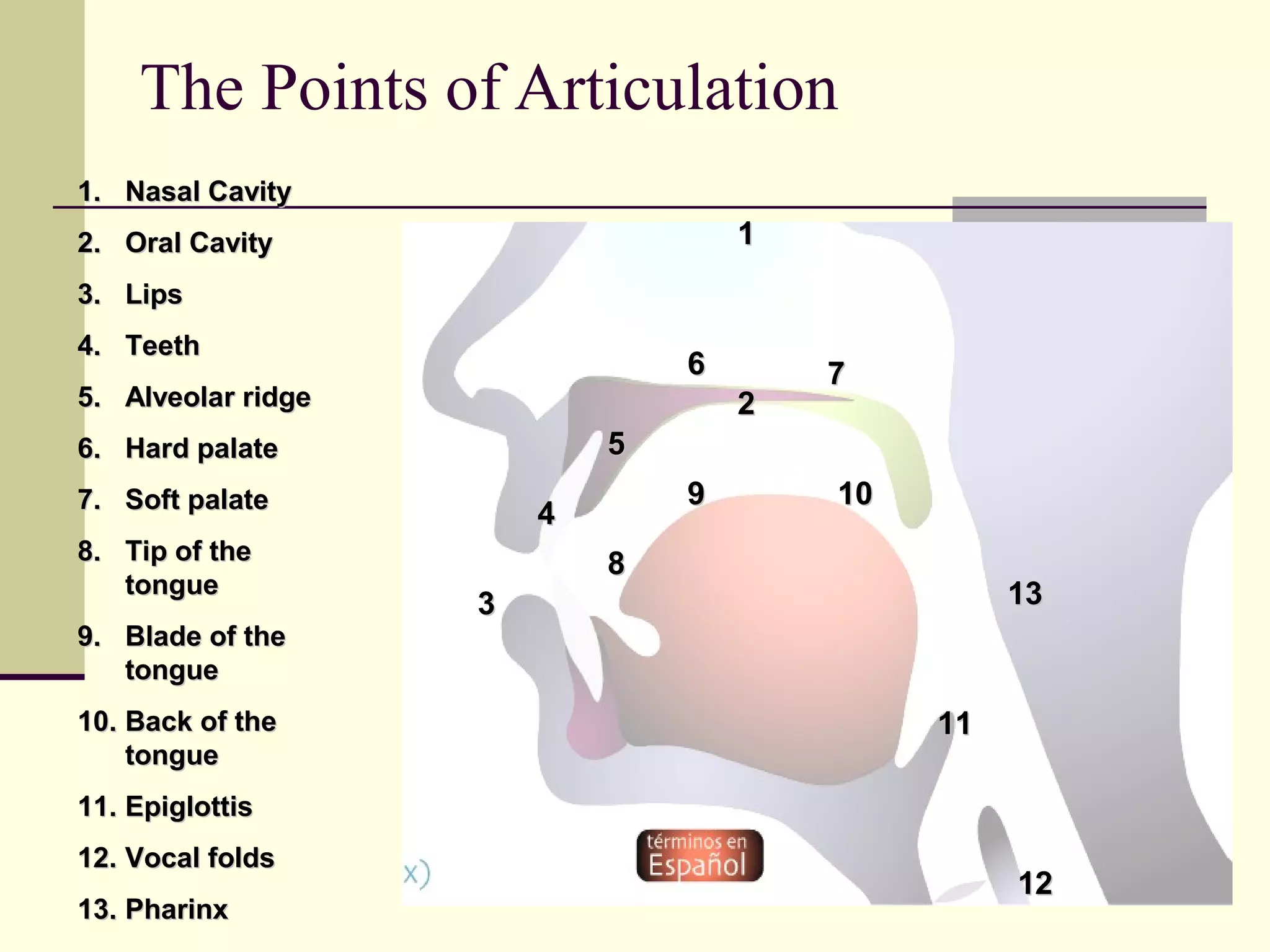
The Points of Articulation
1. Nasal Cavity

1

2. Oral Cavity
3. Lips
4. Teeth

6

5. Alveolar ridge

2
5

6. Hard palate
7. Soft palate
8. Tip of the
tongue
9. Blade of the
tongue
10. Back of the
tongue

7

9

4

10

8

13

3

11

11. Epiglottis
12. Vocal folds
13. Pharinx

12
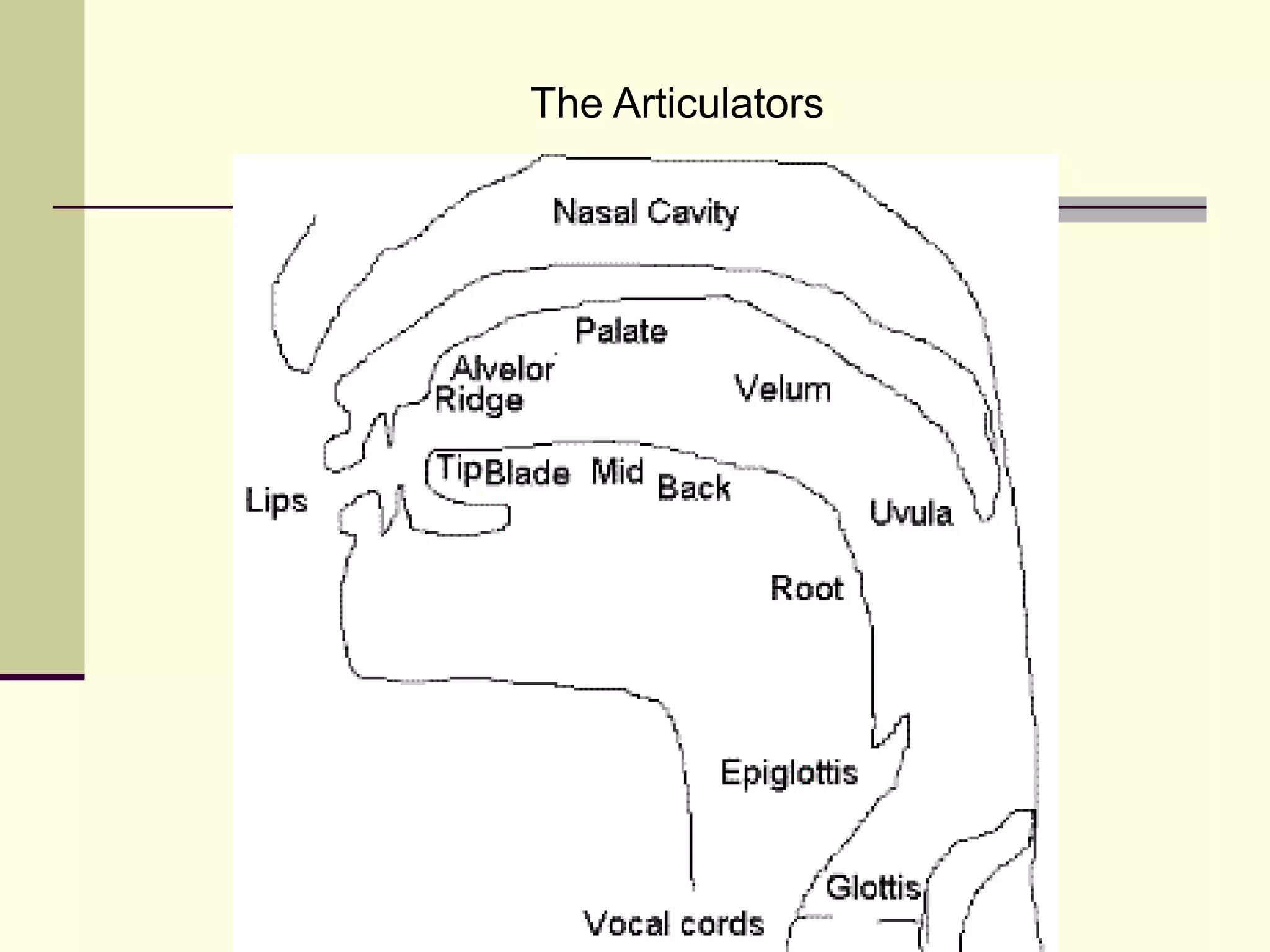
The Articulators
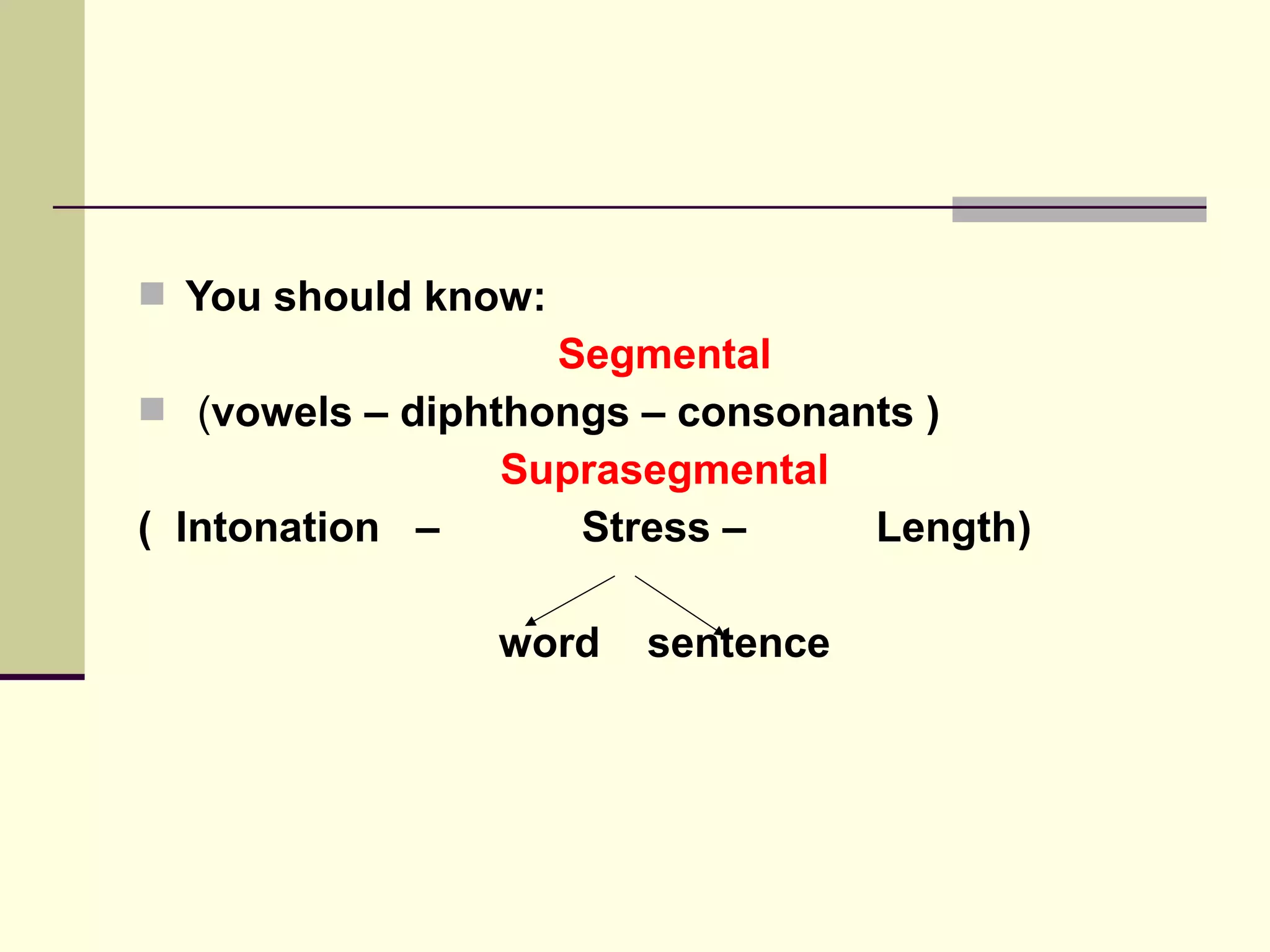
 You should know:

Segmental
 (vowels – diphthongs – consonants )
Suprasegmental
( Intonation –
Stress –
Length)
word

sentence
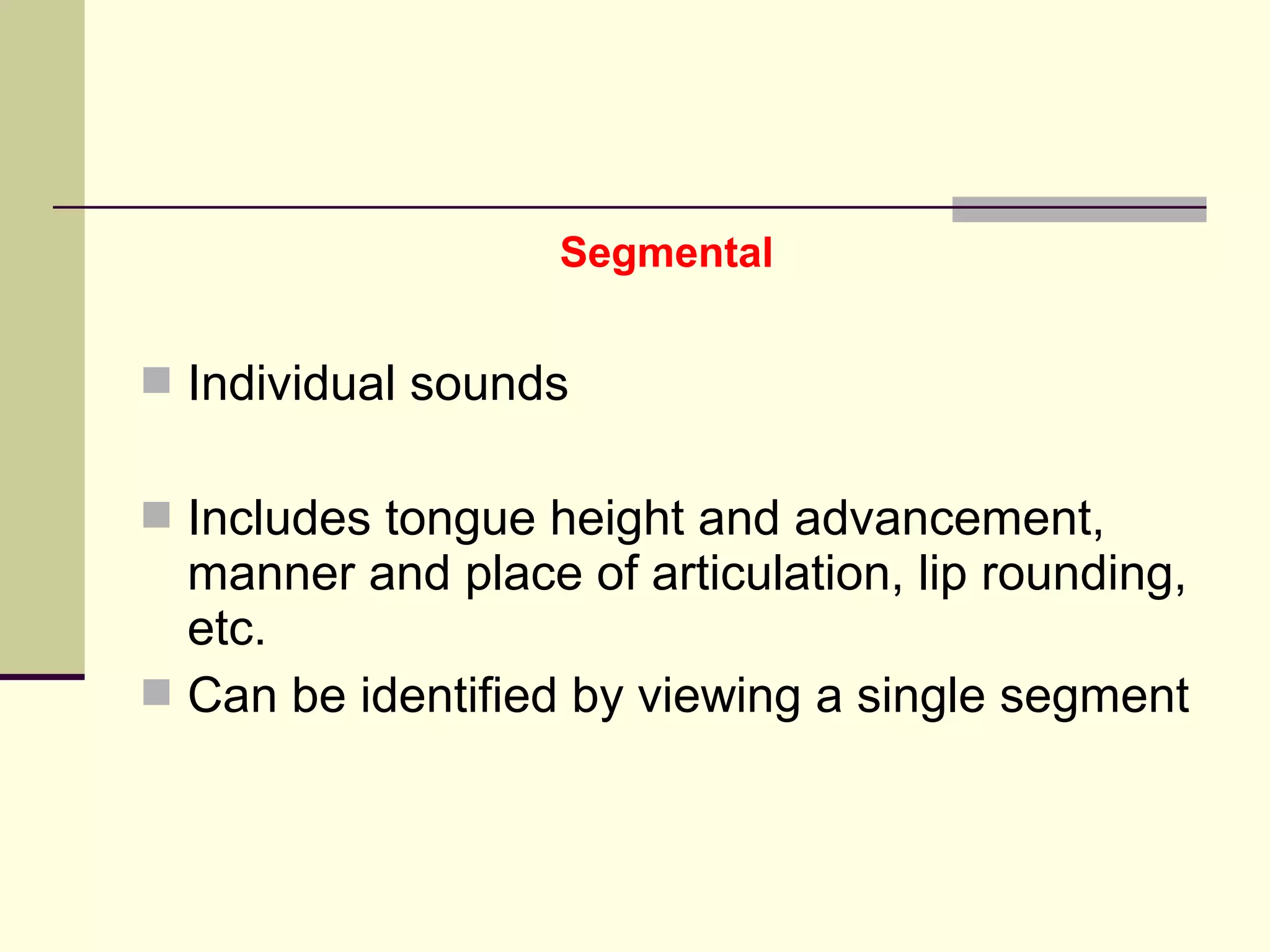
Segmental

 Individual sounds
 Includes tongue height and advancement,

manner and place of articulation, lip rounding,
etc.
 Can be identified by viewing a single segment
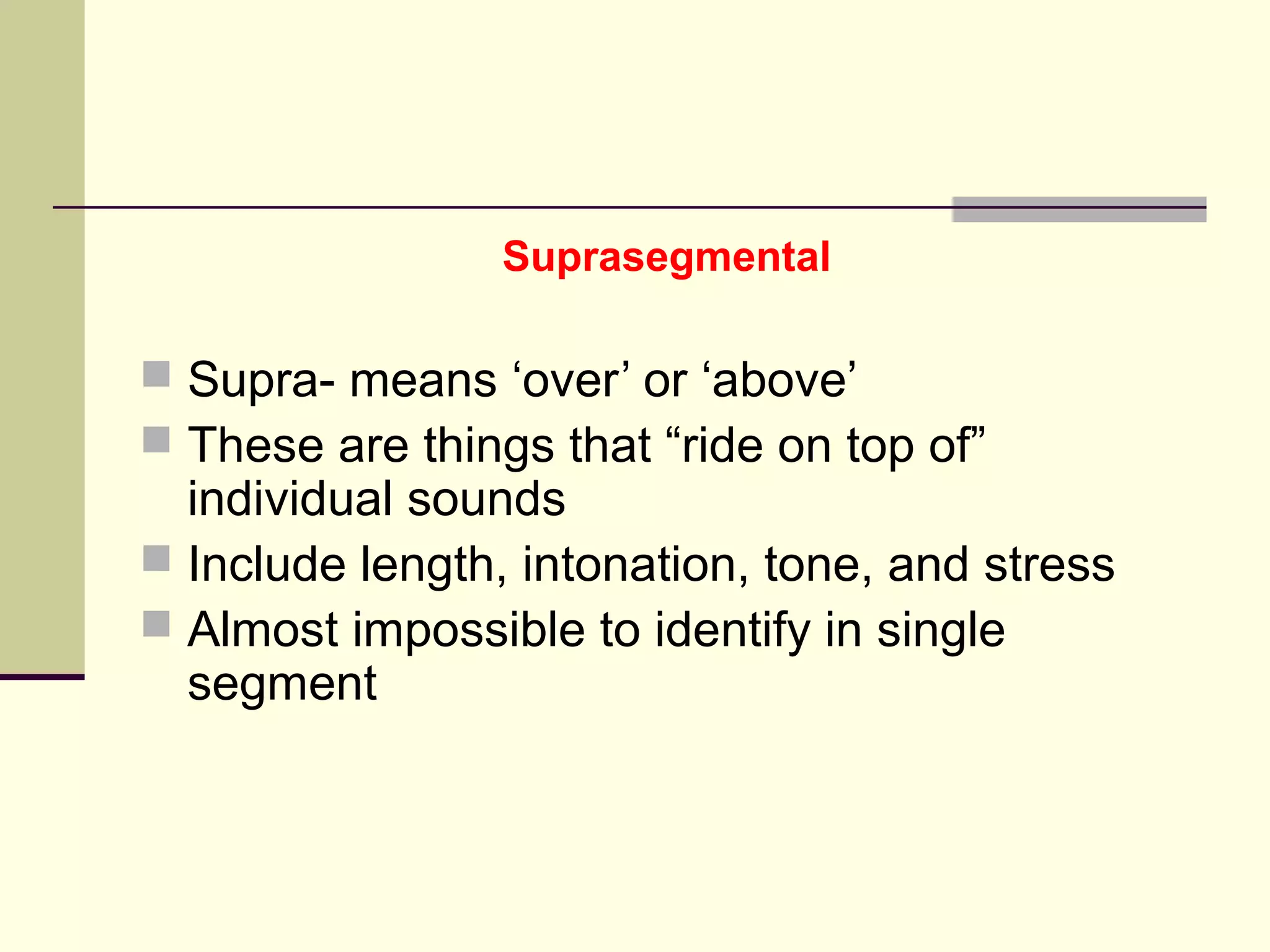
Suprasegmental

 Supra- means ‘over’ or ‘above’
 These are things that “ride on top of”

individual sounds
 Include length, intonation, tone, and stress
 Almost impossible to identify in single
segment
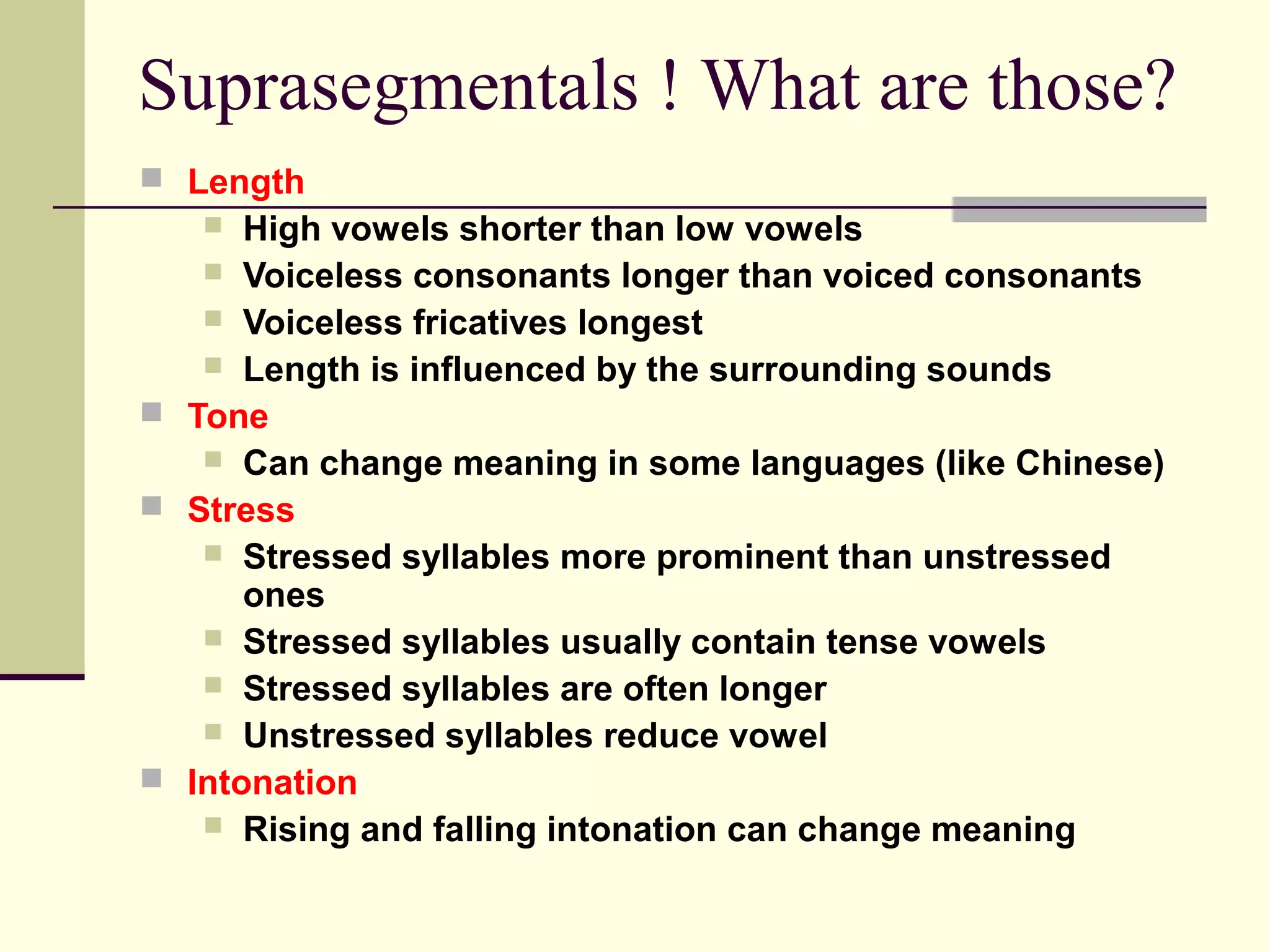
Suprasegmentals ! What are those?
 Length

High vowels shorter than low vowels
 Voiceless consonants longer than voiced consonants
 Voiceless fricatives longest
 Length is influenced by the surrounding sounds
 Tone
 Can change meaning in some languages (like Chinese)
 Stress
 Stressed syllables more prominent than unstressed
ones
 Stressed syllables usually contain tense vowels
 Stressed syllables are often longer
 Unstressed syllables reduce vowel
 Intonation
 Rising and falling intonation can change meaning

Segmentals ! What are
those?
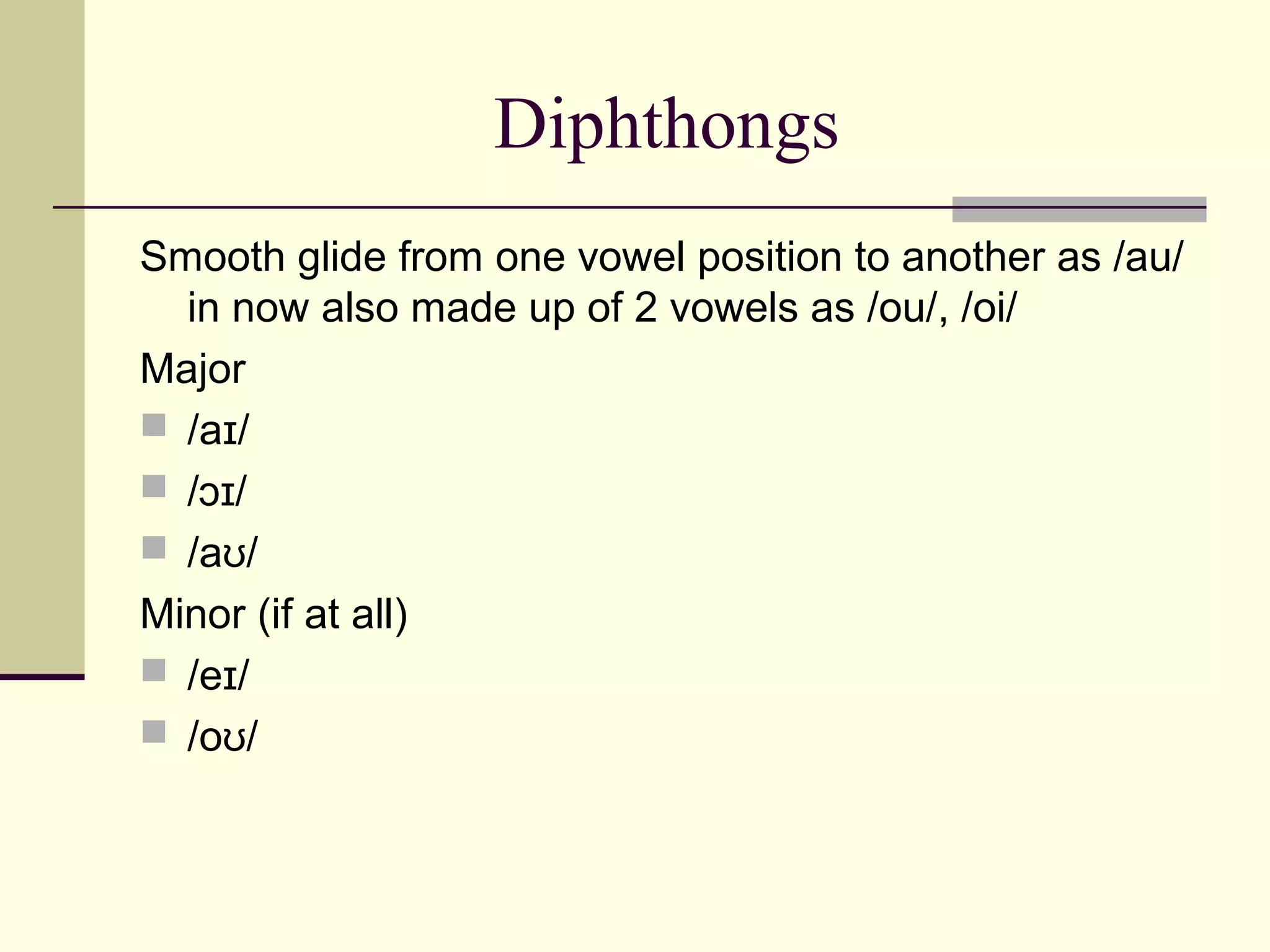
Vowels
 Vowels are all made in the mouth (place), with

little or no air flow constriction (manner) and are
always voiced in English
 So the system that describes vowels does so in
terms 3 characteristics:




tongue placement
tongue height
lip rounding
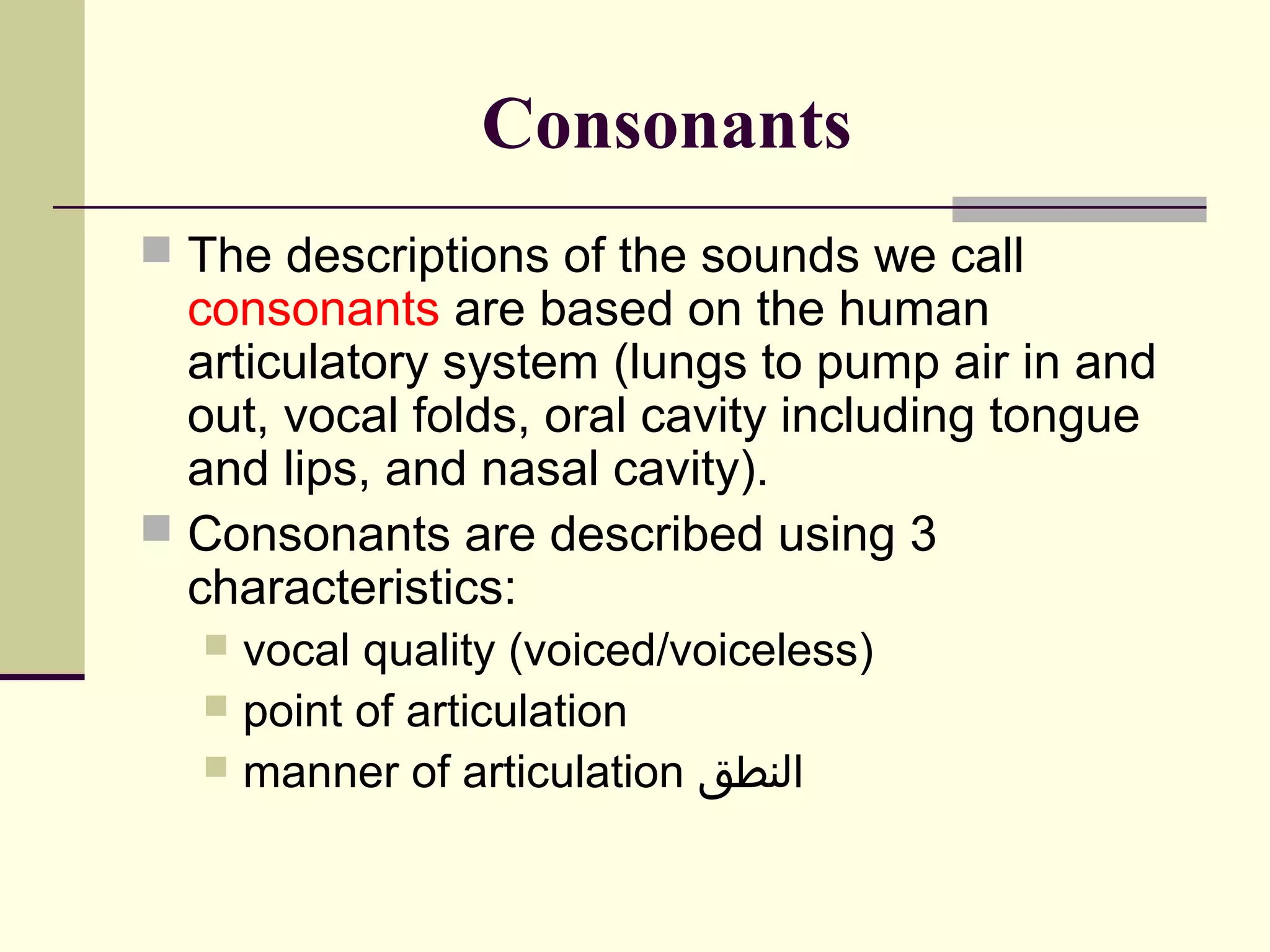
Diphthongs
Smooth glide from one vowel position to another as /au/
in now also made up of 2 vowels as /ou/, /oi/
Major
 /aɪ/
 /ɔɪ/
 /aʊ/
Minor (if at all)
 /eɪ/
 /oʊ/
Consonants
 The descriptions of the sounds we call

consonants are based on the human
articulatory system (lungs to pump air in and
out, vocal folds, oral cavity including tongue
and lips, and nasal cavity).
 Consonants are described using 3
characteristics:
vocal quality (voiced/voiceless)
 point of articulation
 manner of articulation ‫النطق‬

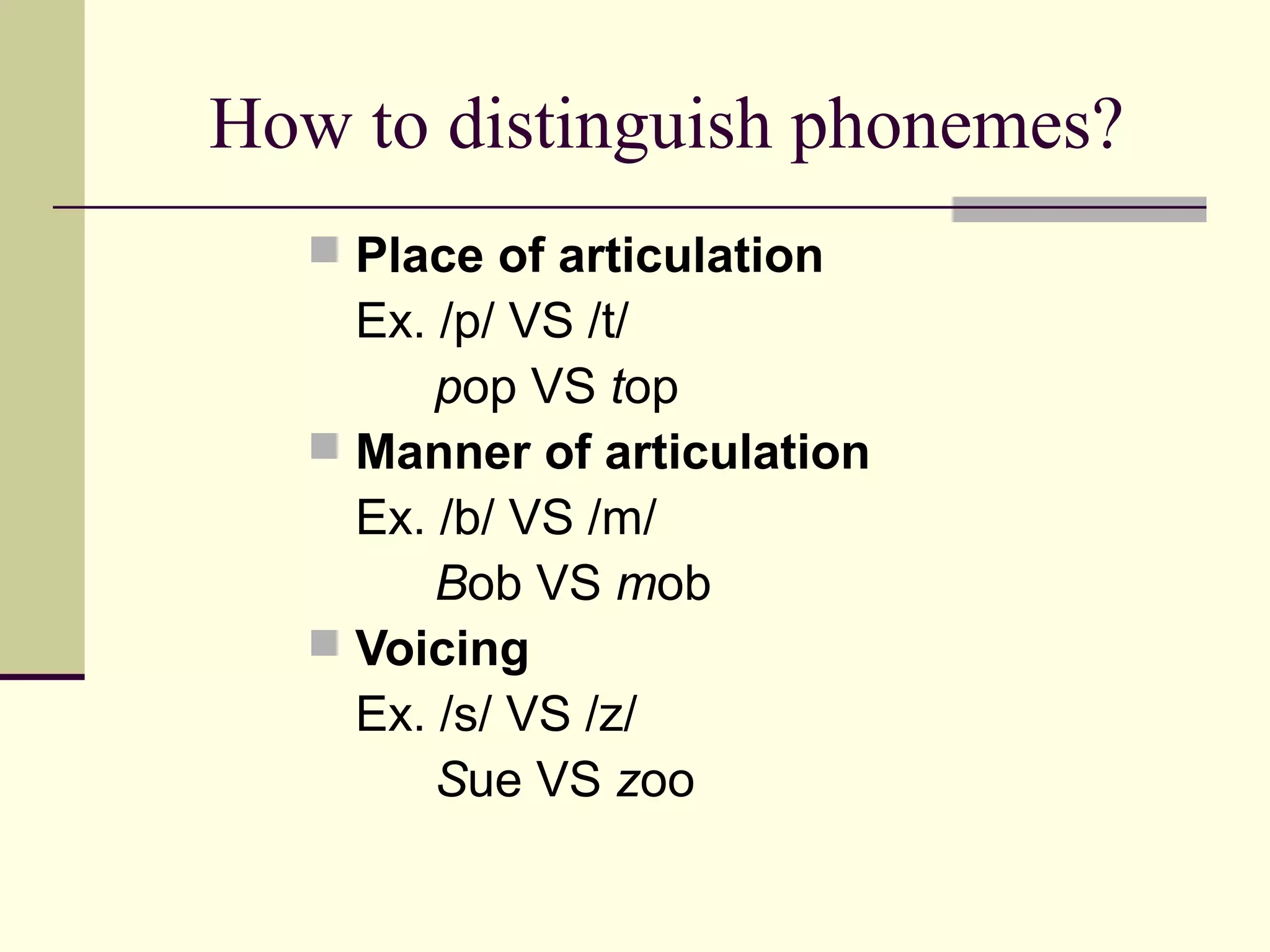
How to distinguish phonemes?
 Place of articulation

Ex. /p/ VS /t/
pop VS top
 Manner of articulation
Ex. /b/ VS /m/
Bob VS mob
 Voicing
Ex. /s/ VS /z/
Sue VS zoo
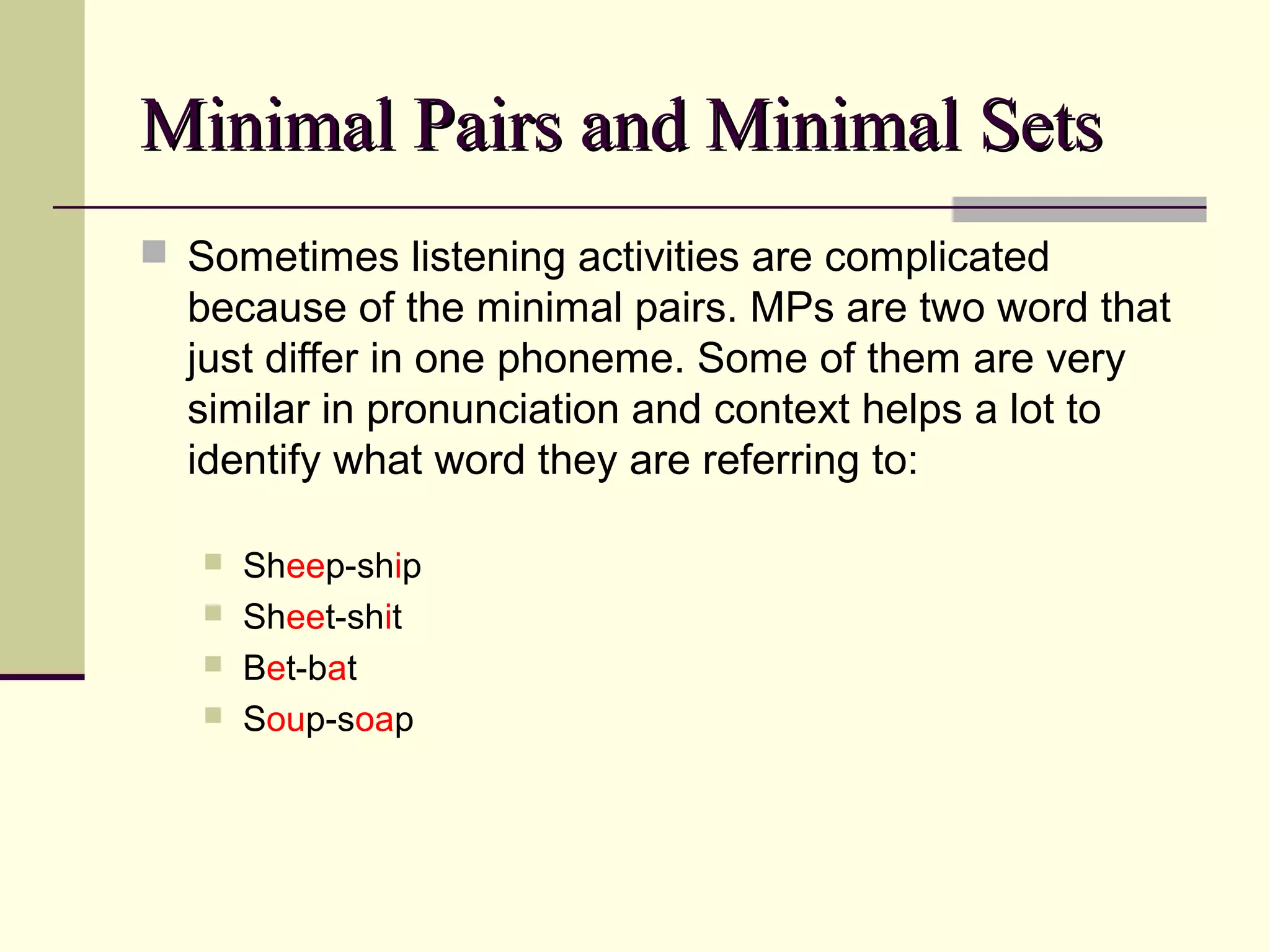
Minimal Pairs and Minimal Sets
 Sometimes listening activities are complicated

because of the minimal pairs. MPs are two word that
just differ in one phoneme. Some of them are very
similar in pronunciation and context helps a lot to
identify what word they are referring to:





Sheep-ship
Sheet-shit
Bet-bat
Soup-soap
Minimal Pairs and Minimal Sets
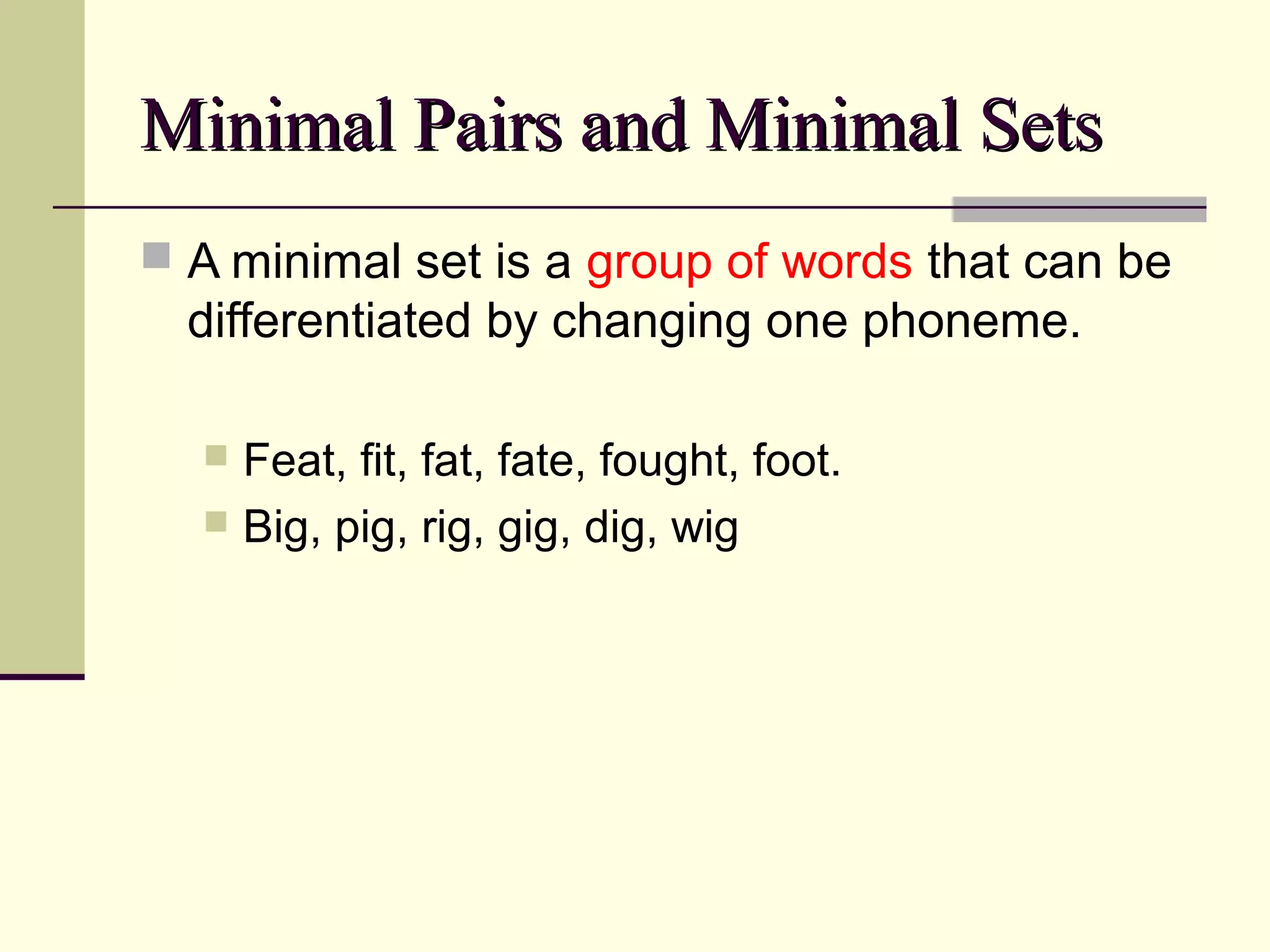
 A minimal set is a group of words that can be

differentiated by changing one phoneme.
Feat, fit, fat, fate, fought, foot.
 Big, pig, rig, gig, dig, wig

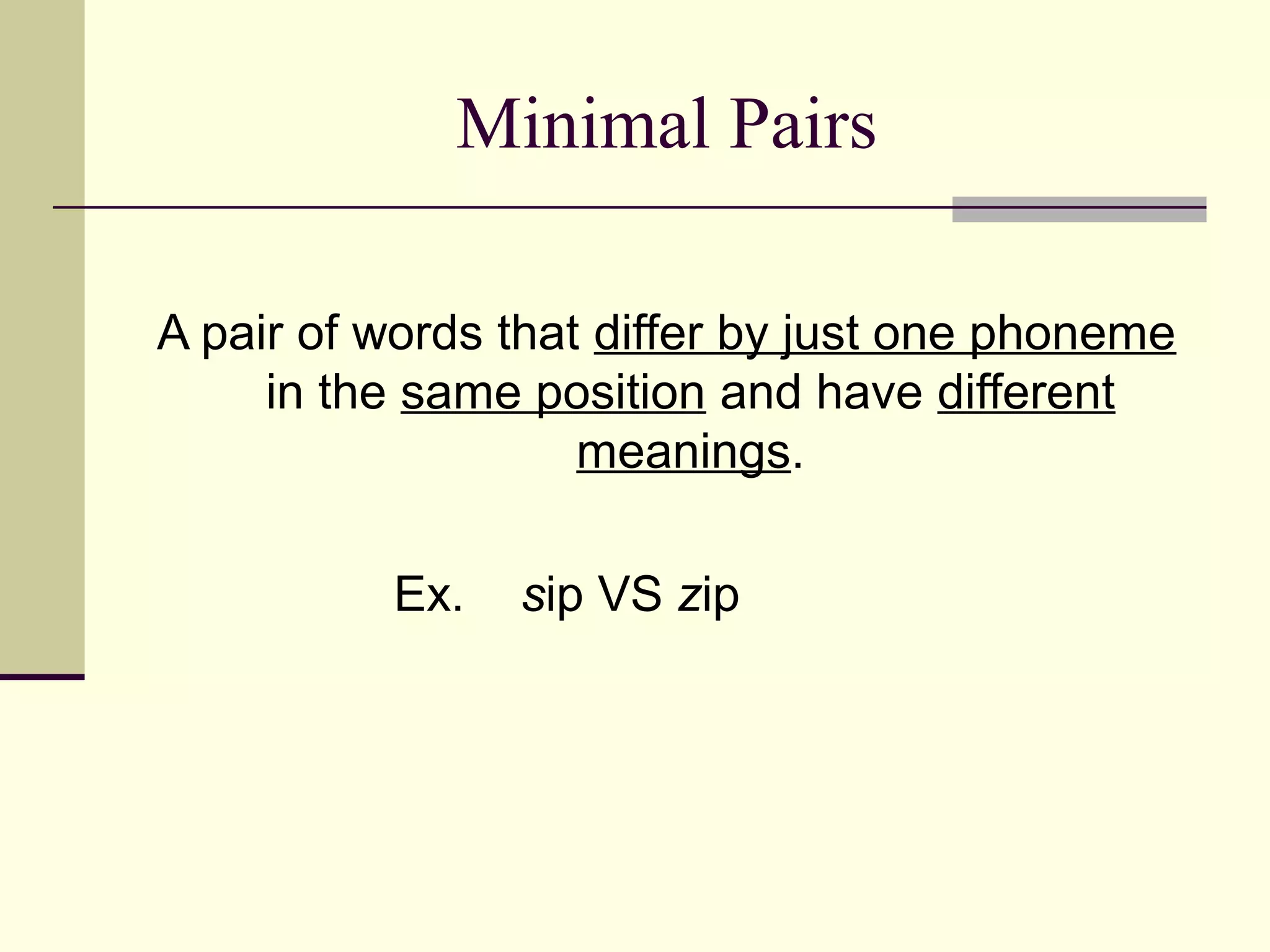
Minimal Pairs
A pair of words that differ by just one phoneme
in the same position and have different
meanings.
Ex.

sip VS zip
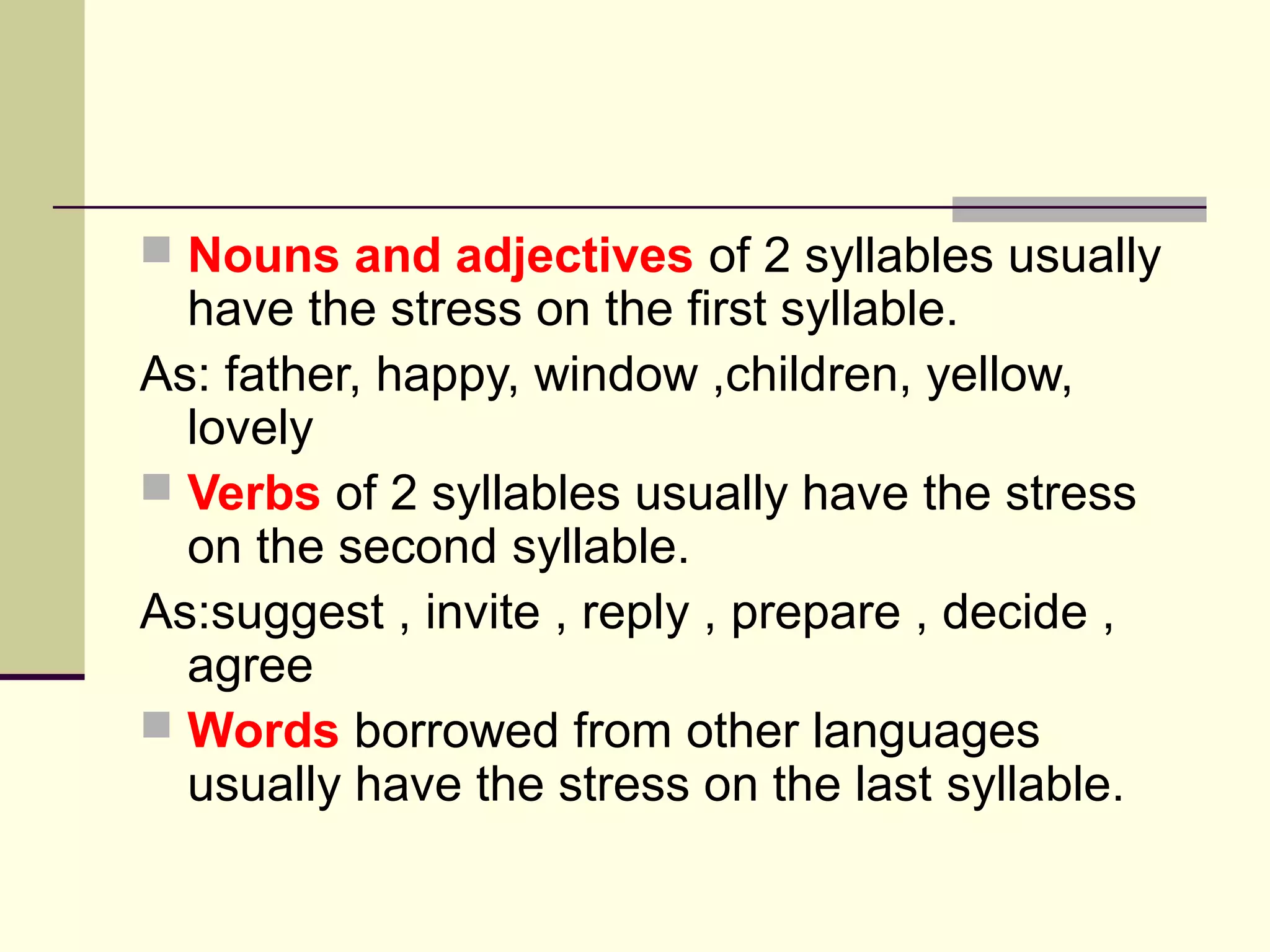
Important Rules
 Nouns and adjectives of 2 syllables usually

have the stress on the first syllable.
As: father, happy, window ,children, yellow,
lovely
 Verbs of 2 syllables usually have the stress
on the second syllable.
As:suggest , invite , reply , prepare , decide ,
agree
 Words borrowed from other languages
usually have the stress on the last syllable.
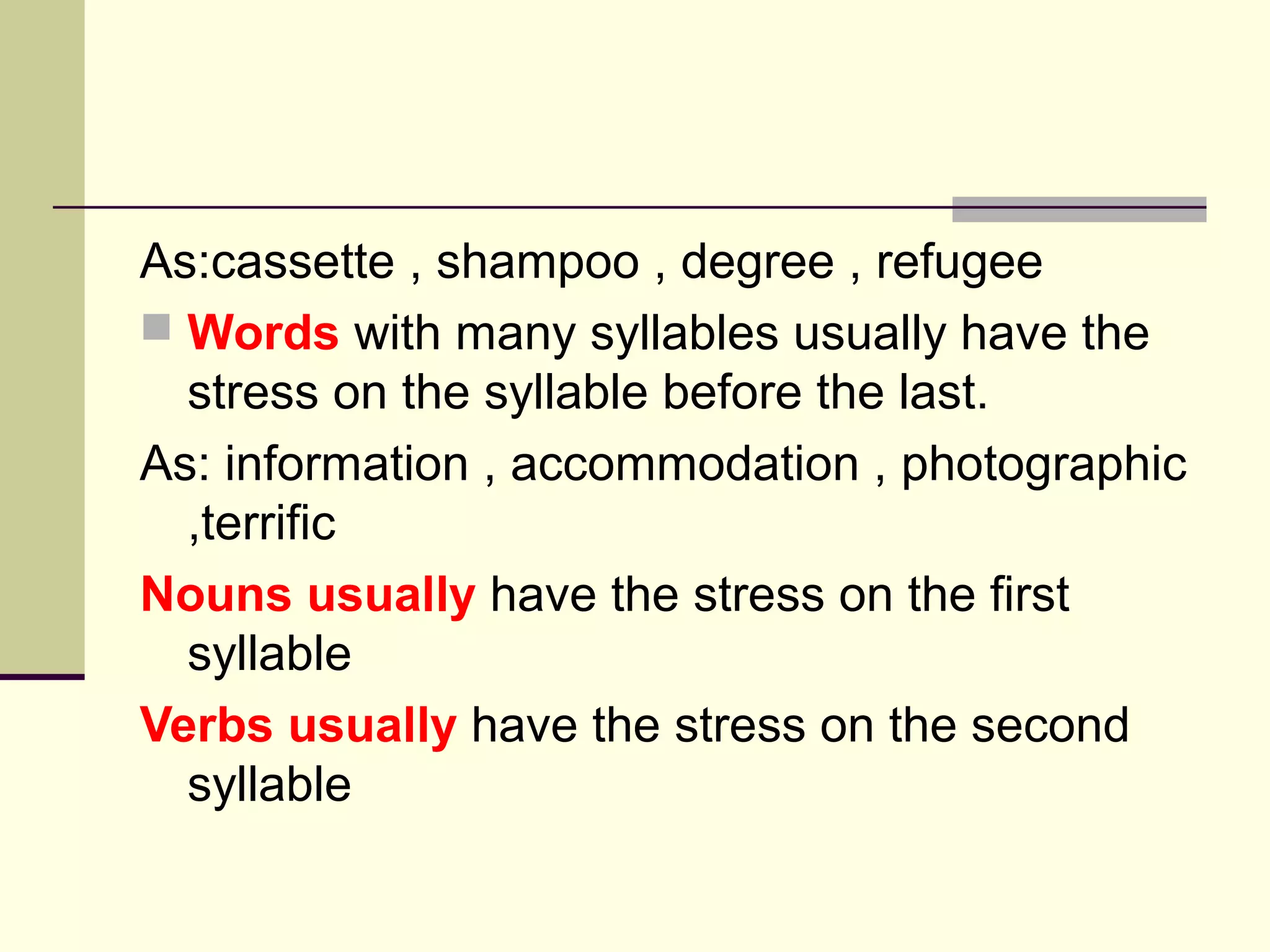
As:cassette , shampoo , degree , refugee
 Words with many syllables usually have the
stress on the syllable before the last.
As: information , accommodation , photographic
,terrific
Nouns usually have the stress on the first
syllable
Verbs usually have the stress on the second
syllable
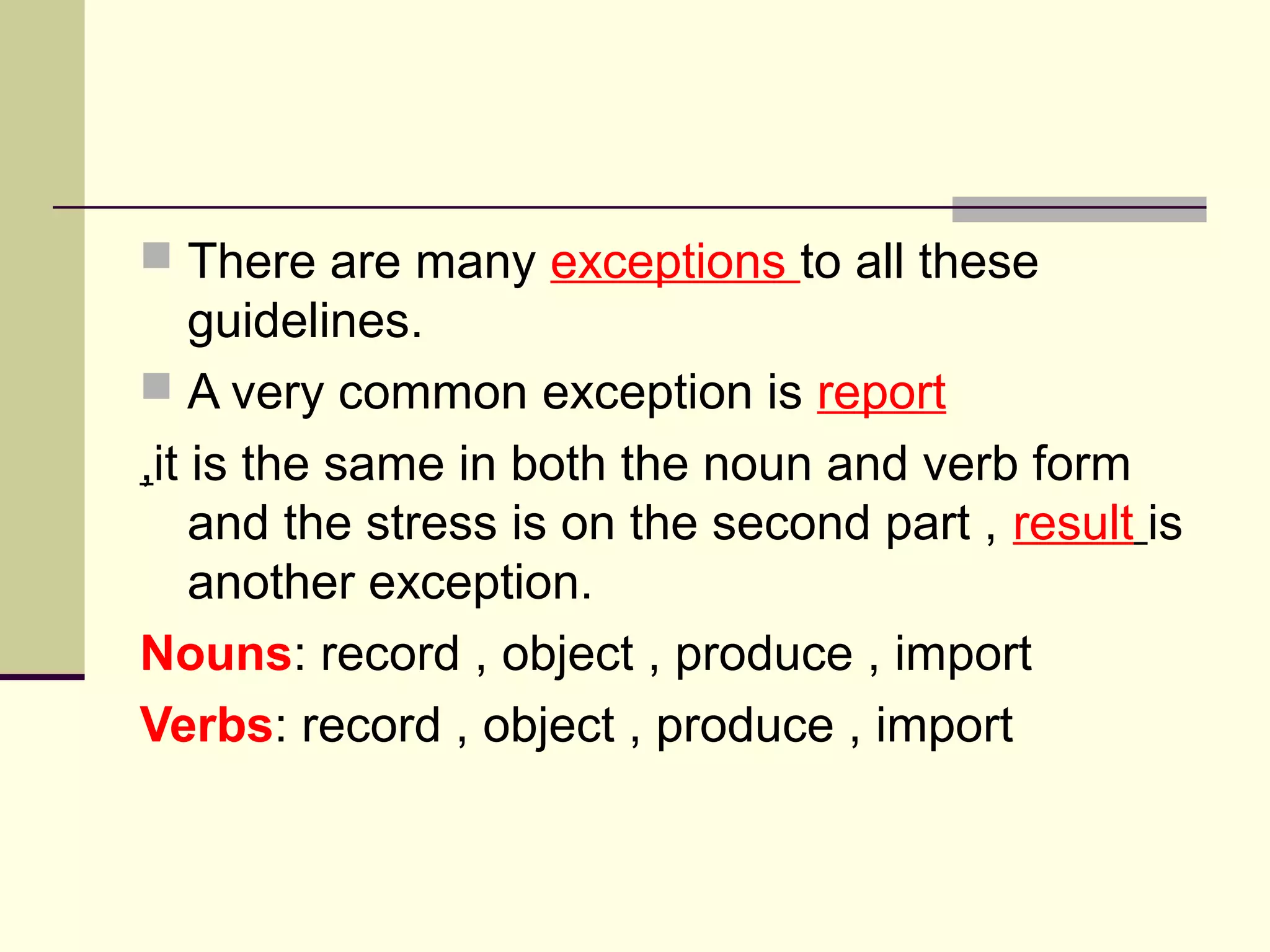
 There are many exceptions to all these

guidelines.
 A very common exception is report
,it is the same in both the noun and verb form
and the stress is on the second part , result is
another exception.
Nouns: record , object , produce , import
Verbs: record , object , produce , import

Towards better pronunciation

  • 1.
  • 2.
    Objectives: Participants will beable to:  define the main features of good pronunciation,  Improve their implementation of the English sounds     system, Identify problems of English sounds, Select and implement teaching techniques to teach good pronunciation, Demonstrate recognition/production drills with problem sounds, Implement appropriate pronunciation correction techniques.
  • 3.
    Phonetics and Phonology Phonetics Phonology Languageindependent Language dependent Study of all sounds Phonetic is different to Phonology in matter that it is the production of sounds. Phonology is a subset of phonetics. Phonology, in the other hand refers to the sound systems of a language
  • 4.
     Phonemics: narrowstudy of sounds  Phonetics: broad study of sounds
  • 5.
    What is Phonetics? Phonetics is the study of speech sounds. Articulatory phonetics – how speech sounds are produced  Acoustic phonetics – the transmission and physical properties of speech sounds  Auditory phonetics – perception of speech sounds   Phonetic transcriptions – one sound = one symbol.
  • 6.
    Why do Ineed to learn Phonetics?  Phonetics increases your knowledge in matters of pronunciation.  By knowing how languages are produced you can better your pronunciation.  It facilitates the acquisition of new words.  It helps you to read the dictionary using the correct sounds inscripted in the words.
  • 7.
    Task Sheet 1 Whatare the main features of good Pronunciation?
  • 8.
    Features of goodPronunciation  Correct articulation of speech sounds.  Correct stress.  Correct intonation.  Proper pauses.
  • 9.
    Task Sheet 2 Why should teachers know how sounds are made?  Can pronunciation written down?  What is the term used for written pronunciation?  Do teachers need to know how to read “written pronunciation”? Why?
  • 10.
    Task Sheet 3 Do your teachers/students have pronunciation problems?  What difficulties do they have?  What are their problematic English sounds? Vowels Diphthongs Consonants
  • 11.
    The Points ofArticulation 1. Nasal Cavity 1 2. Oral Cavity 3. Lips 4. Teeth 6 5. Alveolar ridge 2 5 6. Hard palate 7. Soft palate 8. Tip of the tongue 9. Blade of the tongue 10. Back of the tongue 7 9 4 10 8 13 3 11 11. Epiglottis 12. Vocal folds 13. Pharinx 12
  • 12.
  • 13.
     You shouldknow: Segmental  (vowels – diphthongs – consonants ) Suprasegmental ( Intonation – Stress – Length) word sentence
  • 14.
    Segmental  Individual sounds Includes tongue height and advancement, manner and place of articulation, lip rounding, etc.  Can be identified by viewing a single segment
  • 15.
    Suprasegmental  Supra- means‘over’ or ‘above’  These are things that “ride on top of” individual sounds  Include length, intonation, tone, and stress  Almost impossible to identify in single segment
  • 16.
    Suprasegmentals ! Whatare those?  Length High vowels shorter than low vowels  Voiceless consonants longer than voiced consonants  Voiceless fricatives longest  Length is influenced by the surrounding sounds  Tone  Can change meaning in some languages (like Chinese)  Stress  Stressed syllables more prominent than unstressed ones  Stressed syllables usually contain tense vowels  Stressed syllables are often longer  Unstressed syllables reduce vowel  Intonation  Rising and falling intonation can change meaning 
  • 17.
  • 18.
    Vowels  Vowels areall made in the mouth (place), with little or no air flow constriction (manner) and are always voiced in English  So the system that describes vowels does so in terms 3 characteristics:    tongue placement tongue height lip rounding
  • 19.
    Diphthongs Smooth glide fromone vowel position to another as /au/ in now also made up of 2 vowels as /ou/, /oi/ Major  /aɪ/  /ɔɪ/  /aʊ/ Minor (if at all)  /eɪ/  /oʊ/
  • 20.
    Consonants  The descriptionsof the sounds we call consonants are based on the human articulatory system (lungs to pump air in and out, vocal folds, oral cavity including tongue and lips, and nasal cavity).  Consonants are described using 3 characteristics: vocal quality (voiced/voiceless)  point of articulation  manner of articulation ‫النطق‬ 
  • 21.
    How to distinguishphonemes?  Place of articulation Ex. /p/ VS /t/ pop VS top  Manner of articulation Ex. /b/ VS /m/ Bob VS mob  Voicing Ex. /s/ VS /z/ Sue VS zoo
  • 22.
    Minimal Pairs andMinimal Sets  Sometimes listening activities are complicated because of the minimal pairs. MPs are two word that just differ in one phoneme. Some of them are very similar in pronunciation and context helps a lot to identify what word they are referring to:     Sheep-ship Sheet-shit Bet-bat Soup-soap
  • 23.
    Minimal Pairs andMinimal Sets  A minimal set is a group of words that can be differentiated by changing one phoneme. Feat, fit, fat, fate, fought, foot.  Big, pig, rig, gig, dig, wig 
  • 24.
    Minimal Pairs A pairof words that differ by just one phoneme in the same position and have different meanings. Ex. sip VS zip
  • 25.
  • 26.
     Nouns andadjectives of 2 syllables usually have the stress on the first syllable. As: father, happy, window ,children, yellow, lovely  Verbs of 2 syllables usually have the stress on the second syllable. As:suggest , invite , reply , prepare , decide , agree  Words borrowed from other languages usually have the stress on the last syllable.
  • 27.
    As:cassette , shampoo, degree , refugee  Words with many syllables usually have the stress on the syllable before the last. As: information , accommodation , photographic ,terrific Nouns usually have the stress on the first syllable Verbs usually have the stress on the second syllable
  • 28.
     There aremany exceptions to all these guidelines.  A very common exception is report ,it is the same in both the noun and verb form and the stress is on the second part , result is another exception. Nouns: record , object , produce , import Verbs: record , object , produce , import