EnglishEnglish
long vowels,long vowels,
diphthongs, triphthongsdiphthongs, triphthongs
Lecture 3Lecture 3
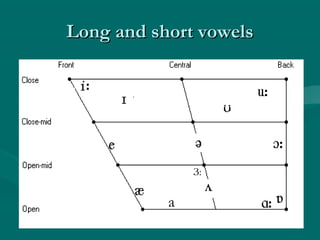
Long and short vowelsLong and short vowels
a
a
З:
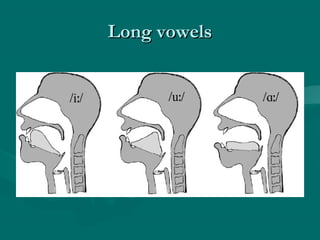
Long vowelsLong vowels
diphthongsdiphthongs
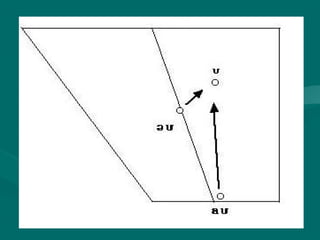
While the position of the tongue is more or lessWhile the position of the tongue is more or less
stable for a pure vowel…stable for a pure vowel…
…… a diphthong is characterised by a gracefula diphthong is characterised by a graceful
movement from one point to another, for thismovement from one point to another, for this
reason they are also sometimes known as glides.reason they are also sometimes known as glides.
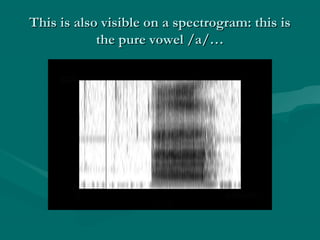
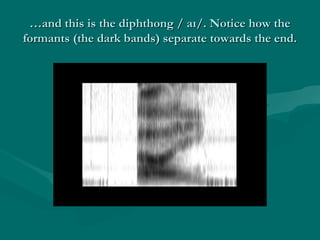
This is also visible on a spectrogram: this isThis is also visible on a spectrogram: this is
the pure vowel /a/…the pure vowel /a/…
……and this is the diphthong / aand this is the diphthong / aıı/. Notice how the/. Notice how the
formants (the dark bands) sepformants (the dark bands) sepaarate towards the end.rate towards the end.
diphthongsdiphthongs
• Movement/glide from one vowel to anotherMovement/glide from one vowel to another
• From constant/pure vowel to another vowelFrom constant/pure vowel to another vowel
• 1st part longer and stronger1st part longer and stronger
• 2nd part shorter and quieter2nd part shorter and quieter
• 8 diphthongs; 2 groups: centring and closing8 diphthongs; 2 groups: centring and closing
ending in /ending in /∂∂/ ending in // ending in / II // /ʊ/ʊ
• English diphthongs may cause difficultyEnglish diphthongs may cause difficulty
Nowhere is the English spelling system more
bizarre than in its representation of diphthongs
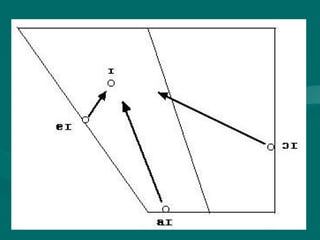
First we will look at theFirst we will look at the closing groupclosing group… … the… … the
‘pay’, ‘ made’, ‘maid’, ‘reign’, ‘obey’, sound‘pay’, ‘ made’, ‘maid’, ‘reign’, ‘obey’, sound
Then we have the ‘I’, ‘my’, ‘tie’, ‘sigh’, ‘either’,Then we have the ‘I’, ‘my’, ‘tie’, ‘sigh’, ‘either’,
‘eye’, ‘Thai’, sound‘eye’, ‘Thai’, sound
Then there is ‘boy’, ‘choice’Then there is ‘boy’, ‘choice’
Then ‘down’, ‘loud’Then ‘down’, ‘loud’
To end the closing group, the most commonTo end the closing group, the most common
diphthong in English, that of ‘no’, ‘know’,‘bone’,diphthong in English, that of ‘no’, ‘know’,‘bone’,
‘foam’, ‘sew’, ‘though’, ‘don’t’, ‘foe’, ‘crow’‘foam’, ‘sew’, ‘though’, ‘don’t’, ‘foe’, ‘crow’
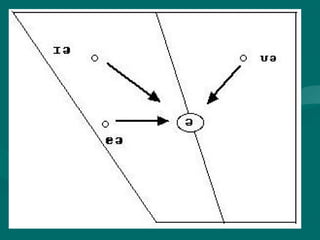
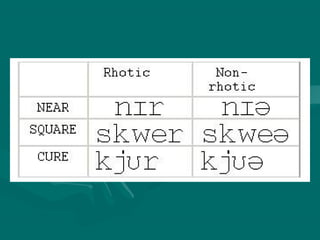
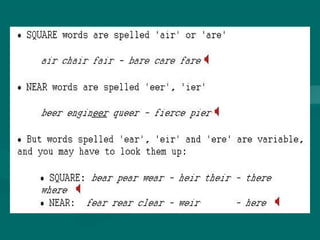
To start with theTo start with the centring groupcentring group, we have the most, we have the most
common, that of ‘clear’, ‘deer’, ‘here’, ‘wier’:common, that of ‘clear’, ‘deer’, ‘here’, ‘wier’:
• Then ‘air’, ‘where’, wear’, ‘care’, ‘heir’:Then ‘air’, ‘where’, wear’, ‘care’, ‘heir’:
• Finally, there is a diphthong which is quite rareFinally, there is a diphthong which is quite rare
and is often realised as /and is often realised as /‫כּ‬‫כּ‬:/ - ‘tour’, ‘poor’::/ - ‘tour’, ‘poor’:
triphthongstriphthongs
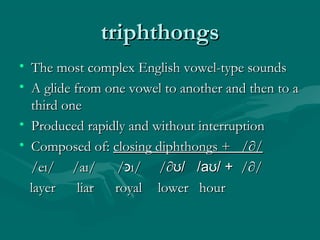
• The most complex English vowel-type soundsThe most complex English vowel-type sounds
• A glide from one vowel to another and then to aA glide from one vowel to another and then to a
third onethird one
• Produced rapidly and without interruptionProduced rapidly and without interruption
• Composed of:Composed of: closing diphthongs + /∂/closing diphthongs + /∂/
/e/eıı/ /a/ /aıı/ // /‫כּ‬‫כּ‬ıı/ // /∂∂ʊʊ/ /a/ /aʊʊ/ +/ + /∂//∂/
layer liarlayer liar royalroyal lower hourlower hour

Diphthongs

  • 1.
    EnglishEnglish long vowels,long vowels, diphthongs,triphthongsdiphthongs, triphthongs Lecture 3Lecture 3
  • 2.
    Long and shortvowelsLong and short vowels a a З:
  • 3.
  • 4.
    diphthongsdiphthongs While the positionof the tongue is more or lessWhile the position of the tongue is more or less stable for a pure vowel…stable for a pure vowel… …… a diphthong is characterised by a gracefula diphthong is characterised by a graceful movement from one point to another, for thismovement from one point to another, for this reason they are also sometimes known as glides.reason they are also sometimes known as glides.
  • 5.
    This is alsovisible on a spectrogram: this isThis is also visible on a spectrogram: this is the pure vowel /a/…the pure vowel /a/…
  • 6.
    ……and this isthe diphthong / aand this is the diphthong / aıı/. Notice how the/. Notice how the formants (the dark bands) sepformants (the dark bands) sepaarate towards the end.rate towards the end.
  • 7.
    diphthongsdiphthongs • Movement/glide fromone vowel to anotherMovement/glide from one vowel to another • From constant/pure vowel to another vowelFrom constant/pure vowel to another vowel • 1st part longer and stronger1st part longer and stronger • 2nd part shorter and quieter2nd part shorter and quieter • 8 diphthongs; 2 groups: centring and closing8 diphthongs; 2 groups: centring and closing ending in /ending in /∂∂/ ending in // ending in / II // /ʊ/ʊ
  • 8.
    • English diphthongsmay cause difficultyEnglish diphthongs may cause difficulty Nowhere is the English spelling system more bizarre than in its representation of diphthongs
  • 9.
    First we willlook at theFirst we will look at the closing groupclosing group… … the… … the ‘pay’, ‘ made’, ‘maid’, ‘reign’, ‘obey’, sound‘pay’, ‘ made’, ‘maid’, ‘reign’, ‘obey’, sound Then we have the ‘I’, ‘my’, ‘tie’, ‘sigh’, ‘either’,Then we have the ‘I’, ‘my’, ‘tie’, ‘sigh’, ‘either’, ‘eye’, ‘Thai’, sound‘eye’, ‘Thai’, sound Then there is ‘boy’, ‘choice’Then there is ‘boy’, ‘choice’ Then ‘down’, ‘loud’Then ‘down’, ‘loud’ To end the closing group, the most commonTo end the closing group, the most common diphthong in English, that of ‘no’, ‘know’,‘bone’,diphthong in English, that of ‘no’, ‘know’,‘bone’, ‘foam’, ‘sew’, ‘though’, ‘don’t’, ‘foe’, ‘crow’‘foam’, ‘sew’, ‘though’, ‘don’t’, ‘foe’, ‘crow’
  • 12.
    To start withtheTo start with the centring groupcentring group, we have the most, we have the most common, that of ‘clear’, ‘deer’, ‘here’, ‘wier’:common, that of ‘clear’, ‘deer’, ‘here’, ‘wier’: • Then ‘air’, ‘where’, wear’, ‘care’, ‘heir’:Then ‘air’, ‘where’, wear’, ‘care’, ‘heir’: • Finally, there is a diphthong which is quite rareFinally, there is a diphthong which is quite rare and is often realised as /and is often realised as /‫כּ‬‫כּ‬:/ - ‘tour’, ‘poor’::/ - ‘tour’, ‘poor’:
  • 16.
    triphthongstriphthongs • The mostcomplex English vowel-type soundsThe most complex English vowel-type sounds • A glide from one vowel to another and then to aA glide from one vowel to another and then to a third onethird one • Produced rapidly and without interruptionProduced rapidly and without interruption • Composed of:Composed of: closing diphthongs + /∂/closing diphthongs + /∂/ /e/eıı/ /a/ /aıı/ // /‫כּ‬‫כּ‬ıı/ // /∂∂ʊʊ/ /a/ /aʊʊ/ +/ + /∂//∂/ layer liarlayer liar royalroyal lower hourlower hour