English Vowel Triangle
          It’s not as easy as you think.
Description of Vowels
 They are unrestricted            They can be sustained
    The teeth, tongue, and lips       As long as you have
    do not prevent airflow            breath, you can sustain a
                                      vowel sound


 They are normally voiced         They have shape or form
    It has pitch – and can be         And they are the core of
    whispered.                        the syllable
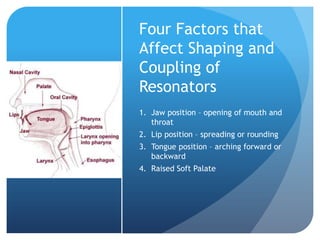
Four Factors that
Affect Shaping and
Coupling of
Resonators
1. Jaw position – opening of mouth and
   throat
2. Lip position – spreading or rounding
3. Tongue position – arching forward or
   backward
4. Raised Soft Palate
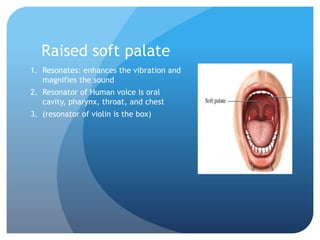
Raised soft palate
1. Resonates: enhances the vibration and
   magnifies the sound
2. Resonator of Human voice is oral
   cavity, pharynx, throat, and chest
3. (resonator of violin is the box)
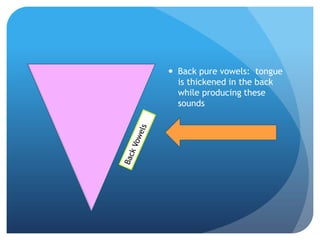
 Back pure vowels: tongue
  is thickened in the back
  while producing these
  sounds
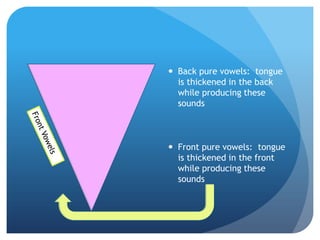
 Back pure vowels: tongue
  is thickened in the back
  while producing these
  sounds


 Front pure vowels: tongue
  is thickened in the front
  while producing these
  sounds
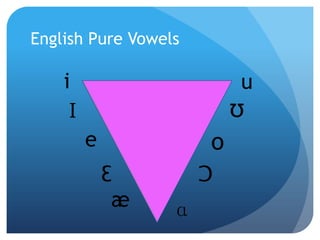
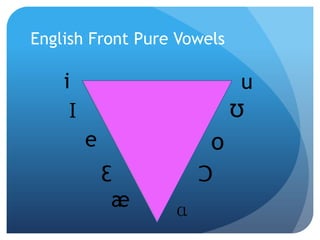
English Pure Vowels

    i                     u
     I                    Ʊ
         e            o
             Ɛ        Ɔ
              æ   ɑ
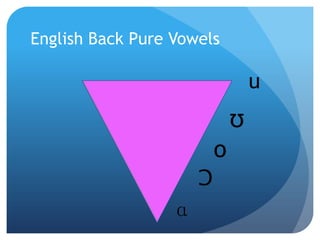
English Back Pure Vowels

                                  u
                              Ʊ
                          o
                      Ɔ
                  ɑ
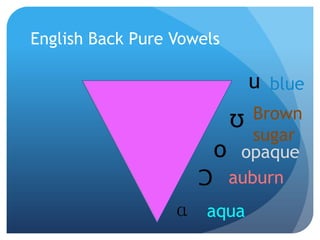
English Back Pure Vowels

                           u blue
                       Ʊ  Brown
                          sugar
                      o opaque
                     Ɔ auburn
                  ɑ aqua
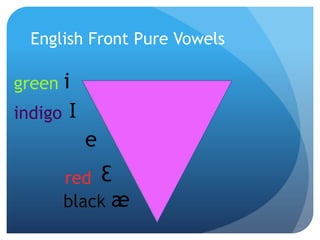
English Front Pure Vowels

green i
indigo   I
             e
         red Ɛ
         black æ
[u]

   Spellings:                           Potential Problems
     1.   Grew                                (see p. 56 in book)
     2.   You                                 Nasal
     3.   Too                                 Insufficient lip rounding
     4.   To                                  Insertion [kul] vs. [kuəl]
     5.   Two
     6.   Blue

                    Practice phrases:
                       Were you there when they crucified my Lord?
                       I love you, truly.
                       Fools, through and through.

English Pure Back Vowels
[ʊ]

   Spellings:                         Potential Problems
    1.   sugar                           Substitution (diphthong)
    2.   took                              [ə,   u]
    3.   could


                   Practice phrases:
                      The crooked straight.
                      My faith looks up to Thee.
                       Man is made for the woman and the woman for
                         the man.
English Pure Back Vowels
[o]

   Spellings:                          Potential Problems
     1.   Violet                          Substitution (diphthong)
     2.   Opaque
                         Practice phrases:
                            For the Lord God omnipotent reigneth
                            Come, every soul by sin oppressed.
                            Memory, hither come and tune your merry
                             notes.

    In American English, the sound [o] is only used in
    unstressed, rhythmically short syllables.
         “Soul” and “notes” do not contain the [o] sound because they
          only have one syllable, and therefore, are stressed.
English Pure Back Vowels
[Ɔ]

   Spellings:                           Potential Problems
     1.   Auburn                           Insertion of diphthong
     2.   Moss                             Inadequate mouth opening
     3.   Fall
     4.   Awkward

                        Practice phrases:
                            That they may offer unto the Lord an offering in
                             righteousness
                            I saw the cross of Jesus
                            Autumn leaves are now falling


English Pure Back Vowels
[ɑ]
                        Potential Problems
                            Insufficient lowering of jaw
   Spellings:
                            Spreading lips, as in a grin
     1.   aqua
                            Retracting the body of tongue
     2.   got
                            Substitution of briɡht [a] for back [ɑ]


                        Practice phrases:
                            Sing alleluia to the Lord
                            Stir thy church, O God, our Father
                            Tis the season to be jolly, fa la la la la . . . . .


English Pure Back Vowels
English Front Pure Vowels

    i                       u
     I                      Ʊ
         e             o
             Ɛ        Ɔ
              æ   ɑ
[i]

   Spellings:                           Potential Problems
     1.   Quay                              Diphthongs:
     2.   She                                we’ll, heeled, yield, seal
     3.   Breathe
     4.   Green
     5.   Conceive
     6.   People         Practice phrases:
     7.   Key                He shall speak peace unto the heathen
     8.   believe            Free to be me, God, I really am free.
                             Beautiful dreamer, wake unto me


English Pure Front Vowels
[I]

   Spellings:                           Potential Problems
                                           Substitution:
     1.   indigo                            been, beautiful, pretty, eternal,
     2.   Busy                              women
                                           Vowel reduction: This sound is
     3.   behold                            typically a schwa [Ə], although
                                            there are other vowels that can
                                            be unstressed or reduced. A
                                            reduced vowel is a vowel that
 Practice phrases:                         can only occur in unstressed
                                            syllables, like schwa, and an
   Because I have been given much, I       unstressed vowel is a vowel that
    too must give                           can be stressed but is not.
                                            Before “ng”, “I” {I} is pronounced
   That her iniquity is pardoned           [I], as in bring, sing, and think
   Sure on this shining night             Typical spellings for vowel
                                            reduction of [I} is ly, -y, -ies, and
                                            –ing.
                                             Any words with these suffixes
English Pure Front Vowels                       have reduced vowels
Vowel Reduction
  Vowel reduction: This sound is typically a schwa
   [ə], although there are other vowels that can be
   unstressed or reduced. A reduced vowel is a vowel that
   can only occur in unstressed syllables, like schwa, and an
   unstressed vowel is a vowel that can be stressed but is not.
   Before “ng”, “I” {I} is pronounced [I], as in
   bring, sing, and think
  Typical spellings for vowel reduction of [I] is -ly, -y, -
   ies, and –ing.
    Any words with these suffixes have reduced vowels
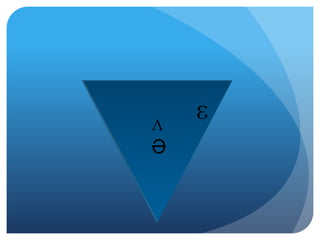
ʌ   ɛ
Ə
[ʌ]
 This sound occurs only in stressed syllables. This includes those
  instances where “un” is a prefix emphasizing negation of the root word

 Spellings: above, us, plum, fuzzy, undone, blood, trouble

 Potential problems: substitution of [ɑ] ̤ fuzzy/fozie, was, love, one, son

 PRACTICE PHRASES
   Unto us a Son is given
   What wondrous love is this
   I wonder as I wander out under the sky

   Above = [Ə.bʌv]
  
[Ə]
   This sound occurs only in unstressed syllables. This includes those instances where “un”
    is a prefix emphasizing negation of the root word

   Spellings: magenta, angel, evil, a, of the, cotton, passion, upon

   The sound only occurs in unstressed syllables or words

   Because in singing every syllable must have a vowel sound, [Ə] is used in singing certain
    syllables which are spoken without a vowels sound, as in little and people

 The schwa is a variable, weakly-defined sound. Other sounds in unstressed
               ɪ
  syllables: [ ] happiness, prepare, remember, receive, rejoice

 PRACTICE PHRASES
       Unto us a Son is given
       Hark! The herald angels sing
       When I think upon the maidens
Angel and Evil
 Angel:

 Evil:
[3]
 Spellings:
  bird, purple, ever, counselor, forward, earth, journey, timbre, m
  artyr

 Potential problems: Some authorities avoid this
  sound, preferring [ʌ] in stressed syllables and [Ə] in unstressed
  syllables: Bud-bird; but-Bert

 Bird = [b3d] vs. bud = [bʌd]

 Bert = [b3t] vs. but [bʌt]

 Practice phrases:
   Wonderful Counselor, the everlasting Father
   Let all the world in every corner sing
   I wonder as I wander out under the sky
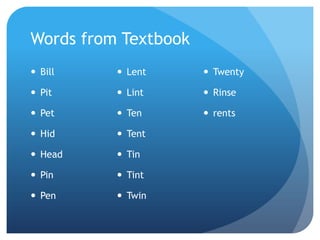
Words from Textbook
 Bill     Lent       Twenty

 Pit      Lint       Rinse

 Pet      Ten        rents

 Hid      Tent

 Head     Tin

 Pin      Tint

 Pen      Twin
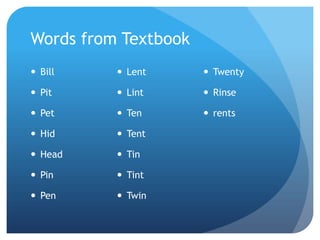
Words from Textbook
 Bill     Lent       Twenty

 Pit      Lint       Rinse

 Pet      Ten        rents

 Hid      Tent

 Head     Tin

 Pin      Tint

 Pen      Twin
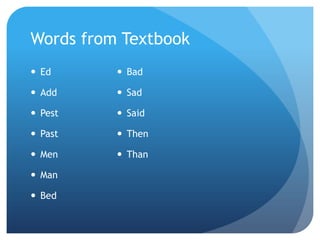
Words from Textbook
 Ed       Bad

 Add      Sad

 Pest     Said

 Past     Then

 Men      Than

 Man

 Bed
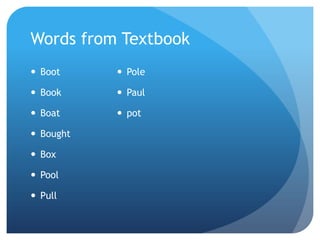
Words from Textbook
 Boot      Pole

 Book      Paul

 Boat      pot

 Bought

 Box

 Pool

 Pull

Overview: English vowels- Diction

  • 1.
    English Vowel Triangle It’s not as easy as you think.
  • 2.
    Description of Vowels They are unrestricted  They can be sustained The teeth, tongue, and lips As long as you have do not prevent airflow breath, you can sustain a vowel sound  They are normally voiced  They have shape or form It has pitch – and can be And they are the core of whispered. the syllable
  • 3.
    Four Factors that AffectShaping and Coupling of Resonators 1. Jaw position – opening of mouth and throat 2. Lip position – spreading or rounding 3. Tongue position – arching forward or backward 4. Raised Soft Palate
  • 4.
    Raised soft palate 1.Resonates: enhances the vibration and magnifies the sound 2. Resonator of Human voice is oral cavity, pharynx, throat, and chest 3. (resonator of violin is the box)
  • 5.
     Back purevowels: tongue is thickened in the back while producing these sounds
  • 6.
     Back purevowels: tongue is thickened in the back while producing these sounds  Front pure vowels: tongue is thickened in the front while producing these sounds
  • 7.
    English Pure Vowels i u I Ʊ e o Ɛ Ɔ æ ɑ
  • 8.
    English Back PureVowels u Ʊ o Ɔ ɑ
  • 9.
    English Back PureVowels u blue Ʊ Brown sugar o opaque Ɔ auburn ɑ aqua
  • 10.
    English Front PureVowels green i indigo I e red Ɛ black æ
  • 11.
    [u] Spellings:  Potential Problems 1. Grew  (see p. 56 in book) 2. You  Nasal 3. Too  Insufficient lip rounding 4. To  Insertion [kul] vs. [kuəl] 5. Two 6. Blue  Practice phrases:  Were you there when they crucified my Lord?  I love you, truly.  Fools, through and through. English Pure Back Vowels
  • 12.
    [ʊ] Spellings:  Potential Problems 1. sugar  Substitution (diphthong) 2. took [ə, u] 3. could  Practice phrases:  The crooked straight.  My faith looks up to Thee.  Man is made for the woman and the woman for the man. English Pure Back Vowels
  • 13.
    [o] Spellings:  Potential Problems 1. Violet  Substitution (diphthong) 2. Opaque  Practice phrases:  For the Lord God omnipotent reigneth  Come, every soul by sin oppressed.  Memory, hither come and tune your merry notes. In American English, the sound [o] is only used in unstressed, rhythmically short syllables.  “Soul” and “notes” do not contain the [o] sound because they only have one syllable, and therefore, are stressed. English Pure Back Vowels
  • 14.
    [Ɔ] Spellings:  Potential Problems 1. Auburn  Insertion of diphthong 2. Moss  Inadequate mouth opening 3. Fall 4. Awkward  Practice phrases:  That they may offer unto the Lord an offering in righteousness  I saw the cross of Jesus  Autumn leaves are now falling English Pure Back Vowels
  • 15.
    [ɑ]  Potential Problems  Insufficient lowering of jaw  Spellings:  Spreading lips, as in a grin 1. aqua  Retracting the body of tongue 2. got  Substitution of briɡht [a] for back [ɑ]  Practice phrases:  Sing alleluia to the Lord  Stir thy church, O God, our Father  Tis the season to be jolly, fa la la la la . . . . . English Pure Back Vowels
  • 16.
    English Front PureVowels i u I Ʊ e o Ɛ Ɔ æ ɑ
  • 17.
    [i] Spellings:  Potential Problems 1. Quay  Diphthongs: 2. She we’ll, heeled, yield, seal 3. Breathe 4. Green 5. Conceive 6. People  Practice phrases: 7. Key  He shall speak peace unto the heathen 8. believe  Free to be me, God, I really am free.  Beautiful dreamer, wake unto me English Pure Front Vowels
  • 18.
    [I] Spellings:  Potential Problems  Substitution: 1. indigo been, beautiful, pretty, eternal, 2. Busy women  Vowel reduction: This sound is 3. behold typically a schwa [Ə], although there are other vowels that can be unstressed or reduced. A reduced vowel is a vowel that  Practice phrases: can only occur in unstressed syllables, like schwa, and an  Because I have been given much, I unstressed vowel is a vowel that too must give can be stressed but is not. Before “ng”, “I” {I} is pronounced  That her iniquity is pardoned [I], as in bring, sing, and think  Sure on this shining night  Typical spellings for vowel reduction of [I} is ly, -y, -ies, and –ing.  Any words with these suffixes English Pure Front Vowels have reduced vowels
  • 19.
    Vowel Reduction Vowel reduction: This sound is typically a schwa [ə], although there are other vowels that can be unstressed or reduced. A reduced vowel is a vowel that can only occur in unstressed syllables, like schwa, and an unstressed vowel is a vowel that can be stressed but is not. Before “ng”, “I” {I} is pronounced [I], as in bring, sing, and think  Typical spellings for vowel reduction of [I] is -ly, -y, - ies, and –ing.  Any words with these suffixes have reduced vowels
  • 20.
    ʌ ɛ Ə
  • 21.
    [ʌ]  This soundoccurs only in stressed syllables. This includes those instances where “un” is a prefix emphasizing negation of the root word  Spellings: above, us, plum, fuzzy, undone, blood, trouble  Potential problems: substitution of [ɑ] ̤ fuzzy/fozie, was, love, one, son  PRACTICE PHRASES  Unto us a Son is given  What wondrous love is this  I wonder as I wander out under the sky  Above = [Ə.bʌv] 
  • 22.
    [Ə]  This sound occurs only in unstressed syllables. This includes those instances where “un” is a prefix emphasizing negation of the root word  Spellings: magenta, angel, evil, a, of the, cotton, passion, upon  The sound only occurs in unstressed syllables or words  Because in singing every syllable must have a vowel sound, [Ə] is used in singing certain syllables which are spoken without a vowels sound, as in little and people  The schwa is a variable, weakly-defined sound. Other sounds in unstressed ɪ syllables: [ ] happiness, prepare, remember, receive, rejoice  PRACTICE PHRASES  Unto us a Son is given  Hark! The herald angels sing  When I think upon the maidens
  • 23.
    Angel and Evil Angel:  Evil:
  • 24.
    [3]  Spellings: bird, purple, ever, counselor, forward, earth, journey, timbre, m artyr  Potential problems: Some authorities avoid this sound, preferring [ʌ] in stressed syllables and [Ə] in unstressed syllables: Bud-bird; but-Bert  Bird = [b3d] vs. bud = [bʌd]  Bert = [b3t] vs. but [bʌt]  Practice phrases:  Wonderful Counselor, the everlasting Father  Let all the world in every corner sing  I wonder as I wander out under the sky
  • 25.
    Words from Textbook Bill  Lent  Twenty  Pit  Lint  Rinse  Pet  Ten  rents  Hid  Tent  Head  Tin  Pin  Tint  Pen  Twin
  • 26.
    Words from Textbook Bill  Lent  Twenty  Pit  Lint  Rinse  Pet  Ten  rents  Hid  Tent  Head  Tin  Pin  Tint  Pen  Twin
  • 27.
    Words from Textbook Ed  Bad  Add  Sad  Pest  Said  Past  Then  Men  Than  Man  Bed
  • 28.
    Words from Textbook Boot  Pole  Book  Paul  Boat  pot  Bought  Box  Pool  Pull