Basic concepts
Atom
What are Atoms
• Atoms are building blocks of matter that
make up everyday objects.
• A desk, air and even you are made up of
atoms.
• There are 90 naturally occurring kinds of
atoms.
Subatomic particles
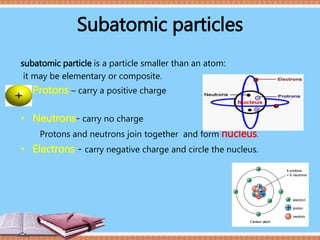
subatomic particle is a particle smaller than an atom:
it may be elementary or composite.
• Protons – carry a positive charge
• Neutrons- carry no charge
Protons and neutrons join together and form nucleus.
• Electrons - carry negative charge and circle the nucleus.
Isotopes
• Isotopes are atoms with the same number of protons ,
but differing numbers of neutrons . Isotopes are different
forms of a single element .
• For example, the most common isotope of hydrogen has
no neutrons at all; there's also a hydrogen isotope called
deuterium, with one neutron, and another, tritium, with
two neutrons.
Hydrogen Deuterium Tritium
Orbit
• Unlike planets orbiting the Sun, electrons cannot be at any arbitrary
distance from the nucleus; they can exist only in certain specific
locations called allowed orbits.
How do the electron orbits work?
• Each orbit around the nucleus represents an energy level, and electrons
cannot exist in between orbits. Orbits closer to the nucleus have lower
energy.
• If energy is added, an electron can be "excited" to jump to a higher
energy level and orbit farther from the nucleus. Eventually, though, the
electron will return to its original state, and the atom will give off energy
equal to the difference between the two orbits.
Orbital versus Orbit
• The definition of orbital is "a wave function describing
the state of a single electron in an atom (atomic orbital)
or in a molecule (molecular orbital)." and also "the wave
function of an electron in an atom or molecule,
indicating the electron's probable location.“
• The definition of orbit is "Physics. (in Bohr theory) the
path traced by an electron revolving around the nucleus
of an atom.
Shell
• An electron shell may be thought of as an orbit followed by
electrons around an atom nucleus.
• Shell Basics
• Let's cover some basics of atomic shells:
1. The center of the atom is called the nucleus.
2. Electrons are found in areas called shells. A shell is sometimes called an
energy level.
3. Shells are areas that surround the center of an atom.
4. Each of those shells has a name (K, L, M...).
How many electrons fit in each shell
around an atom?
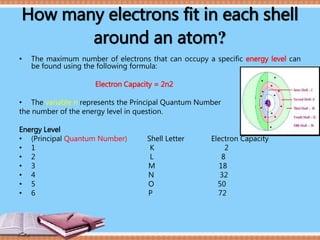
• The maximum number of electrons that can occupy a specific energy level can
be found using the following formula:
Electron Capacity = 2n2
• The variable n represents the Principal Quantum Number
the number of the energy level in question.
Energy Level
• (Principal Quantum Number) Shell Letter Electron Capacity
• 1 K 2
• 2 L 8
• 3 M 18
• 4 N 32
• 5 O 50
• 6 P 72
Subshell
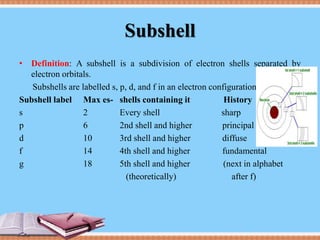
• Definition: A subshell is a subdivision of electron shells separated by
electron orbitals.
Subshells are labelled s, p, d, and f in an electron configuration.
Subshell label Max es- shells containing it History
s 2 Every shell sharp
p 6 2nd shell and higher principal
d 10 3rd shell and higher diffuse
f 14 4th shell and higher fundamental
g 18 5th shell and higher (next in alphabet
(theoretically) after f)
Conductors
• Conductors are made of materials that electricity can flow
through easily.
These materials are made up of atoms whose electrons can
move away freely.
• Examples:
copper Aluminum Gold
insulators
• Insulators are materials opposite of conductors. The
atoms are not easily freed and are stable, preventing or
blocking the flow of electricity.
Examples:
Glass Rubber Plastic
Electron theory
• Electricity is the movement of electrons through a conductor. Electrons are
attracted to protons. Since we have excess electrons on the other end of the
conductor, we have many electrons being attracted to the protons. This
attraction sort of pushes the electrons toward the protons. This push is normally
called electrical pressure. The amount of electrical pressure is determined by
the number of electrons that are attracted to protons.
• The electrical pressure or electromotive force (EMF) attempts to push an
electron out of its orbit and toward the excess protons. If an electron is freed
from its orbit, the atom acquires a positive charge because it now has one more
proton than it has electrons. The unbalanced atom or ion attempts to return to
its balanced state so it will attract electrons from the orbit of other balanced
atoms. This starts a chain reaction as one atom captures an electron and
another releases an electron. As this action continues to occur, electrons will
flow through the conductor. A stream of free electrons forms and an electrical
current is started.
Electron theory
• So far we have described current as the movement of electrons through a
conductor. Electrons are negatively charged particles that move toward
something that is positively charged. Electrons move because of this
potential difference. This describes one of the common theories about
current flow.
• The electron theory states that since electrons are negatively charged,
current flows from the most negative to the most positive point within an
electrical circuit. In other words, current flows from negative to positive.
This theory is widely accepted by the electronic industry.
Electron theory
Two theories describe current flow:
1- The conventional theory, commonly used
for automotive systems, says current flows
from (+) to (-) ... excess electrons flow from
an area of high potential to one of low potential
(-).
2 -The electron theory, commonly used for
electronics, says current flows from (-) to
(+) ... excess electrons cause an area of
negative potential (-) and flow toward an area
lacking electrons, an area of positive potential
(+), to balance the charges.
References
• http://education.jlab.org/atomtour/
• http://education.jlab.org/qa/electron_numbe
r.html
• http://www.princeton.edu/~achaney/tmve/wi
ki100k/docs/Electron_shell.html
• http://www.chem4kids.com/files/atom_orbita
l.html
• http://autolabscopediagnostics.com/electron.
htm
Medical Physics - Atom

Medical Physics - Atom

  • 1.
  • 2.
    What are Atoms •Atoms are building blocks of matter that make up everyday objects. • A desk, air and even you are made up of atoms. • There are 90 naturally occurring kinds of atoms.
  • 3.
    Subatomic particles subatomic particleis a particle smaller than an atom: it may be elementary or composite. • Protons – carry a positive charge • Neutrons- carry no charge Protons and neutrons join together and form nucleus. • Electrons - carry negative charge and circle the nucleus.
  • 4.
    Isotopes • Isotopes areatoms with the same number of protons , but differing numbers of neutrons . Isotopes are different forms of a single element . • For example, the most common isotope of hydrogen has no neutrons at all; there's also a hydrogen isotope called deuterium, with one neutron, and another, tritium, with two neutrons. Hydrogen Deuterium Tritium
  • 5.
    Orbit • Unlike planetsorbiting the Sun, electrons cannot be at any arbitrary distance from the nucleus; they can exist only in certain specific locations called allowed orbits. How do the electron orbits work? • Each orbit around the nucleus represents an energy level, and electrons cannot exist in between orbits. Orbits closer to the nucleus have lower energy. • If energy is added, an electron can be "excited" to jump to a higher energy level and orbit farther from the nucleus. Eventually, though, the electron will return to its original state, and the atom will give off energy equal to the difference between the two orbits.
  • 6.
    Orbital versus Orbit •The definition of orbital is "a wave function describing the state of a single electron in an atom (atomic orbital) or in a molecule (molecular orbital)." and also "the wave function of an electron in an atom or molecule, indicating the electron's probable location.“ • The definition of orbit is "Physics. (in Bohr theory) the path traced by an electron revolving around the nucleus of an atom.
  • 7.
    Shell • An electronshell may be thought of as an orbit followed by electrons around an atom nucleus. • Shell Basics • Let's cover some basics of atomic shells: 1. The center of the atom is called the nucleus. 2. Electrons are found in areas called shells. A shell is sometimes called an energy level. 3. Shells are areas that surround the center of an atom. 4. Each of those shells has a name (K, L, M...).
  • 8.
    How many electronsfit in each shell around an atom? • The maximum number of electrons that can occupy a specific energy level can be found using the following formula: Electron Capacity = 2n2 • The variable n represents the Principal Quantum Number the number of the energy level in question. Energy Level • (Principal Quantum Number) Shell Letter Electron Capacity • 1 K 2 • 2 L 8 • 3 M 18 • 4 N 32 • 5 O 50 • 6 P 72
  • 9.
    Subshell • Definition: Asubshell is a subdivision of electron shells separated by electron orbitals. Subshells are labelled s, p, d, and f in an electron configuration. Subshell label Max es- shells containing it History s 2 Every shell sharp p 6 2nd shell and higher principal d 10 3rd shell and higher diffuse f 14 4th shell and higher fundamental g 18 5th shell and higher (next in alphabet (theoretically) after f)
  • 10.
    Conductors • Conductors aremade of materials that electricity can flow through easily. These materials are made up of atoms whose electrons can move away freely. • Examples: copper Aluminum Gold
  • 11.
    insulators • Insulators arematerials opposite of conductors. The atoms are not easily freed and are stable, preventing or blocking the flow of electricity. Examples: Glass Rubber Plastic
  • 12.
    Electron theory • Electricityis the movement of electrons through a conductor. Electrons are attracted to protons. Since we have excess electrons on the other end of the conductor, we have many electrons being attracted to the protons. This attraction sort of pushes the electrons toward the protons. This push is normally called electrical pressure. The amount of electrical pressure is determined by the number of electrons that are attracted to protons. • The electrical pressure or electromotive force (EMF) attempts to push an electron out of its orbit and toward the excess protons. If an electron is freed from its orbit, the atom acquires a positive charge because it now has one more proton than it has electrons. The unbalanced atom or ion attempts to return to its balanced state so it will attract electrons from the orbit of other balanced atoms. This starts a chain reaction as one atom captures an electron and another releases an electron. As this action continues to occur, electrons will flow through the conductor. A stream of free electrons forms and an electrical current is started.
  • 13.
    Electron theory • Sofar we have described current as the movement of electrons through a conductor. Electrons are negatively charged particles that move toward something that is positively charged. Electrons move because of this potential difference. This describes one of the common theories about current flow. • The electron theory states that since electrons are negatively charged, current flows from the most negative to the most positive point within an electrical circuit. In other words, current flows from negative to positive. This theory is widely accepted by the electronic industry.
  • 14.
    Electron theory Two theoriesdescribe current flow: 1- The conventional theory, commonly used for automotive systems, says current flows from (+) to (-) ... excess electrons flow from an area of high potential to one of low potential (-). 2 -The electron theory, commonly used for electronics, says current flows from (-) to (+) ... excess electrons cause an area of negative potential (-) and flow toward an area lacking electrons, an area of positive potential (+), to balance the charges.
  • 15.
    References • http://education.jlab.org/atomtour/ • http://education.jlab.org/qa/electron_numbe r.html •http://www.princeton.edu/~achaney/tmve/wi ki100k/docs/Electron_shell.html • http://www.chem4kids.com/files/atom_orbita l.html • http://autolabscopediagnostics.com/electron. htm