1
Module # 22
Conductors & Insulators
Electron
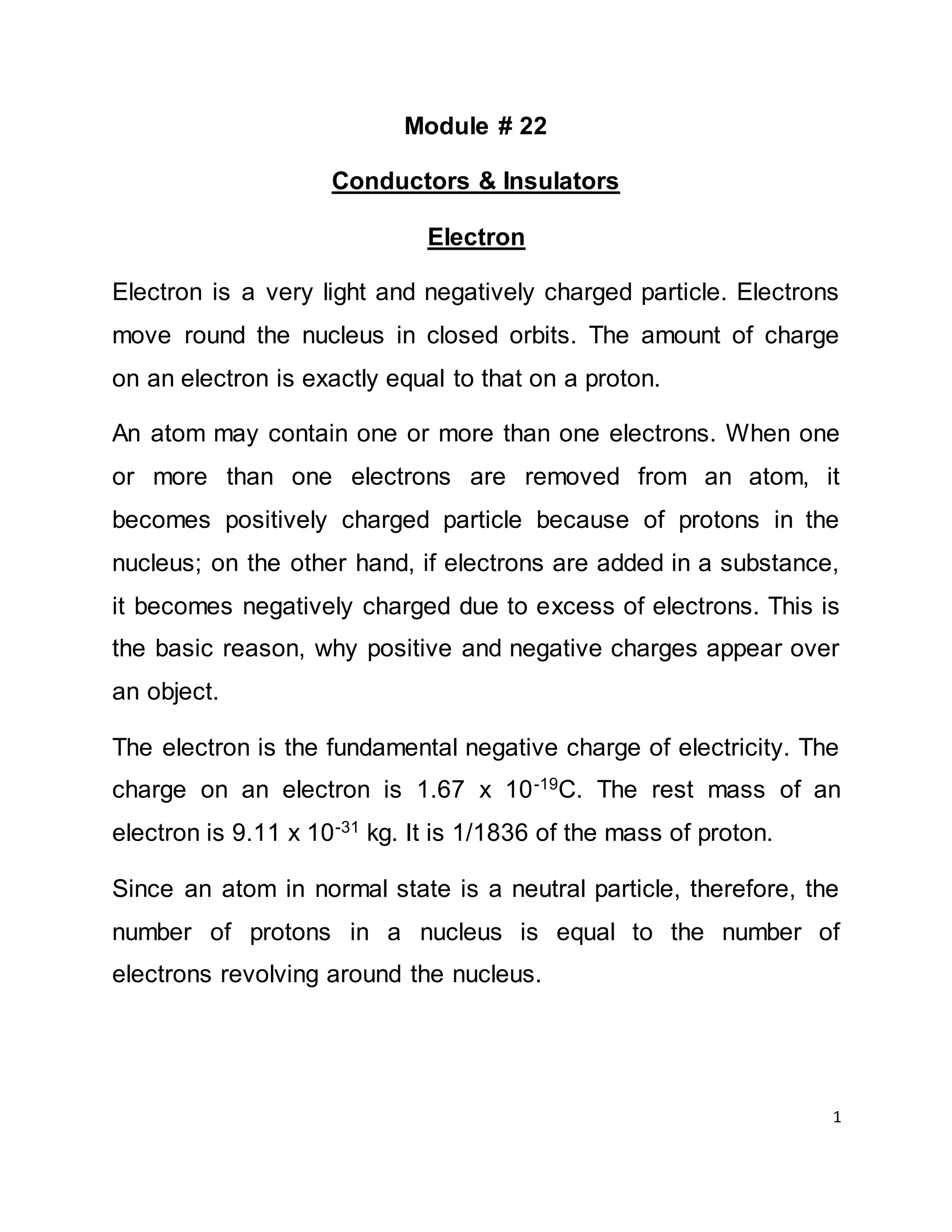
Electron is a very light and negatively charged particle. Electrons
move round the nucleus in closed orbits. The amount of charge
on an electron is exactly equal to that on a proton.
An atom may contain one or more than one electrons. When one
or more than one electrons are removed from an atom, it
becomes positively charged particle because of protons in the
nucleus; on the other hand, if electrons are added in a substance,
it becomes negatively charged due to excess of electrons. This is
the basic reason, why positive and negative charges appear over
an object.
The electron is the fundamental negative charge of electricity. The
charge on an electron is 1.67 x 10⁻¹⁹C. The rest mass of an
electron is 9.11 x 10⁻³¹
kg. It is 1/1836 of the mass of proton.
Since an atom in normal state is a neutral particle, therefore, the
number of protons in a nucleus is equal to the number of
electrons revolving around the nucleus.
2
Free Electrons
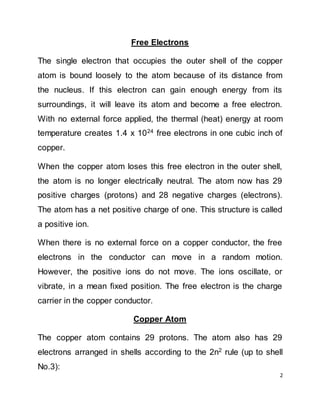
The single electron that occupies the outer shell of the copper
atom is bound loosely to the atom because of its distance from
the nucleus. If this electron can gain enough energy from its
surroundings, it will leave its atom and become a free electron.
With no external force applied, the thermal (heat) energy at room
temperature creates 1.4 x 1024
free electrons in one cubic inch of
copper.
When the copper atom loses this free electron in the outer shell,
the atom is no longer electrically neutral. The atom now has 29
positive charges (protons) and 28 negative charges (electrons).
The atom has a net positive charge of one. This structure is called
a positive ion.
When there is no external force on a copper conductor, the free
electrons in the conductor can move in a random motion.
However, the positive ions do not move. The ions oscillate, or
vibrate, in a mean fixed position. The free electron is the charge
carrier in the copper conductor.
Copper Atom
The copper atom contains 29 protons. The atom also has 29
electrons arranged in shells according to the 2n2
rule (up to shell
No.3):
3
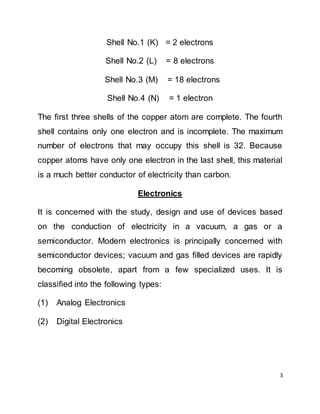
Shell No.1 (K) = 2 electrons
Shell No.2 (L) = 8 electrons
Shell No.3 (M) = 18 electrons
Shell No.4 (N) = 1 electron
The first three shells of the copper atom are complete. The fourth
shell contains only one electron and is incomplete. The maximum
number of electrons that may occupy this shell is 32. Because
copper atoms have only one electron in the last shell, this material
is a much better conductor of electricity than carbon.
Electronics
It is concerned with the study, design and use of devices based
on the conduction of electricity in a vacuum, a gas or a
semiconductor. Modern electronics is principally concerned with
semiconductor devices; vacuum and gas filled devices are rapidly
becoming obsolete, apart from a few specialized uses. It is
classified into the following types:
(1) Analog Electronics
(2) Digital Electronics
4
Applications
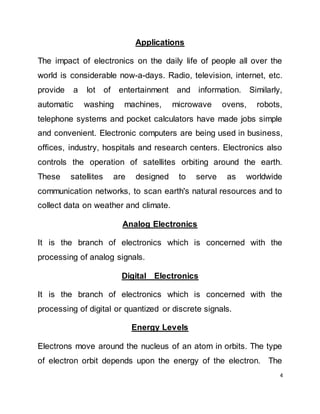
The impact of electronics on the daily life of people all over the
world is considerable now-a-days. Radio, television, internet, etc.
provide a lot of entertainment and information. Similarly,
automatic washing machines, microwave ovens, robots,
telephone systems and pocket calculators have made jobs simple
and convenient. Electronic computers are being used in business,
offices, industry, hospitals and research centers. Electronics also
controls the operation of satellites orbiting around the earth.
These satellites are designed to serve as worldwide
communication networks, to scan earth's natural resources and to
collect data on weather and climate.
Analog Electronics
It is the branch of electronics which is concerned with the
processing of analog signals.
Digital Electronics
It is the branch of electronics which is concerned with the
processing of digital or quantized or discrete signals.
Energy Levels
Electrons move around the nucleus of an atom in orbits. The type
of electron orbit depends upon the energy of the electron. The
5
greater the energy of an electron, the greater is the distance of its
orbit from the nucleus. Electron energies fall into energy bands or
shells which are defined by the maximum number of electrons
that may occupy each shell.
The energy band closest to the nucleus contains no more than
two electrons. The maximum number of electrons in a shell is
equal to 2n2
, where n is the shell number starting at the nucleus
and moving outward.
Forbidden Energy Gap
The separation between conduction band and valence band on
the energy level diagram is called Forbidden Energy Gap.
As there is no allowed energy state in the forbidden energy gap,
thus no electron can remain in a forbidden energy gap. To push
an electron from valence band to the conduction band, external
energy equal or greater to the forbidden energy gap must be
needed.
Energy Band Theory
The electrons in a solid crystal are supposed to have different
energy levels which can be found by the solution of Schrödinger’s
wave equation in wave mechanics. The solution shows that the
electrons can exist in some ranges of energy (called permissible
6
energy levels) and they cannot exist in other ranges of energy
(forbidden energy levels).
The energy bands give us an easy and satisfactory explanation of
the electrical classification of solids.
Filled Band
Filled Band is very near to the nucleus and is always full filled. A
filled band has no free electrons.
Shell or Orbit
The electrons of an atom revolve around the nucleus in shells.
The number of electrons in different shells follows a definite rule
i.e. the number of electrons in the nth shell is given by 2n2
. The
shell closest to a nucleus is given by n = 1 and is termed as K
shell. Two electrons at the most can occupy this shell. If there are
more than two electrons in the atom, then, at the most, eight
electrons can occupy the next shell n = 2, called L shell. Thus, a
maximum of ten electrons can occupy K and L shells. If this
number exceeds, then, rest of the electrons will occupy the third
shell n = 3, called M shell. This orbit or shell can be occupied by a
maximum of eighteen electrons. K, L, M, N and O are the
nomenclature for the shells n = 1, 2, 3, 4 and 5, respectively.
7
Conductor
Conductors are materials in which the free electrons move easily.
All metals are conductors. Silver is the best conductor.
Conductors may be defined as substances whose atoms have
their outermost orbits incomplete. The electrical energy can be
easily transferred from one point to another through certain
materials known as conductors. A conducting wire such as a
copper wire consists of a large number of free electrons.
An electric current is just a directed flow or drift of electrons
through a conductor. The moving electrons as they pass through
molecules or atoms of that substance collide with other electrons.
This electronic collision results in the production of heat energy
and the temperature of the conductor rises.
Conducting materials are those in which plenty of free electrons
are available for electric conduction. Thus, the material objects
which allow the charge to pass through them are called
conductors. Copper, iron, aluminum, gold, silver etc. belong to
this category.
Insulator
An insulator is a material in which the atoms contain electrons
8
that tend to stay in the outer shell. Because it is difficult to free
these electrons from the outer shell, insulators will not conduct
electricity easily. These materials are used to cover current-
carrying wires to protect personnel from injury and to prevent
short circuits.
Practical insulating materials have a very small number of free
electrons as compared to metallic conductors. Insulators oppose
the flow of electrons, or these may be defined as the substances
whose electrons are rigidly held to their atoms. Stated simply
insulators are those materials in which valence electrons are
bound very tightly to their parent atoms thus requiring very large
electric force to remove them from the attraction of their nuclei.
In terms of energy bands, it means that insulators have
(1) Full valence band
(2) An empty conduction band and
(3) A large energy gap between them
For conduction to take place, electrons must be given sufficient
energy to jump from the valence band to the conduction band.
Those material objects which do not allow the charge to pass
through them are called insulators or non-conductors. Wood,
plastic, glass, rubber etc. belong to this category.
9
Insulators and Conductors Differentiated
Suppose we connect a highly charged sphere to an uncharged
sphere by means of a wooden stick, a plastic stick, a glass rod
and a rubber strip one after the other. If we test as to whether any
charge has moved from the charged sphere to the uncharged
sphere through any of the above materials, it is found that no
appreciable amount of charge has passed through any of the
materials to the uncharged sphere. Now, if we connect the two
spheres by means of an iron wire, an appreciable amount of
charge will flow through the iron wire to the uncharged sphere.
The same result is observed if we use a copper wire, an
aluminum wire or any other metallic wire to connect the two
spheres. Thus, we see that there are two types of material.
Semiconductors
[Semiconductors are the elements in the group IV.]
Semiconductors are elements whose ability to conduct electricity
is between that of conductors and insulators. Semiconductors
have fewer free electrons than conductors, but more free
electrons than insulators. The most frequently used
semiconductors are germanium and silicon. Diodes and
transistors are manufactured from these materials.
10
A semiconductor material is one whose electrical properties lie in
between those of insulators and good conductors. Examples are
germanium and silicon.
In terms of energy bands, semiconductors can be found as those
materials which at room temperature have
1. partially-filled conduction band
2. partially-filled valence band and
3. a very narrow energy gap between them
At 0°K, there are no electrons in the conduction band of
semiconductors and their valance band is completely filled. It
means that at absolute zero temperature, a piece of Ge or Si acts
like a perfect insulator. However, with increase in temperature,
width of the forbidden energy band is decreased so that some of
the electrons are liberated into the conduction band. In other
words, conductivity of semiconductors increases with
temperature. It means that they have negative temperature
coefficient of resistance.
The solids which have resistivity higher than conductors but lower
than insulators are semiconductors. Silicon and Germanium are
good semiconductors. In pure form both the materials are poor
conductors. If some impurities are added, then important electrical
11
characteristics can be obtained.
The substances with resistivity of the order of 10-4
ohm-meter are
good conductors of electricity. The value of resistivity for
insulators is of the order of 108
ohm-meter. There are certain
substances which have intermediate values of resistivity. They
are known as semi-conductors. The examples of such substances
are the crystals of Germanium and Silicon which belong to fourth
group of periodic table. They have four electrons in their
outermost shell called valence electrons.
Conduction in Silicon and Germanium (Electrons and Holes)
A pure semiconductor behaves like an insulator at temperature
near absolute zero because the valence electrons of each atom
are tightly held in covalent bonds with neighboring atoms. As the
temperature rises to ambient range (27° C), the atom and the
electrons absorb thermal energy. This energy appears as random
vibration or agitation of these particles about their lattice locations.
So, some electrons become free and mobile by acquiring
sufficient energy to break the covalent bond. The energy required
to break a covalent bond may also be provided by high voltage
across the material or by exposing the material to photons of
proper wavelength.
12
When the bond is broken and an electron is free thereby, electron
vacancy is left in the covalent bond. The vacant electron site is
called a hole. The hole represents the absence of negative
charge and is attractive to electrons. The hole appears to have a
positive charge equal to the negative charge of electron in
magnitude. The hole also appears to be mobile.
The holes and electrons are both mobile charges that can take
part in electrical conduction in semi-conductor materials. The
movement of holes corresponds to conventional current.
(Pair Production & Intrinsic Conduction)
When a covalent bond is broken, we speak of the process as the
generation of electron-hole pair. This is natural and inherent
process in semi-conductors. The conduction due to charges
produced by pair generation is called intrinsic conduction.
The pair production and intrinsic conductivity both are low at room
temperature because of the low value of thermal energy which
breaks the valence bonds. The process is so sensitive to the
temperature that intrinsic current levels may be expected to
double for every increase of 10° C limiting the use of silicon
devices to 200o
C and germanium devices to 90° C.
13
Extrinsic Semiconductors
The doped semiconductors are called impure or extrinsic
semiconductors.
Intrinsic Semiconductors
A semiconductor, which is in its extremely pure form, is called as
an intrinsic semiconductor.

Module No. 22

  • 1.
    1 Module # 22 Conductors& Insulators Electron Electron is a very light and negatively charged particle. Electrons move round the nucleus in closed orbits. The amount of charge on an electron is exactly equal to that on a proton. An atom may contain one or more than one electrons. When one or more than one electrons are removed from an atom, it becomes positively charged particle because of protons in the nucleus; on the other hand, if electrons are added in a substance, it becomes negatively charged due to excess of electrons. This is the basic reason, why positive and negative charges appear over an object. The electron is the fundamental negative charge of electricity. The charge on an electron is 1.67 x 10⁻¹⁹C. The rest mass of an electron is 9.11 x 10⁻³¹ kg. It is 1/1836 of the mass of proton. Since an atom in normal state is a neutral particle, therefore, the number of protons in a nucleus is equal to the number of electrons revolving around the nucleus.
  • 2.
    2 Free Electrons The singleelectron that occupies the outer shell of the copper atom is bound loosely to the atom because of its distance from the nucleus. If this electron can gain enough energy from its surroundings, it will leave its atom and become a free electron. With no external force applied, the thermal (heat) energy at room temperature creates 1.4 x 1024 free electrons in one cubic inch of copper. When the copper atom loses this free electron in the outer shell, the atom is no longer electrically neutral. The atom now has 29 positive charges (protons) and 28 negative charges (electrons). The atom has a net positive charge of one. This structure is called a positive ion. When there is no external force on a copper conductor, the free electrons in the conductor can move in a random motion. However, the positive ions do not move. The ions oscillate, or vibrate, in a mean fixed position. The free electron is the charge carrier in the copper conductor. Copper Atom The copper atom contains 29 protons. The atom also has 29 electrons arranged in shells according to the 2n2 rule (up to shell No.3):
  • 3.
    3 Shell No.1 (K)= 2 electrons Shell No.2 (L) = 8 electrons Shell No.3 (M) = 18 electrons Shell No.4 (N) = 1 electron The first three shells of the copper atom are complete. The fourth shell contains only one electron and is incomplete. The maximum number of electrons that may occupy this shell is 32. Because copper atoms have only one electron in the last shell, this material is a much better conductor of electricity than carbon. Electronics It is concerned with the study, design and use of devices based on the conduction of electricity in a vacuum, a gas or a semiconductor. Modern electronics is principally concerned with semiconductor devices; vacuum and gas filled devices are rapidly becoming obsolete, apart from a few specialized uses. It is classified into the following types: (1) Analog Electronics (2) Digital Electronics
  • 4.
    4 Applications The impact ofelectronics on the daily life of people all over the world is considerable now-a-days. Radio, television, internet, etc. provide a lot of entertainment and information. Similarly, automatic washing machines, microwave ovens, robots, telephone systems and pocket calculators have made jobs simple and convenient. Electronic computers are being used in business, offices, industry, hospitals and research centers. Electronics also controls the operation of satellites orbiting around the earth. These satellites are designed to serve as worldwide communication networks, to scan earth's natural resources and to collect data on weather and climate. Analog Electronics It is the branch of electronics which is concerned with the processing of analog signals. Digital Electronics It is the branch of electronics which is concerned with the processing of digital or quantized or discrete signals. Energy Levels Electrons move around the nucleus of an atom in orbits. The type of electron orbit depends upon the energy of the electron. The
  • 5.
    5 greater the energyof an electron, the greater is the distance of its orbit from the nucleus. Electron energies fall into energy bands or shells which are defined by the maximum number of electrons that may occupy each shell. The energy band closest to the nucleus contains no more than two electrons. The maximum number of electrons in a shell is equal to 2n2 , where n is the shell number starting at the nucleus and moving outward. Forbidden Energy Gap The separation between conduction band and valence band on the energy level diagram is called Forbidden Energy Gap. As there is no allowed energy state in the forbidden energy gap, thus no electron can remain in a forbidden energy gap. To push an electron from valence band to the conduction band, external energy equal or greater to the forbidden energy gap must be needed. Energy Band Theory The electrons in a solid crystal are supposed to have different energy levels which can be found by the solution of Schrödinger’s wave equation in wave mechanics. The solution shows that the electrons can exist in some ranges of energy (called permissible
  • 6.
    6 energy levels) andthey cannot exist in other ranges of energy (forbidden energy levels). The energy bands give us an easy and satisfactory explanation of the electrical classification of solids. Filled Band Filled Band is very near to the nucleus and is always full filled. A filled band has no free electrons. Shell or Orbit The electrons of an atom revolve around the nucleus in shells. The number of electrons in different shells follows a definite rule i.e. the number of electrons in the nth shell is given by 2n2 . The shell closest to a nucleus is given by n = 1 and is termed as K shell. Two electrons at the most can occupy this shell. If there are more than two electrons in the atom, then, at the most, eight electrons can occupy the next shell n = 2, called L shell. Thus, a maximum of ten electrons can occupy K and L shells. If this number exceeds, then, rest of the electrons will occupy the third shell n = 3, called M shell. This orbit or shell can be occupied by a maximum of eighteen electrons. K, L, M, N and O are the nomenclature for the shells n = 1, 2, 3, 4 and 5, respectively.
  • 7.
    7 Conductor Conductors are materialsin which the free electrons move easily. All metals are conductors. Silver is the best conductor. Conductors may be defined as substances whose atoms have their outermost orbits incomplete. The electrical energy can be easily transferred from one point to another through certain materials known as conductors. A conducting wire such as a copper wire consists of a large number of free electrons. An electric current is just a directed flow or drift of electrons through a conductor. The moving electrons as they pass through molecules or atoms of that substance collide with other electrons. This electronic collision results in the production of heat energy and the temperature of the conductor rises. Conducting materials are those in which plenty of free electrons are available for electric conduction. Thus, the material objects which allow the charge to pass through them are called conductors. Copper, iron, aluminum, gold, silver etc. belong to this category. Insulator An insulator is a material in which the atoms contain electrons
  • 8.
    8 that tend tostay in the outer shell. Because it is difficult to free these electrons from the outer shell, insulators will not conduct electricity easily. These materials are used to cover current- carrying wires to protect personnel from injury and to prevent short circuits. Practical insulating materials have a very small number of free electrons as compared to metallic conductors. Insulators oppose the flow of electrons, or these may be defined as the substances whose electrons are rigidly held to their atoms. Stated simply insulators are those materials in which valence electrons are bound very tightly to their parent atoms thus requiring very large electric force to remove them from the attraction of their nuclei. In terms of energy bands, it means that insulators have (1) Full valence band (2) An empty conduction band and (3) A large energy gap between them For conduction to take place, electrons must be given sufficient energy to jump from the valence band to the conduction band. Those material objects which do not allow the charge to pass through them are called insulators or non-conductors. Wood, plastic, glass, rubber etc. belong to this category.
  • 9.
    9 Insulators and ConductorsDifferentiated Suppose we connect a highly charged sphere to an uncharged sphere by means of a wooden stick, a plastic stick, a glass rod and a rubber strip one after the other. If we test as to whether any charge has moved from the charged sphere to the uncharged sphere through any of the above materials, it is found that no appreciable amount of charge has passed through any of the materials to the uncharged sphere. Now, if we connect the two spheres by means of an iron wire, an appreciable amount of charge will flow through the iron wire to the uncharged sphere. The same result is observed if we use a copper wire, an aluminum wire or any other metallic wire to connect the two spheres. Thus, we see that there are two types of material. Semiconductors [Semiconductors are the elements in the group IV.] Semiconductors are elements whose ability to conduct electricity is between that of conductors and insulators. Semiconductors have fewer free electrons than conductors, but more free electrons than insulators. The most frequently used semiconductors are germanium and silicon. Diodes and transistors are manufactured from these materials.
  • 10.
    10 A semiconductor materialis one whose electrical properties lie in between those of insulators and good conductors. Examples are germanium and silicon. In terms of energy bands, semiconductors can be found as those materials which at room temperature have 1. partially-filled conduction band 2. partially-filled valence band and 3. a very narrow energy gap between them At 0°K, there are no electrons in the conduction band of semiconductors and their valance band is completely filled. It means that at absolute zero temperature, a piece of Ge or Si acts like a perfect insulator. However, with increase in temperature, width of the forbidden energy band is decreased so that some of the electrons are liberated into the conduction band. In other words, conductivity of semiconductors increases with temperature. It means that they have negative temperature coefficient of resistance. The solids which have resistivity higher than conductors but lower than insulators are semiconductors. Silicon and Germanium are good semiconductors. In pure form both the materials are poor conductors. If some impurities are added, then important electrical
  • 11.
    11 characteristics can beobtained. The substances with resistivity of the order of 10-4 ohm-meter are good conductors of electricity. The value of resistivity for insulators is of the order of 108 ohm-meter. There are certain substances which have intermediate values of resistivity. They are known as semi-conductors. The examples of such substances are the crystals of Germanium and Silicon which belong to fourth group of periodic table. They have four electrons in their outermost shell called valence electrons. Conduction in Silicon and Germanium (Electrons and Holes) A pure semiconductor behaves like an insulator at temperature near absolute zero because the valence electrons of each atom are tightly held in covalent bonds with neighboring atoms. As the temperature rises to ambient range (27° C), the atom and the electrons absorb thermal energy. This energy appears as random vibration or agitation of these particles about their lattice locations. So, some electrons become free and mobile by acquiring sufficient energy to break the covalent bond. The energy required to break a covalent bond may also be provided by high voltage across the material or by exposing the material to photons of proper wavelength.
  • 12.
    12 When the bondis broken and an electron is free thereby, electron vacancy is left in the covalent bond. The vacant electron site is called a hole. The hole represents the absence of negative charge and is attractive to electrons. The hole appears to have a positive charge equal to the negative charge of electron in magnitude. The hole also appears to be mobile. The holes and electrons are both mobile charges that can take part in electrical conduction in semi-conductor materials. The movement of holes corresponds to conventional current. (Pair Production & Intrinsic Conduction) When a covalent bond is broken, we speak of the process as the generation of electron-hole pair. This is natural and inherent process in semi-conductors. The conduction due to charges produced by pair generation is called intrinsic conduction. The pair production and intrinsic conductivity both are low at room temperature because of the low value of thermal energy which breaks the valence bonds. The process is so sensitive to the temperature that intrinsic current levels may be expected to double for every increase of 10° C limiting the use of silicon devices to 200o C and germanium devices to 90° C.
  • 13.
    13 Extrinsic Semiconductors The dopedsemiconductors are called impure or extrinsic semiconductors. Intrinsic Semiconductors A semiconductor, which is in its extremely pure form, is called as an intrinsic semiconductor.