Atomic Structure
Some ofthe important properties of solid materials depend
• Atomic arrangements
• Interaction between Constituent atoms
Fundamental Concepts
Atom consists of nucleus composed of proton and neutron encircled by moving
electrons.
Charge magnitude of electrons and protons
Electrons are negatively charged
3.
Cont’d
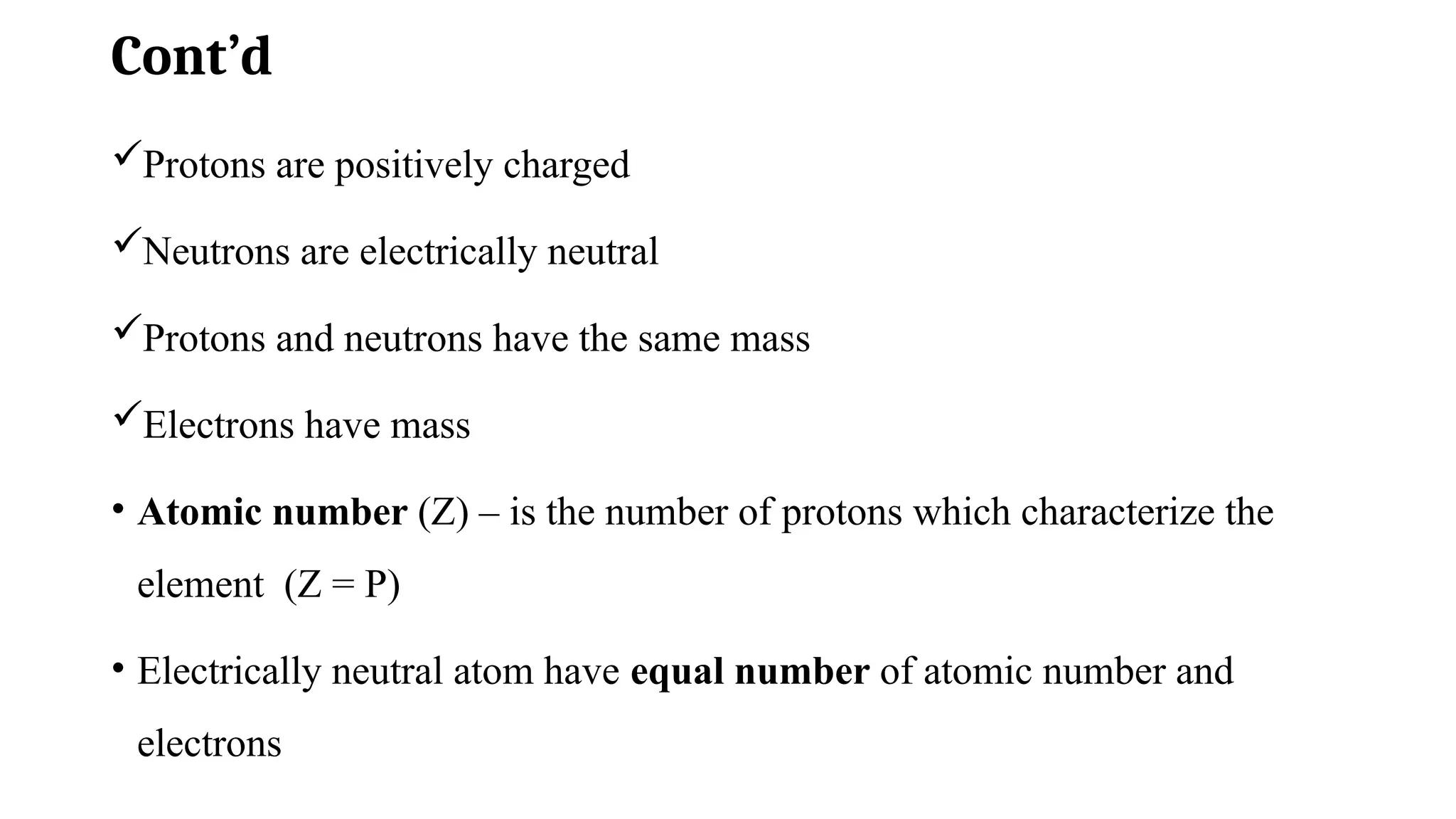
Protons are positivelycharged
Neutrons are electrically neutral
Protons and neutrons have the same mass
Electrons have mass
• Atomic number (Z) – is the number of protons which characterize the
element (Z = P)
• Electrically neutral atom have equal number of atomic number and
electrons
4.
Cont’d
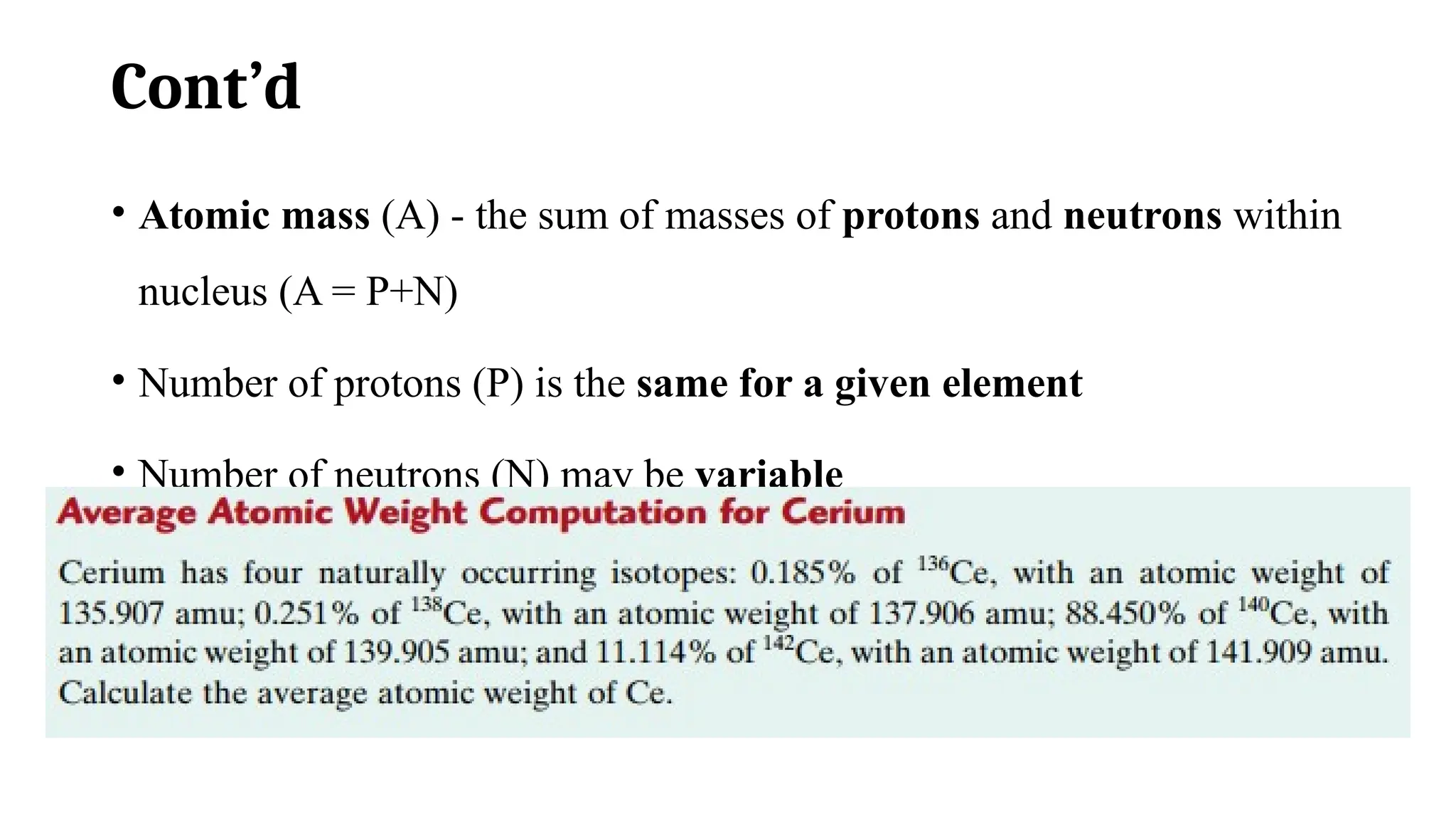
• Atomic mass(A) - the sum of masses of protons and neutrons within
nucleus (A = P+N)
• Number of protons (P) is the same for a given element
• Number of neutrons (N) may be variable
• An element have two or more atomic masses called isotopes.
• Atomic weight of an element weighted average of natural isotopes.
5.
Cont’d
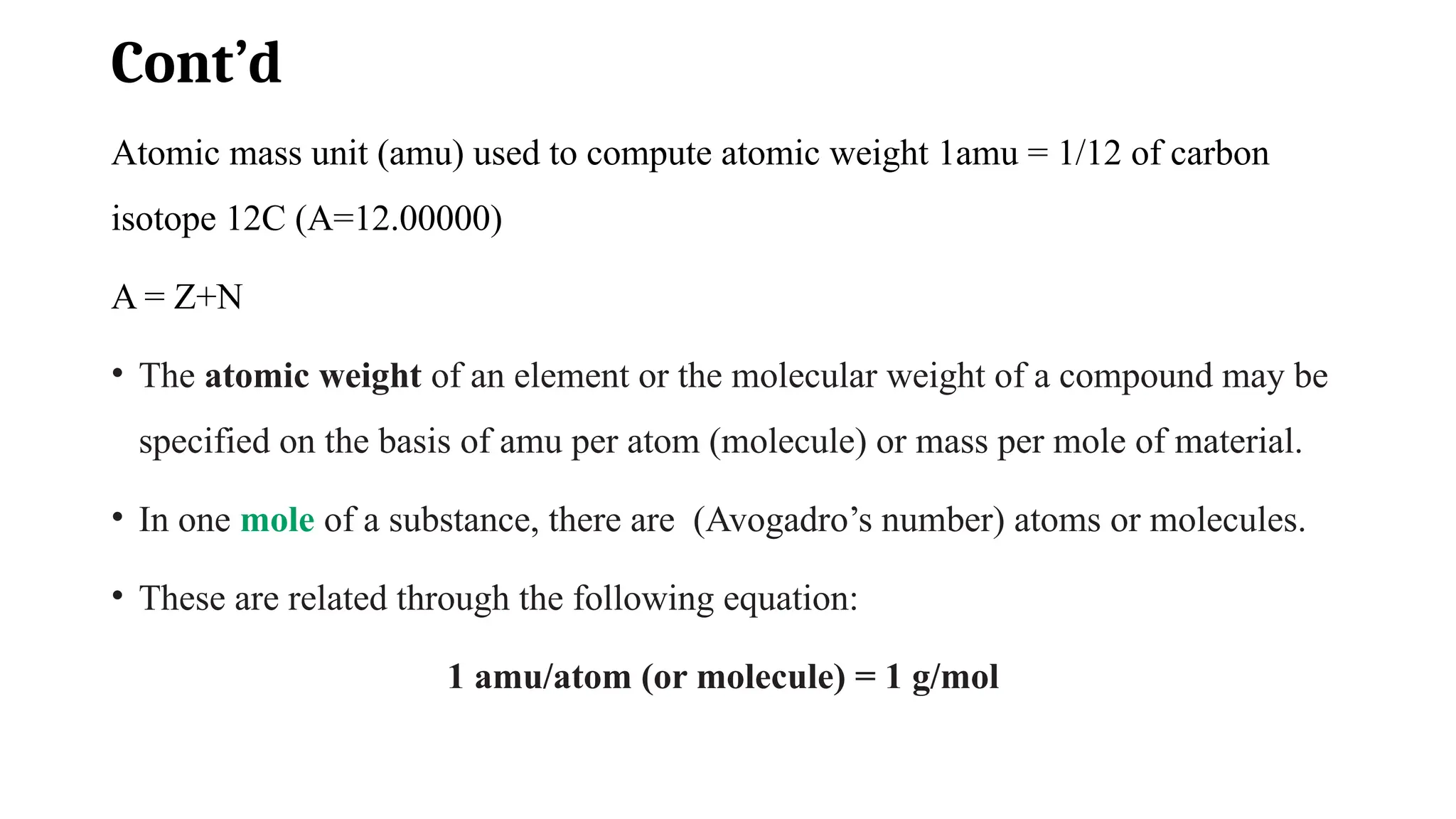
Atomic mass unit(amu) used to compute atomic weight 1amu = 1/12 of carbon
isotope 12C (A=12.00000)
A = Z+N
• The atomic weight of an element or the molecular weight of a compound may be
specified on the basis of amu per atom (molecule) or mass per mole of material.
• In one mole of a substance, there are (Avogadro’s number) atoms or molecules.
• These are related through the following equation:
1 amu/atom (or molecule) = 1 g/mol
6.
ELECTRONS IN ATOMS
AtomicModels
Many phenomena involving electrons in solids could not be explained in
terms of classical mechanics.
Principles and laws that govern systems of atomic and subatomic entities
that came to be known as quantum mechanics.
Bohr atomic model, in which electrons are assumed to revolve around
the atomic nucleus in discrete orbitals
The energies of electrons are quantized—that is, electrons are permitted to
have only specific values of energy
A quantum jump either to an allowed higher energy (with absorption of
energy) or to a lower energy (with emission of energy).
7.
Cont’d
Often, it isconvenient to think of these allowed electron energies as
being associated with energy levels or states.
Wave-mechanical model, in which the electron is considered to
exhibit both wavelike and particle-like characteristics
Position is considered to be the probability of an electron being at
various locations around the nucleus
8.
Quantum Numbers
In wavemechanics, every electron in an atom is characterized by four
parameters called quantum numbers.
The size, shape, and spatial orientation of an electron’s probability
density (or orbital) are specified by three of these quantum numbers.
Furthermore, Bohr energy levels separate into electron subshells, and
quantum numbers dictate the number of states within each subshell.
9.
1st
quantum number
Shells arespecified by a principal quantum number n, which may
take on integral values beginning with unity; sometimes these shells
are designated by the letters K, L, M, N, O, and so on, which
correspond, respectively, to n = 1, 2, 3, 4, 5, . . . ,
This quantum number is related to the size of an electron’s orbital (or
its average distance from the nucleus).
10.
Second quantum number
•The second (or azimuthal) quantum number, l, designates the subshell.
• Values of l are restricted by the magnitude of n integer values that range
from l = 0 to l = (n − 1).
• Each subshell is denoted by a lowercase letter—an s, p, d, or f related to l
values as follows:
• Electron orbital shapes depend on l
11.
3rd
quantum number
• Thenumber of electron orbitals for each subshell is determined by the third
(or magnetic) quantum number, ml; ml can take on integer values between −l
and +l, including 0
• When l = 0, ml can only have a value of 0 because +0 and -0 are the same.
• This corresponds to an s subshell, which can have only one orbital.
Furthermore, for l = 1, ml can take on values of -1, 0, and +1, and three p
orbitals are possible.
• Similarly, it can be shown that d subshells have five orbitals, and f subshells
have seven.
• In the absence of an external magnetic field, all orbitals within each subshell
are identical in energy.
• However, when a magnetic field is applied, these subshell states split, with
each orbital assuming a slightly different energy
12.
4th
quantum number
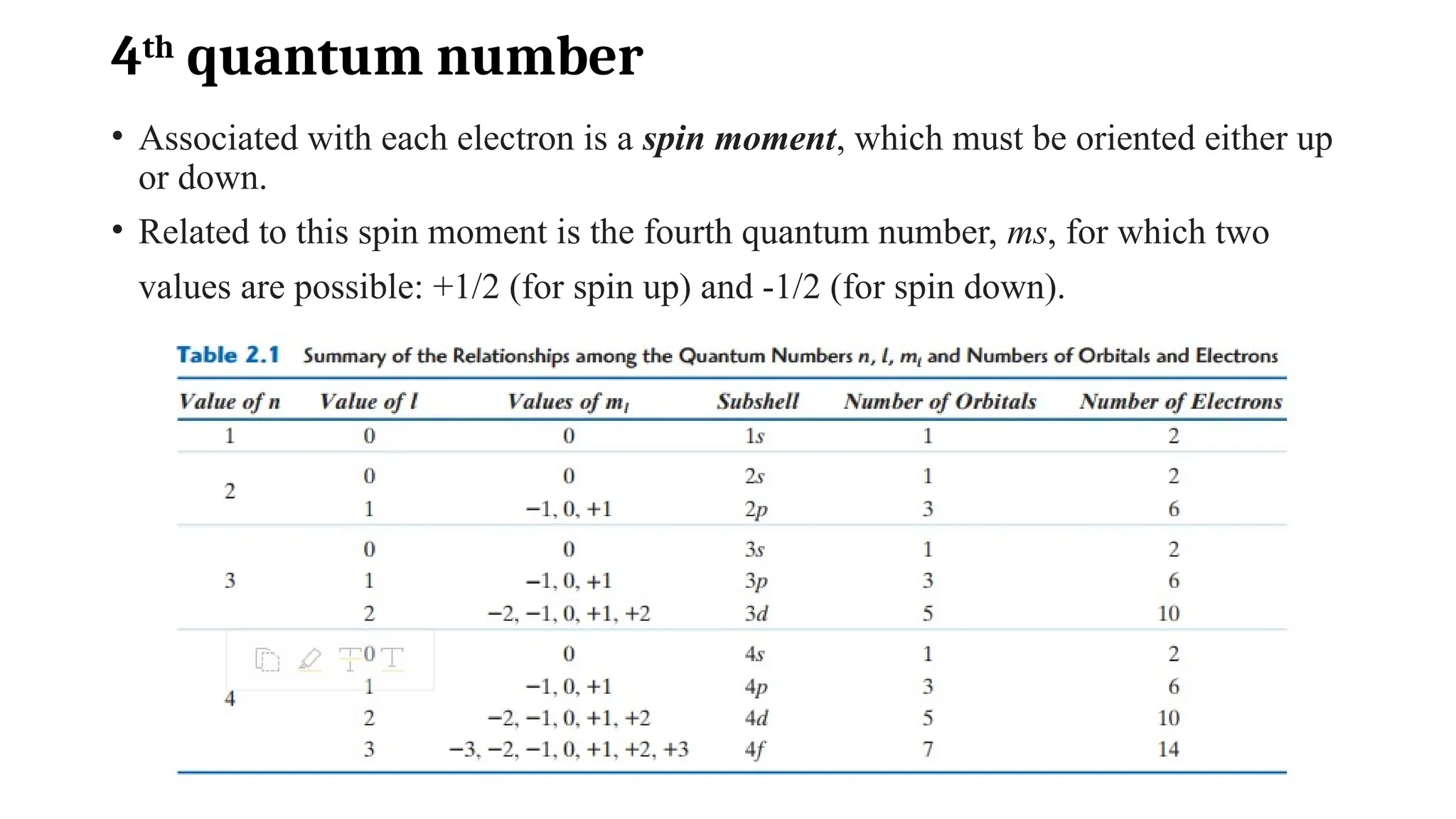
• Associatedwith each electron is a spin moment, which must be oriented either up
or down.
• Related to this spin moment is the fourth quantum number, ms, for which two
values are possible: +1/2 (for spin up) and -1/2 (for spin down).
13.
Electron Configurations
Electron states—valuesof energy that are permitted for electrons.
Pauli exclusion principle, stipulates that each electron state can hold
no more than two electrons that must have opposite spins.
s, p, d, and f subshells may each accommodate, respectively, a total of
2, 6, 10, and 14 electrons
When all the electrons occupy the lowest possible energies in accord
with the foregoing restrictions, an atom is said to be in its ground state.
14.
Cont’d
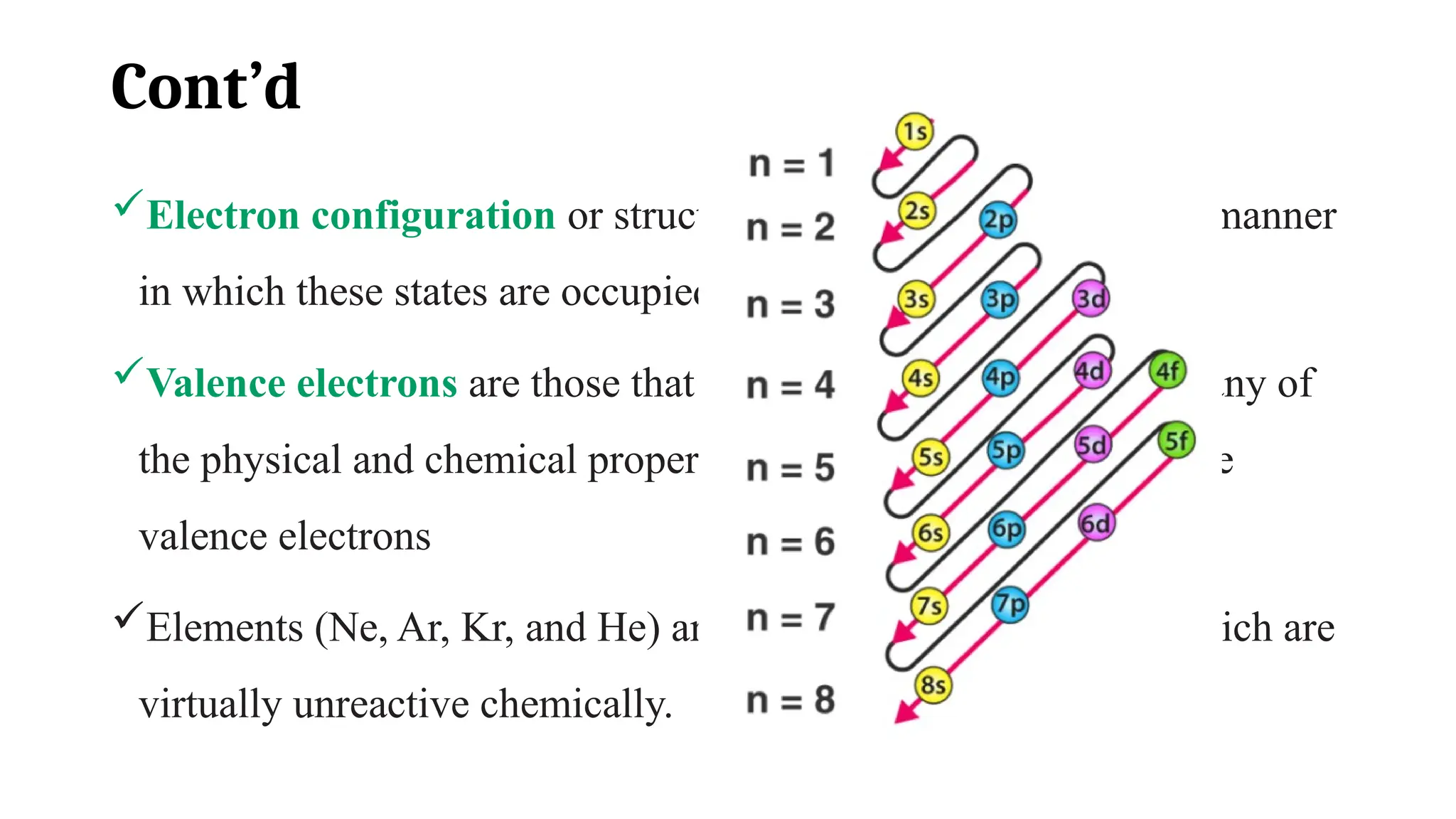
Electron configuration orstructure of an atom represents the manner
in which these states are occupied.
Valence electrons are those that occupy the outermost shell many of
the physical and chemical properties of solids are based on these
valence electrons
Elements (Ne, Ar, Kr, and He) are the inert, or noble, gases, which are
virtually unreactive chemically.
15.
THE PERIODIC TABLE
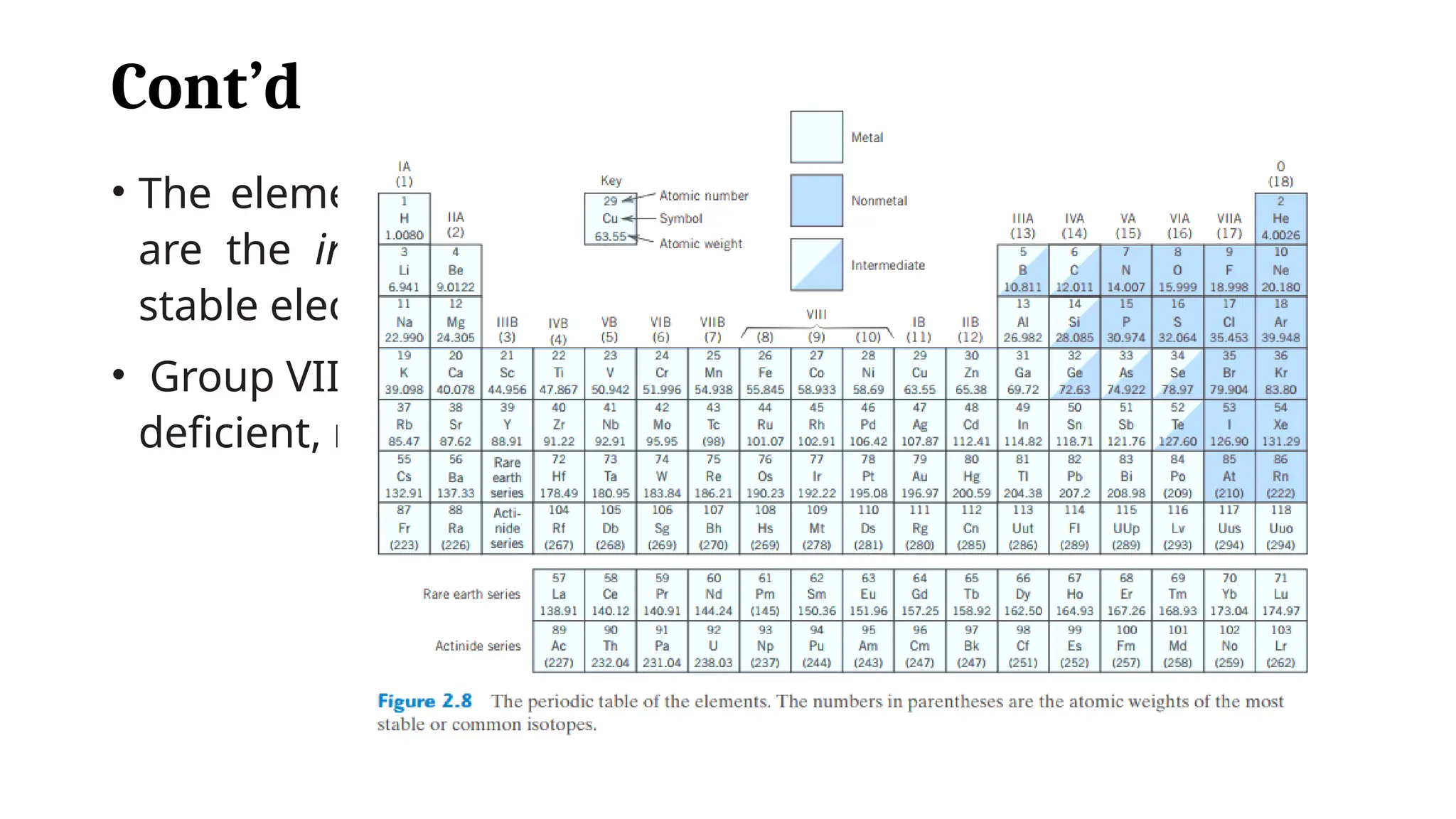
•All the elements have been classified according to electron
configuration in the periodic table
• The elements are situated, with increasing atomic number, in seven
horizontal rows called periods.
• The arrangement is such that all elements arrayed in a given column or
group have similar valence electron structures, as well as chemical and
physical properties.
• These properties change gradually, moving horizontally across each
period and vertically down each column.
16.
Cont’d
• The elementspositioned in Group 0, the rightmost group,
are the inert gases, which have filled electron shells and
stable electron configurations.
• Group VIIA and VIA elements are one and two electrons
deficient, respectively, from having stable structures.
17.
Cont’d
• The alkaliand the alkaline earth metals (Li, Na, K, Be, Mg, Ca, etc.) are labeled
as Groups IA and IIA, having, respectively, one and two electrons in excess of
stable structures.
• The elements in the three long periods, Groups IIIB through IIB, are termed the
transition metals, which have partially filled d electron states and in some cases
one or two electrons in the next higher energy shell.
• Groups IIIA, IVA, and VA (B, Si, Ge, As, etc.) display characteristics that are
intermediate between the metals and nonmetals by virtue of their valence
electron structures.
18.
Cont’d
• Most ofthe elements really come under the metal classification.
• These are sometimes termed electropositive elements, indicating that they
are capable of giving up their few valence electrons to become positively
charged ions.
• Furthermore, the elements situated on the right side of the table are
electronegative—that is, they readily accept electrons to form negatively
charged ions, or sometimes they share electrons with other atoms.
• As a general rule, electronegativity increases in moving from left to right and
from bottom to top.
• Atoms are more likely to accept electrons if their outer shells are almost full
and if they are less “shielded” from (i.e., closer to) the nucleus.
19.
Cont’d
• In additionto chemical behavior, physical properties of the elements also tend to vary
systematically with position in the periodic table.
• For example, most metals that reside in the center of the table (Groups IIIB through
IIB) are relatively good conductors of electricity and heat; nonmetals are typically
electrical and thermal insulators.
• Mechanically, the metallic elements exhibit varying degrees of ductility—the ability
to be plastically deformed without fracturing (e.g., the ability to be rolled into thin
sheets).
20.
Cont’d
• Most ofthe nonmetals are either gases or liquids, or in the solid state are brittle
in nature.
• Furthermore, for the Group IVA elements [C (diamond), Si, Ge, Sn, and Pb],
electrical conductivity increases as we move down this column.
• The Group VB metals (V, Nb, and Ta) have very high melting temperatures,
which increase in going down this column.
21.
Atomic Bonding inSolids
• Three different types of primary or chemical bond are found in solids—ionic,
covalent, and metallic.
• For each type, the bonding necessarily involves the valence electrons; furthermore,
the nature of the bond depends on the electron structures of the constituent atoms.
• In general, each of these three types of bonding arises from the tendency of the
atoms to assume stable electron structures, like those of the inert gases, by
completely filling the outermost electron shell.
• Secondary or physical forces and energies are also found in many solid materials;
they are weaker than the primary ones but nonetheless influence the physical
properties of some materials.
22.
PRIMARY INTERATOMIC BONDS
•Ionic Bonding
• Ionic bonding is perhaps the easiest to describe and visualize. It is always
found in compounds composed of both metallic and nonmetallic elements
• Atoms of a metallic element easily give up their valence electrons to the
nonmetallic atoms. In the process, all the atoms acquire stable or inert gas
configuration
e.g. NaCl Na become positively charged
Cl become negatively charged
23.
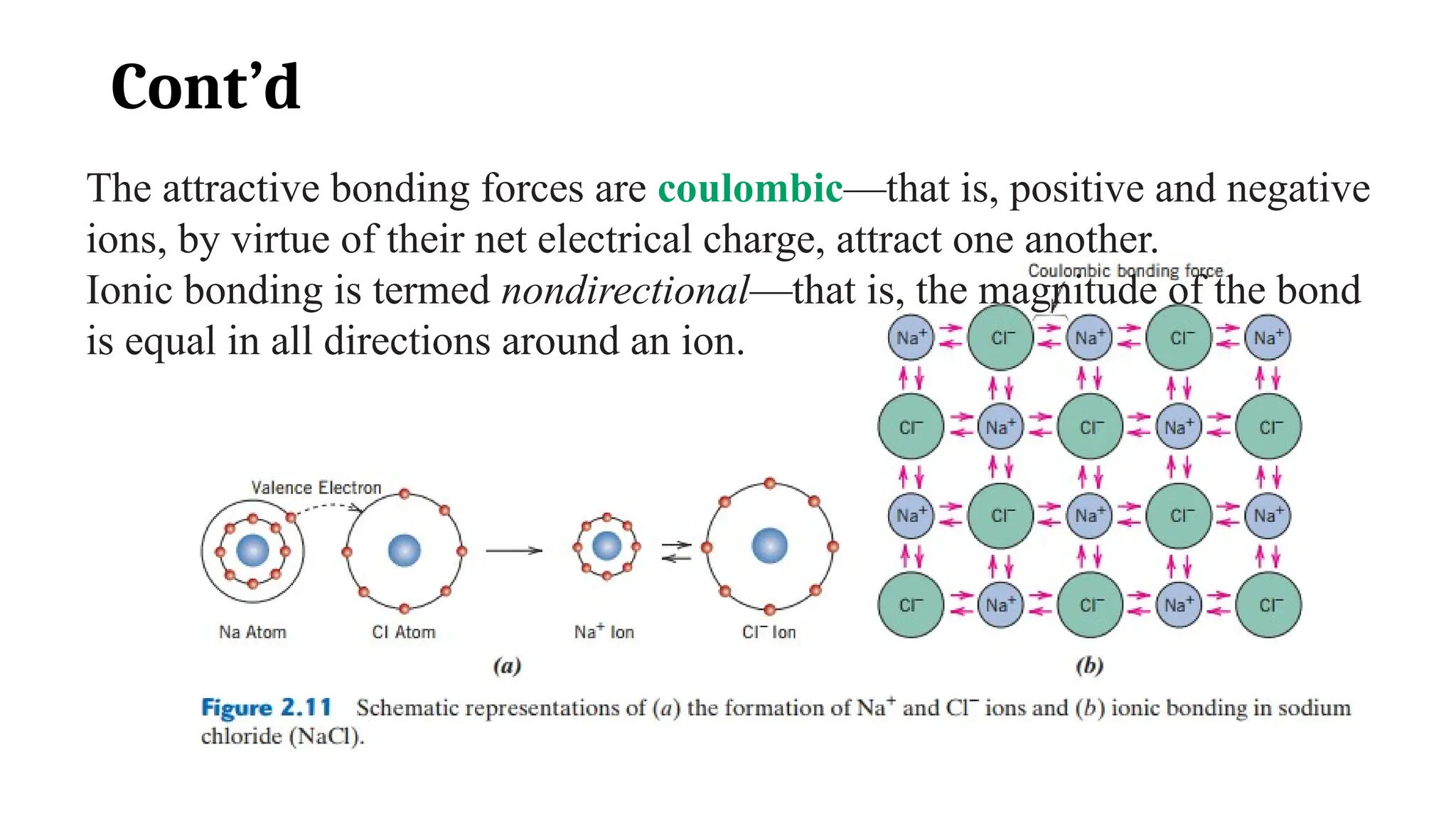
Cont’d
The attractive bondingforces are coulombic—that is, positive and negative
ions, by virtue of their net electrical charge, attract one another.
Ionic bonding is termed nondirectional—that is, the magnitude of the bond
is equal in all directions around an ion.
24.
Covalent Bonding
• Asecond bonding type, covalent bonding, is found in materials whose atoms
have small differences in electronegativity—that is, that lie near one another
in the periodic table.
• For these materials, stable electron configurations are assumed by the sharing
of electrons between adjacent atoms.
• Two covalently bonded atoms will each contribute at least one electron to the
bond, and the shared electrons may be considered to belong to both atoms.
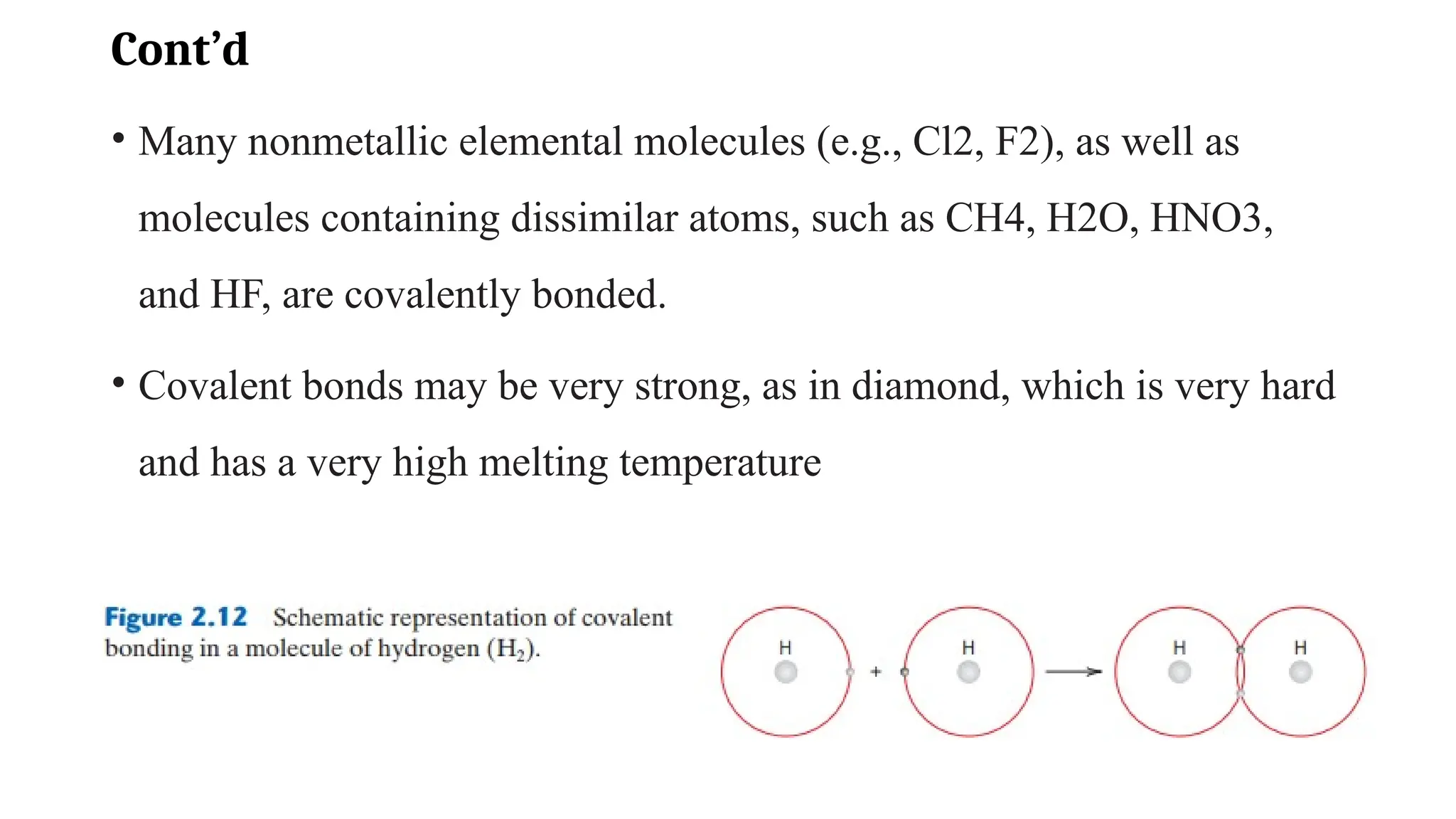
• for a molecule of hydrogen (H2). bond is directional—that is, it is between
specific atoms and may exist only in the direction between one atom and
another that participates in the electron sharing.
25.
Cont’d
• Many nonmetallicelemental molecules (e.g., Cl2, F2), as well as
molecules containing dissimilar atoms, such as CH4, H2O, HNO3,
and HF, are covalently bonded.
• Covalent bonds may be very strong, as in diamond, which is very hard
and has a very high melting temperature
26.
Metallic Bonding
• Metallicbonding, the final primary bonding type, is found in metals and
their alloys.
• these valence electrons are not bound to any particular atom in the solid and
are more or less free to drift throughout the entire metal.
• They may be thought of as belonging to the metal as a whole, or forming a
“sea of electrons” or an “electron cloud.”
• The free electrons shield the positively charged ion cores from the mutually
repulsive electrostatic forces that they would otherwise exert upon one
another; consequently, the metallic bond is nondirectional in character.
• In addition, these free electrons act as a “glue” to hold the ion cores together.
Metals are good conductors of both electricity and heat as a consequence of
their free electrons
27.
SECONDARY BONDING ORVAN DER WAALS BONDING
• Secondary bonds, or van der Waals (physical) bonds, are weak in comparison
to the primary or chemical bonds
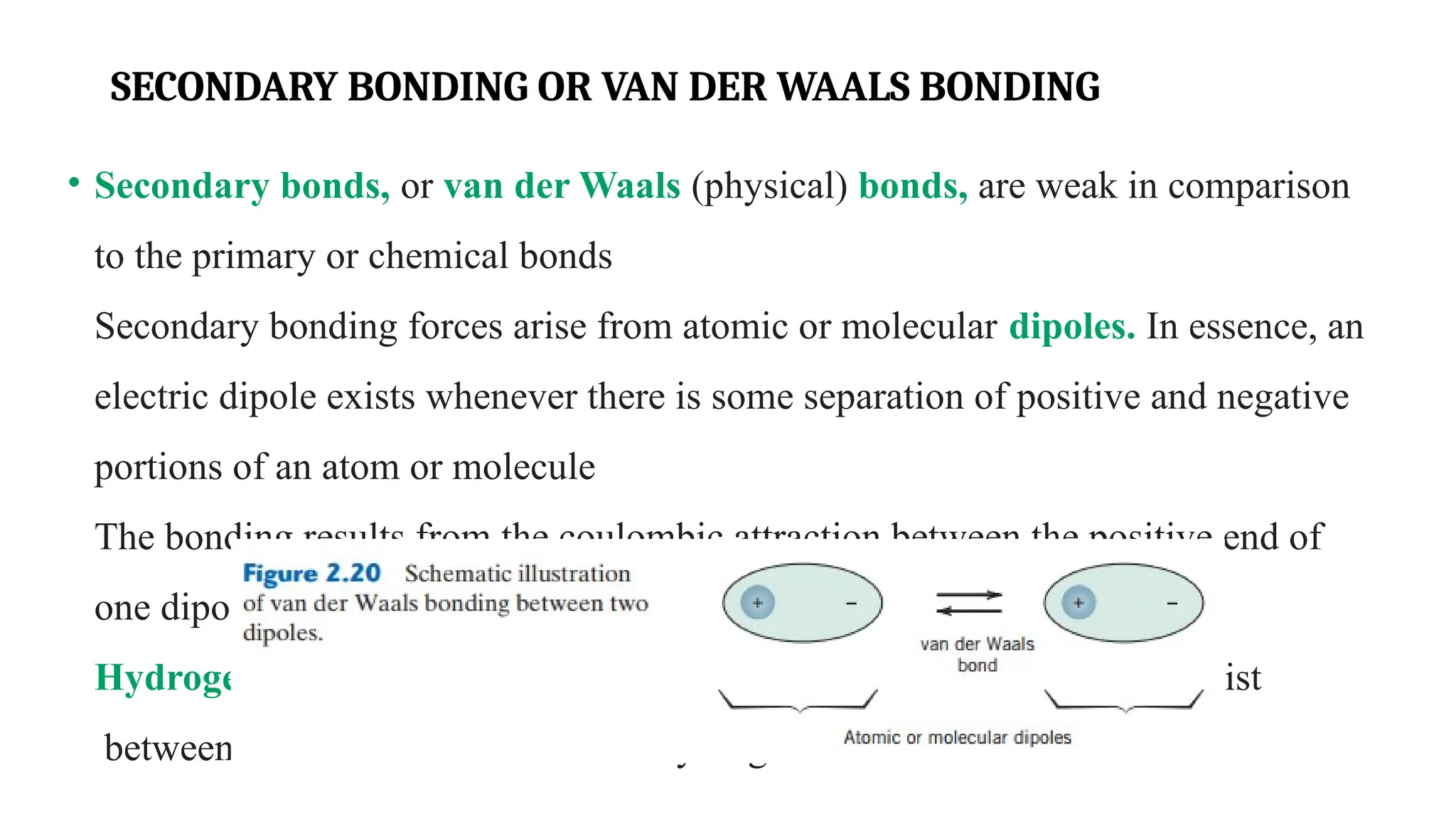
Secondary bonding forces arise from atomic or molecular dipoles. In essence, an
electric dipole exists whenever there is some separation of positive and negative
portions of an atom or molecule
The bonding results from the coulombic attraction between the positive end of
one dipole and the negative region of an adjacent one
Hydrogen bonding, a special type of secondary bonding, is found to exist
between some molecules that have hydrogen as one of the constituents.

![Cont’d
• Most of the nonmetals are either gases or liquids, or in the solid state are brittle
in nature.
• Furthermore, for the Group IVA elements [C (diamond), Si, Ge, Sn, and Pb],
electrical conductivity increases as we move down this column.
• The Group VB metals (V, Nb, and Ta) have very high melting temperatures,
which increase in going down this column.](https://image.slidesharecdn.com/2-250421070908-24713afc/75/Atomic-structure-and-bonding-Engineering-materials-I-pptx-20-2048.jpg)