PRESENTED BY
 INTRODUCTION
 HISTORY
 PLASMA FOURTH STATE OF MATTER
 COMPARISION OF PLASMA AND GAS PHASE
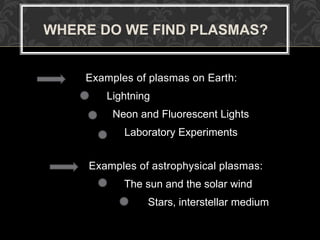
 WHERE WE FIND PLASMA
 WHY WE NEED PLASMA
 APPLICATIONS
 FUSION ENERGY
 FUTURE OF PLASMA PHYSICS
OUTLINE
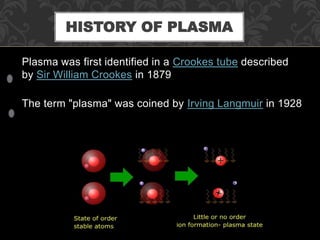
Plasma was first identified in a Crookes tube described
by Sir William Crookes in 1879
The term "plasma" was coined by Irving Langmuir in 1928
HISTORY OF PLASMA
Plasma means moldable Substance
Its is the fourth state of matter
The material has become so hot that electrons are no
longer bound to individual nuclei. Thus a plasma is
electrically conducting, and can exhibit collective
dynamics.
More than 99% mass of universe is in Plasma state
INTRODUCTION
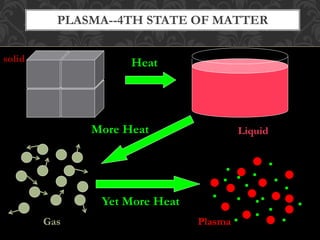
PLASMA--4TH STATE OF MATTER
Heat
More Heat
solid
Gas
Liquid
Yet More Heat
Plasma
COMPARISON OF PLASMA AND GAS PHASES
PROPERTIES GAS PLASMA
Electrical
conductivi-
ty
Very low: Air is an excellent insulator until
it breaks down into plasma at electric field
strengths above 30 kilovolts per centimeter
Usually very high: For many
purposes, the conductivity of a
plasma may be treated as
infinite
Independen-
tly acting
species
One: All gas particles behave in a similar
way, influenced by gravity and
by collisions with one another.
Two or
three: Electrons, ions, protons a
nd neutrons can be
distinguished by the sign and
value of theircharge
Velocity
distribution
Maxwellian: Collisions usually lead to
a Maxwellian velocity distribution of all
gas particles
Non-Maxwellian: Collisional
interactions are often weak in hot
plasmas and external forcing can
drive the plasma far from local
equilibrium and lead to a significant
population of unusually fast particles.
Interactions Binary: Two-particle collisions are the
rule, three-body collisions extremely
rare.
Collective:the particles can
interact at long ranges
through the electric and
magnetic forces.
WHERE DO WE FIND PLASMAS?
Examples of plasmas on Earth:
Lightning
Neon and Fluorescent Lights
Laboratory Experiments
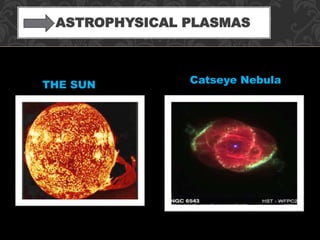
Examples of astrophysical plasmas:
The sun and the solar wind
Stars, interstellar medium
ON EARTH
Laboratory Experiments Lightning
ASTROPHYSICAL PLASMAS
THE SUN Catseye Nebula
Fusion Energy
Potential source of safe, abundant energy.
Astrophysics
Understanding plasmas helps us understand stars
and stellar evolution.
Upper atmospheric dynamics
The upper atmosphere is a plasma.
WHY WE ARE INTERESTED IN PLASMA??
APPLICATIONS
Much of plasma physics research has been motivated by
the goal of controlled fusion energy.
Fusion energy is a form of nuclear energy which is
emitted when two light nuclei combine to form a single
more stable nuclei.
The sun and stars derive their energy from fusion.
PLASMA IN FUSION ENERGY
Plasma
self-heating
Tritium
replenishment
Li
Electricity
Hydrogen
3.5 MeV14 MeV
 It uses a powerful magnetic field to confine plasma in the shape of a torus.
 It is magnetic confinement device developed to contain the hot plasma needed for
producing controlled thermonuclear fusion power
TOKAMAK
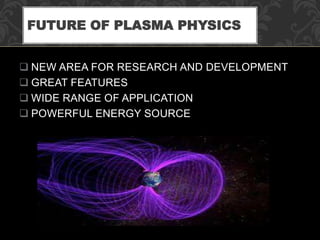
 NEW AREA FOR RESEARCH AND DEVELOPMENT
 GREAT FEATURES
 WIDE RANGE OF APPLICATION
 POWERFUL ENERGY SOURCE
FUTURE OF PLASMA PHYSICS
Plasma physics

Plasma physics

  • 1.
  • 2.
     INTRODUCTION  HISTORY PLASMA FOURTH STATE OF MATTER  COMPARISION OF PLASMA AND GAS PHASE  WHERE WE FIND PLASMA  WHY WE NEED PLASMA  APPLICATIONS  FUSION ENERGY  FUTURE OF PLASMA PHYSICS OUTLINE
  • 3.
    Plasma was firstidentified in a Crookes tube described by Sir William Crookes in 1879 The term "plasma" was coined by Irving Langmuir in 1928 HISTORY OF PLASMA
  • 4.
    Plasma means moldableSubstance Its is the fourth state of matter The material has become so hot that electrons are no longer bound to individual nuclei. Thus a plasma is electrically conducting, and can exhibit collective dynamics. More than 99% mass of universe is in Plasma state INTRODUCTION
  • 5.
    PLASMA--4TH STATE OFMATTER Heat More Heat solid Gas Liquid Yet More Heat Plasma
  • 6.
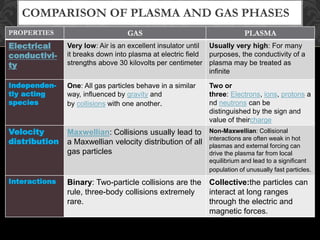
    COMPARISON OF PLASMAAND GAS PHASES PROPERTIES GAS PLASMA Electrical conductivi- ty Very low: Air is an excellent insulator until it breaks down into plasma at electric field strengths above 30 kilovolts per centimeter Usually very high: For many purposes, the conductivity of a plasma may be treated as infinite Independen- tly acting species One: All gas particles behave in a similar way, influenced by gravity and by collisions with one another. Two or three: Electrons, ions, protons a nd neutrons can be distinguished by the sign and value of theircharge Velocity distribution Maxwellian: Collisions usually lead to a Maxwellian velocity distribution of all gas particles Non-Maxwellian: Collisional interactions are often weak in hot plasmas and external forcing can drive the plasma far from local equilibrium and lead to a significant population of unusually fast particles. Interactions Binary: Two-particle collisions are the rule, three-body collisions extremely rare. Collective:the particles can interact at long ranges through the electric and magnetic forces.
  • 7.
    WHERE DO WEFIND PLASMAS? Examples of plasmas on Earth: Lightning Neon and Fluorescent Lights Laboratory Experiments Examples of astrophysical plasmas: The sun and the solar wind Stars, interstellar medium
  • 8.
  • 9.
  • 10.
    Fusion Energy Potential sourceof safe, abundant energy. Astrophysics Understanding plasmas helps us understand stars and stellar evolution. Upper atmospheric dynamics The upper atmosphere is a plasma. WHY WE ARE INTERESTED IN PLASMA??
  • 11.
  • 12.
    Much of plasmaphysics research has been motivated by the goal of controlled fusion energy. Fusion energy is a form of nuclear energy which is emitted when two light nuclei combine to form a single more stable nuclei. The sun and stars derive their energy from fusion. PLASMA IN FUSION ENERGY
  • 13.
  • 14.
     It usesa powerful magnetic field to confine plasma in the shape of a torus.  It is magnetic confinement device developed to contain the hot plasma needed for producing controlled thermonuclear fusion power TOKAMAK
  • 15.
     NEW AREAFOR RESEARCH AND DEVELOPMENT  GREAT FEATURES  WIDE RANGE OF APPLICATION  POWERFUL ENERGY SOURCE FUTURE OF PLASMA PHYSICS