
TUNNELLING IN QUANTUM MECHANICAL SYSTEM
Department of Chemistry
School of Chemical Sciences and Pharmacy
CENTRAL UNIVERSITY OF RAJASTHAN
Bandar Sindri, Ajmer- 305801
Submitted to:
Dr. Jony Saha
Assistant Professor
Central University of Rajasthan
Presentation by:
Soham Thakur
Integrated M.Sc. B.Ed. Chemistry
2018IMSBCH014
INTRODUCTION
Quantum Tunnelling
 Quantum mechanical phenomenon
 Observed in microscopic particles such as electron
 A subatomic particle’s probability disappears from one
side of a potential barrier and appears on the other
side without any probability current appearing inside
the well.
 Occurs in all quantum systems.
 Crucial for nucleosynthesis in stars.
Fig: Representation of Tunnelling in a generalised way
Merzbacher, E., Physics Today, 2002, 55(8), 44–49.
HISTORY
Friedrich Hund George Gamow
1927 1928
First to use quantum mechanical
barrier penetration in discussing the
theory of molecular spectra
Fig 1: Double Potential well by Hund
showing that Levels 2 and 3 are
characteristically quantal and occupy
both wells, with tunnelling through
the barrier
First application of the effect by mathematical
calculation of the alpha decay
Fig 2: 1D potential used
by George Gamow to
illustrate the tunnelling
of alpha particles
F. Hund, Z. Phys., 1927 40, 742 G. Gamow, Z. Phys., 1928, 51, 204.
Max Born
1929
Contd.
Tunnelling, not
restricted
to nuclear physics
but, a general
result of quantum
mechanics that
applies to many
different systems.
Recognizes the
generality of
tunnelling.
Nobel Prize for
Tunnelling
1973
Leo Esaki
Ivar GiaeverBrian Josephson
www.nobleprize.org
Mathematical Discussion
0
32
V
1
Lx
E (Particle energy)
Fig: Representation of a 1D potential barrier
which will be penetrated by the particle
(Barrier Potential)
Schrödinger equation yields two different
differential equations depending on the
region:
Region 1 & 3:
Region 2:
The general solutions can be written as:
:Region 1
:Region 2
:Region 3
Griffiths, David J. Introduction to Quantum Mechanics. Second Edition. Pearson: Upper Saddle River, NJ, 2006
Contd.
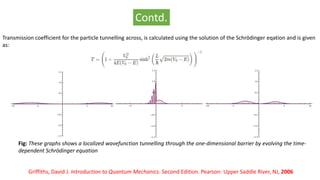
Transmission coefficient for the particle tunnelling across, is calculated using the solution of the Schrödinger eqation and is given
as:
Fig: These graphs shows a localized wavefunction tunnelling through the one-dimensional barrier by evolving the time-
dependent Schrödinger equation
Griffiths, David J. Introduction to Quantum Mechanics. Second Edition. Pearson: Upper Saddle River, NJ, 2006
APPLICATIONS
Scanning Tunnelling Microscope
• Extremely sharp tip of only a single-atom-thick
runs over the surface of the material, with the
tip at a higher voltage than the material.
• Voltage allows tunnelling current to flow from
electrons that tunnel from the surface of the
material, through the potential barrier
represented by the air, to the tip of the
microscope, completing a circuit.
• Basis of detection is amount of current.
Griffiths, David J. Introduction to Quantum Mechanics. Second Edition. Pearson: Upper Saddle River, NJ, 2006
Tunnel Diode
Contd.
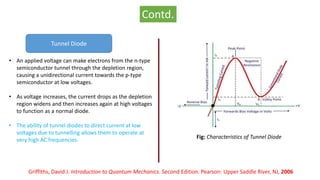
• An applied voltage can make electrons from the n-type
semiconductor tunnel through the depletion region,
causing a unidirectional current towards the p-type
semiconductor at low voltages.
• As voltage increases, the current drops as the depletion
region widens and then increases again at high voltages
to function as a normal diode.
• The ability of tunnel diodes to direct current at low
voltages due to tunnelling allows them to operate at
very high AC frequencies.
Fig: Characteristics of Tunnel Diode
Griffiths, David J. Introduction to Quantum Mechanics. Second Edition. Pearson: Upper Saddle River, NJ, 2006
Josephson effect
• In superconductors, at certain temperature ranges
a current can flow indefinitely without resistive
heating occurring.
• In Josephson junctions, two superconducting
semiconductors are separated by a thin insulating
barrier.
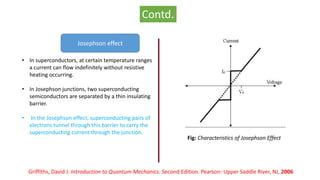
• In the Josephson effect, superconducting pairs of
electrons tunnel through this barrier to carry the
superconducting current through the junction.
Contd.
Fig: Characteristics of Josephson Effect
Griffiths, David J. Introduction to Quantum Mechanics. Second Edition. Pearson: Upper Saddle River, NJ, 2006
ADVANCEMENT
Substrate imprinted universal sensors and sensors
having nano-tunnelling effect Quantum Tunnelling of water
Tunneling effect in the heterogeneously-
catalyzed formic acid dehydrogenation
Self-aligned tunnelling field effect transistors
Tunnel field-effect transistor with reduced trap-
assisted tunnelling leakage
Kolesnikov, Alexander I.; et. al, Physical Review Letters.. 2016, 116 (16): 167802
Zhou, Y., US Patent, US10495637B2, 2020 Vasen, T., et. al., US20200006542A1, 2020
Song Y., et. al., US20200119168A1, 2019 Mori, K., et. al., Nature Comm., 2019, 10(4094)
CONCLUSION
The phenomenon of tunnelling, which has no counterpart in classical physics, is an important
consequence of quantum mechanics.
It has enormous number of applications in the phenomenonal science as well as in instruments
like Diode, Transistor, etc.
Efforts need to improvise quantum computing, and innovation of a quantum computer of
which tunnelling effect will be a huge landmark.
Thank You

Quantum Tunnelling

  • 1.
    TUNNELLING IN QUANTUMMECHANICAL SYSTEM Department of Chemistry School of Chemical Sciences and Pharmacy CENTRAL UNIVERSITY OF RAJASTHAN Bandar Sindri, Ajmer- 305801 Submitted to: Dr. Jony Saha Assistant Professor Central University of Rajasthan Presentation by: Soham Thakur Integrated M.Sc. B.Ed. Chemistry 2018IMSBCH014
  • 2.
    INTRODUCTION Quantum Tunnelling  Quantummechanical phenomenon  Observed in microscopic particles such as electron  A subatomic particle’s probability disappears from one side of a potential barrier and appears on the other side without any probability current appearing inside the well.  Occurs in all quantum systems.  Crucial for nucleosynthesis in stars. Fig: Representation of Tunnelling in a generalised way Merzbacher, E., Physics Today, 2002, 55(8), 44–49.
  • 3.
    HISTORY Friedrich Hund GeorgeGamow 1927 1928 First to use quantum mechanical barrier penetration in discussing the theory of molecular spectra Fig 1: Double Potential well by Hund showing that Levels 2 and 3 are characteristically quantal and occupy both wells, with tunnelling through the barrier First application of the effect by mathematical calculation of the alpha decay Fig 2: 1D potential used by George Gamow to illustrate the tunnelling of alpha particles F. Hund, Z. Phys., 1927 40, 742 G. Gamow, Z. Phys., 1928, 51, 204.
  • 4.
    Max Born 1929 Contd. Tunnelling, not restricted tonuclear physics but, a general result of quantum mechanics that applies to many different systems. Recognizes the generality of tunnelling. Nobel Prize for Tunnelling 1973 Leo Esaki Ivar GiaeverBrian Josephson www.nobleprize.org
  • 5.
    Mathematical Discussion 0 32 V 1 Lx E (Particleenergy) Fig: Representation of a 1D potential barrier which will be penetrated by the particle (Barrier Potential) Schrödinger equation yields two different differential equations depending on the region: Region 1 & 3: Region 2: The general solutions can be written as: :Region 1 :Region 2 :Region 3 Griffiths, David J. Introduction to Quantum Mechanics. Second Edition. Pearson: Upper Saddle River, NJ, 2006
  • 6.
    Contd. Transmission coefficient forthe particle tunnelling across, is calculated using the solution of the Schrödinger eqation and is given as: Fig: These graphs shows a localized wavefunction tunnelling through the one-dimensional barrier by evolving the time- dependent Schrödinger equation Griffiths, David J. Introduction to Quantum Mechanics. Second Edition. Pearson: Upper Saddle River, NJ, 2006
  • 7.
    APPLICATIONS Scanning Tunnelling Microscope •Extremely sharp tip of only a single-atom-thick runs over the surface of the material, with the tip at a higher voltage than the material. • Voltage allows tunnelling current to flow from electrons that tunnel from the surface of the material, through the potential barrier represented by the air, to the tip of the microscope, completing a circuit. • Basis of detection is amount of current. Griffiths, David J. Introduction to Quantum Mechanics. Second Edition. Pearson: Upper Saddle River, NJ, 2006
  • 8.
    Tunnel Diode Contd. • Anapplied voltage can make electrons from the n-type semiconductor tunnel through the depletion region, causing a unidirectional current towards the p-type semiconductor at low voltages. • As voltage increases, the current drops as the depletion region widens and then increases again at high voltages to function as a normal diode. • The ability of tunnel diodes to direct current at low voltages due to tunnelling allows them to operate at very high AC frequencies. Fig: Characteristics of Tunnel Diode Griffiths, David J. Introduction to Quantum Mechanics. Second Edition. Pearson: Upper Saddle River, NJ, 2006
  • 9.
    Josephson effect • Insuperconductors, at certain temperature ranges a current can flow indefinitely without resistive heating occurring. • In Josephson junctions, two superconducting semiconductors are separated by a thin insulating barrier. • In the Josephson effect, superconducting pairs of electrons tunnel through this barrier to carry the superconducting current through the junction. Contd. Fig: Characteristics of Josephson Effect Griffiths, David J. Introduction to Quantum Mechanics. Second Edition. Pearson: Upper Saddle River, NJ, 2006
  • 10.
    ADVANCEMENT Substrate imprinted universalsensors and sensors having nano-tunnelling effect Quantum Tunnelling of water Tunneling effect in the heterogeneously- catalyzed formic acid dehydrogenation Self-aligned tunnelling field effect transistors Tunnel field-effect transistor with reduced trap- assisted tunnelling leakage Kolesnikov, Alexander I.; et. al, Physical Review Letters.. 2016, 116 (16): 167802 Zhou, Y., US Patent, US10495637B2, 2020 Vasen, T., et. al., US20200006542A1, 2020 Song Y., et. al., US20200119168A1, 2019 Mori, K., et. al., Nature Comm., 2019, 10(4094)
  • 11.
    CONCLUSION The phenomenon oftunnelling, which has no counterpart in classical physics, is an important consequence of quantum mechanics. It has enormous number of applications in the phenomenonal science as well as in instruments like Diode, Transistor, etc. Efforts need to improvise quantum computing, and innovation of a quantum computer of which tunnelling effect will be a huge landmark.
  • 12.