DR. N. C.
    DAS
A hazard is anything with the potential to cause harm


A Risk Assessment needs to recognise the likeliness and
   severity of the hazard to do harm ( which leads to the
   precautions to take to minimise the risk )


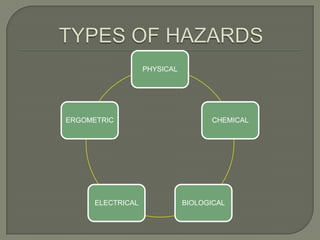
Hazards are: Chemical, Biological, Physical & Ergonomic
   , Electrical
Hazard engineering is concerned with
the identification and treatment of
exceptional circumstances where the
hazards need to be controlled using
specialist skills
A control program consists of all
steps necessary to protect
workers from exposure to a
substance or system, and the
procedures required to monitor
worker exposure and their
health to hazards such as
chemicals, materials or
substance, or other types such
as noise and vibration.
PHYSICAL


ERGOMETRIC                          CHEMICAL


      ELECTRICAL              BIOLOGICAL
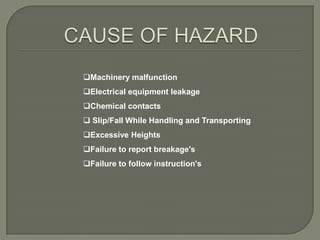
Machinery malfunction
Electrical equipment leakage
Chemical contacts
 Slip/Fall While Handling and Transporting
Excessive Heights
Failure to report breakage's
Failure to follow instruction's
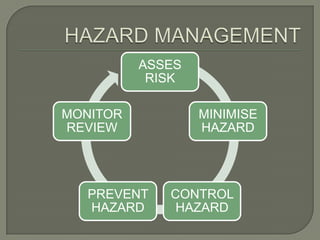
ASSES
           RISK

MONITOR           MINIMISE
REVIEW            HAZARD


  PREVENT    CONTROL
  HAZARD      HAZARD
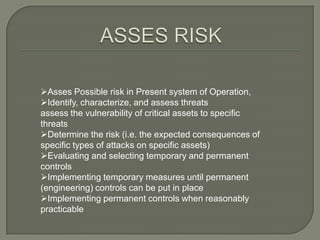
Asses Possible risk in Present system of Operation,
Identify, characterize, and assess threats
assess the vulnerability of critical assets to specific
threats
Determine the risk (i.e. the expected consequences of
specific types of attacks on specific assets)
Evaluating and selecting temporary and permanent
controls
Implementing temporary measures until permanent
(engineering) controls can be put in place
Implementing permanent controls when reasonably
practicable
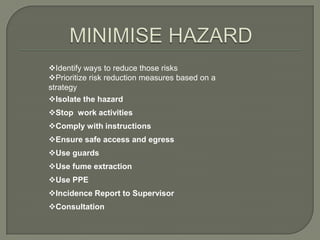
Identify ways to reduce those risks
Prioritize risk reduction measures based on a
strategy
Isolate the hazard
Stop work activities
Comply with instructions
Ensure safe access and egress
Use guards
Use fume extraction
Use PPE
Incidence Report to Supervisor
Consultation
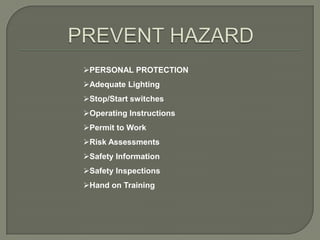
PERSONAL PROTECTION
Adequate Lighting
Stop/Start switches
Operating Instructions
Permit to Work
Risk Assessments
Safety Information
Safety Inspections
Hand on Training
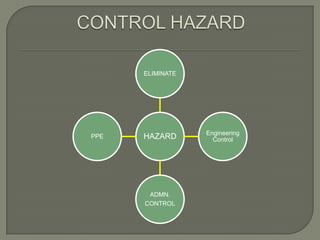
ELIMINATE


                  Engineering
PPE   HAZARD        Control


       ADMN.
      CONTROL
Elimination (including substitution): remove the hazard from the
workplace.
Engineering Controls: includes designs or modifications to
plants, equipment, ventilation systems, and processes that reduce the
source of exposure.
Administrative Controls: controls that alter the way the work is
done, including timing of work, policies and other rules, and work
practices such as standards and operating procedures (including
training, housekeeping, and equipment maintenance, and personal
hygiene practices).
Personal Protective Equipment: equipment worn by individuals to
reduce exposure such as contact with chemicals or exposure to noise.
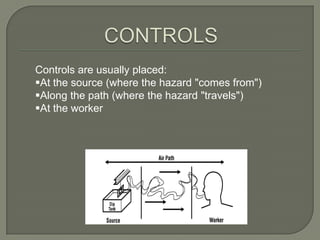
Controls are usually placed:
At the source (where the hazard "comes from")
Along the path (where the hazard "travels")
At the worker
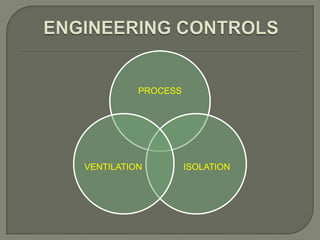
PROCESS


VENTILATION         ISOLATION
Engineering controls are methods
that are built into the design of a
plant, equipment or process to
minimize the hazard.
Engineering controls are a very
reliable way to control worker
exposures as long as the controls are
designed, used and maintained
properly.
The basic types of engineering
controls are:
Process control,
Enclosure and/or isolation of
emission source, and
Ventilation.
Process control involves changing the way a job activity or process
is done to reduce the risk.
Monitoring should be done before and as well as after the change
is implemented to make sure the changes did result in lower
exposures.
EXAMPLES
Use wet methods rather than dry when drilling or grinding. "Wet
method" means that water is sprayed over a dusty surface to keep
dust levels down or material is mixed with water to prevent dust from
being created.
Use an appropriate vacuum or "wet method" instead of dry sweeping
(e.g. with a broom) to control dust and reduce the inhalation hazard.
Decrease the temperature of a process so that less vapour is
released.
Use automation - the less workers have to handle or use the
materials, the less potential there is for exposure.
Use mechanical transportation rather than manual methods.
Isolation aim to keep the chemical "in" and
the worker "out" (or vice versa).
An enclosure keeps a selected hazard
"physically" away from the worker.
Enclosed equipment, is tightly sealed and
only opened for cleaning or maintenance.
Isolation keeps the hazardous process
away from the majority of the workers.
Common isolation techniques are to create
a contaminant-free booth around the
equipment
oVentilation is a method of control that
helps in exchange of fresh air in place of
contaminated air in the work environment.
oVentilation can dilute an air contaminant
below effective level if designed properly.
oLocal exhaust ventilation is very good
and can be adapted to almost all chemicals
and operations.
oIt removes the contaminant from the work
environment so it cannot disperse into the
work place
Administrative controls limit workers' exposures by scheduling
shorter work times in contaminant areas
Scheduling maintenance and other high exposure operations for
times when few workers are present (such as
evenings, weekends).
Using job-rotation schedules that limit the amount of time an
individual worker is exposed to a substance.
Strengthening of National policies for health at work and
development of policy tools
Developing healthy working environment
Developing healthy work practices and promoting health at work
Periodic Medical examination
Immunisation
Work practices are also a form of administrative controls.
Safe work practices are very important. Some elements of safe
work practices include:
        Developing and implementing standard operating
procedures.
        Training and education of employees about the operating
procedures as well as other necessary workplace training
        Establishing and maintaining good house keeping
program
        Keeping equipment well maintained.
        Preparing and training for emergency response for
incidents such as spills, fire or employee injury.
Ergonomics:      ``Adjustment of Man & Machine``
Application of human biological sciences with engineering
     science to achieve optimum mutual adjustment of man &
     his work,
     The benefit being measured in terms of human efficiency
     and well being
Employee education and on machine
training on how to conduct their work safely
helps to minimize the risk of exposure and is a
critical element of any complete workplace
health and safety program.
Training must cover not only how to do the
job safely but it must also ensure that workers
understand the hazards of their job.
It must also provide them with information
on how to protect themselves and co-workers.
Good housekeeping helps to prevent the
accumulation of hazardous or toxic materials
Regular sweeping, Wet mopping of the area.
Once a week the work place to be washed
properly.
Use of Personal protective Equipments as per the need
of the area/work environment.
The contaminant(s) can accumulate on the skin, clothing or hair.
Therefore personal hygiene is essential.
Washing hands after handling material and before eating,
 drinking or smoking;
Avoiding touching lips, nose and eyes with contaminated hands.
No smoking, drinking, chewing gum or eating in the work areas –
 these activities should be permitted only in a "clean" area; and
Not storing hazardous materials in the same refrigerator
as food items.
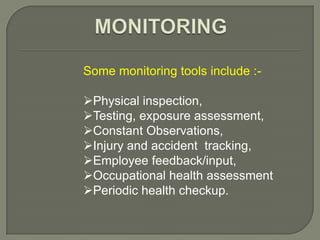
Some monitoring tools include :-

Physical inspection,
Testing, exposure assessment,
Constant Observations,
Injury and accident tracking,
Employee feedback/input,
Occupational health assessment
Periodic health checkup.
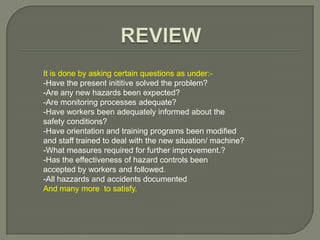
It is done by asking certain questions as under:-
-Have the present inititive solved the problem?
-Are any new hazards been expected?
-Are monitoring processes adequate?
-Have workers been adequately informed about the
safety conditions?
-Have orientation and training programs been modified
and staff trained to deal with the new situation/ machine?
-What measures required for further improvement.?
-Has the effectiveness of hazard controls been
accepted by workers and followed.
-All hazzards and accidents documented
And many more to satisfy.
hospiad
                       Hospital Administration Made Easy


                http//hospiad.blogspot.com
     An effort solely to help students and aspirants
        in their attempt to become a successful
                Hospital Administrator.
                                                DR. N. C. DAS

Engineering hazards

  • 1.
  • 2.
    A hazard isanything with the potential to cause harm A Risk Assessment needs to recognise the likeliness and severity of the hazard to do harm ( which leads to the precautions to take to minimise the risk ) Hazards are: Chemical, Biological, Physical & Ergonomic , Electrical
  • 3.
    Hazard engineering isconcerned with the identification and treatment of exceptional circumstances where the hazards need to be controlled using specialist skills
  • 4.
    A control programconsists of all steps necessary to protect workers from exposure to a substance or system, and the procedures required to monitor worker exposure and their health to hazards such as chemicals, materials or substance, or other types such as noise and vibration.
  • 5.
    PHYSICAL ERGOMETRIC CHEMICAL ELECTRICAL BIOLOGICAL
  • 6.
    Machinery malfunction Electrical equipmentleakage Chemical contacts  Slip/Fall While Handling and Transporting Excessive Heights Failure to report breakage's Failure to follow instruction's
  • 7.
    ASSES RISK MONITOR MINIMISE REVIEW HAZARD PREVENT CONTROL HAZARD HAZARD
  • 8.
    Asses Possible riskin Present system of Operation, Identify, characterize, and assess threats assess the vulnerability of critical assets to specific threats Determine the risk (i.e. the expected consequences of specific types of attacks on specific assets) Evaluating and selecting temporary and permanent controls Implementing temporary measures until permanent (engineering) controls can be put in place Implementing permanent controls when reasonably practicable
  • 9.
    Identify ways toreduce those risks Prioritize risk reduction measures based on a strategy Isolate the hazard Stop work activities Comply with instructions Ensure safe access and egress Use guards Use fume extraction Use PPE Incidence Report to Supervisor Consultation
  • 10.
    PERSONAL PROTECTION Adequate Lighting Stop/Startswitches Operating Instructions Permit to Work Risk Assessments Safety Information Safety Inspections Hand on Training
  • 11.
    ELIMINATE Engineering PPE HAZARD Control ADMN. CONTROL
  • 12.
    Elimination (including substitution):remove the hazard from the workplace. Engineering Controls: includes designs or modifications to plants, equipment, ventilation systems, and processes that reduce the source of exposure. Administrative Controls: controls that alter the way the work is done, including timing of work, policies and other rules, and work practices such as standards and operating procedures (including training, housekeeping, and equipment maintenance, and personal hygiene practices). Personal Protective Equipment: equipment worn by individuals to reduce exposure such as contact with chemicals or exposure to noise.
  • 13.
    Controls are usuallyplaced: At the source (where the hazard "comes from") Along the path (where the hazard "travels") At the worker
  • 14.
  • 15.
    Engineering controls aremethods that are built into the design of a plant, equipment or process to minimize the hazard. Engineering controls are a very reliable way to control worker exposures as long as the controls are designed, used and maintained properly. The basic types of engineering controls are: Process control, Enclosure and/or isolation of emission source, and Ventilation.
  • 16.
    Process control involveschanging the way a job activity or process is done to reduce the risk. Monitoring should be done before and as well as after the change is implemented to make sure the changes did result in lower exposures. EXAMPLES Use wet methods rather than dry when drilling or grinding. "Wet method" means that water is sprayed over a dusty surface to keep dust levels down or material is mixed with water to prevent dust from being created. Use an appropriate vacuum or "wet method" instead of dry sweeping (e.g. with a broom) to control dust and reduce the inhalation hazard. Decrease the temperature of a process so that less vapour is released. Use automation - the less workers have to handle or use the materials, the less potential there is for exposure. Use mechanical transportation rather than manual methods.
  • 17.
    Isolation aim tokeep the chemical "in" and the worker "out" (or vice versa). An enclosure keeps a selected hazard "physically" away from the worker. Enclosed equipment, is tightly sealed and only opened for cleaning or maintenance. Isolation keeps the hazardous process away from the majority of the workers. Common isolation techniques are to create a contaminant-free booth around the equipment
  • 18.
    oVentilation is amethod of control that helps in exchange of fresh air in place of contaminated air in the work environment. oVentilation can dilute an air contaminant below effective level if designed properly. oLocal exhaust ventilation is very good and can be adapted to almost all chemicals and operations. oIt removes the contaminant from the work environment so it cannot disperse into the work place
  • 19.
    Administrative controls limitworkers' exposures by scheduling shorter work times in contaminant areas Scheduling maintenance and other high exposure operations for times when few workers are present (such as evenings, weekends). Using job-rotation schedules that limit the amount of time an individual worker is exposed to a substance. Strengthening of National policies for health at work and development of policy tools Developing healthy working environment Developing healthy work practices and promoting health at work Periodic Medical examination Immunisation
  • 20.
    Work practices arealso a form of administrative controls. Safe work practices are very important. Some elements of safe work practices include:  Developing and implementing standard operating procedures.  Training and education of employees about the operating procedures as well as other necessary workplace training  Establishing and maintaining good house keeping program  Keeping equipment well maintained.  Preparing and training for emergency response for incidents such as spills, fire or employee injury. Ergonomics: ``Adjustment of Man & Machine`` Application of human biological sciences with engineering science to achieve optimum mutual adjustment of man & his work, The benefit being measured in terms of human efficiency and well being
  • 21.
    Employee education andon machine training on how to conduct their work safely helps to minimize the risk of exposure and is a critical element of any complete workplace health and safety program. Training must cover not only how to do the job safely but it must also ensure that workers understand the hazards of their job. It must also provide them with information on how to protect themselves and co-workers.
  • 22.
    Good housekeeping helpsto prevent the accumulation of hazardous or toxic materials Regular sweeping, Wet mopping of the area. Once a week the work place to be washed properly.
  • 23.
    Use of Personalprotective Equipments as per the need of the area/work environment. The contaminant(s) can accumulate on the skin, clothing or hair. Therefore personal hygiene is essential. Washing hands after handling material and before eating, drinking or smoking; Avoiding touching lips, nose and eyes with contaminated hands. No smoking, drinking, chewing gum or eating in the work areas – these activities should be permitted only in a "clean" area; and Not storing hazardous materials in the same refrigerator as food items.
  • 24.
    Some monitoring toolsinclude :- Physical inspection, Testing, exposure assessment, Constant Observations, Injury and accident tracking, Employee feedback/input, Occupational health assessment Periodic health checkup.
  • 25.
    It is doneby asking certain questions as under:- -Have the present inititive solved the problem? -Are any new hazards been expected? -Are monitoring processes adequate? -Have workers been adequately informed about the safety conditions? -Have orientation and training programs been modified and staff trained to deal with the new situation/ machine? -What measures required for further improvement.? -Has the effectiveness of hazard controls been accepted by workers and followed. -All hazzards and accidents documented And many more to satisfy.
  • 26.
    hospiad Hospital Administration Made Easy http//hospiad.blogspot.com An effort solely to help students and aspirants in their attempt to become a successful Hospital Administrator. DR. N. C. DAS