ACCIDENT INVESTIGATION
& REPORTING
L&T Construction
Power Transmission Distribution
700 MW AR RASS
PV IPP PROJECT
Kingdom of Saudi Arabia
Objectives
 Different Terms
- Explain the meaning Incidents
 What is Pyramid Saying
 Explain the impact of accidents
 Identify different types of accident causes
 Know the purpose of Incident investigation
 Explain how to conduct an incident investigation
 Know how to document incident investigations.
Purpose
• This training aims to ensure the full, free, and uninhibited reporting of any work-related incident that
may affect the health, safety, and wellbeing of individuals in the employment of L&T and
subcontractors and/or any third parties or may adversely impact the environment.
• All incidents shall be investigated, not with a view to apportioning blame, but rather to establishing
root cause(s) and identifying appropriate preventive actions to eliminate or reduce the likelihood of
the incident recurrence.
Important Terms
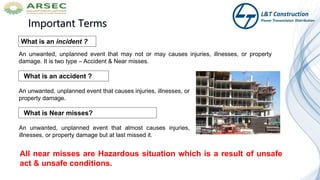
What is an accident ?
An unwanted, unplanned event that causes injuries, illnesses, or
property damage.
What is an incident ?
An unwanted, unplanned event that almost causes injuries,
illnesses, or property damage but at last missed it.
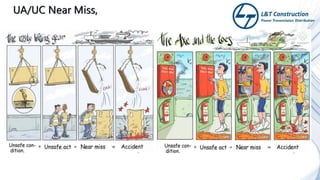
An unwanted, unplanned event that may not or may causes injuries, illnesses, or property
damage. It is two type – Accident & Near misses.
What is Near misses?
All near misses are Hazardous situation which is a result of unsafe
act & unsafe conditions.
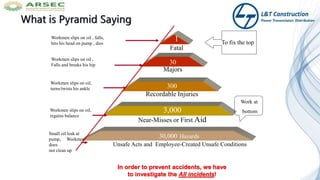
3,000
Near-Misses or First Aid
300
Recordable Injuries
30
Majors
1
Fatal
Small oil leak at
pump, .Workmen
does
not clean up
Workmen slips on oil,
regains balance
Workmen slips on oil,
turns/twists his ankle
Workmen slips on oil ,
Falls and breaks his hip
Workmen slips on oil , falls,
hits his head on pump , dies
30,000 Hazards
Unsafe Acts and Employee-Created Unsafe Conditions
To fix the top
Work at
bottom
In order to prevent accidents, we have
to investigate the All incidents!
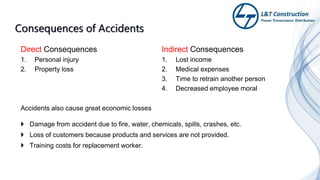
Direct Consequences
1. Personal injury
2. Property loss
Indirect Consequences
1. Lost income
2. Medical expenses
3. Time to retrain another person
4. Decreased employee moral
Accidents also cause great economic losses
 Damage from accident due to fire, water, chemicals, spills, crashes, etc.
 Loss of customers because products and services are not provided.
 Training costs for replacement worker.
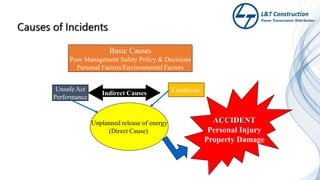
Basic Causes
Poor Management Safety Policy & Decisions
Personal Factors/Environmental Factors
Unsafe Act
Performance
Conditions
Unplanned release of energy
(Direct Cause)
Indirect Causes
ACCIDENT
Personal Injury
Property Damage
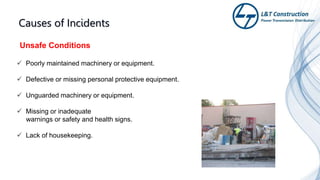
Causes of Incidents
Unsafe Conditions
 Poorly maintained machinery or equipment.
 Defective or missing personal protective equipment.
 Unguarded machinery or equipment.
 Missing or inadequate
warnings or safety and health signs.
 Lack of housekeeping.
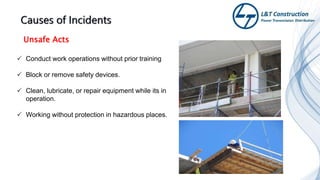
Unsafe Acts
 Conduct work operations without prior training
 Block or remove safety devices.
 Clean, lubricate, or repair equipment while its in
operation.
 Working without protection in hazardous places.
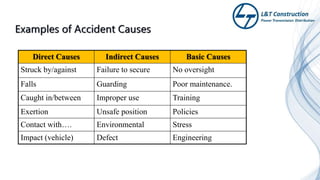
Direct Causes Indirect Causes Basic Causes
Struck by/against Failure to secure No oversight
Falls Guarding Poor maintenance.
Caught in/between Improper use Training
Exertion Unsafe position Policies
Contact with…. Environmental Stress
Impact (vehicle) Defect Engineering
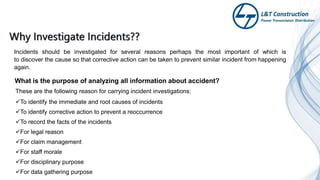
Incidents should be investigated for several reasons perhaps the most important of which is
to discover the cause so that corrective action can be taken to prevent similar incident from happening
again.
These are the following reason for carrying incident investigations:
To identify the immediate and root causes of incidents
To identify corrective action to prevent a reoccurrence
To record the facts of the incidents
For legal reason
For claim management
For staff morale
For disciplinary purpose
For data gathering purpose
What is the purpose of analyzing all information about accident?
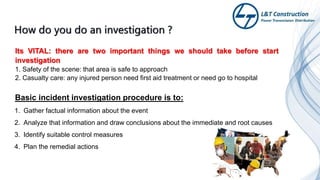
Its VITAL: there are two important things we should take before start
investigation
1. Safety of the scene: that area is safe to approach
2. Casualty care: any injured person need first aid treatment or need go to hospital
1. Gather factual information about the event
2. Analyze that information and draw conclusions about the immediate and root causes
3. Identify suitable control measures
4. Plan the remedial actions
Basic incident investigation procedure is to:
Step 1: gathering information:
Secure the scene as soon as possible to prevent it being altered.
Where necessary, barrier off the area and stop anyone from
entering. Look for clues / evidence, take photo’s.
Collect statements from the injured person(s) immediately, their
information is crucial. Witnesses straight after injured person,
before if injured person(s) unconscious. Then collect witness
details quickly before they start to move away. Why immediately ??
Collect factual information from the scene and record it (pics,
sketches, temperature videos)
 Because they get whisked off to hospital
 AND You may not see them for weeks
 AND You may never see them again & ever
 AND May never get information that’s needed
 AND People change their stories
Why immediately
Step 2: Analyse Information:
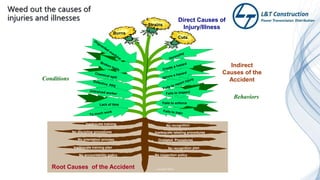
The purpose to draw conclusions about immediate (direct & indirect) and root (basic) causes
 Make documented observations on:
 Pre-accident conditions
 Accident sequence
 Post-accident conditions
 Document the facts (i.e.: location, witness remarks, and contributing factors).
 Review all information (procedures, equipment manuals).
 Determine sequence of events leading to accident
Interview separately, any witnesses
that SAW what actually happened, get
a signed and dated statement.
Document all information
(procedures, equipment manuals).
Inadequate training plan
No accountability policy No inspection policy
No discipline procedures
Outdated Procedures
No orientation process
Inadequate training
Fails to enforce
Lack of time
Inadequate labeling procedures
Cuts
Burns
Strains
Conditions
Behaviors
Indirect
Causes of the
Accident
Root Causes of the Accident
Direct Causes of
Injury/Illness
- Accident Weed
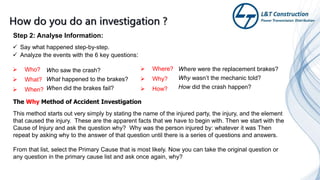
 Who?
 What?
 When?
Who saw the crash?
What happened to the brakes?
When did the brakes fail?
Step 2: Analyse Information:
The Why Method of Accident Investigation
Where were the replacement brakes?
Why wasn’t the mechanic told?
How did the crash happen?
 Say what happened step-by-step.
 Analyze the events with the 6 key questions:
 Where?
 Why?
 How?
This method starts out very simply by stating the name of the injured party, the injury, and the element
that caused the injury. These are the apparent facts that we have to begin with. Then we start with the
Cause of Injury and ask the question why? Why was the person injured by: whatever it was Then
repeat by asking why to the answer of that question until there is a series of questions and answers.
From that list, select the Primary Cause that is most likely. Now you can take the original question or
any question in the primary cause list and ask once again, why?
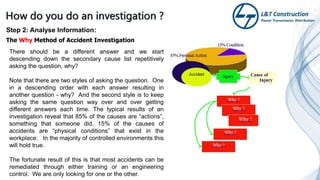
The Why Method of Accident Investigation
Step 2: Analyse Information:
There should be a different answer and we start
descending down the secondary cause list repetitively
asking the question, why?
Note that there are two styles of asking the question. One
in a descending order with each answer resulting in
another question - why? And the second style is to keep
asking the same question way over and over getting
different answers each time. The typical results of an
investigation reveal that 85% of the causes are “actions”,
something that someone did. 15% of the causes of
accidents are “physical conditions” that exist in the
workplace. In the majority of controlled environments this
will hold true.
The fortunate result of this is that most accidents can be
remediated through either training or an engineering
control. We are only looking for one or the other.
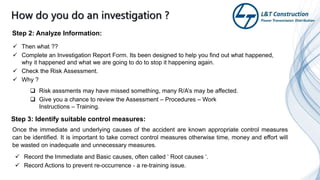
 Then what ??
 Complete an Investigation Report Form. Its been designed to help you find out what happened,
why it happened and what we are going to do to stop it happening again.
 Check the Risk Assessment.
 Why ?
 Risk asssments may have missed something, many R/A’s may be affected.
 Give you a chance to review the Assessment – Procedures – Work
Instructions – Training.
Step 3: Identify suitable control measures:
Step 2: Analyze Information:
Once the immediate and underlying causes of the accident are known appropriate control measures
can be identified. It is important to take correct control measures otherwise time, money and effort will
be wasted on inadequate and unnecessary measures.
 Record the Immediate and Basic causes, often called ‘ Root causes ‘.
 Record Actions to prevent re-occurrence - a re-training issue.
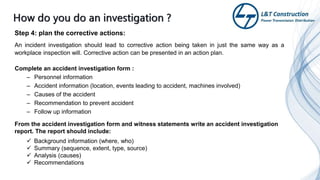
Step 4: plan the corrective actions:
An incident investigation should lead to corrective action being taken in just the same way as a
workplace inspection will. Corrective action can be presented in an action plan.
Complete an accident investigation form :
– Personnel information
– Accident information (location, events leading to accident, machines involved)
– Causes of the accident
– Recommendation to prevent accident
– Follow up information
From the accident investigation form and witness statements write an accident investigation
report. The report should include:
 Background information (where, who)
 Summary (sequence, extent, type, source)
 Analysis (causes)
 Recommendations
L&T Construction
Power Transmission Distribution
HSE TEAM

Accident Investigation & reporting traning.ppt

  • 1.
    ACCIDENT INVESTIGATION & REPORTING L&TConstruction Power Transmission Distribution 700 MW AR RASS PV IPP PROJECT Kingdom of Saudi Arabia
  • 2.
    Objectives  Different Terms -Explain the meaning Incidents  What is Pyramid Saying  Explain the impact of accidents  Identify different types of accident causes  Know the purpose of Incident investigation  Explain how to conduct an incident investigation  Know how to document incident investigations.
  • 3.
    Purpose • This trainingaims to ensure the full, free, and uninhibited reporting of any work-related incident that may affect the health, safety, and wellbeing of individuals in the employment of L&T and subcontractors and/or any third parties or may adversely impact the environment. • All incidents shall be investigated, not with a view to apportioning blame, but rather to establishing root cause(s) and identifying appropriate preventive actions to eliminate or reduce the likelihood of the incident recurrence.
  • 4.
    Important Terms What isan accident ? An unwanted, unplanned event that causes injuries, illnesses, or property damage. What is an incident ? An unwanted, unplanned event that almost causes injuries, illnesses, or property damage but at last missed it. An unwanted, unplanned event that may not or may causes injuries, illnesses, or property damage. It is two type – Accident & Near misses. What is Near misses? All near misses are Hazardous situation which is a result of unsafe act & unsafe conditions.
  • 6.
    3,000 Near-Misses or FirstAid 300 Recordable Injuries 30 Majors 1 Fatal Small oil leak at pump, .Workmen does not clean up Workmen slips on oil, regains balance Workmen slips on oil, turns/twists his ankle Workmen slips on oil , Falls and breaks his hip Workmen slips on oil , falls, hits his head on pump , dies 30,000 Hazards Unsafe Acts and Employee-Created Unsafe Conditions To fix the top Work at bottom In order to prevent accidents, we have to investigate the All incidents!
  • 7.
    Direct Consequences 1. Personalinjury 2. Property loss Indirect Consequences 1. Lost income 2. Medical expenses 3. Time to retrain another person 4. Decreased employee moral Accidents also cause great economic losses  Damage from accident due to fire, water, chemicals, spills, crashes, etc.  Loss of customers because products and services are not provided.  Training costs for replacement worker.
  • 8.
    Basic Causes Poor ManagementSafety Policy & Decisions Personal Factors/Environmental Factors Unsafe Act Performance Conditions Unplanned release of energy (Direct Cause) Indirect Causes ACCIDENT Personal Injury Property Damage
  • 9.
    Causes of Incidents UnsafeConditions  Poorly maintained machinery or equipment.  Defective or missing personal protective equipment.  Unguarded machinery or equipment.  Missing or inadequate warnings or safety and health signs.  Lack of housekeeping.
  • 10.
    Unsafe Acts  Conductwork operations without prior training  Block or remove safety devices.  Clean, lubricate, or repair equipment while its in operation.  Working without protection in hazardous places.
  • 11.
    Direct Causes IndirectCauses Basic Causes Struck by/against Failure to secure No oversight Falls Guarding Poor maintenance. Caught in/between Improper use Training Exertion Unsafe position Policies Contact with…. Environmental Stress Impact (vehicle) Defect Engineering
  • 12.
    Incidents should beinvestigated for several reasons perhaps the most important of which is to discover the cause so that corrective action can be taken to prevent similar incident from happening again. These are the following reason for carrying incident investigations: To identify the immediate and root causes of incidents To identify corrective action to prevent a reoccurrence To record the facts of the incidents For legal reason For claim management For staff morale For disciplinary purpose For data gathering purpose What is the purpose of analyzing all information about accident?
  • 13.
    Its VITAL: thereare two important things we should take before start investigation 1. Safety of the scene: that area is safe to approach 2. Casualty care: any injured person need first aid treatment or need go to hospital 1. Gather factual information about the event 2. Analyze that information and draw conclusions about the immediate and root causes 3. Identify suitable control measures 4. Plan the remedial actions Basic incident investigation procedure is to:
  • 14.
    Step 1: gatheringinformation: Secure the scene as soon as possible to prevent it being altered. Where necessary, barrier off the area and stop anyone from entering. Look for clues / evidence, take photo’s. Collect statements from the injured person(s) immediately, their information is crucial. Witnesses straight after injured person, before if injured person(s) unconscious. Then collect witness details quickly before they start to move away. Why immediately ?? Collect factual information from the scene and record it (pics, sketches, temperature videos)
  • 15.
     Because theyget whisked off to hospital  AND You may not see them for weeks  AND You may never see them again & ever  AND May never get information that’s needed  AND People change their stories Why immediately Step 2: Analyse Information: The purpose to draw conclusions about immediate (direct & indirect) and root (basic) causes  Make documented observations on:  Pre-accident conditions  Accident sequence  Post-accident conditions  Document the facts (i.e.: location, witness remarks, and contributing factors).  Review all information (procedures, equipment manuals).  Determine sequence of events leading to accident Interview separately, any witnesses that SAW what actually happened, get a signed and dated statement. Document all information (procedures, equipment manuals).
  • 16.
    Inadequate training plan Noaccountability policy No inspection policy No discipline procedures Outdated Procedures No orientation process Inadequate training Fails to enforce Lack of time Inadequate labeling procedures Cuts Burns Strains Conditions Behaviors Indirect Causes of the Accident Root Causes of the Accident Direct Causes of Injury/Illness - Accident Weed
  • 17.
     Who?  What? When? Who saw the crash? What happened to the brakes? When did the brakes fail? Step 2: Analyse Information: The Why Method of Accident Investigation Where were the replacement brakes? Why wasn’t the mechanic told? How did the crash happen?  Say what happened step-by-step.  Analyze the events with the 6 key questions:  Where?  Why?  How? This method starts out very simply by stating the name of the injured party, the injury, and the element that caused the injury. These are the apparent facts that we have to begin with. Then we start with the Cause of Injury and ask the question why? Why was the person injured by: whatever it was Then repeat by asking why to the answer of that question until there is a series of questions and answers. From that list, select the Primary Cause that is most likely. Now you can take the original question or any question in the primary cause list and ask once again, why?
  • 18.
    The Why Methodof Accident Investigation Step 2: Analyse Information: There should be a different answer and we start descending down the secondary cause list repetitively asking the question, why? Note that there are two styles of asking the question. One in a descending order with each answer resulting in another question - why? And the second style is to keep asking the same question way over and over getting different answers each time. The typical results of an investigation reveal that 85% of the causes are “actions”, something that someone did. 15% of the causes of accidents are “physical conditions” that exist in the workplace. In the majority of controlled environments this will hold true. The fortunate result of this is that most accidents can be remediated through either training or an engineering control. We are only looking for one or the other.
  • 19.
     Then what??  Complete an Investigation Report Form. Its been designed to help you find out what happened, why it happened and what we are going to do to stop it happening again.  Check the Risk Assessment.  Why ?  Risk asssments may have missed something, many R/A’s may be affected.  Give you a chance to review the Assessment – Procedures – Work Instructions – Training. Step 3: Identify suitable control measures: Step 2: Analyze Information: Once the immediate and underlying causes of the accident are known appropriate control measures can be identified. It is important to take correct control measures otherwise time, money and effort will be wasted on inadequate and unnecessary measures.  Record the Immediate and Basic causes, often called ‘ Root causes ‘.  Record Actions to prevent re-occurrence - a re-training issue.
  • 20.
    Step 4: planthe corrective actions: An incident investigation should lead to corrective action being taken in just the same way as a workplace inspection will. Corrective action can be presented in an action plan. Complete an accident investigation form : – Personnel information – Accident information (location, events leading to accident, machines involved) – Causes of the accident – Recommendation to prevent accident – Follow up information From the accident investigation form and witness statements write an accident investigation report. The report should include:  Background information (where, who)  Summary (sequence, extent, type, source)  Analysis (causes)  Recommendations
  • 22.