DISABILITY AND REHABILITATION APPROACH


                                DR.N.C.DAS
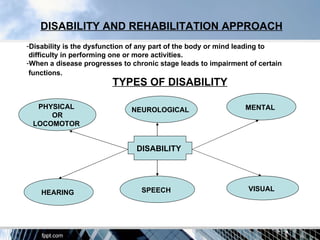
DISABILITY AND REHABILITATION APPROACH
-Disability is the dysfunction of any part of the body or mind leading to
 difficulty in performing one or more activities.
-When a disease progresses to chronic stage leads to impairment of certain
 functions.
                        TYPES OF DISABILITY

  PHYSICAL                    NEUROLOGICAL                     MENTAL
     OR
 LOCOMOTOR


                               DISABILITY


                                 SPEECH                         VISUAL
    HEARING
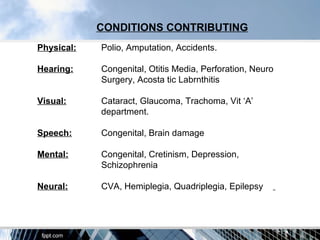
CONDITIONS CONTRIBUTING
Physical:   Polio, Amputation, Accidents.

Hearing:    Congenital, Otitis Media, Perforation, Neuro
            Surgery, Acosta tic Labrnthitis

Visual:     Cataract, Glaucoma, Trachoma, Vit ‘A’
            department.

Speech:     Congenital, Brain damage

Mental:     Congenital, Cretinism, Depression,
            Schizophrenia

Neural:     CVA, Hemiplegia, Quadriplegia, Epilepsy
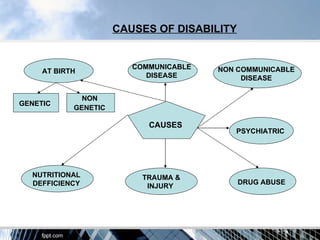
CAUSES OF DISABILITY


                         COMMUNICABLE   NON COMMUNICABLE
     AT BIRTH
                            DISEASE          DISEASE

              NON
GENETIC
            GENETIC

                            CAUSES
                                           PSYCHIATRIC


  NUTRITIONAL              TRAUMA &
  DEFFICIENCY                                DRUG ABUSE
                            INJURY
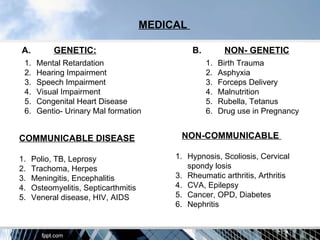
MEDICAL

A.          GENETIC:                             B.         NON- GENETIC
 1.    Mental Retardation                             1.   Birth Trauma
 2.    Hearing Impairment                             2.   Asphyxia
 3.    Speech Impairment                              3.   Forceps Delivery
 4.    Visual Impairment                              4.   Malnutrition
 5.    Congenital Heart Disease                       5.   Rubella, Tetanus
 6.    Gentio- Urinary Mal formation                  6.   Drug use in Pregnancy


COMMUNICABLE DISEASE                         NON-COMMUNICABLE

1.    Polio, TB, Leprosy                    1. Hypnosis, Scoliosis, Cervical
2.    Trachoma, Herpes                         spondy losis
3.    Meningitis, Encephalitis              3. Rheumatic arthritis, Arthritis
4.    Osteomyelitis, Septicarthmitis        4. CVA, Epilepsy
5.    Veneral disease, HIV, AIDS            5. Cancer, OPD, Diabetes
                                            6. Nephritis
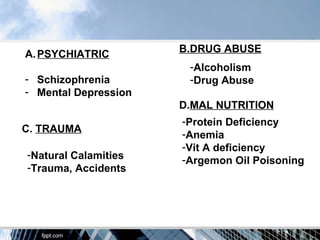
A. PSYCHIATRIC        B.DRUG ABUSE
                       -Alcoholism
- Schizophrenia        -Drug Abuse
- Mental Depression
                      D.MAL NUTRITION
                      -Protein Deficiency
C. TRAUMA
                      -Anemia
                      -Vit A deficiency
-Natural Calamities   -Argemon Oil Poisoning
-Trauma, Accidents
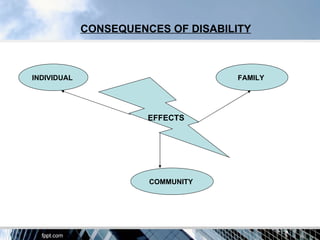
CONSEQUENCES OF DISABILITY


INDIVIDUAL                          FAMILY


                       EFFECTS


                       COMMUNITY
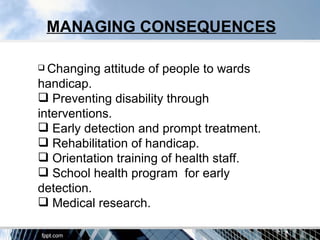
MANAGING CONSEQUENCES

 Changing   attitude of people to wards
handicap.
 Preventing disability through
interventions.
 Early detection and prompt treatment.
 Rehabilitation of handicap.
 Orientation training of health staff.
 School health program for early
detection.
 Medical research.
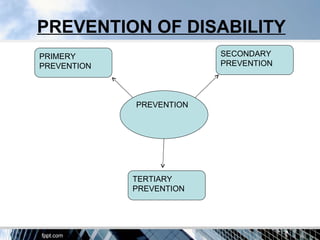
PREVENTION OF DISABILITY
PRIMERY                   SECONDARY
PREVENTION                PREVENTION


             PREVENTION


             TERTIARY
             PREVENTION
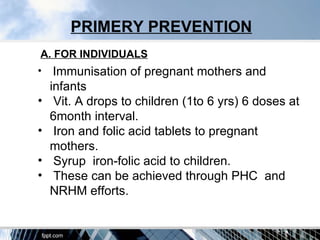
PRIMERY PREVENTION
A. FOR INDIVIDUALS
•    Immunisation of pregnant mothers and
    infants
•    Vit. A drops to children (1to 6 yrs) 6 doses at
    6month interval.
•    Iron and folic acid tablets to pregnant
    mothers.
•    Syrup iron-folic acid to children.
•    These can be achieved through PHC and
    NRHM efforts.
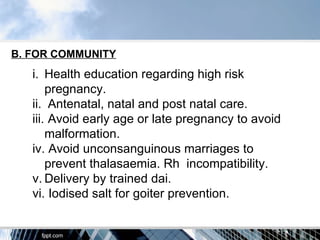
B. FOR COMMUNITY
   i. Health education regarding high risk
       pregnancy.
   ii. Antenatal, natal and post natal care.
   iii. Avoid early age or late pregnancy to avoid
       malformation.
   iv. Avoid unconsanguinous marriages to
       prevent thalasaemia. Rh incompatibility.
   v. Delivery by trained dai.
   vi. Iodised salt for goiter prevention.
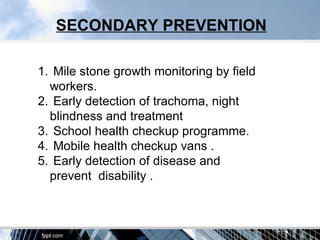
SECONDARY PREVENTION

1. Mile stone growth monitoring by field
  workers.
2. Early detection of trachoma, night
  blindness and treatment
3. School health checkup programme.
4. Mobile health checkup vans .
5. Early detection of disease and
  prevent disability .
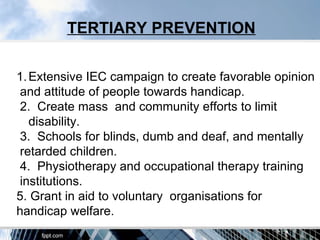
TERTIARY PREVENTION

1. Extensive IEC campaign to create favorable opinion
 and attitude of people towards handicap.
 2. Create mass and community efforts to limit
   disability.
 3. Schools for blinds, dumb and deaf, and mentally
 retarded children.
 4. Physiotherapy and occupational therapy training
 institutions.
5. Grant in aid to voluntary organisations for
handicap welfare.
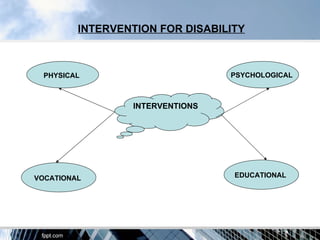
INTERVENTION FOR DISABILITY


  PHYSICAL                       PSYCHOLOGICAL


                 INTERVENTIONS


VOCATIONAL                        EDUCATIONAL
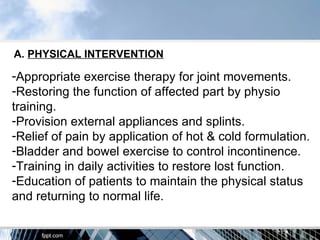
A. PHYSICAL INTERVENTION

-Appropriate exercise therapy for joint movements.
-Restoring the function of affected part by physio
training.
-Provision external appliances and splints.
-Relief of pain by application of hot & cold formulation.
-Bladder and bowel exercise to control incontinence.
-Training in daily activities to restore lost function.
-Education of patients to maintain the physical status
and returning to normal life.
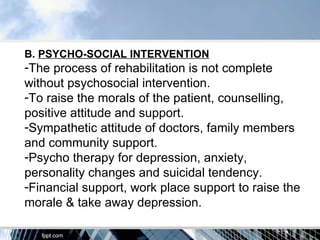
B. PSYCHO-SOCIAL INTERVENTION
-The process of rehabilitation is not complete
without psychosocial intervention.
-To raise the morals of the patient, counselling,
positive attitude and support.
-Sympathetic attitude of doctors, family members
and community support.
-Psycho therapy for depression, anxiety,
personality changes and suicidal tendency.
-Financial support, work place support to raise the
morale & take away depression.
C.      EDUCATIONAL INTERVENTION
-Efforts to be made to continue the education.
-Integrated education for disabled child in normal school.
-Pre school training, parents counselling
-Special training in speech and language
-Orientation and mobility training for blinds
-Day to day living and practices training and skill development
D. DISABILITY FRIENDLY INFRASTRUCTURES
-
-Special parking place for disables
-Ramps with guards at the entrance
-All stair cases must have side railing, disable friendly lifts
and toilets
- Adequate number of wheel chairs for their movement.
- Special transport system for reaching various areas of
hospital.
E. VOCATIONAL INTERVENTION

-Efforts be made to promote vocational training for
  earning according to level of      disability.
- Exploring the type and extent of vocational
  training suiting the level of disability.
- One should be caring, sympathetic and supportive
  in assisting the disabled.
- Vocational training centers, suitable for level of
  disability by GOI and their placement.
OBJECTIVE OF REHABILITATION

-The  basic objective of rehabilitation is to
restore the physical, social and psychological
potential to a level, so that he can
independently function and carry on an
independent life.
-Prevent disability and return to normalcy.
- Maximum level of restoration through
different interventions.
-Training in vocational methods to suit working
with residual disability and earn a lively and
independently.
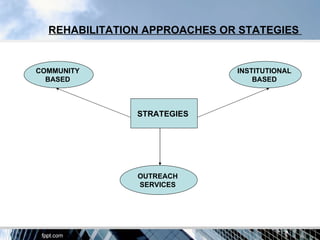
REHABILITATION APPROACHES OR STATEGIES


COMMUNITY                     INSTITUTIONAL
  BASED                           BASED


               STRATEGIES


               OUTREACH
               SERVICES
COMMUNITY BASED REHABILITATION


-This is a strategy of developing rehabilitation services in
the community so as to equalization of opportunity for all.

-Attempt for social integration of disabled.

-There is a collective effort of disabled, family and
community in rehabilitation.

-Along with physical exercise, health education and
vocational
-training are imparted for self independent working and
earning.
INSTITUTIONAL BASED REHABILITATION


 -Disabled persons are provided
 training in hospitals/ rehabilitation
 centers.
 -Exercises under supervision.
 - Functions as a referral center for
 community rehabilitation center.
OUT REACH PROGRAMMES
The experts from hospital visit the community or
home for providing education &
 training to disables in :
-Self Care
-Ambulatory Effect
-Communication
-Vocational Guidance
-Camps are also organized from time to time in rural
area where community facility is not available.
-Efforts are on to integrate the community rehabilitation
centers with institutions to provide maximum
rehabilitation coverage to all parts of the country.
WELFARE MEASURES
a) Scholarship to physically handicap for going to school.
b) Admission quota for disables in schools and collages.
c) Seats are reserved for handicap in Govt .services.
d) Separate employment exchange for handicap.
e) Handicap friendly environment in offices and hospitals,
      lifts ,toilet, ramps, wheel chairs and porters..
 f) Seats are reserved for handicap persons in buses and
    transports.
 g) Special transport allowance to handicaps and
    concessional rail
      tickets with free attendants.
 h) Setting up of rehabilitation centers at district and PHC
    level.
 I ) Availability of artificial limbs, appliances in concessional
    rates.
hospiad
          Hospital Administration Made Easy


                http//hospiad.blogspot.com
     An effort solely to help students and aspirants
        in their attempt to become a successful
                Hospital Administrator.

                                           DR. N. C. DAS

Disability & Rehabilitation approach

  • 1.
    DISABILITY AND REHABILITATIONAPPROACH DR.N.C.DAS
  • 2.
    DISABILITY AND REHABILITATIONAPPROACH -Disability is the dysfunction of any part of the body or mind leading to difficulty in performing one or more activities. -When a disease progresses to chronic stage leads to impairment of certain functions. TYPES OF DISABILITY PHYSICAL NEUROLOGICAL MENTAL OR LOCOMOTOR DISABILITY SPEECH VISUAL HEARING
  • 3.
    CONDITIONS CONTRIBUTING Physical: Polio, Amputation, Accidents. Hearing: Congenital, Otitis Media, Perforation, Neuro Surgery, Acosta tic Labrnthitis Visual: Cataract, Glaucoma, Trachoma, Vit ‘A’ department. Speech: Congenital, Brain damage Mental: Congenital, Cretinism, Depression, Schizophrenia Neural: CVA, Hemiplegia, Quadriplegia, Epilepsy
  • 4.
    CAUSES OF DISABILITY COMMUNICABLE NON COMMUNICABLE AT BIRTH DISEASE DISEASE NON GENETIC GENETIC CAUSES PSYCHIATRIC NUTRITIONAL TRAUMA & DEFFICIENCY DRUG ABUSE INJURY
  • 5.
    MEDICAL A. GENETIC: B. NON- GENETIC 1. Mental Retardation 1. Birth Trauma 2. Hearing Impairment 2. Asphyxia 3. Speech Impairment 3. Forceps Delivery 4. Visual Impairment 4. Malnutrition 5. Congenital Heart Disease 5. Rubella, Tetanus 6. Gentio- Urinary Mal formation 6. Drug use in Pregnancy COMMUNICABLE DISEASE NON-COMMUNICABLE 1. Polio, TB, Leprosy 1. Hypnosis, Scoliosis, Cervical 2. Trachoma, Herpes spondy losis 3. Meningitis, Encephalitis 3. Rheumatic arthritis, Arthritis 4. Osteomyelitis, Septicarthmitis 4. CVA, Epilepsy 5. Veneral disease, HIV, AIDS 5. Cancer, OPD, Diabetes 6. Nephritis
  • 6.
    A. PSYCHIATRIC B.DRUG ABUSE -Alcoholism - Schizophrenia -Drug Abuse - Mental Depression D.MAL NUTRITION -Protein Deficiency C. TRAUMA -Anemia -Vit A deficiency -Natural Calamities -Argemon Oil Poisoning -Trauma, Accidents
  • 7.
    CONSEQUENCES OF DISABILITY INDIVIDUAL FAMILY EFFECTS COMMUNITY
  • 8.
    MANAGING CONSEQUENCES  Changing attitude of people to wards handicap.  Preventing disability through interventions.  Early detection and prompt treatment.  Rehabilitation of handicap.  Orientation training of health staff.  School health program for early detection.  Medical research.
  • 9.
    PREVENTION OF DISABILITY PRIMERY SECONDARY PREVENTION PREVENTION PREVENTION TERTIARY PREVENTION
  • 10.
    PRIMERY PREVENTION A. FORINDIVIDUALS • Immunisation of pregnant mothers and infants • Vit. A drops to children (1to 6 yrs) 6 doses at 6month interval. • Iron and folic acid tablets to pregnant mothers. • Syrup iron-folic acid to children. • These can be achieved through PHC and NRHM efforts.
  • 11.
    B. FOR COMMUNITY i. Health education regarding high risk pregnancy. ii. Antenatal, natal and post natal care. iii. Avoid early age or late pregnancy to avoid malformation. iv. Avoid unconsanguinous marriages to prevent thalasaemia. Rh incompatibility. v. Delivery by trained dai. vi. Iodised salt for goiter prevention.
  • 12.
    SECONDARY PREVENTION 1. Milestone growth monitoring by field workers. 2. Early detection of trachoma, night blindness and treatment 3. School health checkup programme. 4. Mobile health checkup vans . 5. Early detection of disease and prevent disability .
  • 13.
    TERTIARY PREVENTION 1. ExtensiveIEC campaign to create favorable opinion and attitude of people towards handicap. 2. Create mass and community efforts to limit disability. 3. Schools for blinds, dumb and deaf, and mentally retarded children. 4. Physiotherapy and occupational therapy training institutions. 5. Grant in aid to voluntary organisations for handicap welfare.
  • 14.
    INTERVENTION FOR DISABILITY PHYSICAL PSYCHOLOGICAL INTERVENTIONS VOCATIONAL EDUCATIONAL
  • 15.
    A. PHYSICAL INTERVENTION -Appropriateexercise therapy for joint movements. -Restoring the function of affected part by physio training. -Provision external appliances and splints. -Relief of pain by application of hot & cold formulation. -Bladder and bowel exercise to control incontinence. -Training in daily activities to restore lost function. -Education of patients to maintain the physical status and returning to normal life.
  • 16.
    B. PSYCHO-SOCIAL INTERVENTION -Theprocess of rehabilitation is not complete without psychosocial intervention. -To raise the morals of the patient, counselling, positive attitude and support. -Sympathetic attitude of doctors, family members and community support. -Psycho therapy for depression, anxiety, personality changes and suicidal tendency. -Financial support, work place support to raise the morale & take away depression.
  • 17.
    C. EDUCATIONAL INTERVENTION -Efforts to be made to continue the education. -Integrated education for disabled child in normal school. -Pre school training, parents counselling -Special training in speech and language -Orientation and mobility training for blinds -Day to day living and practices training and skill development D. DISABILITY FRIENDLY INFRASTRUCTURES - -Special parking place for disables -Ramps with guards at the entrance -All stair cases must have side railing, disable friendly lifts and toilets - Adequate number of wheel chairs for their movement. - Special transport system for reaching various areas of hospital.
  • 18.
    E. VOCATIONAL INTERVENTION -Effortsbe made to promote vocational training for earning according to level of disability. - Exploring the type and extent of vocational training suiting the level of disability. - One should be caring, sympathetic and supportive in assisting the disabled. - Vocational training centers, suitable for level of disability by GOI and their placement.
  • 19.
    OBJECTIVE OF REHABILITATION -The basic objective of rehabilitation is to restore the physical, social and psychological potential to a level, so that he can independently function and carry on an independent life. -Prevent disability and return to normalcy. - Maximum level of restoration through different interventions. -Training in vocational methods to suit working with residual disability and earn a lively and independently.
  • 20.
    REHABILITATION APPROACHES ORSTATEGIES COMMUNITY INSTITUTIONAL BASED BASED STRATEGIES OUTREACH SERVICES
  • 21.
    COMMUNITY BASED REHABILITATION -Thisis a strategy of developing rehabilitation services in the community so as to equalization of opportunity for all. -Attempt for social integration of disabled. -There is a collective effort of disabled, family and community in rehabilitation. -Along with physical exercise, health education and vocational -training are imparted for self independent working and earning.
  • 22.
    INSTITUTIONAL BASED REHABILITATION -Disabled persons are provided training in hospitals/ rehabilitation centers. -Exercises under supervision. - Functions as a referral center for community rehabilitation center.
  • 23.
    OUT REACH PROGRAMMES Theexperts from hospital visit the community or home for providing education & training to disables in : -Self Care -Ambulatory Effect -Communication -Vocational Guidance -Camps are also organized from time to time in rural area where community facility is not available. -Efforts are on to integrate the community rehabilitation centers with institutions to provide maximum rehabilitation coverage to all parts of the country.
  • 24.
    WELFARE MEASURES a) Scholarshipto physically handicap for going to school. b) Admission quota for disables in schools and collages. c) Seats are reserved for handicap in Govt .services. d) Separate employment exchange for handicap. e) Handicap friendly environment in offices and hospitals, lifts ,toilet, ramps, wheel chairs and porters.. f) Seats are reserved for handicap persons in buses and transports. g) Special transport allowance to handicaps and concessional rail tickets with free attendants. h) Setting up of rehabilitation centers at district and PHC level. I ) Availability of artificial limbs, appliances in concessional rates.
  • 25.
    hospiad Hospital Administration Made Easy http//hospiad.blogspot.com An effort solely to help students and aspirants in their attempt to become a successful Hospital Administrator. DR. N. C. DAS