Prepared By: Miss. Japheth C. Enriquez
INTRODUCTION TO
LIFE SCIENCE
 There are many theories about the origin of life. Some
believed that living organisms were put to Earth by some
divine forces.
 Others say that life did not originate from Earth but from
other planets.
 But among scientists, the most accepted theory is that life
came from inanimate matter.
THE ORIGIN OF LIFE
THE ORIGIN OF LIFE
 PRIMORDIAL SOUP THEORY
Primordial soup, or prebiotic soup, is a hypothetical
condition of the Earth's atmosphere before the emergence of
life. It is a chemical environment in which the first biological
molecules were formed under natural forces.
proposed by Alexander Oparin and John Haldane, life
started in a primordial soup of organic molecules. Some form of
energy from lightning combined with the chemicals in the
atmosphere to make the building blocks of protein known as
the amino acids.
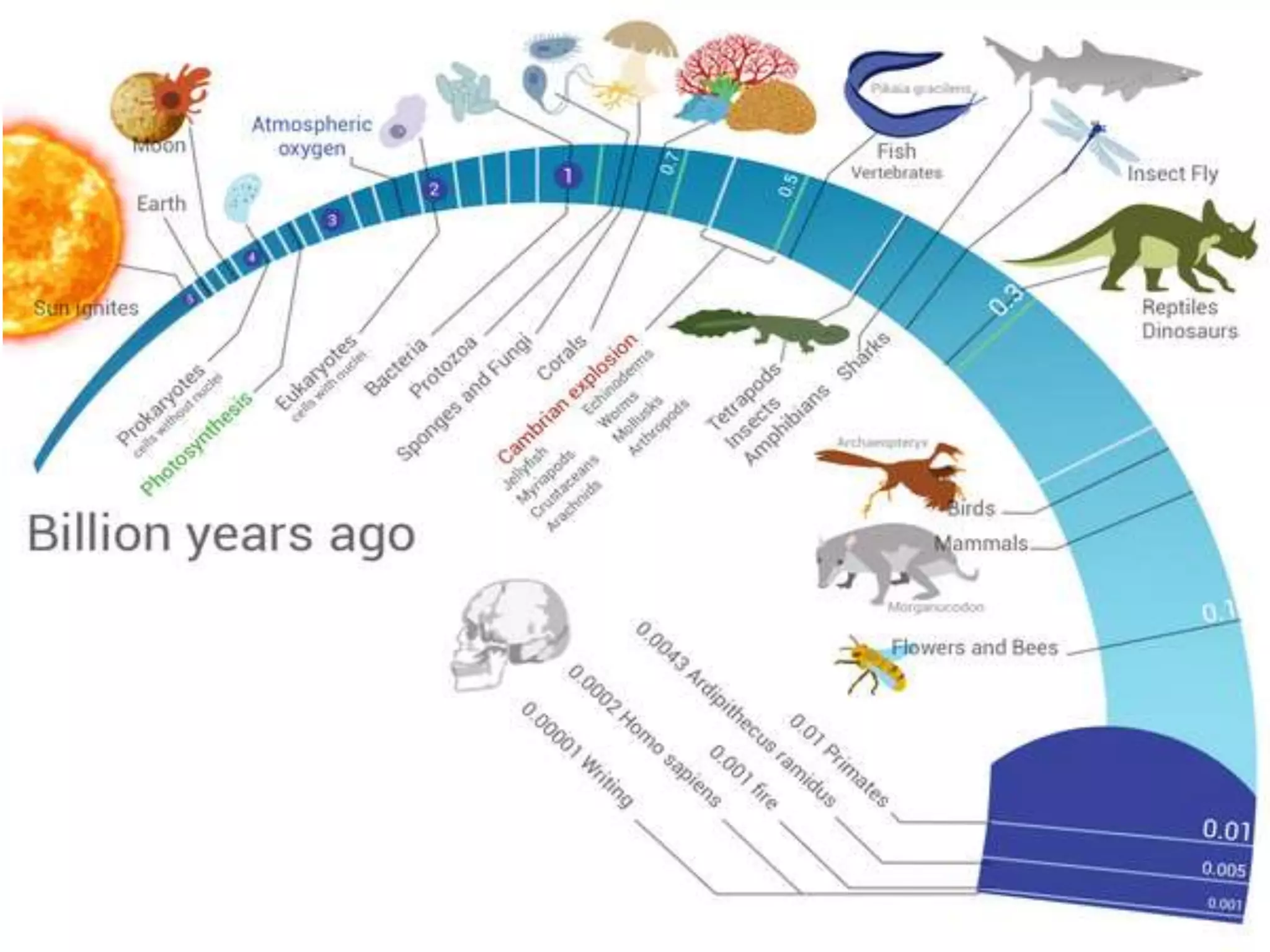
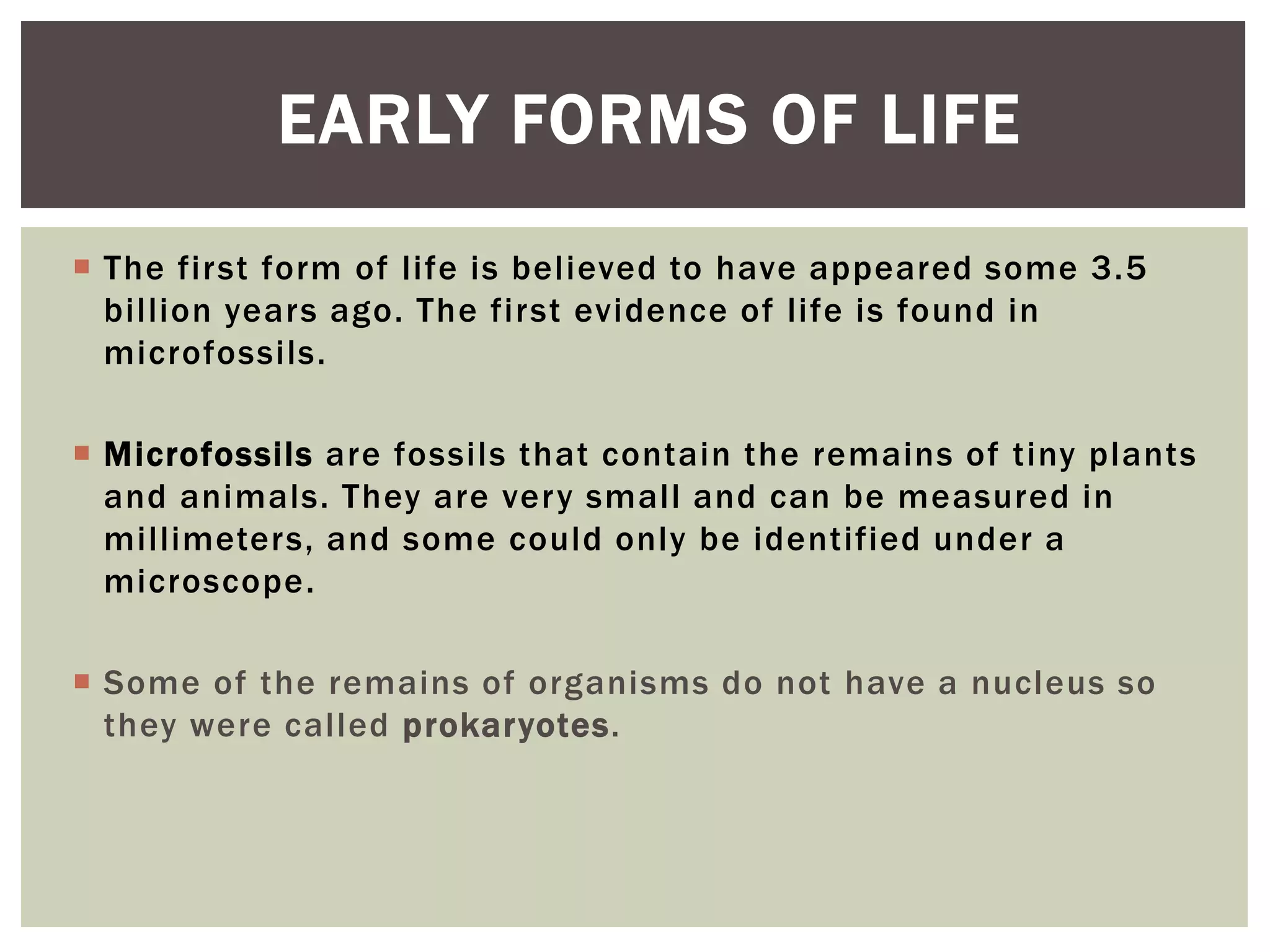
 The first form of life is believed to have appeared some 3.5
billion years ago. The first evidence of life is found in
microfossils.
 Microfossils are fossils that contain the remains of tiny plants
and animals. They are very small and can be measured in
millimeters, and some could only be identified under a
microscope.
 Some of the remains of organisms do not have a nucleus so
they were called prokaryotes.
EARLY FORMS OF LIFE
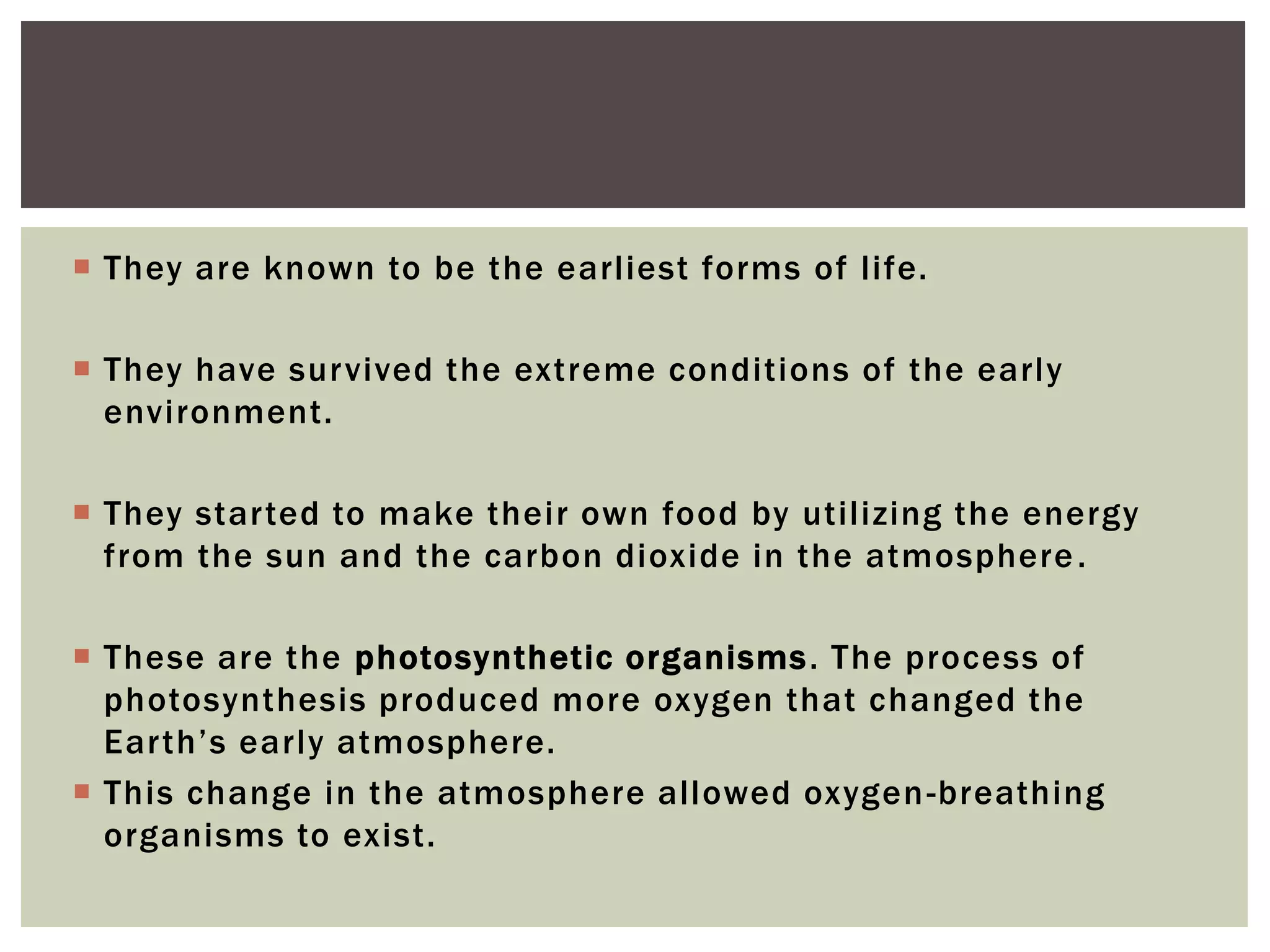
 They are known to be the earliest forms of life.
 They have survived the extreme conditions of the early
environment.
 They started to make their own food by utilizing the energy
from the sun and the carbon dioxide in the atmosphere.
 These are the photosynthetic organisms. The process of
photosynthesis produced more oxygen that changed the
Earth’s early atmosphere.
 This change in the atmosphere allowed oxygen-breathing
organisms to exist.
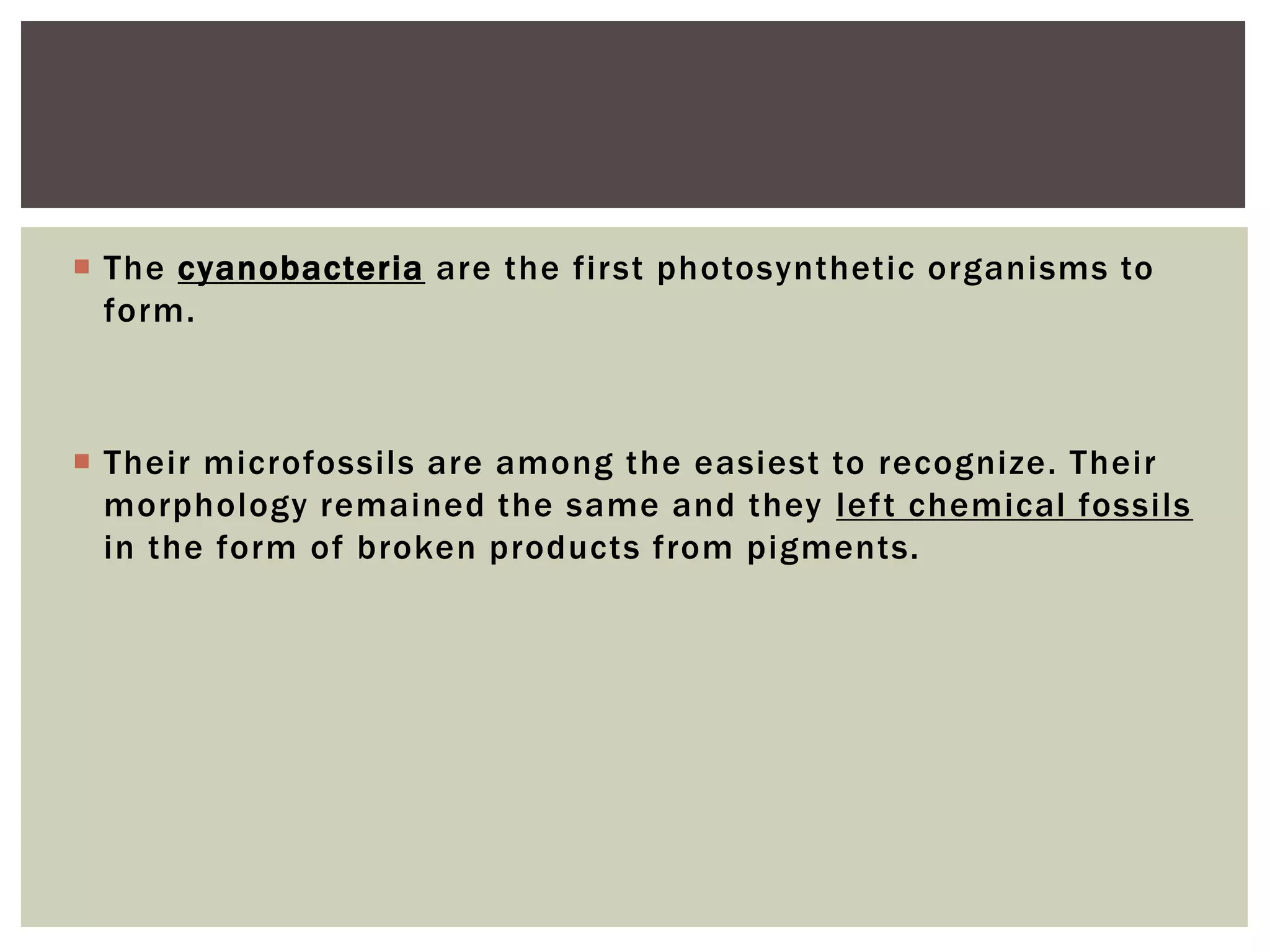
 The cyanobacteria are the first photosynthetic organisms to
form.
 Their microfossils are among the easiest to recognize. Their
morphology remained the same and they left chemical fossils
in the form of broken products from pigments.
 Multicellular organisms are believed to have evolved from
unicellular eukaryotes. Some single eukaryotic cells, like
unicellular algae, formed multicellular aggregates through
association with another cell producing colonies. From
colonial aggregates, the organisms evolved to form
multicellular organisms through cell specialization.
 Protozoans, sponges, and fungi came to being.
 The first fossilized animals which were discovered 580 million
years ago were soft-bodied
 According to Charles Darwin, organisms change over time as a
result of adaptation to their environment in order to survive.
HOW DID MULTICELLULAR ORGANISMS
EVOLVE?
End of the first topic
 
LESSON
2
CLASSICAL
EXPERIMENTS THAT
LEADS TO THE
DISCOVERY OF FIRST
LIFE
 At the end of this lesson, you should be able to describe
classic experiments that model conditions which may have
enabled the first forms of life to evolve.
OBJECTIVES
How did Life Begin on Earth?
One of these theories is the primordial soup
theory proposed by Alexander Oparin and John
Haldane.
According to this theory, life started in a primordial
soup of organic molecules. Chemicals from the
atmosphere and some form of energy from lightning
combined to make amino acids which are the building
blocks of protein.
Several scientists conducted
different experiments that modeled
conditions which may have enabled
the first life forms to evolve

About 4.6 billion years ago, the Earth began to exist. The
existence of life, as believed by many scientists, started from
the moment the Earth’s environment became stable to
support life.
 Several theories were proposed to explain life’s origin. One
of these theories is the primordial soup theory proposed
by Alexander Oparin and John Haldane.
According to this theory, life started in
a primordial soup of organic molecules.
Chemicals from the atmosphere and some
form of energy from lightning combined to
make amino acids which are the building
blocks of protein.
HOW DID LIFE BEGIN ON EARTH?
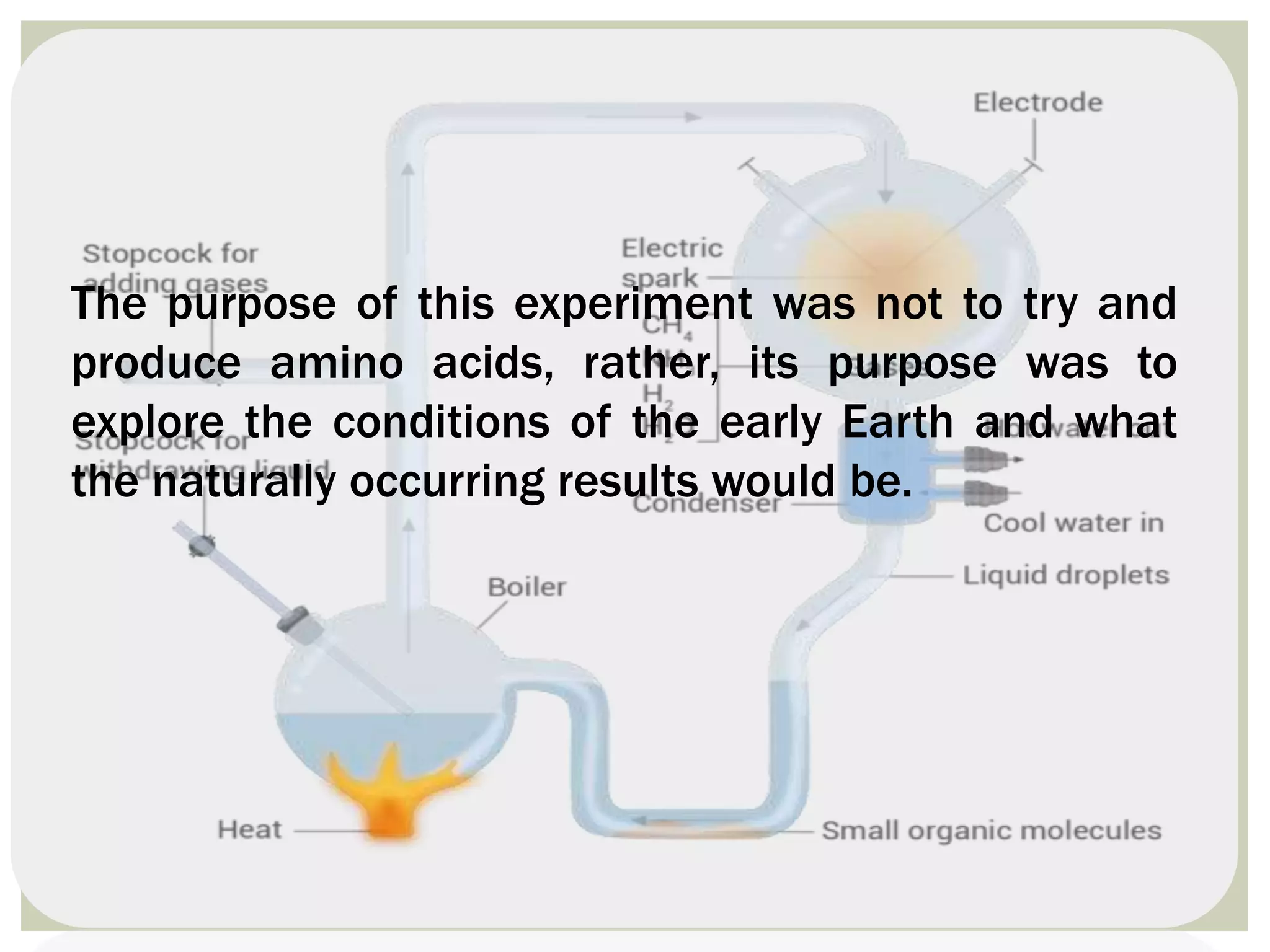
Stanley Miller and Harold Urey verified the
primordial soup theory by simulating the
formation of organic molecules on the early
Earth.
ELECTRICAL DISCHARGE EXPERIMENT
They confined methane, ammonia, water,
and hydrogen in a closed system and
applied continuous electrical sparks to
trigger the formation of the building blocks
of life.
After a day, they observed a change of
color in the solution. After a week, the
solution was tested, and they found
out that several amino acids were
produced.
The purpose of this experiment was not to try and
produce amino acids, rather, its purpose was to
explore the conditions of the early Earth and what
the naturally occurring results would be.
THERMAL SYNTHESIS
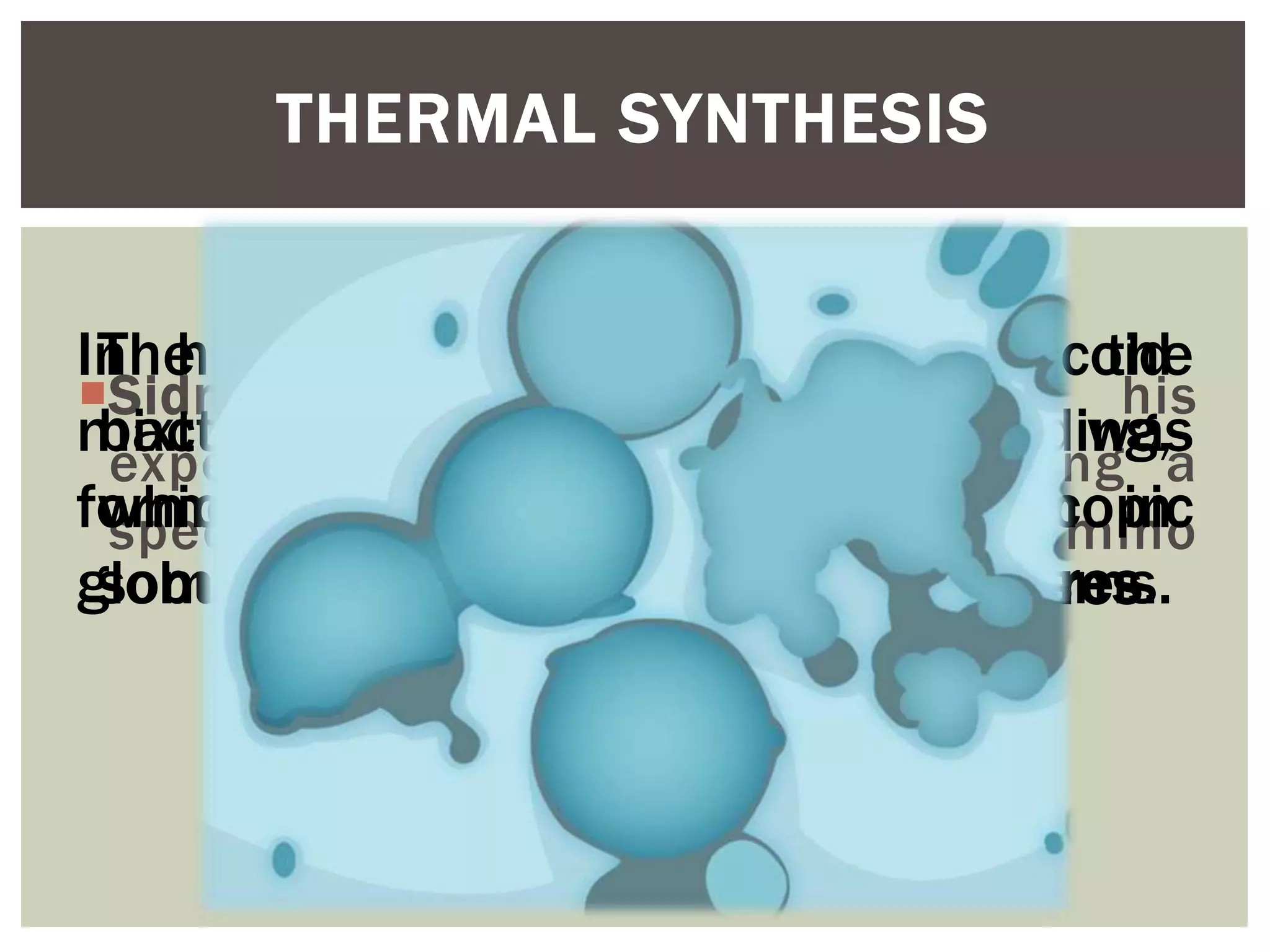
Sidney Fox demonstrated in his
experiment the origin of life using a
specific mixture of pure, dry amino
acids.
In his experiment, after heating the
mixture, an aqueous solution was
formed and cooled into microscopic
globules called protenoid microspheres.
The globules looked like coccoid
bacteria and seemed to be budding,
which is a form of reproduction in
some microorganisms.
Jack Szostak contemplated on how early life
forms formed in a primordial chemical
environment.
He then thought that the simplest possible
living cells or protocells just required two
components to be formed:
THE PROTOCELL EXPERIMENT
a nucleic acid genome to transmit
the genetic information and a lipid
sac which encapsulated the
genome and let itself grow and
divide.
Szostak built lipid sacs made in
fatty acids and a replicase – an
RNA molecule that catalyzes its
own replication, in the test
tube.
He found out that lipid sacs with more RNA
grew faster.
He suggested that such test tube evolution
was possible.
The results suggested that the early forms of
life with just a single gene, an RNA gene,
could have undergone a Darwinian evolution.
Try to leave a piece of bread on the table for
two to three weeks. What do you think will
happen to it? How will you relate this to the
experiments about the origin of life?
TRY IT!
Which of the three experiments is the
most plausible in determining the origin
of life? Why?
WHAT DO YOU THINK?
END OF SECOND LESSON
Lesson 3
THE CONNECTIONS AND
INTERACTIONS AMONG
LIVING THINGS
At the end of this lesson, you should be
able to describe how unifying themes
(e.g., structure and function, evolution,
and ecosystems) show the connections
among living things and how they
interact with each other and with their
environment.
OBJECTIVE:
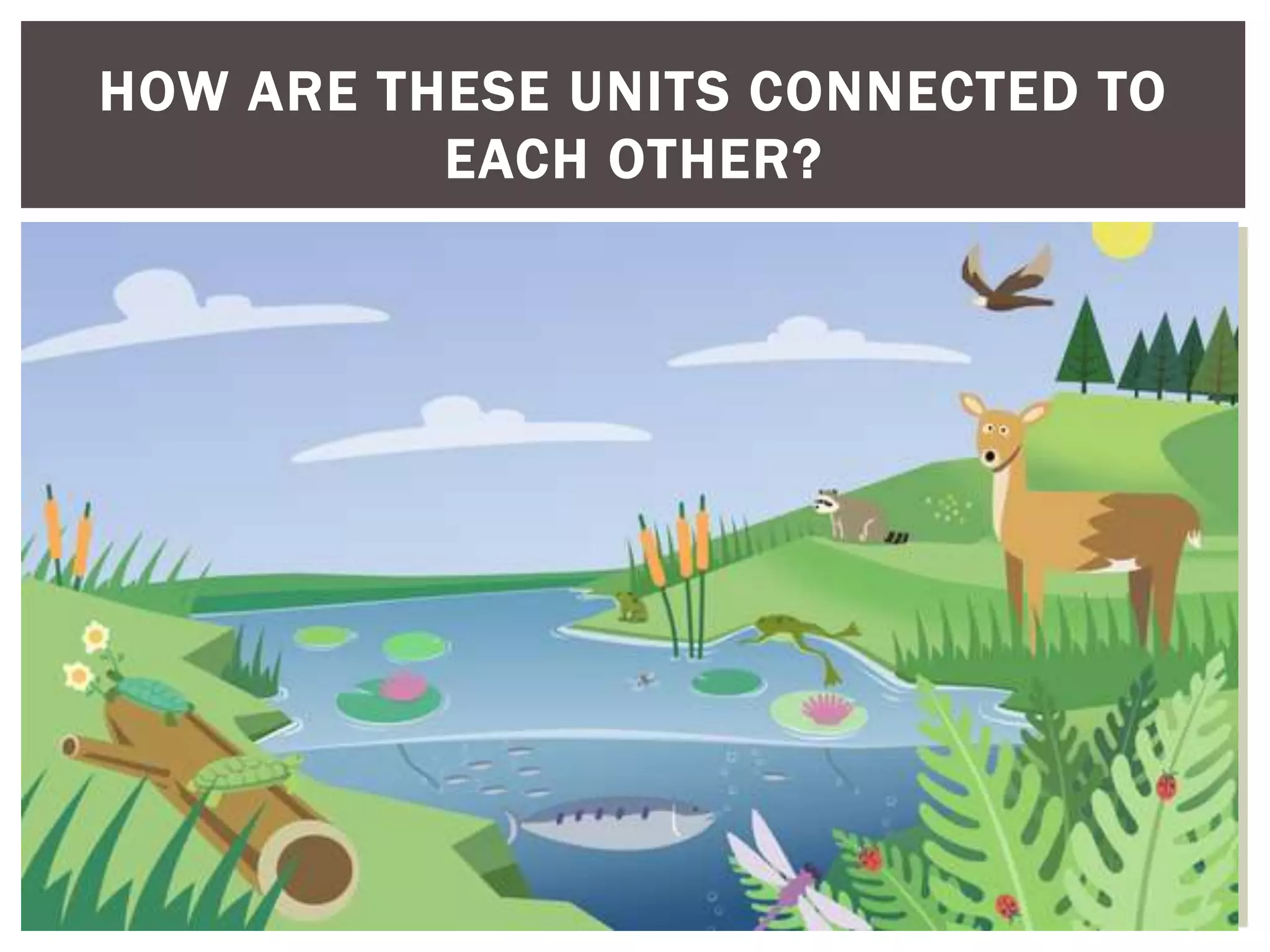
HOW ARE THESE UNITS CONNECTED TO
EACH OTHER?
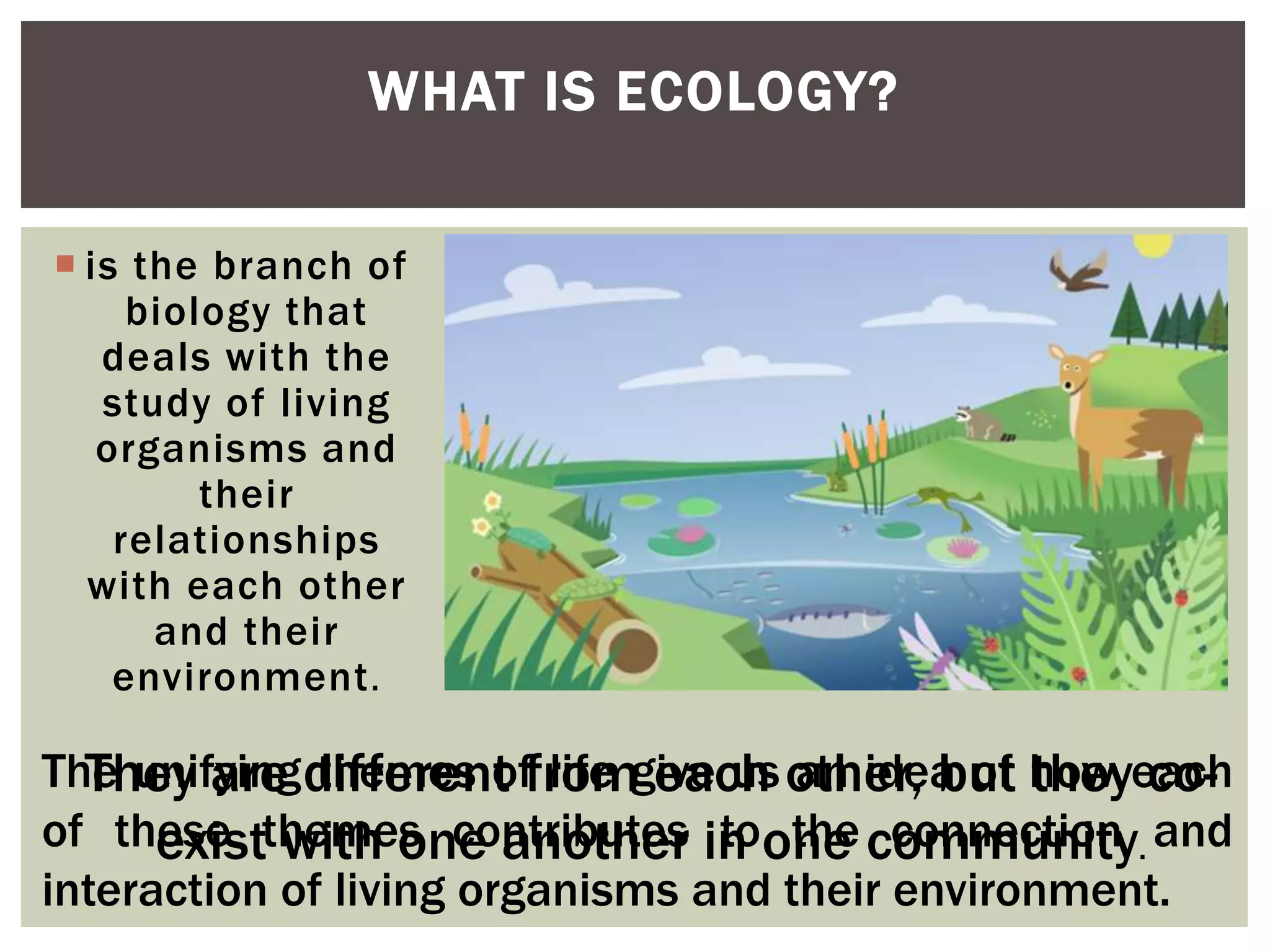
 is the branch of
biology that
deals with the
study of living
organisms and
their
relationships
with each other
and their
environment.
WHAT IS ECOLOGY?
Let’s take the diagram in the
previous slide as an example. The
diagram depicts that everything is
connected and interrelated with
one another.
They are different from each other, but they co-
exist with one another in one community.
The unifying themes of life give us an idea of how each
of these themes contributes to the connection and
interaction of living organisms and their environment.
BIOLOGICAL SYSTEMS
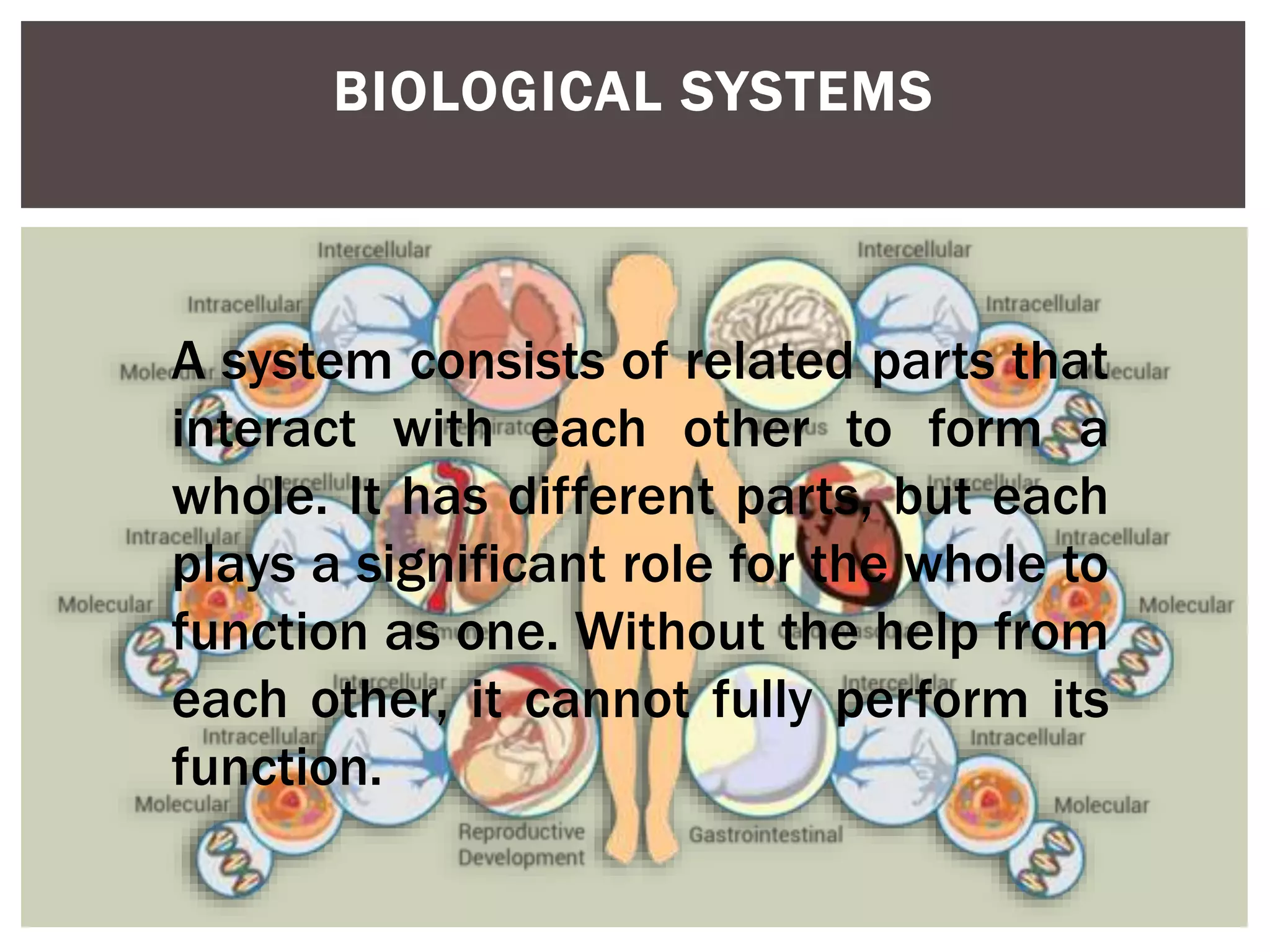
A system consists of related parts that
interact with each other to form a
whole. It has different parts, but each
plays a significant role for the whole to
function as one. Without the help from
each other, it cannot fully perform its
function.
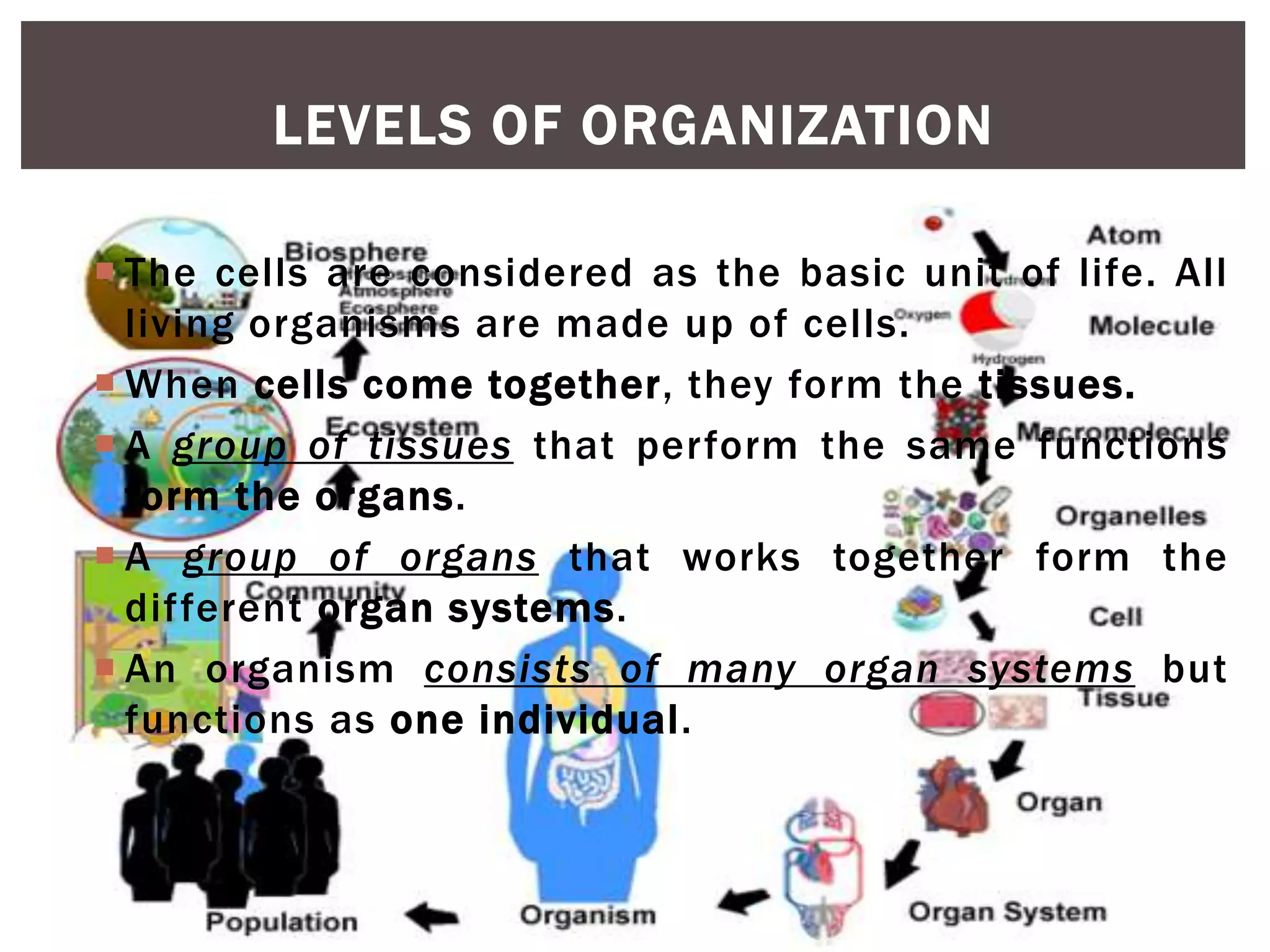
LEVELS OF ORGANIZATION
 The cells are considered as the basic unit of life. All
living organisms are made up of cells.
 When cells come together, they form the tissues.
 A group of tissues that perform the same functions
form the organs.
 A group of organs that works together form the
different organ systems.
 An organism consists of many organ systems but
functions as one individual.
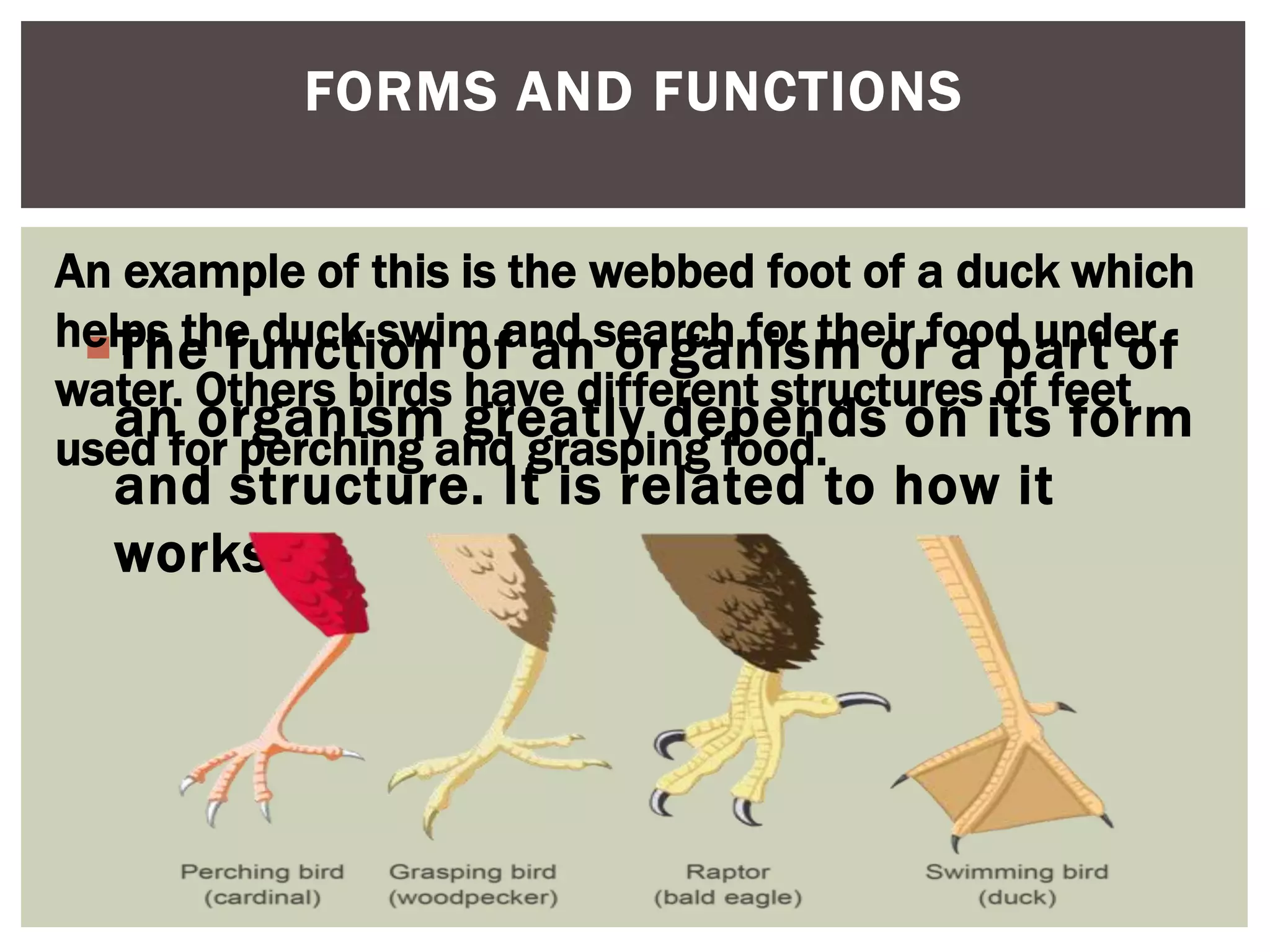
The function of an organism or a part of
an organism greatly depends on its form
and structure. It is related to how it
works.
FORMS AND FUNCTIONS
An example of this is the webbed foot of a duck which
helps the duck swim and search for their food under
water. Others birds have different structures of feet
used for perching and grasping food.
Reproduction ensures the survival of species.
All living organisms reproduce either through
asexual or sexual reproduction.
 In asexual reproduction, the offspring inherits
the genes from a single parent.
REPRODUCTION AND INHERITANCE
Some examples of animals that undergo
asexual reproduction include earthworms,
hydra, planaria, and bacteria.
Animals that undergo sexual reproduction
include some reptiles, fishes, insects, and
mammals.
However in sexual
reproduction, the offspring
inherit the genes from two
individual parents.
Living organisms obtain energy from the food
they eat. Plants undergo photosynthesis where
they convert the energy from the sun into
sugar.
Since most of the animals cannot produce
their own energy, they get the energy from the
consumption and assimilation of the biomass
of plants and other animals.
ENERGY AND LIFE
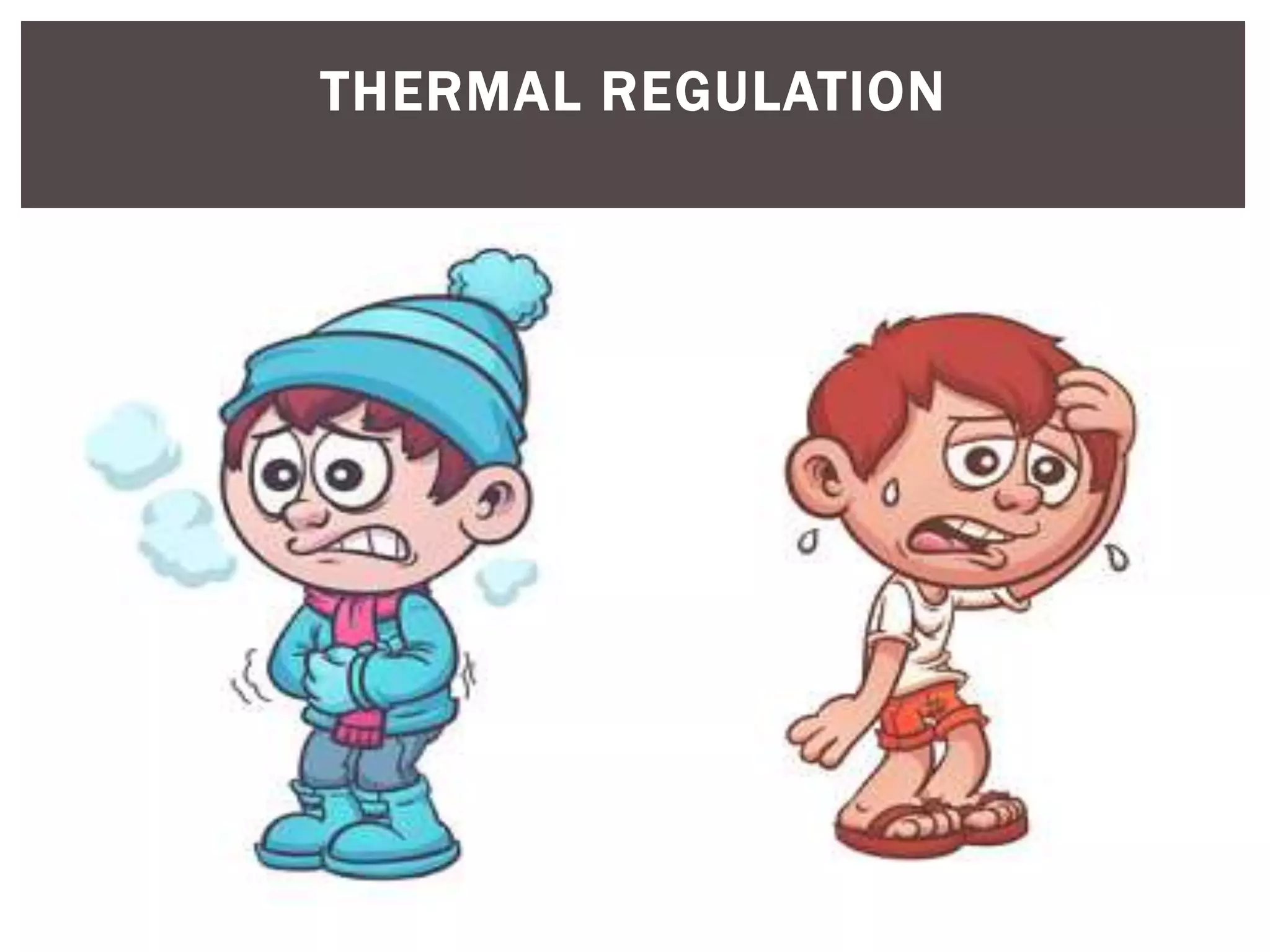
The ability of an organism to regulate their
internal conditions is called homeostasis.
THERMAL REGULATION
Humans have to maintain a body temperature
of 37 C. When the temperature outside our
bodies becomes hot, the skin cools down by
perspiration, maintaining the normal body
temperature.
In a world that is continuously changing, life
itself evolves. Evolution is the change in the
physical and heritable traits of organisms over
successive generations. Organisms change
over time to acclimate to their environment in
order to survive. If they fail to adapt to the
changes, they usually become extinct.
ADAPTATION AND EVOLUTION
The Baiji white dolphin, for
example, became extinct due to
diminished food supply and in
addition to that, the pollution
caused by human activities.
One contemporary example of adaptation is
the Aedes aegypti or the mosquito famous for
carrying dengue that caused major outbreaks
nationwide. Their eggs were able to survive
with scarce or no rainwater which is essential
to their life cycle.
Evolution takes time, usually
decades. However, there are times
when change happens very rapidly.
One example is the blue moon
butterfly that managed to undergo
a mutation which allows the males
to survive an infection of a parasite.
Look around you and identify the living
organisms that surround you. What makes
them similar to one another? What makes
them different?
EXPLORE!
Introduction to life science Grade 11

Introduction to life science Grade 11

  • 1.
    Prepared By: Miss.Japheth C. Enriquez INTRODUCTION TO LIFE SCIENCE
  • 2.
     There aremany theories about the origin of life. Some believed that living organisms were put to Earth by some divine forces.  Others say that life did not originate from Earth but from other planets.  But among scientists, the most accepted theory is that life came from inanimate matter. THE ORIGIN OF LIFE
  • 3.
  • 4.
     PRIMORDIAL SOUPTHEORY Primordial soup, or prebiotic soup, is a hypothetical condition of the Earth's atmosphere before the emergence of life. It is a chemical environment in which the first biological molecules were formed under natural forces. proposed by Alexander Oparin and John Haldane, life started in a primordial soup of organic molecules. Some form of energy from lightning combined with the chemicals in the atmosphere to make the building blocks of protein known as the amino acids.
  • 5.
     The firstform of life is believed to have appeared some 3.5 billion years ago. The first evidence of life is found in microfossils.  Microfossils are fossils that contain the remains of tiny plants and animals. They are very small and can be measured in millimeters, and some could only be identified under a microscope.  Some of the remains of organisms do not have a nucleus so they were called prokaryotes. EARLY FORMS OF LIFE
  • 6.
     They areknown to be the earliest forms of life.  They have survived the extreme conditions of the early environment.  They started to make their own food by utilizing the energy from the sun and the carbon dioxide in the atmosphere.  These are the photosynthetic organisms. The process of photosynthesis produced more oxygen that changed the Earth’s early atmosphere.  This change in the atmosphere allowed oxygen-breathing organisms to exist.
  • 7.
     The cyanobacteriaare the first photosynthetic organisms to form.  Their microfossils are among the easiest to recognize. Their morphology remained the same and they left chemical fossils in the form of broken products from pigments.
  • 8.
     Multicellular organismsare believed to have evolved from unicellular eukaryotes. Some single eukaryotic cells, like unicellular algae, formed multicellular aggregates through association with another cell producing colonies. From colonial aggregates, the organisms evolved to form multicellular organisms through cell specialization.  Protozoans, sponges, and fungi came to being.  The first fossilized animals which were discovered 580 million years ago were soft-bodied  According to Charles Darwin, organisms change over time as a result of adaptation to their environment in order to survive. HOW DID MULTICELLULAR ORGANISMS EVOLVE?
  • 9.
    End of thefirst topic  
  • 10.
  • 11.
     At theend of this lesson, you should be able to describe classic experiments that model conditions which may have enabled the first forms of life to evolve. OBJECTIVES How did Life Begin on Earth?
  • 12.
    One of thesetheories is the primordial soup theory proposed by Alexander Oparin and John Haldane. According to this theory, life started in a primordial soup of organic molecules. Chemicals from the atmosphere and some form of energy from lightning combined to make amino acids which are the building blocks of protein. Several scientists conducted different experiments that modeled conditions which may have enabled the first life forms to evolve
  • 13.
     About 4.6 billionyears ago, the Earth began to exist. The existence of life, as believed by many scientists, started from the moment the Earth’s environment became stable to support life.  Several theories were proposed to explain life’s origin. One of these theories is the primordial soup theory proposed by Alexander Oparin and John Haldane. According to this theory, life started in a primordial soup of organic molecules. Chemicals from the atmosphere and some form of energy from lightning combined to make amino acids which are the building blocks of protein. HOW DID LIFE BEGIN ON EARTH?
  • 14.
    Stanley Miller andHarold Urey verified the primordial soup theory by simulating the formation of organic molecules on the early Earth. ELECTRICAL DISCHARGE EXPERIMENT They confined methane, ammonia, water, and hydrogen in a closed system and applied continuous electrical sparks to trigger the formation of the building blocks of life. After a day, they observed a change of color in the solution. After a week, the solution was tested, and they found out that several amino acids were produced.
  • 15.
    The purpose ofthis experiment was not to try and produce amino acids, rather, its purpose was to explore the conditions of the early Earth and what the naturally occurring results would be.
  • 16.
    THERMAL SYNTHESIS Sidney Foxdemonstrated in his experiment the origin of life using a specific mixture of pure, dry amino acids. In his experiment, after heating the mixture, an aqueous solution was formed and cooled into microscopic globules called protenoid microspheres. The globules looked like coccoid bacteria and seemed to be budding, which is a form of reproduction in some microorganisms.
  • 17.
    Jack Szostak contemplatedon how early life forms formed in a primordial chemical environment. He then thought that the simplest possible living cells or protocells just required two components to be formed: THE PROTOCELL EXPERIMENT a nucleic acid genome to transmit the genetic information and a lipid sac which encapsulated the genome and let itself grow and divide. Szostak built lipid sacs made in fatty acids and a replicase – an RNA molecule that catalyzes its own replication, in the test tube.
  • 18.
    He found outthat lipid sacs with more RNA grew faster. He suggested that such test tube evolution was possible. The results suggested that the early forms of life with just a single gene, an RNA gene, could have undergone a Darwinian evolution.
  • 19.
    Try to leavea piece of bread on the table for two to three weeks. What do you think will happen to it? How will you relate this to the experiments about the origin of life? TRY IT!
  • 20.
    Which of thethree experiments is the most plausible in determining the origin of life? Why? WHAT DO YOU THINK?
  • 21.
  • 22.
    Lesson 3 THE CONNECTIONSAND INTERACTIONS AMONG LIVING THINGS
  • 23.
    At the endof this lesson, you should be able to describe how unifying themes (e.g., structure and function, evolution, and ecosystems) show the connections among living things and how they interact with each other and with their environment. OBJECTIVE:
  • 24.
    HOW ARE THESEUNITS CONNECTED TO EACH OTHER?
  • 25.
     is thebranch of biology that deals with the study of living organisms and their relationships with each other and their environment. WHAT IS ECOLOGY? Let’s take the diagram in the previous slide as an example. The diagram depicts that everything is connected and interrelated with one another. They are different from each other, but they co- exist with one another in one community. The unifying themes of life give us an idea of how each of these themes contributes to the connection and interaction of living organisms and their environment.
  • 26.
    BIOLOGICAL SYSTEMS A systemconsists of related parts that interact with each other to form a whole. It has different parts, but each plays a significant role for the whole to function as one. Without the help from each other, it cannot fully perform its function.
  • 27.
    LEVELS OF ORGANIZATION The cells are considered as the basic unit of life. All living organisms are made up of cells.  When cells come together, they form the tissues.  A group of tissues that perform the same functions form the organs.  A group of organs that works together form the different organ systems.  An organism consists of many organ systems but functions as one individual.
  • 28.
    The function ofan organism or a part of an organism greatly depends on its form and structure. It is related to how it works. FORMS AND FUNCTIONS An example of this is the webbed foot of a duck which helps the duck swim and search for their food under water. Others birds have different structures of feet used for perching and grasping food.
  • 29.
    Reproduction ensures thesurvival of species. All living organisms reproduce either through asexual or sexual reproduction.  In asexual reproduction, the offspring inherits the genes from a single parent. REPRODUCTION AND INHERITANCE Some examples of animals that undergo asexual reproduction include earthworms, hydra, planaria, and bacteria. Animals that undergo sexual reproduction include some reptiles, fishes, insects, and mammals. However in sexual reproduction, the offspring inherit the genes from two individual parents.
  • 30.
    Living organisms obtainenergy from the food they eat. Plants undergo photosynthesis where they convert the energy from the sun into sugar. Since most of the animals cannot produce their own energy, they get the energy from the consumption and assimilation of the biomass of plants and other animals. ENERGY AND LIFE
  • 31.
    The ability ofan organism to regulate their internal conditions is called homeostasis. THERMAL REGULATION Humans have to maintain a body temperature of 37 C. When the temperature outside our bodies becomes hot, the skin cools down by perspiration, maintaining the normal body temperature.
  • 32.
    In a worldthat is continuously changing, life itself evolves. Evolution is the change in the physical and heritable traits of organisms over successive generations. Organisms change over time to acclimate to their environment in order to survive. If they fail to adapt to the changes, they usually become extinct. ADAPTATION AND EVOLUTION The Baiji white dolphin, for example, became extinct due to diminished food supply and in addition to that, the pollution caused by human activities. One contemporary example of adaptation is the Aedes aegypti or the mosquito famous for carrying dengue that caused major outbreaks nationwide. Their eggs were able to survive with scarce or no rainwater which is essential to their life cycle. Evolution takes time, usually decades. However, there are times when change happens very rapidly. One example is the blue moon butterfly that managed to undergo a mutation which allows the males to survive an infection of a parasite.
  • 33.
    Look around youand identify the living organisms that surround you. What makes them similar to one another? What makes them different? EXPLORE!