1
Methods of Molecular Modelling
Molecular Mechanics
&
Quantum Mechanics
Abhijeet Kadam
TSEC
BioTechnology
2
Energy Calculations
● Every molecule had some energy content and
energy level
● 3 major Theoretical computational methods of
calculating energies of molecules are :
– Imperical method – [ Molecular Mechanics ]
– Semi Imperical method – [ Quantum Mechanics ]
– Ab-Initio method – [ Quantum Mechanics ]
● 1 & 2 – rely on embedded emperical parameters
● 3 – capable of reproducing an Expt. Without
parameters
3
Some types of molecular and
Intermolecular energies
● Electronic energy – UV – QM
● Protonation energy – QM
● Conformational energy – NMR – QM – MMech
● Solvation energy – QM – Mmech
● Sublimation energy – Mmech – QM
● Crystallization energy – Mmech
● Binding energy – Mmech – QM
4
Molecular Mechanics
● Less complicated, fast, able to handle large
systems
● Can give extremely accurate energies if proper
parameters are available
● Major disadvantage – parameters are derived
from ground state only
– And cannot represent geometry in bond making and
bond breaking
5
Principles
● Wokrs on principle of vibrational spectroscopy
– Bonds have natural length and natural angles
– Molecules will always adopt geometry that can best
reach the natural value
● When natural values cannot be acheived, there
is strain
– Hence van der waal potential function can mesure
this strain energy
6
History
● Basic idea of Molecular mechanics – 1930
● Serious work started – 1946
● Calculations use the – Born-Oppenheimer
aproximation
– It describes energy of molecule in terms of nuclear
position
– Called as potential energy surface
7
Progress
● Molecular mechanics calculations then employ
an empherically derived set of equations from
the Born-Oppenheimer surface
– Where mathematical form is derived from basic
mechanics
● This function of potential energy – called as
force feild
– Has adjustable parameters
8
Formulae
● General Molecular Mechanics force feild is
based on Westheimer method
● Includes functions for
– Bond streaching
– Angle bending
– Torsion angle
– Vander waal interactions
9
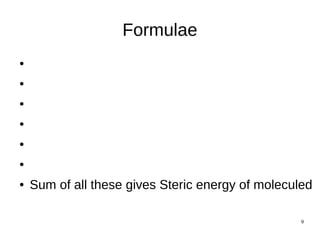
Formulae
●
●
●
●
●
●
● Sum of all these gives Steric energy of moleculed
10
● MM programs have some form of molecular
mechanics builtin
– Ex – Llingers MM2 and MM3 force feilds for Small
molecules
● Energy Minimization
– Inolves successive Iterations
– With full geometry
– All parameters defining geometry are modified in
small increments till it reaches Global Minima.

4.Molecular mechanics + quantum mechanics

  • 1.
    1 Methods of MolecularModelling Molecular Mechanics & Quantum Mechanics Abhijeet Kadam TSEC BioTechnology
  • 2.
    2 Energy Calculations ● Everymolecule had some energy content and energy level ● 3 major Theoretical computational methods of calculating energies of molecules are : – Imperical method – [ Molecular Mechanics ] – Semi Imperical method – [ Quantum Mechanics ] – Ab-Initio method – [ Quantum Mechanics ] ● 1 & 2 – rely on embedded emperical parameters ● 3 – capable of reproducing an Expt. Without parameters
  • 3.
    3 Some types ofmolecular and Intermolecular energies ● Electronic energy – UV – QM ● Protonation energy – QM ● Conformational energy – NMR – QM – MMech ● Solvation energy – QM – Mmech ● Sublimation energy – Mmech – QM ● Crystallization energy – Mmech ● Binding energy – Mmech – QM
  • 4.
    4 Molecular Mechanics ● Lesscomplicated, fast, able to handle large systems ● Can give extremely accurate energies if proper parameters are available ● Major disadvantage – parameters are derived from ground state only – And cannot represent geometry in bond making and bond breaking
  • 5.
    5 Principles ● Wokrs onprinciple of vibrational spectroscopy – Bonds have natural length and natural angles – Molecules will always adopt geometry that can best reach the natural value ● When natural values cannot be acheived, there is strain – Hence van der waal potential function can mesure this strain energy
  • 6.
    6 History ● Basic ideaof Molecular mechanics – 1930 ● Serious work started – 1946 ● Calculations use the – Born-Oppenheimer aproximation – It describes energy of molecule in terms of nuclear position – Called as potential energy surface
  • 7.
    7 Progress ● Molecular mechanicscalculations then employ an empherically derived set of equations from the Born-Oppenheimer surface – Where mathematical form is derived from basic mechanics ● This function of potential energy – called as force feild – Has adjustable parameters
  • 8.
    8 Formulae ● General MolecularMechanics force feild is based on Westheimer method ● Includes functions for – Bond streaching – Angle bending – Torsion angle – Vander waal interactions
  • 9.
    9 Formulae ● ● ● ● ● ● ● Sum ofall these gives Steric energy of moleculed
  • 10.
    10 ● MM programshave some form of molecular mechanics builtin – Ex – Llingers MM2 and MM3 force feilds for Small molecules ● Energy Minimization – Inolves successive Iterations – With full geometry – All parameters defining geometry are modified in small increments till it reaches Global Minima.